1972 Eisenhower Dollar Coin Value: How Much Is It Worth?
The 1972 Eisenhower dollar sits at the crossroads of three different Philadelphia reverse designs, two San Francisco silver options, and a Denver clad issue. Common circulated clad pieces trade near face value.
At the MS63 guide level, ordinary Type 1 and Type 3 clad dollars anchor around $7, while the scarcer Type 2 reverse jumps to about $144. San Francisco 40% silver pieces, both uncirculated and proof, carry guide anchors near $34.
Sorting out which version you actually have is the whole game.
Fast Way to Identify Your 1972 Eisenhower Dollar
Snap a clear photo of both sides of your 1972 Eisenhower dollar, making sure the date, any mint letter below the bust, and the reverse Earth detail are all visible. Upload both images to our identifier for a preliminary read on your coin's mint, reverse type, and finish.
This is a starting point for identification from photos, not a certified attribution or exact value.
1972 Eisenhower Dollar Value
Upload both sides of your 1972 Eisenhower Dollar.
Front Obverse
Upload photo
Back Reverse
Upload photo
Which 1972 Eisenhower Dollar Versions Are Worth Money?
- The no-mint-mark Type 2 reverse is the key variety to check; its MS63 guide anchor is about $144 compared to roughly $7 for Type 1 or Type 3.
- San Francisco 40% silver coins, both uncirculated and proof, carry guide anchors around $34 and contain precious metal content.
- Condition matters even for common Type 1 and Type 3 dollars, since higher Mint State grades command premiums above the MS63 baseline.
Step 1: Identify Your 1972 Eisenhower Dollar Mint Mark and Version
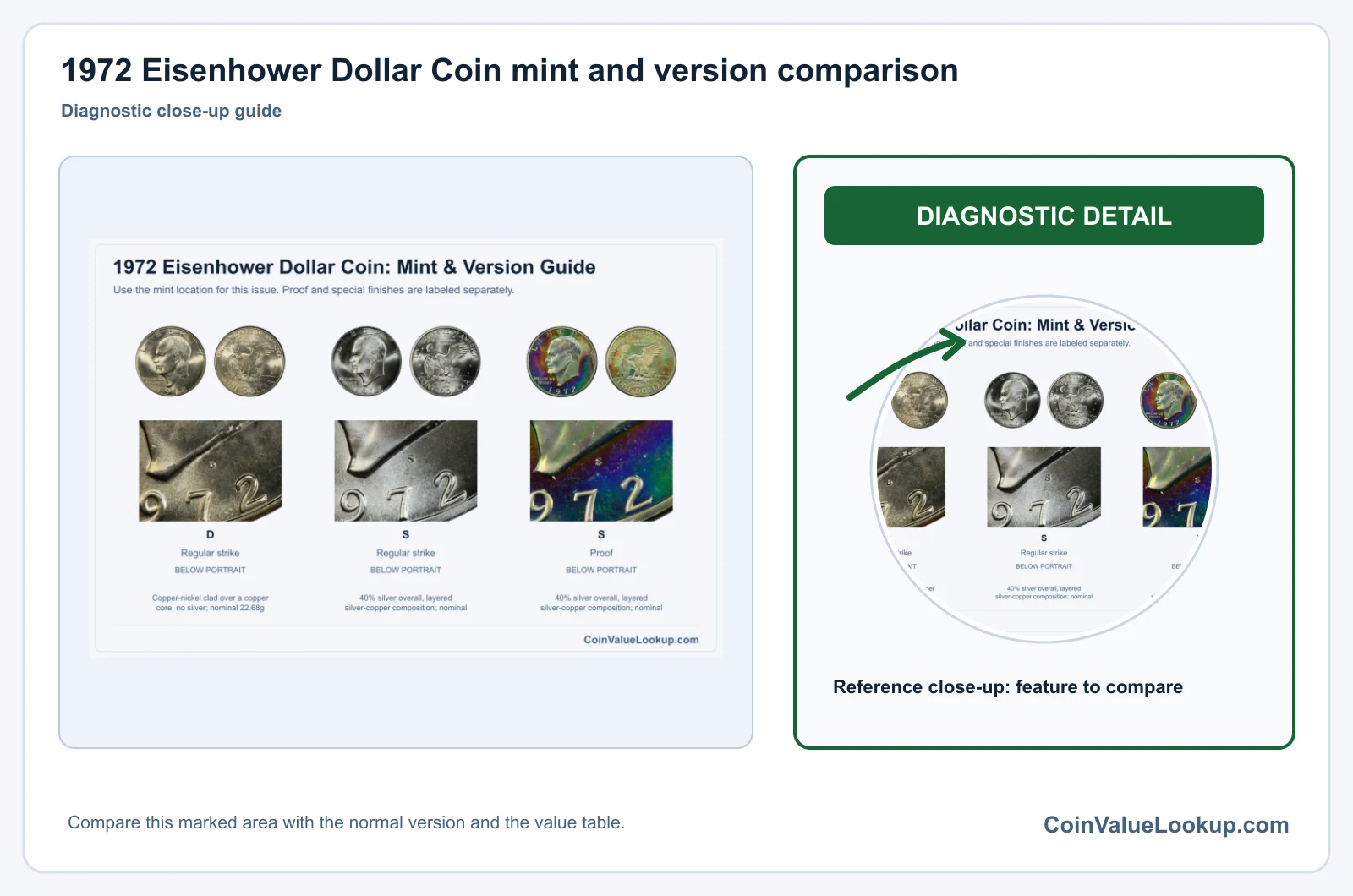
Start with the date. Every 1972 Ike dollar reads "1972" on the obverse, but the mint mark location matters: Philadelphia coins carry no mint letter at all.
Denver coins show a small "D" on the obverse, just below the truncation of Eisenhower's bust and above the date. San Francisco pieces display an "S" in the same spot.
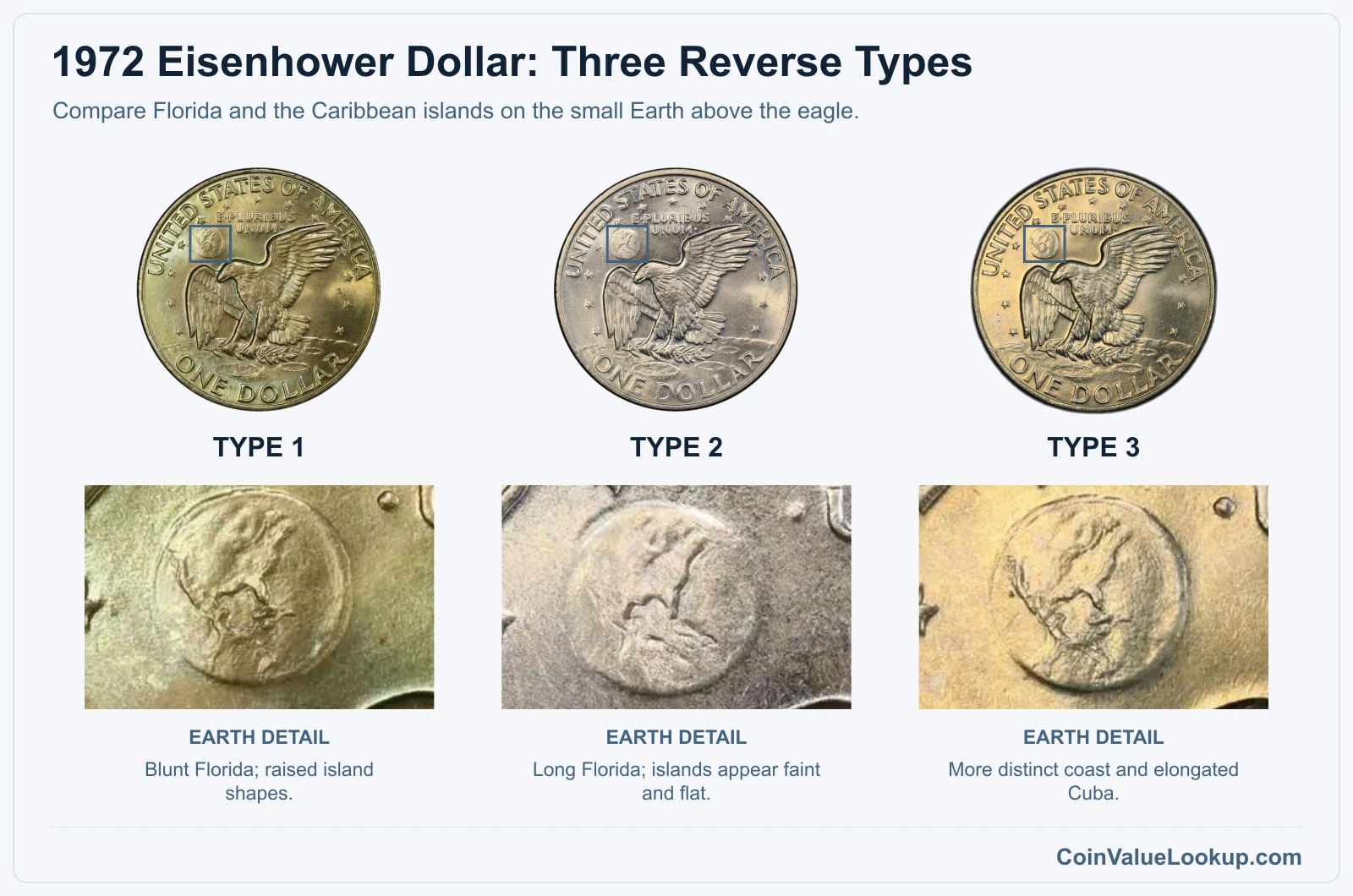
For Philadelphia strikes, flip the coin over and study the Earth above the eagle. Type 1 shows a stubby, crude Florida peninsula with poorly rendered islands.
Type 2 has an elongated Florida and islands that are barely visible or absent. Type 3 shows a more natural, pointed Florida with distinct islands.
These three reverse labels apply only to the no-mint-mark Philadelphia business strikes in this year.
Do not assume a shiny surface means proof or silver. Check the edge: normal clad coins show a copper-colored core sandwiched between the outer layers.
Weight is a screening aid, not proof of composition. The 40% silver San Francisco coins weigh about 24.59 grams versus approximately 22.68 grams for clad.
Never clean or polish the coin. Surface marks on the broad portrait and open fields directly affect uncirculated premiums.
Compare both faces, the edge, and any mint letter before deciding what you have.
Step 2: Check Your 1972 Eisenhower Dollar Grade
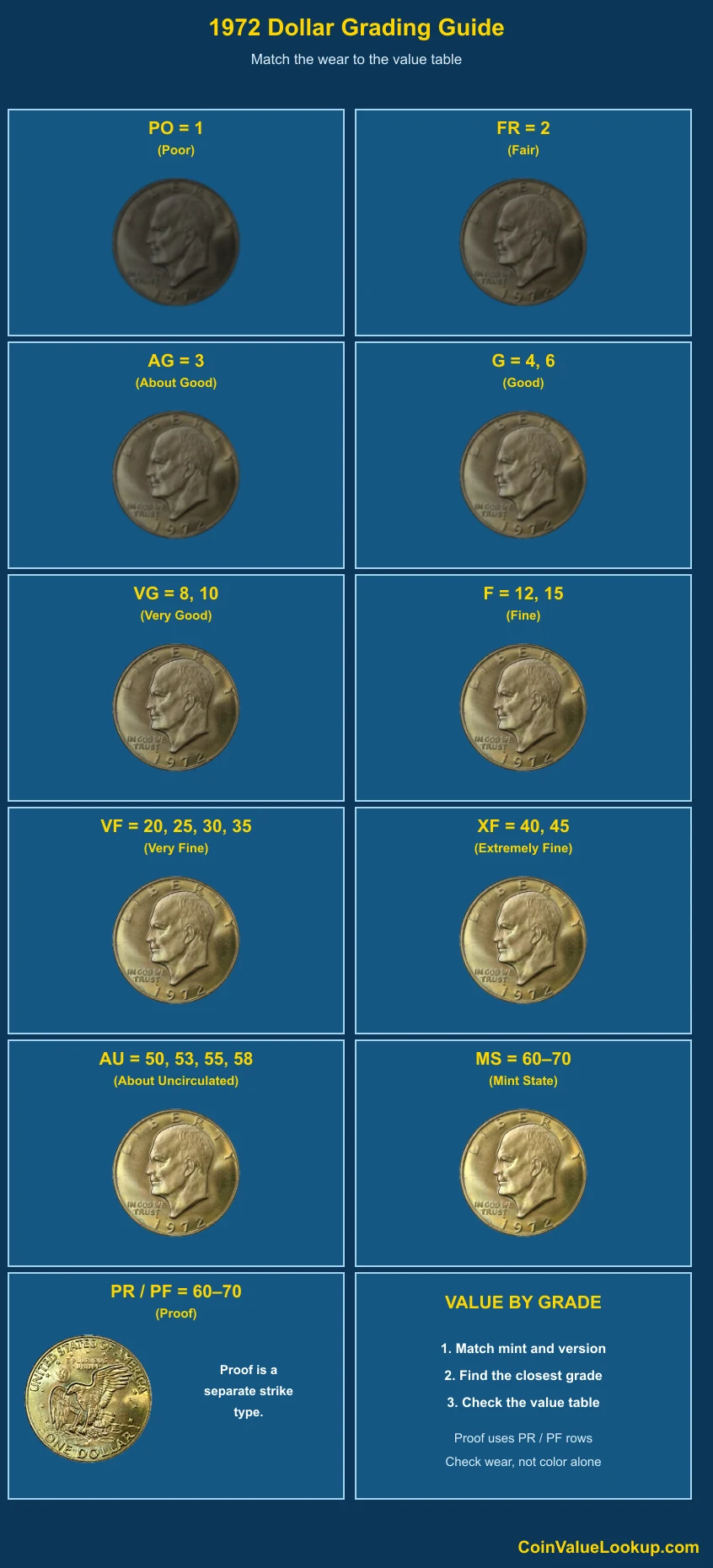
On the obverse, focus on Eisenhower's cheekbone, jawline, and the high points of his hair. These are the first areas to lose detail from circulation.
Even light wear across the cheek flattens the grade significantly on these large coins.
The broad, open fields around the portrait pick up contact marks easily, especially bag marks from other heavy dollars banging around during storage. Tilt the coin under a single light source and watch for continuous, unbroken cartwheel luster.
If luster breaks only at the highest relief but flows smoothly in the fields, you may be looking at a lightly circulated coin rather than a truly uncirculated one.
On the eagle reverse, check feather definition at the breast and wing tips. Weak original detail from a tired die is not the same as circulation wear, so compare yours to the reference image to calibrate your eye.
Proof coins are graded on a separate scale. Look for hairlines, haze, and fingerprints on reflective surfaces rather than wear.
Cameo contrast, where frosted devices sit against mirror fields, is a separate designation from the proof grade itself.
Step 3: Check 1972 Eisenhower Dollar Value by Mint and Version
1972 Eisenhower Dollar — No Mint Mark — Type 1
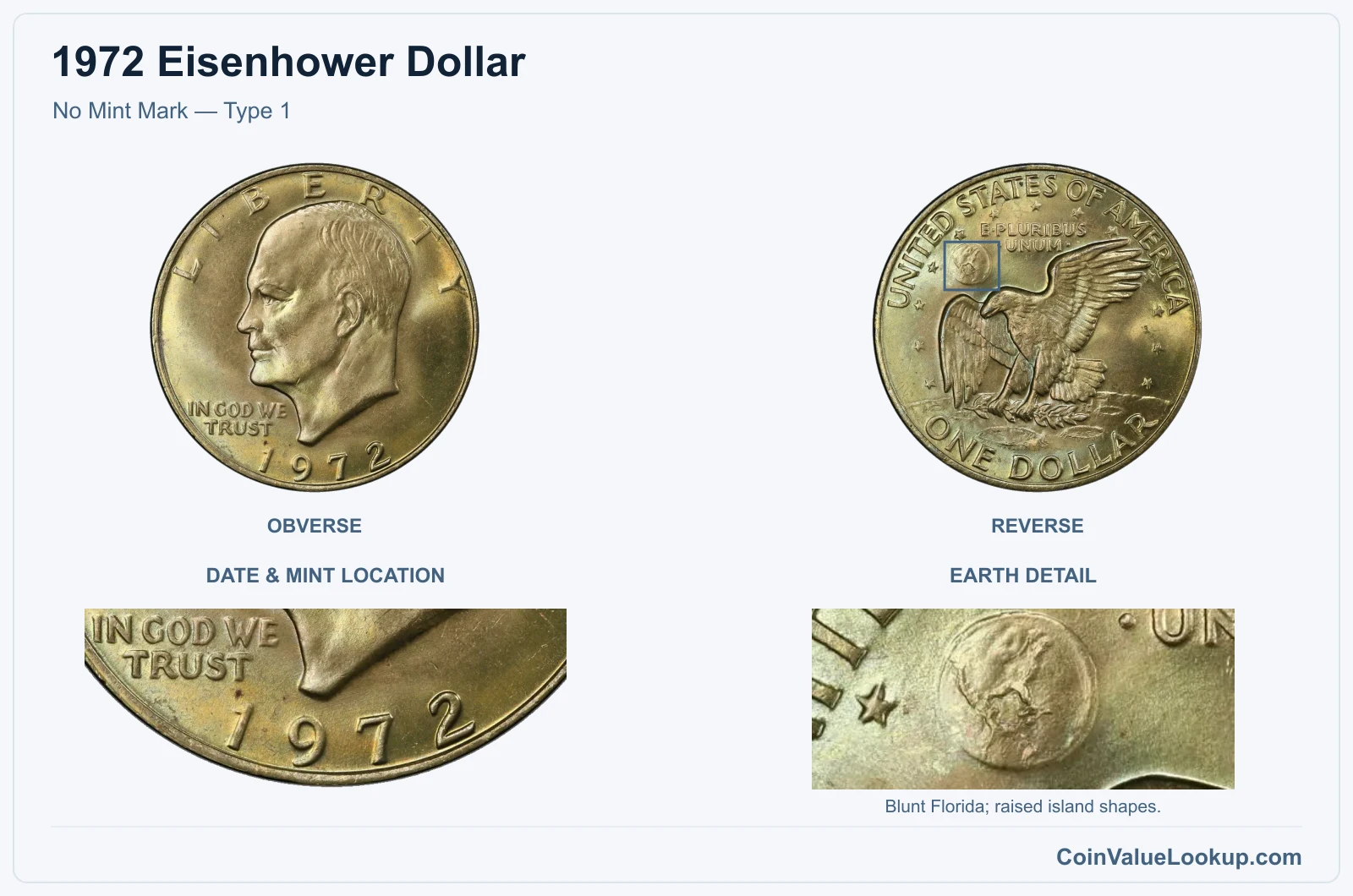
This is the most common Philadelphia variety. It carries no mint mark on the obverse.
Flip it over and study the Earth above the eagle: the Florida peninsula looks stubby and the Caribbean islands are crudely rendered with a low-relief feel.
The USA Coin Book guide places this at about $7 in MS63. Worn examples generally trade near face value, so the premium lives in well-preserved uncirculated pieces with clean fields and full luster.
Make sure you are comparing the Earth geography carefully against the other two types before settling on Type 1.
Range Grade
Price Auction Records Appraisal PO PO 1
—
Coin Identifier FR FR 2
—
Coin Identifier AG AG 3
—
Coin Identifier G G 4
—
Coin Identifier
G 6
—
Coin Identifier VG VG 8
—
Coin Identifier
VG 10
—
Coin Identifier F F 12
—
Coin Identifier
F 15
—
Coin Identifier VF VF 20
—
Coin Identifier
VF 25
—
Coin Identifier
VF 30
—
Coin Identifier
VF 35
—
Coin Identifier XF XF 40
—
Coin Identifier
XF 45
—
Coin Identifier AU AU 50
—
Coin Identifier
AU 53
—
Coin Identifier
AU 55
—
Coin Identifier
AU 58
—
Coin Identifier MS MS 60
—
Coin Identifier
MS 61
—
Coin Identifier
MS 62
Coin Identifier
MS 63
Coin Identifier
MS 64
Coin Identifier
MS 65
Coin Identifier
MS 66
Coin Identifier
MS 67
—
—
—
MS 68
—
—
—
MS 69
—
—
—
MS 70
—
—
—
1972 Eisenhower Dollar — No Mint Mark — Type 2
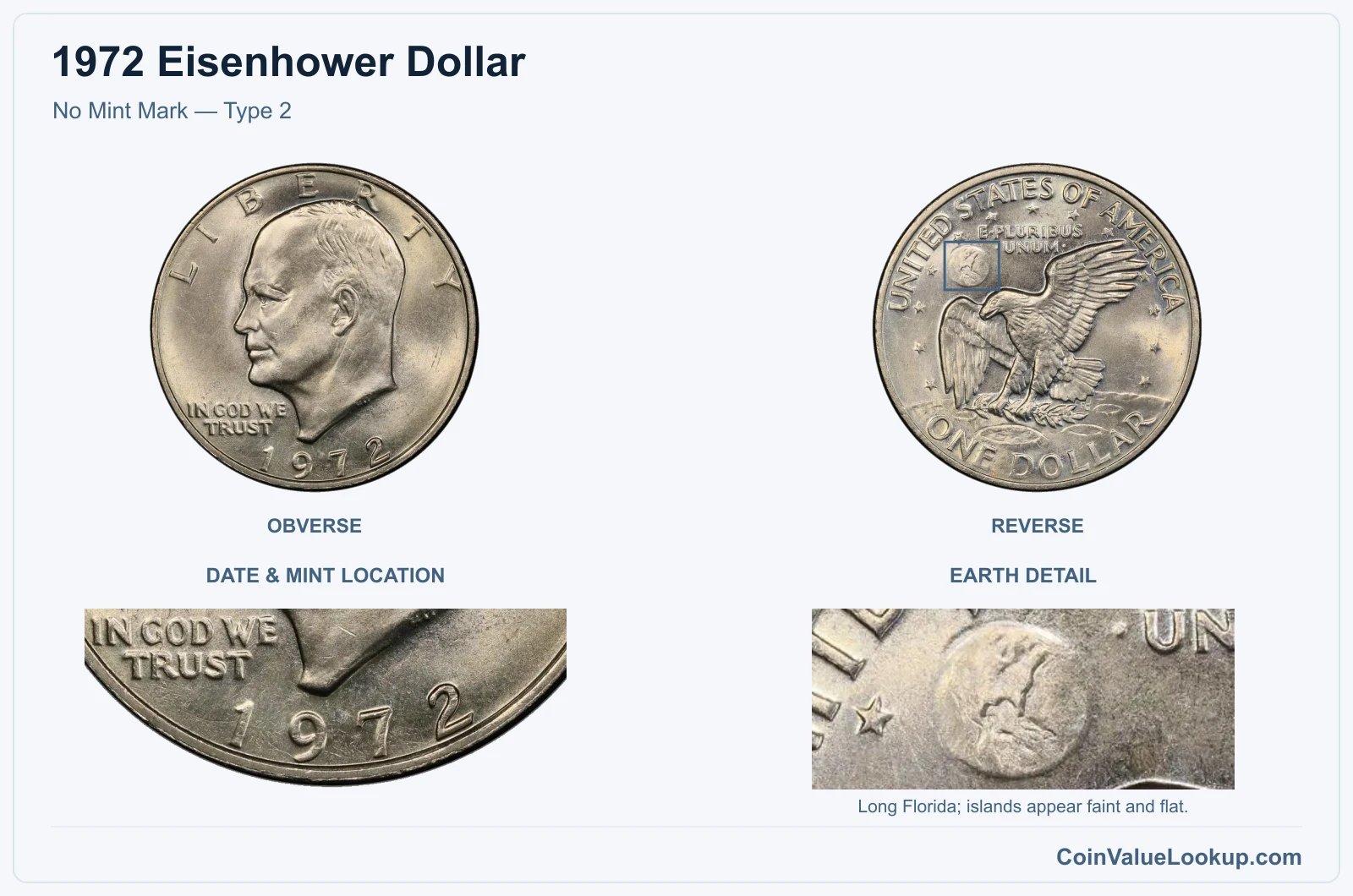
This is the one everyone hopes they have. The Type 2 reverse was produced using a proof-style reverse die pressed into service for business strikes, but the coin itself is not a proof.
On the Earth, Florida is noticeably elongated and the islands are barely visible or essentially gone.
The USA Coin Book guide anchors the Type 2 at roughly $144 in MS63, a massive jump over the other two Philadelphia types. That premium means correct identification is critical.
Compare your coin side-by-side with known Type 1 and Type 3 images before concluding you have a Type 2. A Type 3 with a slightly flat island can fool you.
The coin is copper-nickel clad over a copper core, same as the other Philadelphia issues, weighing about 22.68 grams.
Range Grade
Price Auction Records Appraisal PO PO 1
—
Coin Identifier FR FR 2
—
Coin Identifier AG AG 3
—
Coin Identifier G G 4
—
Coin Identifier
G 6
—
Coin Identifier VG VG 8
—
Coin Identifier
VG 10
—
Coin Identifier F F 12
—
Coin Identifier
F 15
—
Coin Identifier VF VF 20
—
Coin Identifier
VF 25
—
Coin Identifier
VF 30
—
Coin Identifier
VF 35
—
Coin Identifier XF XF 40
—
Coin Identifier
XF 45
—
Coin Identifier AU AU 50
—
Coin Identifier
AU 53
—
Coin Identifier
AU 55
Coin Identifier
AU 58
Coin Identifier MS MS 60
—
Coin Identifier
MS 61
Coin Identifier
MS 62
Coin Identifier
MS 63
Coin Identifier
MS 64
Coin Identifier
MS 65
Coin Identifier
MS 66
Coin Identifier
MS 67
—
—
—
MS 68
—
—
—
MS 69
—
—
—
MS 70
—
—
—
1972 Eisenhower Dollar — No Mint Mark — Type 3
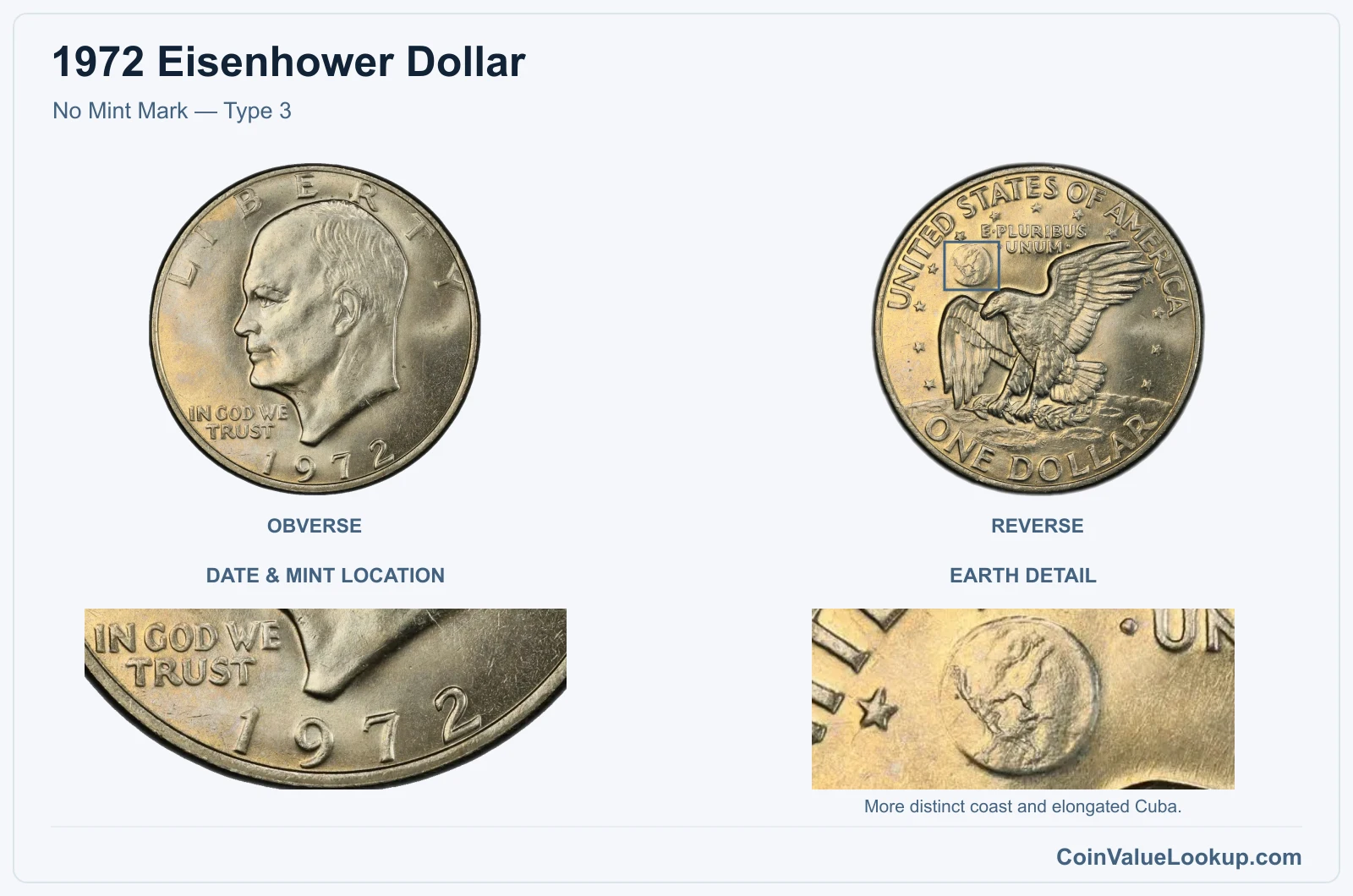
Type 3 is the other common Philadelphia variety. The Earth shows a more natural, pointed Florida peninsula and the islands are clearly distinct, unlike the barely visible islands of Type 2 or the crude blobs of Type 1.
The guide estimate sits at about $7 in MS63, the same neighborhood as Type 1. Lower-grade Type 3 pieces should absolutely not inherit a Type 2 premium.
The reverse geography difference is the entire story, so compare carefully. Like all Philadelphia 1972 dollars, this is a copper-nickel clad coin with no mint mark.
Range Grade
Price Auction Records Appraisal PO PO 1
—
Coin Identifier FR FR 2
—
Coin Identifier AG AG 3
—
Coin Identifier G G 4
—
Coin Identifier
G 6
—
Coin Identifier VG VG 8
—
Coin Identifier
VG 10
—
Coin Identifier F F 12
—
Coin Identifier
F 15
—
Coin Identifier VF VF 20
—
Coin Identifier
VF 25
—
Coin Identifier
VF 30
—
Coin Identifier
VF 35
—
Coin Identifier XF XF 40
—
Coin Identifier
XF 45
—
Coin Identifier AU AU 50
—
Coin Identifier
AU 53
—
Coin Identifier
AU 55
—
Coin Identifier
AU 58
Coin Identifier MS MS 60
—
Coin Identifier
MS 61
—
Coin Identifier
MS 62
—
Coin Identifier
MS 63
Coin Identifier
MS 64
Coin Identifier
MS 65
Coin Identifier
MS 66
Coin Identifier
MS 67
—
—
—
MS 68
—
—
—
MS 69
—
—
—
MS 70
—
—
—
1972 Eisenhower Dollar — D — Clad
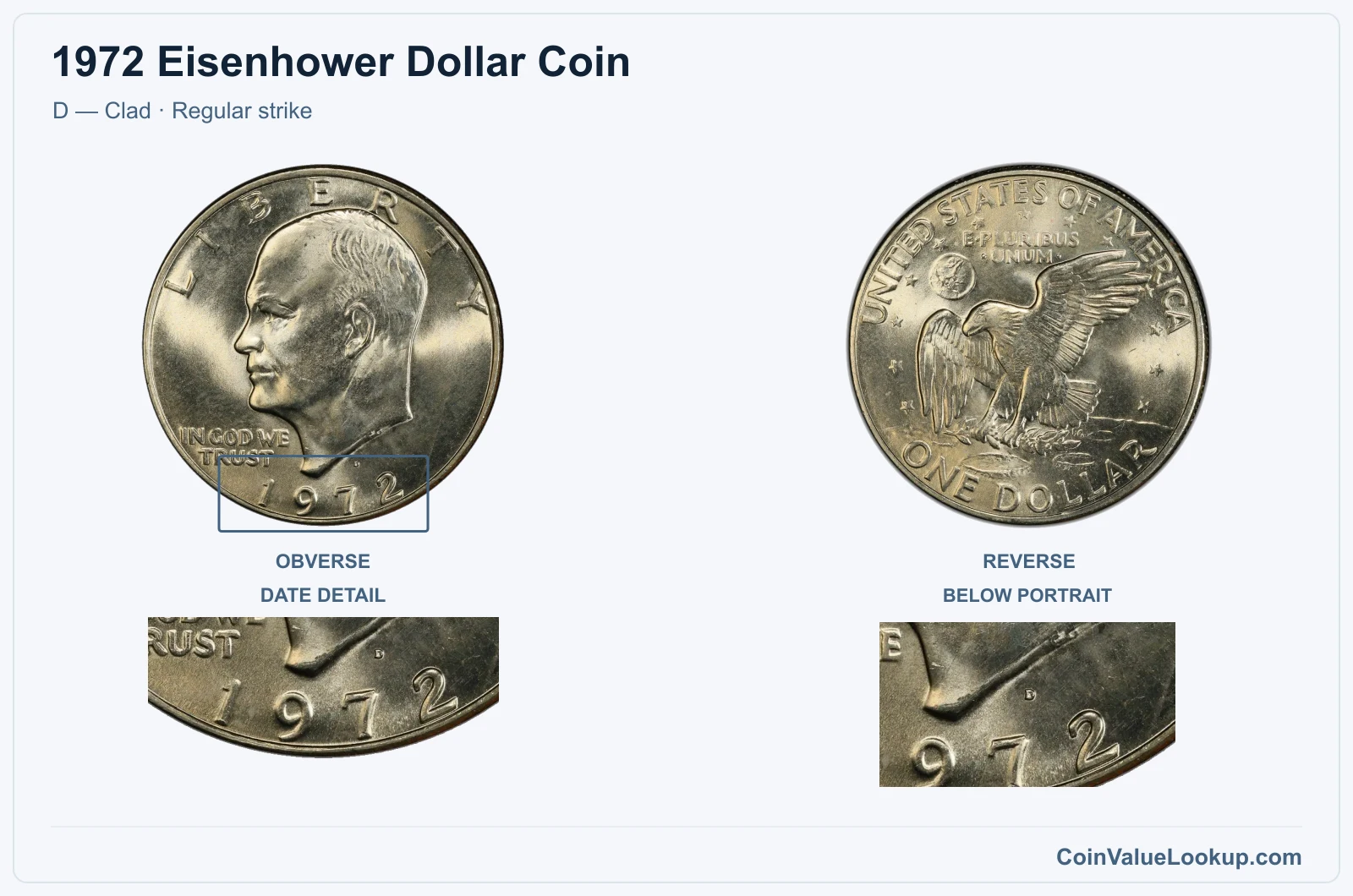
The Denver mint struck 1972-D Eisenhower dollars in copper-nickel clad, the same composition as Philadelphia issues. Look for the small "D" on the obverse below the bust truncation.
The USA Coin Book guide places these at about $7 in MS63. Circulated examples are common and generally worth face value.
For uncirculated coins, luster quality and freedom from bag marks across those wide open fields make the difference. Inspect both sides under good light before assuming a high grade.
Coin Value Lookup is a handy starting point when you want to look up guides for other Eisenhower dollar dates or different coin series entirely.
Range Grade
Price Auction Records Appraisal PO PO 1
—
Coin Identifier FR FR 2
—
Coin Identifier AG AG 3
—
Coin Identifier G G 4
—
Coin Identifier
G 6
—
Coin Identifier VG VG 8
—
Coin Identifier
VG 10
—
Coin Identifier F F 12
—
Coin Identifier
F 15
—
Coin Identifier VF VF 20
—
Coin Identifier
VF 25
—
Coin Identifier
VF 30
—
Coin Identifier
VF 35
—
Coin Identifier XF XF 40
—
Coin Identifier
XF 45
—
Coin Identifier AU AU 50
—
Coin Identifier
AU 53
—
Coin Identifier
AU 55
—
Coin Identifier
AU 58
Coin Identifier MS MS 60
—
Coin Identifier
MS 61
Coin Identifier
MS 62
Coin Identifier
MS 63
Coin Identifier
MS 64
Coin Identifier
MS 65
Coin Identifier
MS 66
Coin Identifier
MS 67
Coin Identifier
MS 68
—
—
—
MS 69
—
—
—
MS 70
—
—
—
1972 Eisenhower Dollar — S — 40% Silver Uncirculated
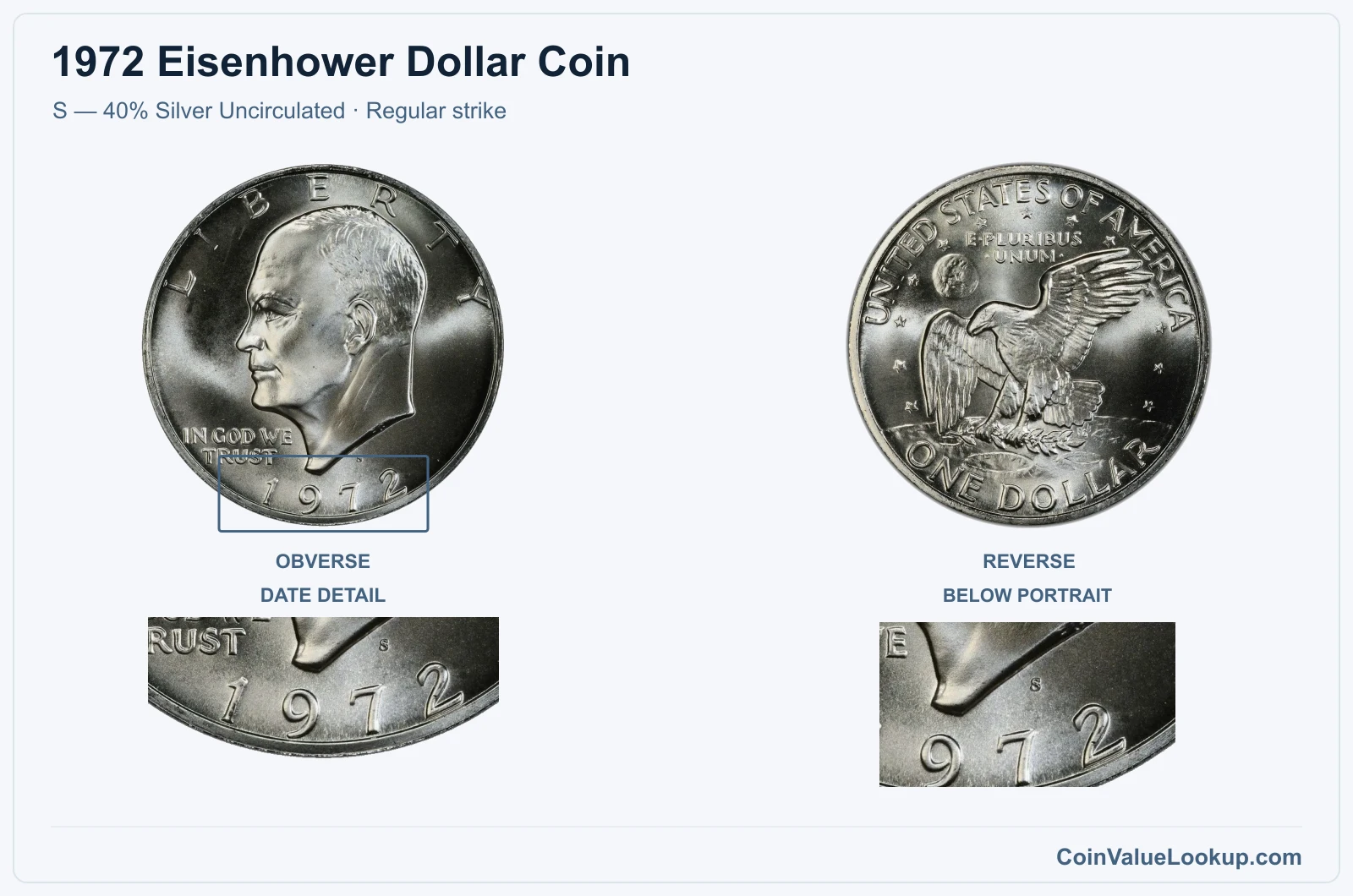
San Francisco produced 40% silver uncirculated Eisenhower dollars for collectors in 1972. These carry an "S" mint mark on the obverse.
The layered silver-copper composition brings the weight up to about 24.59 grams, noticeably heavier than the 22.68-gram clad versions.
The guide anchor from USA Coin Book is approximately $34 at MS63. Separate the uncirculated finish from the proof finish by examining the surfaces: business-strike silver coins have satiny or frosty luster rather than the mirror fields of a proof.
The silver content alone gives these a floor above face value.
Range Grade
Price Auction Records Appraisal PO PO 1
—
Coin Identifier FR FR 2
—
Coin Identifier AG AG 3
—
Coin Identifier G G 4
—
Coin Identifier
G 6
—
Coin Identifier VG VG 8
—
Coin Identifier
VG 10
—
Coin Identifier F F 12
—
Coin Identifier
F 15
—
Coin Identifier VF VF 20
—
Coin Identifier
VF 25
—
Coin Identifier
VF 30
—
Coin Identifier
VF 35
—
Coin Identifier XF XF 40
—
Coin Identifier
XF 45
—
Coin Identifier AU AU 50
—
Coin Identifier
AU 53
—
Coin Identifier
AU 55
—
Coin Identifier
AU 58
—
Coin Identifier MS MS 60
—
Coin Identifier
MS 61
—
Coin Identifier
MS 62
—
Coin Identifier
MS 63
—
Coin Identifier
MS 64
Coin Identifier
MS 65
Coin Identifier
MS 66
Coin Identifier
MS 67
Coin Identifier
MS 68
Coin Identifier
MS 69
Coin Identifier
MS 70
—
—
—
1972 Eisenhower Dollar — S — 40% Silver Proof
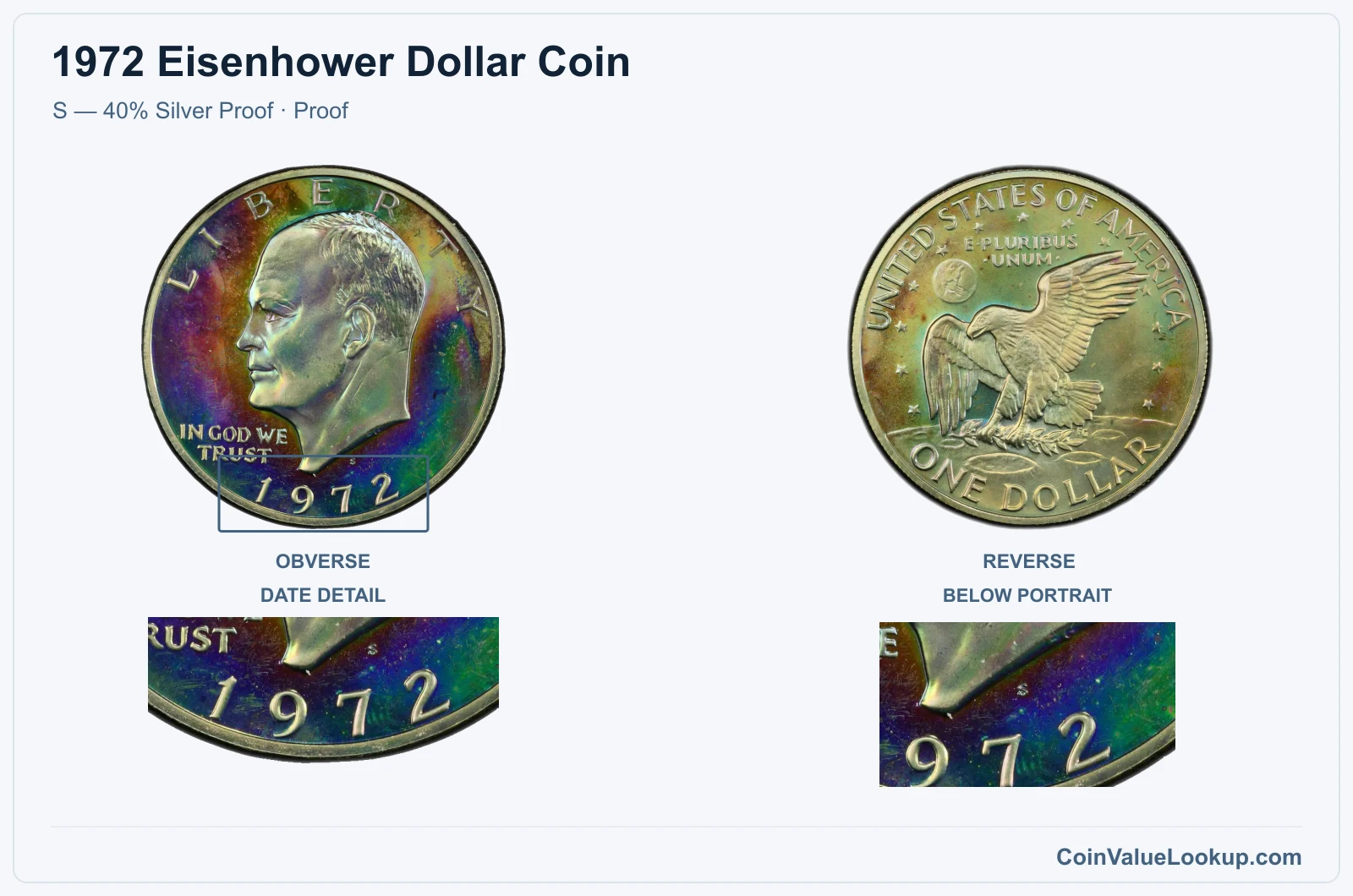
The 1972-S proof Eisenhower dollar is a 40% silver coin with mirror-like fields and sharp, often frosted devices. Proofs were struck at San Francisco for collector sets, and they carry the "S" mint mark on the obverse.
The USA Coin Book guide places these at about $34 in PR65. Proof is a manufacturing method, not a grade above Mint State, so these are evaluated on their own scale for hairlines, haze, and surface quality.
Cameo contrast, where the frosted portrait pops against deep mirrors, is a separate designation. Weight should be near 24.59 grams, consistent with the 40% silver composition.
Range Grade
Price Auction Records Appraisal PR PR 1
—
Coin Identifier
PR 2
—
Coin Identifier
PR 3
—
Coin Identifier
PR 4
—
Coin Identifier
PR 6
—
Coin Identifier
PR 8
—
Coin Identifier
PR 10
—
Coin Identifier
PR 12
—
Coin Identifier
PR 15
—
Coin Identifier
PR 20
—
Coin Identifier
PR 25
—
Coin Identifier
PR 30
—
Coin Identifier
PR 35
—
Coin Identifier
PR 40
—
Coin Identifier
PR 45
—
Coin Identifier
PR 50
—
Coin Identifier
PR 53
—
Coin Identifier
PR 55
—
Coin Identifier
PR 58
—
Coin Identifier
PR 60
—
Coin Identifier
PR 61
—
Coin Identifier
PR 62
—
Coin Identifier
PR 63
Coin Identifier
PR 64
—
Coin Identifier
PR 65
—
Coin Identifier
PR 66
Coin Identifier
PR 67
Coin Identifier
PR 68
Coin Identifier
PR 69
Coin Identifier
PR 70
—
—
—
1972 Eisenhower Dollar Error List
1. 1972 Eisenhower Dollar — Struck on a Philippine One-Piso Planchet
This error involves a 1972-D Eisenhower dollar struck on a Philippine one-piso planchet, an unintended foreign blank that ended up under dollar dies. The result is a coin carrying the full Ike dollar design on metal that was never meant for it.
Certified attribution is essential here. A PCGS MS64 example sold for $747.50 in May 2005 at Heritage Auctions, a single historical sale that gives a reference point but not a reliable market range.
The wrong-planchet origin must be verified by professional authentication, since a normal clad dollar could superficially resemble this error if you are only checking the design. Weight and metal composition testing separate legitimate wrong-planchet errors from ordinary coins.
2. 1972 Eisenhower Dollar — Double Strike, Both Strikes Off Center
A dramatic error: a 1972-S silver proof struck twice, with both impressions landing off center. Two displaced design images overlap, leaving unstruck blank areas on the planchet.
Date and mint mark evidence should be retained on at least one of the strikes.
One NGC PR66 Ultra Cameo example sold for $13,800 in August 2022 through Heritage Auctions. That is an extraordinary result for a proof-error coin.
Do not confuse this with minor machine doubling, which produces flat shelf-like traces rather than two fully separated design impressions. Post-mint damage from pressing or squeezing can also create misleading doubled images.
A genuine double-struck coin will show distinct unstruck crescent areas and two independent sets of design detail.
3. 1972 Eisenhower Dollar — Partly Detached Reverse Clad Layer
This error was documented on a 1972 no-mint-mark Type 3 dollar where approximately 35 percent of the reverse clad layer separated from the coin after striking. The separated fragment carries matching struck design that lines up with the missing sector on the coin itself.
Value depends on the authenticated identity, condition, and severity of the separation. When evaluating this kind of error, showing the coin and its original matching fragment together is key.
A fragment without a verified match to a specific coin is much weaker evidence. Watch out for layers missing before the strike, which produce a different appearance, as well as post-mint peeling, cuts, or glue repairs that can mimic a legitimate clad separation.
4. 1972 Eisenhower Dollar — Misaligned Obverse Die
On a 1972-D dollar with a misaligned obverse die, one side of the coin is shifted relative to the rim while the opposite face stays better centered. Compare both sides: if only the obverse design is displaced toward one edge with an uneven rim, while the reverse sits normally, that points to a misaligned die rather than a full off-center strike.
One PCGS MS64 example sold for $114 in December 2024 through Heritage Auctions. That single sale provides a reference point, not a market range.
Lookalikes include whole-coin off-center strikes where both sides shift together, uneven rim wear from circulation, and outright rim damage. Check both faces before drawing a conclusion.
5. 1972 Eisenhower Dollar — Clipped Planchet
Clipped-planchet 1972 Eisenhower dollars have been documented on both no-mint-mark and Denver clad issues. A curved incomplete edge was present on the blank before striking, so the press did not fill the design fully in the clip zone.
The clip boundary should show a smooth, unstruck curve rather than a jagged post-mint break.
One documented no-mint-mark example was misidentified as a Type 2 reverse by its holder. Do not rely on a holder label alone for the reverse type, especially when the coin also has an error that may have complicated attribution.
Value depends on individual assessment of the clip size, mint, condition, and authenticity. A missing piece that was cut out after striking will typically show a sharp, irregular edge interrupting the design, unlike the smooth pre-strike clip boundary.
6. 1972 Eisenhower Dollar — Struck Through a Capped Die
A 1972-D dollar struck through a capped die shows a softened, distorted reverse where a previously struck coin adhered to the die and interfered with subsequent strikes. The obverse portrait may look relatively normal while the reverse appears mushy, spread, or partially mirrored in an abnormal way.
Value is determined by individual assessment of authentication, condition, and the severity of the cap effect. Compare the abnormal reverse carefully against a normally struck 1972-D to see the difference.
Lookalikes include heavy wear, polishing that flattened design detail, and grease-filled dies that left weak areas. A struck-through-cap coin has a specific pattern of design displacement rather than simple detail loss.
7. 1972 Eisenhower Dollar — Partly Missing Obverse Clad Layer
This error appears on a 1972-D dollar where part of the obverse clad layer is missing, exposing the underlying core metal. A visible boundary separates the normal outer surface from the exposed layer beneath it.
Do not diagnose this solely by a copper-colored area. Post-mint peeling, chemical stripping, environmental staining, and deliberate alteration can all produce a similar look.
The key is checking whether the strike detail crosses that boundary consistently, and whether both faces and the coin's weight tell a coherent story. This is distinct from the separately documented reverse clad layer that detached after striking on a different 1972 coin.
Authentication matters because the visual overlap with damaged coins is substantial. Value depends on authenticated identity, condition, and extent of the missing layer.
8. 1972 Eisenhower Dollar — Doubled Die Reverse
A doubled die reverse has been documented on the 1972-D Eisenhower dollar. Look for separated or doubled contours around the reverse rim lettering, stars, Earth, and the lunar craters beneath the eagle.
This is not the same thing as the Type 1, 2, and 3 reverse design differences on Philadelphia coins. Those are different die designs, not doubling.
Machine doubling, which produces flat, shelf-like displacement, is also a common lookalike. True doubled-die doubling shows raised, rounded separation between the two impressions.
Use an attributed comparison image, because weak strikes and minor die deterioration can mimic doubled contours on these large coins. Value depends on individual assessment of the variety's strength, authentication, and the coin's condition.
9. 1972 Eisenhower Dollar — Proof Dollar Dies on Cent and Dime Planchets
A documented 1972-S proof mated pair consists of a cent planchet and a dime planchet that were both under the dollar proof dies at the same time. Each tiny blank received only a small portion of the oversized Eisenhower dollar design, and the two pieces fit together to show how they sat in the press.
The pair should be shown and evaluated together, since a lone piece without its mate is harder to attribute confidently. Neither coin should be valued as a normal cent or dime, and an ordinary dollar cut into small pieces will show interrupted design edges rather than the natural blank boundary of a wrong-planchet strike.
Value depends on individual assessment by condition, authentication, and the completeness of the documented pair.