1929 Buffalo Nickel Coin Value: How Much Is It Worth?
A 1929 Buffalo Nickel in ordinary circulation condition carries guide values from about $1.56 in G4 to $162 in MS63, depending on the mint. Higher-grade or error coins can exceed those figures.
All three mints struck this date with the Type 2 recessed-denomination reverse, and no regular proof issue exists for this year.
Fast Way to Identify Your 1929 Buffalo Nickel
The quickest way to start figuring out what your 1929 Buffalo Nickel is worth is to upload clear photos of the front and back. Show the full date, the area below FIVE CENTS on the reverse where a mintmark would sit, and any unusual surface details.
That gives a solid foundation for preliminary identification.
1929 Buffalo Nickel Value
Upload both sides of your 1929 Buffalo Nickel.
Front Obverse
Upload photo
Back Reverse
Upload photo
Which 1929 Buffalo Nickel Versions Are Worth Money?
- The 1929-D in MS63 carries the highest listed guide value at $162, making the Denver mint the one to watch in uncirculated grades.
- All three mints share a $1.56 guide value in G4, so condition is what separates a common coin from a worthwhile one.
- Error varieties such as doubled dies, off-center strikes, and wrong-planchet strikes have been reported for this date and can carry premiums above normal coins.
Step 1: Identify Your 1929 Buffalo Nickel Mint Mark and Version
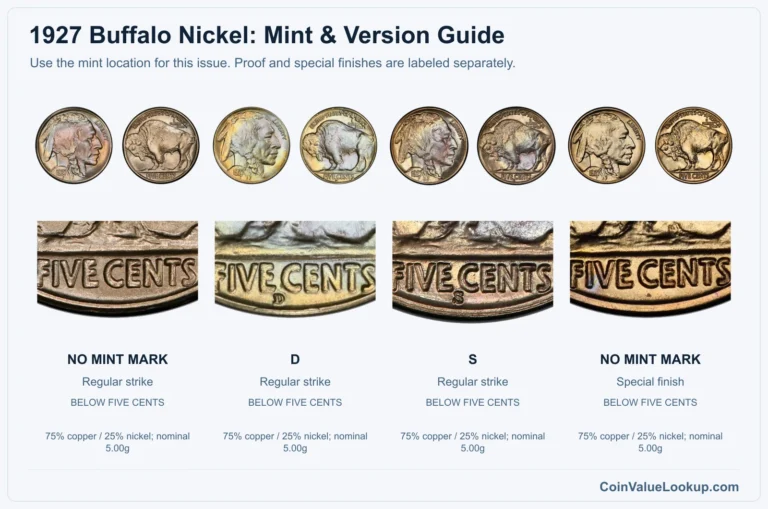
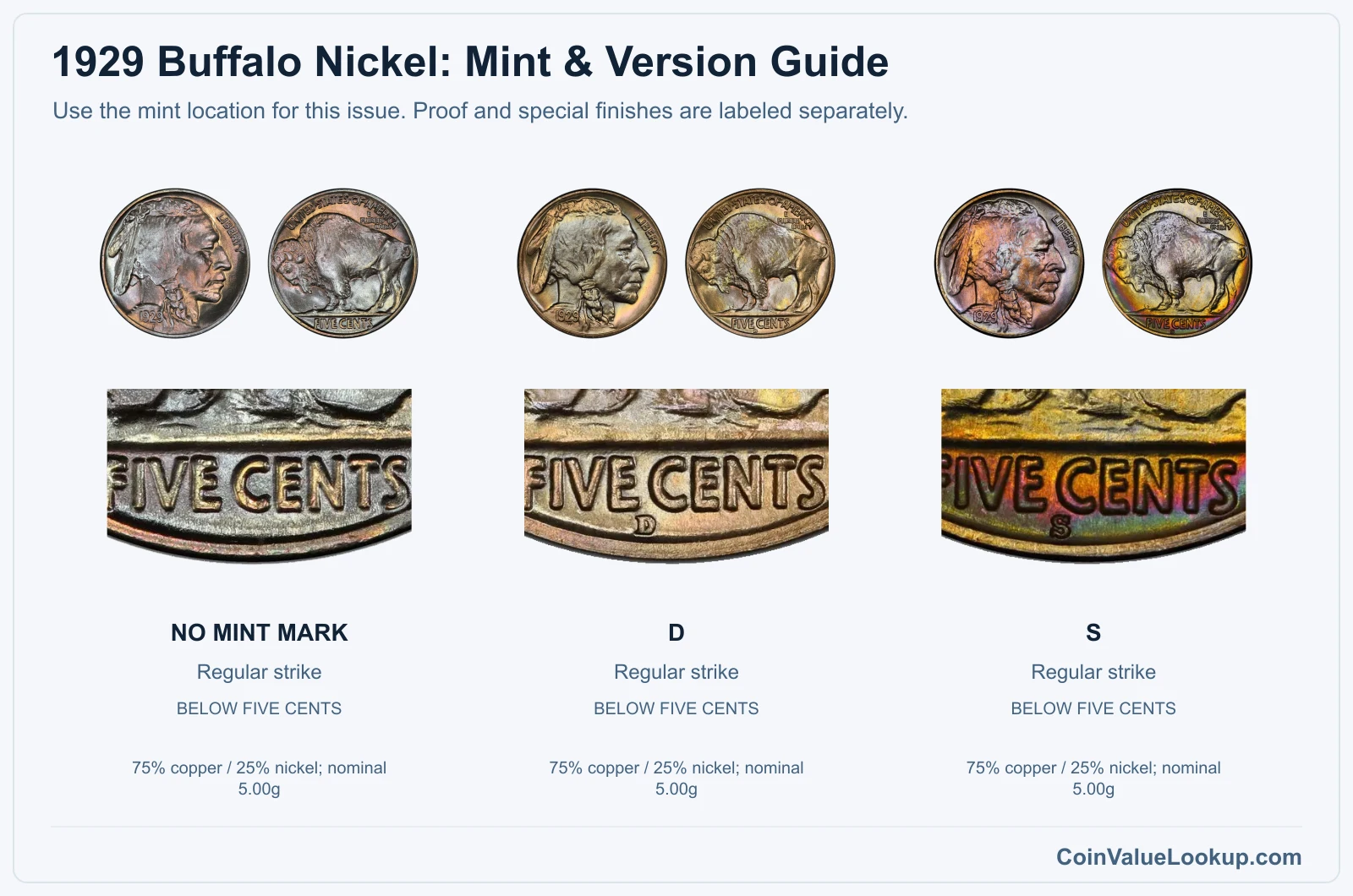
Three mints produced the 1929 Buffalo Nickel: Philadelphia, Denver, and San Francisco. Philadelphia coins carry no mintmark at all.
Denver pieces show a small D on the reverse, just below the words FIVE CENTS, while San Francisco pieces display an S in the same spot.
All 1929 nickels use the Type 2 reverse design with FIVE CENTS recessed below the ground line. There is no Type 1 raised-mound variety for this date; that design was only used in 1913.
The coin is struck in 75% copper and 25% nickel, weighs about 5 grams, measures 21.2 mm across, and has a plain edge.
If your coin looks silver-colored but unusually thin or light, it may be damaged or altered rather than a special issue. There is no regular silver version of the Buffalo Nickel.
Verify the date is fully legible before assessing value, and never use acid to restore a worn date.
Step 2: Check Your 1929 Buffalo Nickel Grade
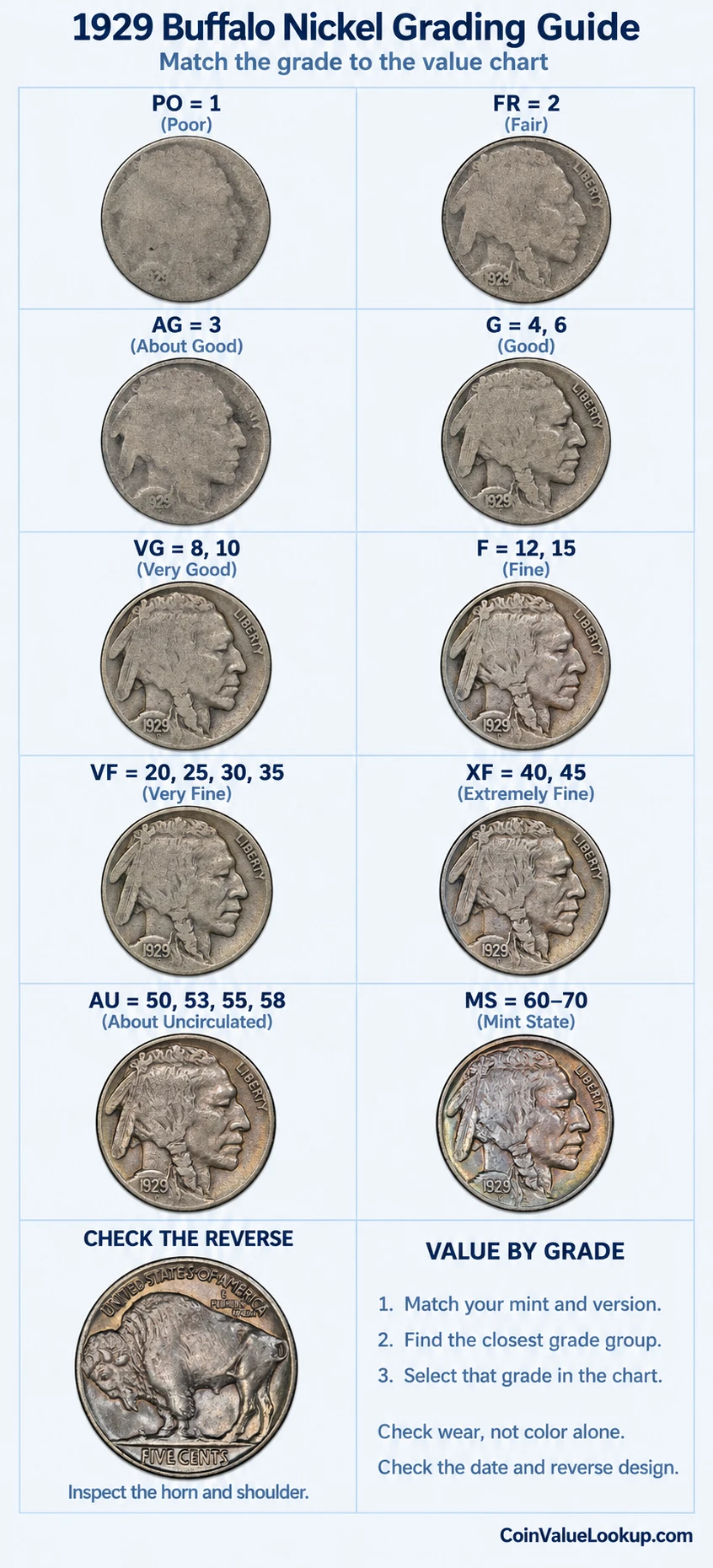
Start with the Native American portrait on the obverse. In higher grades the hair braid above the ear shows crisp individual strands, the cheek retains a slight roundness, and the feathers at the back of the head are separated.
As wear increases, the braid merges into a flat mass and the cheek flattens first.
On the reverse, check the bison's shoulder hump and horn. A sharp horn tip and distinct fur lines on the upper leg signal a coin that saw little circulation.
But here is the catch: 1920s branch-mint strikes can come weakly struck from the factory, so a soft horn does not always mean heavy wear.
Luster is your best friend. Original mint luster on a Buffalo Nickel has a satiny, slightly cartwheel sheen.
If the high points are worn but the fields still glow, the coin grades higher than one that is uniformly dull. Compare your coin side by side with the grading reference image to calibrate your eye.
Avoid cleaning or polishing the surface. A coin with natural toning and honest wear will always grade and sell better than one that has been scrubbed bright.
Step 3: Check 1929 Buffalo Nickel Value by Mint and Version
1929 Buffalo Nickel — No Mint Mark — Type2 Circulation
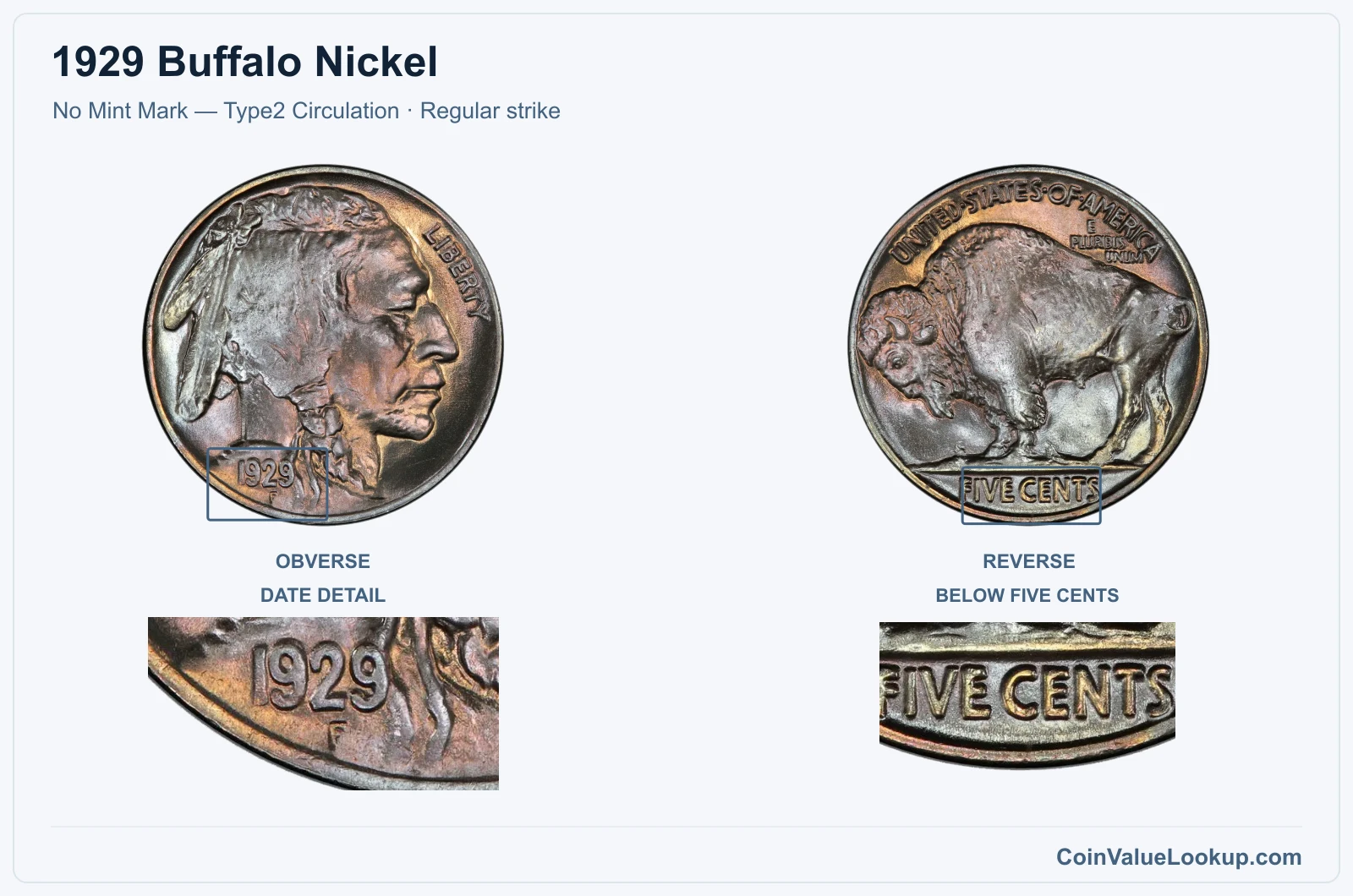
The 1929 Philadelphia Buffalo Nickel has no mintmark. Look at the reverse below FIVE CENTS and confirm the space is empty.
USA Coin Book lists a guide value of about $1.56 in G4 and around $100 in MS63.
Philadelphia struck the largest quantities, so finding one in low grades is straightforward. The jump to uncirculated territory is where this coin starts to get interesting.
Look for full, unbroken luster across both sides and sharp feather detail on the obverse. A well-struck Philly example with original surfaces stands out despite its common-date status.
Range Grade
Price Auction Records Appraisal PO PO 1
—
Coin Identifier FR FR 2
—
Coin Identifier AG AG 3
—
Coin Identifier G G 4
—
Coin Identifier
G 6
—
Coin Identifier VG VG 8
—
Coin Identifier
VG 10
—
Coin Identifier F F 12
—
Coin Identifier
F 15
—
Coin Identifier VF VF 20
—
Coin Identifier
VF 25
—
Coin Identifier
VF 30
—
Coin Identifier
VF 35
—
Coin Identifier XF XF 40
—
Coin Identifier
XF 45
Coin Identifier AU AU 50
—
Coin Identifier
AU 53
—
Coin Identifier
AU 55
Coin Identifier
AU 58
Coin Identifier MS MS 60
—
Coin Identifier
MS 61
—
Coin Identifier
MS 62
Coin Identifier
MS 63
Coin Identifier
MS 64
Coin Identifier
MS 65
Coin Identifier
MS 66
Coin Identifier
MS 67
Coin Identifier
MS 68
—
—
—
MS 69
—
—
—
MS 70
—
—
—
1929 Buffalo Nickel — D — Type2 Circulation
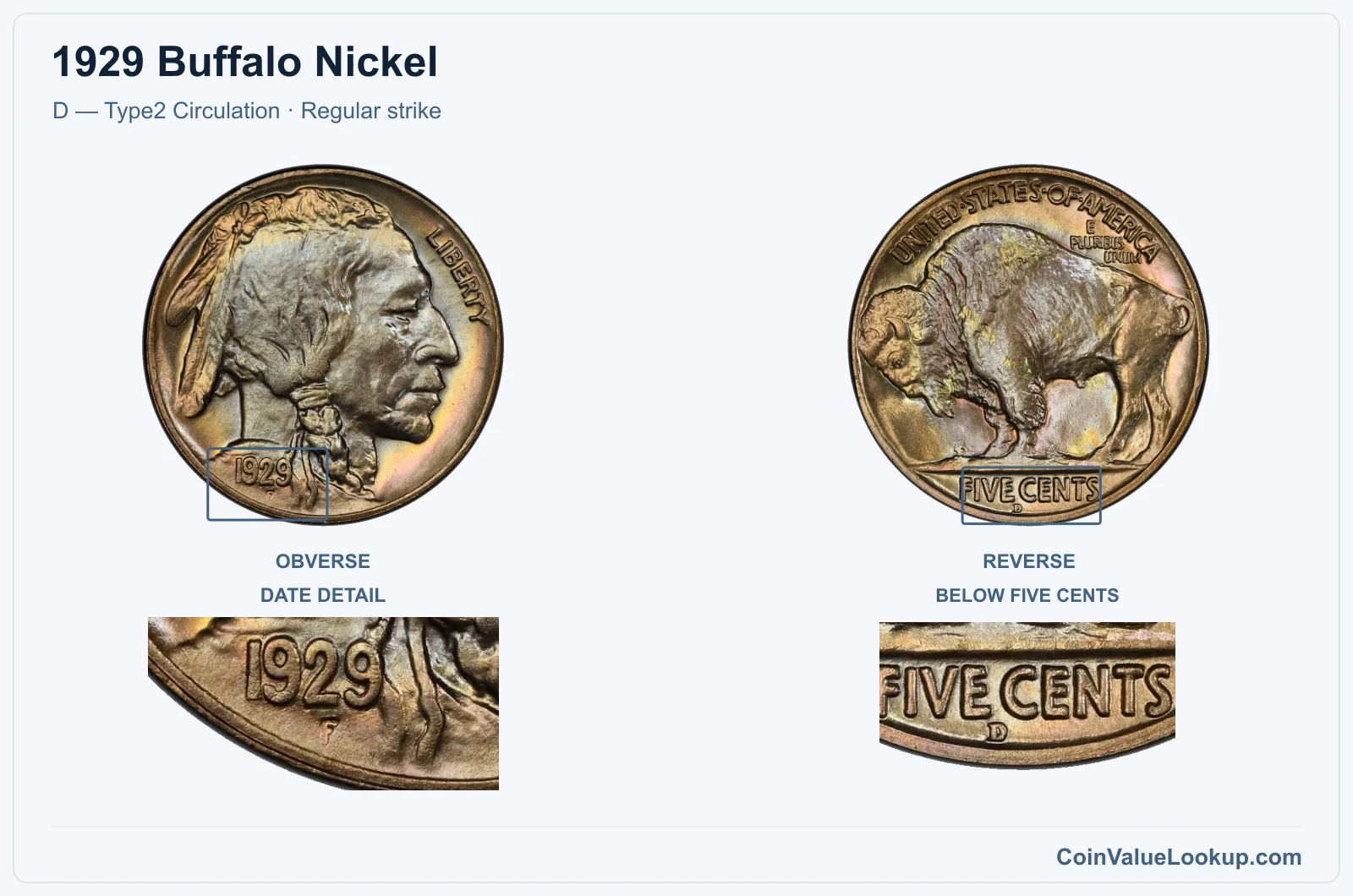
The 1929-D carries a small D mintmark on the reverse, sitting just below the denomination. This Denver issue guides at roughly $1.56 in G4 and about $162 in MS63, the highest MS63 figure among the three mints for this date.
Denver strikes from this era can be inconsistent, so finding a fully struck example with sharp horn detail and complete braid separation is harder than it sounds. That difficulty is exactly why the MS63 guide value sits above the Philadelphia and San Francisco versions.
When evaluating one, pay close attention to the bison's shoulder and the feather tips on the obverse.
Coin Value Lookup is a good starting point if you want to compare guide values across other Buffalo Nickel dates and mints before deciding whether your 1929-D is worth grading.
Range Grade
Price Auction Records Appraisal PO PO 1
—
Coin Identifier FR FR 2
—
Coin Identifier AG AG 3
—
Coin Identifier G G 4
—
Coin Identifier
G 6
—
Coin Identifier VG VG 8
—
Coin Identifier
VG 10
—
Coin Identifier F F 12
—
Coin Identifier
F 15
—
Coin Identifier VF VF 20
Coin Identifier
VF 25
—
Coin Identifier
VF 30
—
Coin Identifier
VF 35
—
Coin Identifier XF XF 40
—
Coin Identifier
XF 45
—
Coin Identifier AU AU 50
—
Coin Identifier
AU 53
Coin Identifier
AU 55
Coin Identifier
AU 58
Coin Identifier MS MS 60
—
Coin Identifier
MS 61
Coin Identifier
MS 62
Coin Identifier
MS 63
Coin Identifier
MS 64
Coin Identifier
MS 65
Coin Identifier
MS 66
Coin Identifier
MS 67
Coin Identifier
MS 68
—
—
—
MS 69
—
—
—
MS 70
—
—
—
1929 Buffalo Nickel — S — Type2 Circulation
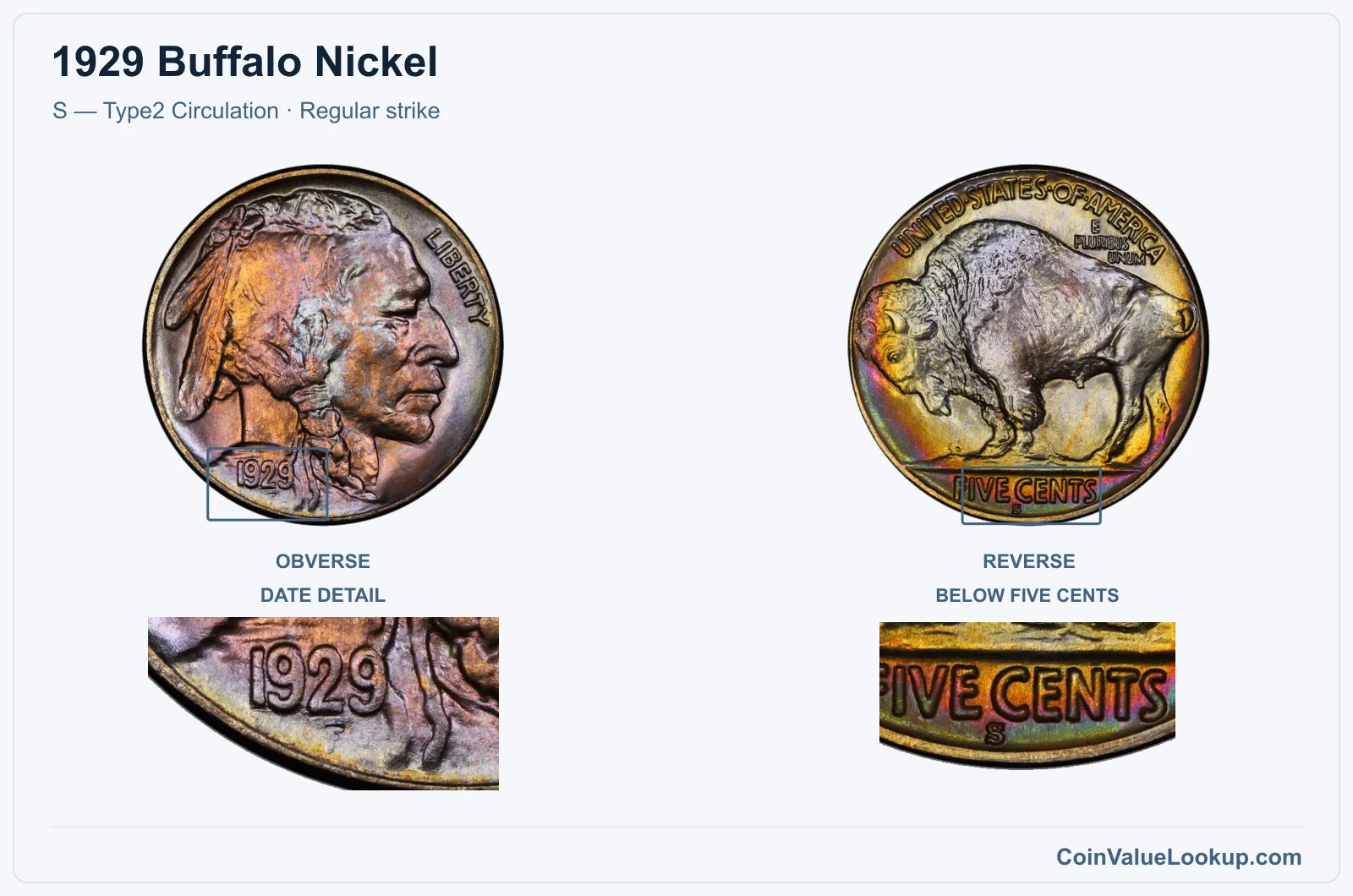
San Francisco's 1929-S shows an S mintmark on the reverse below FIVE CENTS. Guide values run from about $1.56 in G4 to approximately $123 in MS63.
San Francisco Buffalo Nickels from the late 1920s are notorious for soft strikes. A mushy horn or indistinct fur detail does not necessarily mean your coin is worn; it may simply reflect the original strike quality.
Compare the high-point wear against the field luster to get a more accurate read on actual grade. Survivors in true uncirculated condition with clean fields and full detail command the premium reflected in that MS63 guide figure.
Range Grade
Price Auction Records Appraisal PO PO 1
—
Coin Identifier FR FR 2
—
Coin Identifier AG AG 3
—
Coin Identifier G G 4
—
Coin Identifier
G 6
—
Coin Identifier VG VG 8
—
Coin Identifier
VG 10
—
Coin Identifier F F 12
—
Coin Identifier
F 15
—
Coin Identifier VF VF 20
—
Coin Identifier
VF 25
—
Coin Identifier
VF 30
—
Coin Identifier
VF 35
—
Coin Identifier XF XF 40
Coin Identifier
XF 45
Coin Identifier AU AU 50
—
Coin Identifier
AU 53
—
Coin Identifier
AU 55
—
Coin Identifier
AU 58
Coin Identifier MS MS 60
Coin Identifier
MS 61
Coin Identifier
MS 62
Coin Identifier
MS 63
Coin Identifier
MS 64
Coin Identifier
MS 65
Coin Identifier
MS 66
Coin Identifier
MS 67
Coin Identifier
MS 68
—
—
—
MS 69
—
—
—
MS 70
—
—
—
1929 Buffalo Nickel Error List
1. 1929 Buffalo Nickel — Wrong Planchet / Off-Metal Strike
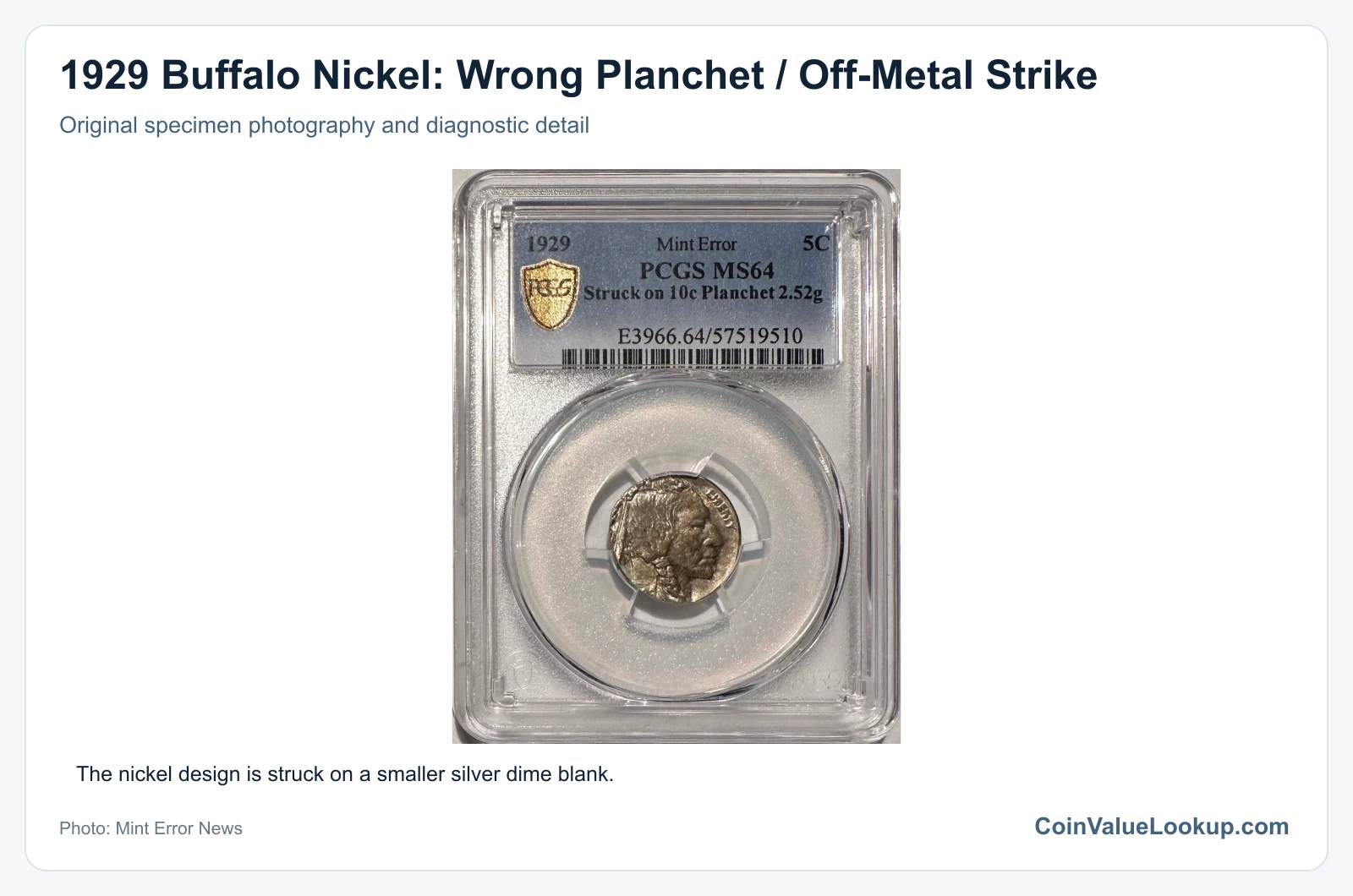
A 1929 Philadelphia Buffalo Nickel struck on a dime-sized planchet has been reported. This happens when a blank intended for another denomination gets fed into the nickel press.
To check, compare your coin's weight, diameter, and edge to a standard Buffalo Nickel, which should be about 5 grams and 21.2 mm with a plain edge. A wrong-planchet strike will typically show an incomplete design because the blank is too small to receive the full impression.
Be careful with lookalikes. Coins that appear thin or oddly colored may have been plated, corroded, or acid-treated after leaving the mint.
Genuine off-metal errors show consistent design weakness that corresponds to the smaller blank, not random surface damage. Condition, visibility of the date, and the specific planchet involved all affect value.
2. 1929 Buffalo Nickel — Off-Center Strike
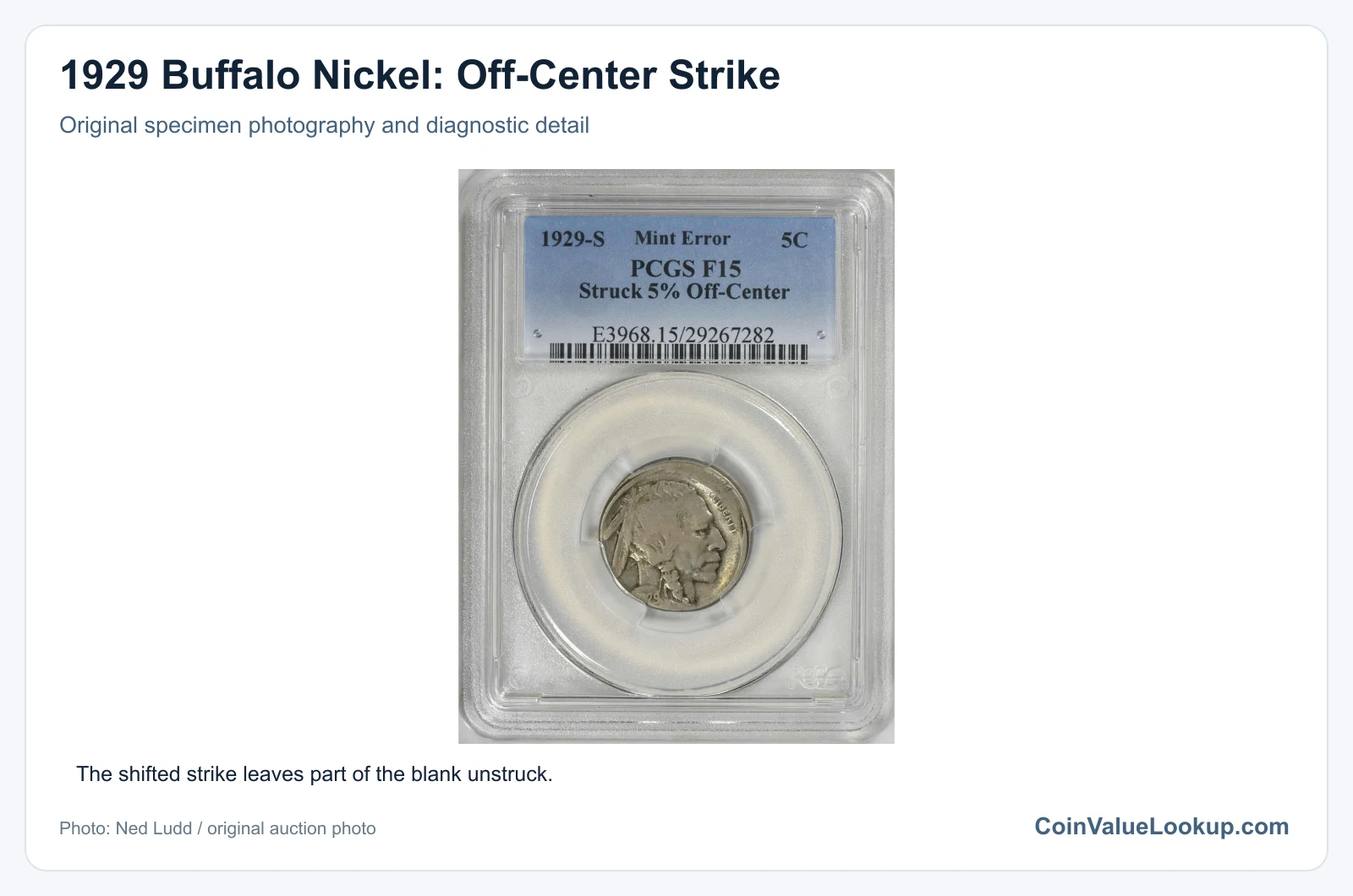
Off-center strikes occur when the planchet is not properly seated between the dies. The result is a displaced design with an unstruck crescent of blank metal along one edge.
A 1929-dated off-center Buffalo Nickel has been reported, though the specific mint is not identified.
The most important factor for value is whether the date remains fully visible. An off-center nickel with a readable 1929 date is far more collectible than one where the date has shifted off the flan entirely.
Do not confuse this error with a clipped planchet, a one-sided die misalignment, or post-mint flattening from a vise or machinery. Genuine off-center strikes show a clean, curved blank area and the design elements shift uniformly in one direction.
Value depends on the percentage off-center, date visibility, and overall condition.
3. 1929 Buffalo Nickel — Die Crack / Die Chip
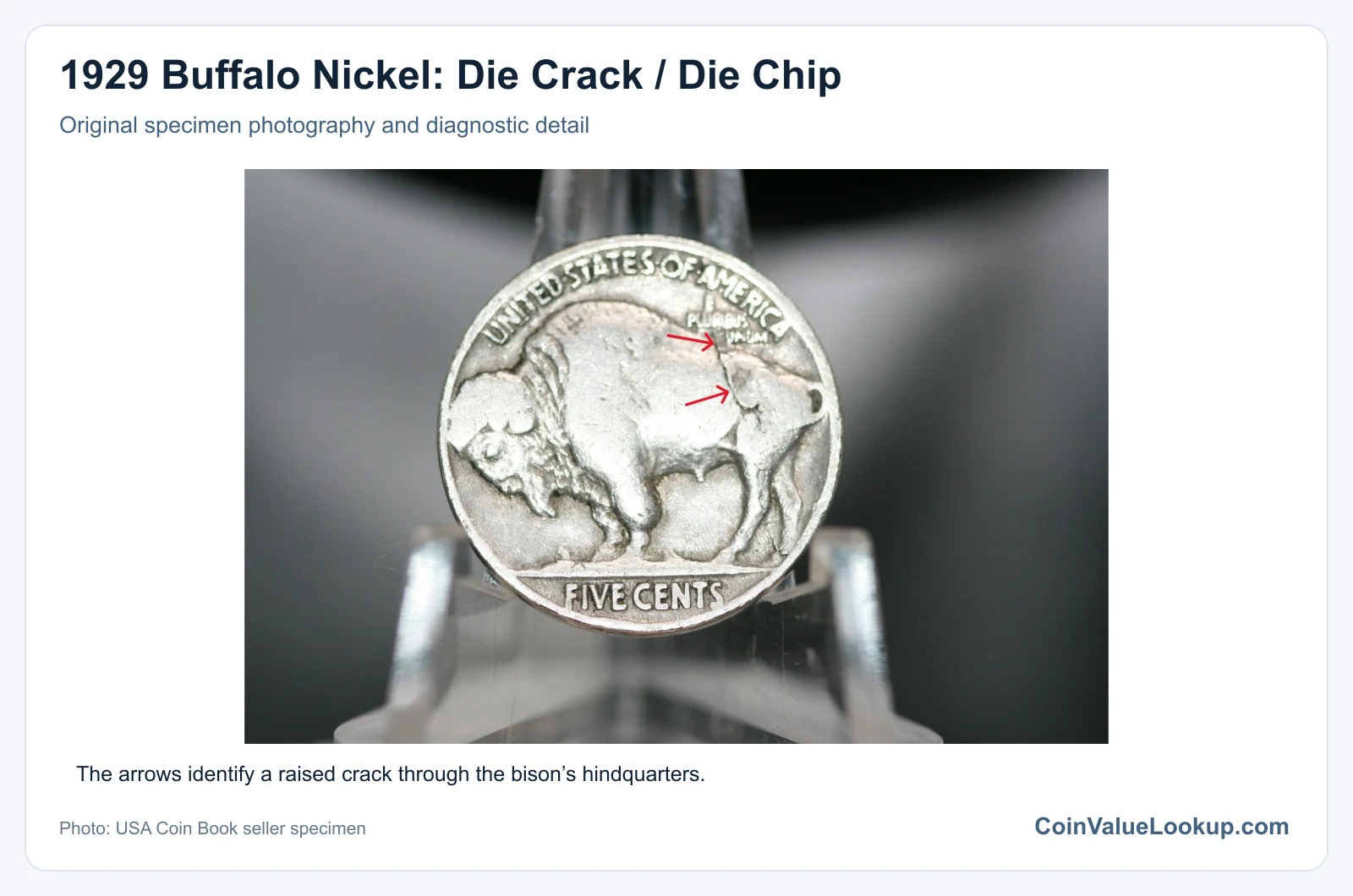
Die cracks and die chips have been reported on the 1929-S Buffalo Nickel specifically. These appear as raised lines or small raised blobs on the coin's surface, caused by fractures in the steel die during production.
A die crack that runs from the interior of the design to the rim is a standard crack. If a piece of the die breaks away near the rim and leaves a raised lump of metal, that is called a cud, and cuds generally command more collector interest than interior cracks.
Do not mistake incuse scratches, corrosion tracks, or foreign material stuck to the surface for die cracks. Genuine cracks are raised above the field and follow a consistent path.
Photograph the entire coin plus a close-up of the crack for identification. The size, location, and severity of the crack all influence collector interest.
4. 1929 Buffalo Nickel — Doubled Die Obverse
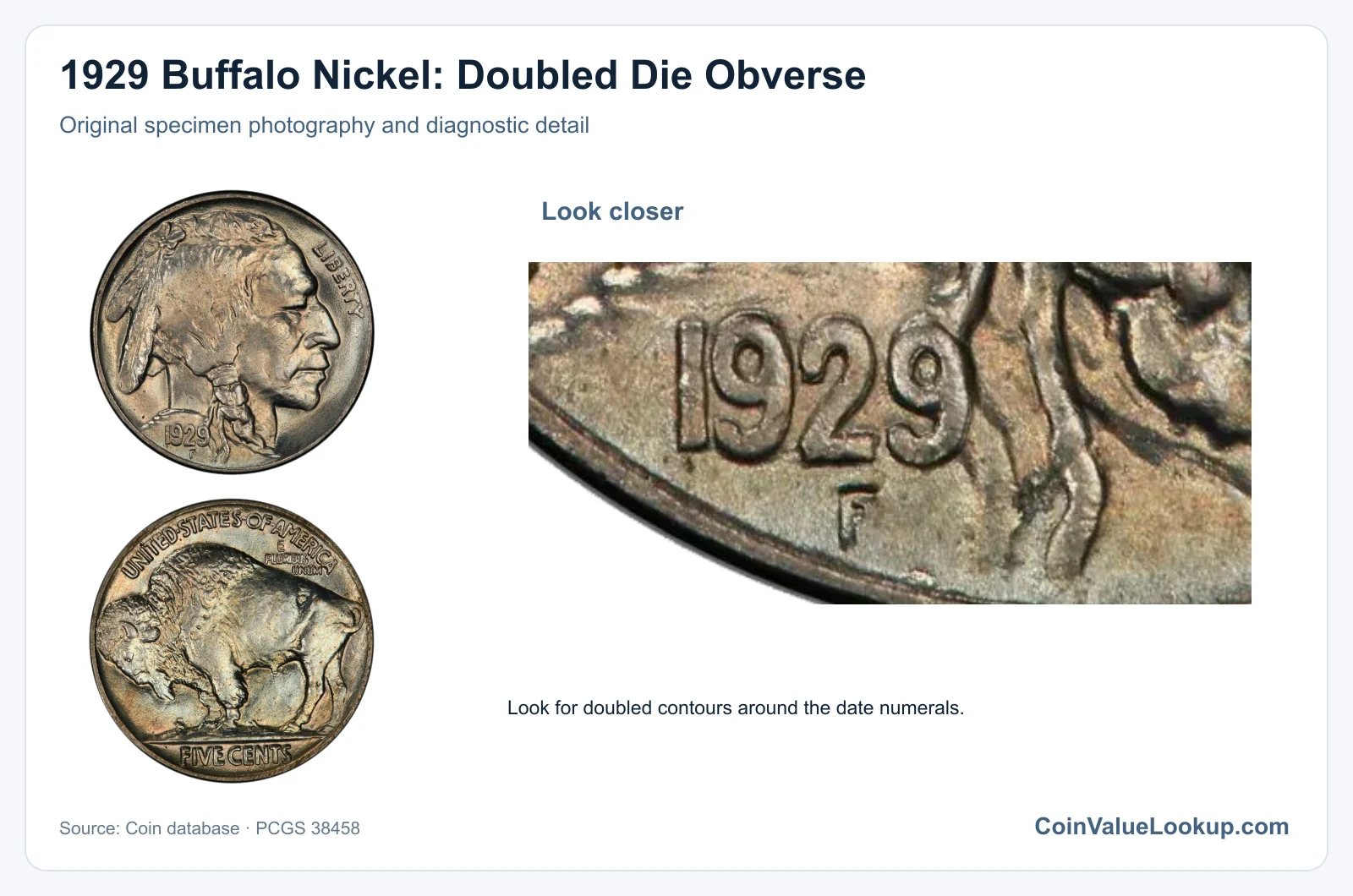
A doubled die obverse has been reported on the 1929 Philadelphia Buffalo Nickel. This variety results from a misalignment during the die-making process, leaving a consistent doubling visible on design elements.
Look at the obverse lettering and the portrait details under magnification and good lighting. Genuine hub doubling shows consistent separation or notching on affected elements, not a flat, shelf-like distortion.
The doubling should repeat in the same direction across multiple design features.
Machine doubling is the most common lookalike and it is not the same thing. Machine doubling produces flat, shelf-like displacement on the high points and adds no premium.
Reflections under certain lighting angles and worn die contours can also mimic doubling to the naked eye. Condition and the strength of the doubling affect value for confirmed examples.
5. 1929 Buffalo Nickel — Doubled Die Reverse
A doubled die reverse has also been reported on the 1929 Philadelphia Buffalo Nickel. As with the obverse variety, this originates during die production rather than during the striking process.
Examine the reverse legends, the bison's outline, and the denomination under magnification. Compare what you see against a known normal example under matching lighting conditions.
True hub doubling will show consistent separation or notching across multiple letters or design contours.
Machine doubling on the reverse can look superficially similar but appears as a flat shelf rather than distinct, rounded secondary lettering. Random nicks and damage can also create confusing marks.
Avoid jumping to conclusions without a careful side-by-side comparison. Value for a genuine doubled die reverse depends on the degree of separation and the coin's overall condition.
6. 1929 Buffalo Nickel — Lamination / Split Planchet
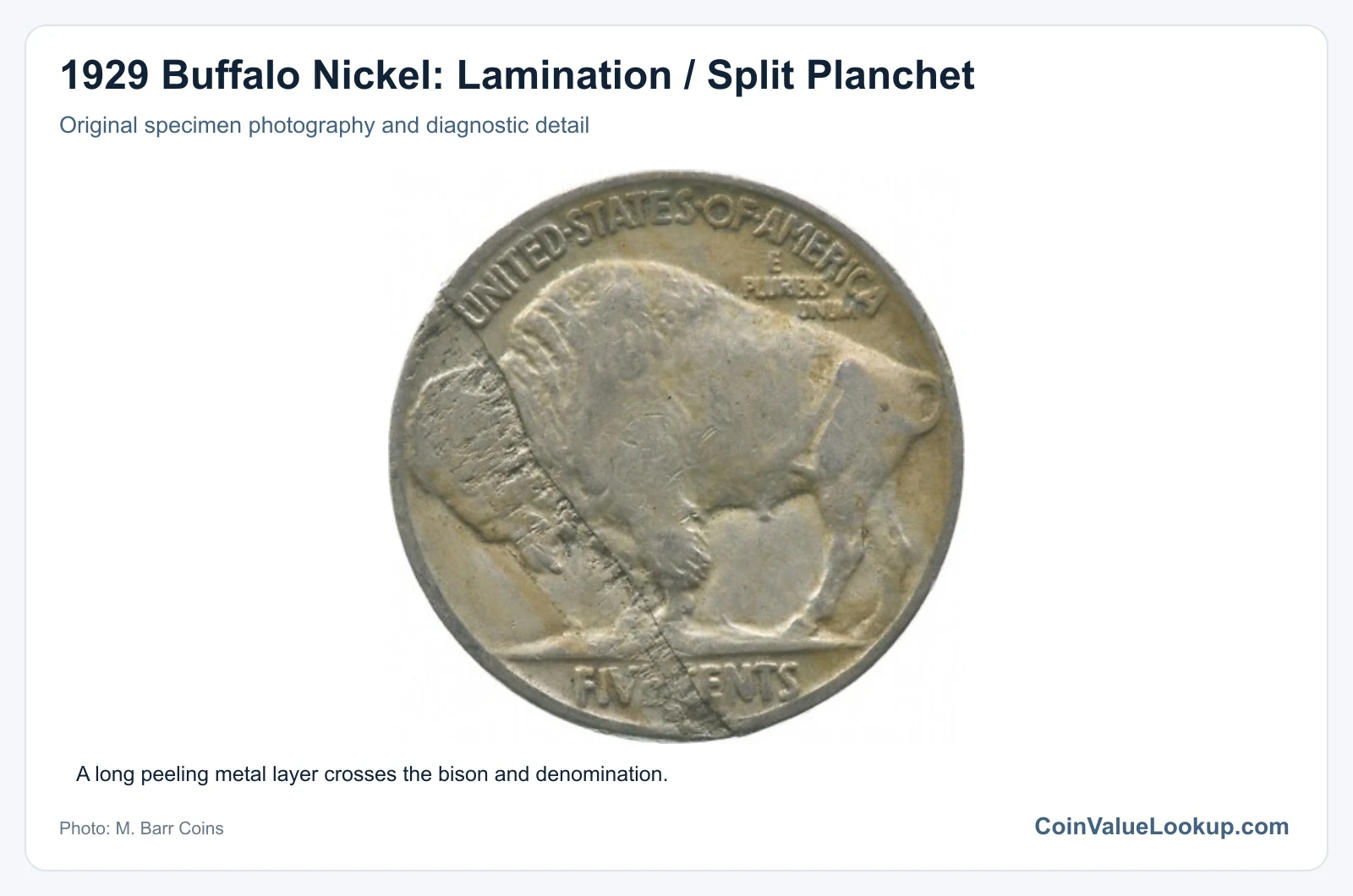
Lamination errors on the 1929 Buffalo Nickel have been reported. These occur when impurities or gas pockets within the alloy cause layers of metal to separate, peel, or flake away from the coin's surface.
The result can range from a small retained flap of metal to a significant area of missing surface. When photographing a suspected lamination, capture both the affected face and the coin's edge so the separation within the metal is visible.
This error is easy to confuse with post-mint damage. Scraping, corrosion pitting, or deliberate cuts can remove metal in ways that superficially resemble a lamination.
The key difference is that a genuine lamination follows the internal structure of the alloy and usually shows a smooth underlying surface beneath the flap. Value depends on size, location, and overall condition of the coin.
7. 1929 Buffalo Nickel — Clipped Planchet
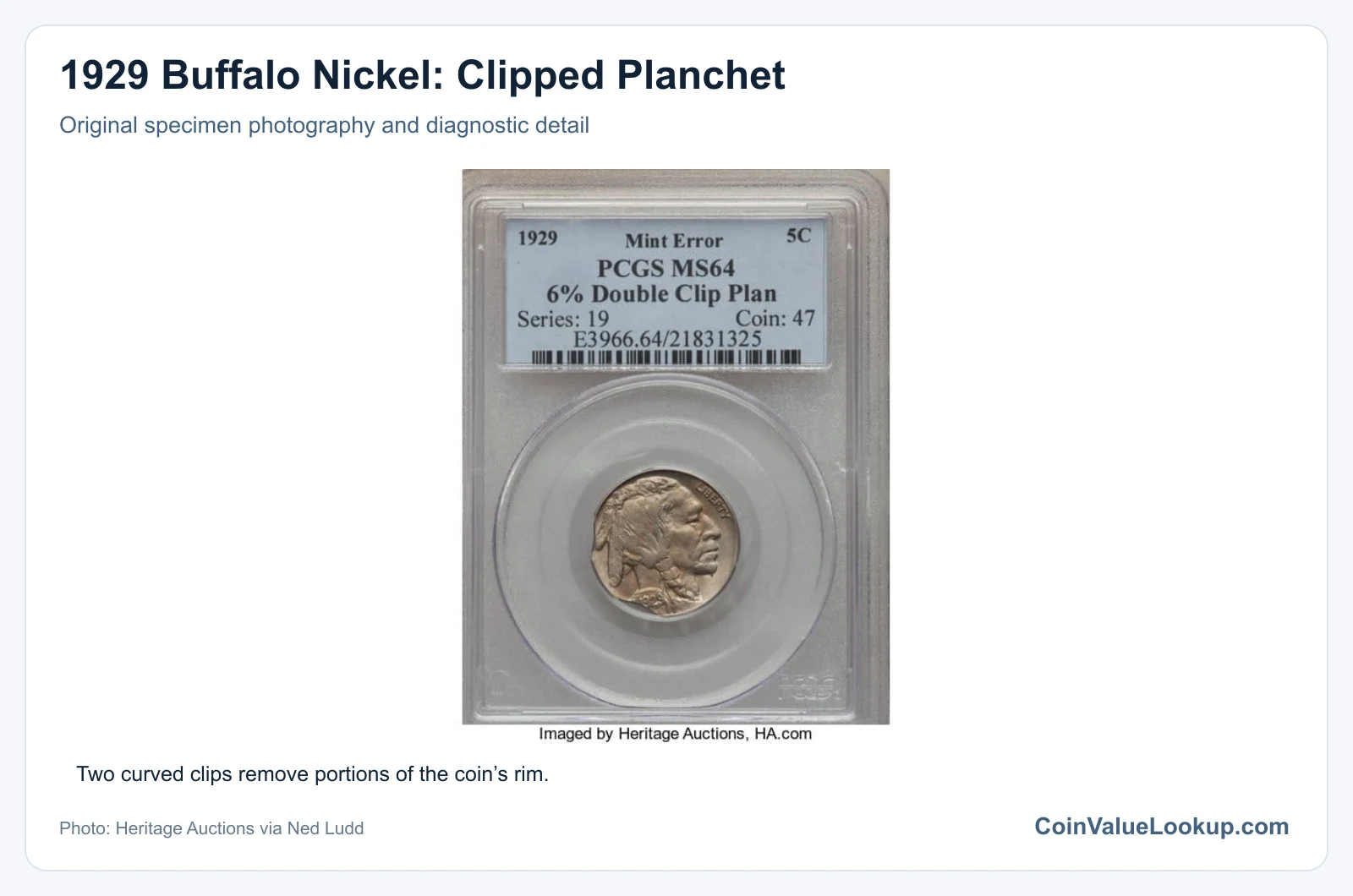
Clipped planchet errors on the 1929 Buffalo Nickel have been reported. A clip happens when the blanking press overlaps a previously punched area of the metal strip, producing a planchet with a missing curved section.
Look for a concave bite out of the edge. On a genuine clip, the area opposite the missing section often shows design weakness known as the Blakesley effect, where metal could not flow fully during striking.
The edge at the clip itself will have a different texture than the normally upset rim.
Straight clips and ragged clips also exist but are less common. Do not confuse a clip with a filed notch, a deliberate edge cut, or corrosion that has eaten away part of the rim.
Those post-mint alterations lack the characteristic metal-flow weakness and uniform blank-edge texture. Value depends on clip size, date visibility, and overall condition.