1994 Washington Quarter Coin Value: How Much Is It Worth?
Most 1994 Washington quarters you find in change are worth face value — 25 cents. A well-preserved example graded MS65 can bring around $12 according to USA Coin Book guide estimates.
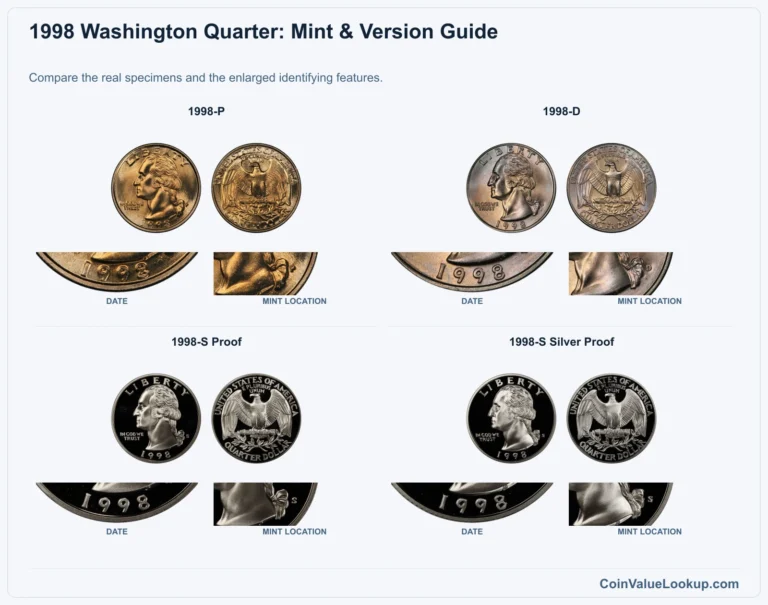
The 1994-S silver proof stands apart, with a PR65 guide estimate near $21. Four distinct versions exist for this date: the P and D business strikes in copper-nickel clad, plus two S-mint proofs — one clad and one struck in 90% silver.
Fast Way to Identify Your 1994 Washington Quarter
Snap a clear photo of the front and back of your 1994 quarter and upload both images to our identifier. It will give you a preliminary identification of your coin's mint, version and general category.
This is not a substitute for professional authentication or exact grading, but it gets you pointed in the right direction quickly.
1994 Washington Quarter Value
Upload both sides of your 1994 Washington Quarter.
Front Obverse
Upload photo
Back Reverse
Upload photo
Which 1994 Washington Quarter Versions Are Worth Money?
- The 1994-S silver proof (90% silver, ~6.25 g) has a PR65 guide estimate around $21 — confirm the uniform silver edge and heavier weight to separate it from the clad proof.
- 1994-P and 1994-D quarters in pristine MS65 condition carry guide estimates near $12 each — far above face value if genuinely uncirculated.
- A 1994-P quarter struck on a dime planchet sold for $863.65 in ANACS MS63 at Heritage Auctions in April 2006 — a dramatic wrong-planchet error.
- A 1994-D quarter missing its reverse clad layer sold for $211.50 in NGC MS64 at Heritage Auctions in July 2014 — an eye-catching mint error exposing the copper core.
Step 1: Identify Your 1994 Washington Quarter Mint Mark and Version
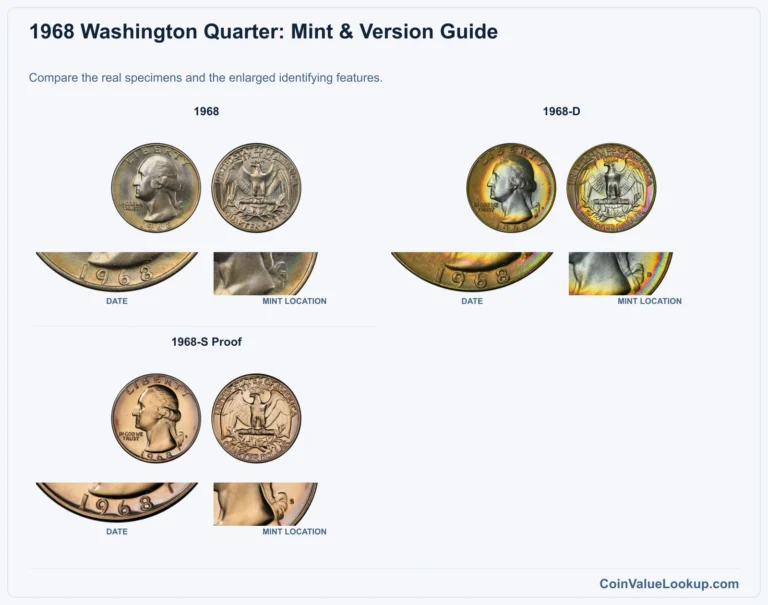
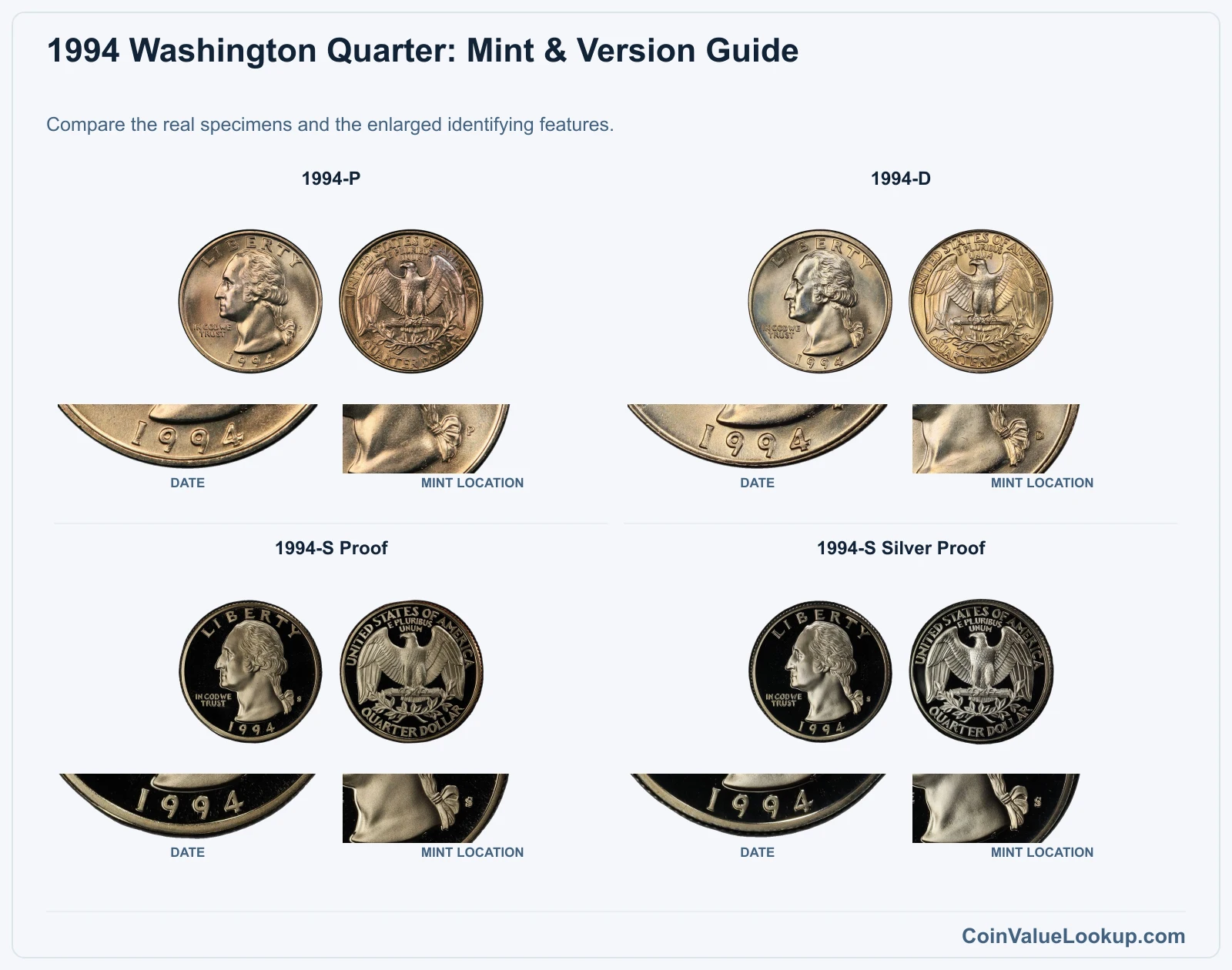
Start at the mintmark, located on the obverse just to the right of the ribbon in Washington's hair. A "P" means Philadelphia, "D" means Denver, and "S" means San Francisco.
There is no blank-mintmark Philadelphia variety for 1994.
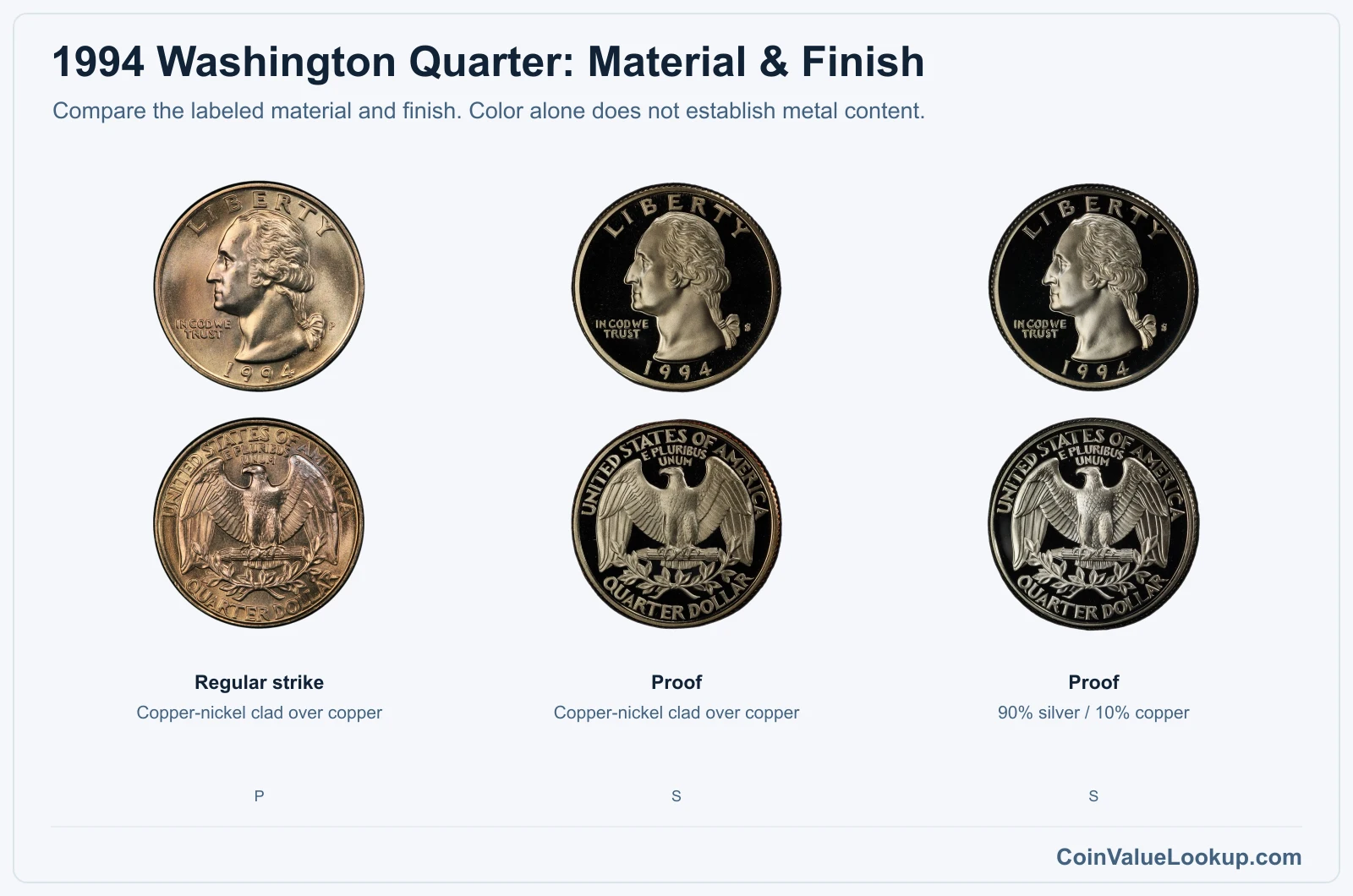
All P and D quarters are copper-nickel clad business strikes with a nominal weight of 5.67 grams and a diameter of about 24.3 mm. The S-mint coins are proofs, but they come in two metals: copper-nickel clad (same composition as P/D) and 90% silver with 10% copper.
Separating the two S proofs requires more than just reading the mintmark. The silver version weighs approximately 6.25 grams versus 5.67 grams for the clad.
Check the edge — a clad proof shows the familiar copper-colored stripe, while the silver proof has a uniform silver-gray edge. Original government packaging also identifies which set the coin came from.
Do not assume a coin is silver just because it carries an S mintmark.
One more thing: a quarter struck on a wrong (dime-sized) planchet is a completely different animal from the silver proof. They look nothing alike, but both are smaller or lighter than a standard clad quarter, so weigh and measure carefully before jumping to conclusions.
Step 2: Check Your 1994 Washington Quarter Grade
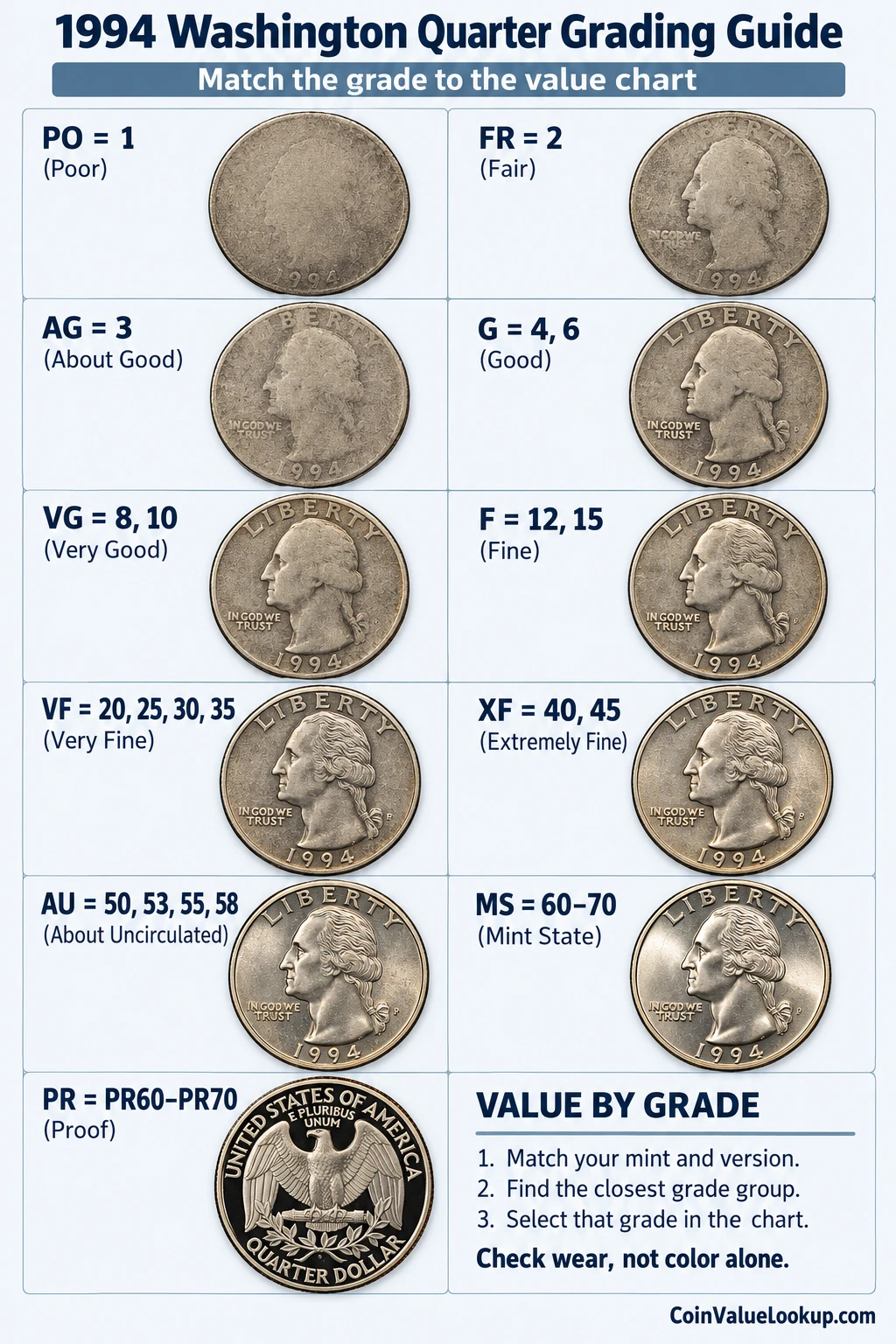
The key wear spots on a Washington quarter are the hair above the ear, the cheek and jawline on the obverse, and the eagle's breast feathers on the reverse. Compare your coin to the reference image — an uncirculated coin will show full, unbroken luster across those areas, not just brightness from cleaning.
Light rub on the cheek is the first sign of wear, dropping the coin from Mint State to About Uncirculated. Hairlines from wiping, scattered contact marks from rolling around in bags, and any sign of cleaning all reduce the grade and the value.
For proofs, grade is separate from contrast. A coin labeled DCAM (Deep Cameo) has frosted raised devices against mirror-like fields — that is a contrast designation, not a silver-content indicator and not a higher grade.
A PR65 guide estimate for a standard proof is not the same as a DCAM quote.
Step 3: Check 1994 Washington Quarter Value by Mint and Version
1994 Washington Quarter — P
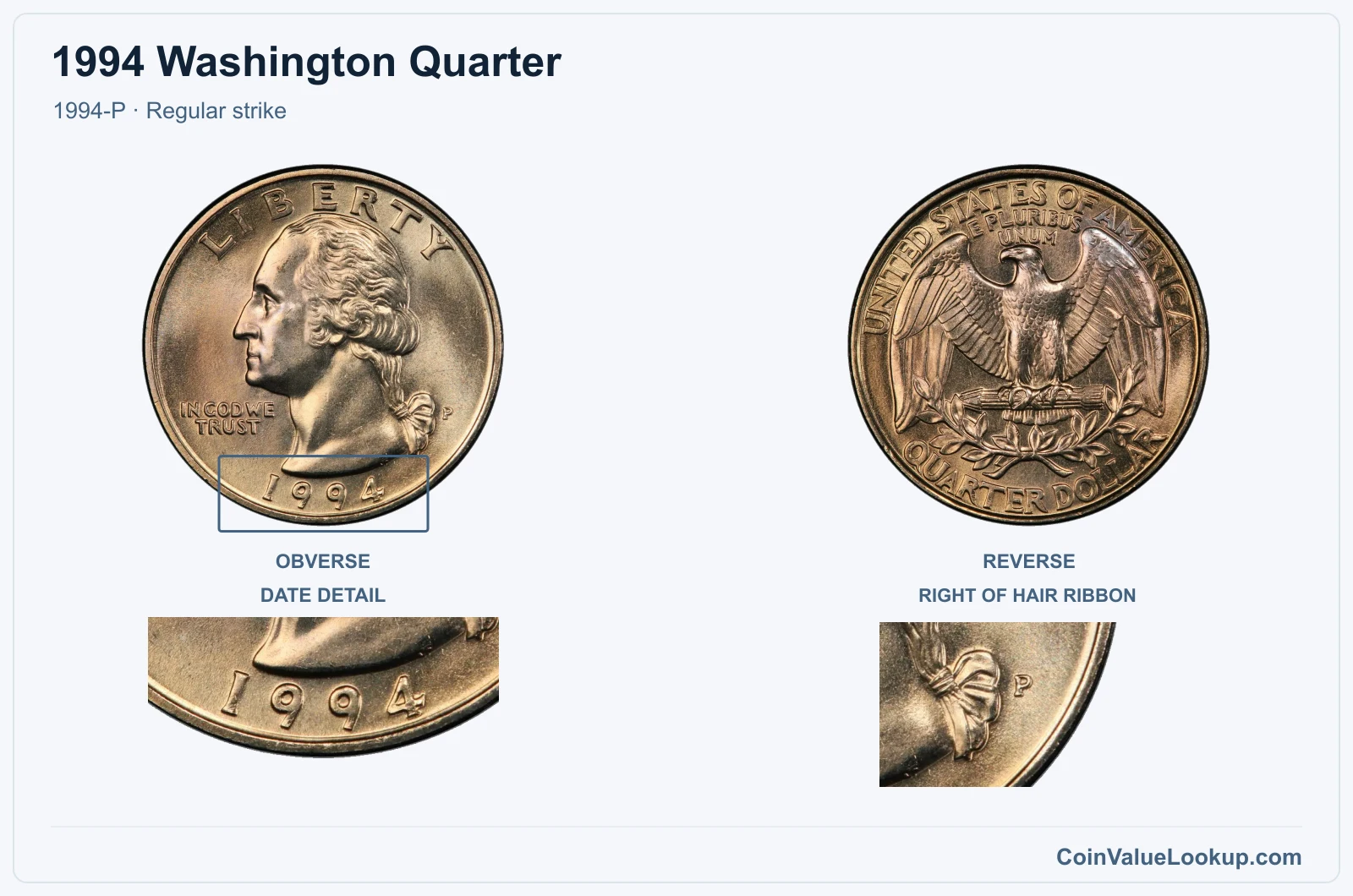
The 1994-P is a standard copper-nickel clad business strike from Philadelphia. It carries a small "P" mintmark on the obverse.
In typical circulated condition, it is a 25-cent coin. In MS65 — meaning full original luster with only minor contact marks — the USA Coin Book guide estimate is about $12.
Finding one that nice usually means pulling it from an original bank roll; pocket change examples rarely survive without wear on the cheek and hair.
| Range | Grade | Price | Auction Records | Appraisal |
|---|---|---|---|---|
| PO | PO 1 | — | Coin Identifier | |
| FR | FR 2 | — | Coin Identifier | |
| AG | AG 3 | — | Coin Identifier | |
| G | G 4 | — | Coin Identifier | |
| G 6 | — | Coin Identifier | ||
| VG | VG 8 | — | Coin Identifier | |
| VG 10 | — | Coin Identifier | ||
| F | F 12 | — | Coin Identifier | |
| F 15 | — | Coin Identifier | ||
| VF | VF 20 | — | Coin Identifier | |
| VF 25 | — | Coin Identifier | ||
| VF 30 | — | Coin Identifier | ||
| VF 35 | — | Coin Identifier | ||
| XF | XF 40 | — | Coin Identifier | |
| XF 45 | — | Coin Identifier | ||
| AU | AU 50 | — | Coin Identifier | |
| AU 53 | — | Coin Identifier | ||
| AU 55 | — | Coin Identifier | ||
| AU 58 | — | Coin Identifier | ||
| MS | MS 60 | — | Coin Identifier | |
| MS 61 | — | Coin Identifier | ||
| MS 62 | — | Coin Identifier | ||
| MS 63 | — | Coin Identifier | ||
| MS 64 | Coin Identifier | |||
| MS 65 | Coin Identifier | |||
| MS 66 | Coin Identifier | |||
| MS 67 | Coin Identifier | |||
| MS 68 | — | Coin Identifier | ||
| MS 69 | — | — | — | |
| MS 70 | — | — | — |
1994 Washington Quarter — D
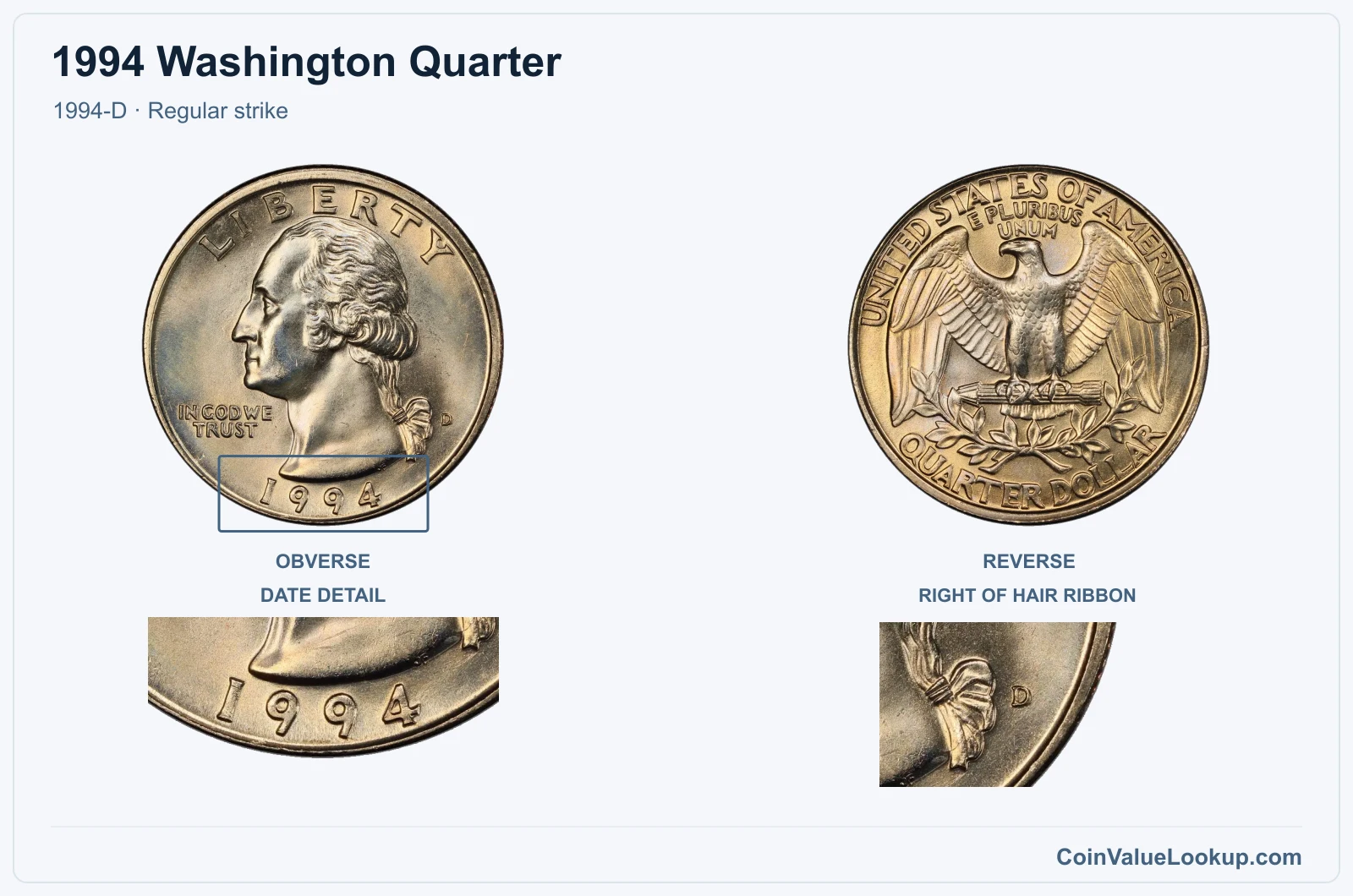
Denver's 1994-D shares the same copper-nickel clad composition and 5.67-gram nominal weight as its Philadelphia counterpart. Look for the "D" mintmark on the obverse.
Circulated pieces are worth face value. At MS65, the guide estimate is also around $12.
The same wear checkpoints apply: hair detail above the ear and the eagle's breast feathers are the first areas to show contact.
| Range | Grade | Price | Auction Records | Appraisal |
|---|---|---|---|---|
| PO | PO 1 | — | Coin Identifier | |
| FR | FR 2 | — | Coin Identifier | |
| AG | AG 3 | — | Coin Identifier | |
| G | G 4 | — | Coin Identifier | |
| G 6 | — | Coin Identifier | ||
| VG | VG 8 | — | Coin Identifier | |
| VG 10 | — | Coin Identifier | ||
| F | F 12 | — | Coin Identifier | |
| F 15 | — | Coin Identifier | ||
| VF | VF 20 | — | Coin Identifier | |
| VF 25 | — | Coin Identifier | ||
| VF 30 | — | Coin Identifier | ||
| VF 35 | — | Coin Identifier | ||
| XF | XF 40 | — | Coin Identifier | |
| XF 45 | — | Coin Identifier | ||
| AU | AU 50 | — | Coin Identifier | |
| AU 53 | — | Coin Identifier | ||
| AU 55 | — | Coin Identifier | ||
| AU 58 | — | Coin Identifier | ||
| MS | MS 60 | — | Coin Identifier | |
| MS 61 | — | Coin Identifier | ||
| MS 62 | — | Coin Identifier | ||
| MS 63 | — | Coin Identifier | ||
| MS 64 | — | Coin Identifier | ||
| MS 65 | — | Coin Identifier | ||
| MS 66 | Coin Identifier | |||
| MS 67 | Coin Identifier | |||
| MS 68 | — | — | — | |
| MS 69 | — | — | — | |
| MS 70 | — | — | — |
1994 Washington Quarter — S Proof
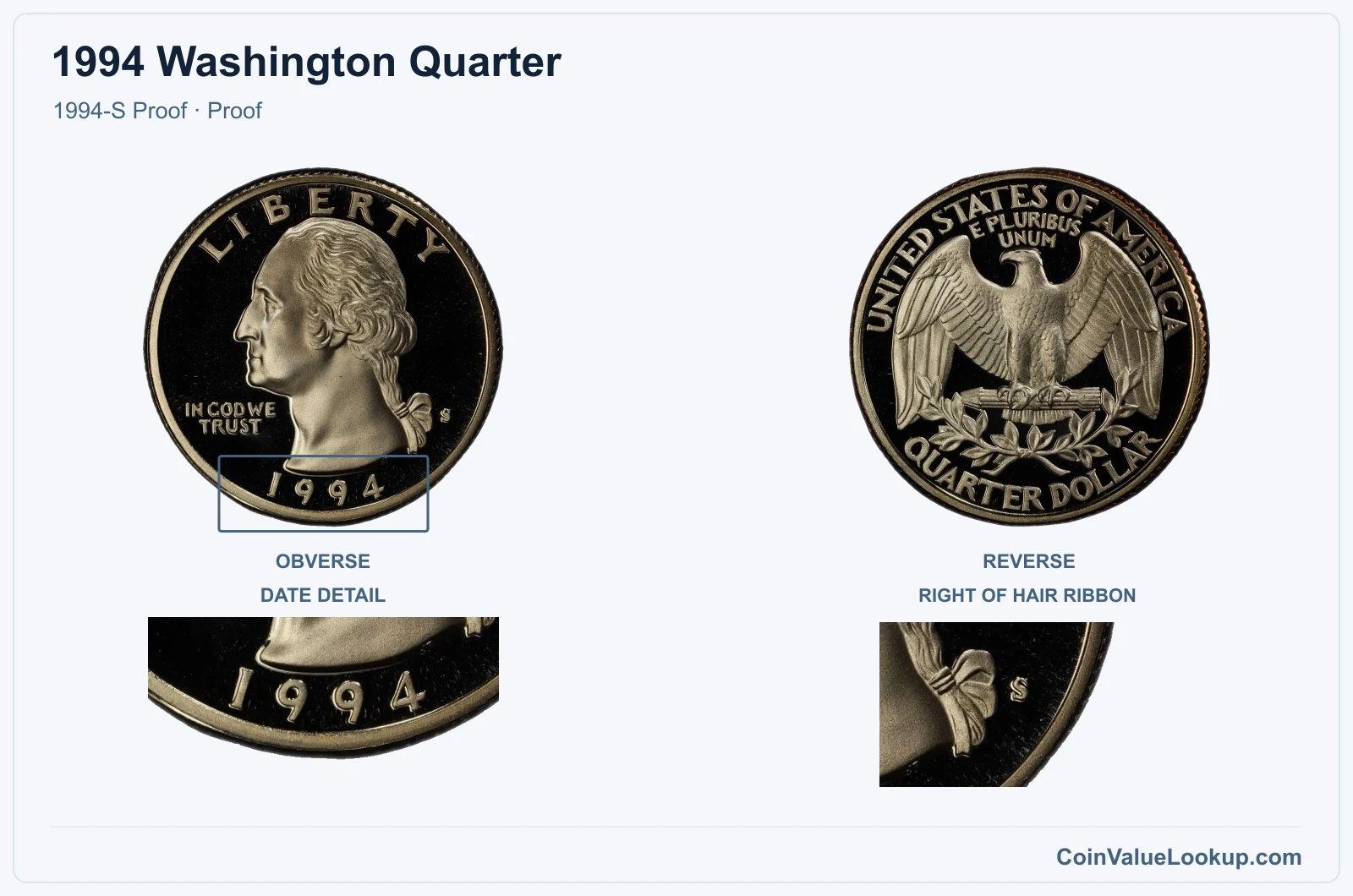
The 1994-S clad proof was struck at San Francisco on the same copper-nickel clad planchets used for circulation quarters, but with polished dies and specially prepared blanks that produce mirror fields. The PR65 guide estimate from USA Coin Book is approximately $4.96.
That modest figure reflects the large number produced for collector sets.
Do not confuse this with the silver proof — both say "S" on the obverse. Check the edge for a copper stripe (clad) versus uniform silver-gray (silver), and weigh the coin if possible.
A DCAM contrast designation is separate from the metal type; a clad proof can be DCAM, and the PR65 guide figure here is for a standard proof, not a DCAM example.
| Range | Grade | Price | Auction Records | Appraisal |
|---|---|---|---|---|
| PR | PR 1 | — | Coin Identifier | |
| PR 2 | — | Coin Identifier | ||
| PR 3 | — | Coin Identifier | ||
| PR 4 | — | Coin Identifier | ||
| PR 6 | — | Coin Identifier | ||
| PR 8 | — | Coin Identifier | ||
| PR 10 | — | Coin Identifier | ||
| PR 12 | — | Coin Identifier | ||
| PR 15 | — | Coin Identifier | ||
| PR 20 | — | Coin Identifier | ||
| PR 25 | — | Coin Identifier | ||
| PR 30 | — | Coin Identifier | ||
| PR 35 | — | Coin Identifier | ||
| PR 40 | — | Coin Identifier | ||
| PR 45 | — | Coin Identifier | ||
| PR 50 | — | Coin Identifier | ||
| PR 53 | — | Coin Identifier | ||
| PR 55 | — | Coin Identifier | ||
| PR 58 | — | Coin Identifier | ||
| PR 60 | — | Coin Identifier | ||
| PR 61 | — | Coin Identifier | ||
| PR 62 | — | Coin Identifier | ||
| PR 63 | — | Coin Identifier | ||
| PR 64 | — | Coin Identifier | ||
| PR 65 | — | Coin Identifier | ||
| PR 66 | — | Coin Identifier | ||
| PR 67 | — | Coin Identifier | ||
| PR 68 | Coin Identifier | |||
| PR 69 | Coin Identifier | |||
| PR 70 | Coin Identifier |
1994 Washington Quarter — S Silver Proof
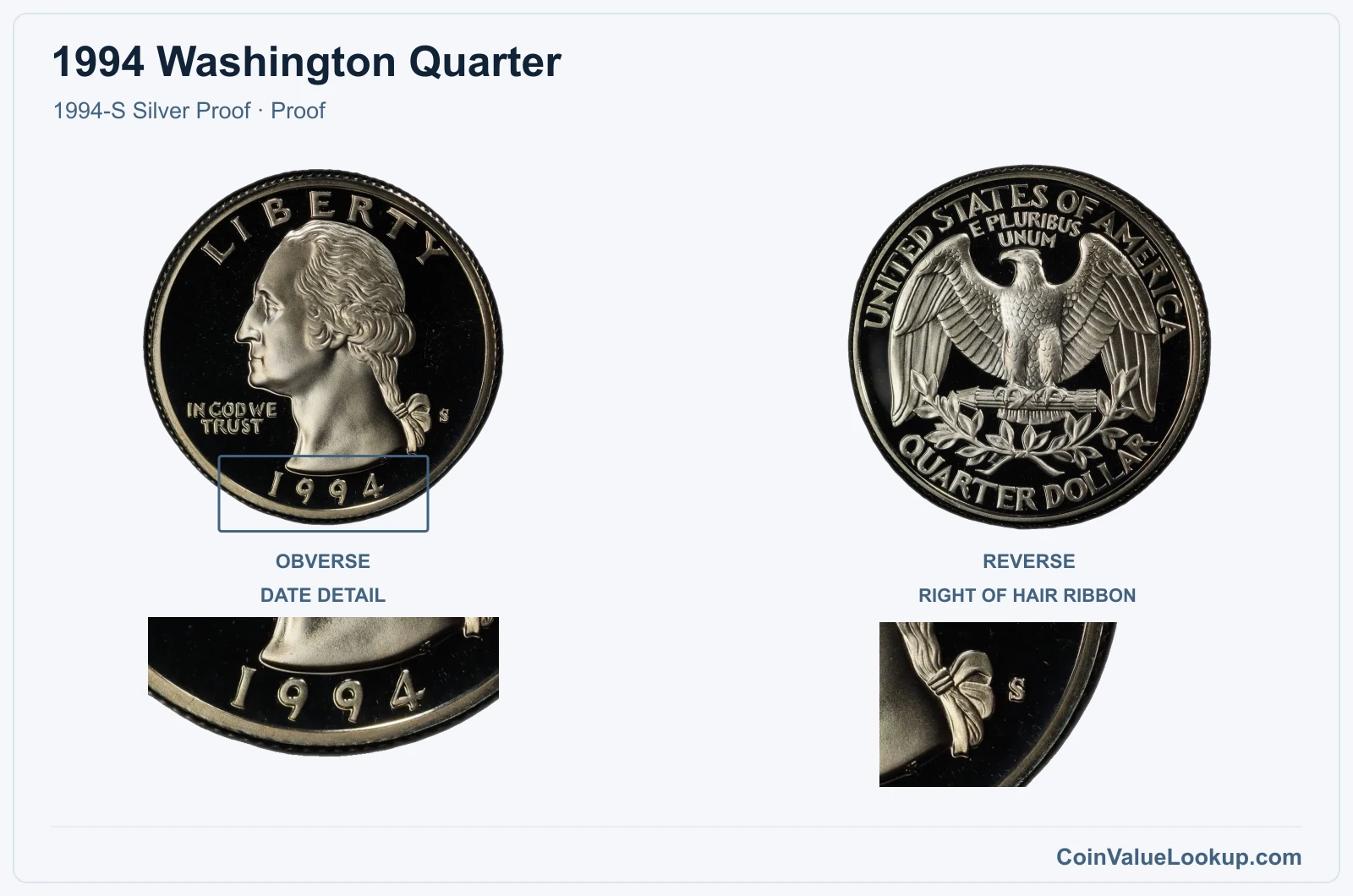
The 1994-S silver proof is struck on a 90% silver, 10% copper planchet weighing approximately 6.25 grams. PCGS rounds the catalog weight to 6.30 grams.
The PR65 guide estimate is about $21 according to USA Coin Book, and that figure can shift with the silver market.
Coin Value Lookup is a good starting point if you want to compare this silver proof's value against other years or denominations. You can look up guides across the Washington quarter series without digging through multiple sites.
Authentication matters here. The only visible mintmark difference between this and the clad proof is zero — both show an "S." You need the edge color, the weight, or the original mint packaging to confirm silver content.
A coin pulled loose from an unknown source should be weighed on a gram scale before you price it as silver.
| Range | Grade | Price | Auction Records | Appraisal |
|---|---|---|---|---|
| PR | PR 1 | — | Coin Identifier | |
| PR 2 | — | Coin Identifier | ||
| PR 3 | — | Coin Identifier | ||
| PR 4 | — | Coin Identifier | ||
| PR 6 | — | Coin Identifier | ||
| PR 8 | — | Coin Identifier | ||
| PR 10 | — | Coin Identifier | ||
| PR 12 | — | Coin Identifier | ||
| PR 15 | — | Coin Identifier | ||
| PR 20 | — | Coin Identifier | ||
| PR 25 | — | Coin Identifier | ||
| PR 30 | — | Coin Identifier | ||
| PR 35 | — | Coin Identifier | ||
| PR 40 | — | Coin Identifier | ||
| PR 45 | — | Coin Identifier | ||
| PR 50 | — | Coin Identifier | ||
| PR 53 | — | Coin Identifier | ||
| PR 55 | — | Coin Identifier | ||
| PR 58 | — | Coin Identifier | ||
| PR 60 | — | Coin Identifier | ||
| PR 61 | — | Coin Identifier | ||
| PR 62 | — | Coin Identifier | ||
| PR 63 | — | Coin Identifier | ||
| PR 64 | — | Coin Identifier | ||
| PR 65 | — | Coin Identifier | ||
| PR 66 | — | Coin Identifier | ||
| PR 67 | — | Coin Identifier | ||
| PR 68 | Coin Identifier | |||
| PR 69 | Coin Identifier | |||
| PR 70 | Coin Identifier |
1994 Washington Quarter Error List
1. 1994 Washington Quarter — Missing Reverse Clad Layer
A 1994-D quarter missing its reverse clad layer shows exposed copper on the entire back of the coin while the obverse and edge appear relatively normal. The result is a coin with a strikingly different color on one side — a warm copper tone on the reverse versus the expected silver-gray on the obverse.
One example graded NGC MS64 sold for $211.50 at Heritage Auctions in July 2014. That price reflects the confirmed attribution with a date and D mintmark intact on a coin showing original strike surfaces.
Watch out for coins that have been filed, sanded, chemically stripped or plated after leaving the mint. Post-mint alteration can remove a clad layer too, but the surface texture and edge will look wrong — uneven, scratchy or pitted rather than showing the smooth metal flow of a genuine mint error.
An odd color alone is not enough to call it authentic. Professional attribution from a grading service is the safest route.
2. 1994 Washington Quarter — Struck on a Dime Planchet
This is a 1994-P quarter die impression struck onto a blank intended for a dime. The result is a coin noticeably smaller than a normal quarter, with the design displaced — in the reported example, toward roughly the 10:30 position.
The date and P mintmark remain fully visible, but portions of the motto run off the edge because the planchet is too small to receive the full quarter design.
Do not confuse the missing peripheral lettering with a grease-filled die. On a wrong-planchet strike, the blank itself is physically smaller, and portions of the design simply had nowhere to land.
A grease-filled coin is full-sized but shows mushy or missing detail.
An ANACS MS63 example sold for $863.65 at Heritage Auctions in April 2006. Coins that have been cut down, filed or hammered after minting may mimic a smaller diameter, but they will lack the original strike surfaces and correct edge profile.
Professional attribution confirms the wrong blank.
3. 1994 Washington Quarter — Doubled Die Obverse
Doubled die obverse varieties have been reported for the 1994 quarter. The doubling typically appears as consistent separation or notching on obverse letters or design elements.
To check, compare your coin's lettering closely against a normal 1994 quarter under the same lighting — look for uniform extra thickness or a second outline on letters like LIBERTY or IN GOD WE TRUST.
Genuine hub doubling shows the same directional shift on multiple design elements across the die. Machine doubling, by contrast, tends to produce flat, shelf-like distortion without the crispness of a true doubled die.
Worn die contours and reflected light can also create misleading appearances.
No specific price is adopted for this variety. Value depends on the degree of doubling, the coin's condition, and the specific die pair involved.
A barely visible doubled die in low grade is a different proposition from a bold example in Mint State.
4. 1994 Washington Quarter — Off-Center Strike
Off-center strikes occur when the planchet is not properly seated between the dies. The result is a displaced design with an unstruck crescent-shaped blank area.
For collectors, the date needs to be visible for the coin to carry meaningful value.
Off-center 1994 quarters have been reported. The degree of misalignment matters a great deal — a 5% shift is barely noticeable, while a 50% shift with a readable date is dramatic.
Do not confuse an off-center strike with a clipped planchet, a misaligned die that only shifts one side, or post-mint damage from being bent or flattened. A genuine off-center coin shows a complete blank crescent with a normal edge where no design was imprinted.
No specific price is adopted; value depends on the percentage of offset, date visibility and overall condition.
5. 1994 Washington Quarter — Clipped Planchet
Clipped planchet errors on 1994 quarters show a missing curved, straight or ragged section of the original blank. The clip happens before striking, so the coin's design may show weakness opposite the clip where metal could not flow fully into the die.
Check the edge at the clip boundary. A genuine clip has a smooth, natural break consistent with the blanking process, and the metal flow around it will look undisturbed.
A filed notch, a deliberate cut or corrosion damage will show tool marks, uneven texture or pitting that do not match a mint-produced edge.
No specific price is adopted for this category. The size and type of clip, the coin's condition, and whether key design elements remain intact all influence what a collector will pay.
Small clips command less attention than large or unusual ones.
6. 1994 Washington Quarter — Double / Multiple Strike
Double-struck errors on the 1994-P quarter have been reported. A double strike means the coin received two separate impressions from the dies, usually with some displacement or rotation between strikes.
You will see overlapping or offset design elements — two partial portraits, two dates or two sets of lettering at different angles.
This is different from a doubled die, where the duplication is on the die itself and every coin from that die looks the same. A double strike is unique to the individual coin.
It is also different from post-mint damage where someone pressed the coin against another object.
Look for two distinct, sharp impressions with consistent die detail on both. No specific price is adopted.
Value depends heavily on how dramatic the second strike is, whether the date is readable, and overall condition.
7. 1994 Washington Quarter — Die Cap / Capped-Die Strike
A die cap error on the 1994-P quarter occurs when a struck coin sticks to one of the dies and keeps getting hit as new blanks feed in. The stuck coin gradually cups into a bottle-cap shape.
Coins struck underneath the cap pick up a softened, spread-out mirror image of whichever side the cap covered.
Identifying a genuine capped die strike means looking at both sides. The capped coin itself will be deeply cupped with progressively distorted design.
A coin struck through the cap will have one sharp side and one mushy, expanded side.
Do not confuse this with a coin that has been bent in a vise or stepped on, or with a normal weak strike from tired dies. Post-mint bending lacks the radiating design spread of a true cap strike.
No specific price is adopted; value depends on the stage of capping, visual drama and coin condition.