1977 Kennedy Half Dollar Coin Value: How Much Is It Worth?
The 1977 Kennedy half dollar carries a face value of fifty cents, and most circulated clad examples are worth exactly that. Collector guide estimates for well-preserved or proof specimens range from roughly $3.62 to $4.96, depending on mint, finish and grade.
Before checking any price chart, you need to confirm whether your coin is a Philadelphia or Denver business strike or a San Francisco proof, because each version has its own value track.
Fast Way to Identify Your 1977 Kennedy Half Dollar
Snap a clear photo of the front and back of your 1977 half dollar and upload both images for a preliminary identification. This helps narrow down the mint, finish and approximate condition so you know which version you are working with.
It is not a substitute for professional authentication, but it is a solid starting point.
1977 Kennedy Half Dollar Value
Upload both sides of your 1977 Kennedy Half Dollar.
Front Obverse
Upload photo
Back Reverse
Upload photo
Which 1977 Kennedy Half Dollar Versions Are Worth Money?
- The 1977-S clad proof, graded PR65, carries a guide estimate of about $4.96 — the highest listed value among the three standard versions.
- A 1977 Philadelphia (no mintmark) business strike in MS65 condition is estimated around $3.62 by USA Coin Book, well above face value for a clad half.
- The 1977-D business strike in MS65 also estimates at $3.62, so condition matters far more than mint for these two.
- Mint-made errors such as doubled dies or wrong-planchet strikes on 1977 halves have been reported and can carry premiums, though values depend heavily on the specific error and its condition.
Step 1: Identify Your 1977 Kennedy Half Dollar Mint Mark and Version
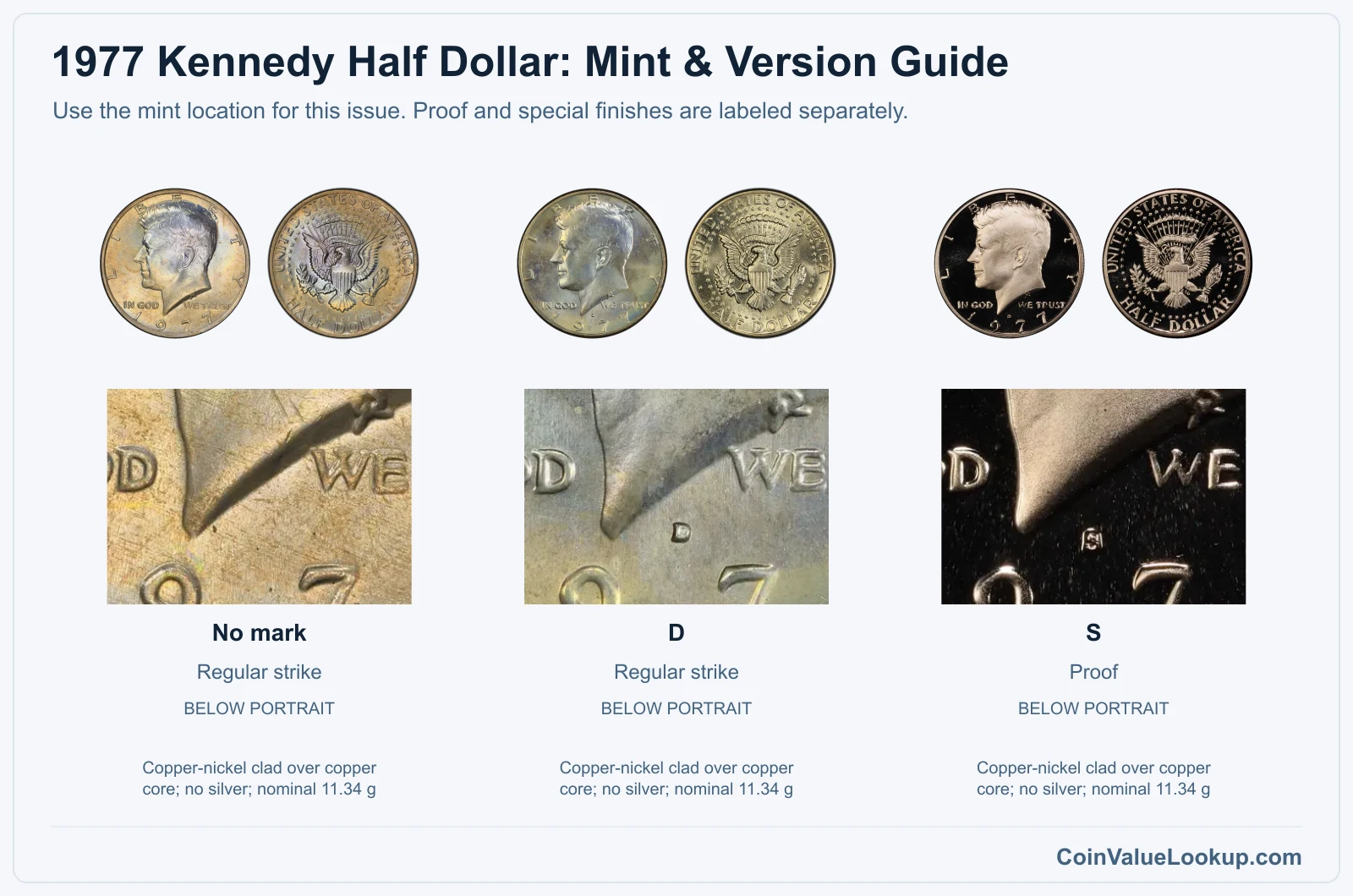
Flip the coin to the obverse and look just below Kennedy's portrait, above the date. A "D" means Denver, an "S" means San Francisco, and no mintmark at all means Philadelphia — that is normal for 1977, since the Philadelphia mint did not use a "P" on half dollars until 1980.
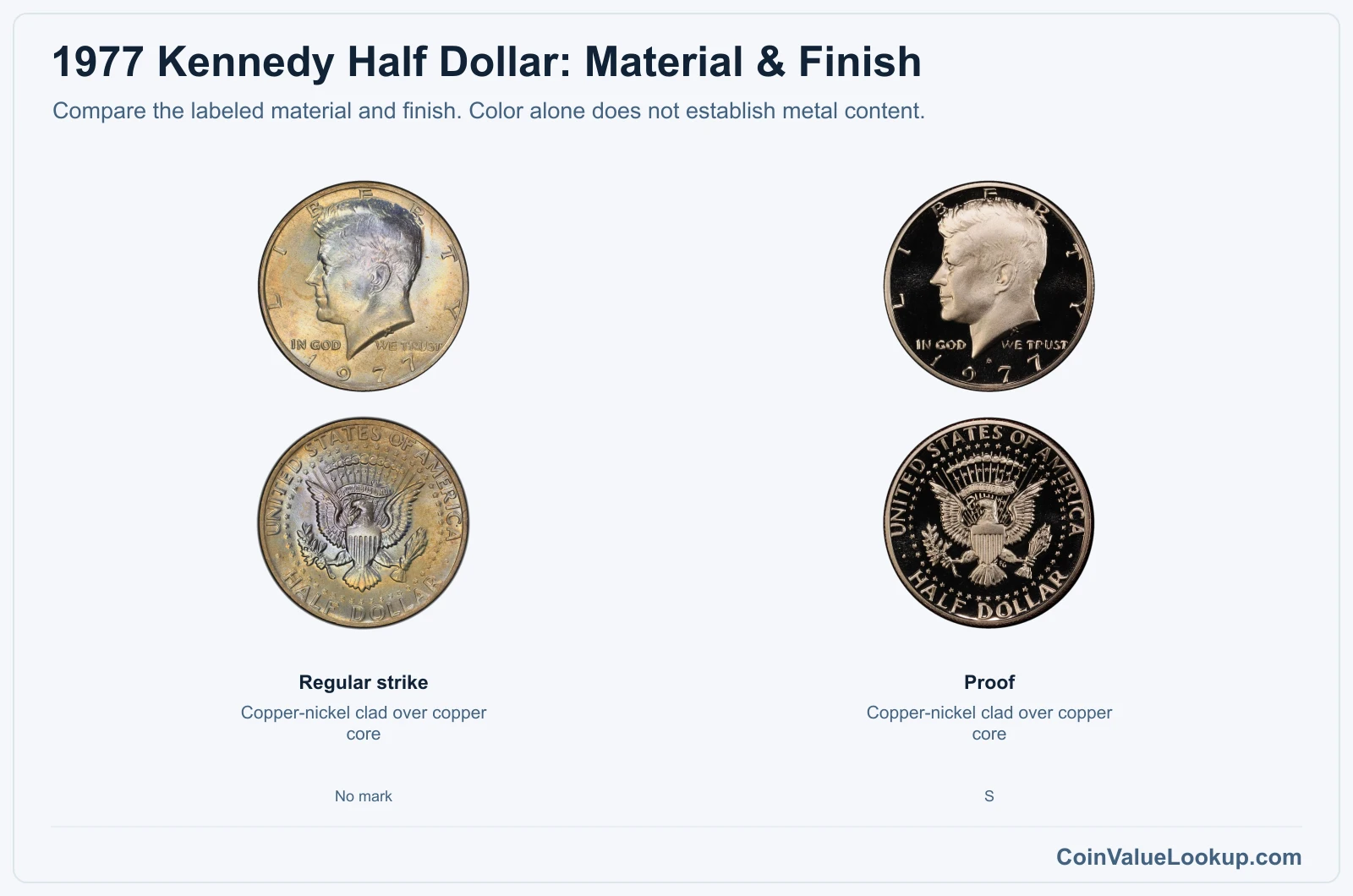
All three 1977 versions are copper-nickel clad over a copper core. None contain silver.
If someone tells you a regular 1977 half is silver, they are mistaken.
Edge color is a quick check. A copper-nickel clad coin shows a visible copper stripe on the edge.
Silver coins look uniform on the edge. Toning, plating or lighting tricks can fool you, so weigh the coin as well — a standard clad half should be about 11.34 grams.
The initials "FG" on the reverse near the eagle's tail feathers belong to designer Frank Gasparro. Weak or partially missing initials are usually just die wear or grease fill, not an independently authenticated variety.
Step 2: Check Your 1977 Kennedy Half Dollar Grade
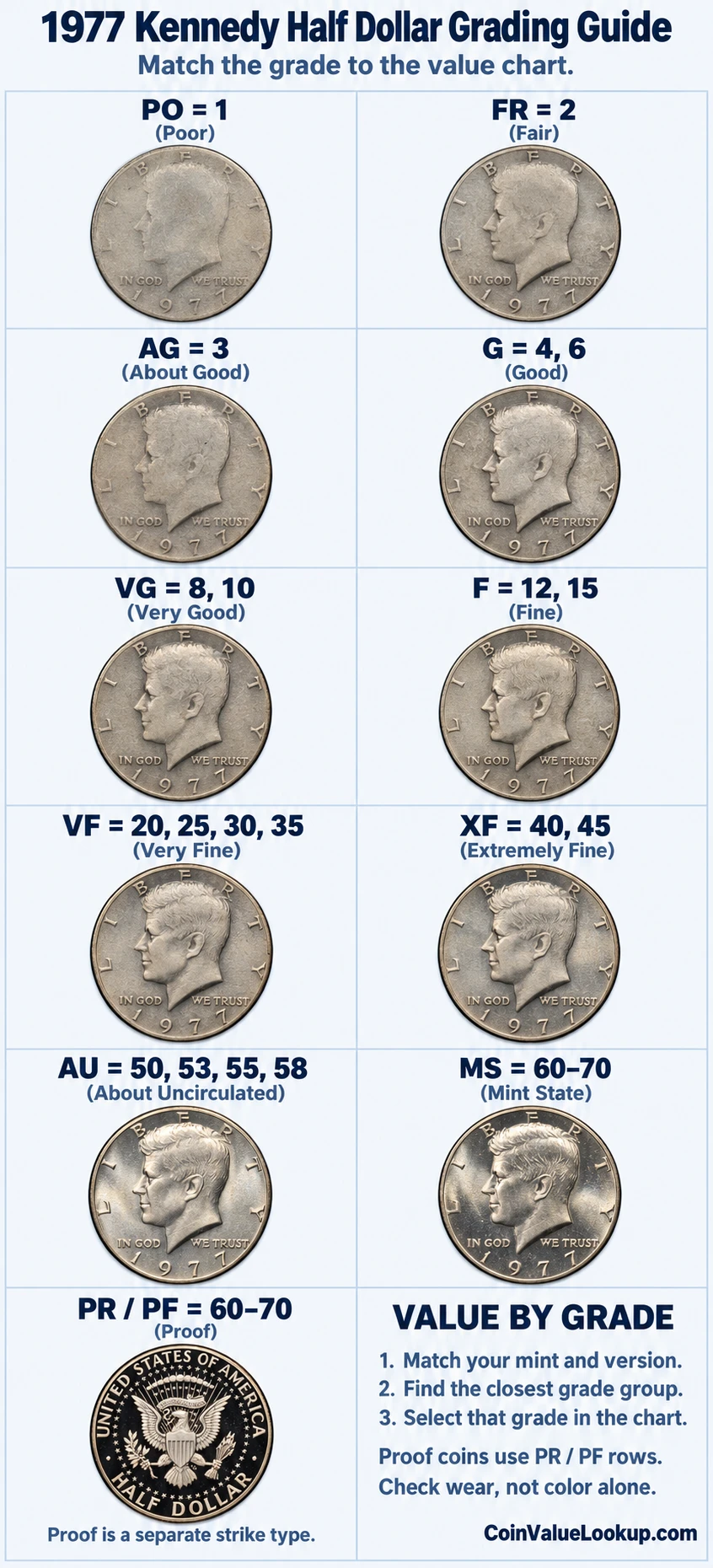
Start with Kennedy's cheek and jawline on the obverse. Those are the highest points and the first places to lose detail from circulation wear.
Next, check the hair above the ear — on a well-struck Mint State coin, individual strands should be sharp.
On the reverse, look at the eagle's breast feathers and the tops of the wings. Flatness there means the coin saw some use.
Bag marks are a different animal. A coin can be uncirculated but still carry nicks and scuffs from bouncing around in mint bags.
These dings lower the Mint State grade without being actual circulation wear, so compare your coin to the grading image to see the difference.
Proofs are graded on a separate scale. Mirror fields should be deeply reflective, and devices should show crisp frosted detail.
Hairlines from cleaning or haze from improper storage drag a proof's grade down fast.
Step 3: Check 1977 Kennedy Half Dollar Value by Mint and Version
1977 Kennedy Half Dollar — No mark — clad business
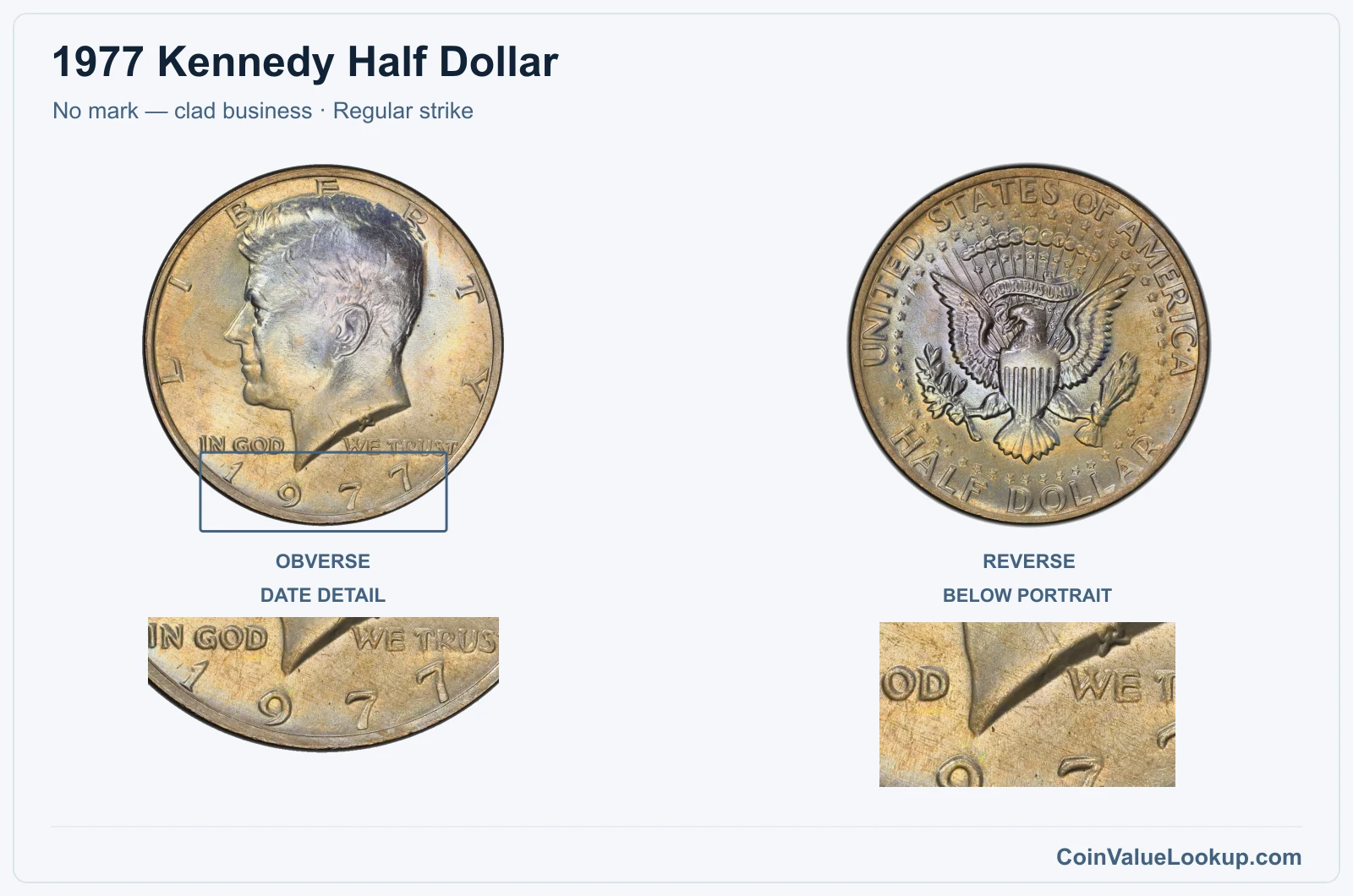
The 1977 Philadelphia half dollar has no mintmark — look below Kennedy's portrait and you will see blank space above the date. This is copper-nickel clad, not silver, weighing about 11.34 grams with a visible copper edge stripe.
Circulated examples are face-value coins. You could pull one from a roll and get fifty cents for it at a bank.
Where things get more interesting is at the upper end of the Mint State scale: a USA Coin Book guide estimate places an MS65 example at roughly $3.62. That is not a fortune, but it means a well-preserved, original-surface coin is worth hunting for.
Range Grade
Price Auction Records Appraisal PO PO 1
—
Coin Identifier FR FR 2
—
Coin Identifier AG AG 3
—
Coin Identifier G G 4
—
Coin Identifier
G 6
—
Coin Identifier VG VG 8
—
Coin Identifier
VG 10
—
Coin Identifier F F 12
—
Coin Identifier
F 15
—
Coin Identifier VF VF 20
—
Coin Identifier
VF 25
—
Coin Identifier
VF 30
—
Coin Identifier
VF 35
—
Coin Identifier XF XF 40
—
Coin Identifier
XF 45
—
Coin Identifier AU AU 50
—
Coin Identifier
AU 53
—
Coin Identifier
AU 55
—
Coin Identifier
AU 58
—
Coin Identifier MS MS 60
—
Coin Identifier
MS 61
—
Coin Identifier
MS 62
—
Coin Identifier
MS 63
—
Coin Identifier
MS 64
Coin Identifier
MS 65
Coin Identifier
MS 66
Coin Identifier
MS 67
Coin Identifier
MS 68
—
—
—
MS 69
—
—
—
MS 70
—
—
—
1977 Kennedy Half Dollar — D — clad business
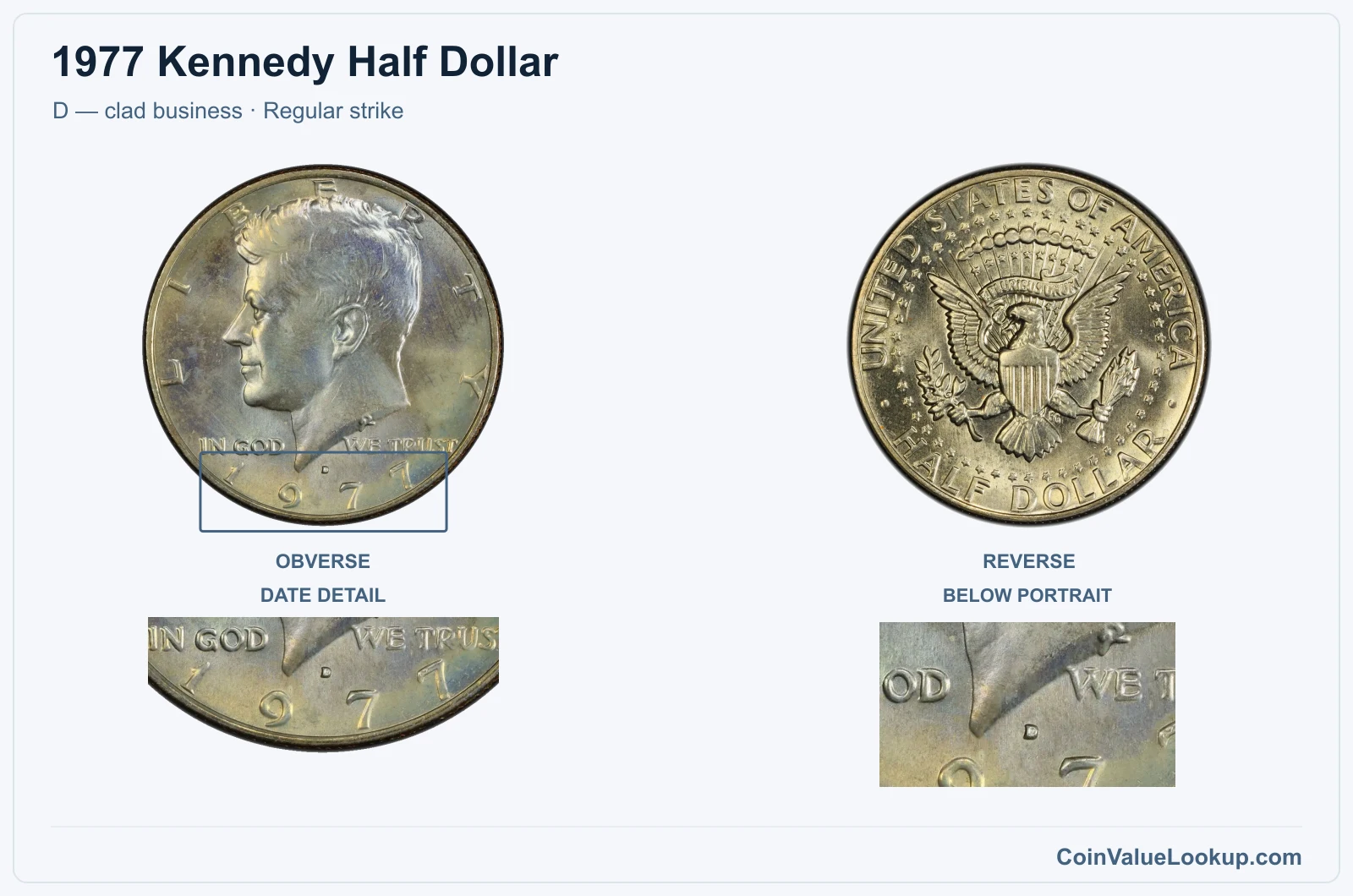
Look for the small "D" mintmark below Kennedy's portrait. That confirms Denver production.
Like its Philadelphia sibling, this is a copper-nickel clad coin with no silver content and a nominal weight of 11.34 grams.
Worn 1977-D halves are worth face value, plain and simple. The guide estimate from USA Coin Book for an MS65 piece is about $3.62 — identical to the Philadelphia version at that grade.
Condition is what separates a pocket-change coin from one a collector would pay a few dollars for. Clean surfaces, strong hair detail and minimal bag marks are what you want to see.
Coin Value Lookup is a good place to look up guides for other Kennedy half dollar years and denominations if you are working through a collection.
Range Grade
Price Auction Records Appraisal PO PO 1
—
Coin Identifier FR FR 2
—
Coin Identifier AG AG 3
—
Coin Identifier G G 4
—
Coin Identifier
G 6
—
Coin Identifier VG VG 8
—
Coin Identifier
VG 10
—
Coin Identifier F F 12
—
Coin Identifier
F 15
—
Coin Identifier VF VF 20
—
Coin Identifier
VF 25
—
Coin Identifier
VF 30
—
Coin Identifier
VF 35
—
Coin Identifier XF XF 40
—
Coin Identifier
XF 45
—
Coin Identifier AU AU 50
—
Coin Identifier
AU 53
Coin Identifier
AU 55
—
Coin Identifier
AU 58
Coin Identifier MS MS 60
—
Coin Identifier
MS 61
—
Coin Identifier
MS 62
Coin Identifier
MS 63
Coin Identifier
MS 64
Coin Identifier
MS 65
Coin Identifier
MS 66
Coin Identifier
MS 67
Coin Identifier
MS 68
—
Coin Identifier
MS 69
—
—
—
MS 70
—
—
—
1977 Kennedy Half Dollar — S — clad proof
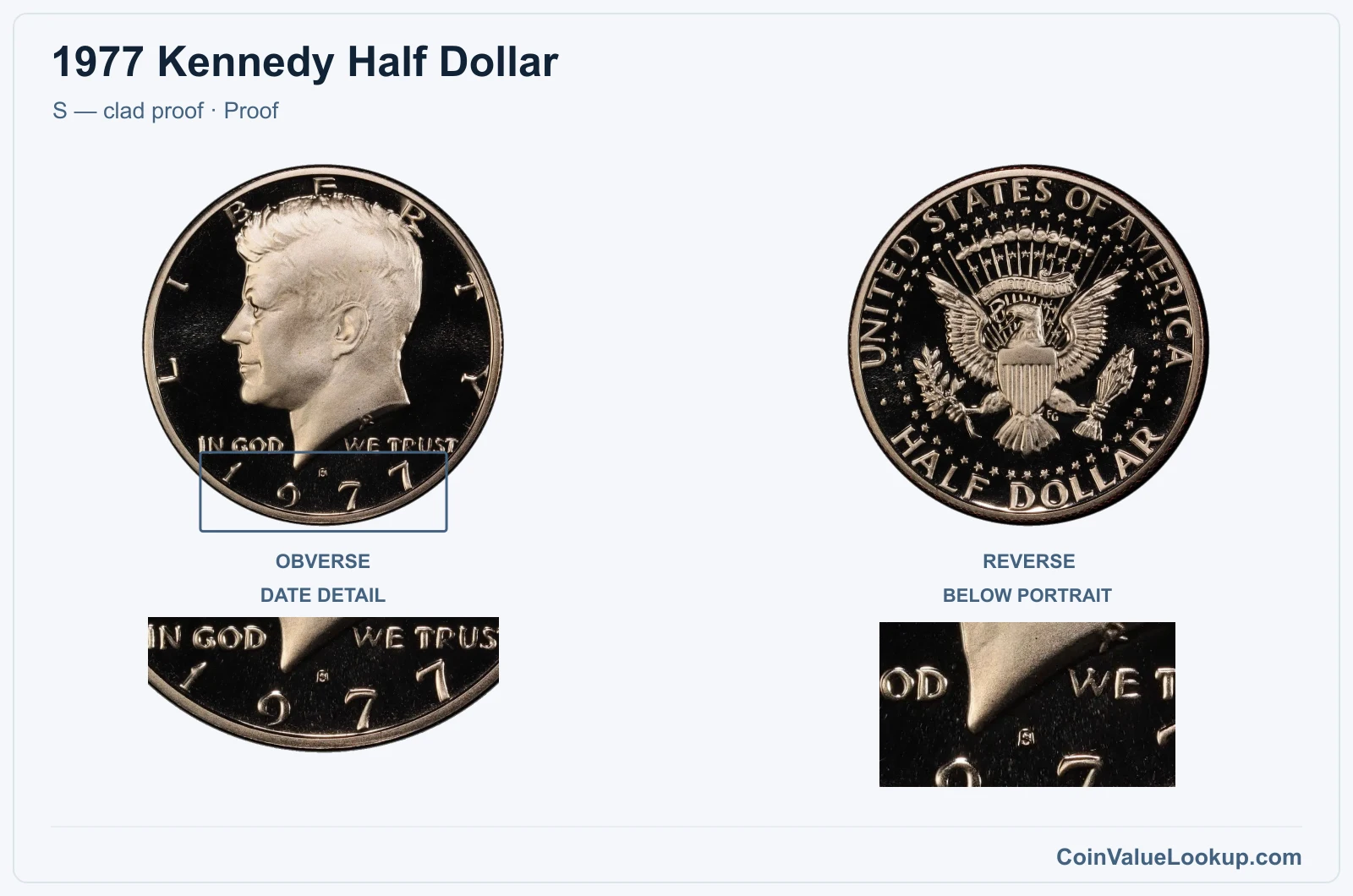
The "S" mintmark identifies San Francisco, and in 1977 that means a clad proof — not a business strike. These were sold in proof sets, not released into circulation.
A genuine proof has deeply mirrored fields and sharply frosted raised devices. The contrast is obvious once you have seen one.
The coin is still copper-nickel clad over a copper core, not silver.
USA Coin Book estimates a PR65 example at about $4.96. Hairlines from handling or haze from decades in a vinyl holder can knock the grade down, so storage matters.
If yours still sits in the original government packaging with clean surfaces, that is a good sign.
Range Grade
Price Auction Records Appraisal PR PR 1
—
Coin Identifier
PR 2
—
Coin Identifier
PR 3
—
Coin Identifier
PR 4
—
Coin Identifier
PR 6
—
Coin Identifier
PR 8
—
Coin Identifier
PR 10
—
Coin Identifier
PR 12
—
Coin Identifier
PR 15
—
Coin Identifier
PR 20
—
Coin Identifier
PR 25
—
Coin Identifier
PR 30
—
Coin Identifier
PR 35
—
Coin Identifier
PR 40
—
Coin Identifier
PR 45
—
Coin Identifier
PR 50
—
Coin Identifier
PR 53
—
Coin Identifier
PR 55
—
Coin Identifier
PR 58
—
Coin Identifier
PR 60
—
Coin Identifier
PR 61
—
Coin Identifier
PR 62
—
Coin Identifier
PR 63
—
Coin Identifier
PR 64
—
Coin Identifier
PR 65
—
Coin Identifier
PR 66
—
Coin Identifier
PR 67
Coin Identifier
PR 68
Coin Identifier
PR 69
Coin Identifier
PR 70
Coin Identifier
1977 Kennedy Half Dollar Error List
1. 1977 Kennedy Half Dollar — Doubled Die Obverse
A doubled die obverse has been reported specifically on the 1977-D Kennedy half dollar. The doubling appears on obverse lettering or design elements as consistent separation or notching — not a flat, shelf-like smear.
To check, compare your coin's obverse inscriptions under steady light to a normal 1977-D. Genuine hub doubling shows matching directional separation on multiple letters or features.
Machine doubling, by contrast, tends to produce flat shelves on one side of the design and is far less valuable.
Reflections and worn die lines can also mimic doubling, so a side-by-side comparison is important. No specific price range is available for this variety, since value depends on the strength of the doubling, overall coin condition and market demand at the time of sale.
Professional authentication is recommended before assuming you have a genuine doubled die.
2. 1977 Kennedy Half Dollar — Wrong Planchet / Off-Metal Strike
A 1977-D Kennedy half struck on a 40% silver planchet has been reported as a wrong-planchet error. The coin would have been struck on a leftover silver blank from an earlier production run instead of the standard copper-nickel clad blank.
The diagnostic here is weight and edge appearance. A 40% silver planchet is heavier than clad and shows a different edge color — no copper stripe.
Weigh the coin on a precise scale and compare it against the standard 11.34-gram clad specification.
Be cautious. Plating, chemical treatment, corrosion and deliberate alteration can all make a clad coin look or weigh differently.
An acid-etched coin or one coated in silver solder is not a mint error. No numerical price range is available for this variety; value hinges on authentication, condition and the specific blank involved.
3. 1977 Kennedy Half Dollar — Off-Center Strike
Off-center strikes occur when the blank is not seated properly between the dies. The result is a displaced design with an unstruck crescent of blank metal on one side.
The 1977 Kennedy half has been reported with this error combined with a large clip.
The key detail is whether the date remains visible — off-center coins that still show the year are generally more collectible. Look for a clean, uniform crescent of unstruck metal rather than post-mint damage like a vice mark or deliberate flattening, which can mimic the look.
A one-sided die misalignment can also shift the design, so compare both sides to confirm the displacement is consistent. No specific price is available; value depends on the percentage off-center, date visibility and overall condition.
4. 1977 Kennedy Half Dollar — Clipped Planchet
A clipped planchet error means part of the original blank was missing before the coin was struck. On a 1977 Kennedy half, this shows up as a curved, straight or irregular bite out of the edge.
The design near the clip is often weak because the metal could not flow fully into the die.
Check the edge texture at the missing section. A genuine clip often shows a smooth, slightly rounded break consistent with the original punching process, and you may notice design weakness on the opposite side of the coin — a useful confirmation.
Filed edges, deliberate cuts and corrosion pits are common lookalikes. If the missing section has tool marks or a rough, crystalline texture, it is likely post-mint damage.
No price range is available for this error; value depends on the clip size, shape and the coin's preservation.