1970 Jefferson Nickel Coin Value: How Much Is It Worth?
The 1970 Jefferson nickel is a common coin in most grades, but certain versions and errors can push its value well beyond five cents. Ordinary worn examples are worth face value.
In uncirculated condition, guide estimates range from around $0.30 at MS60 to $12 at MS65, depending on the mint and surface quality. Proofs and authenticated error coins occupy their own price tiers entirely.
Fast Way to Identify Your 1970 Jefferson Nickel
The quickest way to start figuring out what you have is to upload clear photos of both the front and back of your coin. Our identifier can give you a preliminary read on the mint, finish, and general type.
Good lighting and a steady hand help — try to capture the date, mintmark area, and any unusual surface features.
1970 Jefferson Nickel Value
Upload both sides of your 1970 Jefferson Nickel.
Front Obverse
Upload photo
Back Reverse
Upload photo
Which 1970 Jefferson Nickel Versions Are Worth Money?
- High-grade 1970-D or 1970-S business strikes with certified Full Steps can carry a premium above standard uncirculated prices.
- The 1970-S proof is a distinct product with its own market; base proof guide value sits around $2.50 at PR65, with cameo and deep cameo finishes tracked separately.
- A 1970 nickel struck over a 1970-D cent is a dramatic double-denomination error — one Heritage example brought $3,737.50 in 2011.
- Nickels struck on cent-sized copper blanks are genuine off-metal errors worth investigating if your coin is undersized and copper-colored.
- Die caps, die breaks, doubled dies, repunched mintmarks, and clashed dies have all been reported for this date — check the error section below.
Step 1: Identify Your 1970 Jefferson Nickel Mint Mark and Version
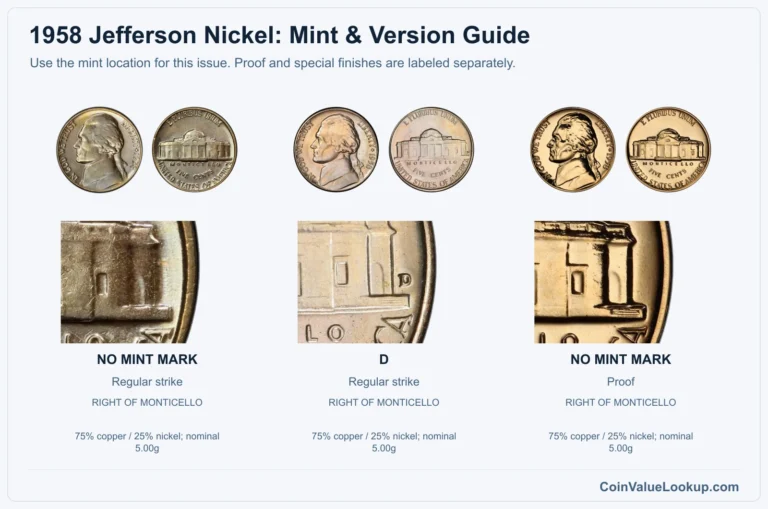
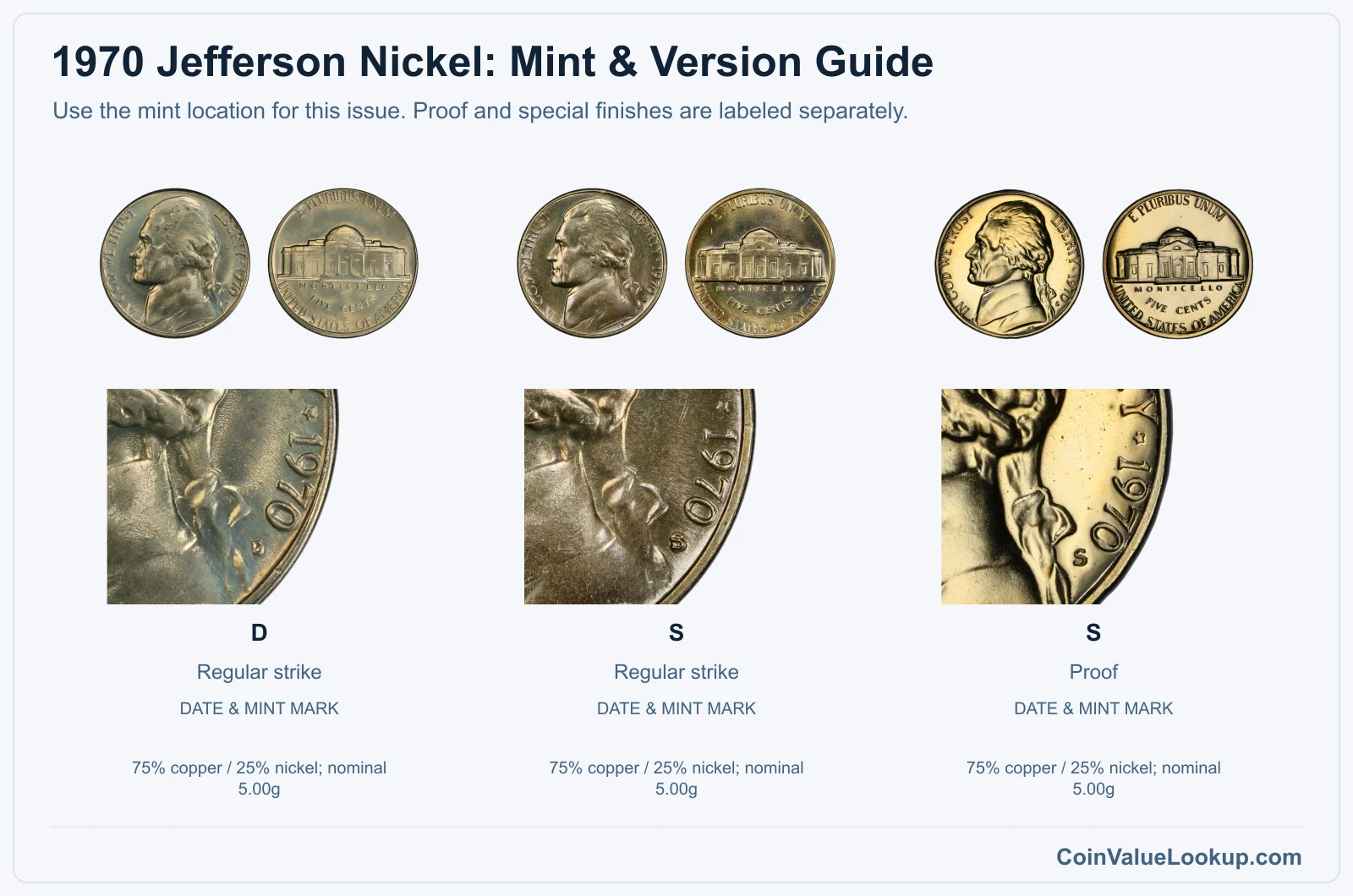
The 1970 Jefferson nickel was struck at two mints for circulation: Denver (D) and San Francisco (S). Both carry a small mintmark to the right of Monticello on the reverse.
San Francisco also produced proof coins that year, so an S-mint coin could be either a business strike or a proof — you need to look at the finish, not just the letter.
Proofs have mirror-like fields and sharply defined design elements. A business strike from San Francisco will look like any normal nickel with typical luster and minor contact marks.
These are not interchangeable categories, and proof finish is not a grade above Mint State.
The coin's composition is 75% copper and 25% nickel, weighing about 5 grams with a plain edge and a diameter of 21.2 mm. It is a solid copper-nickel alloy, not a clad sandwich.
If you see unusual color, do not assume a wrong-planchet error without checking the weight and diameter against known standards. Record both faces, the date, the mintmark, and any odd features before drawing conclusions.
Step 2: Check Your 1970 Jefferson Nickel Grade
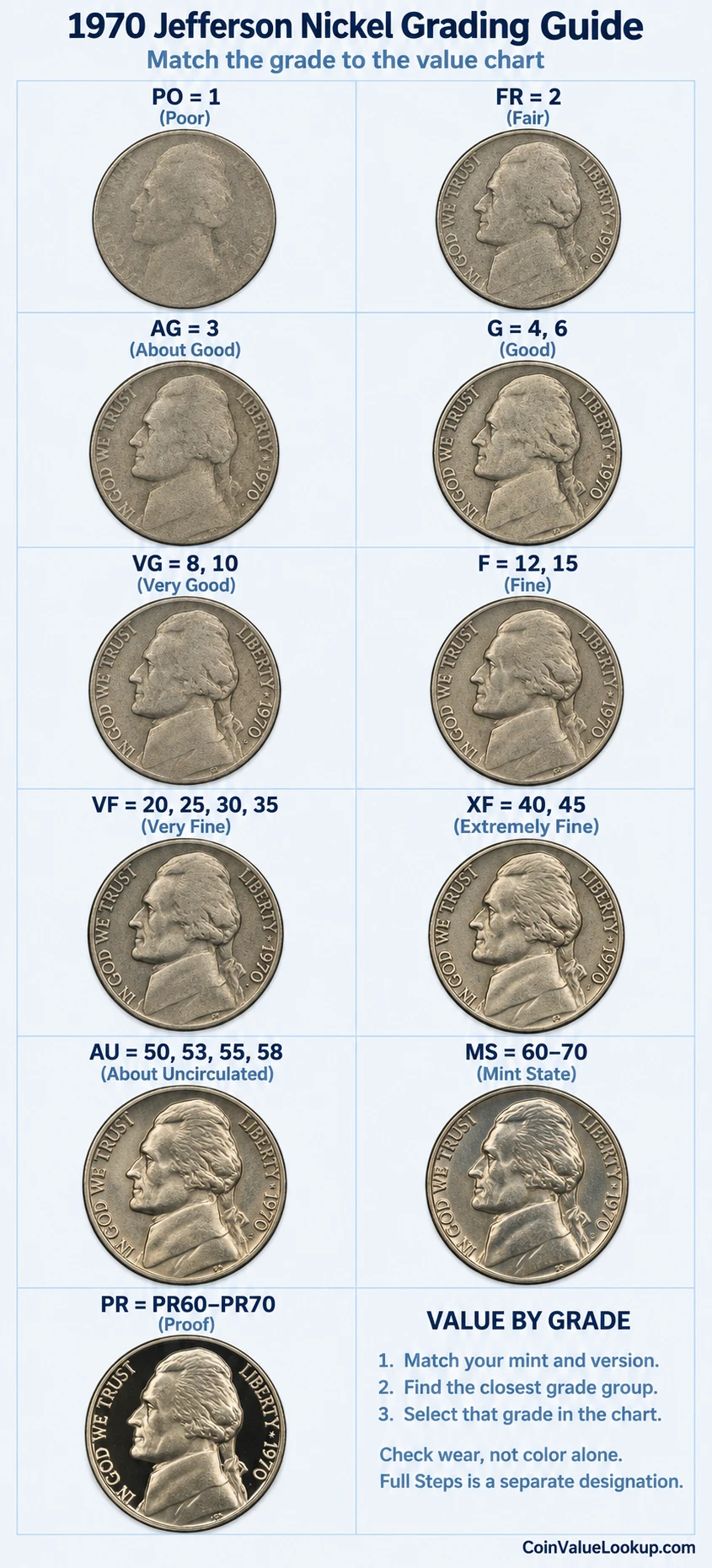
Start with Jefferson's cheekbone and the hair detail around his ear. On a well-worn coin, the cheek flattens first, followed by the fine hair strands blending together.
Flip it over and check the columns and steps of Monticello — these lose sharpness progressively as the coin circulates.
Surface preservation matters as much as design sharpness. Luster, contact marks, and any discoloration all factor into the overall grade.
Compare your coin against the grading image to see where it falls.
Full Steps is a separate attribution for strike quality, not a wear grade. It requires uninterrupted steps on Monticello, and only applies to Mint State business strikes.
A coin can be technically uncirculated but still lack Full Steps because of a weak strike at the mint. Do not confuse incomplete steps from striking with steps worn down from use — they look different under magnification.
Step 3: Check 1970 Jefferson Nickel Value by Mint and Version
1970 Jefferson Nickel — D Business strike
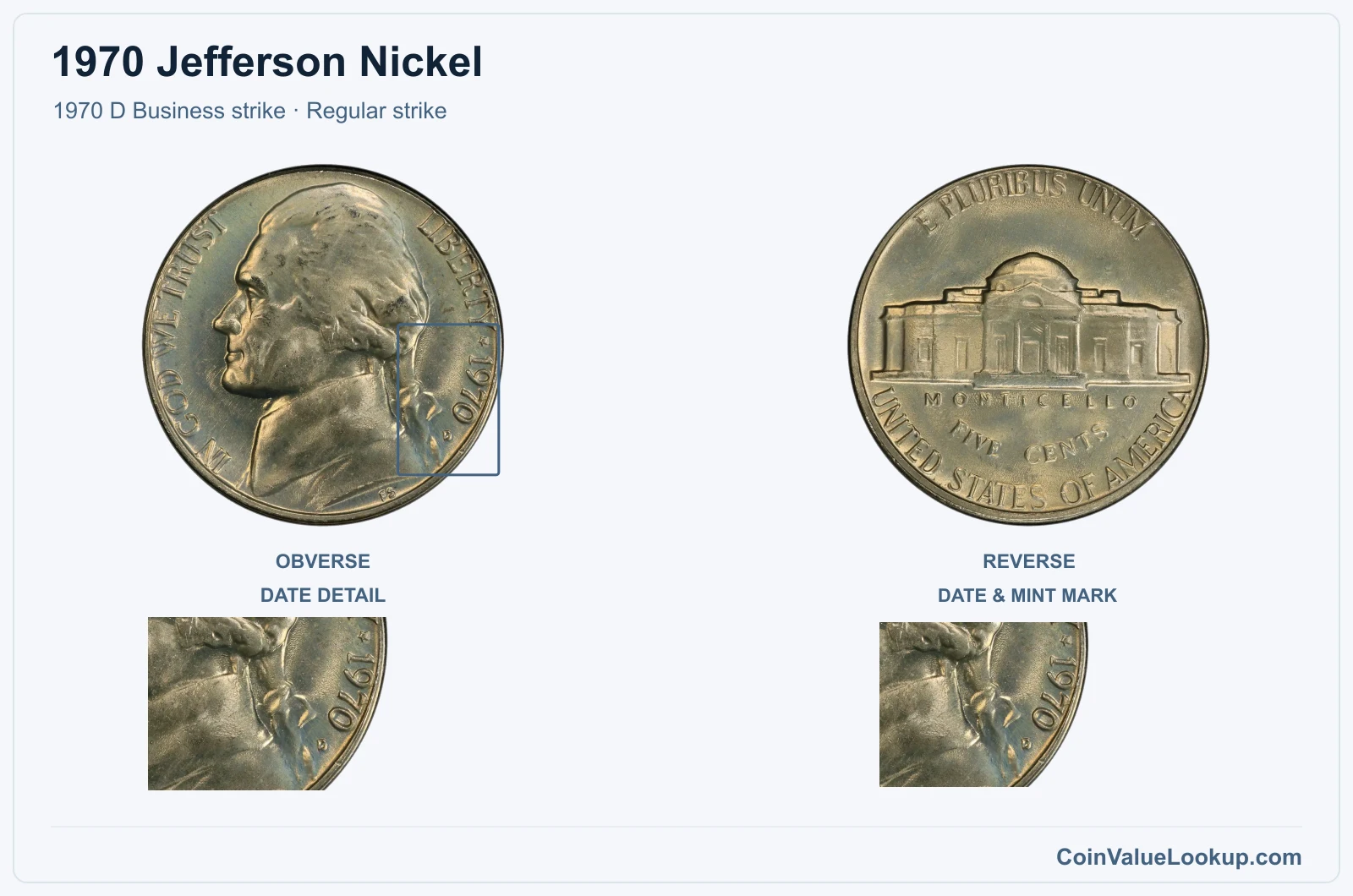
The 1970-D is the Denver Mint business strike, carrying a small D mintmark on the reverse near Monticello. It is struck in solid 75% copper / 25% nickel at a nominal weight of 5.00 grams.
In circulated grades, this coin is worth face value. USA Coin Book guide estimates place it around $0.30 at MS60 and up to $12 at MS65.
Coins with certified Full Steps can command a premium beyond those figures, but do not assume every shiny nickel qualifies — strike quality and third-party attribution matter.
| Range | Grade | Price | Auction Records | Appraisal |
|---|---|---|---|---|
| PO | PO 1 | — | Coin Identifier | |
| FR | FR 2 | — | Coin Identifier | |
| AG | AG 3 | — | Coin Identifier | |
| G | G 4 | — | Coin Identifier | |
| G 6 | — | Coin Identifier | ||
| VG | VG 8 | — | Coin Identifier | |
| VG 10 | — | Coin Identifier | ||
| F | F 12 | — | Coin Identifier | |
| F 15 | — | Coin Identifier | ||
| VF | VF 20 | — | Coin Identifier | |
| VF 25 | — | Coin Identifier | ||
| VF 30 | — | Coin Identifier | ||
| VF 35 | — | Coin Identifier | ||
| XF | XF 40 | — | Coin Identifier | |
| XF 45 | — | Coin Identifier | ||
| AU | AU 50 | — | Coin Identifier | |
| AU 53 | — | Coin Identifier | ||
| AU 55 | — | Coin Identifier | ||
| AU 58 | — | Coin Identifier | ||
| MS | MS 60 | — | Coin Identifier | |
| MS 61 | — | Coin Identifier | ||
| MS 62 | — | Coin Identifier | ||
| MS 63 | — | Coin Identifier | ||
| MS 64 | Coin Identifier | |||
| MS 65 | Coin Identifier | |||
| MS 66 | Coin Identifier | |||
| MS 67 | — | — | — | |
| MS 68 | — | — | — | |
| MS 69 | — | — | — | |
| MS 70 | — | — | — |
1970 Jefferson Nickel — S Business strike
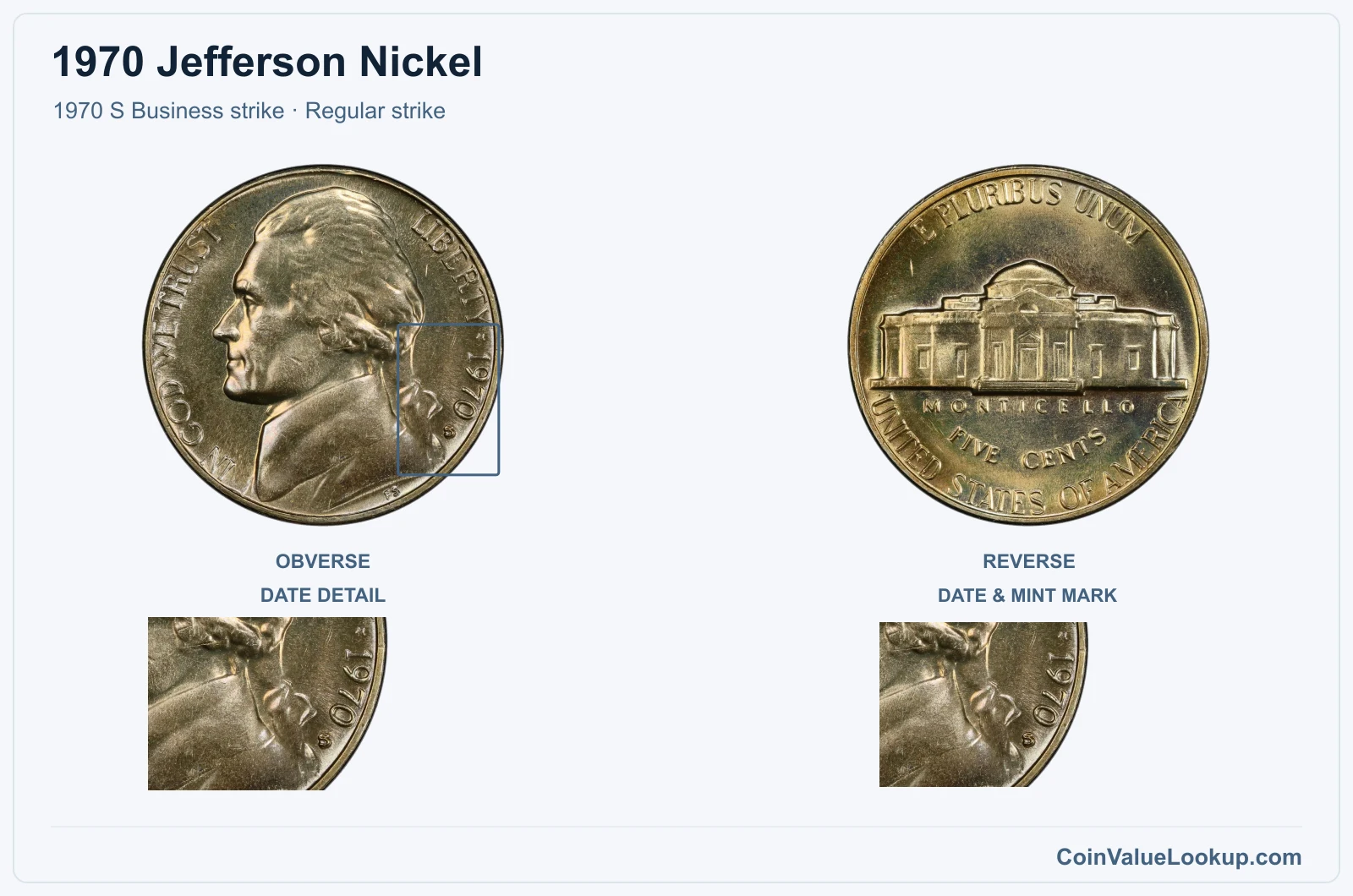
The 1970-S business strike was produced at the San Francisco Mint for circulation. It looks like a normal nickel, not a proof, despite carrying the same S mintmark that appears on proofs from that year.
Check the surface: business strikes show typical cartwheel luster and bag marks, not mirror fields.
USA Coin Book guide estimates put this version at about $0.93 at MS60 and around $10 at MS65. Those are retail guide figures, not guaranteed sale prices.
As with the D mint, Full Steps examples in high grades can bring more, but that requires professional attribution.
Coin Value Lookup is a good starting point if you want to compare guide values across different Jefferson nickel dates and mints before deciding whether to pursue formal grading.
| Range | Grade | Price | Auction Records | Appraisal |
|---|---|---|---|---|
| PO | PO 1 | — | Coin Identifier | |
| FR | FR 2 | — | Coin Identifier | |
| AG | AG 3 | — | Coin Identifier | |
| G | G 4 | — | Coin Identifier | |
| G 6 | — | Coin Identifier | ||
| VG | VG 8 | — | Coin Identifier | |
| VG 10 | — | Coin Identifier | ||
| F | F 12 | — | Coin Identifier | |
| F 15 | — | Coin Identifier | ||
| VF | VF 20 | — | Coin Identifier | |
| VF 25 | — | Coin Identifier | ||
| VF 30 | — | Coin Identifier | ||
| VF 35 | — | Coin Identifier | ||
| XF | XF 40 | — | Coin Identifier | |
| XF 45 | — | Coin Identifier | ||
| AU | AU 50 | — | Coin Identifier | |
| AU 53 | — | Coin Identifier | ||
| AU 55 | — | Coin Identifier | ||
| AU 58 | — | Coin Identifier | ||
| MS | MS 60 | — | Coin Identifier | |
| MS 61 | — | Coin Identifier | ||
| MS 62 | — | Coin Identifier | ||
| MS 63 | — | Coin Identifier | ||
| MS 64 | Coin Identifier | |||
| MS 65 | Coin Identifier | |||
| MS 66 | Coin Identifier | |||
| MS 67 | — | — | — | |
| MS 68 | — | — | — | |
| MS 69 | — | — | — | |
| MS 70 | — | — | — |
1970 Jefferson Nickel — S Proof
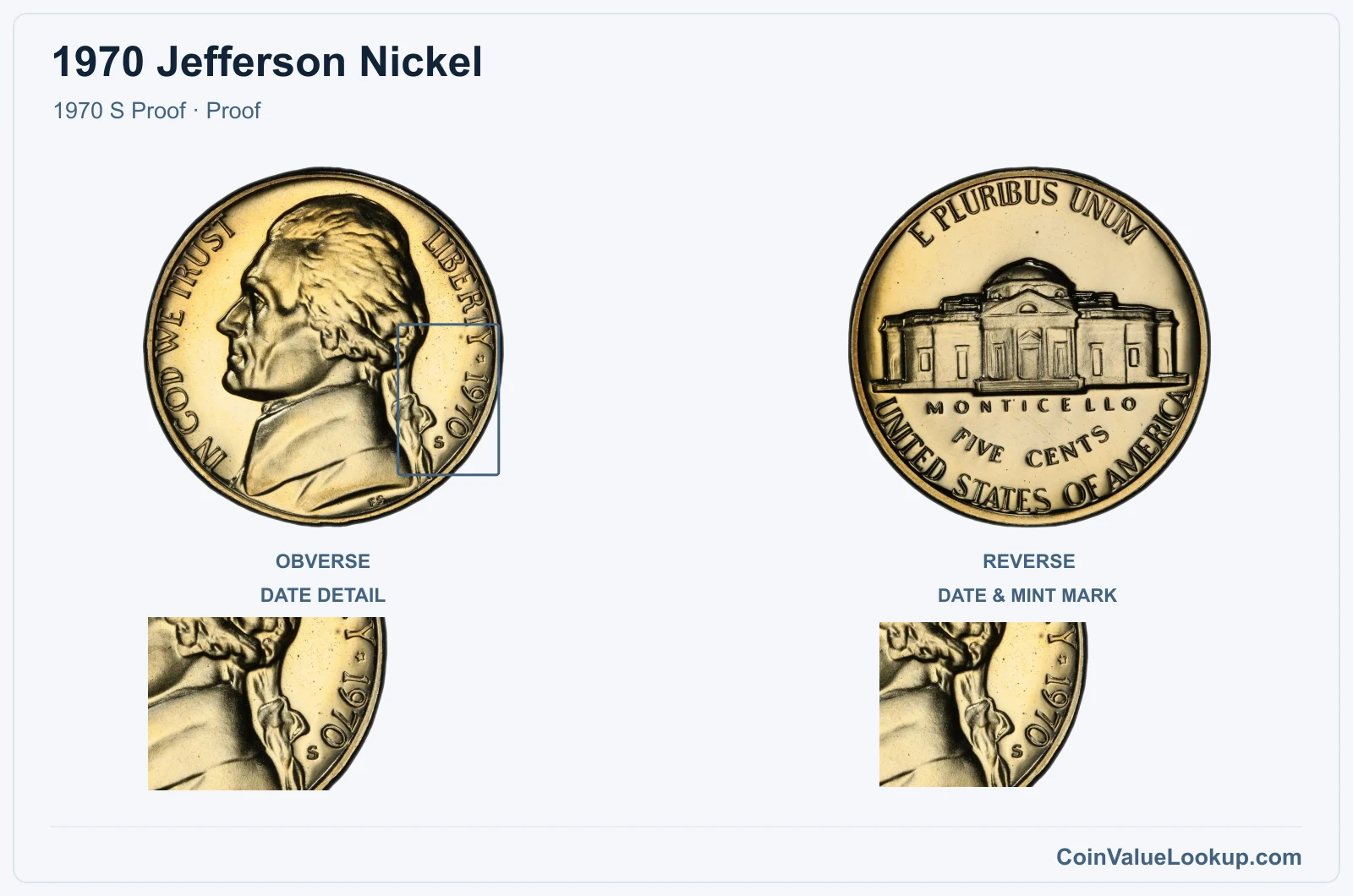
The 1970-S proof was struck at San Francisco specifically for collectors, using polished dies and specially prepared planchets. The result is a coin with mirror-like fields and frosted design elements — though the degree of contrast (cameo vs. deep cameo) varies from coin to coin and affects value separately.
The base proof guide value from USA Coin Book is approximately $2.50 at PR65. That figure applies to standard proofs without cameo or deep cameo designations.
Do not use this price for higher-contrast or top-grade examples — those categories carry different premiums. Proof finish is a manufacturing method, not a grade above Mint State.
| Range | Grade | Price | Auction Records | Appraisal |
|---|---|---|---|---|
| PR | PR 1 | — | Coin Identifier | |
| PR 2 | — | Coin Identifier | ||
| PR 3 | — | Coin Identifier | ||
| PR 4 | — | Coin Identifier | ||
| PR 6 | — | Coin Identifier | ||
| PR 8 | — | Coin Identifier | ||
| PR 10 | — | Coin Identifier | ||
| PR 12 | — | Coin Identifier | ||
| PR 15 | — | Coin Identifier | ||
| PR 20 | — | Coin Identifier | ||
| PR 25 | — | Coin Identifier | ||
| PR 30 | — | Coin Identifier | ||
| PR 35 | — | Coin Identifier | ||
| PR 40 | — | Coin Identifier | ||
| PR 45 | — | Coin Identifier | ||
| PR 50 | — | Coin Identifier | ||
| PR 53 | — | Coin Identifier | ||
| PR 55 | — | Coin Identifier | ||
| PR 58 | — | Coin Identifier | ||
| PR 60 | Coin Identifier | |||
| PR 61 | — | Coin Identifier | ||
| PR 62 | — | Coin Identifier | ||
| PR 63 | — | Coin Identifier | ||
| PR 64 | Coin Identifier | |||
| PR 65 | Coin Identifier | |||
| PR 66 | Coin Identifier | |||
| PR 67 | Coin Identifier | |||
| PR 68 | Coin Identifier | |||
| PR 69 | Coin Identifier | |||
| PR 70 | — | — | — |
1970 Jefferson Nickel Error List
1. 1970 Jefferson Nickel — Struck over a1970-D cent
This is a double-denomination error: a 1970 Jefferson nickel struck over a 1970-D Lincoln cent. Both the cent and nickel designs survive on the same coin, along with traces of both date and mintmark identities.
That overlap of two complete denominations is what makes it genuine.
A Heritage Auctions example graded NGC MS66 RB sold for $3,737.50 in January 2011. That is a single auction result for one specific coin, not a general market range.
Do not confuse this with a nickel struck on a blank copper planchet (no pre-existing cent design) or with coins glued or pressed together in a vise. The key diagnostic is visible remnants of both the cent's and nickel's designs and legends on the same struck piece.
Weight and diameter should also reflect the cent host.
2. 1970 Jefferson Nickel — Struck on cent blank
A 1970 Jefferson nickel struck on a cent-sized copper blank will be noticeably smaller and lighter than a standard nickel. The nickel's design appears on a copper planchet, so the outer portions of the legends and rim may be cropped or missing because the blank was too small for the nickel dies.
A Heritage Auctions example — an S business strike graded PCGS MS64 — sold for $420 in December 2024. That is one recorded sale, not a market average.
Check the weight carefully and examine both faces. The copper color should be uniform and inherent to the blank, not the result of plating, chemical treatment, or surface grinding.
Verify the exact mint attribution as well. If the coin weighs close to 5 grams and measures 21.2 mm, it is a normal nickel regardless of surface toning.
3. 1970 Jefferson Nickel — Obverse die break
A die break on the 1970 nickel shows up as a raised area of irregular metal on the obverse, corresponding to a section of the die that cracked and eventually lost material. The result is an unmistakable blob or ridge of extra metal that is part of the coin's surface, not added afterward.
A Heritage Auctions example — a 1970-D graded NGC AU58 — sold for $63 in October 2022. That price reflects one specific coin's size of break and overall condition.
Do not mistake incuse gouges, solder blobs, or corrosion buildup for a die break. Genuine breaks are raised, follow the contour of the missing die fragment, and are consistent across the struck surface.
Compare your coin to an authenticated example at matching magnification before drawing conclusions.
4. 1970 Jefferson Nickel — Die cap and mated broadstrike
This is a dramatic mint error involving two coins that were struck together. One coin became a die cap — it stuck to the upper die and was driven repeatedly into subsequent blanks, forming a deep cup shape with a reversed, incuse portrait spreading across its outer surface.
Its mated partner shows a broadstrike with evidence that a second strike was obstructed by another blank.
A Heritage Auctions sale in September 2010 brought $2,070 for both coins together as a mated pair, graded NGC MS67. That price applies to the pair, not to a single piece.
Look for the deep concave shape and reversed incuse design on the cap coin. Coins hammered into a cup shape in a vise or showing transferred designs from post-mint contact are not die caps.
Keeping the pair together preserves the error's context and collectibility.
5. 1970 Jefferson Nickel — Doubled Die Obverse
A Doubled Die Obverse on the 1970 nickel means the obverse die received a misaligned secondary impression during its manufacture, transferring a slight but consistent doubling to every coin it struck. On the finished coin you would see separation, notching, or thickening on obverse lettering or design elements.
The value depends on the visibility of the doubling and the coin's overall condition. No specific price range is available here, so have any suspected example evaluated individually.
Compare your coin's obverse legends to a normal 1970 nickel under the same lighting and magnification. True hub doubling shows consistent directional separation.
Machine doubling — caused by die bounce during striking — produces a flat, shelf-like distortion that looks different and carries little premium.
6. 1970 Jefferson Nickel — Doubled Die Reverse
A Doubled Die Reverse on the 1970 nickel shows doubling on the reverse design elements — the Monticello image, lettering, or denomination — caused by a misaligned hub impression on the working die. Every coin from that die carries the same doubling in the same location.
No specific price range is adopted for this variety. Value hinges on how visible the doubling is and the coin's preservation.
Examine the reverse legends and architectural details of Monticello under magnification, comparing directly to a normal coin. True doubled-die doubling is consistent and directional.
Machine doubling produces flat, shelf-like distortion without the rounded separation of a hub error. Random scratches or damage will not repeat in the same spot on multiple coins.
7. 1970 Jefferson Nickel — Repunched Mintmark
A Repunched Mintmark on the 1970 nickel means the mintmark punch was applied to the working die more than once, in slightly different positions. The result is a visible remnant of the first placement — a partial extra letter peeking out from beneath or beside the final mintmark.
No specific price range is adopted for this variety. Condition, the clarity of the repunching, and collector demand all influence what a given example might bring.
Inspect the mintmark area on the reverse under magnification and compare it to a normal example at the same scale. A genuine repunched mintmark shows a distinct secondary impression.
Die chips, corrosion around the letter, or machine doubling can mimic repunching but lack the crisp outline of a second punch.
8. 1970 Jefferson Nickel — Clashed Dies
Clashed dies occur when the obverse and reverse dies strike each other without a planchet between them. The impact transfers traces of each die's design onto the opposing die, and those ghost impressions then appear on subsequently struck coins.
On a 1970 nickel with clashed dies, look for faint outlines of the opposite design in the open fields — parts of Monticello ghosting onto Jefferson's side, or vice versa. These traces align with the expected position of the opposing design.
No specific price is adopted for this variety. Value depends on visibility and coin condition.
Do not confuse clashed-die traces with random scratches, raised lines from a damaged die, or brockage impressions. Clashed images are symmetrically placed and correspond to the opposite die's layout.