1987 Lincoln Penny Coin Value: How Much Is It Worth?
Normal worn 1987 pennies are worth face value. A USA Coin Book guide estimates about $0.36 for an MS65 business strike, while the 1987-S proof lists around $6.25 at PR65.
Before comparing prices, match your coin's mint, finish, copper color designation and condition to the correct branch. Check 1987-D examples closely for a repunched mintmark.
Fast Way to Identify Your 1987 Lincoln Penny
Upload clear photos of both sides of your 1987 penny for a preliminary identification. This helps narrow down the mint, finish and any visible anomalies so you can start comparing your coin to the right version and price references.
Sharp, well-lit images make a real difference.
1987 Penny Value
Upload both sides of your 1987 Lincoln Penny.
Front Obverse
Upload photo
Back Reverse
Upload photo
Which 1987 Lincoln Penny Versions Are Worth Money?
- A 1987-D cent with a confirmed repunched mintmark (D/D) is an attributable variety worth individual assessment based on severity and condition.
- Proofs and original high-grade coins need finish- and color-matched comparisons; a dramatic error sale does not set the price for normal pocket change.
Step 1: Identify Your 1987 Lincoln Penny Mint Mark and Version
The 1987 Lincoln cent carries the familiar Lincoln portrait obverse and Memorial reverse, with a plain edge. It is copper-plated zinc, weighing about 2.50 grams, with a composition of 97.5% zinc and 2.5% copper overall.
A copper-colored surface does not mean your coin is solid copper.
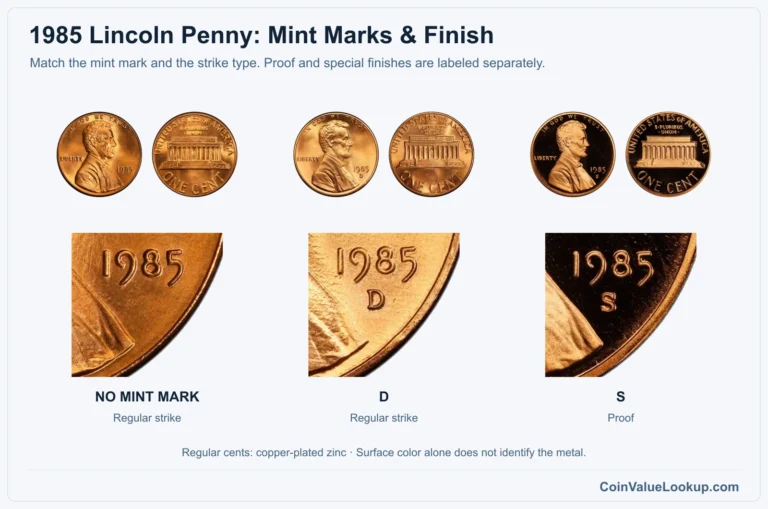
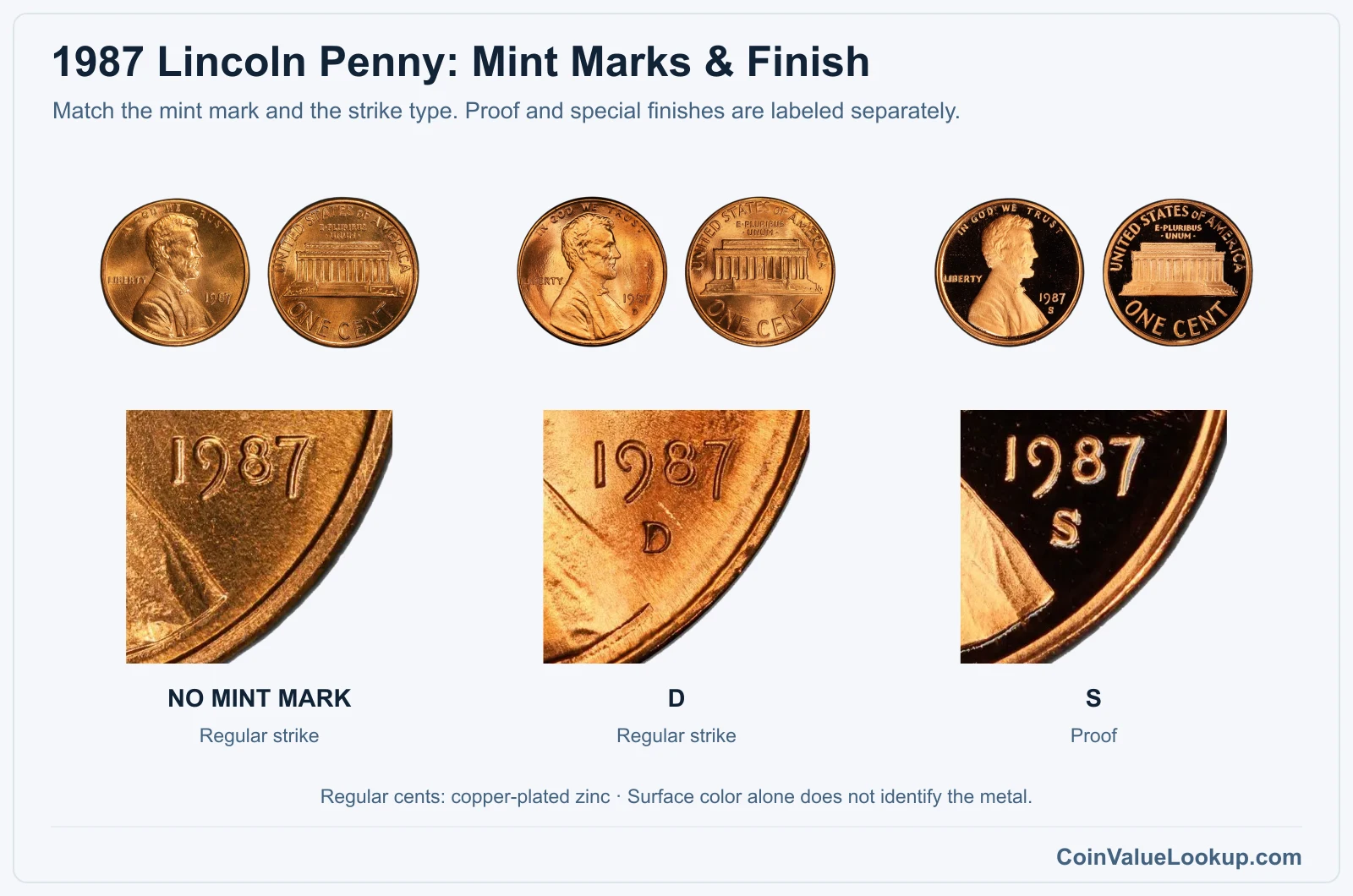
Three normal branches exist: the Philadelphia issue (no mintmark), the Denver issue (D mintmark), and the San Francisco proof (S mintmark). There is no circulating S-mint coin or P-letter cent for this year.
The mintmark sits below the date on the obverse. The absence of a mintmark alone does not indicate a rare proof omission.
When comparing values, keep the color designations (BN, RB, RD) and any cameo or deep cameo contrast labels separate from the numerical grade and alloy. They are filters for narrowing value, not indicators of a different metal.
Step 2: Check Your 1987 Lincoln Penny Grade
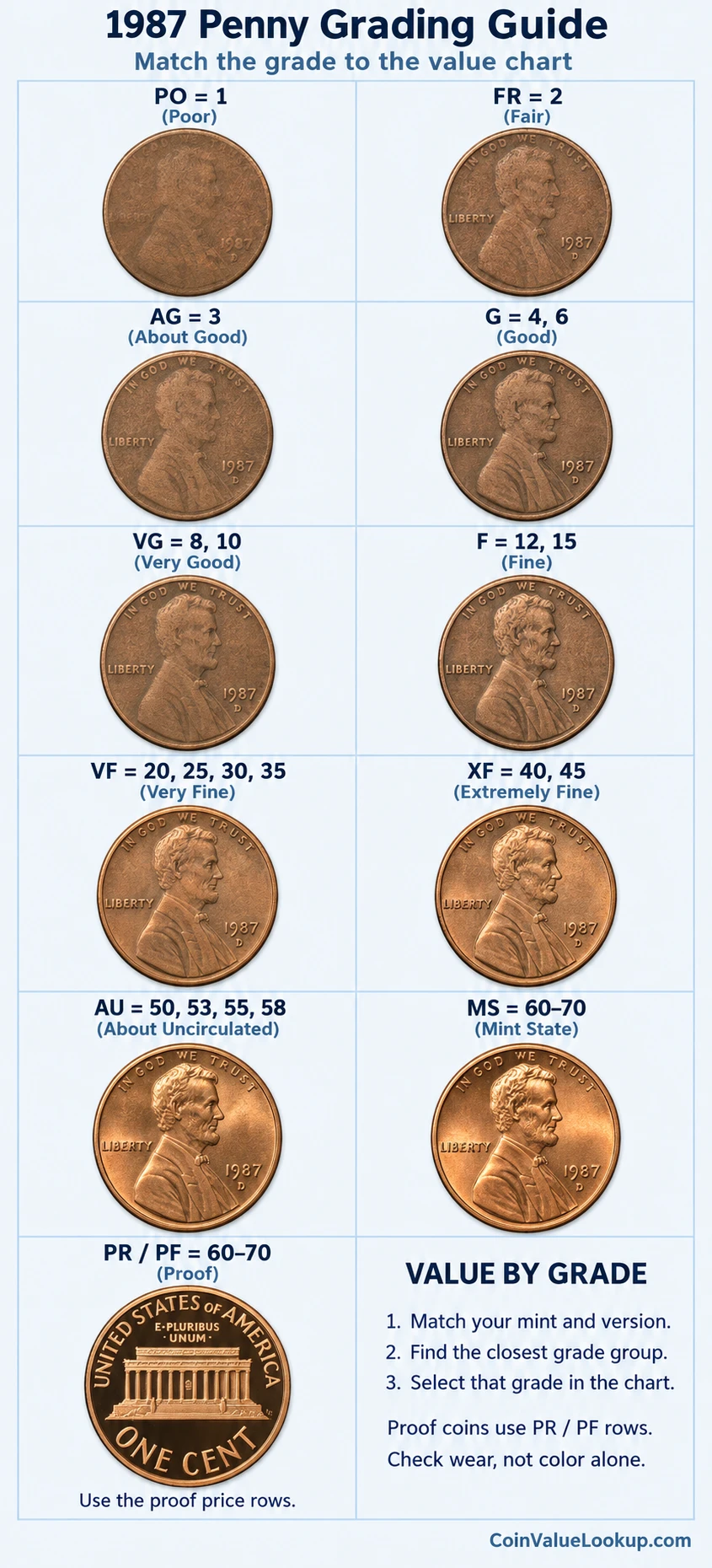
Start by checking Lincoln's cheekbone, jawline and hair detail on the obverse. These are the first spots to show wear.
On the reverse, look at the Memorial roof and column lines for smoothing or loss of separation.
Grade your coin by evaluating remaining luster, contact marks and actual wear together. Color alone is not a grading shortcut.
A coin can look red and still carry bag marks that limit its grade.
Plating splits, bubbles, corrosion spots and evidence of cleaning are surface issues. Every exposed zinc patch is not a mint error or a reason to expect a premium.
Compare your coin to the reference image to gauge where it falls on the wear scale, paying attention to the high points mentioned above.
Step 3: Check 1987 Lincoln Penny Value by Mint and Version
1987 Lincoln Penny
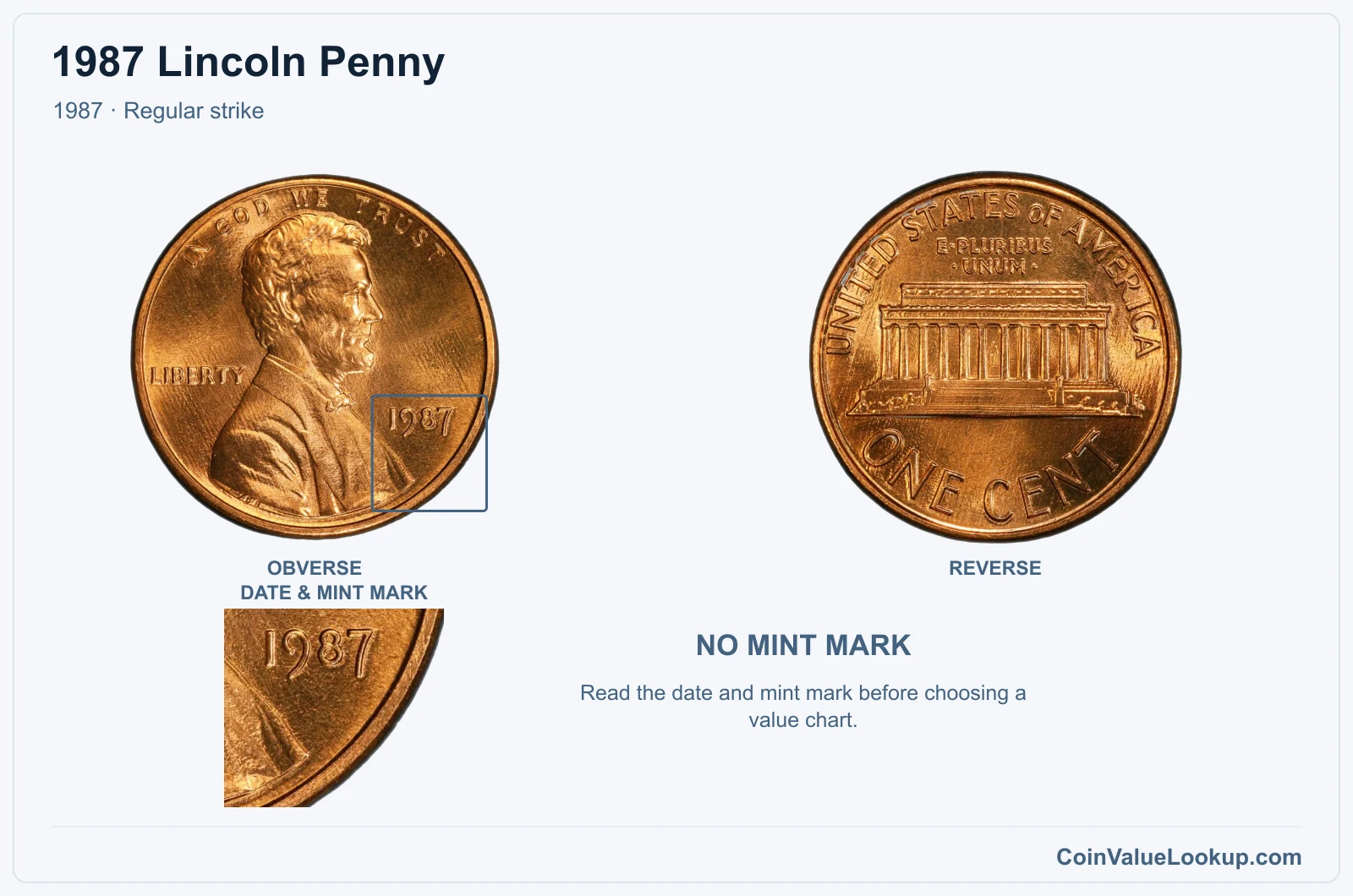
The 1987 Philadelphia cent has no mintmark. It is a copper-plated zinc business strike weighing about 2.50 grams.
Most circulated examples are worth face value.
At MS65, a USA Coin Book guide lists this coin around $0.36. To reach that estimate legitimately, you need a coin with full original luster, minimal contact marks and no plating damage.
Match the copper color designation (RD, RB or BN) before settling on a value comparison.
| Range | Grade | Price | Auction Records | Appraisal |
|---|---|---|---|---|
| PO | PO 1 | — | Coin Identifier | |
| FR | FR 2 | — | Coin Identifier | |
| AG | AG 3 | — | Coin Identifier | |
| G | G 4 | — | Coin Identifier | |
| G 6 | — | Coin Identifier | ||
| VG | VG 8 | — | Coin Identifier | |
| VG 10 | — | Coin Identifier | ||
| F | F 12 | — | Coin Identifier | |
| F 15 | — | Coin Identifier | ||
| VF | VF 20 | — | Coin Identifier | |
| VF 25 | — | Coin Identifier | ||
| VF 30 | — | Coin Identifier | ||
| VF 35 | — | Coin Identifier | ||
| XF | XF 40 | — | Coin Identifier | |
| XF 45 | — | Coin Identifier | ||
| AU | AU 50 | — | Coin Identifier | |
| AU 53 | — | Coin Identifier | ||
| AU 55 | — | Coin Identifier | ||
| AU 58 | — | Coin Identifier | ||
| MS | MS 60 | — | Coin Identifier | |
| MS 61 | — | Coin Identifier | ||
| MS 62 | — | Coin Identifier | ||
| MS 63 | — | Coin Identifier | ||
| MS 64 | — | Coin Identifier | ||
| MS 65 | Coin Identifier | |||
| MS 66 | Coin Identifier | |||
| MS 67 | Coin Identifier | |||
| MS 68 | Coin Identifier | |||
| MS 69 | Coin Identifier | |||
| MS 70 | — | — | — |
1987 Lincoln Penny — D
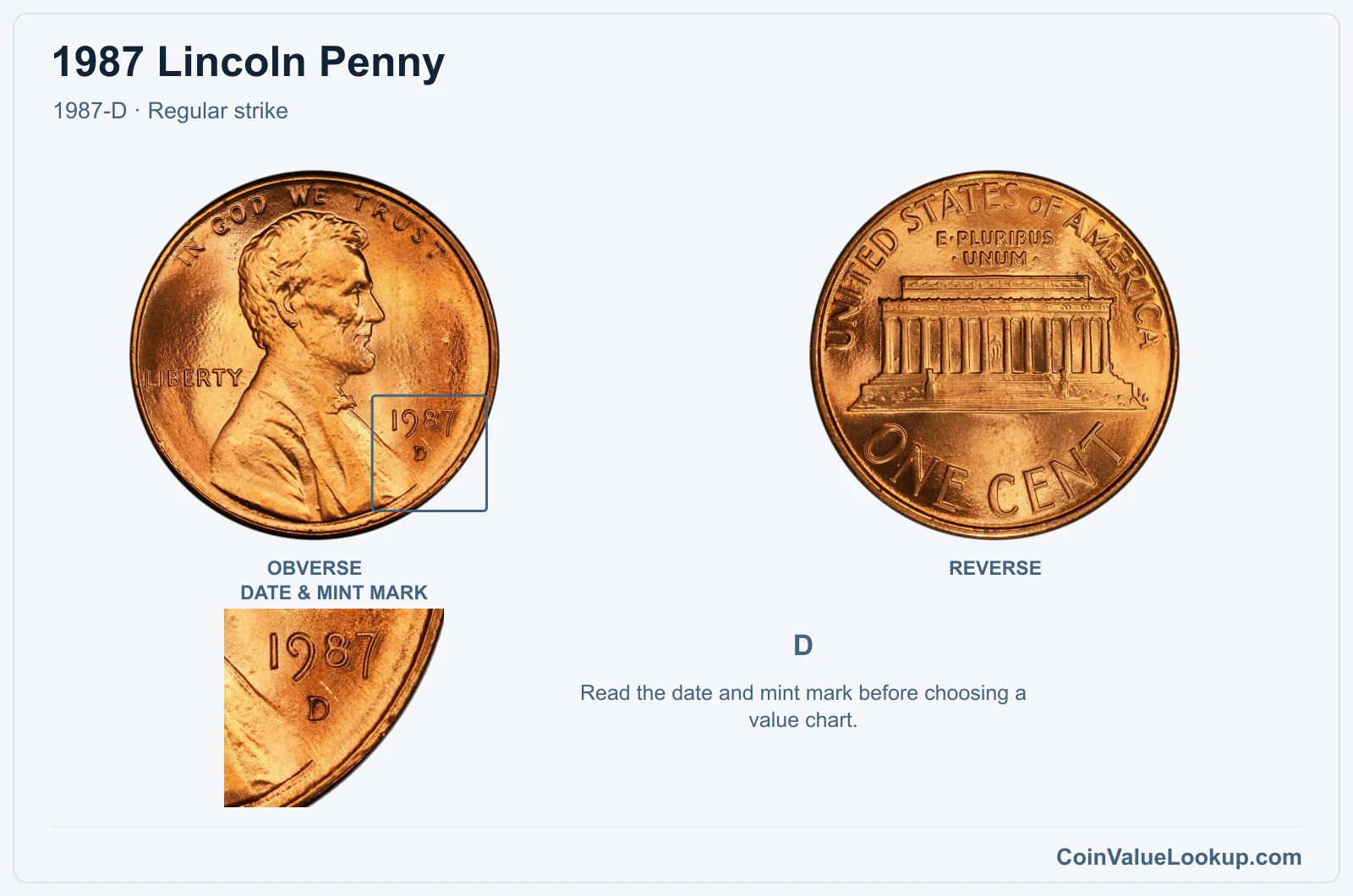
The 1987-D cent carries a small D mintmark below the date and was struck at Denver. Same copper-plated zinc composition and 2.50-gram target weight as the Philadelphia issue.
A USA Coin Book guide estimates about $0.36 at MS65. Circulated pieces remain at face value.
This is the branch to inspect carefully for the repunched mintmark variety, where remnants of an earlier D punch appear around the final D. That variety is covered in the error section below.
Coin Value Lookup is a handy starting point if you want to look up guides for other dates and mints in the Lincoln cent series.
| Range | Grade | Price | Auction Records | Appraisal |
|---|---|---|---|---|
| PO | PO 1 | — | Coin Identifier | |
| FR | FR 2 | — | Coin Identifier | |
| AG | AG 3 | — | Coin Identifier | |
| G | G 4 | — | Coin Identifier | |
| G 6 | — | Coin Identifier | ||
| VG | VG 8 | — | Coin Identifier | |
| VG 10 | — | Coin Identifier | ||
| F | F 12 | — | Coin Identifier | |
| F 15 | — | Coin Identifier | ||
| VF | VF 20 | — | Coin Identifier | |
| VF 25 | — | Coin Identifier | ||
| VF 30 | — | Coin Identifier | ||
| VF 35 | — | Coin Identifier | ||
| XF | XF 40 | — | Coin Identifier | |
| XF 45 | — | Coin Identifier | ||
| AU | AU 50 | — | Coin Identifier | |
| AU 53 | — | Coin Identifier | ||
| AU 55 | — | Coin Identifier | ||
| AU 58 | — | Coin Identifier | ||
| MS | MS 60 | — | Coin Identifier | |
| MS 61 | — | Coin Identifier | ||
| MS 62 | — | Coin Identifier | ||
| MS 63 | — | Coin Identifier | ||
| MS 64 | Coin Identifier | |||
| MS 65 | Coin Identifier | |||
| MS 66 | Coin Identifier | |||
| MS 67 | Coin Identifier | |||
| MS 68 | Coin Identifier | |||
| MS 69 | Coin Identifier | |||
| MS 70 | — | — | — |
1987 Lincoln Penny — S PR
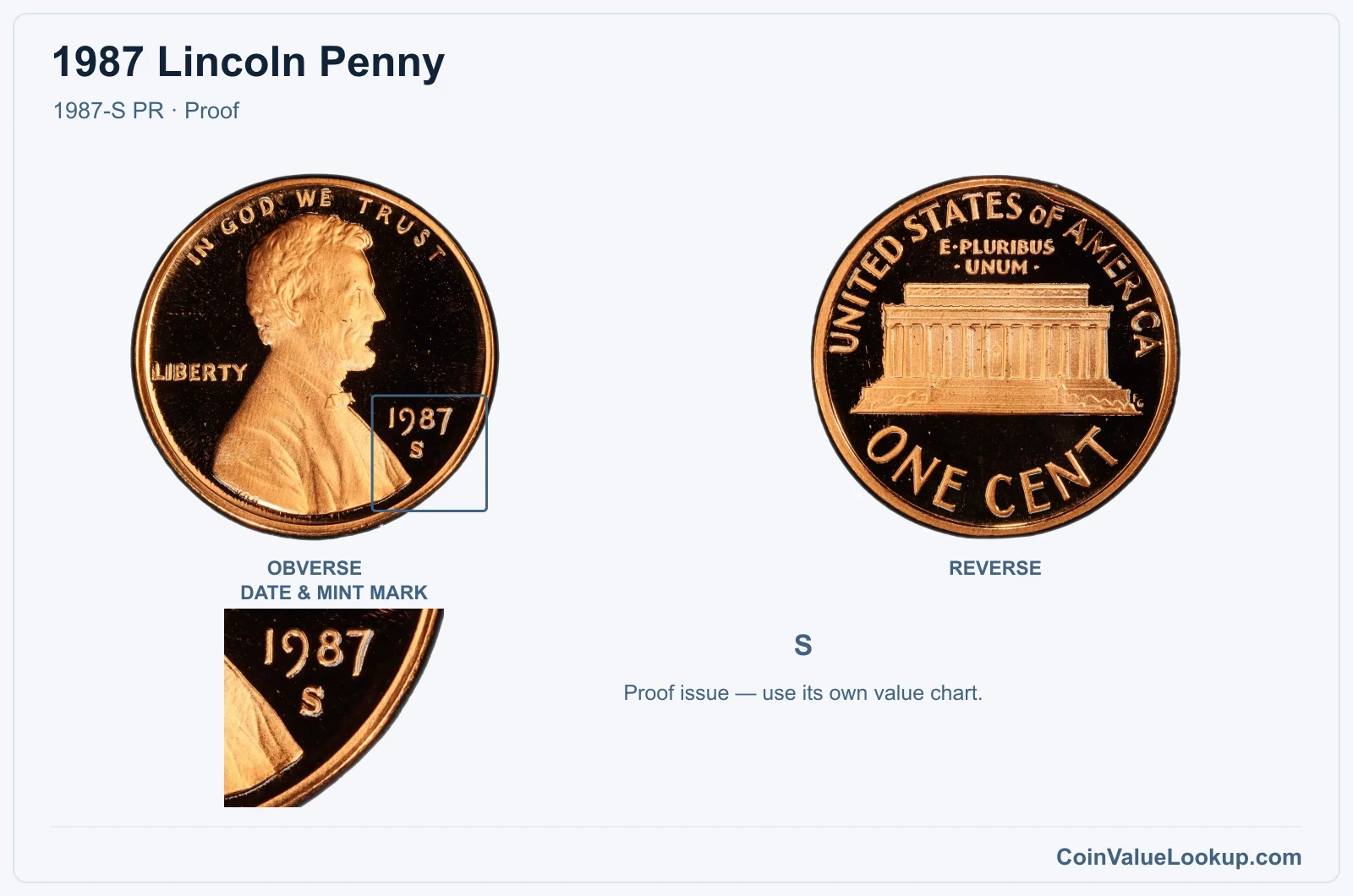
The 1987-S proof was struck at San Francisco exclusively for collectors, not for circulation. It is the same copper-plated zinc composition as the business strikes.
A USA Coin Book guide places the PR65 value at roughly $6.25. Remember that proof is a manufacturing finish characterized by mirrored fields and sharp detail, not a grade above Mint State.
Keep any cameo or deep cameo contrast designation separate from the numerical proof grade when comparing prices, and match the color filter as well.
| Range | Grade | Price | Auction Records | Appraisal |
|---|---|---|---|---|
| PR | PR 1 | — | Coin Identifier | |
| PR 2 | — | Coin Identifier | ||
| PR 3 | — | Coin Identifier | ||
| PR 4 | — | Coin Identifier | ||
| PR 6 | — | Coin Identifier | ||
| PR 8 | — | Coin Identifier | ||
| PR 10 | — | Coin Identifier | ||
| PR 12 | — | Coin Identifier | ||
| PR 15 | — | Coin Identifier | ||
| PR 20 | — | Coin Identifier | ||
| PR 25 | — | Coin Identifier | ||
| PR 30 | — | Coin Identifier | ||
| PR 35 | — | Coin Identifier | ||
| PR 40 | — | Coin Identifier | ||
| PR 45 | — | Coin Identifier | ||
| PR 50 | — | Coin Identifier | ||
| PR 53 | — | Coin Identifier | ||
| PR 55 | — | Coin Identifier | ||
| PR 58 | — | Coin Identifier | ||
| PR 60 | — | Coin Identifier | ||
| PR 61 | — | Coin Identifier | ||
| PR 62 | — | Coin Identifier | ||
| PR 63 | — | Coin Identifier | ||
| PR 64 | — | Coin Identifier | ||
| PR 65 | — | Coin Identifier | ||
| PR 66 | — | Coin Identifier | ||
| PR 67 | — | Coin Identifier | ||
| PR 68 | Coin Identifier | |||
| PR 69 | Coin Identifier | |||
| PR 70 | Coin Identifier |
1987 Lincoln Penny Error List
1. 1987 Lincoln Penny — Repunched D Mintmark
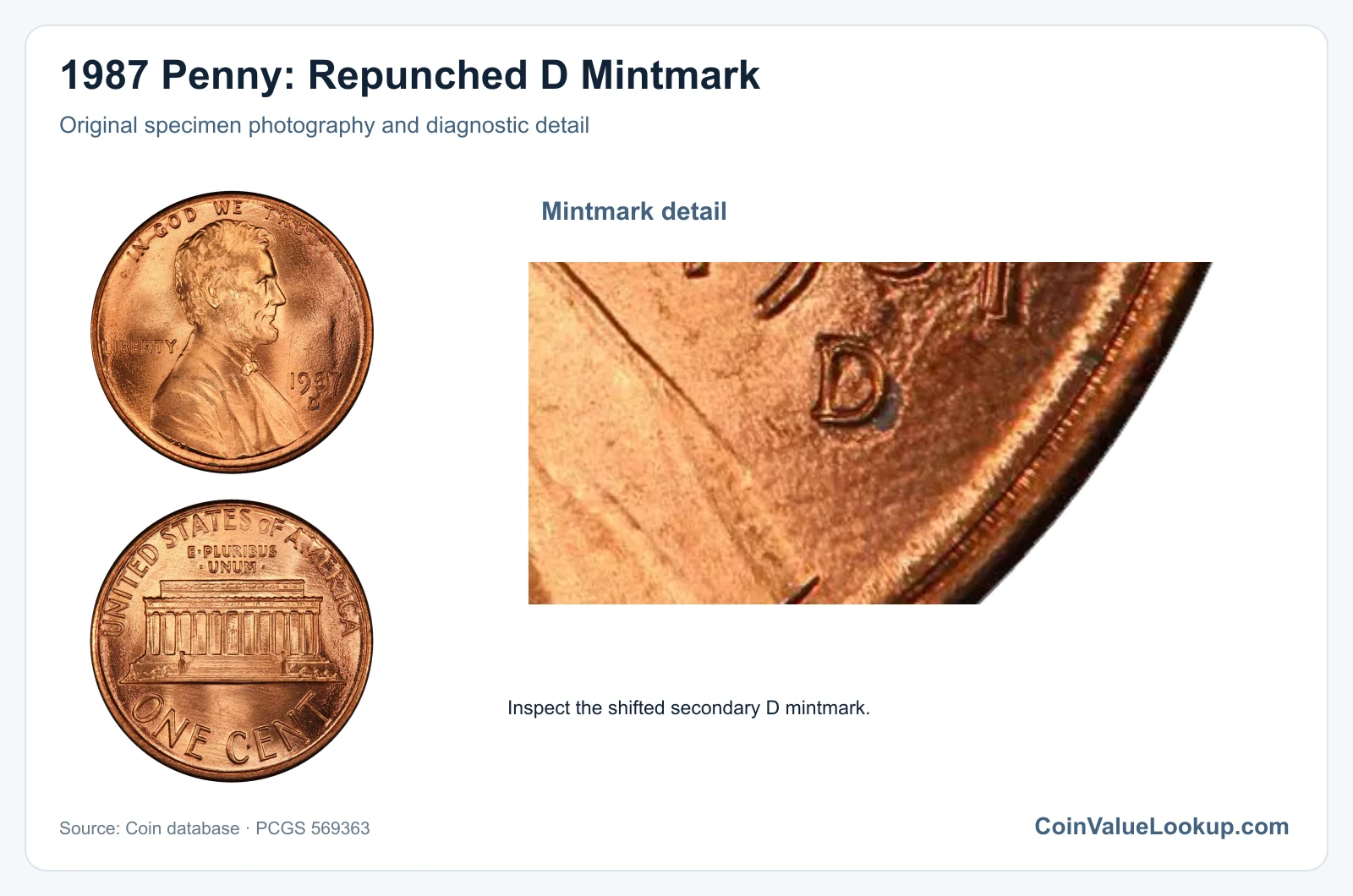
On a 1987-D/D repunched mintmark cent, remnants of an earlier D punch are visible around the final, correctly positioned D. You need magnification to see the secondary outline clearly.
Compare what you see to an attributed example at the same magnification so you know exactly which contours to look for.
This variety is cataloged by PCGS. Value depends on the specific attribution, error severity and the coin's overall condition.
No general price range is adopted here because individual assessment matters.
Don't confuse machine doubling, small die chips near the mintmark, or zinc plating splits with a genuine repunched mintmark. Machine doubling tends to produce a flat, shelf-like image rather than a distinct second punch impression.
2. 1987 Lincoln Penny — Double Strike with Displaced Impression
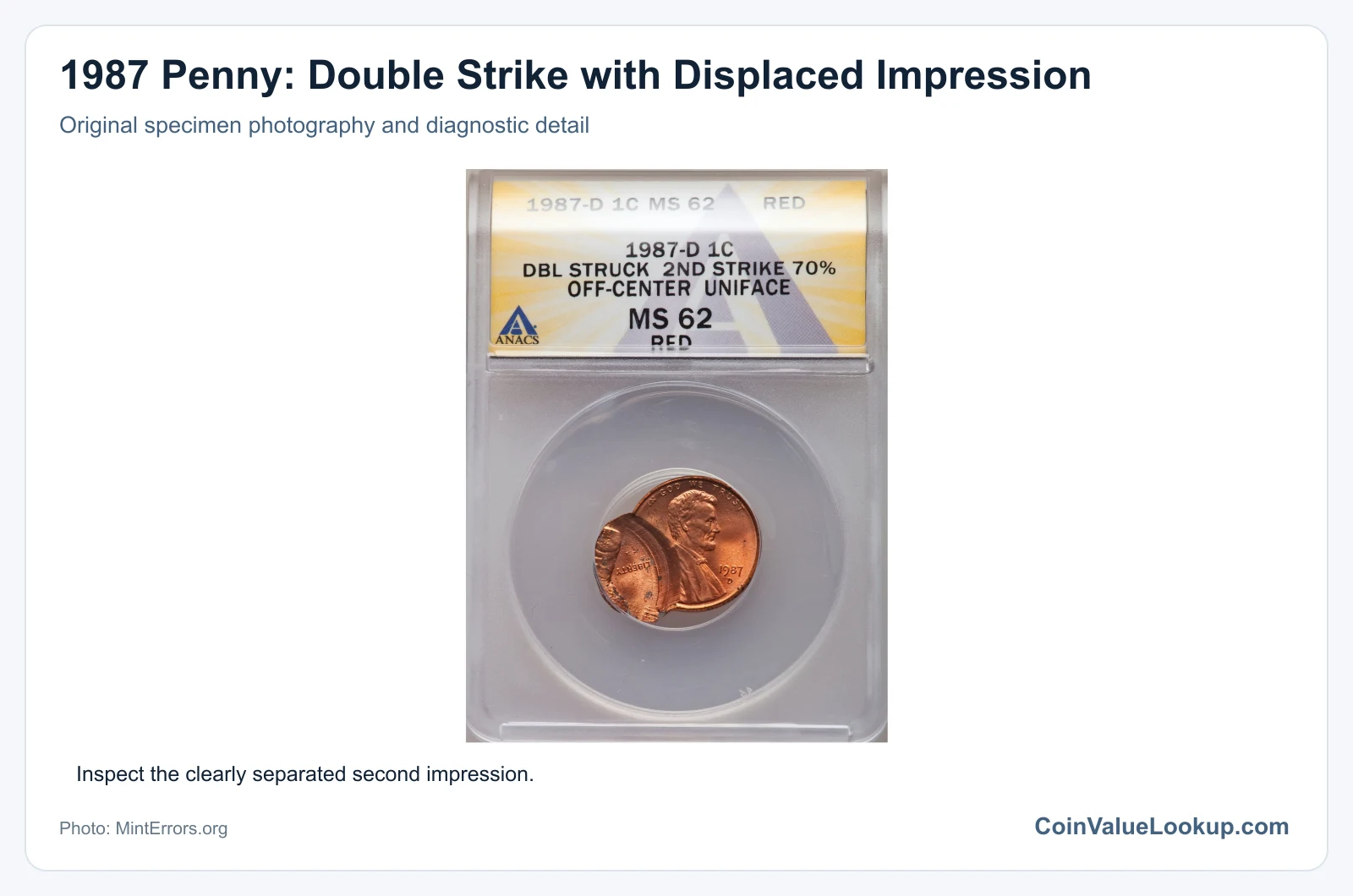
A 1987 no-mintmark cent struck twice with the second impression displaced roughly 50% off center is a genuine double-strike error. Both complete struck designs are visible on the coin, overlapping and physically shifted from each other.
The key diagnostic is two distinct impressions of the full design, not just doubled lettering.
An NGC MS66 Red example sold for $408 at auction in June 2023. That is one recorded sale, not a market range for all double strikes.
Condition, degree of displacement and date visibility all affect what a given piece might bring.
Do not confuse doubled die varieties, machine doubling or vise-damage impressions with a true double strike. A doubled die shows consistent letter separation across the design from a single strike off a flawed die, while a double strike involves two separate impacts of the press.
3. 1987 Lincoln Penny — Missing Copper Plating
A 1987-D cent missing roughly 80% of its copper plating before it was struck is classified as a missing-plating error. The exposed zinc surface retains original mint-strike texture in the unplated areas, which is the key diagnostic separating it from post-mint damage.
These coins typically weigh slightly less than the standard 2.50 grams; the recorded example came in at 2.4 grams.
An NGC MS63 Red example sold for $97 in November 2020. That sale is one data point, not a broad price range.
Plating coverage percentage and overall condition both influence value.
Coins that have been chemically stripped, abraded or corroded after leaving the mint can look similar. Authentication is important because a coin plated after minting or one that simply lost plating through wear is not the same thing as a planchet that entered the press without full plating.
4. 1987 Lincoln Penny — Doubled Die Obverse
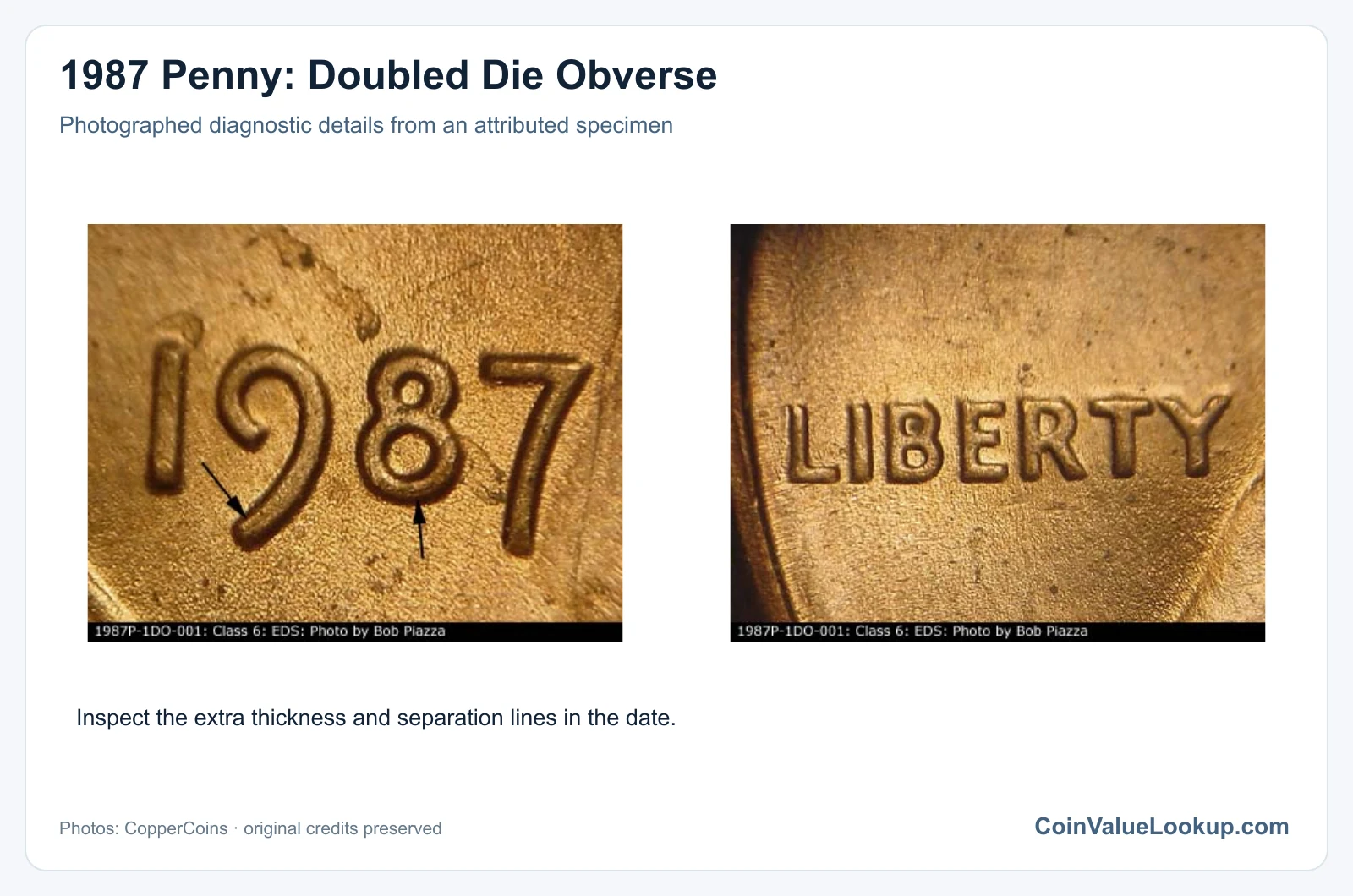
A doubled die obverse on a 1987 cent shows consistent separation or notching on obverse design elements such as letters or the date. Under magnification, look for doubling that appears in the same direction across multiple features.
This consistency is what separates a genuine doubled die from other forms of doubling.
No specific price range is adopted for this variety. Condition, the strength of visible doubling and the specific die involved all affect value, so individual assessment is necessary.
Machine doubling is the most common lookalike. It produces a flat, shelf-like appearance rather than the rounded, separated profiles of a true doubled die.
Reflections from worn dies and lighting tricks can also fool you, so compare under steady, even light against a confirmed normal example.
5. 1987 Lincoln Penny — Off-Center Strike
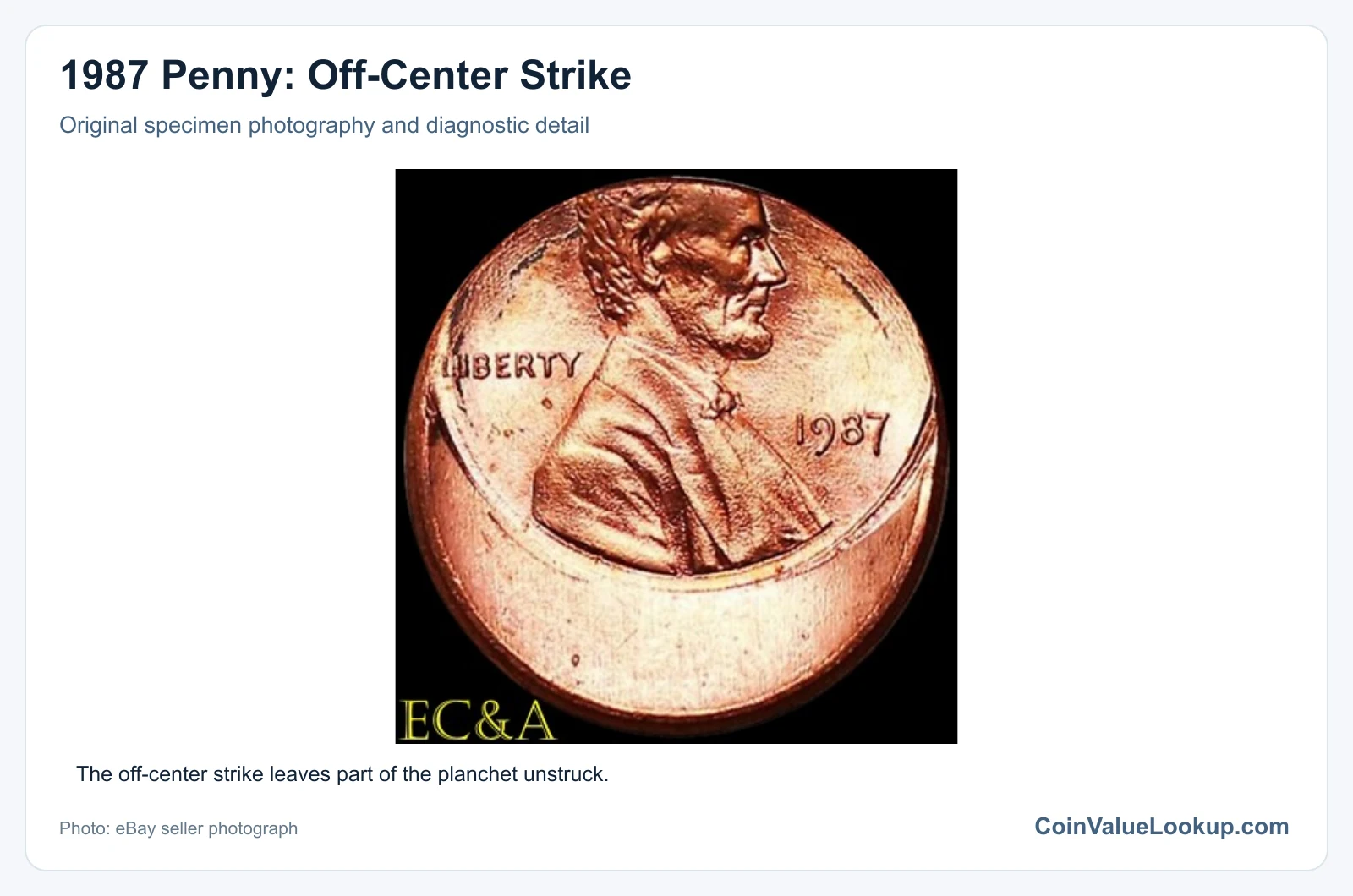
An off-center 1987 cent was struck with the planchet misaligned relative to the dies, leaving part of the design missing and a blank crescent along one edge. The more dramatic the misalignment while still retaining a readable date, the more collector interest the coin tends to generate.
No numerical price range is adopted. Value depends on the percentage off center, whether the date is fully visible and the coin's overall condition.
Don't mistake a clipped planchet or one-sided die misalignment for an off-center strike. A clip has a curved or straight edge cut, while post-mint flattening from a vise or hammer produces distortion without the characteristic unstruck crescent.
6. 1987 Lincoln Penny — BIE Die Break
A BIE die break on a 1987 cent appears as a small raised vertical line or blob between the letters B and E in LIBERTY. It is caused by a crack in the die that fills with metal during striking.
The result looks like a tiny capital I wedged between those two letters.
No specific price is adopted. These are minor die breaks, and value depends on the size and sharpness of the raised area plus overall coin condition.
Dirt lodged between letters, fine scratches or bits of foreign material stuck to the surface can mimic a BIE. The genuine article is raised metal that is part of the struck surface, not sitting on top of it.
Check under magnification.
7. 1987 Lincoln Penny — Broadstrike
A broadstrike occurs when the coin is struck without the retaining collar that normally confines the planchet. The result is a coin with outward metal spread, slightly larger than normal diameter and often with a distorted or missing rim.
The full design is still present, just expanded.
No specific price range is adopted for a 1987 broadstrike cent. Value depends on the degree of spread, overall condition and whether the coin retains attractive detail despite the missing collar.
A coin that is simply off center is not the same thing. Off-center strikes shift the design to one side with a blank crescent, while a broadstrike keeps the design roughly centered.
Coins flattened after minting by a railroad track or a hammer lack the characteristic uniform metal flow and rim profile of a true broadstrike.
8. 1987 Lincoln Penny — Die Cracks and Cuds
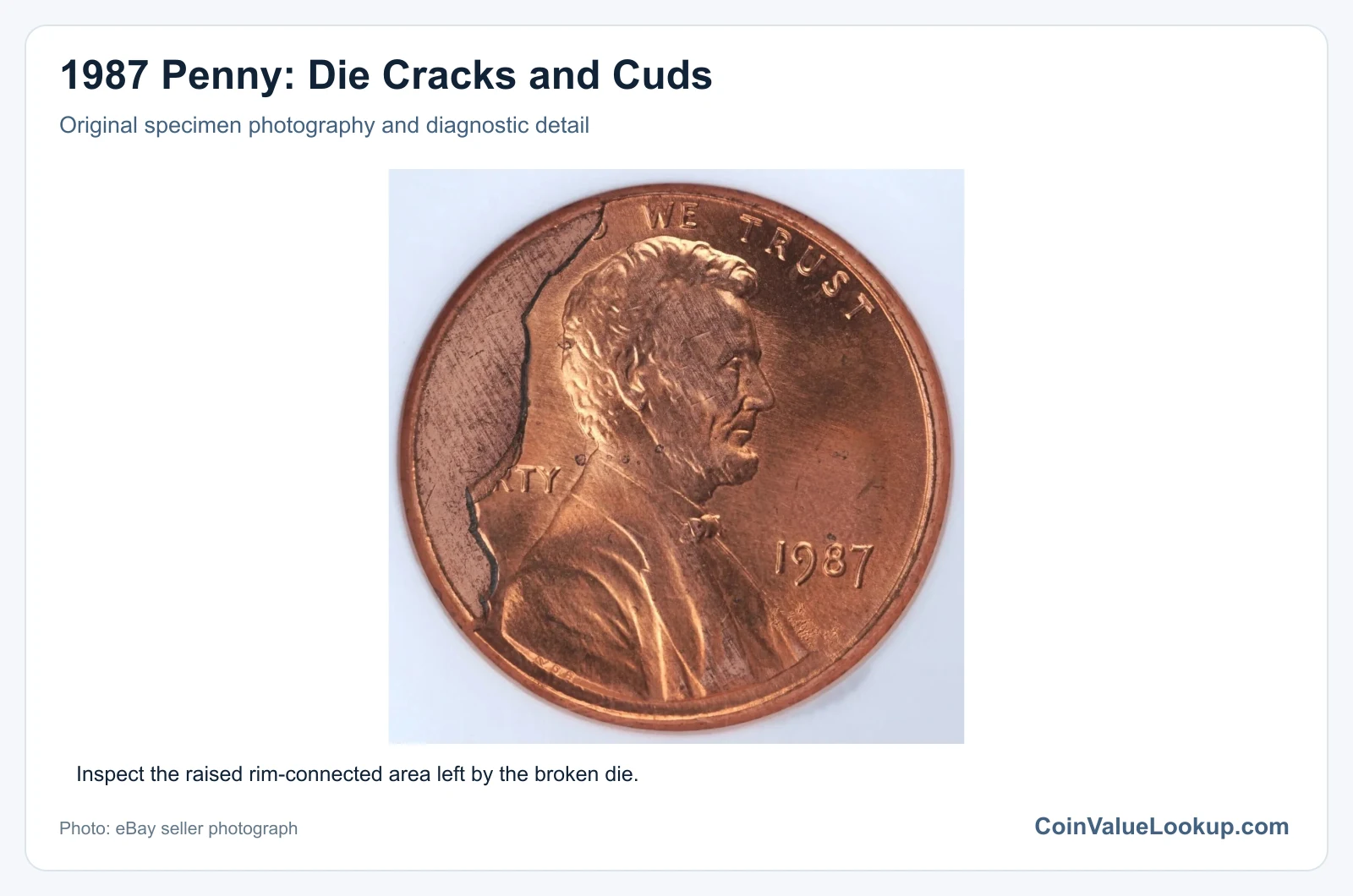
Die cracks on a 1987 cent appear as thin raised lines across the coin's surface, created when the die itself develops fractures from repeated use. A cud is a larger raised blob of metal connected to the rim, formed when a piece of the die breaks away entirely.
Both are raised above the normal surface.
No price range is adopted. Value depends on size, location and how dramatic the crack or cud is, plus the coin's condition.
Do not confuse incuse scratches, corrosion lines or foreign material with die cracks. Scratches cut into the surface.
Cracks rise above it. Under magnification the difference is usually clear.
Multiple stages of the same die crack appearing on different coins do not represent separate varieties for pricing purposes.