1950 Wheat Penny Coin Value: How Much Is It Worth?
A 1950 Wheat Penny in circulated condition carries a guide value around $0.06 to $0.08 at Fine-12, depending on the mint, while an uncirculated example at MS63 runs about $2.50. These are guide estimates for ordinary circulation strikes and do not cover proofs, major varieties or error coins, which are priced separately.
Original surfaces, color and the degree of wear all influence what a specific coin brings.
Fast Way to Identify Your 1950 Wheat Penny
The quickest way to start figuring out what you have is to upload clear photos of both the front and back of your coin. Our identifier can give you a preliminary identification based on those images, helping you narrow down the mint, general condition and whether anything unusual stands out.
It is not a substitute for professional authentication or precise grading, but it points you in the right direction.
1950 Wheat Penny Value
Upload both sides of your 1950 Wheat Penny.
Front Obverse
Upload photo
Back Reverse
Upload photo
Which 1950 Wheat Penny Versions Are Worth Money?
- The 1950 Philadelphia (no mintmark) and 1950-D are each valued around $0.06 in Fine-12 and about $2.50 at MS63 in guide estimates, so mint-specific differences matter more as condition improves.
- The 1950-S carries a slightly higher circulated guide value of roughly $0.08 at Fine-12, reaching the same $2.50 at MS63.
- The 1950 Proof, struck only at Philadelphia, is the standout at about $87 in PR63, making it far more valuable than any ordinary circulation strike of this date.
- Authenticated error coins such as repunched mintmarks, off-center strikes or doubled die reverses can carry individual premiums beyond standard guide values, assessed case by case.
Step 1: Identify Your 1950 Wheat Penny Mint Mark and Version
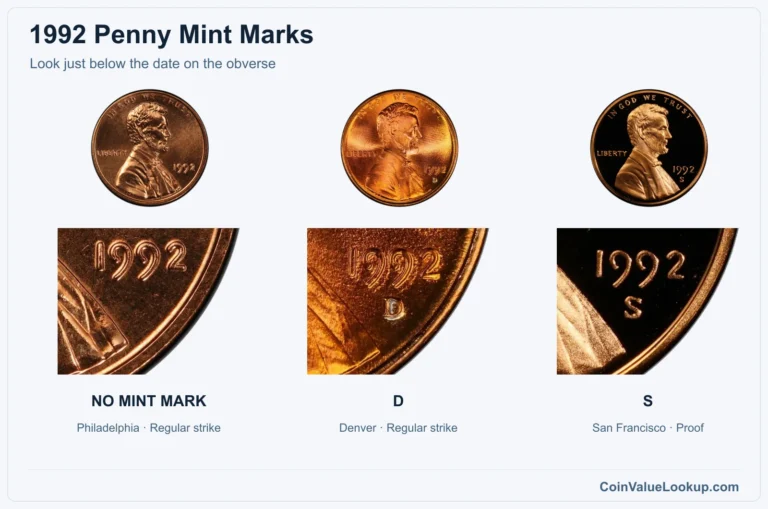
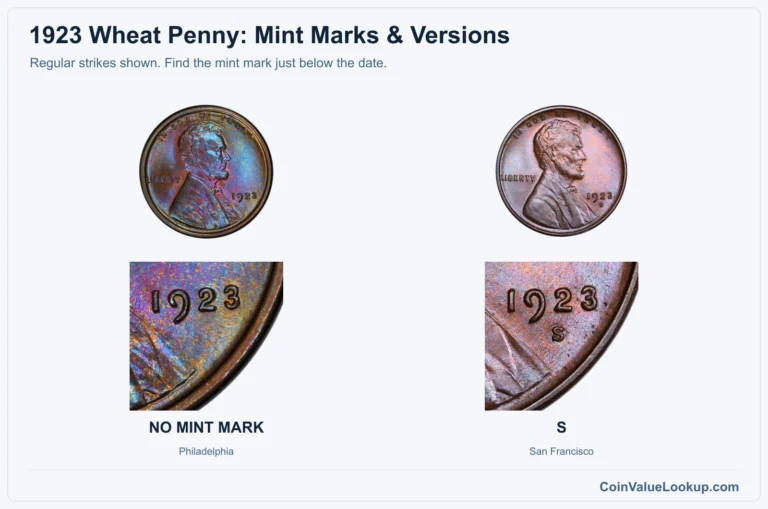
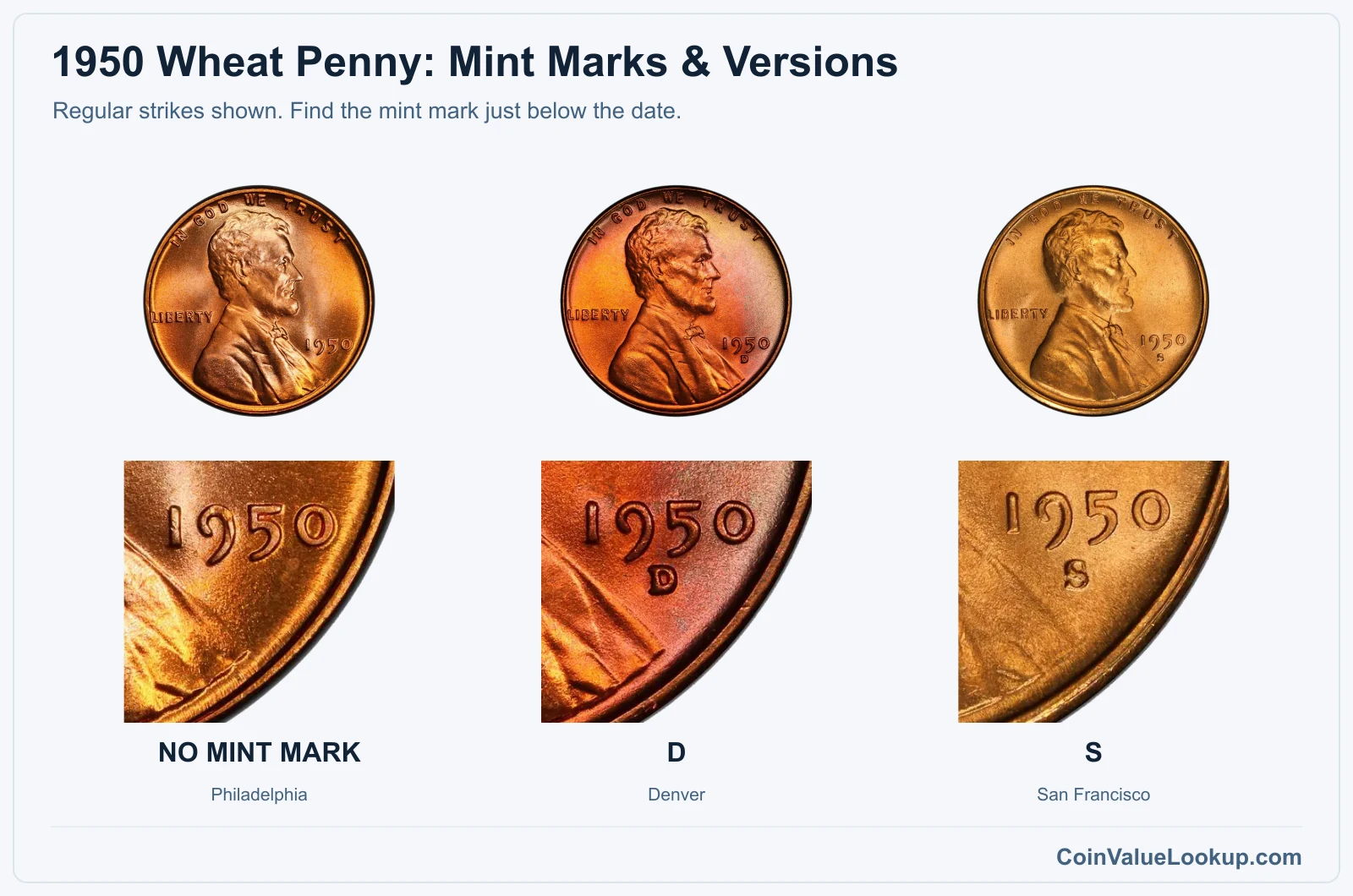
First, flip the coin over and look below the date on the obverse. No letter means Philadelphia.
A small "D" means Denver, and an "S" means San Francisco. All three mints struck circulation cents in 1950, and Philadelphia also produced brilliant proof cents for collectors.
The design is standard Lincoln Wheat: Lincoln's portrait faces right on the obverse, and two wheat ears frame ONE CENT on the reverse. The coin is a copper alloy (95% copper, 5% tin and zinc), weighs about 3.11 grams, and has a plain edge.
Do not confuse a polished circulation cent with a proof. Proofs were specially manufactured with mirrored fields, not simply shiny from cleaning.
Red, brown or red-brown color describes the copper toning state and is a separate attribute from the coin's grade or manufacturing method.
Step 2: Check Your 1950 Wheat Penny Grade
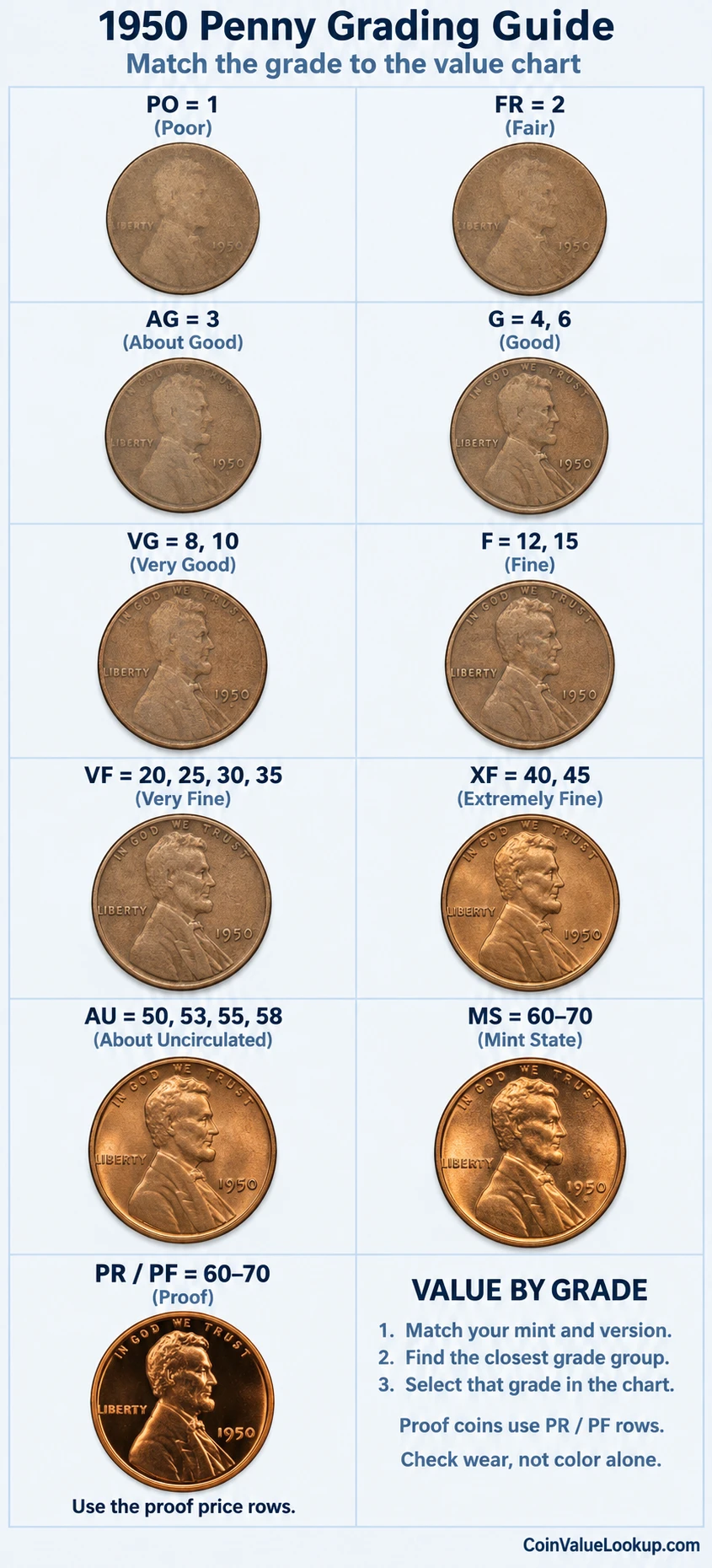
Start with Lincoln's cheek and jawline. These are the highest points and the first places to lose detail.
A coin grading Fine-12 will show moderate wear across the cheek and some flattening of the hair, but the major features remain clear.
Next, check the reverse wheat ears. Look at the individual grain lines and the horizontal lines between the stalks.
Luster is your best friend here: an uncirculated coin retains its original mint sheen across the entire surface.
A weak strike can mimic wear, so compare your coin to the reference image provided. Soft detail on a fully lustrous surface usually signals a strike issue, not circulation damage.
Finally, evaluate the surfaces independently of wear. Cleaning, spots, corrosion and environmental damage all reduce a coin's appeal regardless of how sharp the detail looks.
A naturally toned brown coin with honest wear often outperforms a harshly cleaned one that appears shinier.
Step 3: Check 1950 Wheat Penny Value by Mint and Version
1950 Wheat Penny
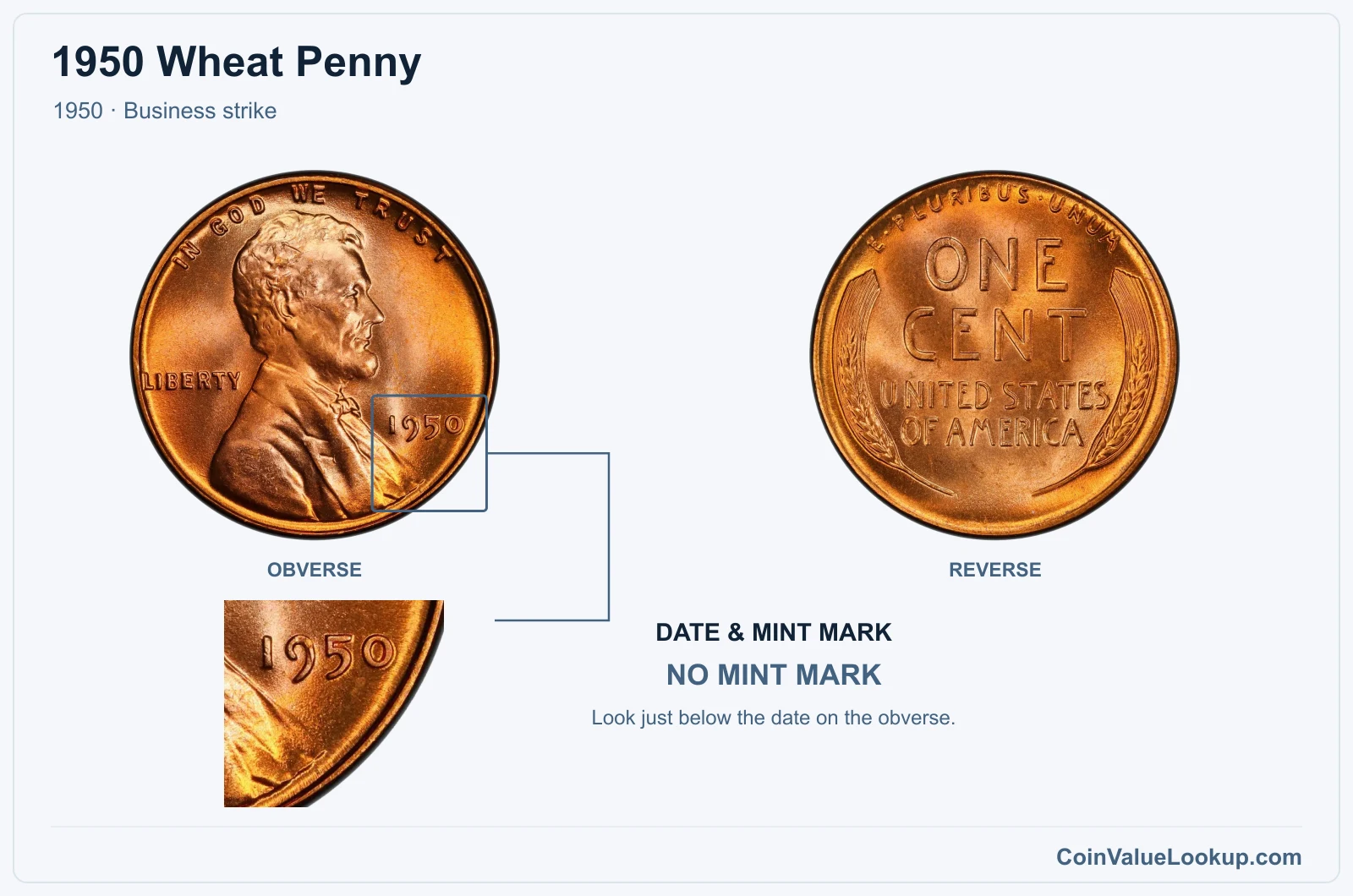
The 1950 Philadelphia cent has no mintmark below the date. It is the standard business strike from the Philadelphia Mint, composed of 95% copper with 5% tin and zinc, weighing about 3.11 grams.
Guide estimates place it around $0.06 in Fine-12 and about $2.50 at MS63. These figures assume original, unimpaired surfaces and do not specify a certified color designation, so do not treat them as quotes for a coin graded Red.
Most examples you encounter will be well-circulated and worth only a few cents above face value. Uncirculated survivors with strong luster are where the value starts to climb.
| Range | Grade | Price | Auction Records | Appraisal |
|---|---|---|---|---|
| PO | PO 1 | — | Coin Identifier | |
| FR | FR 2 | — | Coin Identifier | |
| AG | AG 3 | — | Coin Identifier | |
| G | G 4 | — | Coin Identifier | |
| G 6 | — | Coin Identifier | ||
| VG | VG 8 | — | Coin Identifier | |
| VG 10 | — | Coin Identifier | ||
| F | F 12 | — | Coin Identifier | |
| F 15 | — | Coin Identifier | ||
| VF | VF 20 | — | Coin Identifier | |
| VF 25 | — | Coin Identifier | ||
| VF 30 | — | Coin Identifier | ||
| VF 35 | — | Coin Identifier | ||
| XF | XF 40 | — | Coin Identifier | |
| XF 45 | — | Coin Identifier | ||
| AU | AU 50 | — | Coin Identifier | |
| AU 53 | — | Coin Identifier | ||
| AU 55 | — | Coin Identifier | ||
| AU 58 | — | Coin Identifier | ||
| MS | MS 60 | — | Coin Identifier | |
| MS 61 | — | Coin Identifier | ||
| MS 62 | — | Coin Identifier | ||
| MS 63 | — | Coin Identifier | ||
| MS 64 | Coin Identifier | |||
| MS 65 | Coin Identifier | |||
| MS 66 | Coin Identifier | |||
| MS 67 | Coin Identifier | |||
| MS 68 | — | — | — | |
| MS 69 | — | — | — | |
| MS 70 | — | — | — |
1950 Wheat Penny — D
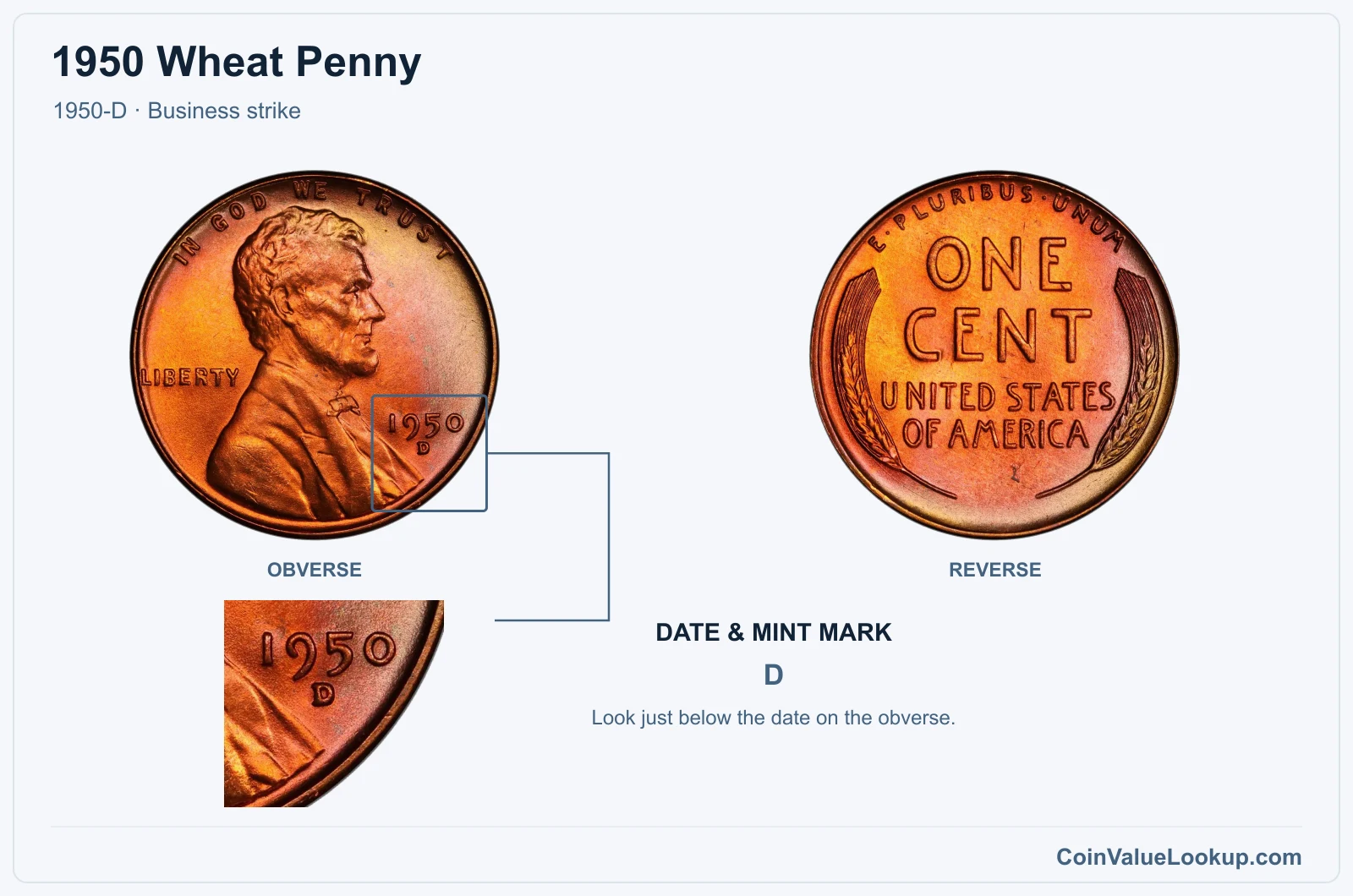
Look for a small "D" mintmark below the date to confirm a Denver strike. The 1950-D shares the same copper alloy composition and weight as its Philadelphia sibling.
Guide values are essentially identical: about $0.06 at Fine-12 and roughly $2.50 at MS63. Denver produced large quantities, so circulated pieces are common.
The premium really kicks in at the uncirculated level where original surfaces and luster matter. Match your coin's exact mint and condition before applying any published estimate.
| Range | Grade | Price | Auction Records | Appraisal |
|---|---|---|---|---|
| PO | PO 1 | — | Coin Identifier | |
| FR | FR 2 | — | Coin Identifier | |
| AG | AG 3 | — | Coin Identifier | |
| G | G 4 | — | Coin Identifier | |
| G 6 | — | Coin Identifier | ||
| VG | VG 8 | — | Coin Identifier | |
| VG 10 | — | Coin Identifier | ||
| F | F 12 | — | Coin Identifier | |
| F 15 | — | Coin Identifier | ||
| VF | VF 20 | — | Coin Identifier | |
| VF 25 | — | Coin Identifier | ||
| VF 30 | — | Coin Identifier | ||
| VF 35 | — | Coin Identifier | ||
| XF | XF 40 | — | Coin Identifier | |
| XF 45 | — | Coin Identifier | ||
| AU | AU 50 | — | Coin Identifier | |
| AU 53 | — | Coin Identifier | ||
| AU 55 | — | Coin Identifier | ||
| AU 58 | — | Coin Identifier | ||
| MS | MS 60 | — | Coin Identifier | |
| MS 61 | — | Coin Identifier | ||
| MS 62 | — | Coin Identifier | ||
| MS 63 | — | Coin Identifier | ||
| MS 64 | Coin Identifier | |||
| MS 65 | Coin Identifier | |||
| MS 66 | Coin Identifier | |||
| MS 67 | Coin Identifier | |||
| MS 68 | Coin Identifier | |||
| MS 69 | — | — | — | |
| MS 70 | — | — | — |
1950 Wheat Penny — S
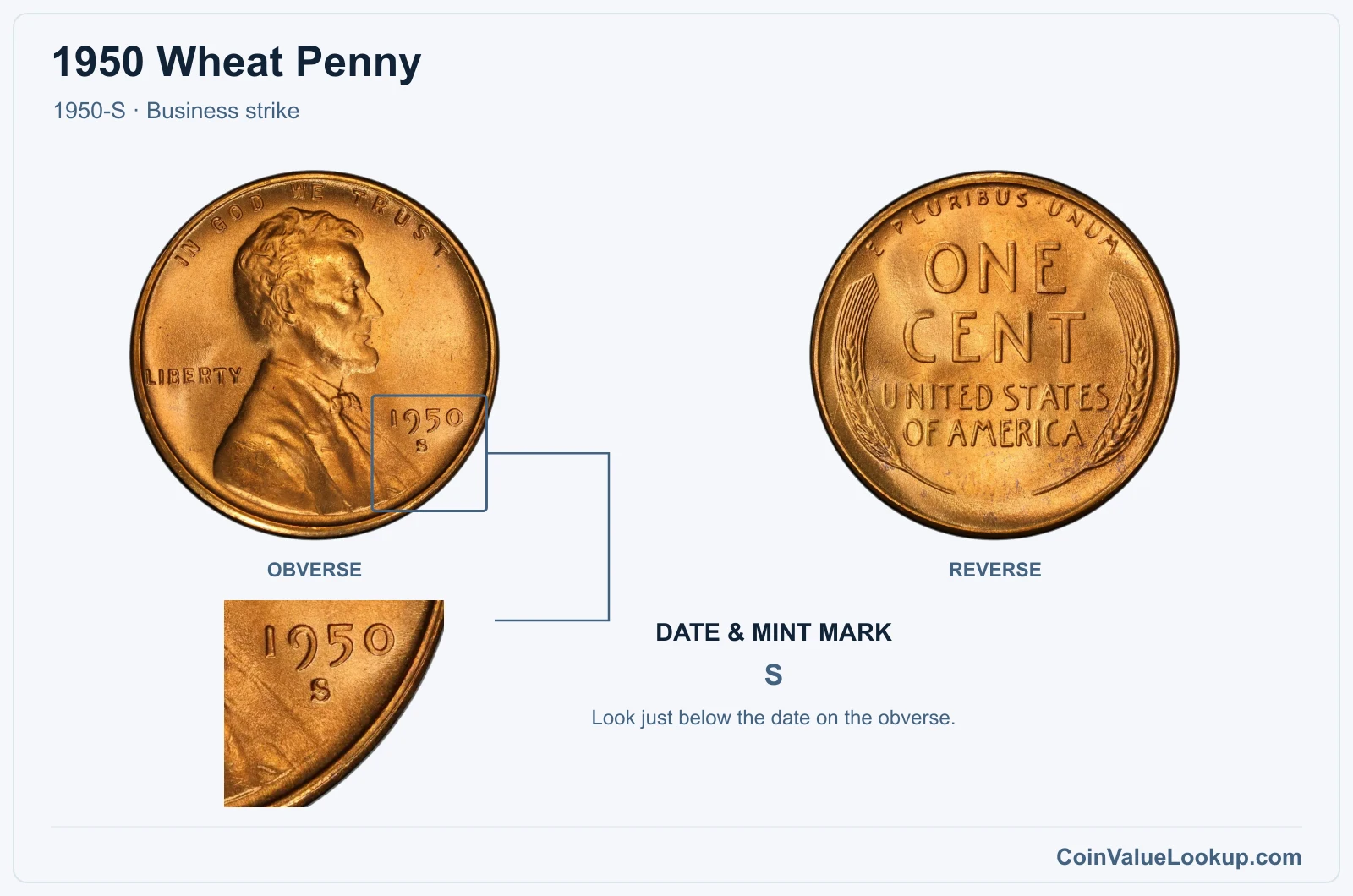
A small "S" below the date identifies the San Francisco issue. The 1950-S edges slightly ahead in circulated grades, with a guide value around $0.08 at Fine-12 versus $0.06 for the Philadelphia and Denver strikes.
At MS63 the playing field levels out at about $2.50. Same alloy, same weight, same design.
The modest circulated premium reflects collector demand rather than a dramatic rarity difference. As always, original surfaces without cleaning or damage will command the best offers.
If you are exploring values for other dates and mints, Coin Value Lookup is a handy place to look up guides across the full range of U.S. coin series.
| Range | Grade | Price | Auction Records | Appraisal |
|---|---|---|---|---|
| PO | PO 1 | — | Coin Identifier | |
| FR | FR 2 | — | Coin Identifier | |
| AG | AG 3 | — | Coin Identifier | |
| G | G 4 | — | Coin Identifier | |
| G 6 | — | Coin Identifier | ||
| VG | VG 8 | — | Coin Identifier | |
| VG 10 | — | Coin Identifier | ||
| F | F 12 | — | Coin Identifier | |
| F 15 | — | Coin Identifier | ||
| VF | VF 20 | — | Coin Identifier | |
| VF 25 | — | Coin Identifier | ||
| VF 30 | — | Coin Identifier | ||
| VF 35 | — | Coin Identifier | ||
| XF | XF 40 | — | Coin Identifier | |
| XF 45 | — | Coin Identifier | ||
| AU | AU 50 | — | Coin Identifier | |
| AU 53 | — | Coin Identifier | ||
| AU 55 | — | Coin Identifier | ||
| AU 58 | — | Coin Identifier | ||
| MS | MS 60 | — | Coin Identifier | |
| MS 61 | — | Coin Identifier | ||
| MS 62 | — | Coin Identifier | ||
| MS 63 | — | Coin Identifier | ||
| MS 64 | Coin Identifier | |||
| MS 65 | Coin Identifier | |||
| MS 66 | Coin Identifier | |||
| MS 67 | Coin Identifier | |||
| MS 68 | Coin Identifier | |||
| MS 69 | — | — | — | |
| MS 70 | — | — | — |
1950 Wheat Penny — PR
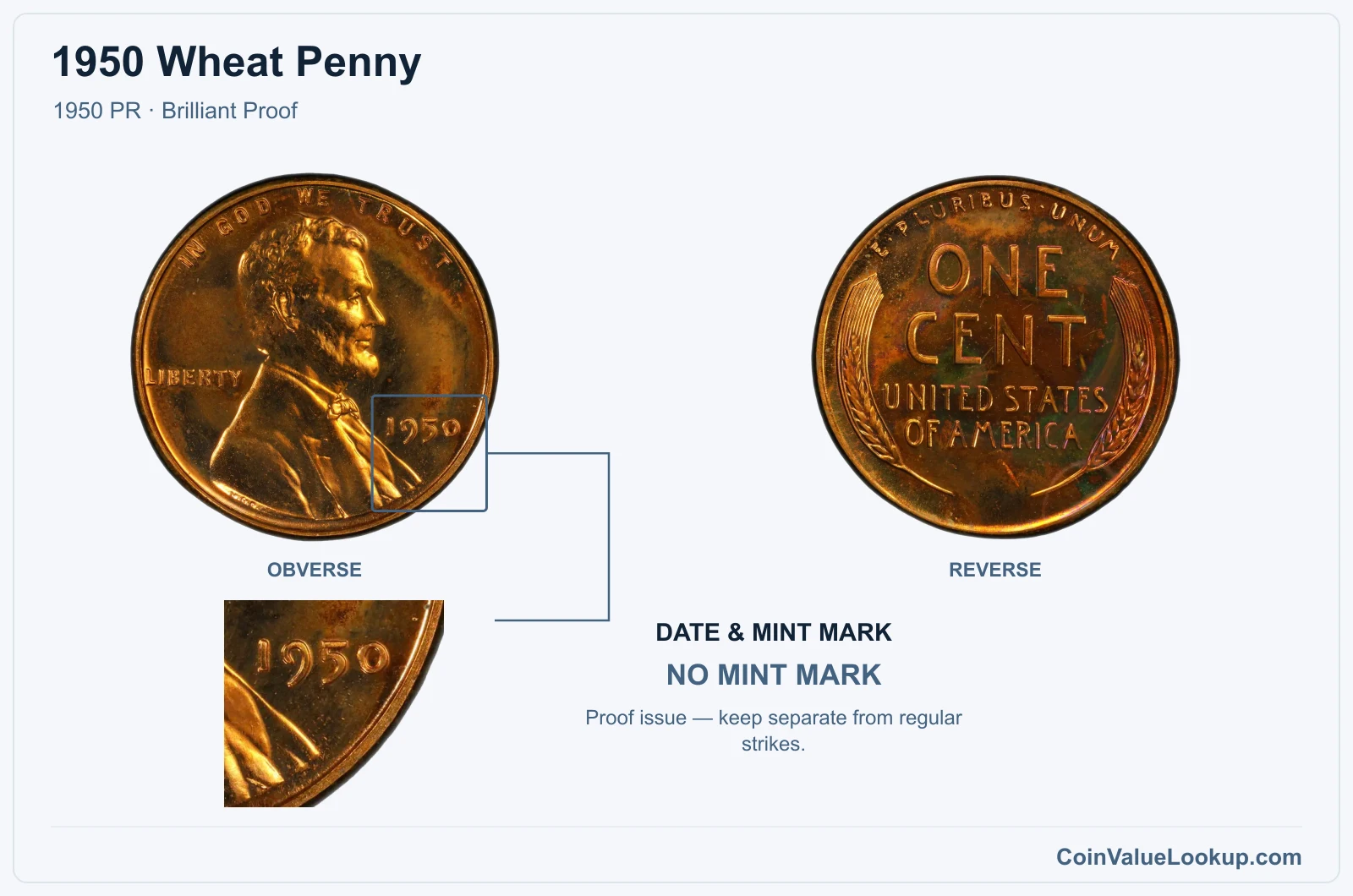
The 1950 Proof cent was struck at Philadelphia with specially prepared dies, producing brilliant mirrored fields. There is no mintmark, just like the business strike, so you need to look at the surfaces themselves: a genuine proof has deep, reflective fields and sharp rims that a polished circulation coin simply cannot replicate.
The guide estimate is about $87 at PR63, making this by far the most valuable standard issue of the 1950 Lincoln cent date. Cameo and deep cameo designations describe the degree of contrast between frosted devices and mirrored fields; these are contrast labels, not errors.
A cleaned or impaired proof will not command the same premium, so original surfaces are critical.
| Range | Grade | Price | Auction Records | Appraisal |
|---|---|---|---|---|
| PR | PR 1 | — | Coin Identifier | |
| PR 2 | — | Coin Identifier | ||
| PR 3 | — | Coin Identifier | ||
| PR 4 | — | Coin Identifier | ||
| PR 6 | — | Coin Identifier | ||
| PR 8 | — | Coin Identifier | ||
| PR 10 | — | Coin Identifier | ||
| PR 12 | — | Coin Identifier | ||
| PR 15 | — | Coin Identifier | ||
| PR 20 | — | Coin Identifier | ||
| PR 25 | — | Coin Identifier | ||
| PR 30 | — | Coin Identifier | ||
| PR 35 | — | Coin Identifier | ||
| PR 40 | — | Coin Identifier | ||
| PR 45 | — | Coin Identifier | ||
| PR 50 | — | Coin Identifier | ||
| PR 53 | — | Coin Identifier | ||
| PR 55 | — | Coin Identifier | ||
| PR 58 | — | Coin Identifier | ||
| PR 60 | — | Coin Identifier | ||
| PR 61 | — | Coin Identifier | ||
| PR 62 | — | Coin Identifier | ||
| PR 63 | Coin Identifier | |||
| PR 64 | — | Coin Identifier | ||
| PR 65 | Coin Identifier | |||
| PR 66 | Coin Identifier | |||
| PR 67 | Coin Identifier | |||
| PR 68 | — | — | — | |
| PR 69 | — | — | — | |
| PR 70 | — | — | — |
1950 Wheat Penny Error List
1. 1950 Wheat Penny — Repunched Mintmark
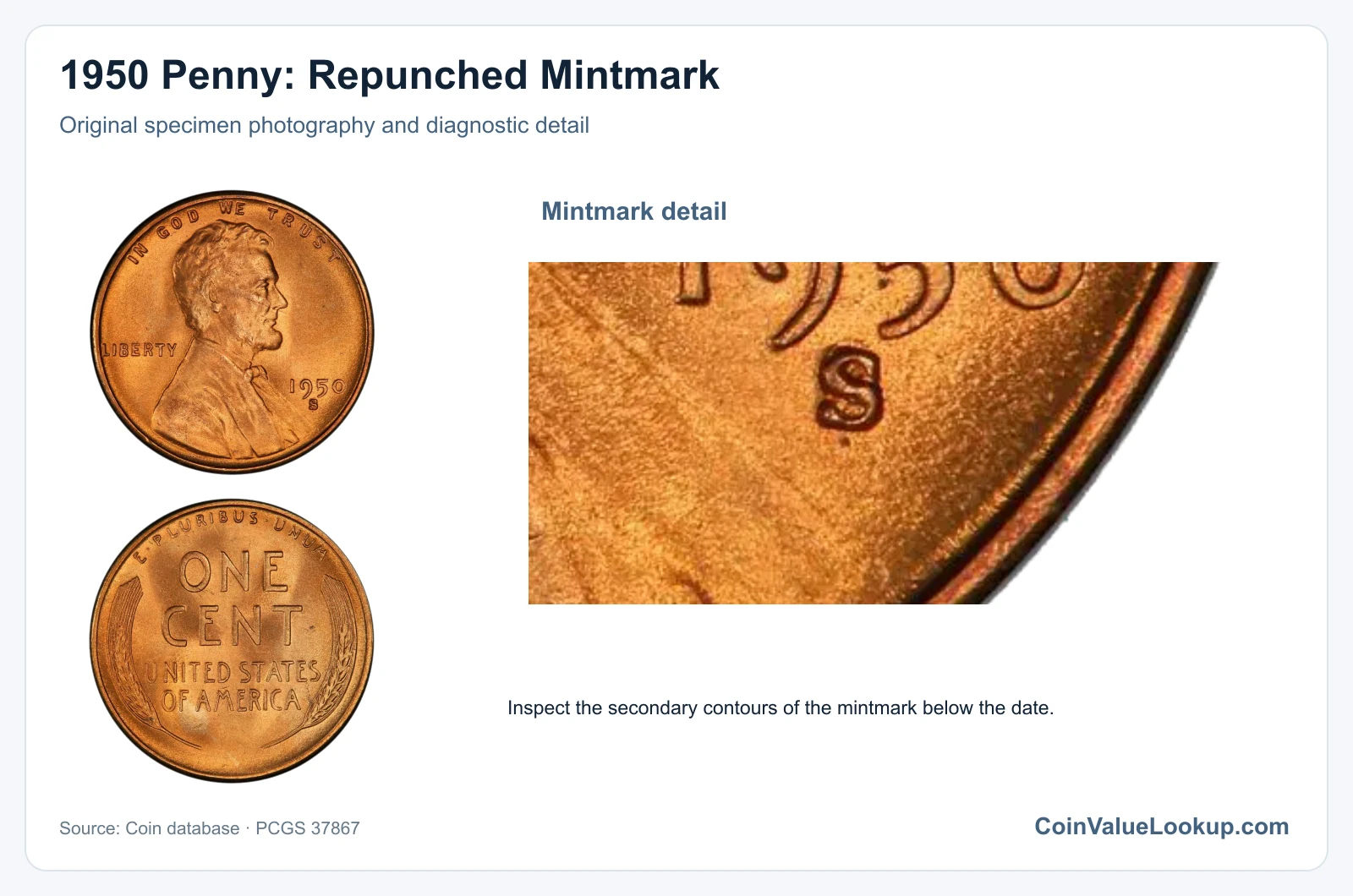
A repunched mintmark occurs when the mintmark punch was applied more than once at slightly different positions, leaving a visible trace of the earlier impression alongside the final one. On 1950 cents, only Denver (D) and San Francisco (S) issues can show this error, since Philadelphia coins carry no mintmark.
To check, examine the mintmark area under magnification and look for remnants of a second letter offset from the primary one. Compare with a normal example at the same magnification to be sure.
Machine doubling around the mintmark, a die chip or simple corrosion can all mimic the appearance. Value depends on the specific die variety, severity and the coin's authenticated condition, so individual assessment is needed.
2. 1950 Wheat Penny — Off-Center Strike
An off-center strike happens when the planchet is not properly seated between the dies, producing a displaced design and an unstruck crescent of blank metal on one side. The amount of misalignment varies widely.
A coin that is 5% off-center looks like a minor curiosity, while one that is 50% off-center with the date still visible is a genuinely desirable error. Make sure the date remains readable, because that is what ties the error to a specific year.
Do not confuse an off-center strike with a clipped planchet, one-sided die misalignment or post-mint damage like a coin that was flattened or bent. Authentication matters here, since the value depends on the percentage of offset, date visibility and overall condition.
3. 1950 Wheat Penny — BIE Die Break
The BIE error is a specific type of die break that creates a raised vertical line or blob between the letters B and E in LIBERTY on the obverse. It looks like a tiny capital I has been inserted into the word.
These are caused by a crack or chip in the die that fills with metal during striking. Check the LIBERTY legend under magnification and compare the space between B and E with normal examples.
Dirt lodged between the letters, a thin scratch or a bit of foreign material stuck to the surface can all look similar at first glance, but a genuine BIE will be raised metal that is part of the coin's surface, not sitting on top of it. Each BIE varies in size and clarity, and value depends on individual assessment.
4. 1950 Wheat Penny — Die Crack / Die Chip
Die cracks show up as thin, raised lines on the coin's surface, while die chips appear as small raised blobs. Both result from fractures or missing pieces in the steel die.
They can appear anywhere on either side of the coin. The key word is raised: genuine die cracks and chips produce metal that stands above the normal field.
Incuse scratches, corrosion tracks or foreign material pressed into the surface are common lookalikes. Interior die chips that do not reach the rim are distinguished from cuds, which connect to the rim and involve a larger area of missing die.
Value for a 1950 Wheat cent with this error depends on size, location and the coin's overall condition, so each piece requires individual evaluation.
5. 1950 Wheat Penny — Die Break / Cud
A cud is a major die break that connects to the rim. When a piece of the die breaks away entirely, the corresponding area on the coin shows a raised, featureless lump of metal along the edge where the design would normally be.
The bigger and more prominent the cud, the more collector interest it attracts. Look for a smooth raised area at the rim with a clear boundary where normal design detail resumes.
Do not confuse a cud with a simple rim dent from post-mint damage, surface corrosion or a small interior die chip that does not touch the rim. Rim contact is the defining feature.
Value is assessed individually based on the cud's size, location and the coin's authenticated condition.
6. 1950 Wheat Penny — Doubled Die Reverse
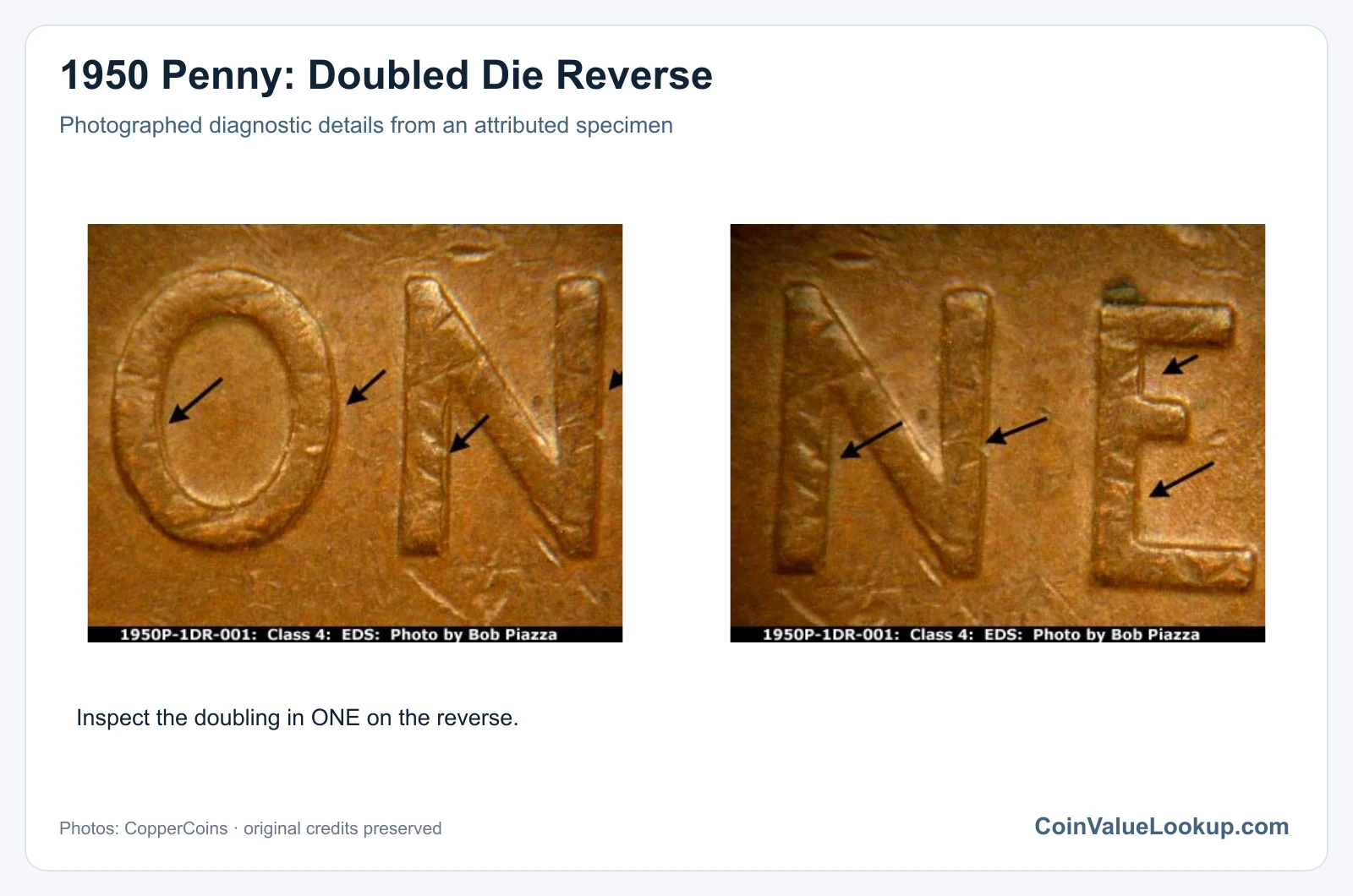
A doubled die reverse shows doubling on the reverse design elements that was created during the die-making process. This is not the same as machine doubling, which is flat, shelf-like and far less valuable.
On a genuine doubled die reverse, you may see a secondary image on the lettering, wheat ears or other design features. Compare the reverse legends and design contours carefully against a normal 1950 cent.
Machine doubling, reflections from lighting or random damage can all create appearances that resemble hub doubling at first glance. Confirming this error typically requires authentication, and value depends on the specific die, the severity of the doubling and the coin's condition.
7. 1950 Wheat Penny — Clipped Planchet
A clipped planchet error occurs when the coin blank is punched from strip metal that overlaps a previously punched hole, resulting in a missing curved, straight or ragged portion of the coin. A genuine clip usually shows a characteristic weakness in the design opposite the missing area, because the metal did not flow evenly during striking.
Check the edge texture at the clip boundary: it should look like original blank metal, not a filed or cut surface. Post-mint damage such as an edge gouge, a deliberately filed notch or heavy corrosion eating away the rim can all mimic a clip.
Authentication helps establish whether the missing metal was absent before striking, which is what gives the error its collector value.