1979 Jefferson Nickel Coin Value: How Much Is It Worth?
Most 1979 Jefferson nickels pulled from pocket change are worth face value. The real action starts with uncirculated examples: guide estimates run from about $0.30 at MS60 up to roughly $4.96 at MS65, depending on the mint.
Proofs and authenticated mint errors occupy their own price tiers entirely. Grade and condition context matter, so do not assume every 1979 nickel commands a premium.
Fast Way to Identify Your 1979 Jefferson Nickel
The quickest way to get a preliminary identification of your 1979 Jefferson nickel is to upload clear photos of the front and back. Good lighting and a steady shot help capture the mintmark, surface condition, and any oddities.
This gives a starting point for figuring out which version you have and whether it deserves a closer look.
1979 Jefferson Nickel Value
Upload both sides of your 1979 Jefferson Nickel.
Front Obverse
Upload photo
Back Reverse
Upload photo
Which 1979 Jefferson Nickel Versions Are Worth Money?
- High-grade uncirculated business strikes with certified Full Steps can carry a premium over ordinary examples at the same grade.
- San Francisco proof nickels are a separate market from circulation strikes; condition and finish level matter.
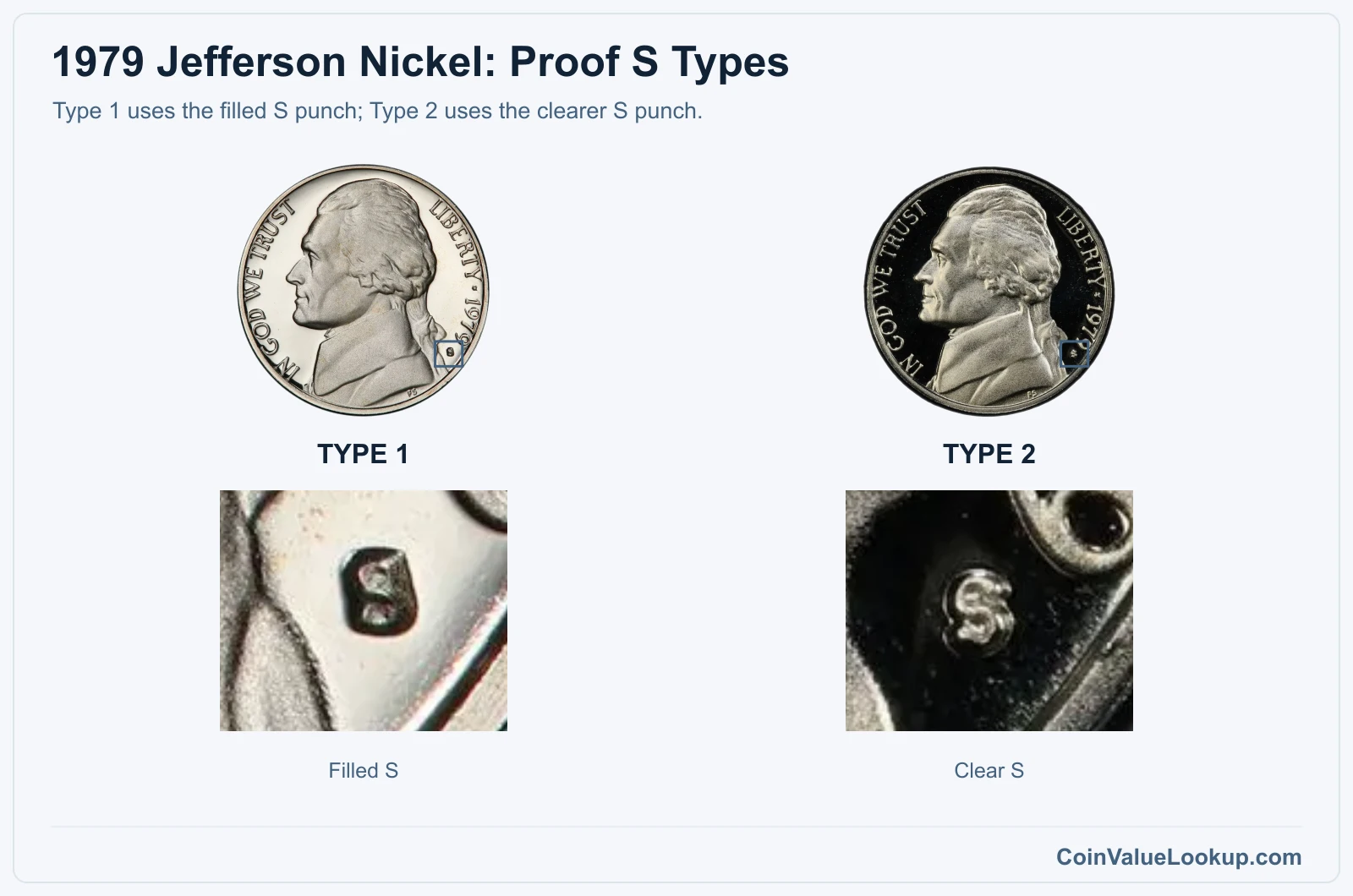
- The 1979-S proof comes in two mintmark varieties, Type 1 (filled S) and Type 2 (clear S), which require close comparison to distinguish.
- Authenticated mint errors such as off-metal strikes and double brockages have sold individually for hundreds to thousands of dollars at auction.
Step 1: Identify Your 1979 Jefferson Nickel Mint Mark and Version
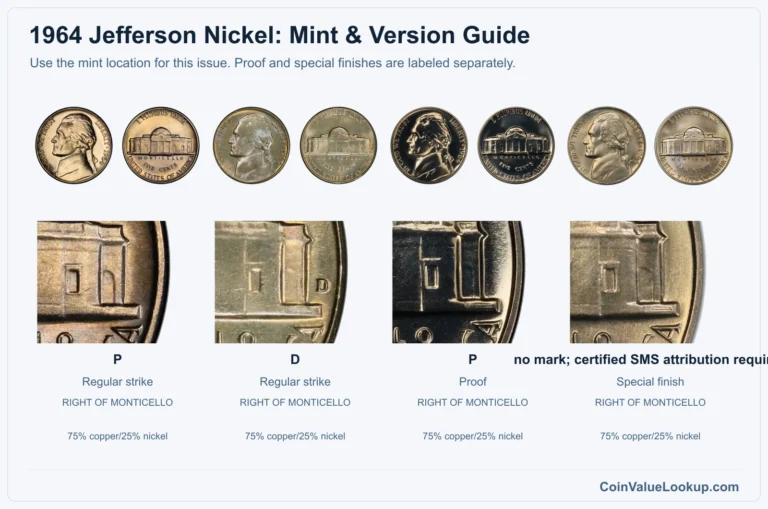
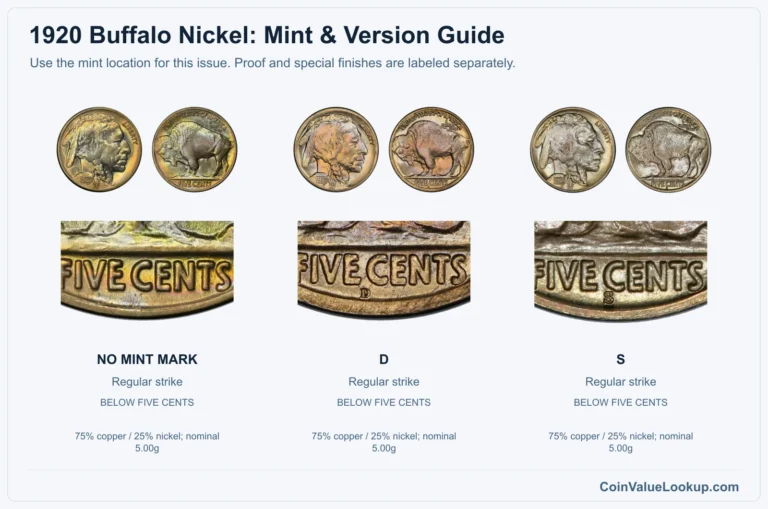
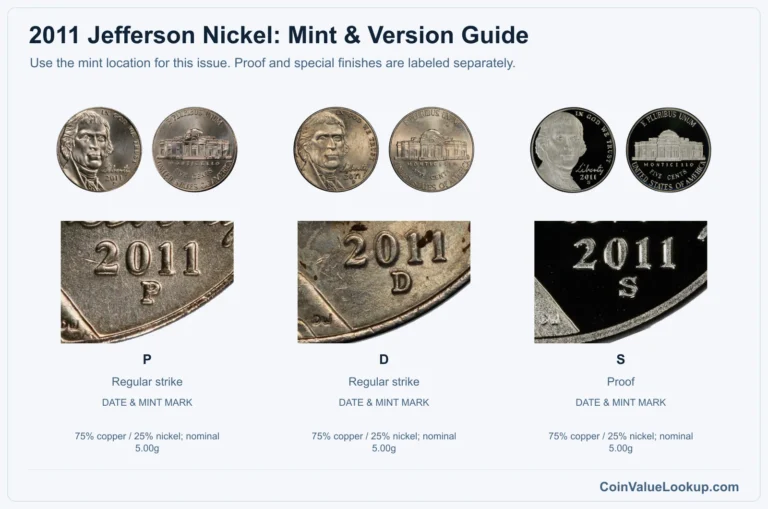
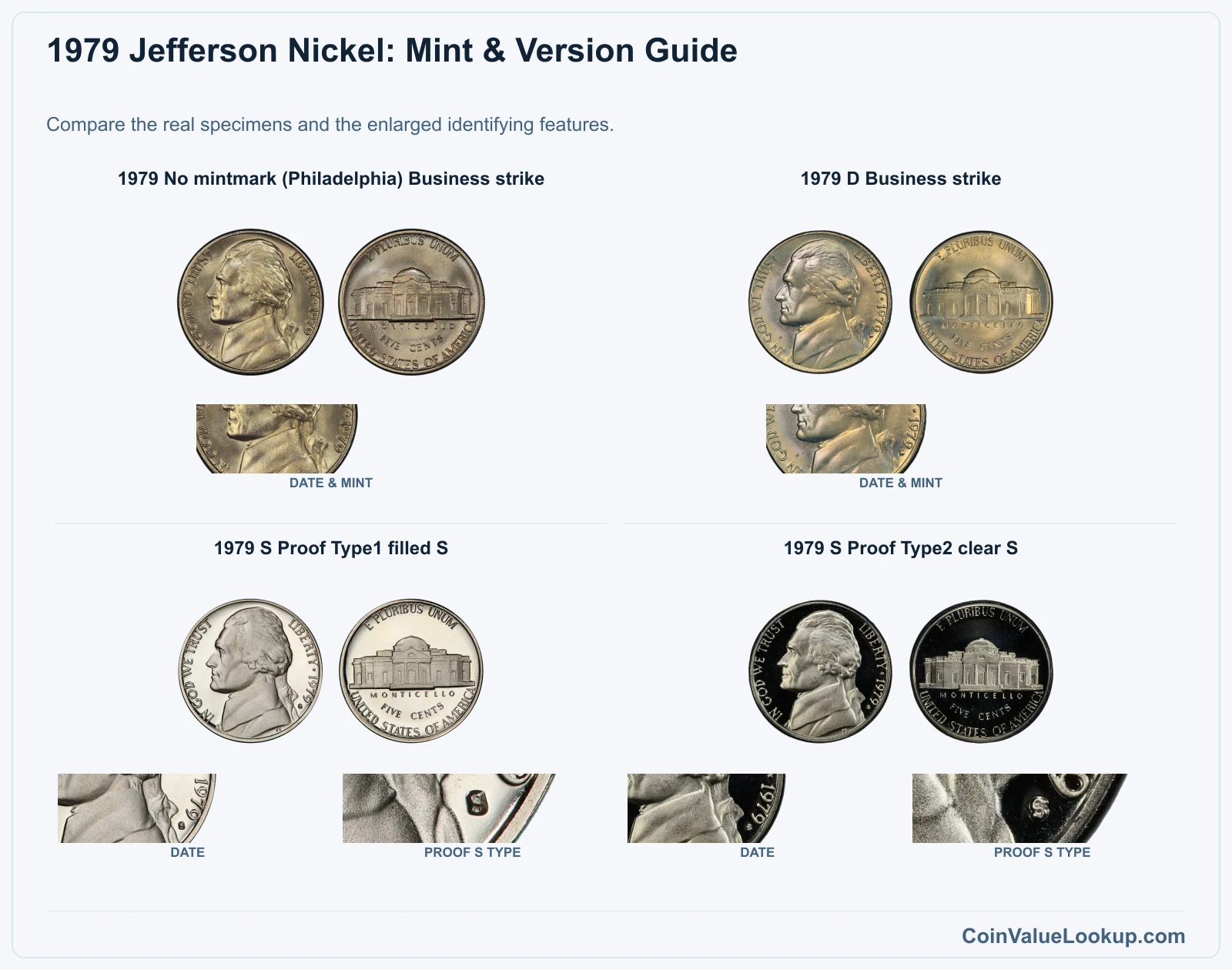
Three mints produced 1979 Jefferson nickels. Philadelphia strikes carry no mintmark.
Denver coins show a small "D," and San Francisco pieces bear an "S" reserved for proofs. The mintmark sits on the obverse, just below the date.
All regular 1979 nickels are 75% copper and 25% nickel, weigh about 5 grams, measure 21.2 mm across, and have a plain edge. This is a solid copper-nickel alloy, not a clad sandwich, so do not mistake normal surface wear or discoloration for a missing layer.
Proof finish is a manufacturing method, not a grade above Mint State. A proof can still have contact marks or haze.
Record both faces, the date, mint, finish type, and anything unusual about the coin's size or weight before drawing conclusions.
Step 2: Check Your 1979 Jefferson Nickel Grade
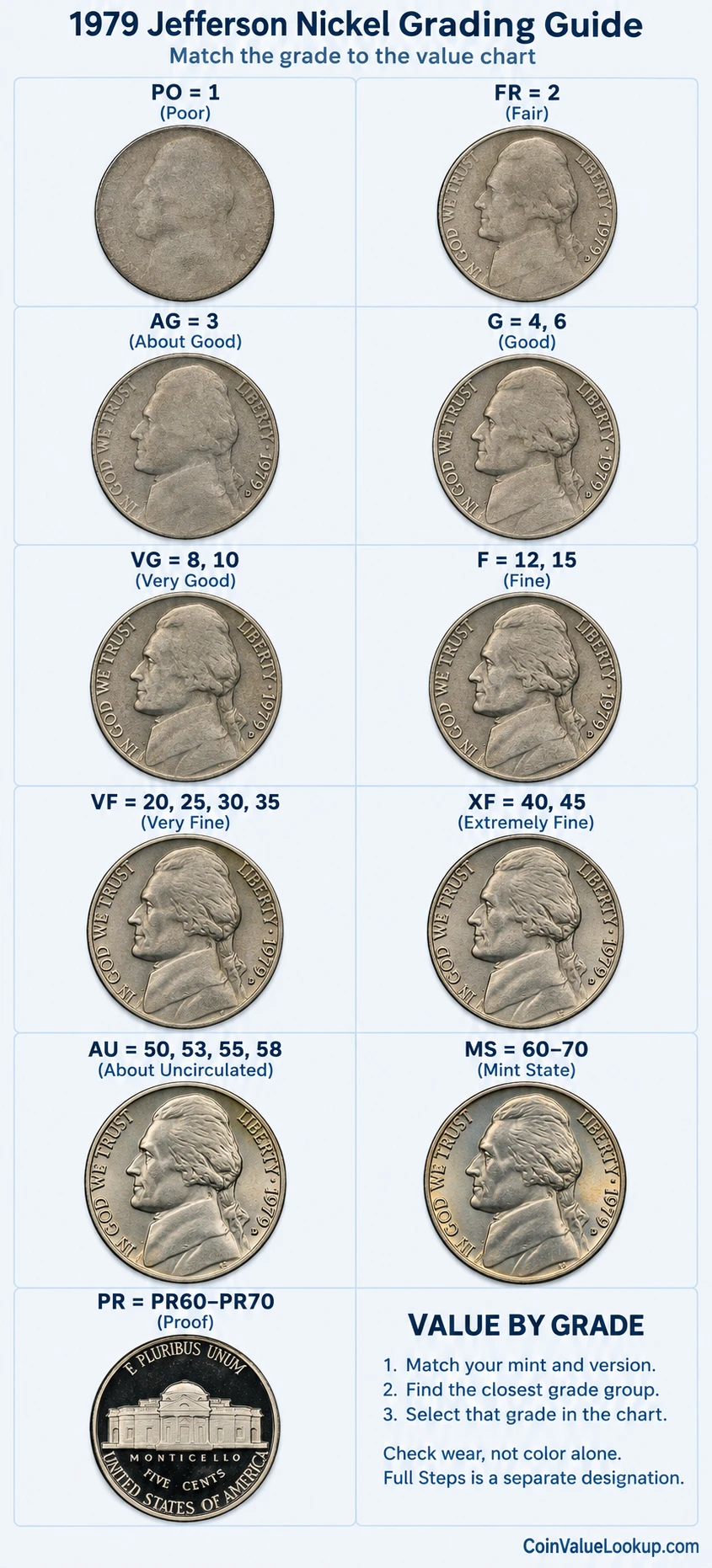
Start with Jefferson's cheekbone and the hair detail behind his ear. On a well-circulated coin, these high points flatten first.
Flip it over and check Monticello's columns and the triangular roof area for matching wear.
Full Steps is a strike-quality designation applied to business strikes whose Monticello staircase lines remain uninterrupted. That is different from steps that wore down in circulation.
A coin can look shiny and still lack Full Steps because the dies did not fully impress the design.
Surface preservation, original luster, and the number of contact marks all factor into the final grade. Compare your coin against the reference image to gauge where it falls.
Bag marks from other coins in mint storage are normal on uncirculated pieces and do not automatically disqualify a high grade, but heavy marks will limit it.
Step 3: Check 1979 Jefferson Nickel Value by Mint and Version
1979 Jefferson Nickel — No mintmark (Philadelphia) Business strike
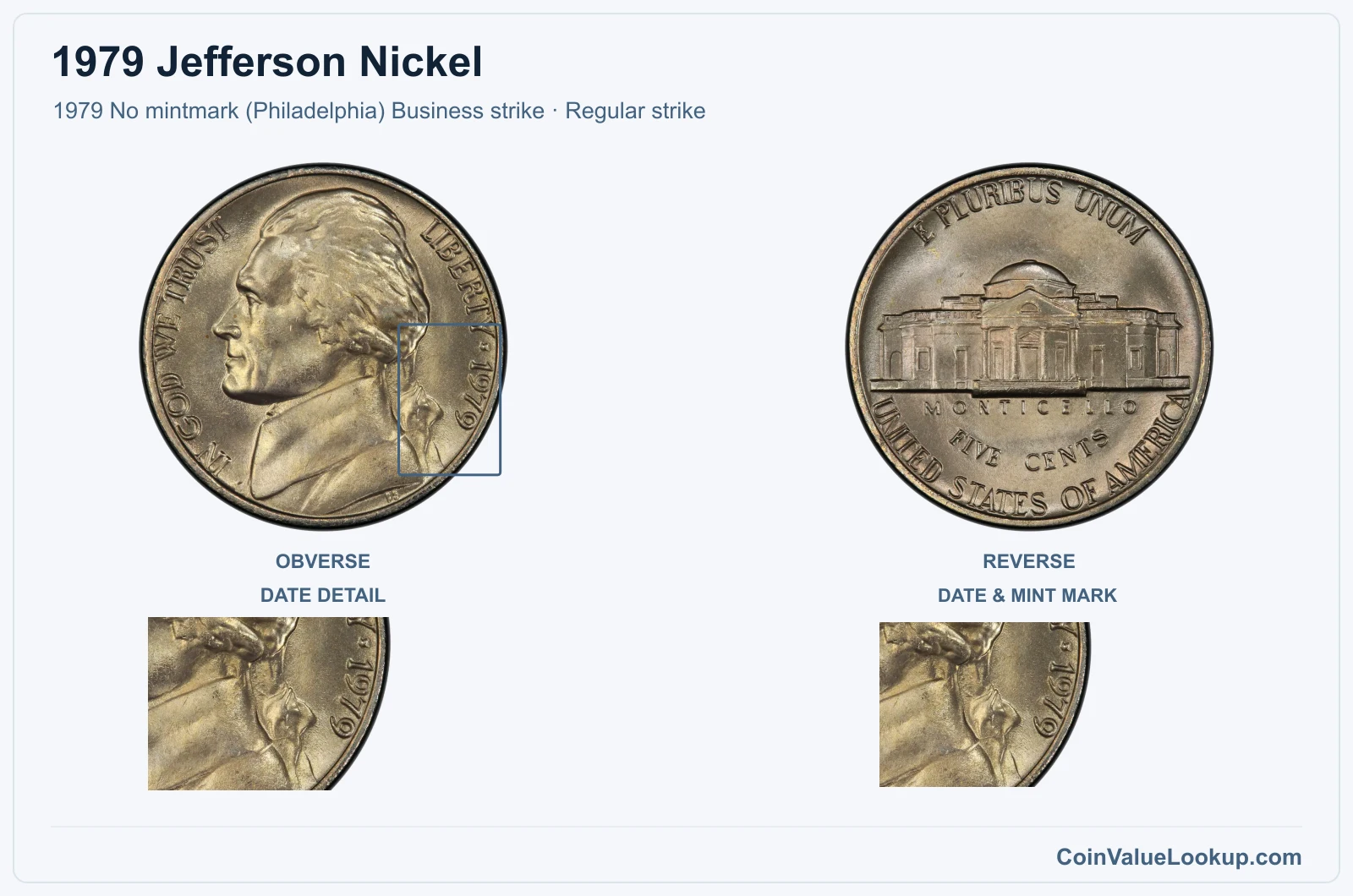
The 1979 Philadelphia nickel has no mintmark. Look below the date on the obverse and confirm the space is blank.
This is the standard circulation strike with Jefferson's portrait on the front and Monticello on the reverse.
Guide estimates place this version at about $0.30 in MS60 condition and around $3.62 at MS65. Worn examples from circulation are generally worth face value.
If your coin has strong luster and minimal bag marks, it may grade higher and warrant professional evaluation, especially if the Monticello steps are fully struck.
| Range | Grade | Price | Auction Records | Appraisal |
|---|---|---|---|---|
| PO | PO 1 | — | Coin Identifier | |
| FR | FR 2 | — | Coin Identifier | |
| AG | AG 3 | — | Coin Identifier | |
| G | G 4 | — | Coin Identifier | |
| G 6 | — | Coin Identifier | ||
| VG | VG 8 | — | Coin Identifier | |
| VG 10 | — | Coin Identifier | ||
| F | F 12 | — | Coin Identifier | |
| F 15 | — | Coin Identifier | ||
| VF | VF 20 | — | Coin Identifier | |
| VF 25 | — | Coin Identifier | ||
| VF 30 | — | Coin Identifier | ||
| VF 35 | — | Coin Identifier | ||
| XF | XF 40 | — | Coin Identifier | |
| XF 45 | — | Coin Identifier | ||
| AU | AU 50 | — | Coin Identifier | |
| AU 53 | — | Coin Identifier | ||
| AU 55 | — | Coin Identifier | ||
| AU 58 | — | Coin Identifier | ||
| MS | MS 60 | — | Coin Identifier | |
| MS 61 | — | Coin Identifier | ||
| MS 62 | — | Coin Identifier | ||
| MS 63 | Coin Identifier | |||
| MS 64 | Coin Identifier | |||
| MS 65 | — | Coin Identifier | ||
| MS 66 | Coin Identifier | |||
| MS 67 | — | — | — | |
| MS 68 | — | — | — | |
| MS 69 | — | — | — | |
| MS 70 | — | — | — |
1979 Jefferson Nickel — D Business strike
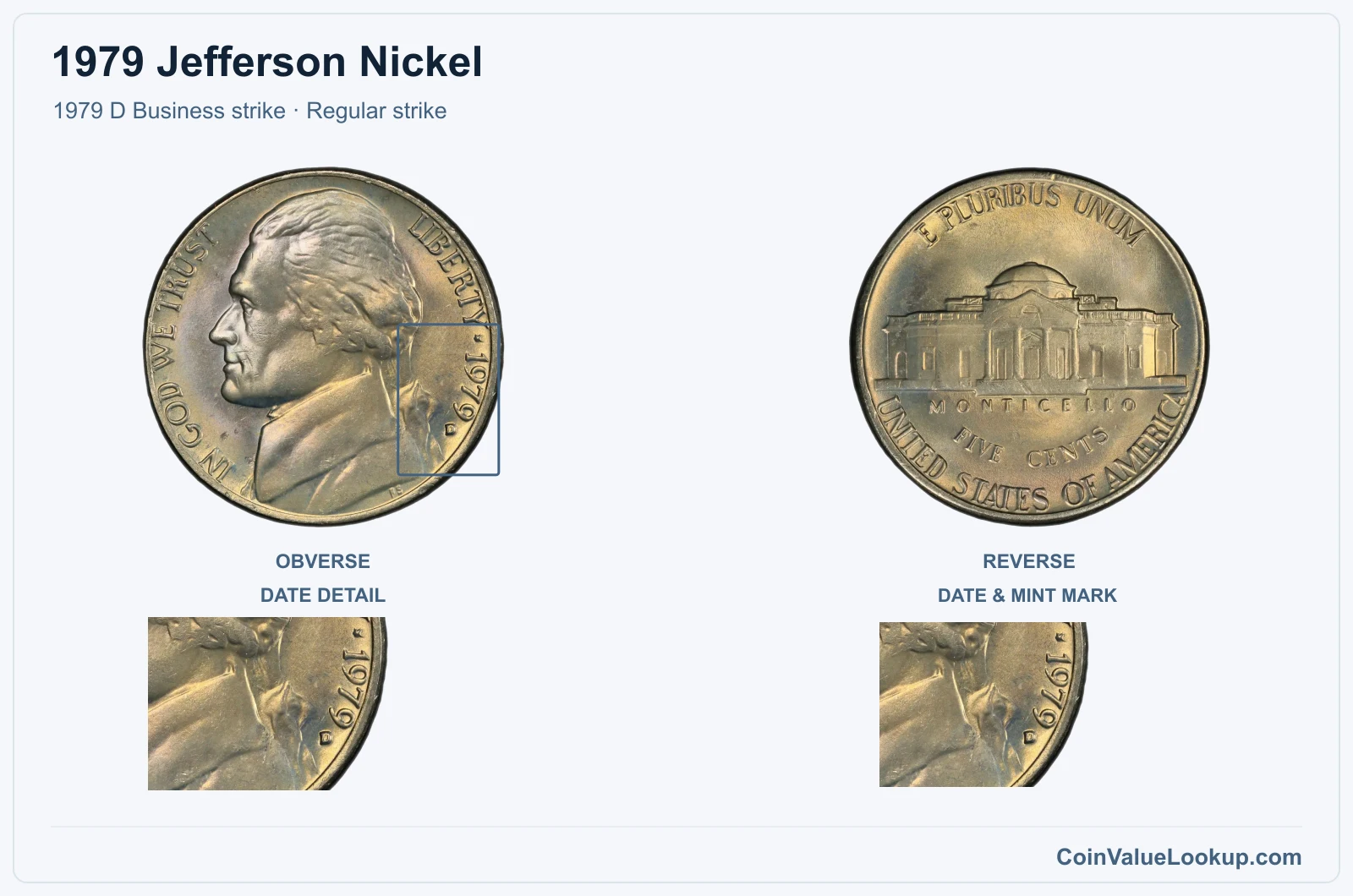
Denver strikes show a small "D" mintmark on the obverse below the date. Same alloy, same weight, same design as Philadelphia, just a different facility.
Guide estimates for the 1979-D run about $0.30 at MS60 and approximately $4.96 at MS65, making the Denver issue slightly higher than Philadelphia at the top uncirculated grade point. As always, circulated pieces are worth five cents.
Look for clean surfaces and strong step detail if you think yours might grade well.
Coin Value Lookup is a good place to check guides for other Jefferson nickel years and denominations while you are sorting through a collection.
| Range | Grade | Price | Auction Records | Appraisal |
|---|---|---|---|---|
| PO | PO 1 | — | Coin Identifier | |
| FR | FR 2 | — | Coin Identifier | |
| AG | AG 3 | — | Coin Identifier | |
| G | G 4 | — | Coin Identifier | |
| G 6 | — | Coin Identifier | ||
| VG | VG 8 | — | Coin Identifier | |
| VG 10 | — | Coin Identifier | ||
| F | F 12 | — | Coin Identifier | |
| F 15 | — | Coin Identifier | ||
| VF | VF 20 | — | Coin Identifier | |
| VF 25 | — | Coin Identifier | ||
| VF 30 | — | Coin Identifier | ||
| VF 35 | — | Coin Identifier | ||
| XF | XF 40 | — | Coin Identifier | |
| XF 45 | — | Coin Identifier | ||
| AU | AU 50 | — | Coin Identifier | |
| AU 53 | — | Coin Identifier | ||
| AU 55 | — | Coin Identifier | ||
| AU 58 | — | Coin Identifier | ||
| MS | MS 60 | — | Coin Identifier | |
| MS 61 | — | Coin Identifier | ||
| MS 62 | — | Coin Identifier | ||
| MS 63 | — | Coin Identifier | ||
| MS 64 | — | Coin Identifier | ||
| MS 65 | — | Coin Identifier | ||
| MS 66 | Coin Identifier | |||
| MS 67 | — | — | — | |
| MS 68 | — | — | — | |
| MS 69 | — | — | — | |
| MS 70 | — | — | — |
1979 Jefferson Nickel — S Proof Type1 filled S
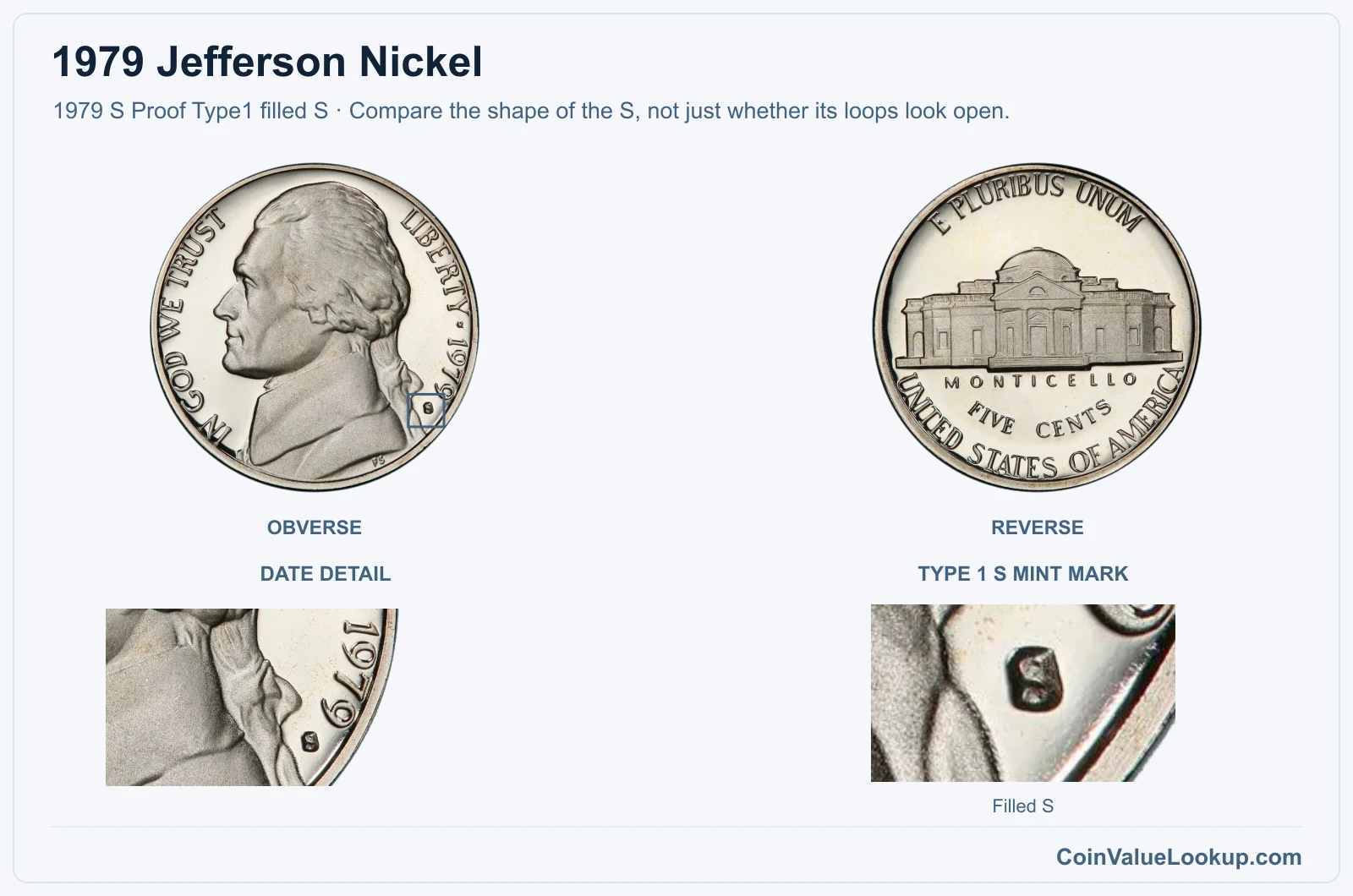
The 1979-S Type 1 proof has a filled "S" mintmark. Under magnification the interior of the letter looks blobby or partially filled in, giving it a mushy appearance compared to the Type 2.
This is not damage or wear; it is a different mintmark punch used early in production.
Compare the S shape only against other 1979 proofs. Do not use a worn business-strike mintmark as your reference.
A base proof guide estimate at PR65 is about $6.25. That figure applies to standard proof finish only and does not extend to cameo or deep cameo designations, which are tracked separately.
Identifying which type you have requires a clear, well-lit closeup of the mintmark area.
| Range | Grade | Price | Auction Records | Appraisal |
|---|---|---|---|---|
| PR | PR 1 | — | Coin Identifier | |
| PR 2 | — | Coin Identifier | ||
| PR 3 | — | Coin Identifier | ||
| PR 4 | — | Coin Identifier | ||
| PR 6 | — | Coin Identifier | ||
| PR 8 | — | Coin Identifier | ||
| PR 10 | — | Coin Identifier | ||
| PR 12 | — | Coin Identifier | ||
| PR 15 | — | Coin Identifier | ||
| PR 20 | — | Coin Identifier | ||
| PR 25 | — | Coin Identifier | ||
| PR 30 | — | Coin Identifier | ||
| PR 35 | — | Coin Identifier | ||
| PR 40 | — | Coin Identifier | ||
| PR 45 | — | Coin Identifier | ||
| PR 50 | — | Coin Identifier | ||
| PR 53 | — | Coin Identifier | ||
| PR 55 | — | Coin Identifier | ||
| PR 58 | — | Coin Identifier | ||
| PR 60 | — | Coin Identifier | ||
| PR 61 | — | Coin Identifier | ||
| PR 62 | — | Coin Identifier | ||
| PR 63 | — | Coin Identifier | ||
| PR 64 | — | Coin Identifier | ||
| PR 65 | — | Coin Identifier | ||
| PR 66 | Coin Identifier | |||
| PR 67 | Coin Identifier | |||
| PR 68 | Coin Identifier | |||
| PR 69 | Coin Identifier | |||
| PR 70 | Coin Identifier |
1979 Jefferson Nickel — S Proof Type2 clear S
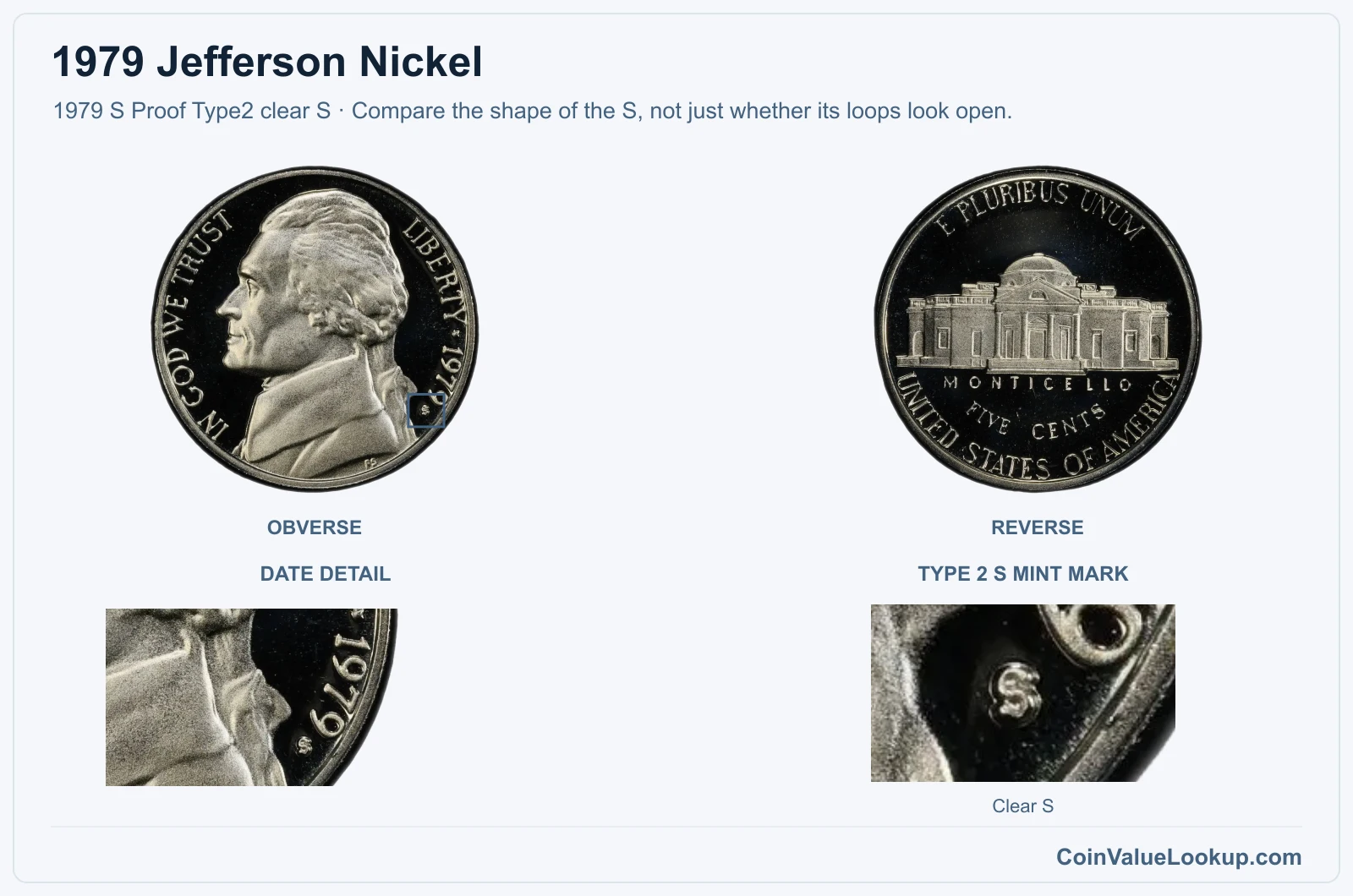
The 1979-S Type 2 proof carries a distinctly sharper, more clearly defined "S" mintmark. The serifs and interior openings of the letter are crisp rather than filled.
Side-by-side comparison with a Type 1 makes the difference obvious, but a single coin viewed alone can be tricky for beginners.
A base proof guide estimate at PR65 is about $2.50. Again, this is for standard proof finish and does not apply to cameo or deep cameo examples.
The Type 2 clear S is a deliberate mintmark-punch variety, not an error. Worn dies or debris can sometimes make an S look partially filled on other years, so restrict your comparison to 1979-dated proofs when trying to classify yours.
| Range | Grade | Price | Auction Records | Appraisal |
|---|---|---|---|---|
| PR | PR 1 | — | Coin Identifier | |
| PR 2 | — | Coin Identifier | ||
| PR 3 | — | Coin Identifier | ||
| PR 4 | — | Coin Identifier | ||
| PR 6 | — | Coin Identifier | ||
| PR 8 | — | Coin Identifier | ||
| PR 10 | — | Coin Identifier | ||
| PR 12 | — | Coin Identifier | ||
| PR 15 | — | Coin Identifier | ||
| PR 20 | — | Coin Identifier | ||
| PR 25 | — | Coin Identifier | ||
| PR 30 | — | Coin Identifier | ||
| PR 35 | — | Coin Identifier | ||
| PR 40 | — | Coin Identifier | ||
| PR 45 | — | Coin Identifier | ||
| PR 50 | — | Coin Identifier | ||
| PR 53 | — | Coin Identifier | ||
| PR 55 | — | Coin Identifier | ||
| PR 58 | — | Coin Identifier | ||
| PR 60 | — | Coin Identifier | ||
| PR 61 | — | Coin Identifier | ||
| PR 62 | — | Coin Identifier | ||
| PR 63 | — | Coin Identifier | ||
| PR 64 | — | Coin Identifier | ||
| PR 65 | — | Coin Identifier | ||
| PR 66 | — | Coin Identifier | ||
| PR 67 | Coin Identifier | |||
| PR 68 | Coin Identifier | |||
| PR 69 | Coin Identifier | |||
| PR 70 | Coin Identifier |
1979 Jefferson Nickel Error List
1. 1979 Jefferson Nickel — Struck over a1978cent
This is a 1979 nickel struck over a 1978 Lincoln cent. The nickel's Jefferson portrait and Monticello design overlie the earlier cent, and the 1978 undertype date is still visible near the back of Jefferson's head.
That leftover date is the key diagnostic.
A Philadelphia-mint example graded NGC MS65 RB sold through Heritage Auctions in January 2011 for $2,990. Because the prior coin's design is literally embedded beneath the new strike, this cannot be replicated by a vise job or simple plating.
A wrong-planchet error with no underlying design is a different category entirely.
Authentication by a major grading service is essential here. The copper undertones from the cent blank give the coin an unusual color, but color alone does not prove a strike-over; you need that underlying design confirmed.
2. 1979 Jefferson Nickel — Struck on cent blank
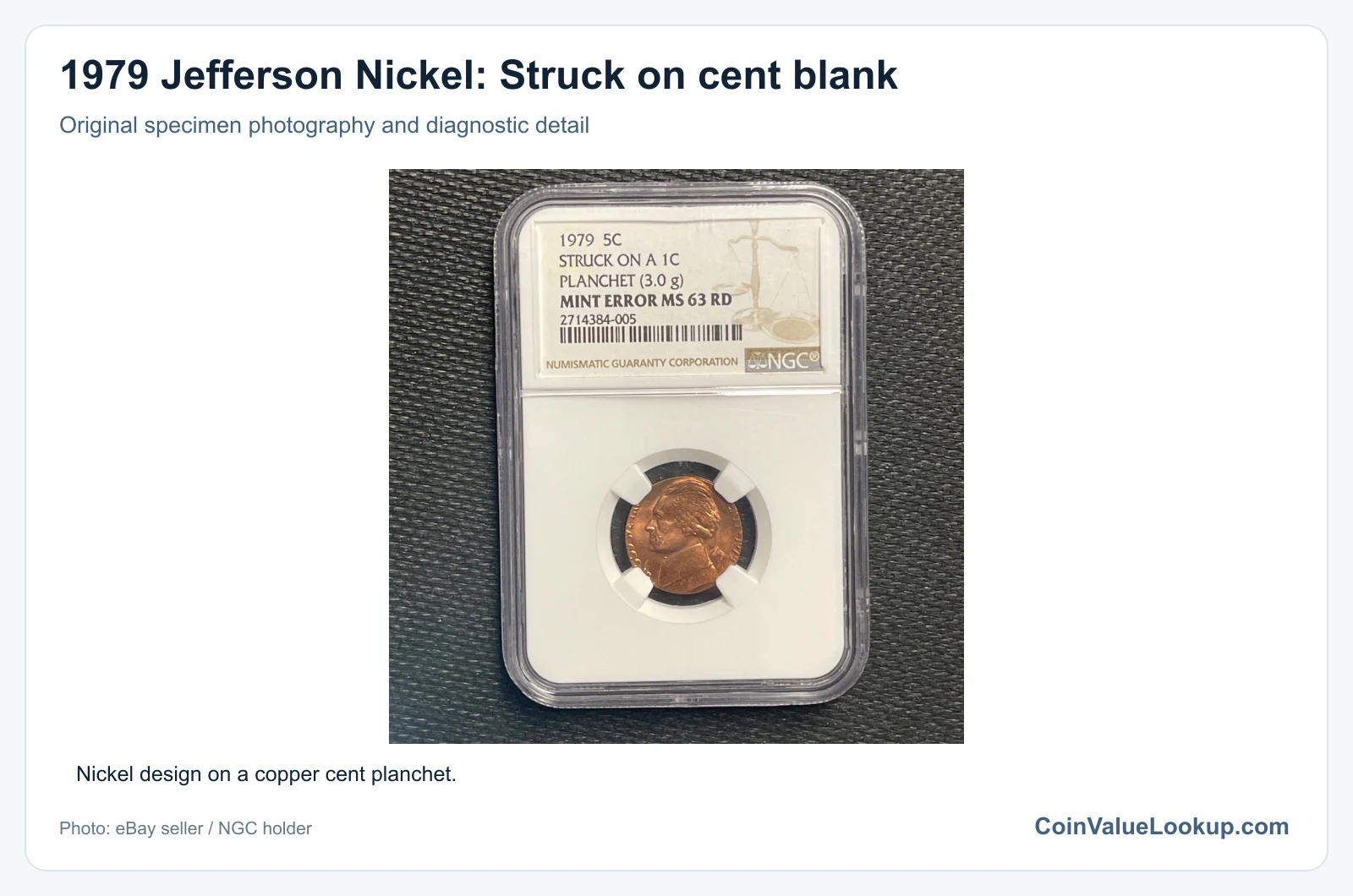
A 1979 nickel struck on a cent-sized copper blank weighs roughly 3.1 grams instead of the normal 5 grams. The nickel design appears on both sides, but outer lettering and rim detail are cropped because the planchet is smaller than intended.
A Philadelphia example graded NGC MS64 RB sold through Heritage Auctions in November 2020 for $216. The copper color is obvious, but be careful: coins that have been copper-plated, chemically altered, or ground down can mimic the look.
Weigh the coin. If it is close to 5 grams and normal diameter, the color is almost certainly environmental or artificial.
Both faces and accurate weight are needed for any preliminary identification of this type.
3. 1979 Jefferson Nickel — Double strike with brockage
This compound error combines a second off-center strike with a brockage impression. The coin was struck once normally, then struck again roughly 65% off center, and during that second strike the reverse picked up an incuse mirror-image transfer from an adjacent coin or die cap.
The result is a dramatic, visually complex piece.
A 1979-D example graded PCGS MS65 sold through Heritage Auctions in April 2020 for $552. To distinguish genuine compound errors from post-mint damage, look for consistent metal flow and design continuity across both strikes.
Machine doubling produces flat, shelf-like doubling on a single strike and lacks the displaced second impression. Vise damage can press designs together but typically shows uneven pressure and lacks mint luster in the transferred area.
4. 1979 Jefferson Nickel — Off-center strike
An off-center strike happens when the planchet is not properly seated between the dies. The result is a blank crescent on one side and missing design on the opposite side.
How much of the design is missing, and whether the date is still readable, heavily influences value.
A Philadelphia 1979 nickel struck approximately 60% off center at the 11:30 position was authenticated by ANACS at MS63. The value of any individual off-center nickel depends on authenticated identity, condition, and the severity of the displacement.
Date visibility is critical: a dramatic off-center piece that lost the date is far less desirable than one that kept it.
Do not confuse a genuine off-center strike with a misaligned die, a trimmed edge, or a weak strike near the rim. Genuine displacement shows a smooth, unstruck blank area, not a rough cut or gradual fade.