1968 Washington Quarter Coin Value: How Much Is It Worth?
Most 1968 Washington quarters you find in pocket change are worth face value — 25 cents. These are copper-nickel clad coins, not silver, even the ones with an S mintmark.
In higher uncirculated grades the picture changes a bit: a USA Coin Book guide estimate puts a top-condition Philadelphia piece around $10 at MS65. Certain mint errors can push values much higher, so it is worth knowing what to look for.
Fast Way to Identify Your 1968 Washington Quarter
The quickest way to start is to upload clear photos of both sides of your coin. A front-and-back image lets our identifier give you a preliminary read on which version you have — Philadelphia, Denver, or San Francisco proof — and flag anything that looks unusual.
Snap both sides in even light and avoid glare.
1968 Washington Quarter Value
Upload both sides of your 1968 Washington Quarter.
Front Obverse
Upload photo
Back Reverse
Upload photo
Which 1968 Washington Quarter Versions Are Worth Money?
- A 1968-S proof struck on a 90% silver planchet sold for $11,700 at Heritage in May 2022 — a rare wrong-planchet error.
- A 1968-S proof double strike with obverse rotation brought $1,680 at Heritage in August 2024 in PR68 Ultra Cameo.
- A 1968 Philadelphia quarter missing its reverse clad layer sold for $67.85 in AU58 at Heritage in March 2004.
- A 1968 Philadelphia outer-clad-layer off-center strike sold for $240 in MS64 at Heritage in December 2022.
- Doubled die obverse and doubled die reverse varieties have been reported for the 1968 date and may carry premiums depending on visibility and grade.
Step 1: Identify Your 1968 Washington Quarter Mint Mark and Version
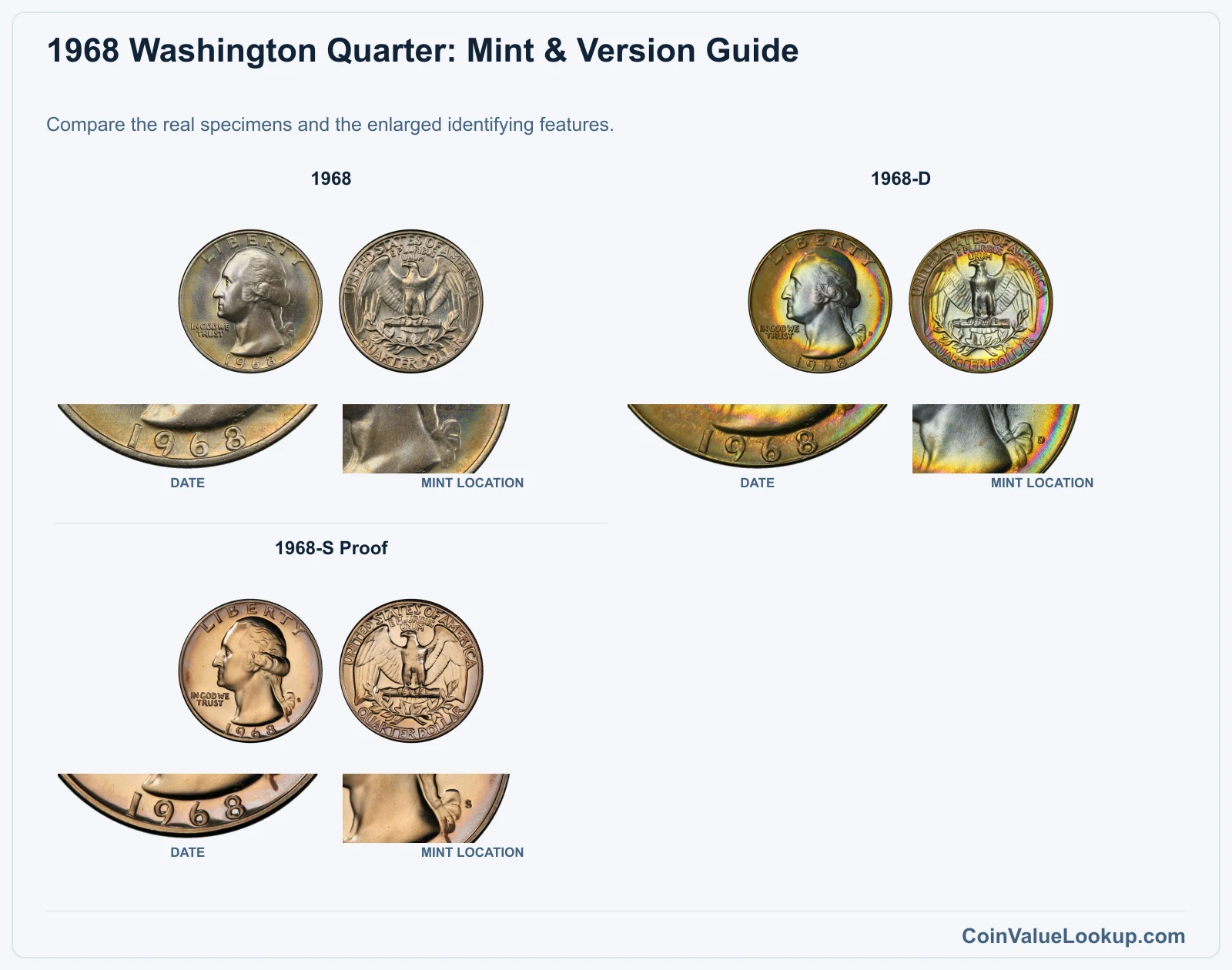
The 1968 quarter was the first year the mintmark appeared on the obverse, near the date at about the 4 o'clock position. Philadelphia coins carry no mintmark at all.
A "D" means Denver, and an "S" means San Francisco proof.
Don't assume a missing letter is an error. From 1965 through 1967 mintmarks were suppressed entirely, and even on 1968 Philadelphia coins there simply is no letter.
That is normal.
All three versions are copper-nickel clad over a copper core, weighing about 5.67 grams with a diameter of roughly 24.3 mm. If you look at the edge, you should see a thin copper stripe sandwiched between silvery layers.
The S mintmark does not indicate silver — standard 1968-S proofs are clad just like their circulation counterparts.
Design-wise, these carry the classic Washington bust obverse and the heraldic eagle with arrows and olive branches on the reverse.
Step 2: Check Your 1968 Washington Quarter Grade
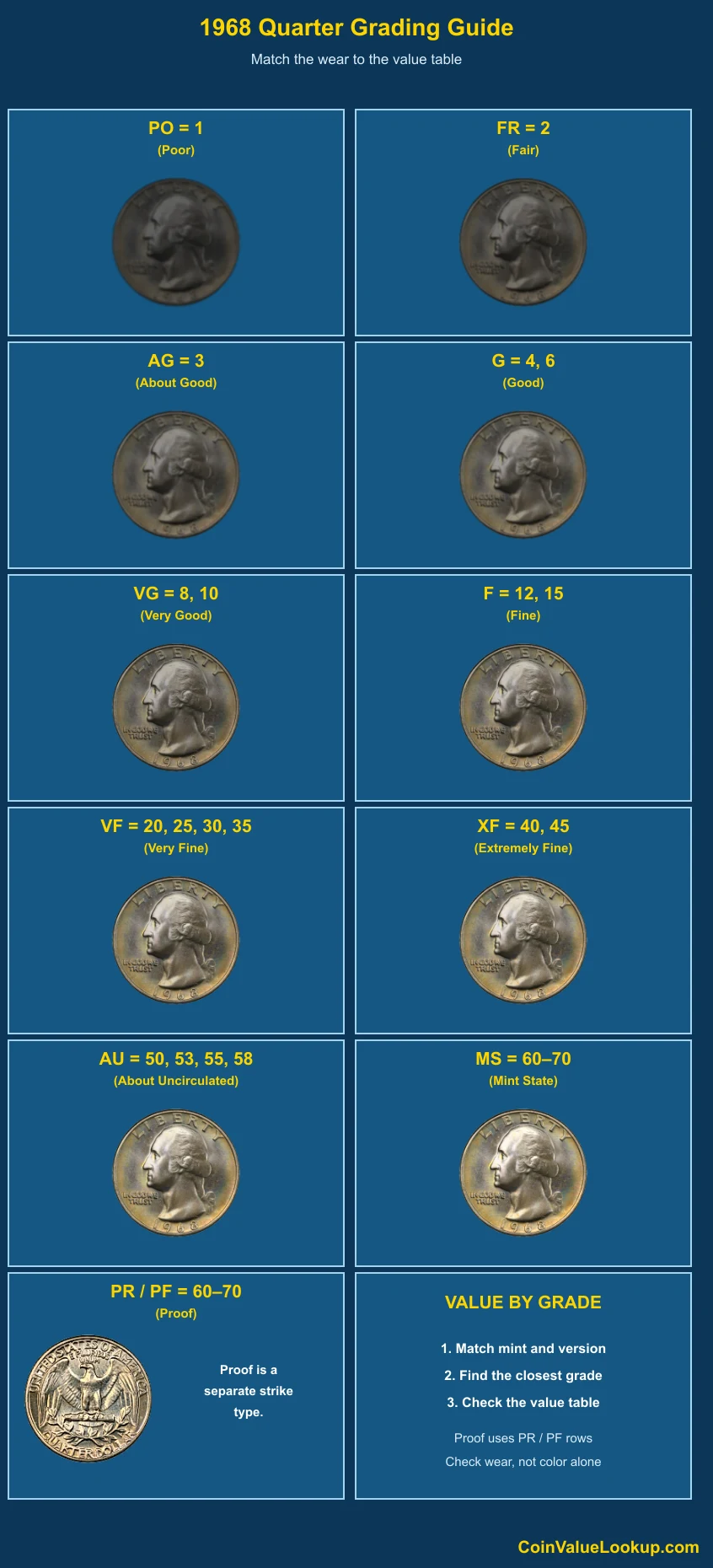
Start by checking the hair detail above Washington's ear. On a well-worn coin that area will be flat and featureless, while a mint-state piece retains full individual strands.
The cheekbone and jawline lose sharpness next.
Flip the coin over and inspect the eagle's breast feathers. They wear quickly on circulated examples.
Compare your coin to the reference image to see how luster breaks progress from AU down through VF and beyond.
Surface quality matters too. Hairlines from cleaning, contact marks from other coins, and rim dings all drag the grade down even if the high points look sharp.
A proof coin should be evaluated on its mirrored fields and any frost on the devices — polishing a circulation coin cannot turn it into a proof.
Step 3: Check 1968 Washington Quarter Value by Mint and Version
1968 Washington Quarter
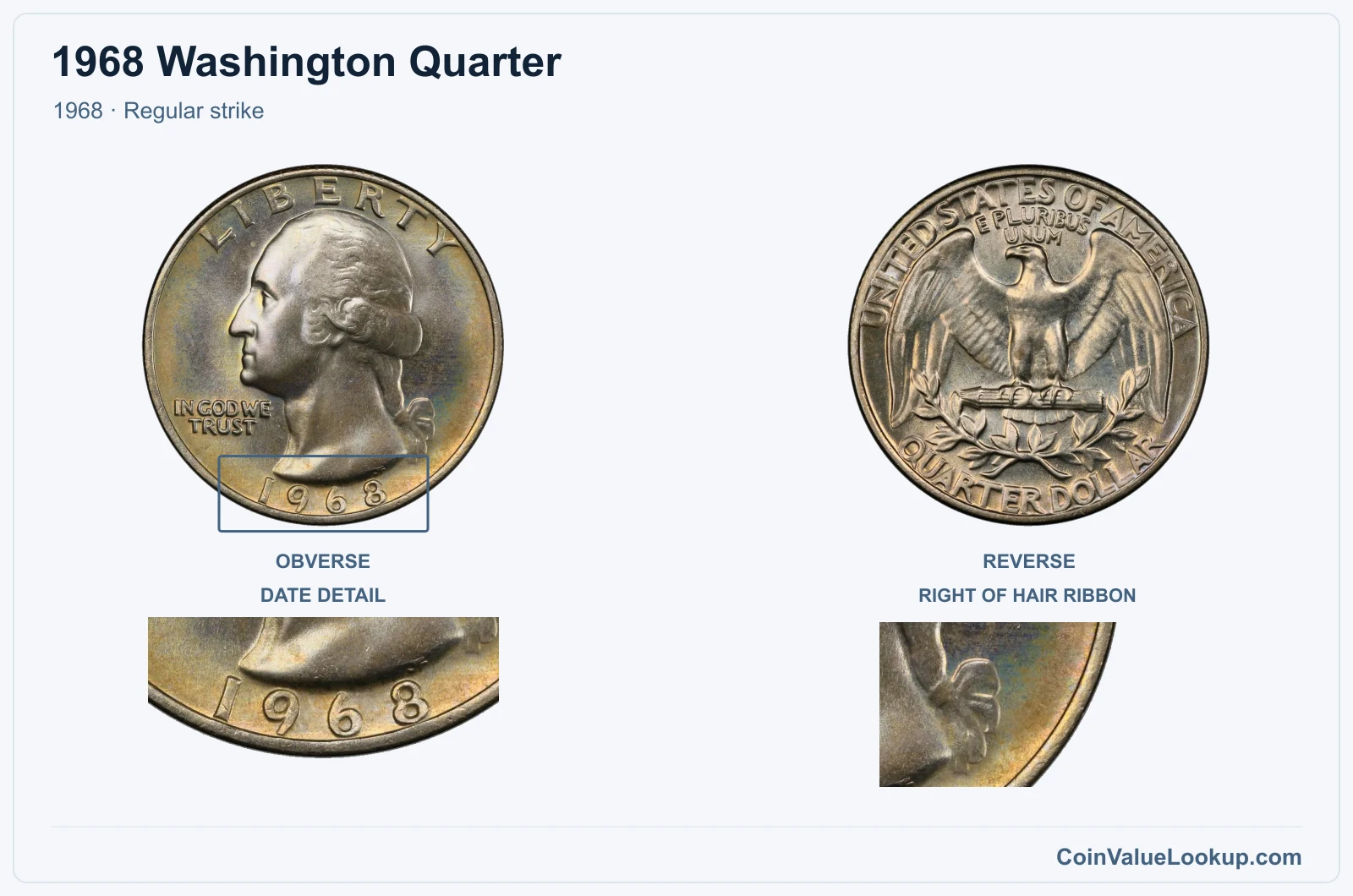
The 1968 Philadelphia quarter has no mintmark — just a blank space near the date on the obverse. That is perfectly normal, not an error.
These are copper-nickel clad business strikes with the standard Washington obverse and eagle reverse.
In well-worn condition they spend at face value. A USA Coin Book guide estimate places an MS65 example at about $10.
Finding one that clean is uncommon because hundreds of millions entered circulation and took a beating. Look for full hair detail, no contact marks, and original luster if you think yours might grade that high.
| Range | Grade | Price | Auction Records | Appraisal |
|---|---|---|---|---|
| PO | PO 1 | — | Coin Identifier | |
| FR | FR 2 | — | Coin Identifier | |
| AG | AG 3 | — | Coin Identifier | |
| G | G 4 | — | Coin Identifier | |
| G 6 | — | Coin Identifier | ||
| VG | VG 8 | — | Coin Identifier | |
| VG 10 | — | Coin Identifier | ||
| F | F 12 | — | Coin Identifier | |
| F 15 | — | Coin Identifier | ||
| VF | VF 20 | — | Coin Identifier | |
| VF 25 | — | Coin Identifier | ||
| VF 30 | — | Coin Identifier | ||
| VF 35 | — | Coin Identifier | ||
| XF | XF 40 | — | Coin Identifier | |
| XF 45 | — | Coin Identifier | ||
| AU | AU 50 | — | Coin Identifier | |
| AU 53 | — | Coin Identifier | ||
| AU 55 | — | Coin Identifier | ||
| AU 58 | — | Coin Identifier | ||
| MS | MS 60 | — | Coin Identifier | |
| MS 61 | — | Coin Identifier | ||
| MS 62 | — | Coin Identifier | ||
| MS 63 | — | Coin Identifier | ||
| MS 64 | — | Coin Identifier | ||
| MS 65 | Coin Identifier | |||
| MS 66 | Coin Identifier | |||
| MS 67 | Coin Identifier | |||
| MS 68 | Coin Identifier | |||
| MS 69 | — | — | — | |
| MS 70 | — | — | — |
1968 Washington Quarter — D
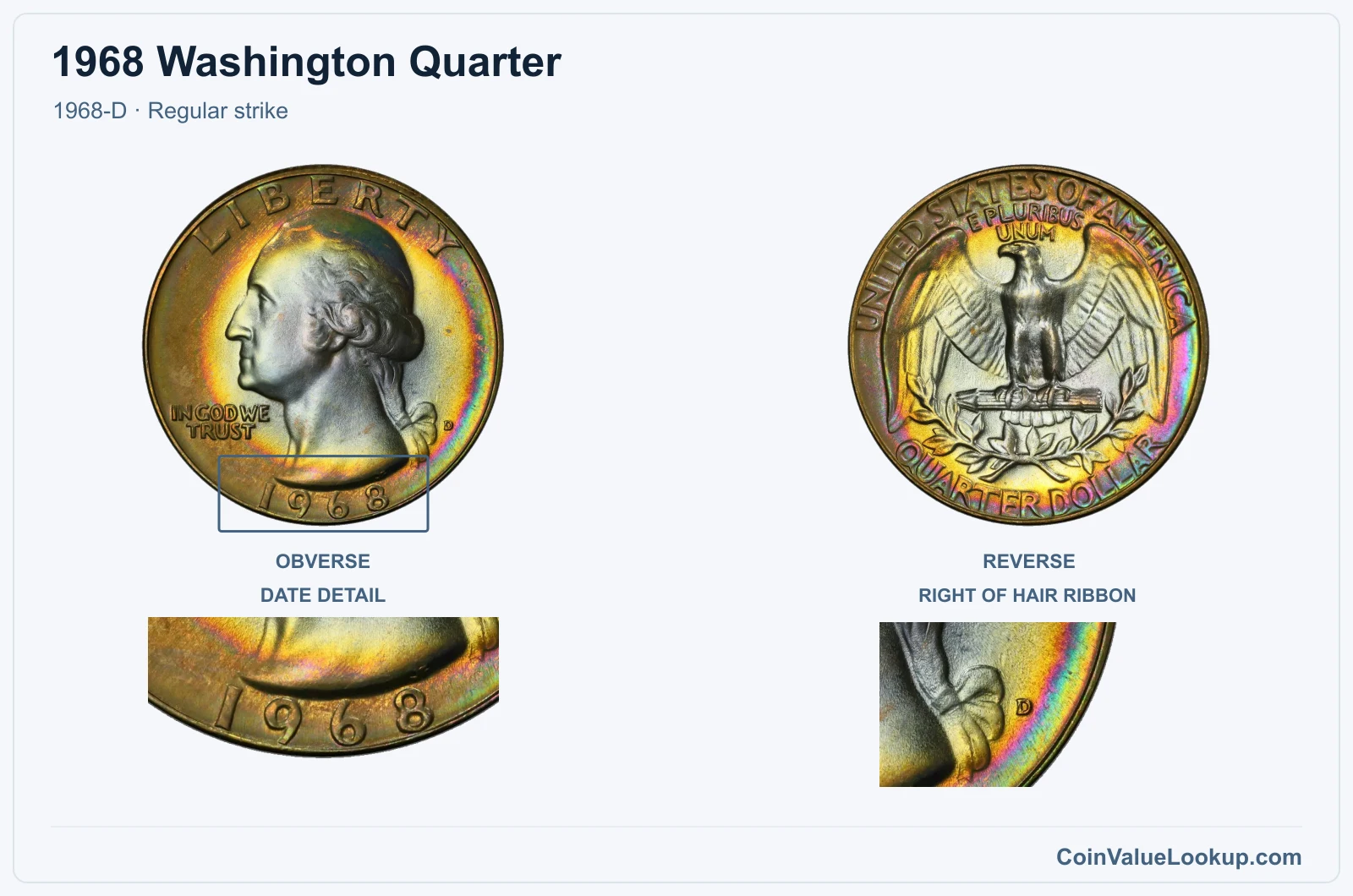
The 1968-D was struck at the Denver Mint and carries a small "D" mintmark on the obverse near the date. Same copper-nickel clad composition, same design.
A USA Coin Book guide estimate for MS65 is around $7.29. Circulated pieces are worth face value.
Denver struck enormous quantities of these, so gem survivors exist but you have to earn them — bag marks and light wear knock most examples out of the running.
Coin Value Lookup is a handy starting point if you want to check guide values for other dates and denominations in the Washington quarter series.
| Range | Grade | Price | Auction Records | Appraisal |
|---|---|---|---|---|
| PO | PO 1 | — | Coin Identifier | |
| FR | FR 2 | — | Coin Identifier | |
| AG | AG 3 | — | Coin Identifier | |
| G | G 4 | — | Coin Identifier | |
| G 6 | — | Coin Identifier | ||
| VG | VG 8 | — | Coin Identifier | |
| VG 10 | — | Coin Identifier | ||
| F | F 12 | — | Coin Identifier | |
| F 15 | — | Coin Identifier | ||
| VF | VF 20 | — | Coin Identifier | |
| VF 25 | — | Coin Identifier | ||
| VF 30 | — | Coin Identifier | ||
| VF 35 | — | Coin Identifier | ||
| XF | XF 40 | — | Coin Identifier | |
| XF 45 | — | Coin Identifier | ||
| AU | AU 50 | — | Coin Identifier | |
| AU 53 | — | Coin Identifier | ||
| AU 55 | — | Coin Identifier | ||
| AU 58 | — | Coin Identifier | ||
| MS | MS 60 | — | Coin Identifier | |
| MS 61 | — | Coin Identifier | ||
| MS 62 | — | Coin Identifier | ||
| MS 63 | — | Coin Identifier | ||
| MS 64 | — | Coin Identifier | ||
| MS 65 | Coin Identifier | |||
| MS 66 | Coin Identifier | |||
| MS 67 | Coin Identifier | |||
| MS 68 | Coin Identifier | |||
| MS 69 | — | — | — | |
| MS 70 | — | — | — |
1968 Washington Quarter — S Proof
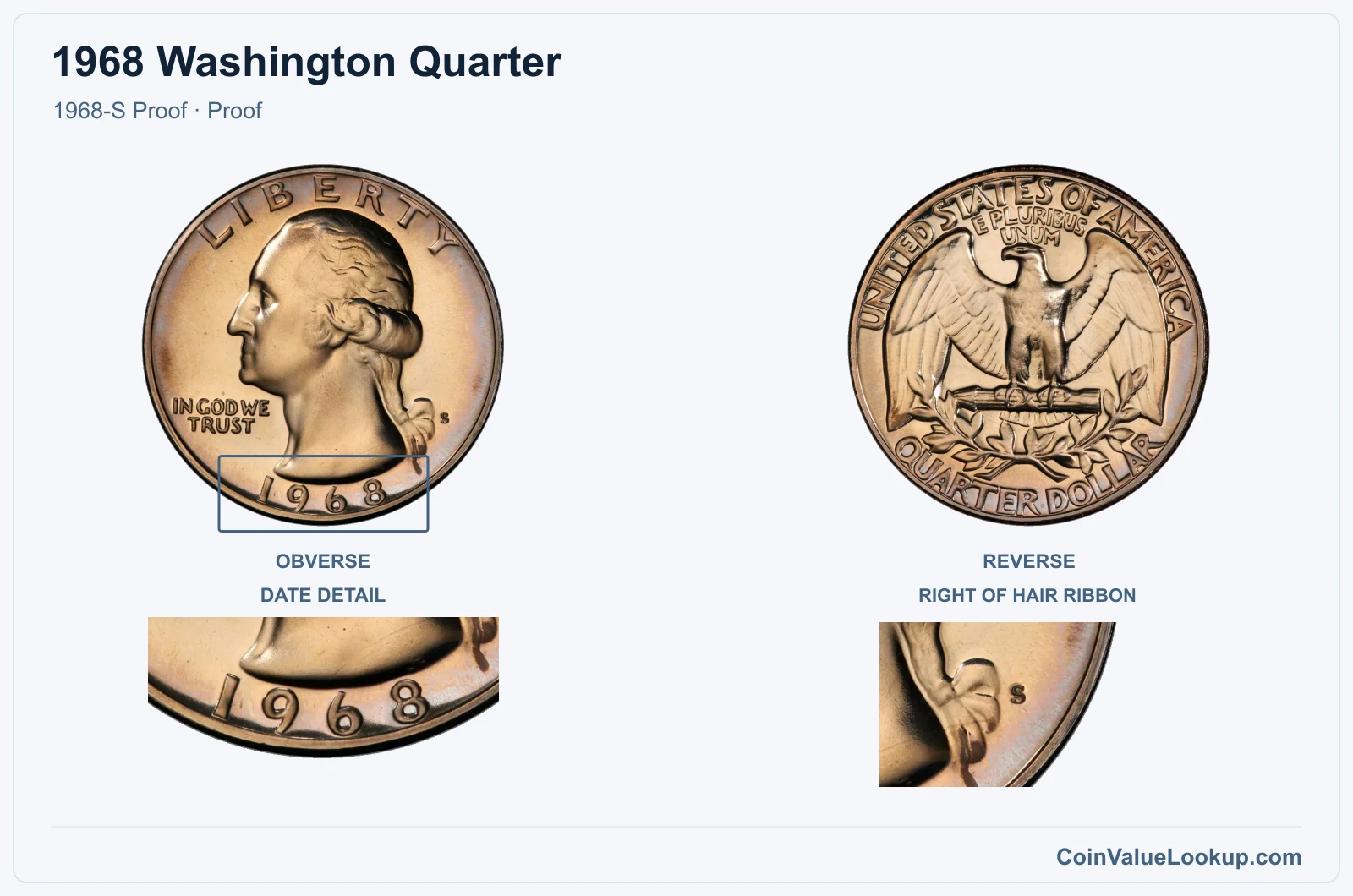
The 1968-S proof quarter was struck at the San Francisco Mint, which resumed proof production that year after a hiatus. It carries an "S" mintmark on the obverse near the date.
Despite the S, this is a copper-nickel clad coin, not silver.
Proofs were sold in sets to collectors, so most survive in excellent condition. A USA Coin Book guide estimate at PR65 is about $6.25.
These have mirrored fields and sharply struck devices. To grade higher, the surfaces need to be free of haze, hairlines, and toning spots.
Cameo or deep-cameo contrast between frosted devices and reflective fields can add appeal, but this guide estimate covers the standard proof designation.
| Range | Grade | Price | Auction Records | Appraisal |
|---|---|---|---|---|
| PR | PR 1 | — | Coin Identifier | |
| PR 2 | — | Coin Identifier | ||
| PR 3 | — | Coin Identifier | ||
| PR 4 | — | Coin Identifier | ||
| PR 6 | — | Coin Identifier | ||
| PR 8 | — | Coin Identifier | ||
| PR 10 | — | Coin Identifier | ||
| PR 12 | — | Coin Identifier | ||
| PR 15 | — | Coin Identifier | ||
| PR 20 | — | Coin Identifier | ||
| PR 25 | — | Coin Identifier | ||
| PR 30 | — | Coin Identifier | ||
| PR 35 | — | Coin Identifier | ||
| PR 40 | — | Coin Identifier | ||
| PR 45 | — | Coin Identifier | ||
| PR 50 | — | Coin Identifier | ||
| PR 53 | — | Coin Identifier | ||
| PR 55 | — | Coin Identifier | ||
| PR 58 | — | Coin Identifier | ||
| PR 60 | — | Coin Identifier | ||
| PR 61 | — | Coin Identifier | ||
| PR 62 | — | Coin Identifier | ||
| PR 63 | — | Coin Identifier | ||
| PR 64 | — | Coin Identifier | ||
| PR 65 | Coin Identifier | |||
| PR 66 | Coin Identifier | |||
| PR 67 | Coin Identifier | |||
| PR 68 | Coin Identifier | |||
| PR 69 | Coin Identifier | |||
| PR 70 | — | — | — |
1968 Washington Quarter Error List
1. 1968 Washington Quarter — Missing Reverse Clad Layer
A genuine 1968 Philadelphia quarter missing its reverse clad layer shows raw copper color on the reverse because the outer nickel-copper layer was never bonded to that side of the planchet. The documented example weighed only 4.6 grams — noticeably lighter than the normal 5.67 grams — and was graded AU58 by NGC.
That coin sold for $67.85 at a Heritage auction in March 2004. Weight is a key diagnostic: a coin that simply looks discolored but weighs normal is almost certainly corroded, stripped, or plated after leaving the mint.
To distinguish a genuine missing clad layer, examine both faces and the edge. The strike details on the affected side should still be sharp and consistent with a mint-produced coin, not rough or uneven the way post-mint damage looks.
2. 1968 Washington Quarter — Proof Struck on a 90% Silver Planchet
One documented 1968-S proof quarter was struck on a 90% silver planchet instead of the standard copper-nickel clad blank. That coin weighed 6.3 grams and was graded PR64 by PCGS.
It sold for $11,700 at Heritage in May 2022.
This is a wrong-planchet error, not a regular silver proof offering — there was no standard silver proof quarter in 1968. The edge is the giveaway: a silver planchet shows a uniform silver-colored edge with no copper core stripe.
You also need authenticated alloy confirmation, because a clad coin can be polished or plated to look silvery.
Do not assume your 1968-S proof is silver based on appearance alone. Post-mint alteration, corrosion, and filing can all change how an edge looks.
Professional attribution is essential for a claim this significant.
3. 1968 Washington Quarter — 50% Off-Center on Outer Clad Layer
This error is a 1968 Philadelphia quarter struck roughly 50% off-center on a detached outer clad layer — not a full planchet. The result is a thin, partial-design piece weighing only about 0.9 grams.
Heritage lot 93172, graded MS64 by NGC, sold for $240 in December 2022.
What makes this different from a regular off-center strike is the planchet itself: it is just one of the two outer clad layers, separated from the core before striking. A normal off-center coin retains a full-thickness planchet.
Look for the displacement of the design relative to the edge, plus an unusually thin cross-section. Post-mint filing or cutting can produce odd-looking fragments, but those lack genuine strike detail across the remaining surface.
4. 1968 Washington Quarter — Proof Double Strike with Obverse Rotation
A 1968-S proof quarter struck twice with obverse rotation shows two overlapping impressions of Washington's portrait and the inscriptions. The rotation between strikes means the second impression is visibly shifted, creating doubled text — especially noticeable on IN GOD WE TRUST and the neck detail.
An NGC PR68 Ultra Cameo example sold for $1,680 at Heritage in August 2024. The rotation should remain consistent when you flip the coin on a fixed axis; if the doubling shifts with viewing angle, you are probably seeing die deterioration or light reflections, not a genuine second strike.
Holder orientation does not confirm this error. Look for two distinct sets of design elements that cannot be explained by machine doubling or worn-die softness.
5. 1968 Washington Quarter — Doubled Die Obverse
Doubled die obverse varieties have been reported for both the 1968 Philadelphia and 1968-D Denver quarters. On a genuine doubled die, you will see consistent separation or notching on obverse lettering or design elements — the doubling looks the same under any lighting angle and persists across the affected area.
Compare your coin's obverse inscriptions to a known normal example under the same magnification. Machine doubling is far more common and typically shows a flat, shelf-like distortion rather than the rounded, separated profiles of a true doubled die.
Condition, the specific die variety, and the visibility of the doubling all affect what a collector might pay. No single guide price covers every doubled die, so individual assessment matters.
6. 1968 Washington Quarter — Broadstrike
A broadstrike occurs when the coin is struck without the retaining collar that normally shapes the edge and controls the diameter. The result is a coin that spreads outward, looking slightly larger than normal with a smooth or irregular rim instead of the usual reeded edge.
This has been reported for the 1968 quarter. A genuine broadstrike retains a complete or near-complete design — the coin was centered in the press, just unconstrained at the edge.
That distinguishes it from an off-center strike, which shifts the design away from the planchet center.
Watch out for coins flattened after leaving the mint by a railroad track or a vice. Those lack the sharp strike detail and normal surface texture of a mint-produced broadstrike.
Value depends on condition and how dramatic the spread is.
7. 1968 Washington Quarter — Repunched Mintmark
Repunched mintmark varieties have been reported for the 1968-D Denver quarter. Before mintmarks were added to the working die by a single hub, they were hand-punched, and sometimes the punch landed slightly off position on the first try.
The result is a trace of the original placement visible alongside the final D.
To check, examine the D mintmark under magnification for any remnant of a second, slightly offset letter. Compare your coin to a normal 1968-D at the same magnification so you know what a clean, single-punch D looks like.
Die chips, corrosion, or machine doubling near the mintmark can mimic an RPM. A true repunched mintmark shows a recognizable second letter form, not just a blob or shelf.
Value depends on condition, clarity, and the specific variety.
8. 1968 Washington Quarter — Doubled Die Reverse
Doubled die reverse varieties have been reported for the 1968 quarter. On the reverse, look for consistent doubling in the legends — especially UNITED STATES OF AMERICA or E PLURIBUS UNUM — and in the eagle's design contours.
A genuine doubled die shows the same separation pattern across the affected elements regardless of lighting. Put your coin next to a normal 1968 quarter under matching magnification and see whether any lettering or feather detail appears split or notched in a way the normal coin does not.
Machine doubling is much more common and produces a flat, shelf-like distortion that lacks the rounded separation of a true hub-doubled die. Random damage and corrosion can also create misleading marks.
Value depends on the specific variety, how visible the doubling is, and the coin's overall condition.