1961 Washington Quarter Coin Value: How Much Is It Worth?
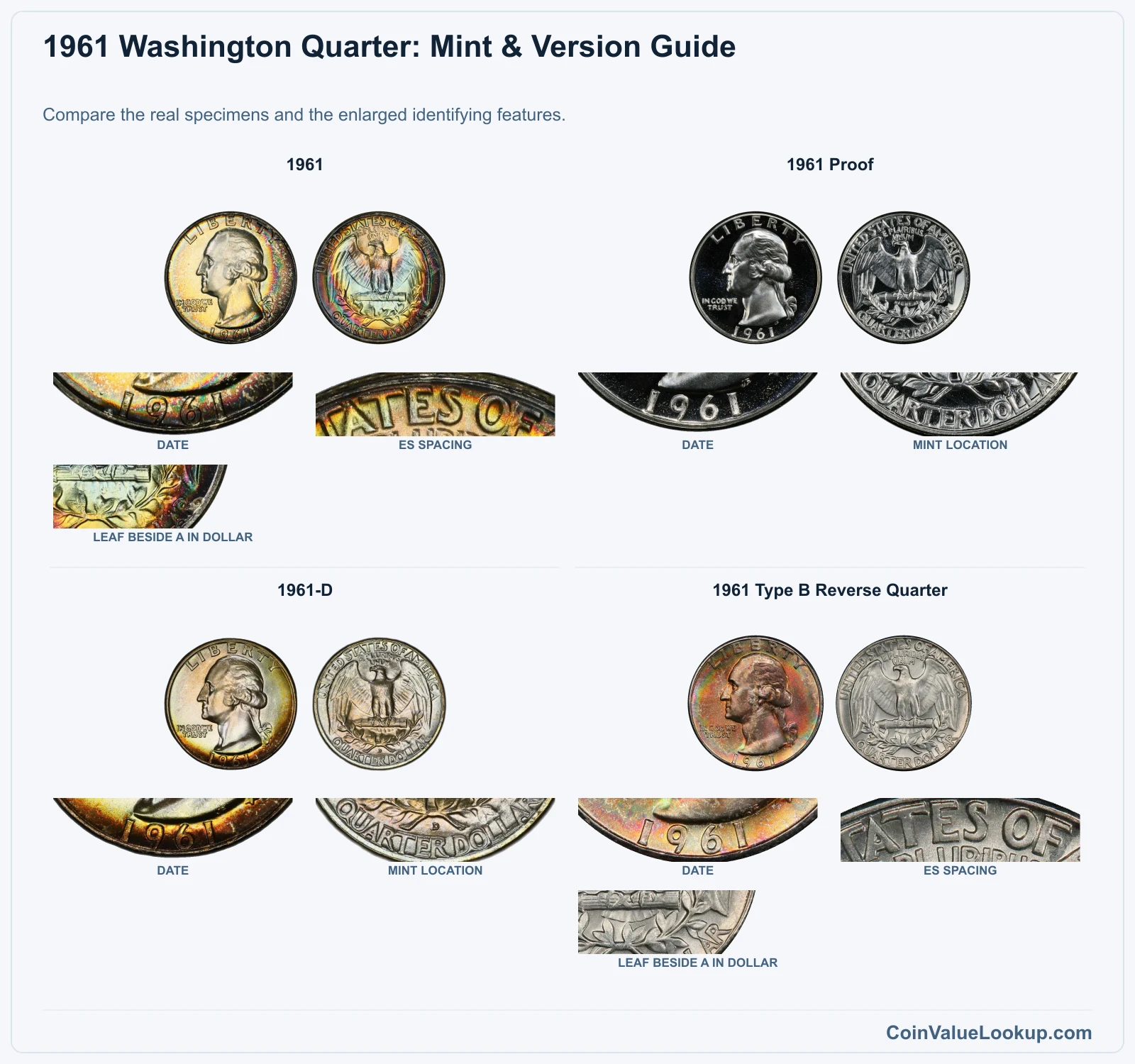
The 1961 Washington Quarter is a 90% silver coin, and even well-worn examples carry a guide value around $16.43 in Good condition thanks to that metal content. Mint State pieces from Philadelphia or Denver range up to about $27–$30 at the MS65 level, depending on mint.
Proofs, a scarce Type B reverse variety, and wrong-planchet errors can push values well beyond those ordinary figures, though condition and authentication matter.
Fast Way to Identify Your 1961 Washington Quarter
Want a quick read on what you have? Upload clear photos of both the front and back of your 1961 quarter, and our identifier can give you a preliminary take on the version, mint, and finish.
That is not a substitute for professional authentication, but it will point you in the right direction before you dig deeper.
1961 Washington Quarter Value
Upload both sides of your 1961 Washington Quarter.
Front Obverse
Upload photo
Back Reverse
Upload photo
Which 1961 Washington Quarter Versions Are Worth Money?
- The 1961 Type B Reverse is a Philadelphia business strike using a proof-style reverse hub, identifiable by the separated E and S in STATES. A single MS67 example brought $8,519 at auction in December 2021.
- Wrong-planchet errors on the 1961-D, such as a quarter struck on a cent blank, have sold for thousands; a PCGS MS64 cent-planchet example realized $6,900 at Heritage in 2006.
- A 1961-D/D repunched mintmark, where traces of a second D are visible near the primary mark, is a recognized variety whose value depends on the specific punch position and the coin's condition.
- A 1961 Doubled Die Obverse has been reported, with value depending on the strength and visibility of the doubling along with overall grade.
Step 1: Identify Your 1961 Washington Quarter Mint Mark and Version
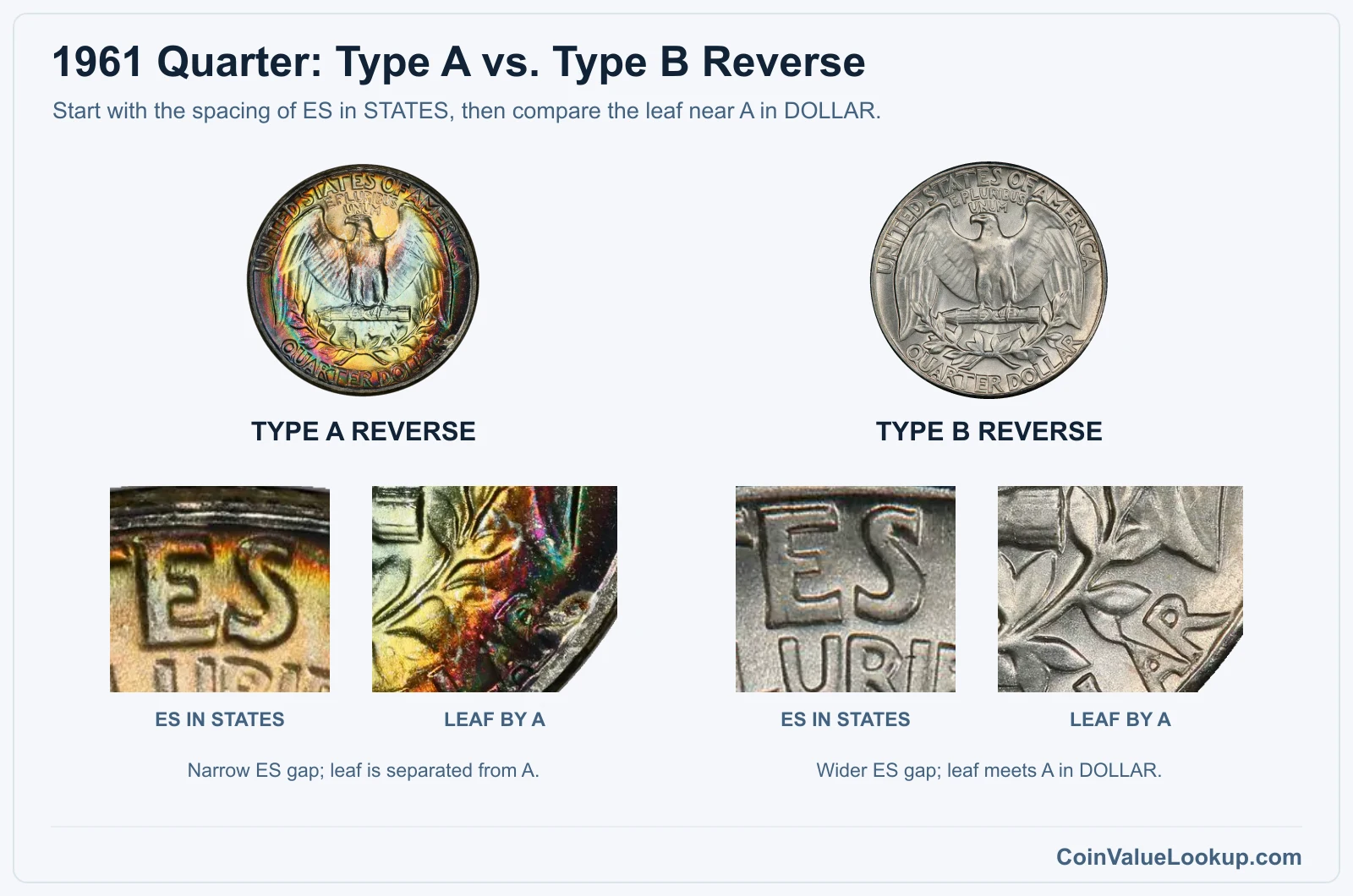
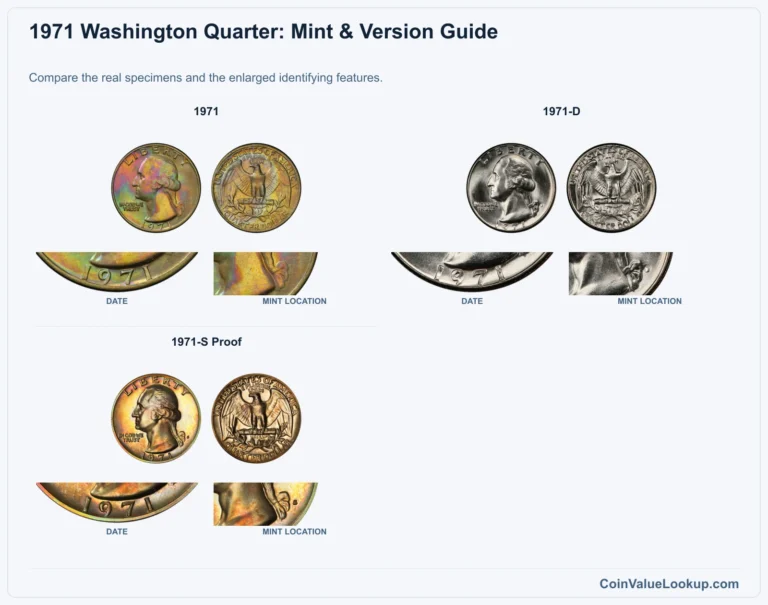
The date sits on the obverse beneath Washington's bust. Flip the coin over and look below the wreath: a small "D" means Denver, and no mintmark at all means Philadelphia.
A blank mintmark area is completely normal for Philadelphia quarters of this era, so do not assume something is missing.
Every standard 1961 quarter is struck in 90% silver and 10% copper, weighing about 6.25 grams and measuring roughly 24.3 mm across. Proofs were made only at Philadelphia and share the same alloy, but they have mirror-like fields that business strikes lack.
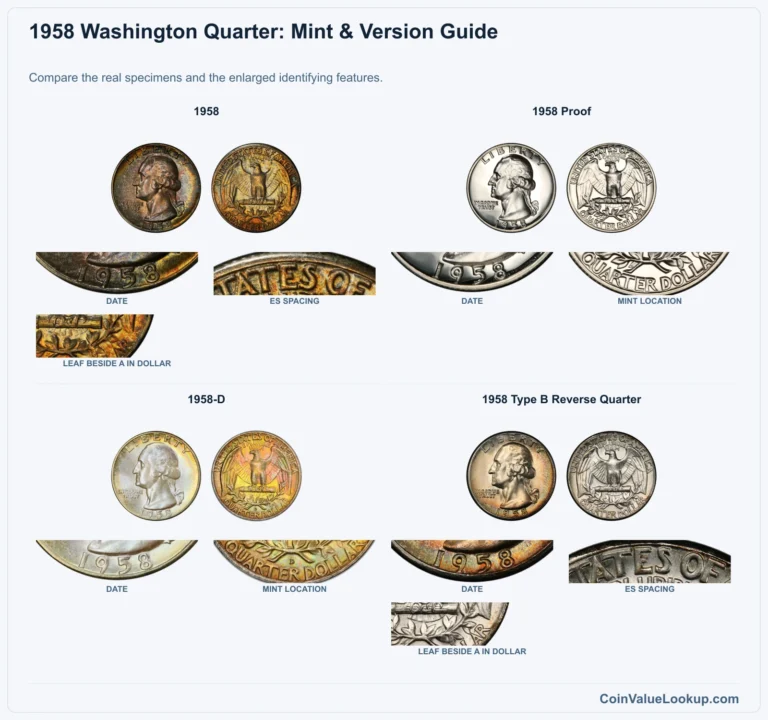
There are four main branches to know: the Philadelphia business strike, the Denver business strike, the Philadelphia proof, and the Philadelphia Type B reverse. The Type B uses a proof-style reverse hub on a circulation-strike coin, which you can spot by checking the gap between the E and S in STATES on the reverse.
On an ordinary quarter the letters nearly touch; on a Type B they are clearly separated. A regular proof with that same reverse is normal and is not the collectible variety.
Step 2: Check Your 1961 Washington Quarter Grade
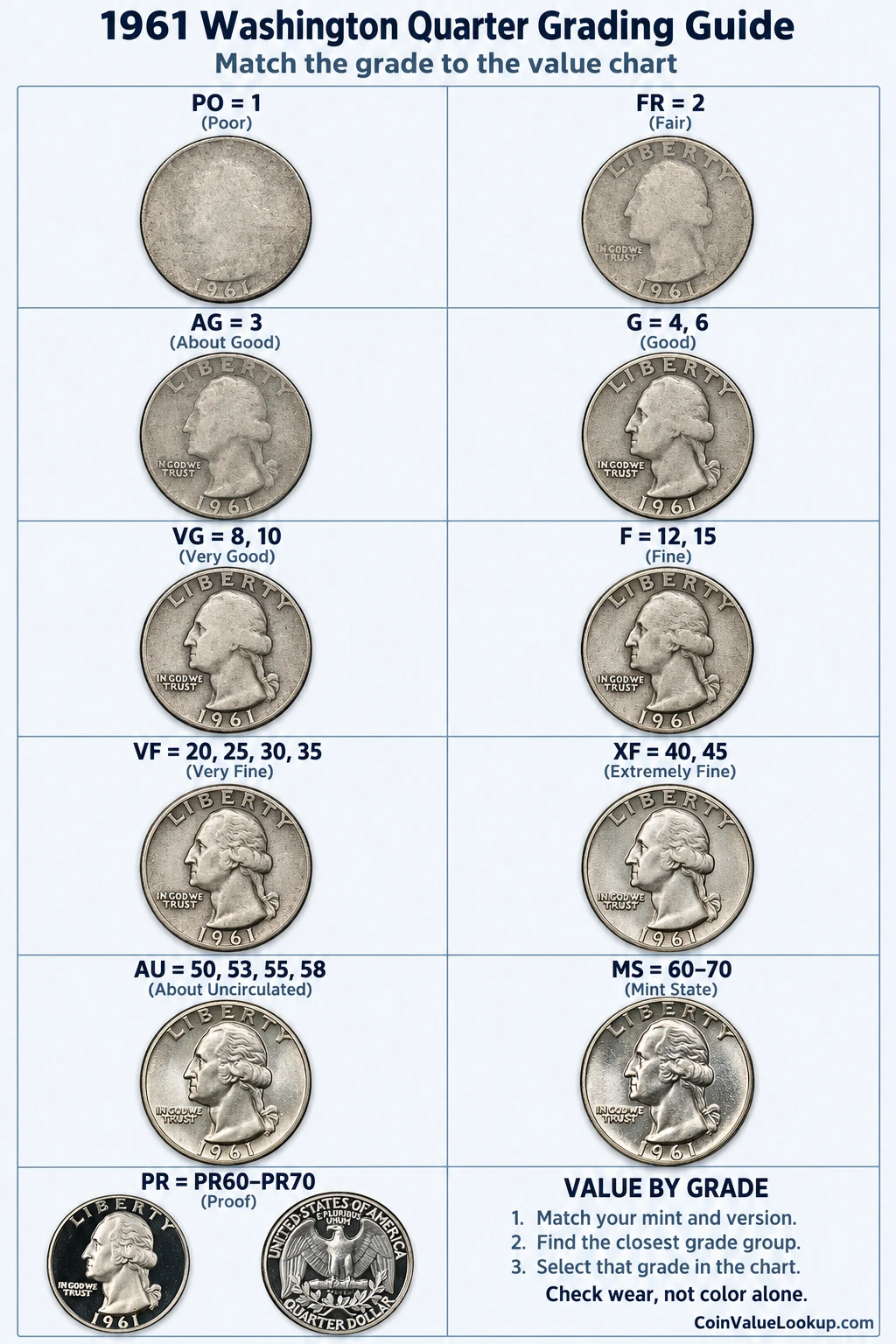
Start on the obverse. Washington's cheek, jawline, and the hair directly over his ear lose detail first.
Even light friction will dull the luster on those high points before anywhere else. If you can still see full hair strands over the ear with unbroken mint luster, you are likely in Mint State territory.
On the reverse, check the eagle's breast feathers and the tops of the wings. Those wear at roughly the same rate as the obverse high points.
Compare what you see with the reference image to gauge where your coin falls.
Do not confuse a weak strike with wear. Some 1961 quarters left the press with soft detail in the hair or breast feathers but still have full, cartwheel luster.
If the luster is intact and continuous, the coin may grade higher than it first appears.
Look carefully for cleaning hairlines under angled light. Cleaned coins lose their original surfaces and grade lower.
Also check for rim nicks, contact marks on the cheek, and any dark spots. Proof coins carry their own designations and should not be compared on the same scale as business strikes.
Step 3: Check 1961 Washington Quarter Value by Mint and Version
1961 Washington Quarter
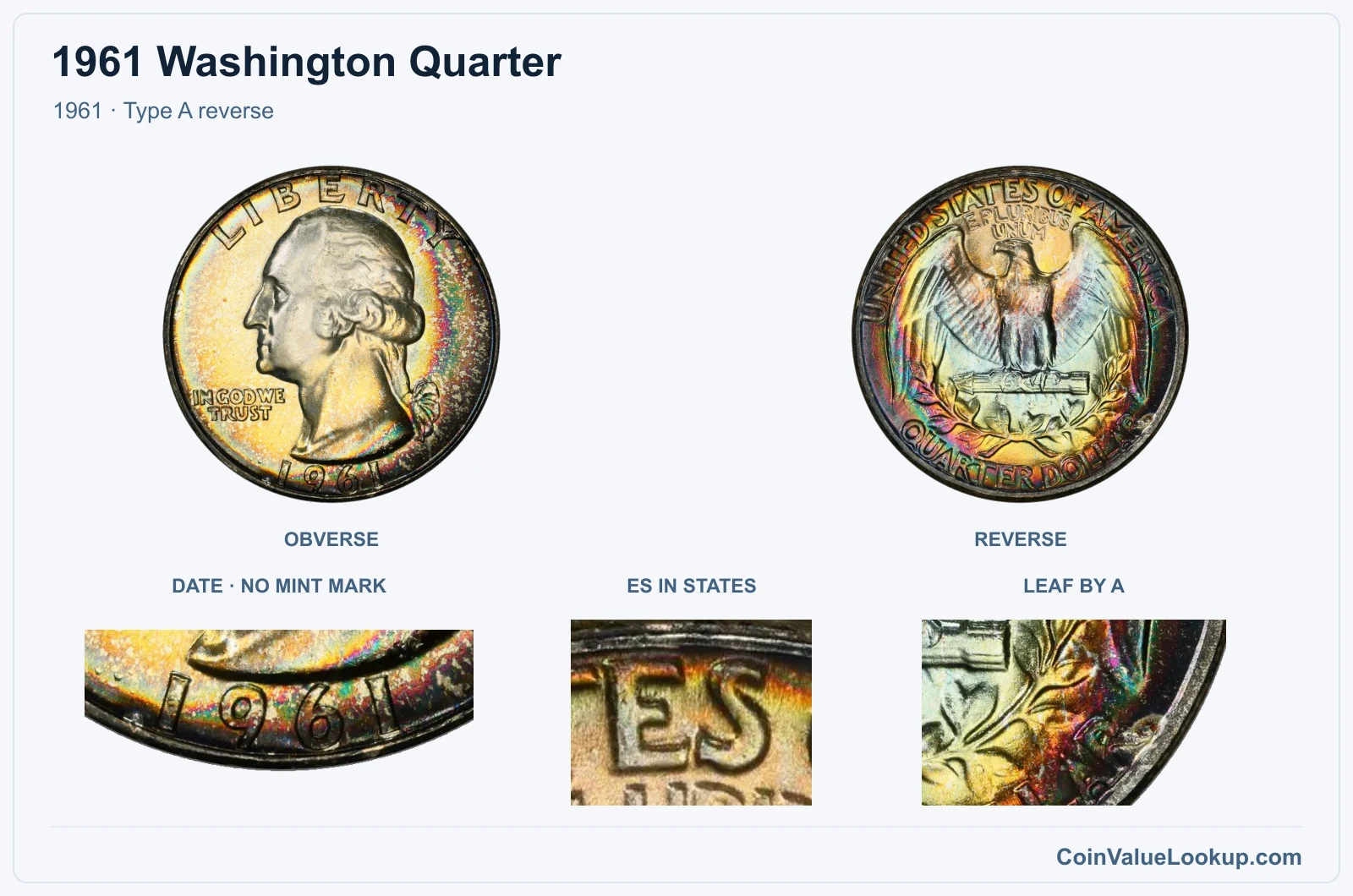
The 1961 Philadelphia quarter has no mintmark below the reverse wreath. It is a 90% silver, 6.25-gram business strike with the standard Type A circulation reverse, where the E and S of STATES nearly touch.
USA Coin Book guide estimates place this coin at about $16.43 in Good-4, $20 at MS60, and $27 at MS65. Lower grades are common and trade close to silver melt.
Full, original luster with minimal bag marks is what separates an MS65 from the crowd.
If you are comparing your coin against the Type B variety, check that ES gap first. A standard Philadelphia strike is not rare, but a nice gem example with clean surfaces still has a modest premium over melt.
| Range | Grade | Price | Auction Records | Appraisal |
|---|---|---|---|---|
| PO | PO 1 | — | Coin Identifier | |
| FR | FR 2 | — | Coin Identifier | |
| AG | AG 3 | — | Coin Identifier | |
| G | G 4 | — | Coin Identifier | |
| G 6 | — | Coin Identifier | ||
| VG | VG 8 | — | Coin Identifier | |
| VG 10 | — | Coin Identifier | ||
| F | F 12 | — | Coin Identifier | |
| F 15 | — | Coin Identifier | ||
| VF | VF 20 | — | Coin Identifier | |
| VF 25 | — | Coin Identifier | ||
| VF 30 | — | Coin Identifier | ||
| VF 35 | — | Coin Identifier | ||
| XF | XF 40 | — | Coin Identifier | |
| XF 45 | — | Coin Identifier | ||
| AU | AU 50 | — | Coin Identifier | |
| AU 53 | — | Coin Identifier | ||
| AU 55 | — | Coin Identifier | ||
| AU 58 | — | Coin Identifier | ||
| MS | MS 60 | — | Coin Identifier | |
| MS 61 | — | Coin Identifier | ||
| MS 62 | — | Coin Identifier | ||
| MS 63 | Coin Identifier | |||
| MS 64 | Coin Identifier | |||
| MS 65 | Coin Identifier | |||
| MS 66 | Coin Identifier | |||
| MS 67 | Coin Identifier | |||
| MS 68 | — | — | — | |
| MS 69 | — | — | — | |
| MS 70 | — | — | — |
1961 Washington Quarter — Proof
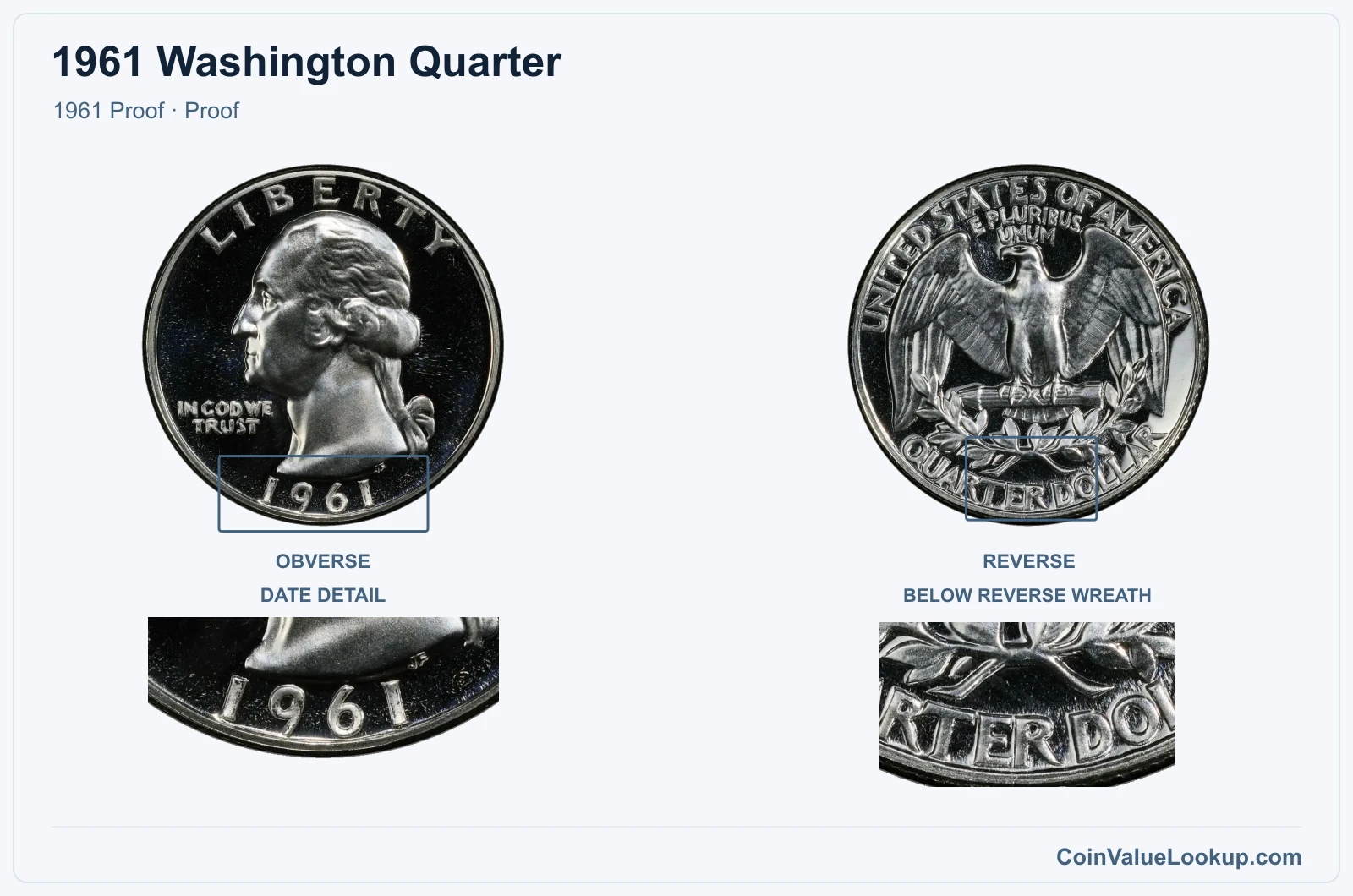
Philadelphia also produced proof quarters in 1961, struck with the same 90% silver alloy but on polished planchets using specially prepared dies. The fields are mirror-like, and design details are sharper than any business strike.
A USA Coin Book guide estimate lists the PR65 at about $23. Cameo and Deep Cameo contrast designations exist for proofs with frosted devices against mirrored fields, but those are separate categories with their own valuations.
Do not confuse a proof's reverse with the Type B circulation variety. A proof is supposed to have that reverse style.
The collectible oddity is when a circulation strike carries it.
| Range | Grade | Price | Auction Records | Appraisal |
|---|---|---|---|---|
| PR | PR 1 | — | Coin Identifier | |
| PR 2 | — | Coin Identifier | ||
| PR 3 | — | Coin Identifier | ||
| PR 4 | — | Coin Identifier | ||
| PR 6 | — | Coin Identifier | ||
| PR 8 | — | Coin Identifier | ||
| PR 10 | — | Coin Identifier | ||
| PR 12 | — | Coin Identifier | ||
| PR 15 | — | Coin Identifier | ||
| PR 20 | — | Coin Identifier | ||
| PR 25 | — | Coin Identifier | ||
| PR 30 | — | Coin Identifier | ||
| PR 35 | — | Coin Identifier | ||
| PR 40 | — | Coin Identifier | ||
| PR 45 | — | Coin Identifier | ||
| PR 50 | — | Coin Identifier | ||
| PR 53 | — | Coin Identifier | ||
| PR 55 | — | Coin Identifier | ||
| PR 58 | — | Coin Identifier | ||
| PR 60 | — | Coin Identifier | ||
| PR 61 | — | Coin Identifier | ||
| PR 62 | — | Coin Identifier | ||
| PR 63 | — | Coin Identifier | ||
| PR 64 | Coin Identifier | |||
| PR 65 | Coin Identifier | |||
| PR 66 | Coin Identifier | |||
| PR 67 | Coin Identifier | |||
| PR 68 | Coin Identifier | |||
| PR 69 | Coin Identifier | |||
| PR 70 | Coin Identifier |
1961 Washington Quarter — D
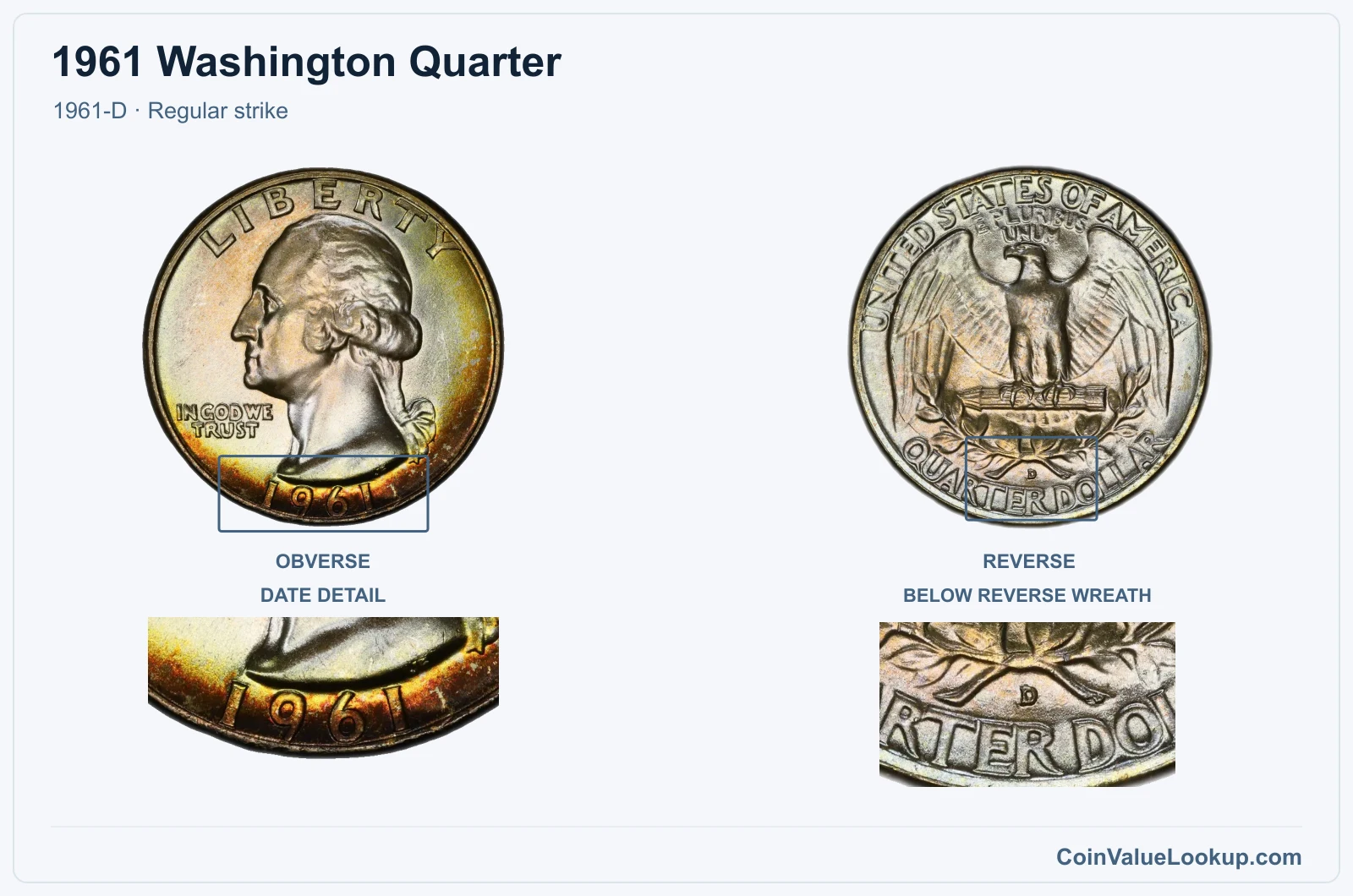
The 1961-D quarter carries a small "D" mintmark below the wreath on the reverse. Same silver composition, same weight, same design as the Philadelphia issue.
Guide estimates from USA Coin Book run about $16.43 in Good-4, $20 at MS60, and $30 at MS65. That MS65 figure edges slightly above the Philadelphia business strike, though both are readily available in circulated grades.
Coin Value Lookup is a good starting point if you want to compare this coin against other dates or denominations in the Washington Quarter series. You can pull up guides for the specific year and mint you are holding.
| Range | Grade | Price | Auction Records | Appraisal |
|---|---|---|---|---|
| PO | PO 1 | — | Coin Identifier | |
| FR | FR 2 | — | Coin Identifier | |
| AG | AG 3 | — | Coin Identifier | |
| G | G 4 | — | Coin Identifier | |
| G 6 | — | Coin Identifier | ||
| VG | VG 8 | — | Coin Identifier | |
| VG 10 | — | Coin Identifier | ||
| F | F 12 | — | Coin Identifier | |
| F 15 | — | Coin Identifier | ||
| VF | VF 20 | — | Coin Identifier | |
| VF 25 | — | Coin Identifier | ||
| VF 30 | — | Coin Identifier | ||
| VF 35 | — | Coin Identifier | ||
| XF | XF 40 | — | Coin Identifier | |
| XF 45 | — | Coin Identifier | ||
| AU | AU 50 | — | Coin Identifier | |
| AU 53 | — | Coin Identifier | ||
| AU 55 | — | Coin Identifier | ||
| AU 58 | — | Coin Identifier | ||
| MS | MS 60 | — | Coin Identifier | |
| MS 61 | — | Coin Identifier | ||
| MS 62 | Coin Identifier | |||
| MS 63 | — | Coin Identifier | ||
| MS 64 | Coin Identifier | |||
| MS 65 | Coin Identifier | |||
| MS 66 | Coin Identifier | |||
| MS 67 | Coin Identifier | |||
| MS 68 | — | — | — | |
| MS 69 | — | — | — | |
| MS 70 | — | — | — |
1961 Washington Quarter — Type B Reverse Quarter
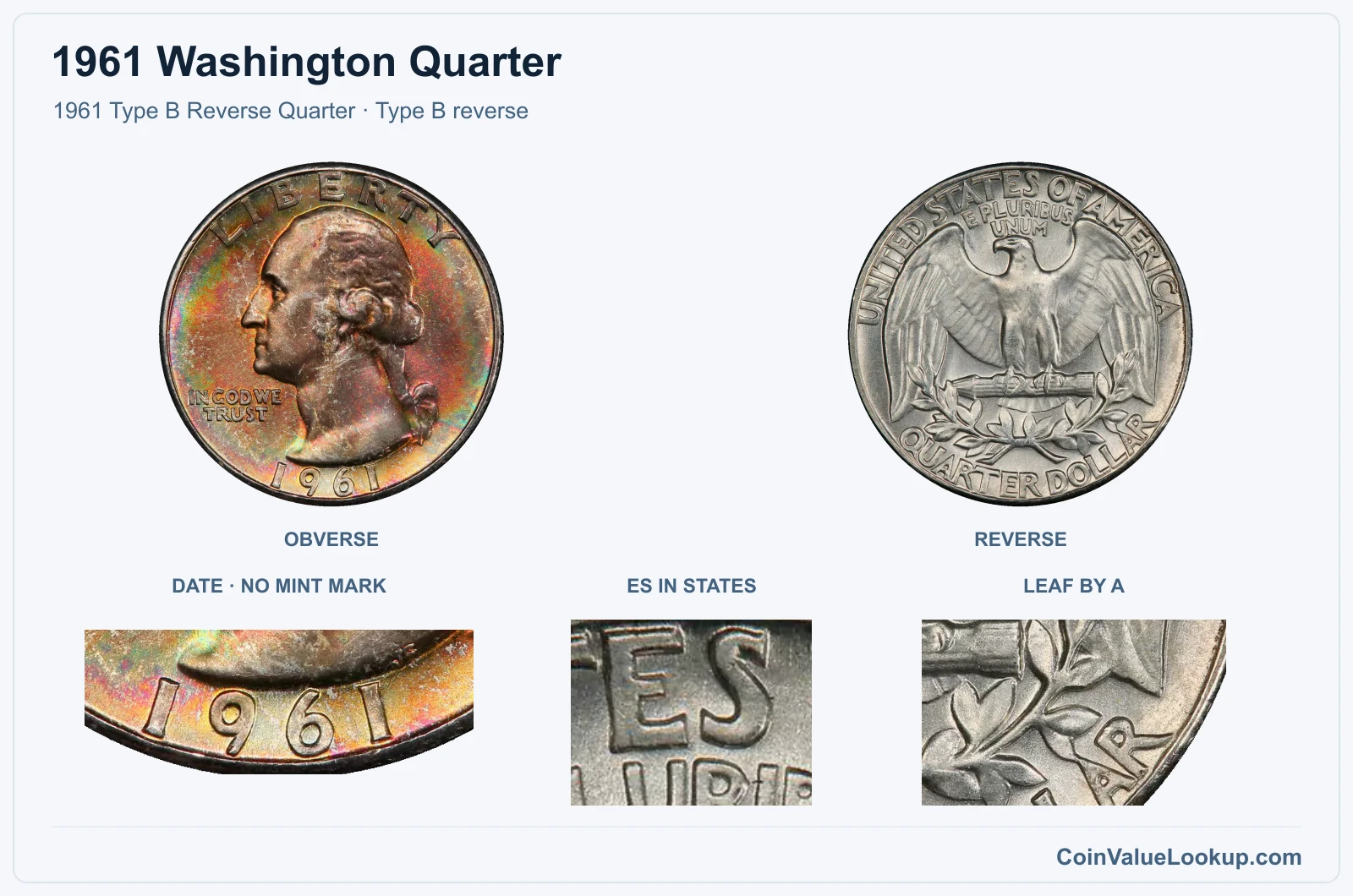
This is the one to hunt for. The 1961 Type B Reverse is a Philadelphia business strike that was made using a proof-style reverse hub instead of the normal circulation hub.
The key diagnostic is the space between the E and S in STATES on the reverse. On a regular quarter, those letters nearly touch.
On the Type B, there is a clear, deliberate gap.
You must confirm the coin has business-strike surfaces, not proof mirrors. A proof with this reverse is simply a normal proof and carries no special premium as a variety.
A single MS67 example sold for $8,519 at Legend Rare Coin Auctions in December 2021. That is one coin at one grade at one auction, not a universal price, but it shows why the variety is worth learning to identify.
Even in lower grades, a confirmed Type B commands collector interest well above ordinary Philadelphia quarters.
Range Grade
Price Auction Records Appraisal PO PO 1
—
Coin Identifier FR FR 2
—
Coin Identifier AG AG 3
—
Coin Identifier G G 4
—
Coin Identifier
G 6
—
Coin Identifier VG VG 8
—
Coin Identifier
VG 10
—
Coin Identifier F F 12
—
Coin Identifier
F 15
—
Coin Identifier VF VF 20
—
Coin Identifier
VF 25
—
Coin Identifier
VF 30
—
Coin Identifier
VF 35
—
Coin Identifier XF XF 40
—
Coin Identifier
XF 45
—
Coin Identifier AU AU 50
—
Coin Identifier
AU 53
—
Coin Identifier
AU 55
—
Coin Identifier
AU 58
—
Coin Identifier MS MS 60
—
Coin Identifier
MS 61
—
Coin Identifier
MS 62
—
Coin Identifier
MS 63
—
Coin Identifier
MS 64
Coin Identifier
MS 65
Coin Identifier
MS 66
Coin Identifier
MS 67
Coin Identifier
MS 68
—
—
—
MS 69
—
—
—
MS 70
—
—
—
1961 Washington Quarter Error List
1. 1961 Washington Quarter — Struck on a Cent Planchet
A 1961-D quarter struck on a copper cent planchet is a dramatic wrong-planchet error. The documented example retains a clear D mintmark and motto but shows only faint impressions of the final date digits and partial LIBERTY, because the smaller, thinner cent blank could not receive the full quarter design.
A PCGS MS64 specimen sold for $6,900 at Heritage Auctions in August 2006. That is one coin at one grade, so treat it as a historical data point rather than a standing price.
Look-alikes include coins that have been ground down, cut, or hammered after leaving the mint. A genuine wrong-planchet strike shows consistent, die-made surfaces and an intact rim profile that match the smaller blank's geometry.
Any piece claiming this error should be submitted to a third-party grading service for independent authentication.
2. 1961 Washington Quarter — Struck on a Nickel Planchet
Another wrong-planchet variety exists for the 1961-D: a quarter struck on a five-cent nickel blank. The documented coin is displaced toward roughly the seven-o'clock position, with portions of UNITED STATES missing from the reverse.
The date remains visible but shows distortion, and the D mintmark is bold.
No confirmed sale price is available for this piece, so value depends on the individual coin's condition, the severity of the off-center displacement, and authentication. Do not assume a price based on other wrong-planchet errors.
Coins that have been filed, trimmed, or otherwise altered after striking can mimic wrong-planchet characteristics. Compare the overall shape, edge profile, and strike geometry against a known genuine specimen.
Independent third-party authentication is essential before assigning any premium to a coin like this.
3. 1961 Washington Quarter — Type B Reverse Variety
The Type B Reverse variety occurs on 1961 Philadelphia circulation-strike quarters. A proof-style reverse hub was used during production, and the telltale diagnostic is the gap between the E and S in STATES.
On the standard circulation reverse, those two letters nearly touch. On the Type B, they are clearly separated.
This variety applies only to business strikes. A proof quarter naturally carries this reverse design, so a proof is not an error or variety in this context.
A PCGS MS67 example realized $8,519 at Legend Rare Coin Auctions in December 2021. That was a single high-grade coin, not a blanket value for every Type B.
Be careful not to confuse worn or mushy lettering with the Type B gap. Also rule out mechanical doubling, which creates flat shelf-like displacement rather than a consistent hub-design difference.
Use magnification and compare directly against a known normal reverse.
4. 1961 Washington Quarter — Repunched Mintmark
Repunched mintmark varieties have been reported for the 1961-D quarter, where the D appears to have been punched into the die more than once in slightly different positions. Under magnification, you may see traces of a second D overlapping or offset from the primary mintmark.
Inspect the mintmark area carefully and compare it side-by-side with a normal 1961-D at the same magnification. A genuine repunched mintmark shows a consistent secondary impression that is part of the die, not a random blob.
Watch out for machine doubling, die chips, or corrosion around the mintmark, all of which can mimic an RPM at first glance. Machine doubling tends to produce a flat, shelf-like image rather than a rounded secondary punch.
No specific price data is available here; value depends on the particular punch position, its visibility, and the coin's overall condition.
5. 1961 Washington Quarter — Doubled Die Obverse
A Doubled Die Obverse has been reported for the 1961 quarter. This variety involves a misalignment during the hub-to-die process that leaves doubled impressions on obverse design elements such as lettering or date digits.
To check, compare your coin's obverse inscriptions against a normal 1961 quarter under the same lighting and magnification. Look for consistent separation or notching on letters, not a flat, shelf-like shadow.
The doubling should appear in the same direction and strength across affected elements.
Machine doubling, worn dies, and reflections from angled light can all create false positives. Machine doubling produces a flat displacement without the rounded, raised profile of a true doubled die.
No numerical price range is available for this variety. Value will depend on the visibility and strength of the doubling, plus the coin's overall grade and eye appeal.