1845 Braided Hair Cent Coin Value: How Much Is It Worth?
The 1845 Braided Hair Cent is a copper large cent struck at Philadelphia, and guide estimates place ordinary business strikes from around $30 in Good-4 condition up to roughly $860 in MS63. Proof versions also exist but require individual assessment rather than a simple price range.
Identifying your exact variety is the first step to understanding what your coin might be worth.
Fast Way to Identify Your 1845 Braided Hair Cent
The quickest way to start figuring out your 1845 cent is to upload clear photos of both the front and back. Good lighting and a straight-on angle help show the hair detail, wreath condition, and any irregularities.
These photos allow for a preliminary identification of your coin's variety and approximate condition, which is where all valuation begins.
1845 Braided Hair Cent Value
Upload both sides of your 1845 Braided Hair Cent.
Front Obverse
Upload photo
Back Reverse
Upload photo
Which 1845 Braided Hair Cent Versions Are Worth Money?
- Business strikes range from about $30 in G4 to $860 in MS63 per USA Coin Book guide estimates; higher-grade examples with original surfaces command attention.
- Proof 1845 cents exist but have no standard guide price; each requires individual authentication of die characteristics, surfaces, and rims before valuation.
- Mint errors such as off-center strikes, clipped planchets, and die breaks on this date can add significant value when properly attributed.
- Original, problem-free surfaces on any 1845 cent are more desirable than cleaned or corroded examples, even at the same technical grade.
Step 1: Identify Your 1845 Braided Hair Cent Mint Mark and Version
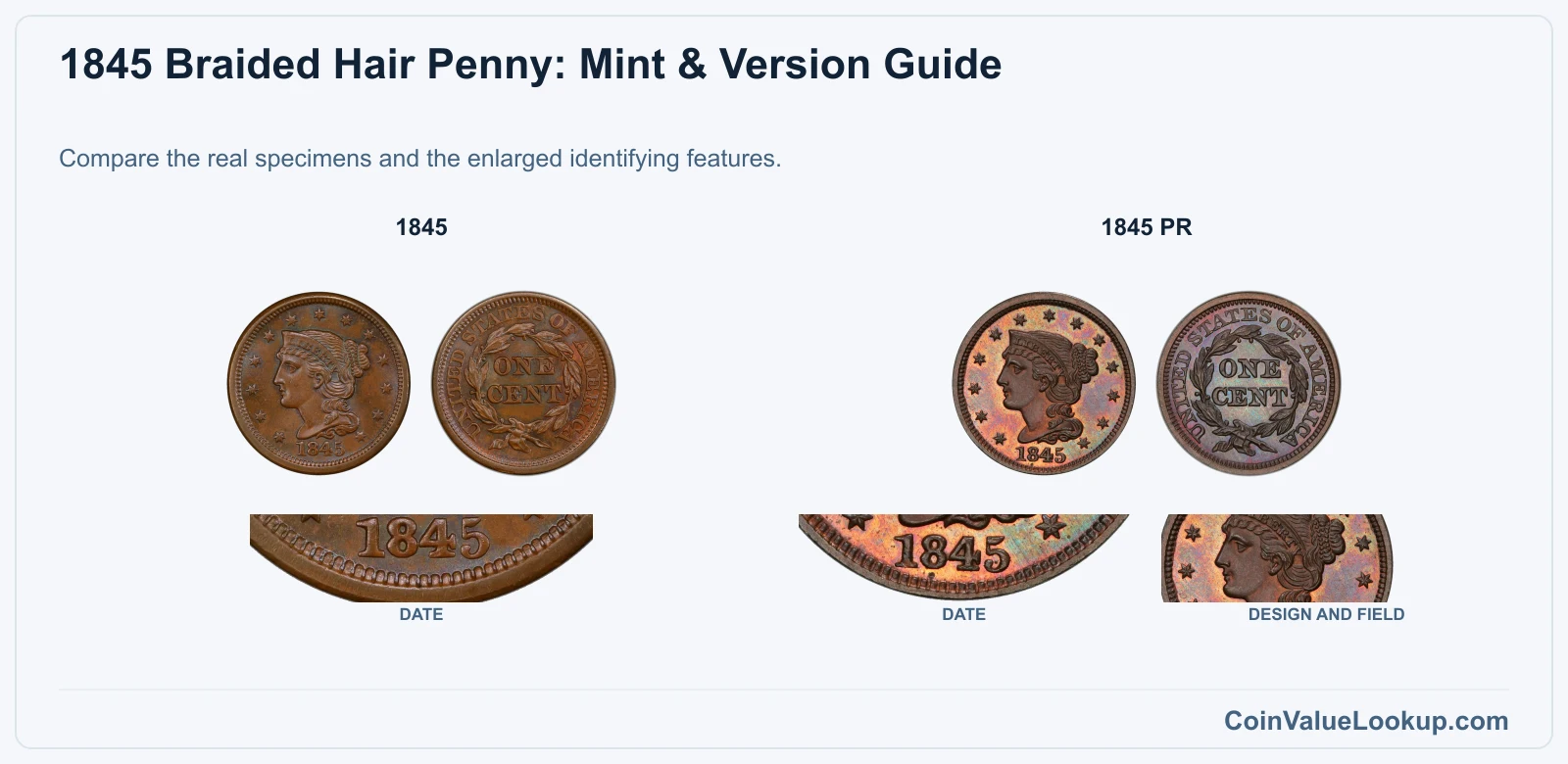
The 1845 Braided Hair Cent shows Liberty facing left with her hair swept into braids and bound by a cord, surrounded by stars. The reverse displays the denomination "ONE CENT" inside a laurel wreath.
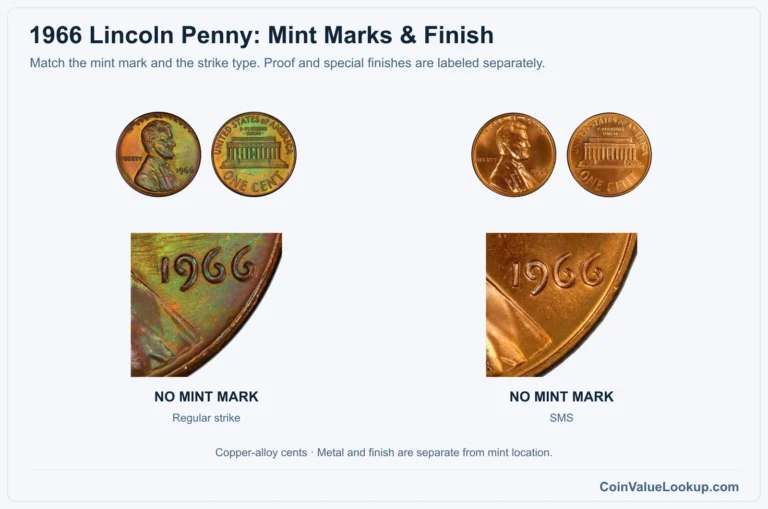
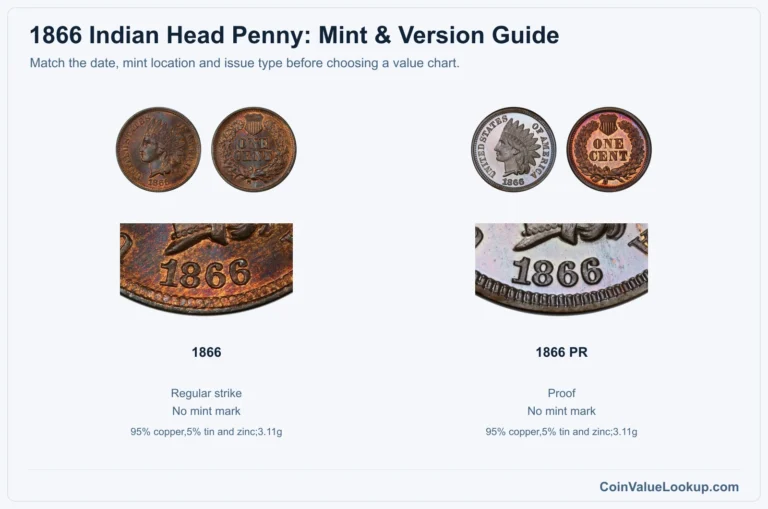
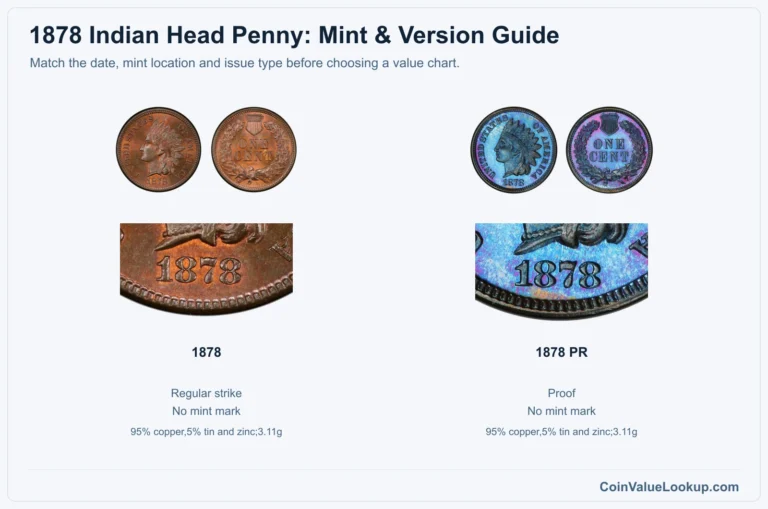
All 1845 cents were struck at Philadelphia, so there is no mintmark to look for.
Do not assume a shiny coin is a proof. Proof cents from this era were made with specially prepared dies and planchets, producing sharp rims, squared-off edges, and mirror-like fields.
A polished business strike is not a proof, no matter how reflective it looks.
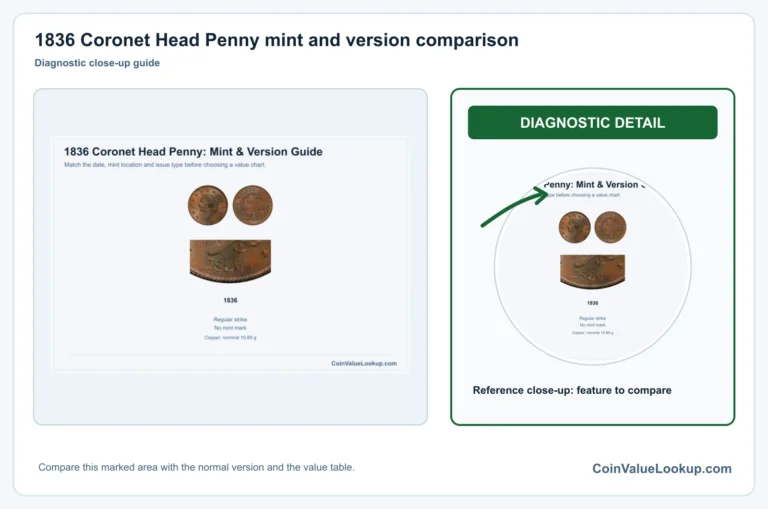
Check the date-punch style, legend wording, and wreath details on both sides. The coin should weigh approximately 10.89 grams in copper.
Weight can support identification, but wear, corrosion, and normal production tolerances mean weight alone does not prove authenticity.
Step 2: Check Your 1845 Braided Hair Cent Grade
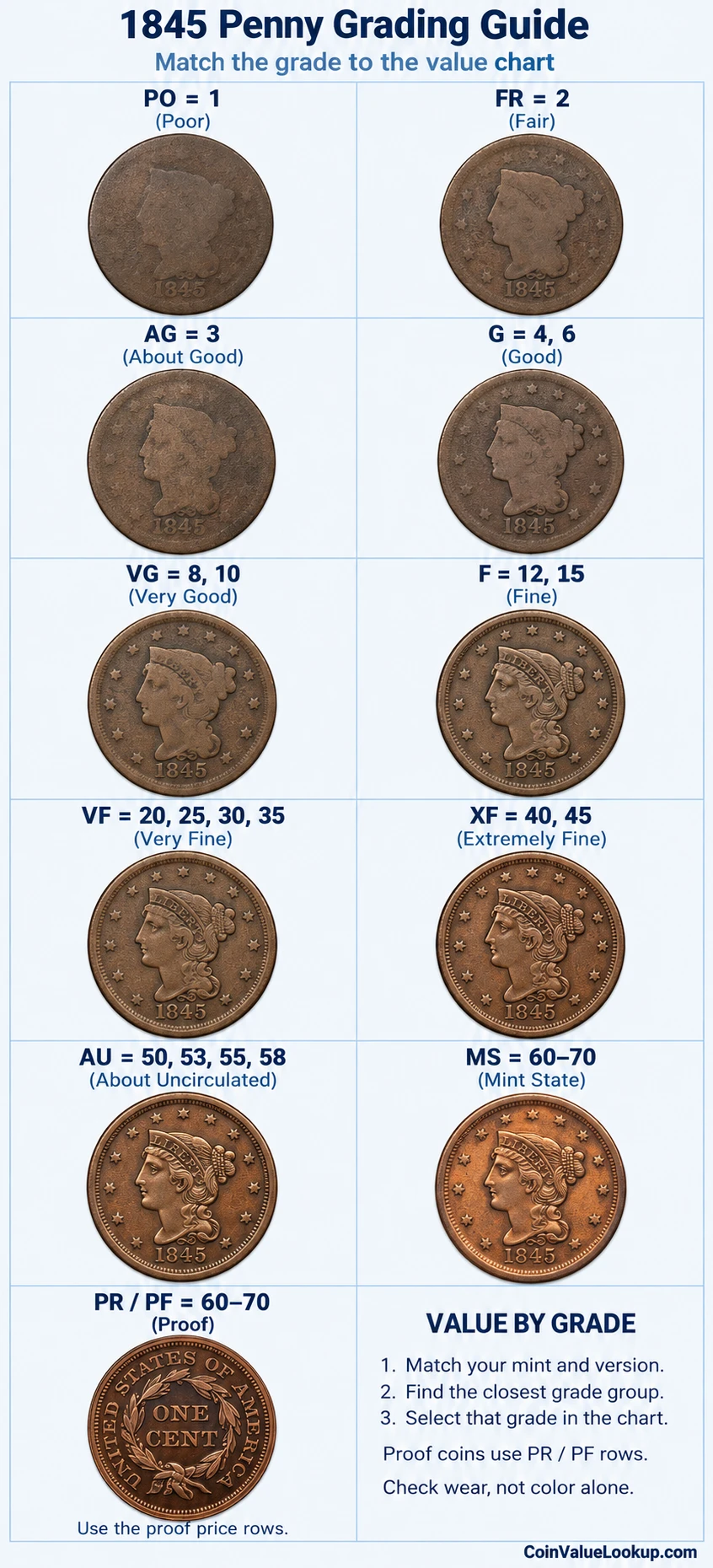
Start by examining Liberty's hair above the ear and the fine braid detail. On a well-worn coin in the Good-4 range, the outline of the portrait remains but most hair strands have merged.
In Very Fine territory, individual braids show separation though the highest points are flat.
On the reverse, check the leaf detail in the wreath. Sharper leaves with visible veins indicate less wear.
At MS63, you should see full original detail with only minor contact marks.
Don't confuse a weak strike with wear. Some 1845 cents left the press with soft spots, especially on the hair curls.
Compare your coin's surfaces to the reference image for like-type examples.
Surface problems matter a lot on copper. Porosity, corrosion, and old cleaning can substantially reduce a coin's market appeal even when the underlying detail is strong.
Color designations like BN (brown), RB (red-brown), and RD (red) describe the copper's surface tone, not different alloys.
Step 3: Check 1845 Braided Hair Cent Value by Mint and Version
1845 Braided Hair Cent
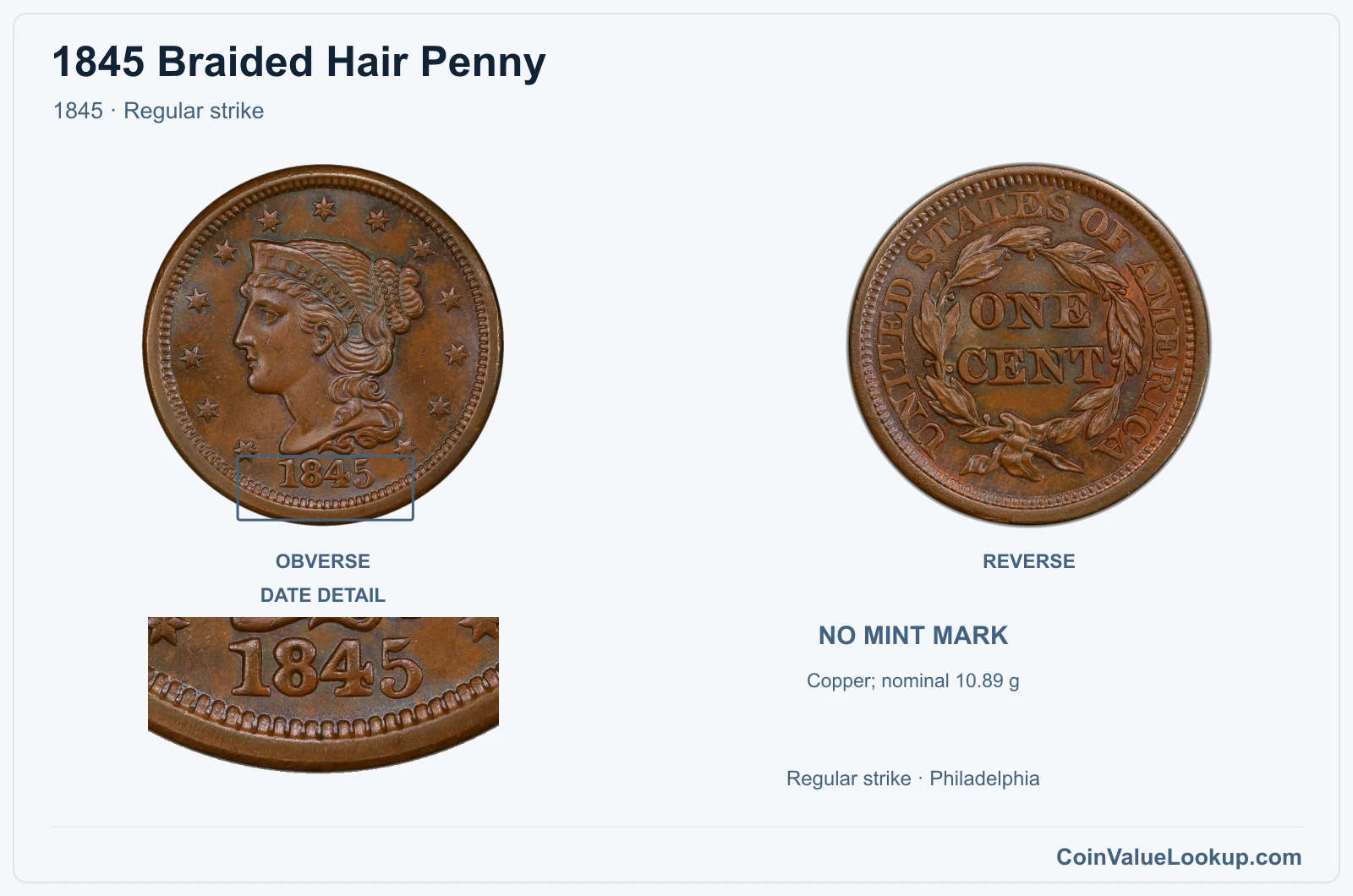
The standard 1845 Braided Hair Cent is a copper business strike from Philadelphia, weighing about 10.89 grams. No mintmark appears on the coin.
USA Coin Book guide estimates place this version at roughly $30 in G4 and up to approximately $860 in MS63.
Look for the classic Braided Hair portrait on the obverse and the wreath-and-denomination reverse. Original brown surfaces with no signs of cleaning or corrosion are what the market rewards most.
Bright, obviously re-toned coins tend to sell for less than honest, naturally toned examples at the same grade level.
| Range | Grade | Price | Auction Records | Appraisal |
|---|---|---|---|---|
| PO | PO 1 | — | Coin Identifier | |
| FR | FR 2 | — | Coin Identifier | |
| AG | AG 3 | — | Coin Identifier | |
| G | G 4 | — | Coin Identifier | |
| G 6 | — | Coin Identifier | ||
| VG | VG 8 | — | Coin Identifier | |
| VG 10 | — | Coin Identifier | ||
| F | F 12 | Coin Identifier | ||
| F 15 | Coin Identifier | |||
| VF | VF 20 | Coin Identifier | ||
| VF 25 | Coin Identifier | |||
| VF 30 | — | Coin Identifier | ||
| VF 35 | Coin Identifier | |||
| XF | XF 40 | Coin Identifier | ||
| XF 45 | Coin Identifier | |||
| AU | AU 50 | Coin Identifier | ||
| AU 53 | Coin Identifier | |||
| AU 55 | Coin Identifier | |||
| AU 58 | Coin Identifier | |||
| MS | MS 60 | Coin Identifier | ||
| MS 61 | Coin Identifier | |||
| MS 62 | Coin Identifier | |||
| MS 63 | Coin Identifier | |||
| MS 64 | Coin Identifier | |||
| MS 65 | Coin Identifier | |||
| MS 66 | — | — | — | |
| MS 67 | — | — | — | |
| MS 68 | — | — | — | |
| MS 69 | — | — | — | |
| MS 70 | — | — | — |
1845 Braided Hair Cent — PR
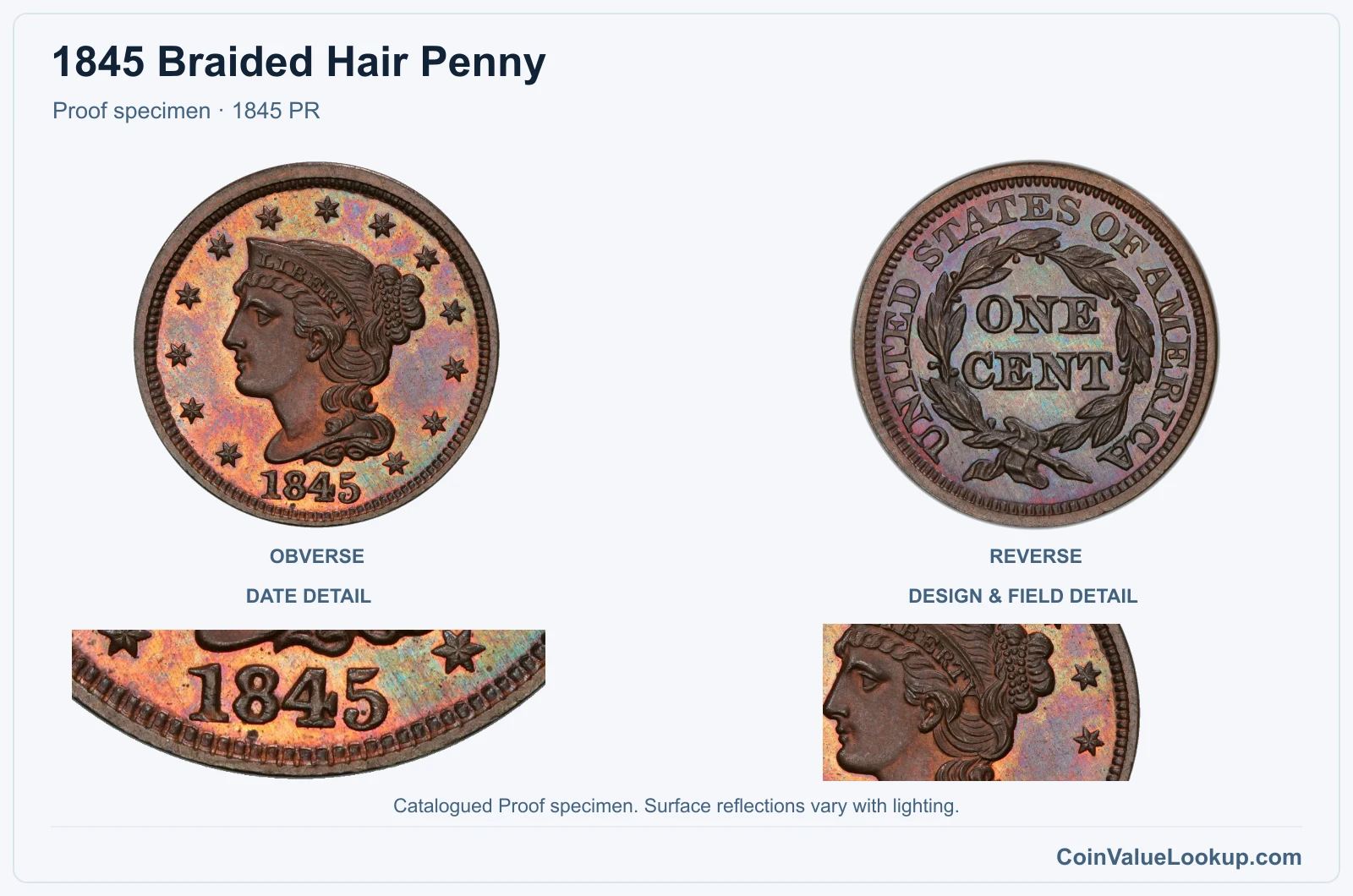
The 1845 Proof Braided Hair Cent is a cataloged issue, but confirming one is not simple. Genuine proofs from this period show squared-off rims, deeply mirrored fields, and sharp die detail that business strikes cannot replicate.
A coin that has merely been polished or dipped is not a proof.
No standard guide price has been adopted for this version because each example must be individually assessed. Authentication by a recognized grading service is essential.
Die characteristics, surface quality, and rim profiles all factor into confirming proof manufacture.
Coin Value Lookup can help you explore guides for other large cent dates and series while you research your specific coin. If you suspect you have a proof 1845 cent, professional attribution is the logical next step before any valuation.
| Range | Grade | Price | Auction Records | Appraisal |
|---|---|---|---|---|
| PR | PR 1 | — | Coin Identifier | |
| PR 2 | — | Coin Identifier | ||
| PR 3 | — | Coin Identifier | ||
| PR 4 | — | Coin Identifier | ||
| PR 6 | — | Coin Identifier | ||
| PR 8 | — | Coin Identifier | ||
| PR 10 | — | Coin Identifier | ||
| PR 12 | — | Coin Identifier | ||
| PR 15 | — | Coin Identifier | ||
| PR 20 | — | Coin Identifier | ||
| PR 25 | — | Coin Identifier | ||
| PR 30 | — | Coin Identifier | ||
| PR 35 | — | Coin Identifier | ||
| PR 40 | — | Coin Identifier | ||
| PR 45 | — | Coin Identifier | ||
| PR 50 | — | Coin Identifier | ||
| PR 53 | — | Coin Identifier | ||
| PR 55 | — | Coin Identifier | ||
| PR 58 | — | Coin Identifier | ||
| PR 60 | — | Coin Identifier | ||
| PR 61 | — | Coin Identifier | ||
| PR 62 | Coin Identifier | |||
| PR 63 | — | Coin Identifier | ||
| PR 64 | Coin Identifier | |||
| PR 65 | Coin Identifier | |||
| PR 66 | — | Coin Identifier | ||
| PR 67 | — | — | — | |
| PR 68 | — | — | — | |
| PR 69 | — | — | — | |
| PR 70 | — | — | — |
1845 Braided Hair Cent Error List
1. 1845 Braided Hair Cent — Off-Center Strike
An off-center 1845 Braided Hair Cent shows a displaced design with a crescent-shaped area of blank, unstruck metal. The degree of misalignment matters, and coins that retain a fully visible date are more desirable than those where the date has shifted off the planchet entirely.
When examining a potential off-center error, compare carefully against lookalikes. A clipped edge removes part of the blank before striking, which is a different error category.
Post-mint damage from a vise or hammer can flatten one side and mimic an off-center appearance, but the metal flow and surface texture will differ.
No standard price range has been adopted for this error on the 1845 date. Value depends on the degree of off-center shift, date visibility, and the coin's authenticated condition.
2. 1845 Braided Hair Cent — Clipped Planchet
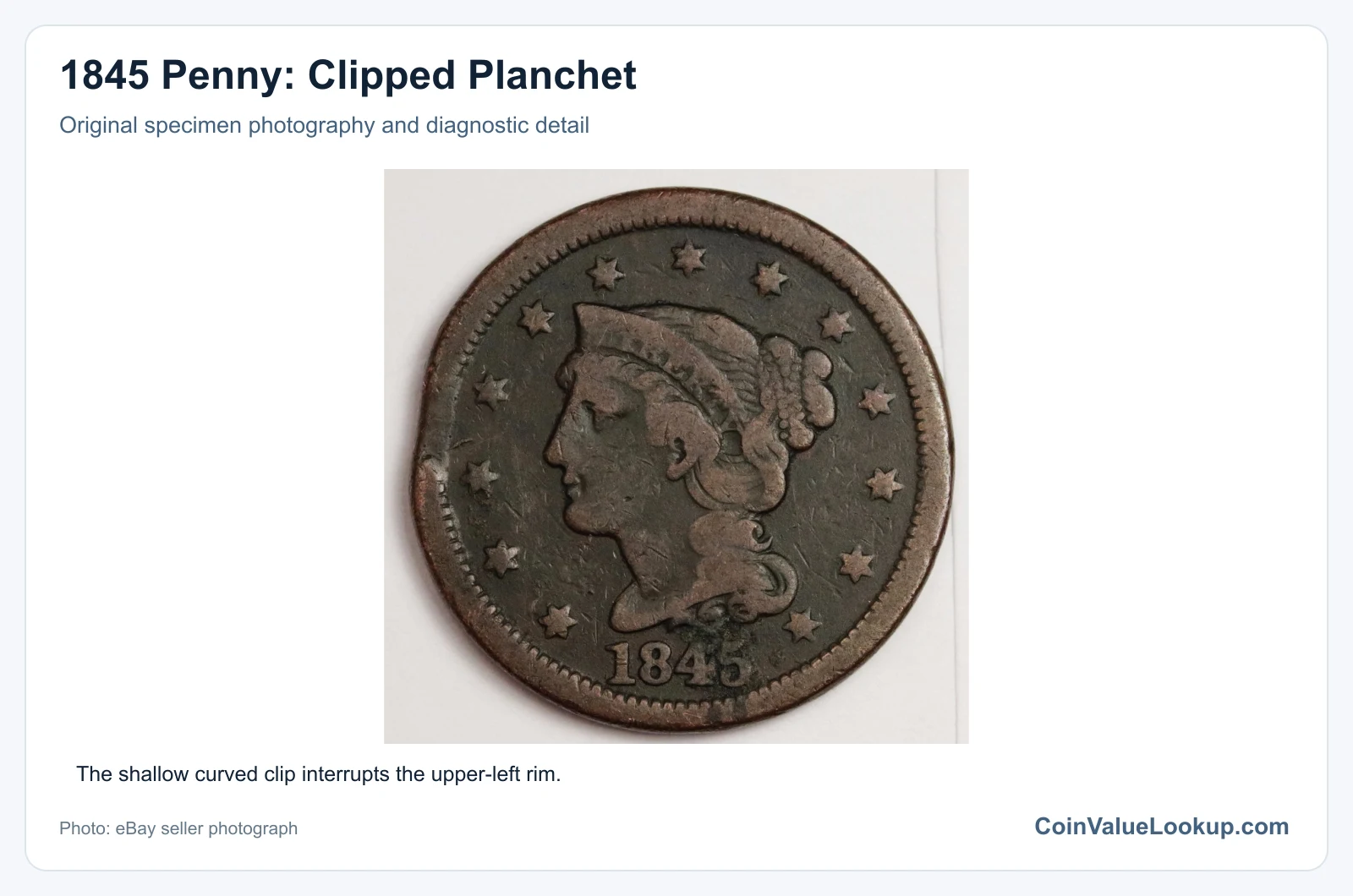
A clipped planchet error on the 1845 Braided Hair Cent means part of the original copper blank was missing before the coin was struck. The clip can be curved, straight, or ragged, depending on how the blank was cut from the copper strip.
Look for a corresponding area of weakness on the opposite side of the coin, which results from uneven metal flow during striking.
Don't confuse a clip with post-mint damage. Filed edges, deliberate cuts, and heavy corrosion can all remove metal and mimic a clip, but they won't produce that telltale opposite-side weakness or the smooth, natural contour of a genuine planchet clip.
No specific price range has been adopted for clipped 1845 cents. Each coin's value depends on the clip's size, type, and the overall condition of the piece as confirmed by professional attribution.
3. 1845 Braided Hair Cent — Lamination / Split Planchet
Lamination errors on copper large cents happen when the metal separates into layers, creating a peeling flap, a raised bubble, or an outright split in the planchet. On an 1845 Braided Hair Cent, look for areas where the copper appears to lift away from the surface or where a thin layer has partially detached.
Photograph the edge alongside the affected face. A genuine lamination will show a natural separation within the metal, not a sharp-edged gouge or deliberate cut.
Corrosion can eat into copper and create flaky surfaces that resemble lamination, but corroded areas typically lack the smooth internal plane of a true split.
No adopted price range exists for this error on the 1845 date. Severity, location, and overall coin condition determine individual value, and professional review is recommended.
4. 1845 Braided Hair Cent — Die Crack
Die cracks appear as raised lines on the coin's surface, running across fields or through design elements. They form when a working die develops a fracture, and every coin struck from that cracked die carries the same raised line.
On your 1845 cent, trace any suspicious line with magnification.
The key distinction: die cracks are raised because metal fills the crack in the die. A scratch is incuse, meaning it cuts into the surface.
Corrosion lines and tool marks also sit below the surface rather than above it. If the line is raised and consistent with the surrounding strike, it is likely a die crack.
No specific price has been adopted for die-cracked 1845 cents. Dramatic cracks affecting major design elements tend to draw more interest than minor hairline fractures.
5. 1845 Braided Hair Cent — Die Break / Cud
A cud is a specific type of die break where a chunk of the die breaks away at the rim, leaving a raised, featureless blob of metal on the finished coin that connects directly to the edge. On an 1845 Braided Hair Cent, a cud replaces part of the normal design with a smooth, flat-topped lump.
Don't mistake a rim dent or ding for a cud. Rim damage from being dropped or hit creates a depression, not a raised area.
Interior die chips that produce small raised dots away from the rim are related but technically different from a true cud.
No adopted price range covers cuds on the 1845 date. Large, well-defined cuds on identifiable coins tend to attract more collector interest.
Professional attribution helps confirm the error and distinguish it from post-mint damage.
6. 1845 Braided Hair Cent — Struck-Through Error
A struck-through error occurs when foreign material sits between the die and the planchet during striking. On an 1845 Braided Hair Cent, this shows up as a localized depression or an impression of whatever object was in the way, whether grease, a thread, a metal fragment, or another piece of debris.
Grease-filled dies produce a smooth, shallow area of missing detail. Retained foreign objects can leave a more dramatic, textured impression.
Either way, the affected zone should appear to be part of the original strike, not something added or removed afterward.
Lookalikes include ordinary wear, cleaning scratches, and weak strikes from tired dies. The difference is that a struck-through depression is sharply defined within its boundary and does not match normal wear patterns.
No price range has been adopted for this error on the 1845 date; each example requires individual assessment.