1853 Braided Hair Cent Coin Value: How Much Is It Worth?
An 1853 Braided Hair Cent in well-worn condition starts around $30 at a G4 grade, while an uncirculated example in MS63 can reach about $437 according to USA Coin Book guide estimates. These anchors cover the ordinary business strike only.
Proof versions and major mint errors fall outside that range and need individual assessment, so identifying your exact variety is the first step.
Fast Way to Identify Your 1853 Braided Hair Cent
The quickest way to start figuring out what you have is to upload clear photos of the front and back of your coin. That gives us enough to make a preliminary identification of the series, variety and general condition.
Snap both sides in even lighting, and include the edge if you notice anything unusual there.
1853 Braided Hair Cent Value
Upload both sides of your 1853 Braided Hair Cent.
Front Obverse
Upload photo
Back Reverse
Upload photo
Which 1853 Braided Hair Cent Versions Are Worth Money?
- Business strikes range from about $30 in G4 to roughly $437 in MS63 per USA Coin Book estimates; higher-grade original-surface examples are scarcer and worth closer inspection.
- Proof 1853 Braided Hair Cents exist and require authenticated attribution of die characteristics, surfaces and rims; no ordinary business-strike price applies to a confirmed proof.
- Mint errors such as off-center strikes, die cracks and cuds can add value beyond the base coin, but each piece needs individual evaluation based on severity and condition.
- Coins retaining original brown or red-brown surfaces without cleaning or corrosion tend to bring stronger prices than impaired examples at similar grades.
Step 1: Identify Your 1853 Braided Hair Cent Mint Mark and Version
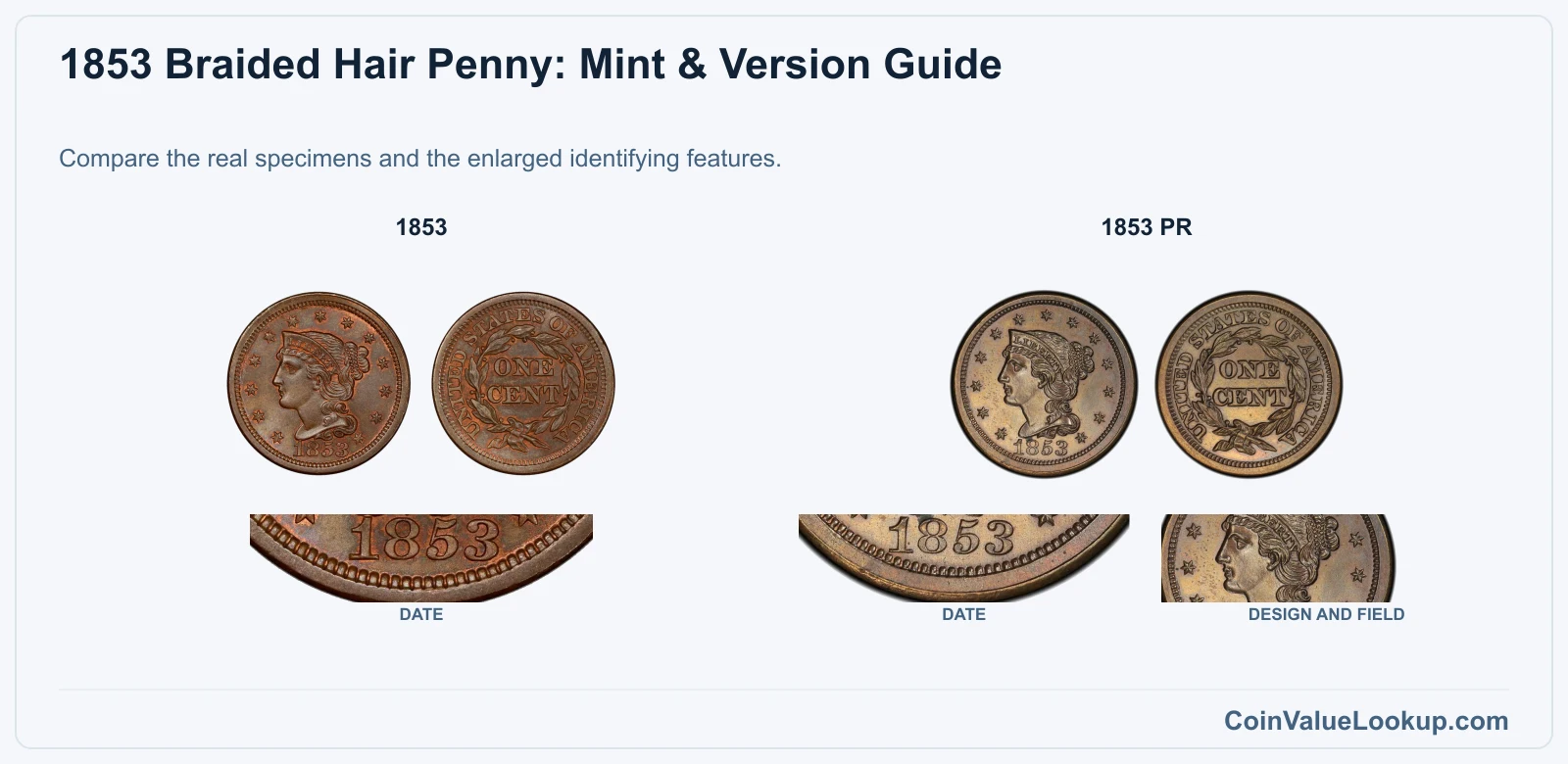
The obverse shows Liberty facing left with a braided hair bun and a coronet inscribed LIBERTY, surrounded by thirteen stars and the date 1853. The reverse displays ONE CENT inside a laurel wreath.
Match both sides to confirm you have a Braided Hair type and not a Coronet or Flying Eagle cent from a nearby year.
All 1853 Braided Hair Cents were struck at Philadelphia. There is no mintmark to look for.
If you see a letter below the wreath or near the date, you may be looking at a different denomination or series entirely.
The standard coin is a copper business strike weighing nominally 10.89 grams. Some 1853 cents also exist as proofs, which are a special manufacturing category with mirror-like surfaces and sharp rims, not simply a high grade.
Polished or cleaned business strikes can mimic the look, so proof attribution depends on die characteristics, surface quality and rim details, not just shininess.
Weight can support identification but is not proof of authenticity by itself. Wear, corrosion and original production tolerances all affect weight, so use it alongside visual checks rather than as a standalone test.
Step 2: Check Your 1853 Braided Hair Cent Grade
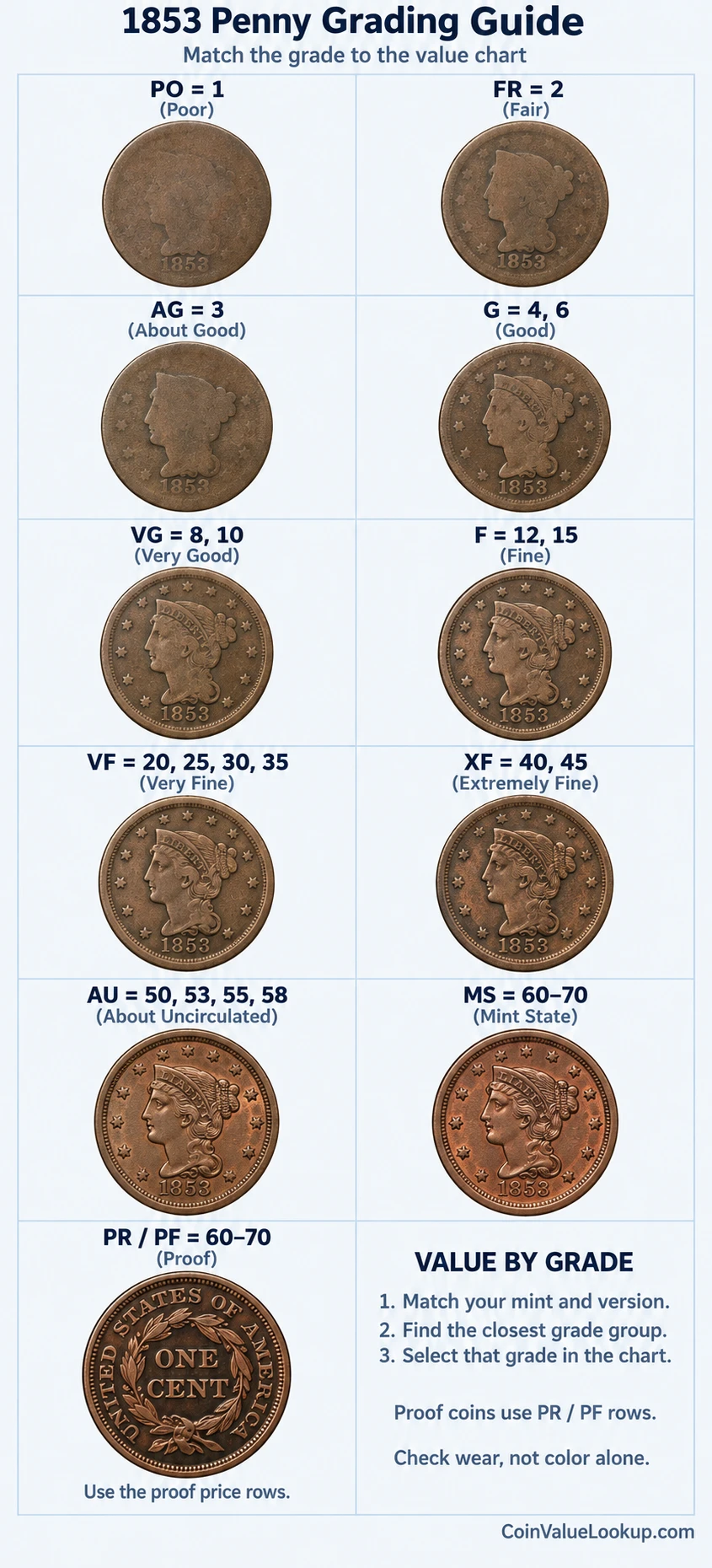
Start with the hair detail above Liberty's ear and the cheek. On a well-worn coin grading around Good-4, only the outline of the portrait remains and most hair strands are flat.
As you move up the scale, individual braids become distinct, and on a Fine example the hair above the forehead shows clear separation.
On the reverse, check the leaf veins in the wreath. They wear down quickly in circulation, so visible veining usually means VF or better.
At the Mint State level, full luster covers both sides with no wear on the highest points of the cheek and hair ribbon.
Copper coins come described as BN (brown), RB (red-brown) or RD (red). These are color designations, not separate alloys or grades.
A fully red cent commands more than a brown one at the same numerical grade, all else equal.
Use the comparison image to gauge your coin's detail against known grade examples. Be honest about surface problems: corrosion pits, porosity and old cleaning can drop the effective market value well below what the grade number alone suggests.
A coin with sharp detail but harsh cleaning is not the same as an original-surface coin at that grade.
Step 3: Check 1853 Braided Hair Cent Value by Mint and Version
1853 Braided Hair Cent
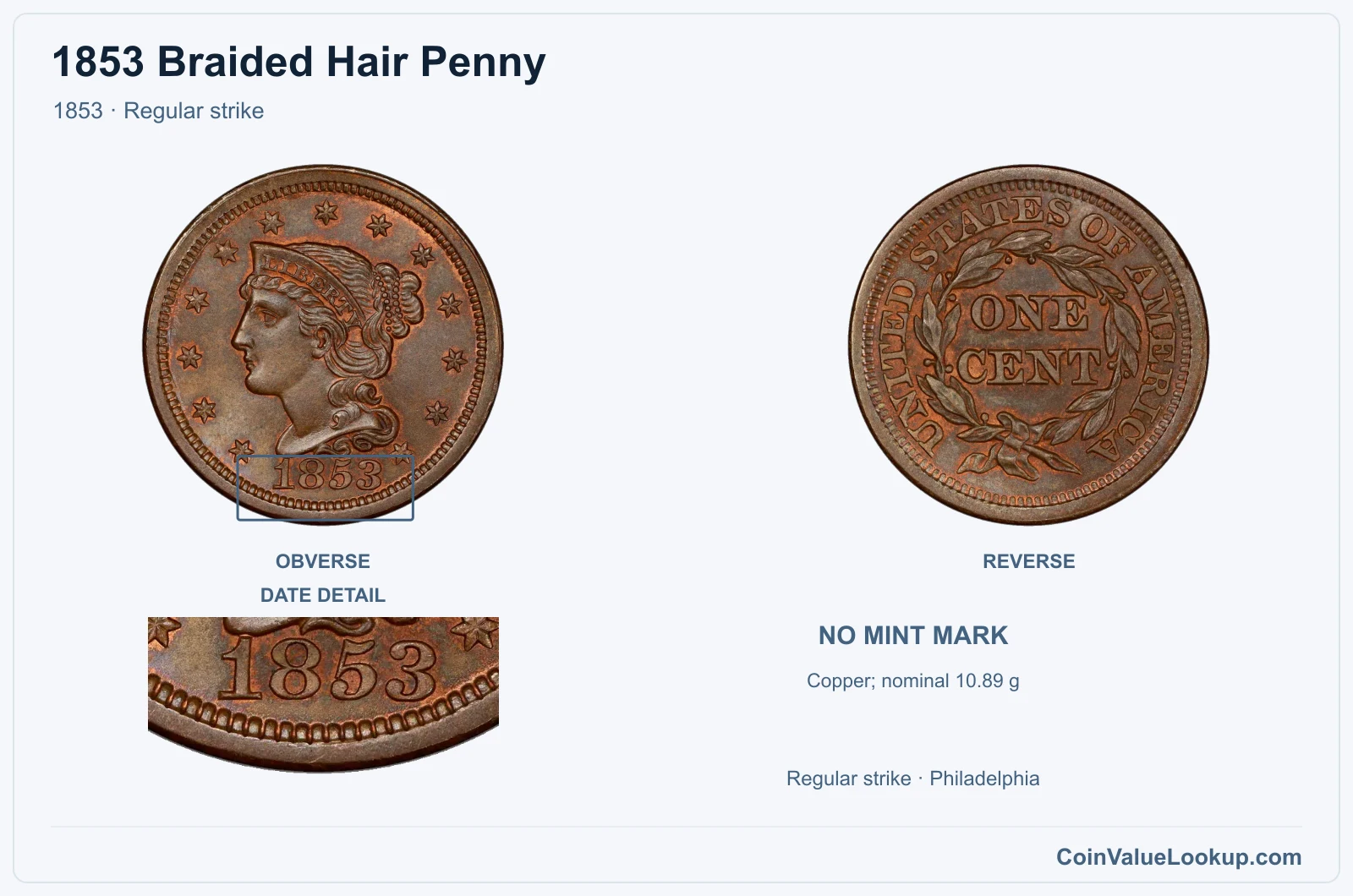
This is the standard 1853 Braided Hair Cent struck for circulation at the Philadelphia Mint. No mintmark.
It weighs about 10.89 grams in copper.
USA Coin Book lists guide values from around $30 in G4 to approximately $437 in MS63. Circulated examples in the VF to XF range sit in between, with price climbing as hair detail and original surfaces improve.
Look for sharp braids, clean fields and undamaged rims when evaluating condition.
Coin Value Lookup is a handy starting point if you want to look up values for other dates in this series or compare across denominations.
| Range | Grade | Price | Auction Records | Appraisal |
|---|---|---|---|---|
| PO | PO 1 | — | Coin Identifier | |
| FR | FR 2 | — | Coin Identifier | |
| AG | AG 3 | — | Coin Identifier | |
| G | G 4 | — | Coin Identifier | |
| G 6 | — | Coin Identifier | ||
| VG | VG 8 | — | Coin Identifier | |
| VG 10 | — | Coin Identifier | ||
| F | F 12 | — | Coin Identifier | |
| F 15 | Coin Identifier | |||
| VF | VF 20 | Coin Identifier | ||
| VF 25 | Coin Identifier | |||
| VF 30 | Coin Identifier | |||
| VF 35 | Coin Identifier | |||
| XF | XF 40 | Coin Identifier | ||
| XF 45 | Coin Identifier | |||
| AU | AU 50 | Coin Identifier | ||
| AU 53 | Coin Identifier | |||
| AU 55 | Coin Identifier | |||
| AU 58 | Coin Identifier | |||
| MS | MS 60 | Coin Identifier | ||
| MS 61 | Coin Identifier | |||
| MS 62 | Coin Identifier | |||
| MS 63 | Coin Identifier | |||
| MS 64 | Coin Identifier | |||
| MS 65 | Coin Identifier | |||
| MS 66 | Coin Identifier | |||
| MS 67 | Coin Identifier | |||
| MS 68 | — | — | — | |
| MS 69 | — | — | — | |
| MS 70 | — | — | — |
1853 Braided Hair Cent — PR
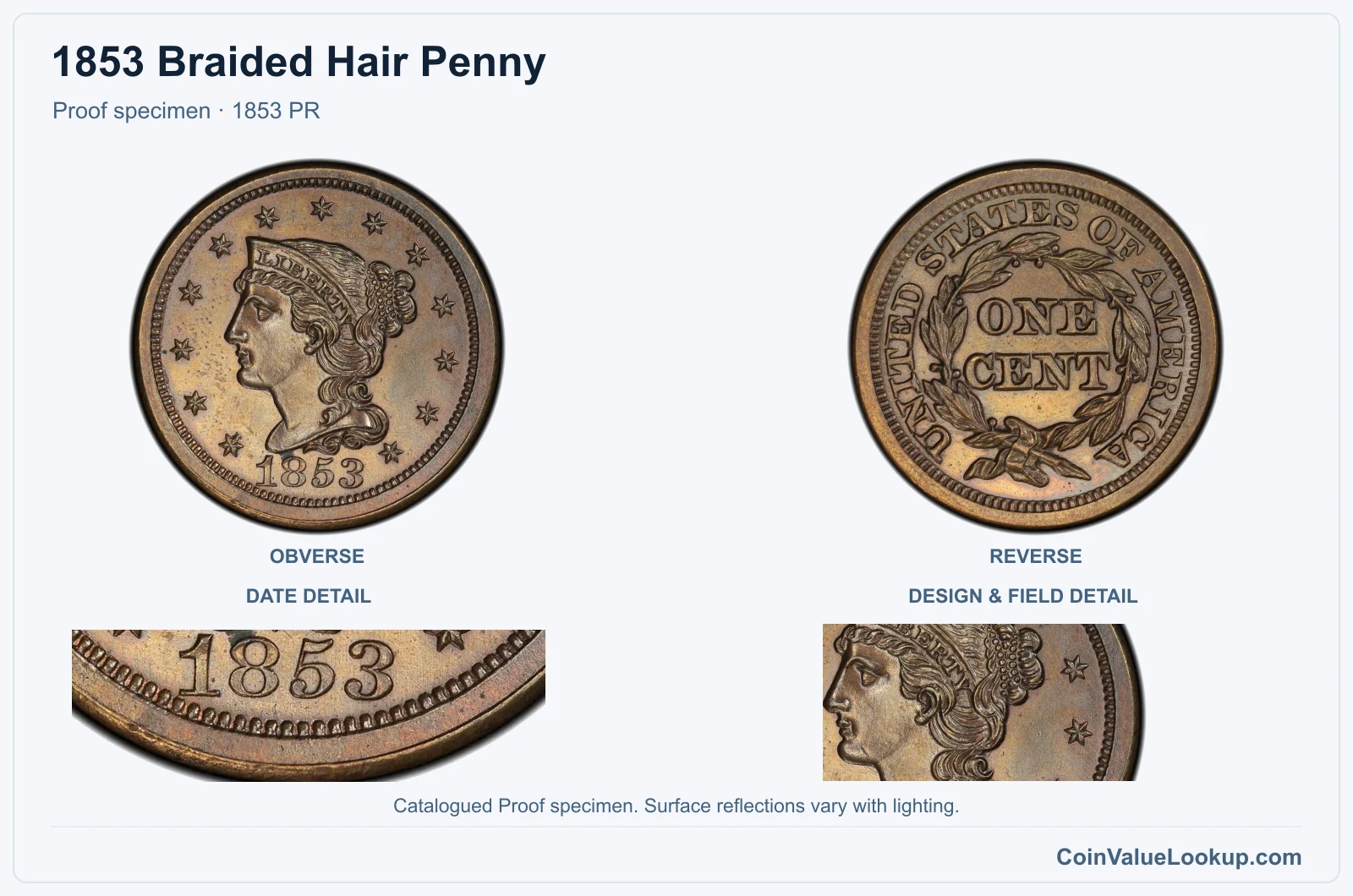
Proof 1853 Braided Hair Cents are a separate manufacturing category. They were struck with specially prepared dies on polished planchets, producing sharply defined rims and mirror-like fields.
A business strike that has been polished or dipped is not a proof, no matter how shiny it looks.
Attributing a genuine proof requires examining die characteristics, rim profile and surface structure. Third-party authentication is strongly recommended before assuming you hold one.
No ordinary business-strike price transfers to a confirmed proof, and no supported numeric range is available here. Each proof trades on its own merits: authenticated identity, preservation and eye appeal all factor into what a buyer will pay.
| Range | Grade | Price | Auction Records | Appraisal |
|---|---|---|---|---|
| PR | PR 1 | — | Coin Identifier | |
| PR 2 | — | Coin Identifier | ||
| PR 3 | — | Coin Identifier | ||
| PR 4 | — | Coin Identifier | ||
| PR 6 | — | Coin Identifier | ||
| PR 8 | — | Coin Identifier | ||
| PR 10 | — | Coin Identifier | ||
| PR 12 | — | Coin Identifier | ||
| PR 15 | — | Coin Identifier | ||
| PR 20 | — | Coin Identifier | ||
| PR 25 | — | Coin Identifier | ||
| PR 30 | — | Coin Identifier | ||
| PR 35 | — | Coin Identifier | ||
| PR 40 | — | Coin Identifier | ||
| PR 45 | — | Coin Identifier | ||
| PR 50 | — | Coin Identifier | ||
| PR 53 | — | Coin Identifier | ||
| PR 55 | — | Coin Identifier | ||
| PR 58 | — | Coin Identifier | ||
| PR 60 | — | Coin Identifier | ||
| PR 61 | — | Coin Identifier | ||
| PR 62 | — | Coin Identifier | ||
| PR 63 | — | Coin Identifier | ||
| PR 64 | Coin Identifier | |||
| PR 65 | — | — | — | |
| PR 66 | — | — | — | |
| PR 67 | — | — | — | |
| PR 68 | — | — | — | |
| PR 69 | — | — | — | |
| PR 70 | — | — | — |
1853 Braided Hair Cent Error List
1. 1853 Braided Hair Cent — Off-Center Strike
An off-center strike happens when the planchet is not properly seated between the dies, shifting the entire design to one side and leaving an unstruck crescent of blank metal. On an 1853 Braided Hair Cent, you want to see the date still visible in the struck portion; without a readable date, collector interest drops sharply.
To tell it apart from look-alikes, check whether the blank crescent is smooth and uniform. A clipped planchet has a curved or straight cut edge, not a crescent of full-thickness blank metal.
Post-mint damage or one-sided die misalignment can also mimic the appearance. No specific price range is adopted for this error; each piece is assessed individually based on the degree of off-center shift, date visibility and overall condition.
2. 1853 Braided Hair Cent — Misaligned Die
A misaligned die shifts one face of the design relative to the planchet or opposite face, creating uneven rim width on the affected side. Both sides still show a complete design, which is the key difference from an off-center strike where part of the design is missing entirely.
Look at the rims on both sides. If one side has a noticeably wider rim at one point and a narrower rim directly opposite, you may have a misaligned die.
A tilted photograph or post-mint rim ding can fool you, so compare at multiple angles. This is also distinct from a rotated die, where the alignment between obverse and reverse is twisted rather than shifted.
No adopted price range exists; value depends on the severity of misalignment and the coin's overall grade and surfaces.
3. 1853 Braided Hair Cent — Die Crack
Die cracks appear as thin raised lines running across the coin's surface. They form when the steel die develops a fracture from repeated use, and the crack fills with metal during striking.
On an 1853 cent, trace the line carefully: it should sit above the field, not cut into it.
The main look-alike is an incuse scratch, which is recessed into the surface rather than raised. Corrosion lines and tool marks can also mimic a crack at first glance, but they lack the sharp, consistent profile of a genuine die crack.
Minor cracks are common on heavily used dies and add modest interest; dramatic cracks spanning the full face are less common and more desirable. No specific pricing is adopted here, so each example needs individual evaluation based on prominence and condition.
4. 1853 Braided Hair Cent — Die Break / Cud
A cud is a raised blob of metal connected to the rim, caused by a piece of the die breaking away entirely. The missing die section leaves no design detail in that area, just a smooth lump.
Smaller interior die breaks exist too but are technically distinct from a true rim-connected cud.
Check the boundary carefully. A rim dent or ding is depressed, not raised, and corrosion can create rough lumps that superficially resemble a cud.
A genuine cud will have a defined edge where the intact die met the broken section. On copper cents from this era, large cuds are scarce and tend to attract attention.
No numeric price range is adopted; assessment depends on the cud's size, location and the coin's overall preservation.
5. 1853 Braided Hair Cent — Lamination / Split Planchet
Lamination errors show up as peeling or flaking metal on the coin's surface. You might see a retained flap still attached, or a void where a layer separated completely.
On a copper cent like the 1853, impurities or gas trapped during the planchet rolling process can cause layers to split apart.
Photograph the edge and affected face together so the depth of the separation is visible. The main look-alikes are scraping from a hard surface, corrosion that has eaten through the metal, or a deliberately shaved coin.
Genuine laminations follow the metal's internal structure and usually have smooth, rounded edges at the separation point. No adopted price range exists for this error on the 1853 cent; each piece is evaluated based on the size and visual impact of the flaw alongside overall condition.
6. 1853 Braided Hair Cent — Struck-Through Error
A struck-through error occurs when foreign material sits between the die and the planchet during striking, leaving a depressed area or impression in the finished coin. The obstruction might be grease, a thread, a metal fragment or another small object.
Grease fill-ins tend to produce soft, featureless patches, while a retained foreign object leaves a sharper impression.
Distinguish these from ordinary wear, scratches or cleaning damage. Wear removes detail gradually and uniformly from high points, while a struck-through depression is localized and often surrounded by normally struck detail.
Cleaning marks are usually directional and incuse. No supported price range is adopted for struck-through errors on this date; value depends on the clarity of the impression, the type of obstruction and the coin's overall grade.