1856 Braided Hair Cent Coin Value: How Much Is It Worth?
The 1856 Braided Hair Cent is one of the final large copper cents struck at Philadelphia. Guide estimates for ordinary business strikes range from about $30 in G4 to $437 in MS63, depending on variety and condition.
Identify your exact variety first — the Upright 5 and Slanted 5 are distinct die varieties, and proof examples require individual assessment beyond these figures.
Fast Way to Identify Your 1856 Braided Hair Cent
Snap clear photos of the front and back of your 1856 cent and upload them here for a preliminary identification. This step helps sort out whether you have the Upright 5 or Slanted 5 variety and flags any obvious condition issues.
Sharp, well-lit images of both sides make a real difference.
1856 Braided Hair Cent Value
Upload both sides of your 1856 Braided Hair Cent.
Front Obverse
Upload photo
Back Reverse
Upload photo
Which 1856 Braided Hair Cent Versions Are Worth Money?
- The Upright 5 and Slanted 5 business strikes are the two main varieties — guide estimates run $30 in G4 to $437 in MS63 for each, but actual condition matters enormously.
- Proof examples with the Slanted 5 exist and require individual assessment of authenticated identity, surfaces and die characteristics; no standard guide price is transferred from business strikes.
- Off-center strikes and clipped planchets are reported error categories for this date, and confirmed examples with visible dates can carry premiums that depend on severity and authentication.
Step 1: Identify Your 1856 Braided Hair Cent Mint Mark and Version
First things first: the 1856 Braided Hair Cent is a large copper coin, roughly 10.89 grams. Do not confuse it with the small copper-nickel 1856 Flying Eagle cent, which is a pattern issue with later restrikes — a completely different coin in size, metal and design.
All 1856 Braided Hair Cents were struck at Philadelphia. There is no mintmark to look for.
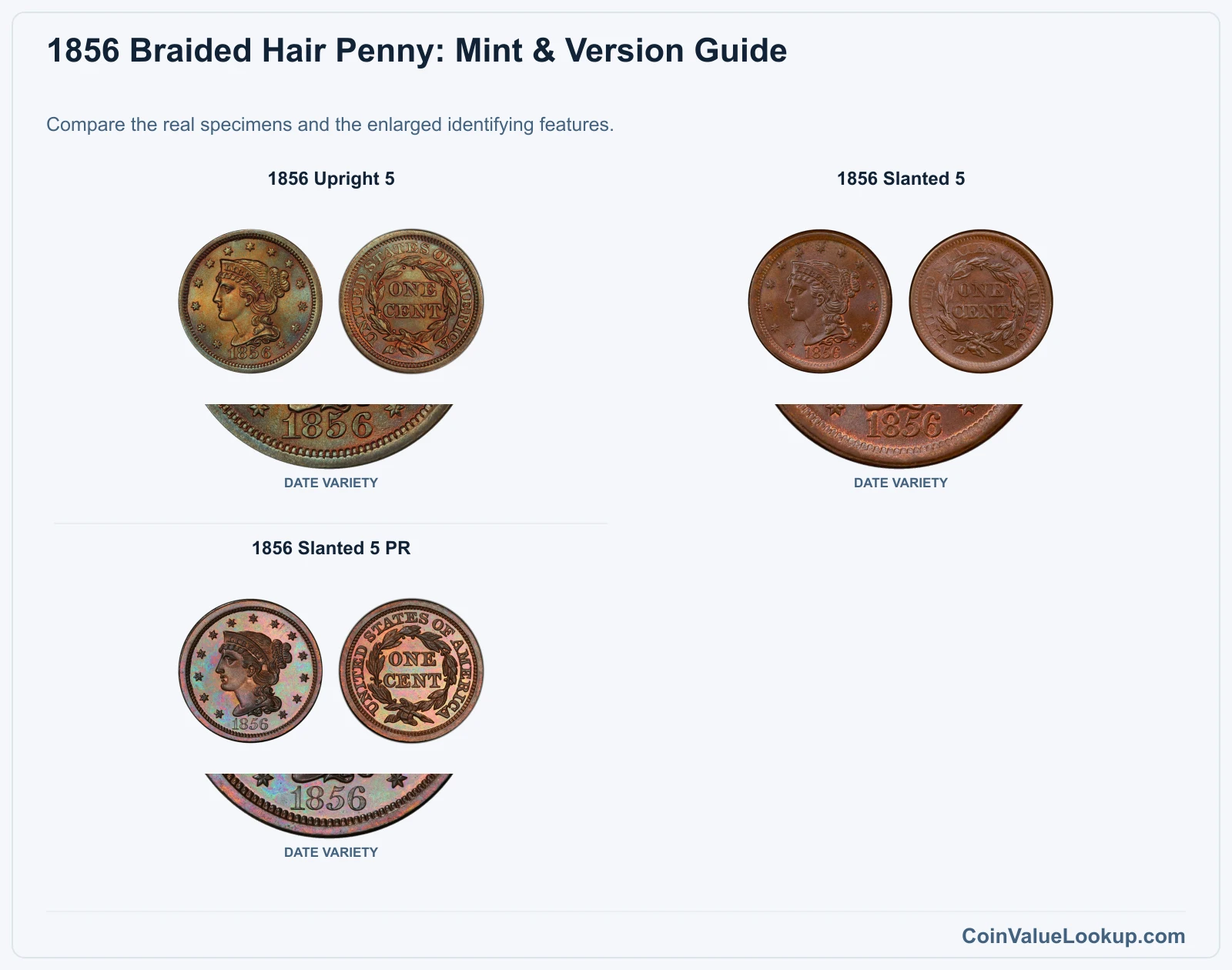
The key variety split is the shape of the "5" in the date. An Upright 5 stands more or less vertical, while a Slanted 5 leans noticeably to the right.
Look at the digit under magnification and compare it to known examples.
Inspect both faces and the edge carefully. Date-punch shape, legend wording and wreath details all matter when confirming the correct category.
Weight and material can support your identification, but wear, corrosion and normal production tolerances mean weight alone will not prove authenticity.
Step 2: Check Your 1856 Braided Hair Cent Grade
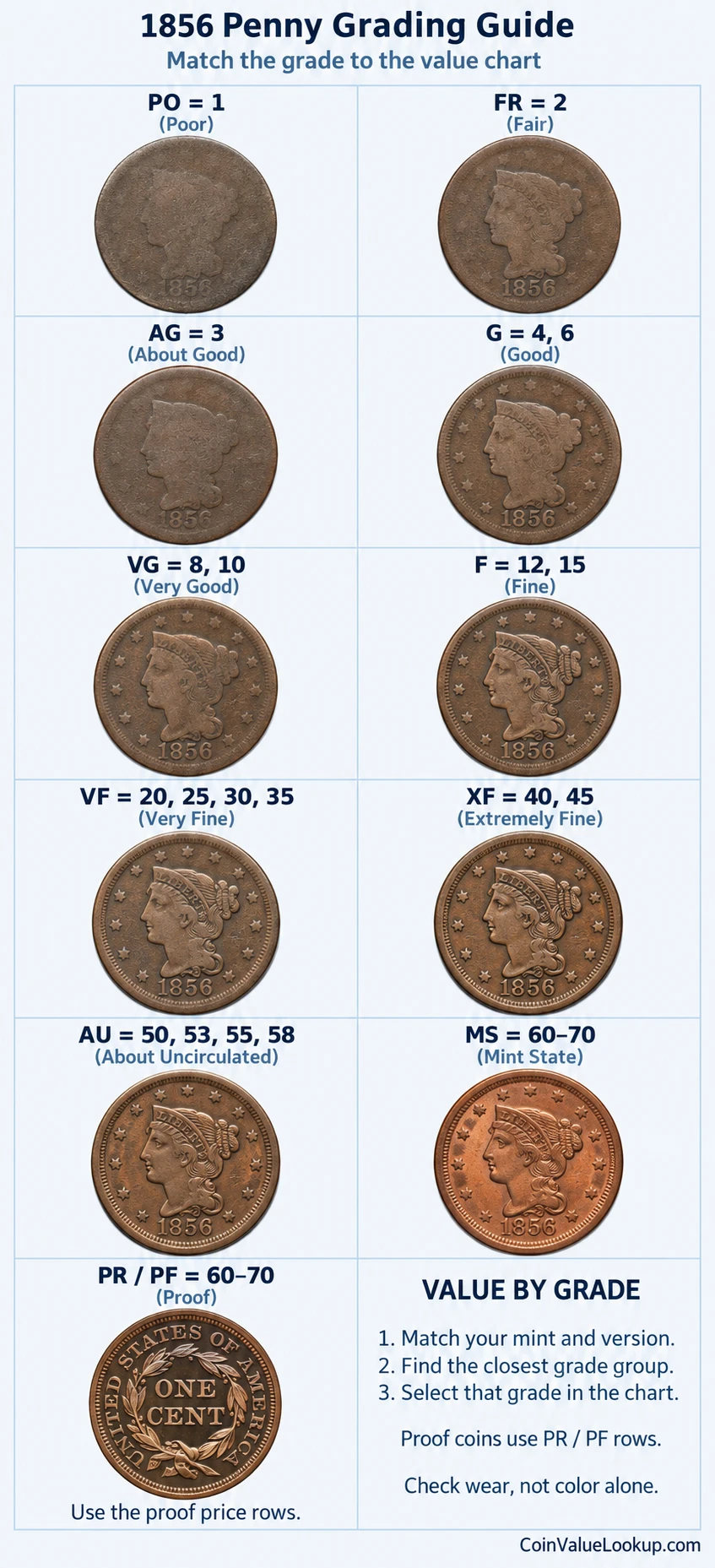
Focus on Liberty's hair detail and cheek, the wreath leaf relief, and the sharpness of lettering around the rim. Compare your coin side-by-side with the grade comparison image for a like-type example.
Wear from circulation looks different from a weak strike or surface problems like corrosion and porosity. A coin with sharp design elements but rough, porous surfaces will still trade below a smoother example at the same grade.
Surface problems can lower market value substantially.
On copper coins you will see color designations: BN (brown), RB (red-brown), and RD (red). These describe how much original mint color survives — they are not separate alloys.
Most survivors from 1856 are fully brown.
Proof is a manufacturing method, not a grade above Mint State. A polished coin is not a proof.
Proof attribution requires specific die characteristics, rim profiles and surface quality consistent with known proof production.
Step 3: Check 1856 Braided Hair Cent Value by Mint and Version
1856 Braided Hair Cent — Upright 5
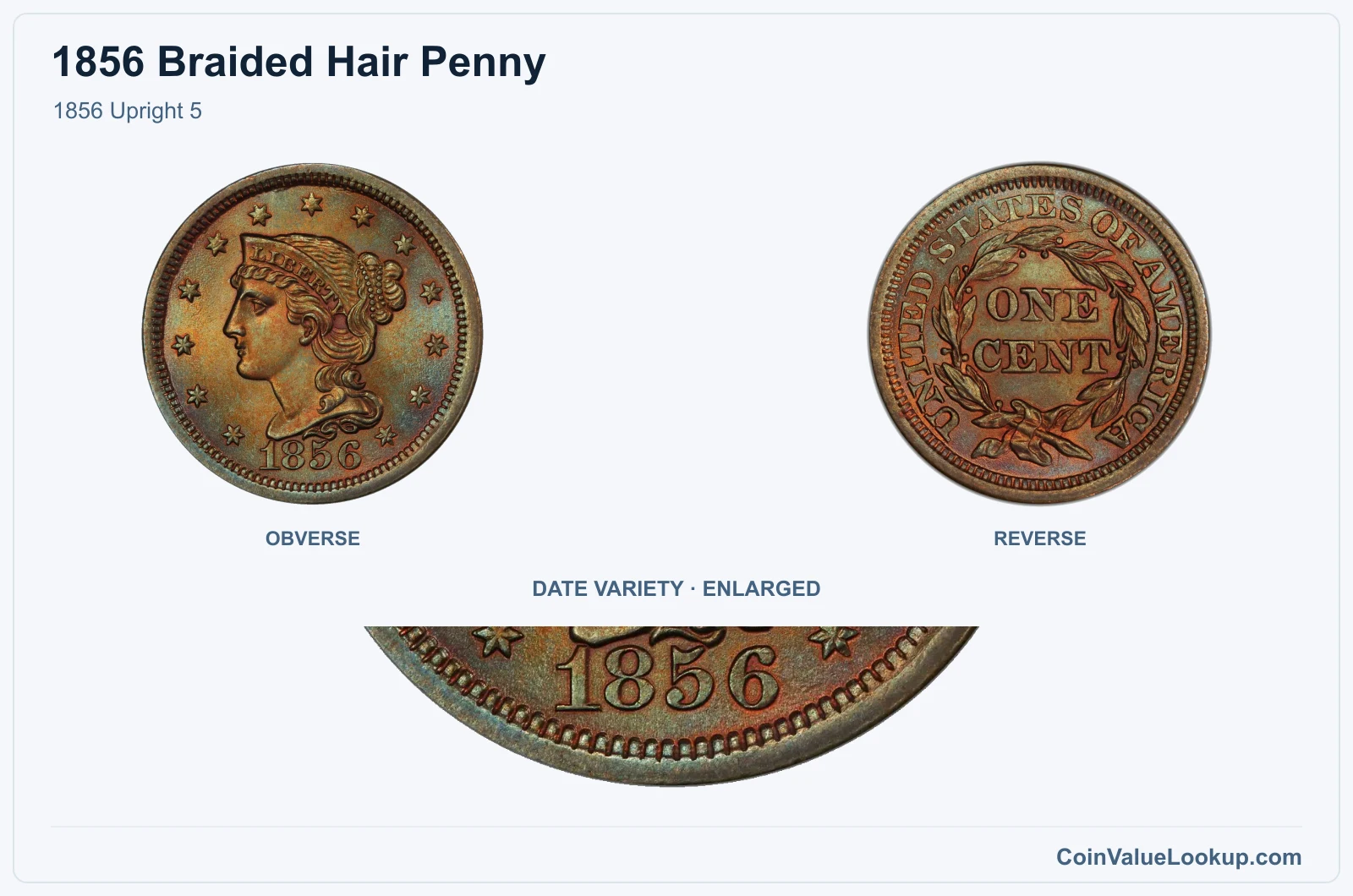
The Upright 5 variety shows a nearly vertical numeral "5" in the date. It is a large copper business strike from Philadelphia, with no mintmark, weighing a nominal 10.89 grams.
The obverse carries the classic Braided Hair portrait of Liberty, and the reverse displays the denomination within a wreath.
Guide estimates place this variety at roughly $30 in G4 and up to $437 in MS63, according to USA Coin Book. Those figures assume original, problem-free surfaces.
Cleaned or corroded pieces routinely sell for less, even when the detail grade looks decent. Do not confuse this large copper cent with the small copper-nickel 1856 Flying Eagle, which is an entirely separate coin.
Coin Value Lookup is a good starting point if you want to compare this date against other years in the Braided Hair series or check values across different denominations.
| Range | Grade | Price | Auction Records | Appraisal |
|---|---|---|---|---|
| PO | PO 1 | — | Coin Identifier | |
| FR | FR 2 | — | Coin Identifier | |
| AG | AG 3 | — | Coin Identifier | |
| G | G 4 | — | Coin Identifier | |
| G 6 | — | Coin Identifier | ||
| VG | VG 8 | — | Coin Identifier | |
| VG 10 | — | Coin Identifier | ||
| F | F 12 | — | Coin Identifier | |
| F 15 | — | Coin Identifier | ||
| VF | VF 20 | — | Coin Identifier | |
| VF 25 | Coin Identifier | |||
| VF 30 | Coin Identifier | |||
| VF 35 | Coin Identifier | |||
| XF | XF 40 | Coin Identifier | ||
| XF 45 | Coin Identifier | |||
| AU | AU 50 | Coin Identifier | ||
| AU 53 | Coin Identifier | |||
| AU 55 | Coin Identifier | |||
| AU 58 | Coin Identifier | |||
| MS | MS 60 | Coin Identifier | ||
| MS 61 | Coin Identifier | |||
| MS 62 | Coin Identifier | |||
| MS 63 | Coin Identifier | |||
| MS 64 | Coin Identifier | |||
| MS 65 | Coin Identifier | |||
| MS 66 | Coin Identifier | |||
| MS 67 | — | — | — | |
| MS 68 | — | — | — | |
| MS 69 | — | — | — | |
| MS 70 | — | — | — |
1856 Braided Hair Cent — Slanted 5
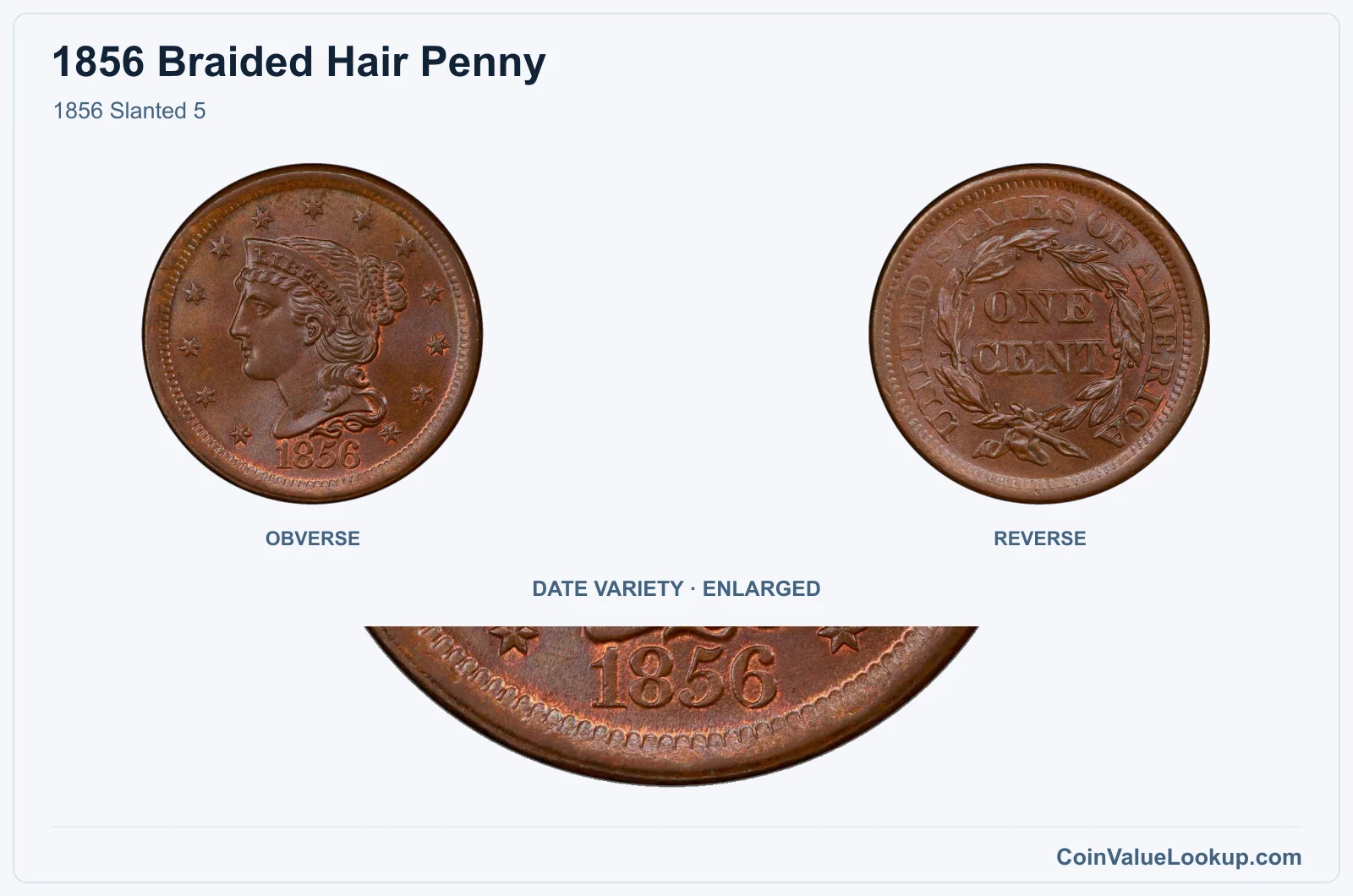
The Slanted 5 variety has the numeral "5" in the date leaning distinctly to the right. Same mint, same copper composition, same nominal 10.89-gram weight — the difference is purely in the date punch used by the die engraver.
Guide estimates match the Upright 5: about $30 in G4 up to $437 in MS63, per USA Coin Book. In practice, advanced collectors may pay differently for one punch style over the other depending on census data and personal preference, but the published guide figures are identical.
Check the angle of that "5" under magnification before committing to a label.
| Range | Grade | Price | Auction Records | Appraisal |
|---|---|---|---|---|
| PO | PO 1 | — | Coin Identifier | |
| FR | FR 2 | — | Coin Identifier | |
| AG | AG 3 | — | Coin Identifier | |
| G | G 4 | — | Coin Identifier | |
| G 6 | — | Coin Identifier | ||
| VG | VG 8 | — | Coin Identifier | |
| VG 10 | — | Coin Identifier | ||
| F | F 12 | — | Coin Identifier | |
| F 15 | Coin Identifier | |||
| VF | VF 20 | Coin Identifier | ||
| VF 25 | — | Coin Identifier | ||
| VF 30 | Coin Identifier | |||
| VF 35 | — | Coin Identifier | ||
| XF | XF 40 | Coin Identifier | ||
| XF 45 | Coin Identifier | |||
| AU | AU 50 | Coin Identifier | ||
| AU 53 | Coin Identifier | |||
| AU 55 | Coin Identifier | |||
| AU 58 | Coin Identifier | |||
| MS | MS 60 | Coin Identifier | ||
| MS 61 | Coin Identifier | |||
| MS 62 | Coin Identifier | |||
| MS 63 | Coin Identifier | |||
| MS 64 | Coin Identifier | |||
| MS 65 | Coin Identifier | |||
| MS 66 | Coin Identifier | |||
| MS 67 | — | — | — | |
| MS 68 | — | — | — | |
| MS 69 | — | — | — | |
| MS 70 | — | — | — |
1856 Braided Hair Cent — Slanted 5 PR
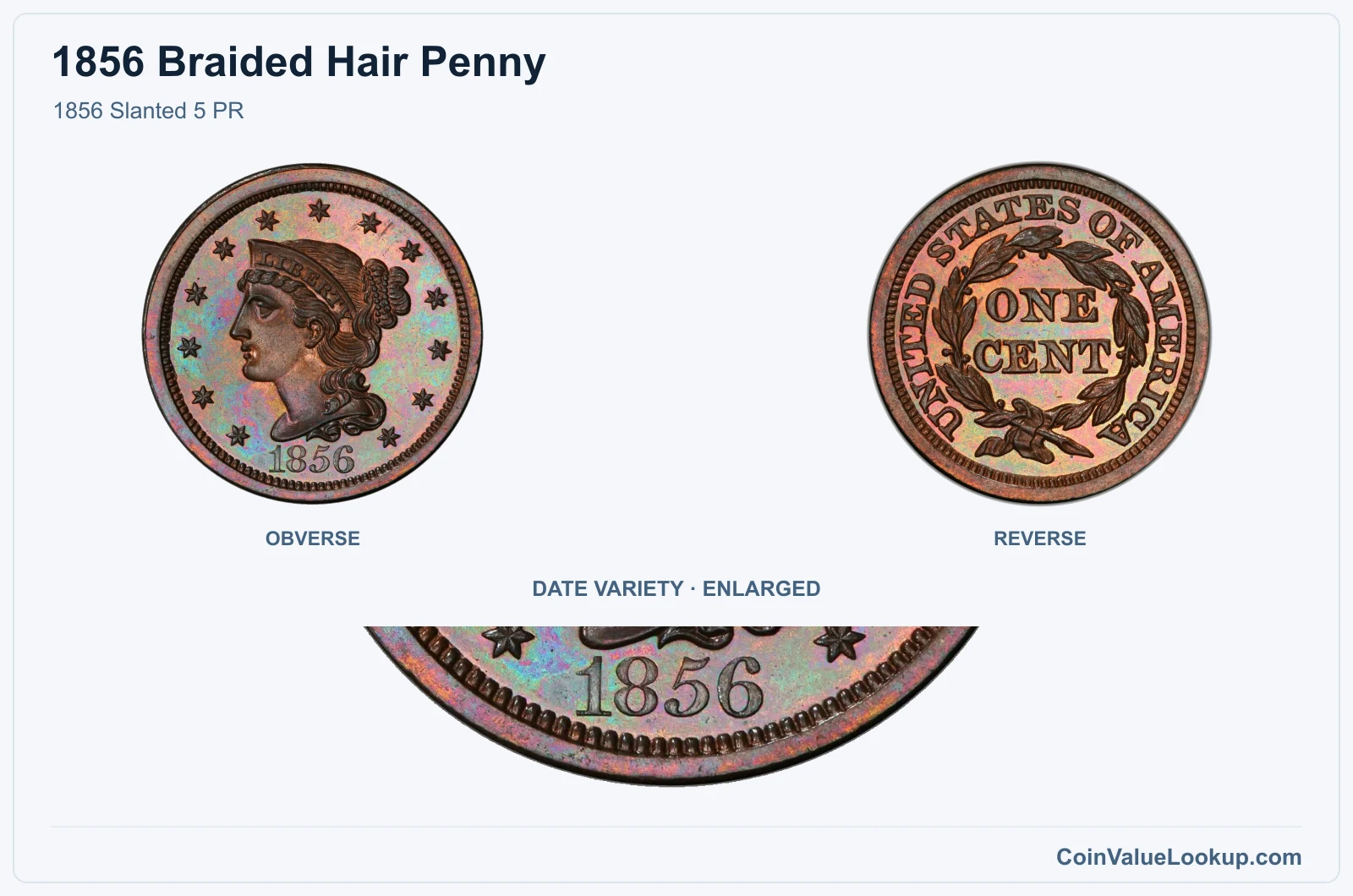
Proof 1856 Braided Hair Cents carry the Slanted 5 date punch. These were produced at Philadelphia using specially prepared dies and planchets, yielding reflective fields and sharp detail that business strikes do not replicate.
Attributing a genuine proof requires examining die characteristics, rim profiles and surface quality — not just a shiny appearance. Polishing a circulated coin does not create a proof, and plenty of cleaned large cents get misidentified this way.
No numeric guide price from the business-strike tables is transferred here.
Because genuine proofs of this date are rare, each example needs individual assessment by an authenticated identity, its actual surfaces and any impairments. Third-party certification from a recognized grading service is the practical standard for establishing a proof's bona fides.
| Range | Grade | Price | Auction Records | Appraisal |
|---|---|---|---|---|
| PR | PR 1 | — | Coin Identifier | |
| PR 2 | — | Coin Identifier | ||
| PR 3 | — | Coin Identifier | ||
| PR 4 | — | Coin Identifier | ||
| PR 6 | — | Coin Identifier | ||
| PR 8 | — | Coin Identifier | ||
| PR 10 | — | Coin Identifier | ||
| PR 12 | — | Coin Identifier | ||
| PR 15 | — | Coin Identifier | ||
| PR 20 | — | Coin Identifier | ||
| PR 25 | — | Coin Identifier | ||
| PR 30 | — | Coin Identifier | ||
| PR 35 | — | Coin Identifier | ||
| PR 40 | — | Coin Identifier | ||
| PR 45 | — | Coin Identifier | ||
| PR 50 | — | Coin Identifier | ||
| PR 53 | — | Coin Identifier | ||
| PR 55 | — | Coin Identifier | ||
| PR 58 | — | Coin Identifier | ||
| PR 60 | — | Coin Identifier | ||
| PR 61 | — | Coin Identifier | ||
| PR 62 | — | Coin Identifier | ||
| PR 63 | Coin Identifier | |||
| PR 64 | Coin Identifier | |||
| PR 65 | Coin Identifier | |||
| PR 66 | Coin Identifier | |||
| PR 67 | — | — | — | |
| PR 68 | — | — | — | |
| PR 69 | — | — | — | |
| PR 70 | — | — | — |
1856 Braided Hair Cent Error List
1. 1856 Braided Hair Cent — Off-Center Strike
An off-center strike happens when the planchet is not seated properly between the dies at the moment of striking. The result is a displaced design with an unstruck crescent of blank metal along part of the rim.
The more dramatic the shift, the larger that crescent.
For an 1856 Braided Hair Cent, the date must remain visible for the coin to be attributed to this year — and date visibility is a major factor in any off-center coin's desirability. Look at both sides: the design shift should be consistent from obverse to reverse.
Watch out for lookalikes. A clipped planchet, one-sided die misalignment or post-mint damage from flattening can mimic an off-center appearance.
No numeric price is adopted for this error; value depends on authenticated identity, the degree of off-center shift, date visibility and overall condition.
2. 1856 Braided Hair Cent — Clipped Planchet
A clipped planchet error occurs when the blank was incompletely punched from the copper strip before striking. You will see a missing curved, straight or ragged section where metal should be.
The edge texture at the clip usually differs from a filed or cut edge — look for the natural curvature and, on many clips, a zone of design weakness on the opposite side where metal could not flow fully into the die.
That opposing weakness is a useful diagnostic. Post-mint damage like an intentional edge cut, a filed notch or corrosion eating away the rim will not produce that characteristic opposite-side softness.
No numeric price is adopted for clipped 1856 Braided Hair Cents. Value depends on the clip's size and type, whether the date is fully legible, overall surface quality and third-party authentication confirming the error is genuine.