1857 Braided Hair Cent Coin Value: How Much Is It Worth?
The 1857 Braided Hair Cent marks the end of an era — literally the last year the United States Mint produced Large Cents. Guide estimates for ordinary business strikes range from about $217 in G4 to $1,878 in MS63, depending on whether you hold a Large Date or Small Date variety.
Proof strikes and major errors fall outside that range and need individual assessment. Identify your exact variety before drawing any value conclusions.
Fast Way to Identify Your 1857 Braided Hair Cent
The quickest way to start figuring out what you have is to upload clear photos of both sides of your coin. A sharp image of the obverse (front) and reverse (back) helps with preliminary identification of the date size, surface condition, and any obvious striking anomalies.
Snap both sides in good light and compare what you see against the variety details below.
1857 Braided Hair Cent Value
Upload both sides of your 1857 Braided Hair Cent.
Front Obverse
Upload photo
Back Reverse
Upload photo
Which 1857 Braided Hair Cent Versions Are Worth Money?
- The 1857 Large Date and Small Date varieties share similar guide values — roughly $217 at G4 to $1,878 at MS63 — but confirming the correct variety is essential for accurate assessment.
- Proof examples of the 1857 Small Date exist but carry no standard guide price; each requires individual evaluation based on authenticated identity and condition.
- Off-center strikes and clipped planchets are reported error categories for this date and can carry premiums, though values depend on severity and authentication.
- Because 1857 was the final year of the Large Cent series, collector demand spans beginners and advanced specialists alike, keeping even circulated examples solidly above face value.
Step 1: Identify Your 1857 Braided Hair Cent Mint Mark and Version
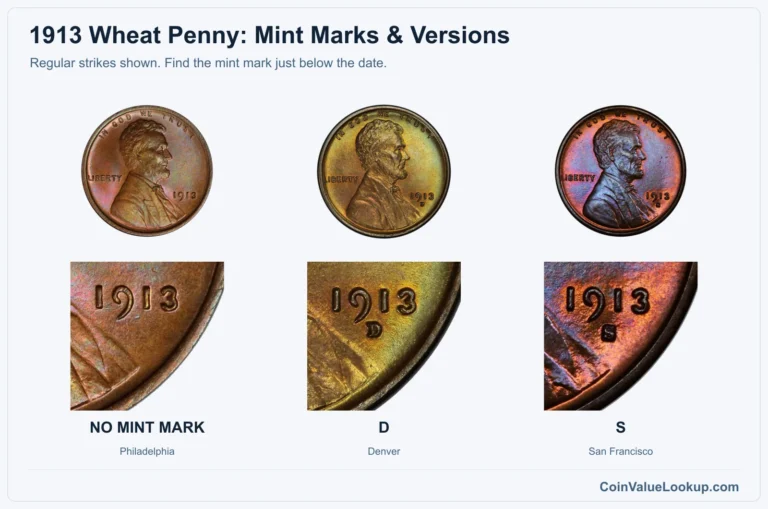
The 1857 Braided Hair Cent was struck only at Philadelphia, so there is no mintmark to look for. Every genuine example is a Philadelphia product.
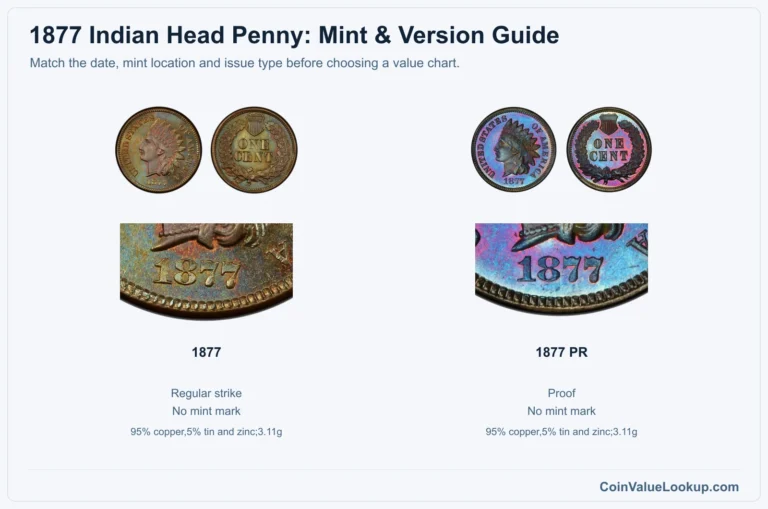
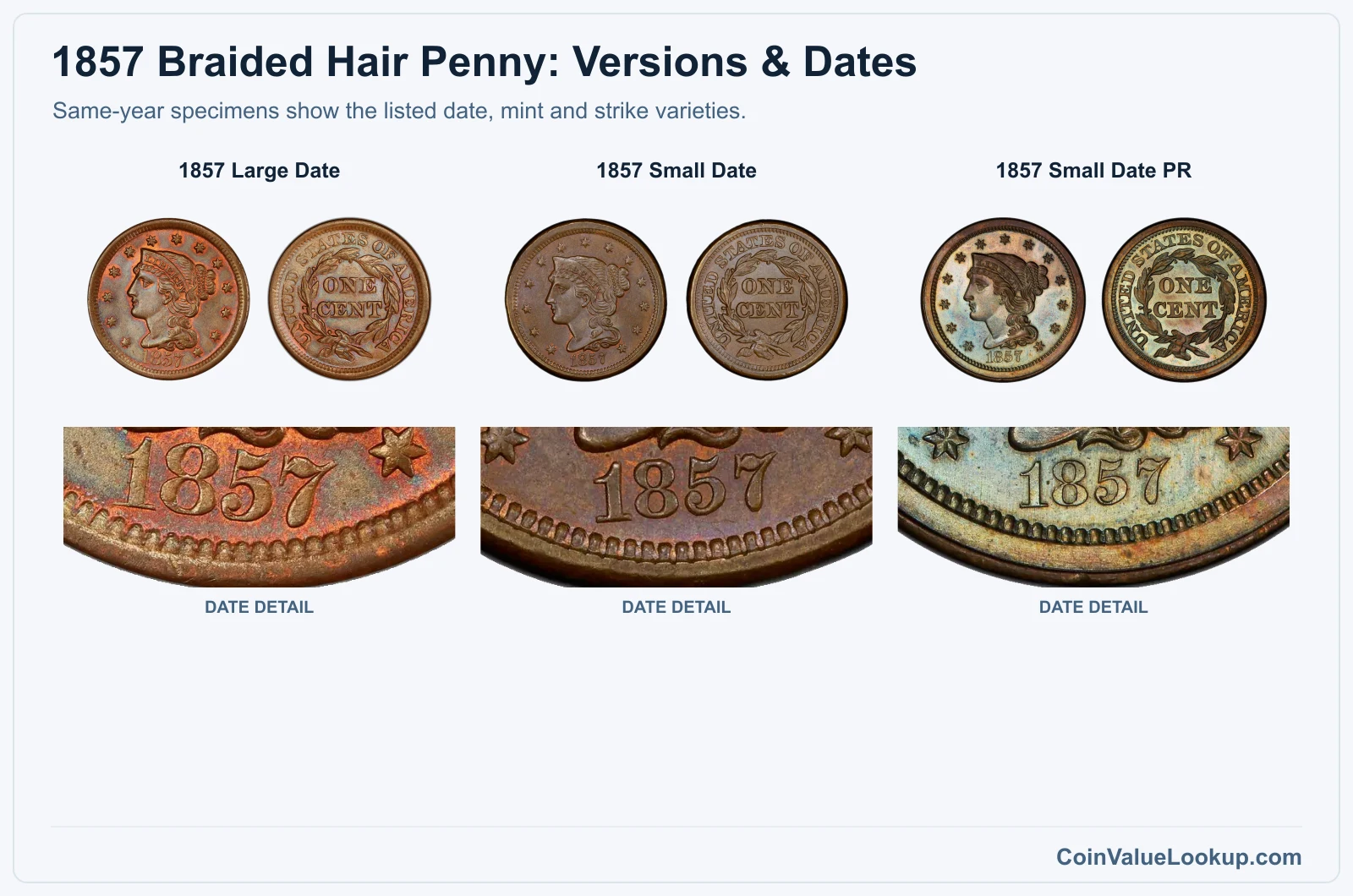
The key variety split is Large Date versus Small Date. Look carefully at the numerals in "1857" — the Large Date version has taller, broader digits, while the Small Date digits are noticeably more compact and closely spaced.
Side-by-side comparison with known examples is the most reliable way to tell them apart.
Don't confuse this coin with the 1857 Flying Eagle Cent, which also entered production that year. The Flying Eagle is a completely different design on a smaller, lighter planchet made of copper-nickel rather than pure copper.
If your coin shows a flying eagle on the obverse instead of the braided-hair Liberty portrait, you're looking at the wrong series.
Weight can support your identification — a genuine Braided Hair Cent has a nominal weight of 10.89 grams — but wear, corrosion, and production tolerances mean weight alone doesn't prove authenticity. Check both faces and the edge carefully.
Step 2: Check Your 1857 Braided Hair Cent Grade
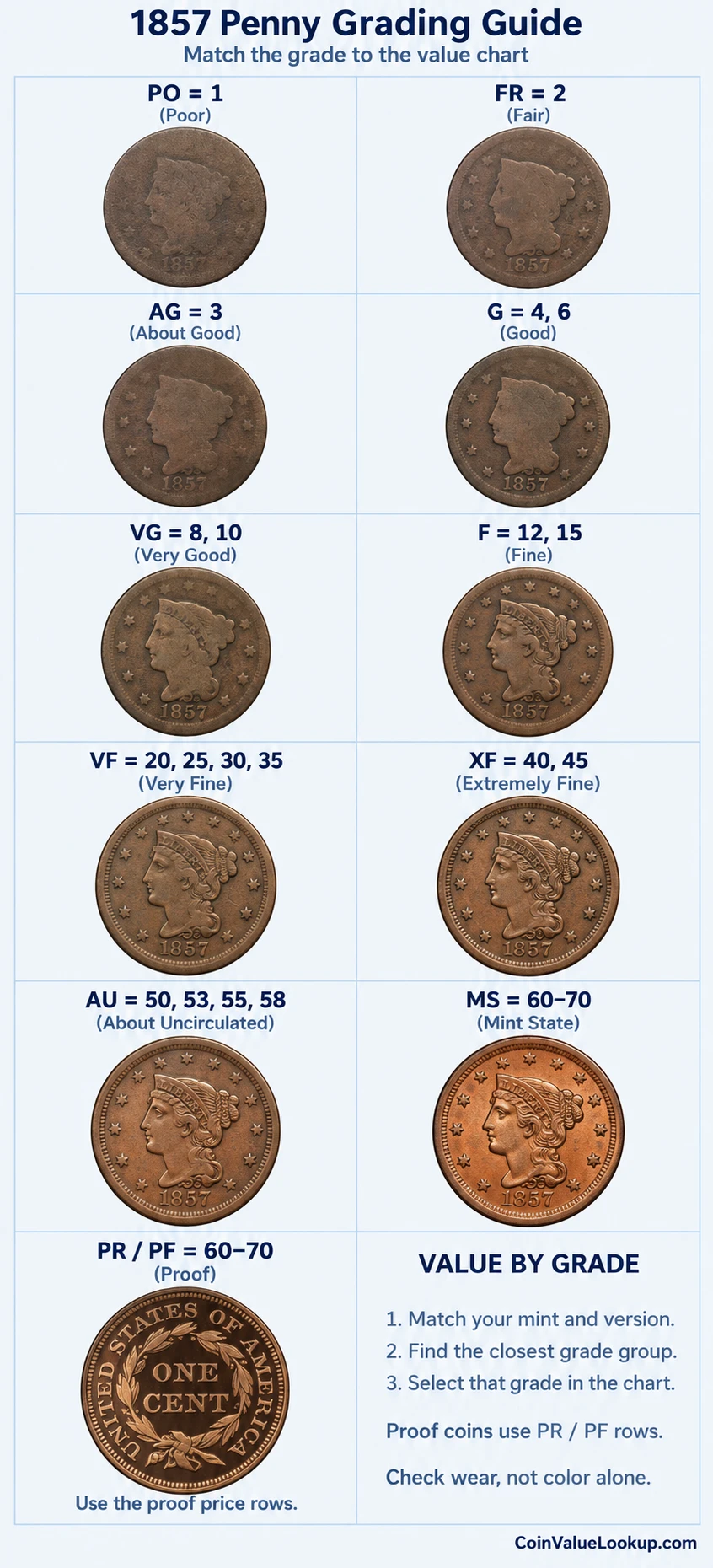
Start with Liberty's hair above the ear and along the braid. On a well-worn coin (around G4), most hair detail merges into flat areas, and the date is barely legible.
A mid-grade piece (VF range) retains individual strands over Liberty's temple and sharper definition in the wreath leaves on the reverse.
At the MS63 level, full hair and leaf detail remain, with original luster visible across both sides. Compare your coin to the reference image and look for matching sharpness.
Don't confuse a weakly struck area with honest wear. Some 1857 cents left the press with soft detail in the hair curls or wreath tips.
That's a strike issue, not circulation damage, and it affects eye appeal differently than a coin worn smooth from decades in pockets.
Surface problems matter a lot on copper. Cleaning, corrosion, and porosity can dramatically reduce a coin's market appeal even if the underlying detail looks decent.
Color designations like BN, RB, and RD describe the remaining original copper color, not different metals — a coin with full red surfaces (RD) is the same alloy as a brown one (BN), just better preserved.
Proof is a method of manufacture, not a grade level above Mint State. A shiny coin is not automatically a proof.
Step 3: Check 1857 Braided Hair Cent Value by Mint and Version
1857 Braided Hair Cent — Large Date
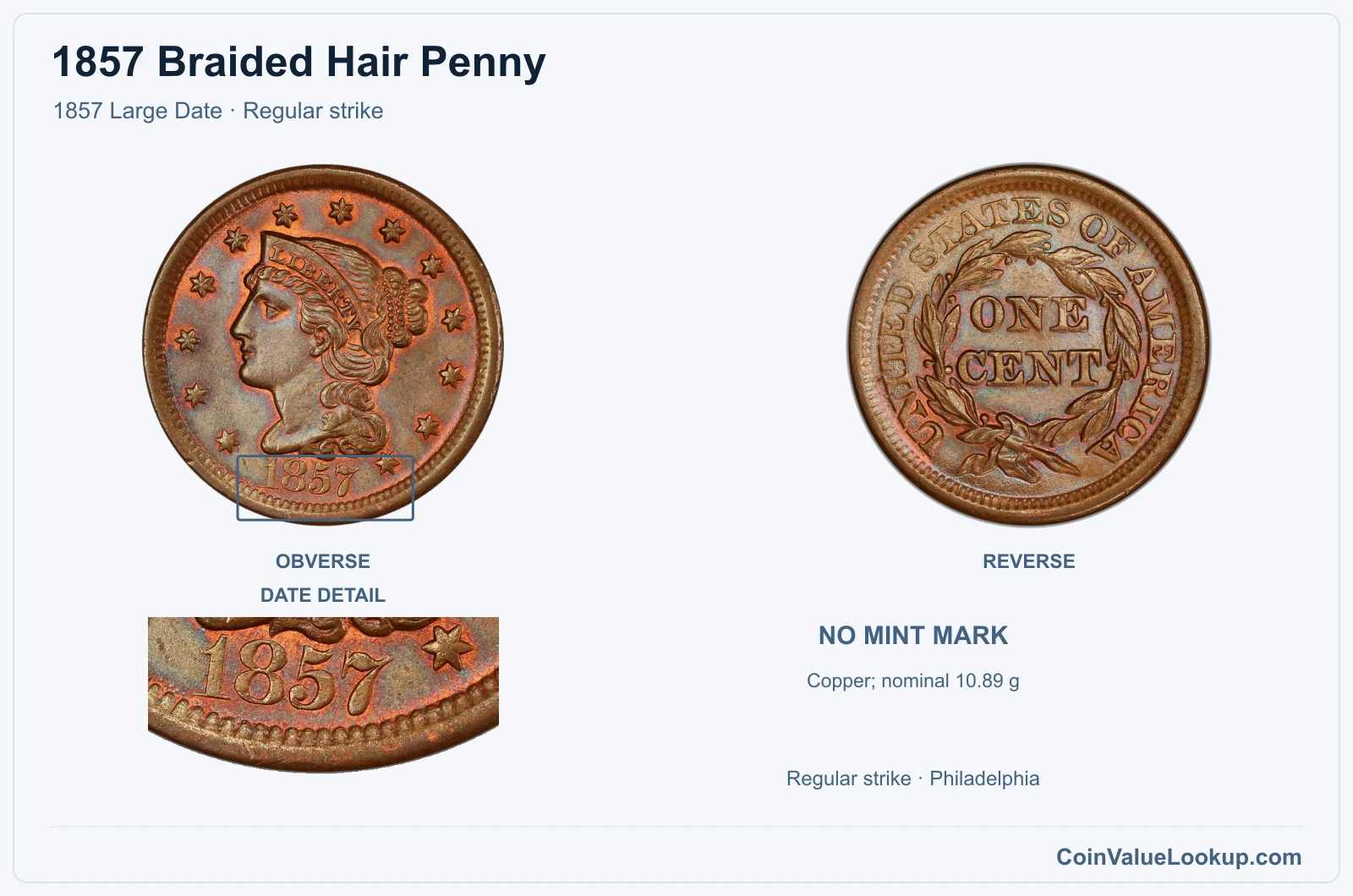
The 1857 Large Date is the variety with taller, wider numerals in the date. It's a copper business strike weighing a nominal 10.89 grams, produced at Philadelphia with no mintmark.
The obverse carries the classic Braided Hair portrait of Liberty; the reverse shows the denomination inside a wreath.
USA Coin Book guide estimates place this variety at about $217 in G4 and up to $1,878 in MS63. Those anchors give you a starting framework, but actual transaction prices depend on surface quality, color, and eye appeal.
Copper coins are especially sensitive to environmental damage, so a problem-free example in any grade tends to outperform a cleaned or corroded one at the same technical sharpness.
| Range | Grade | Price | Auction Records | Appraisal |
|---|---|---|---|---|
| PO | PO 1 | — | Coin Identifier | |
| FR | FR 2 | — | Coin Identifier | |
| AG | AG 3 | — | Coin Identifier | |
| G | G 4 | — | Coin Identifier | |
| G 6 | — | Coin Identifier | ||
| VG | VG 8 | — | Coin Identifier | |
| VG 10 | — | Coin Identifier | ||
| F | F 12 | — | Coin Identifier | |
| F 15 | Coin Identifier | |||
| VF | VF 20 | Coin Identifier | ||
| VF 25 | Coin Identifier | |||
| VF 30 | Coin Identifier | |||
| VF 35 | Coin Identifier | |||
| XF | XF 40 | Coin Identifier | ||
| XF 45 | Coin Identifier | |||
| AU | AU 50 | Coin Identifier | ||
| AU 53 | Coin Identifier | |||
| AU 55 | Coin Identifier | |||
| AU 58 | Coin Identifier | |||
| MS | MS 60 | Coin Identifier | ||
| MS 61 | Coin Identifier | |||
| MS 62 | Coin Identifier | |||
| MS 63 | Coin Identifier | |||
| MS 64 | Coin Identifier | |||
| MS 65 | Coin Identifier | |||
| MS 66 | — | — | — | |
| MS 67 | — | — | — | |
| MS 68 | — | — | — | |
| MS 69 | — | — | — | |
| MS 70 | — | — | — |
1857 Braided Hair Cent — Small Date
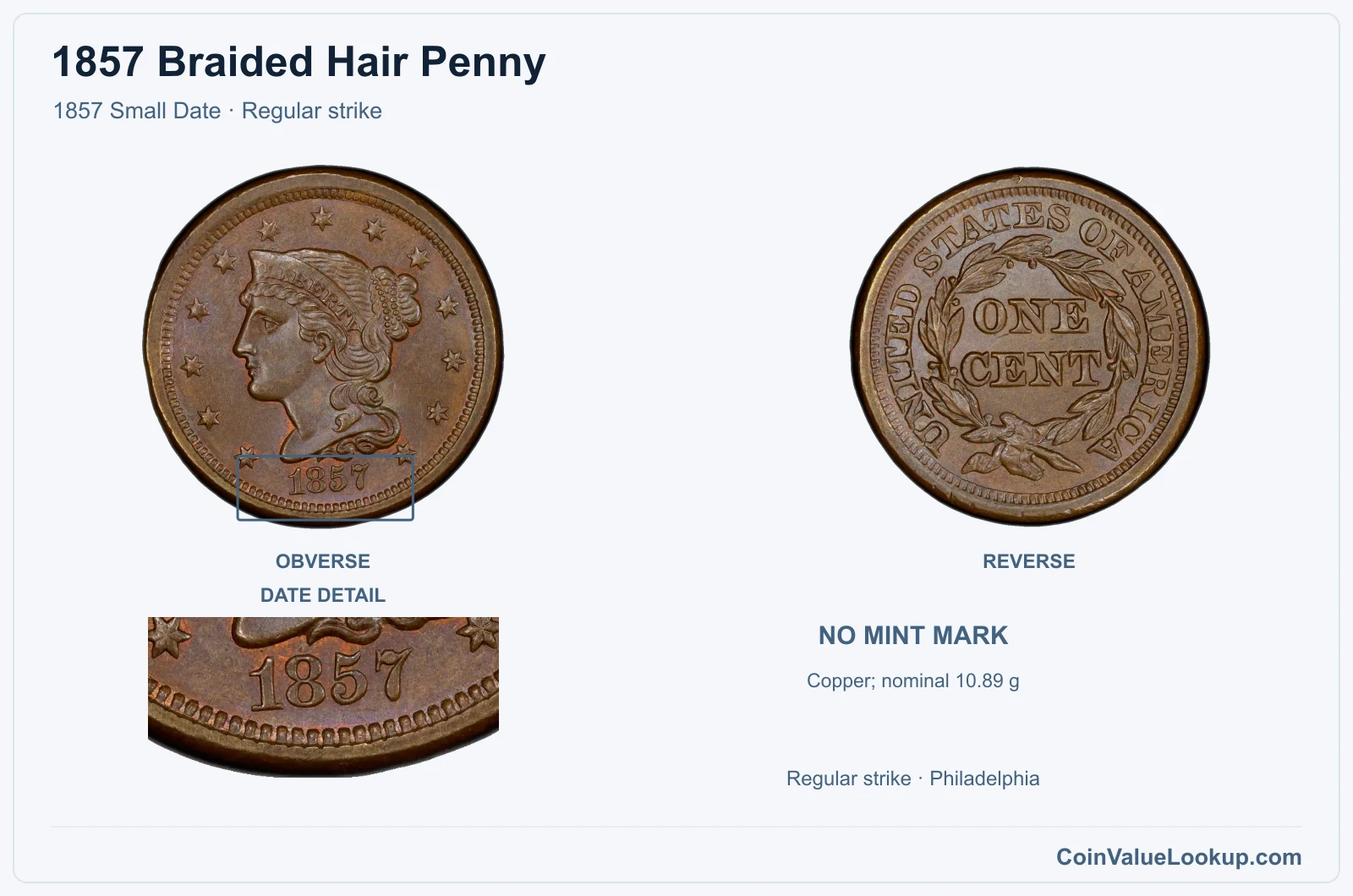
The 1857 Small Date variety features noticeably more compact, closely spaced numerals compared to the Large Date. Same metal, same weight, same mint — the difference is entirely in the date punch the Mint used.
Guide estimates from USA Coin Book match the Large Date at roughly $217 in G4 and $1,878 in MS63. That symmetry might surprise you, but both varieties are well-known and collected in parallel.
The real price driver at this level is condition. A fully original, uncleaned Small Date with good surfaces will outperform a higher-grade coin that's been harshly cleaned.
Coin Value Lookup is a useful starting point if you're working through other dates in the Braided Hair or Large Cent series. You can look up guides for specific years and denominations without digging through multiple sites.
| Range | Grade | Price | Auction Records | Appraisal |
|---|---|---|---|---|
| PO | PO 1 | — | Coin Identifier | |
| FR | FR 2 | — | Coin Identifier | |
| AG | AG 3 | — | Coin Identifier | |
| G | G 4 | — | Coin Identifier | |
| G 6 | — | Coin Identifier | ||
| VG | VG 8 | — | Coin Identifier | |
| VG 10 | — | Coin Identifier | ||
| F | F 12 | — | Coin Identifier | |
| F 15 | Coin Identifier | |||
| VF | VF 20 | Coin Identifier | ||
| VF 25 | — | Coin Identifier | ||
| VF 30 | Coin Identifier | |||
| VF 35 | Coin Identifier | |||
| XF | XF 40 | Coin Identifier | ||
| XF 45 | Coin Identifier | |||
| AU | AU 50 | Coin Identifier | ||
| AU 53 | Coin Identifier | |||
| AU 55 | Coin Identifier | |||
| AU 58 | Coin Identifier | |||
| MS | MS 60 | — | Coin Identifier | |
| MS 61 | Coin Identifier | |||
| MS 62 | Coin Identifier | |||
| MS 63 | Coin Identifier | |||
| MS 64 | Coin Identifier | |||
| MS 65 | Coin Identifier | |||
| MS 66 | — | — | — | |
| MS 67 | — | — | — | |
| MS 68 | — | — | — | |
| MS 69 | — | — | — | |
| MS 70 | — | — | — |
1857 Braided Hair Cent — Small Date PR
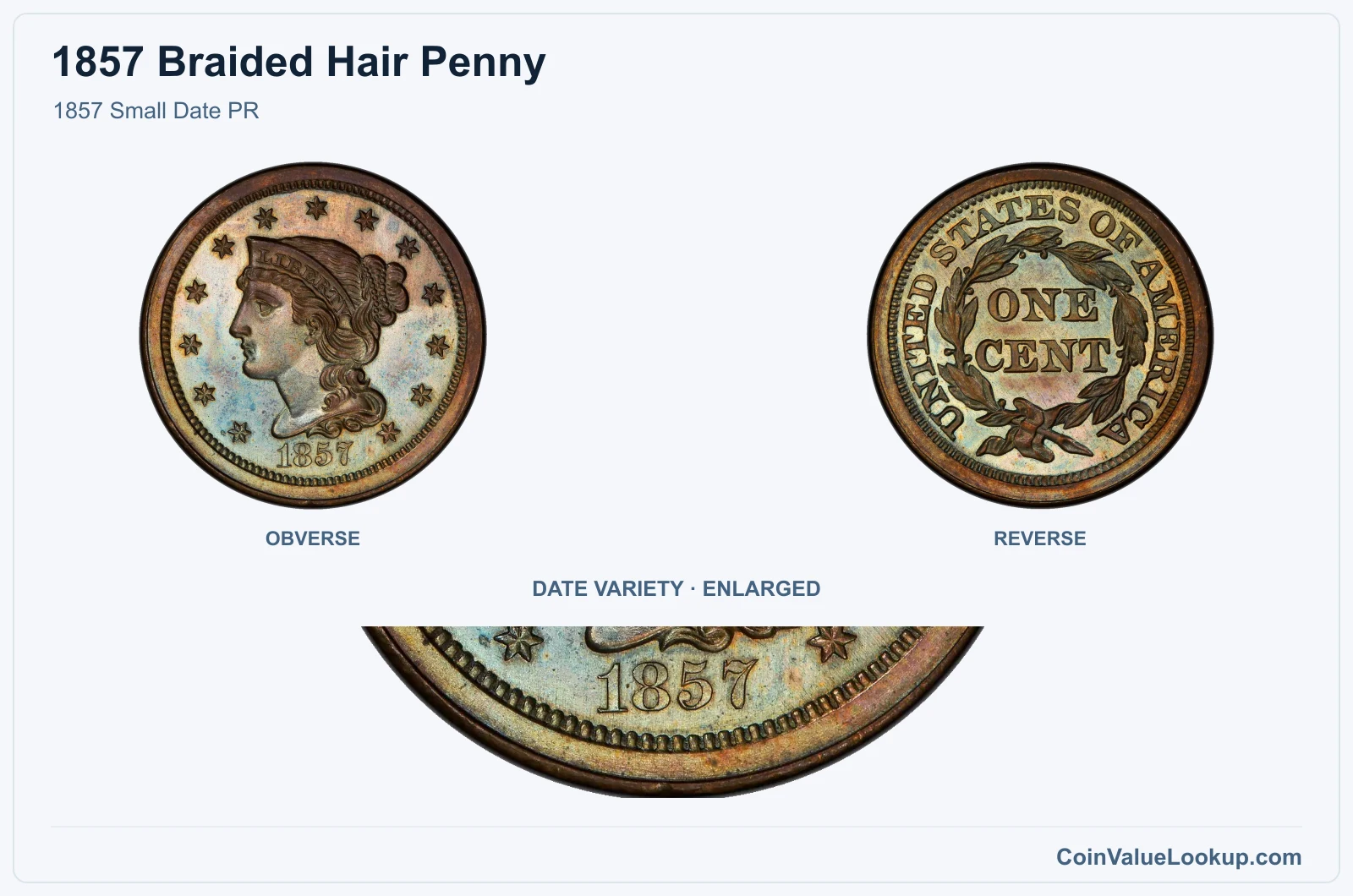
Proof strikes of the 1857 Braided Hair Cent exist in the Small Date variety. These were specially made at the Philadelphia Mint using polished dies and carefully prepared planchets, resulting in sharply detailed, mirror-like surfaces.
There is no standard guide price adopted for this issue. Each proof requires individual assessment based on its authenticated identity, surface preservation, and die characteristics.
A coin that simply looks shiny or has been polished is not a proof — genuine proofs show specific rim, surface, and die traits that distinguish them from business strikes.
Because proof Large Cents from any year are genuinely rare, authentication by a recognized grading service is strongly recommended before assigning any value. The difference between a real proof and a polished business strike can be thousands of dollars, so getting this right matters.
| Range | Grade | Price | Auction Records | Appraisal |
|---|---|---|---|---|
| PR | PR 1 | — | Coin Identifier | |
| PR 2 | — | Coin Identifier | ||
| PR 3 | — | Coin Identifier | ||
| PR 4 | — | Coin Identifier | ||
| PR 6 | — | Coin Identifier | ||
| PR 8 | — | Coin Identifier | ||
| PR 10 | — | Coin Identifier | ||
| PR 12 | — | Coin Identifier | ||
| PR 15 | — | Coin Identifier | ||
| PR 20 | — | Coin Identifier | ||
| PR 25 | — | Coin Identifier | ||
| PR 30 | — | Coin Identifier | ||
| PR 35 | — | Coin Identifier | ||
| PR 40 | — | Coin Identifier | ||
| PR 45 | — | Coin Identifier | ||
| PR 50 | — | Coin Identifier | ||
| PR 53 | — | Coin Identifier | ||
| PR 55 | — | Coin Identifier | ||
| PR 58 | — | Coin Identifier | ||
| PR 60 | — | Coin Identifier | ||
| PR 61 | — | Coin Identifier | ||
| PR 62 | Coin Identifier | |||
| PR 63 | Coin Identifier | |||
| PR 64 | Coin Identifier | |||
| PR 65 | Coin Identifier | |||
| PR 66 | Coin Identifier | |||
| PR 67 | — | — | — | |
| PR 68 | — | — | — | |
| PR 69 | — | — | — | |
| PR 70 | — | — | — |
1857 Braided Hair Cent Error List
1. 1857 Braided Hair Cent — Off-Center Strike
An off-center strike happens when the planchet isn't properly seated between the dies at the moment of striking. The result is a displaced design with an unstruck crescent-shaped blank area along part of the rim.
The more dramatic the shift, the more visually striking the error — but the date needs to remain visible for the coin to hold strong collector interest.
This error category is reported for the 1857 Braided Hair Cent, though no standard guide price is adopted. Value depends on the percentage of off-center shift, whether the date is fully readable, and the coin's overall condition.
Be careful not to confuse an off-center strike with a clipped planchet, one-sided die misalignment, or post-mint damage from being struck or flattened outside the Mint. Genuine off-center errors show a consistent shift of the entire design in one direction relative to the blank.
2. 1857 Braided Hair Cent — Clipped Planchet
A clipped planchet error occurs when the blank (planchet) was incompletely punched from the copper strip before striking. The result is a missing curved, straight, or ragged section along the edge.
On a genuine clip, you'll often notice a area of weakness in the design directly opposite the clip — that's because the planchet didn't fully fill the die cavity during striking.
This category is reported for the 1857 Braided Hair Cent. No standard price is adopted; value depends on the size and type of clip, overall preservation, and whether the coin has been authenticated.
Look closely at the edge texture and metal flow near the missing area. A genuine clip has a distinctive character that differs from an edge that's been cut, filed, or eaten away by corrosion.
Post-mint damage tends to show tool marks or sharp, unnatural edges rather than the smooth contour of a clip formed during the blanking process.