1822 Coronet Head Cent Coin Value: How Much Is It Worth?
The 1822 Coronet Head Cent is a coin that commands real attention from early copper specialists. Guide estimates for ordinary business strikes range from about $43 in Good-4 condition to around $3,247 at the MS63 level, based on USA Coin Book figures.
Proof strikes and major mint errors fall outside that range and need individual evaluation. Identifying your exact variety is the first step toward understanding what you have.
Fast Way to Identify Your 1822 Coronet Head Cent
Want a quick read on your 1822 cent? Upload clear photos of the front and back, and our identifier can offer a preliminary take on what variety you might be holding.
Good lighting and a steady shot make all the difference. This is not a substitute for professional authentication, but it is a solid starting point.
1822 Coronet Head Cent Value
Upload both sides of your 1822 Coronet Head Cent.
Front Obverse
Upload photo
Back Reverse
Upload photo
Which 1822 Coronet Head Cent Versions Are Worth Money?
- Business strikes in circulated grades guide from $43 (G4) upward, with uncirculated examples reaching $3,247 at MS63 per USA Coin Book estimates.
- Proof 1822 Coronet Head Cents are cataloged but extremely rare; no standard guide price applies, and each requires authenticated attribution of die characteristics, surfaces, and rims.
- Mint errors such as clipped planchets, die cracks, and die breaks (cuds) are reported for this date and can add collector interest beyond the base coin value.
Step 1: Identify Your 1822 Coronet Head Cent Mint Mark and Version
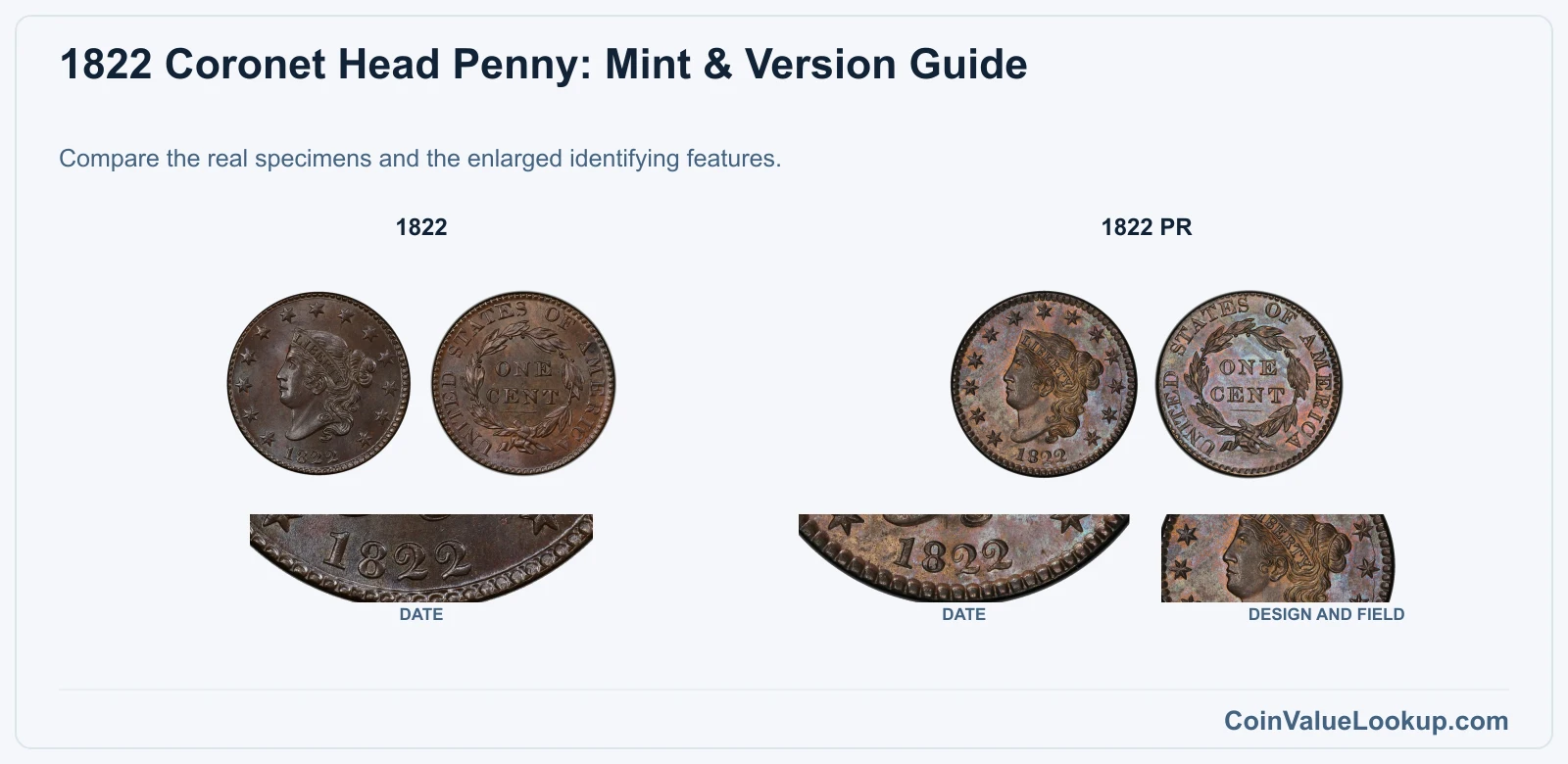
All 1822 Coronet Head Cents were struck at Philadelphia, so there is no mintmark to hunt for. Do not let anyone tell you a branch-mint version exists for this date.
On the obverse, look for the classic Liberty portrait facing left, wearing a coronet inscribed LIBERTY, surrounded by thirteen stars and the date 1822 below. The reverse shows ONE CENT inside a laurel wreath with UNITED STATES OF AMERICA around the border.
Original surfaces and legible detail matter more than brightness on early copper. A dark, evenly worn coin with honest surfaces will often trade for more than a bright, cleaned example.
Weight should be around 10.89 grams in copper. Wear, corrosion, and the production tolerances of the 1820s mean weight alone cannot prove authenticity, but a wildly off-spec coin deserves closer scrutiny.
Separate ordinary business strikes from any cataloged proof. The distinction is about how the coin was made at the mint, not about surface shine or perceived grade.
Step 2: Check Your 1822 Coronet Head Cent Grade
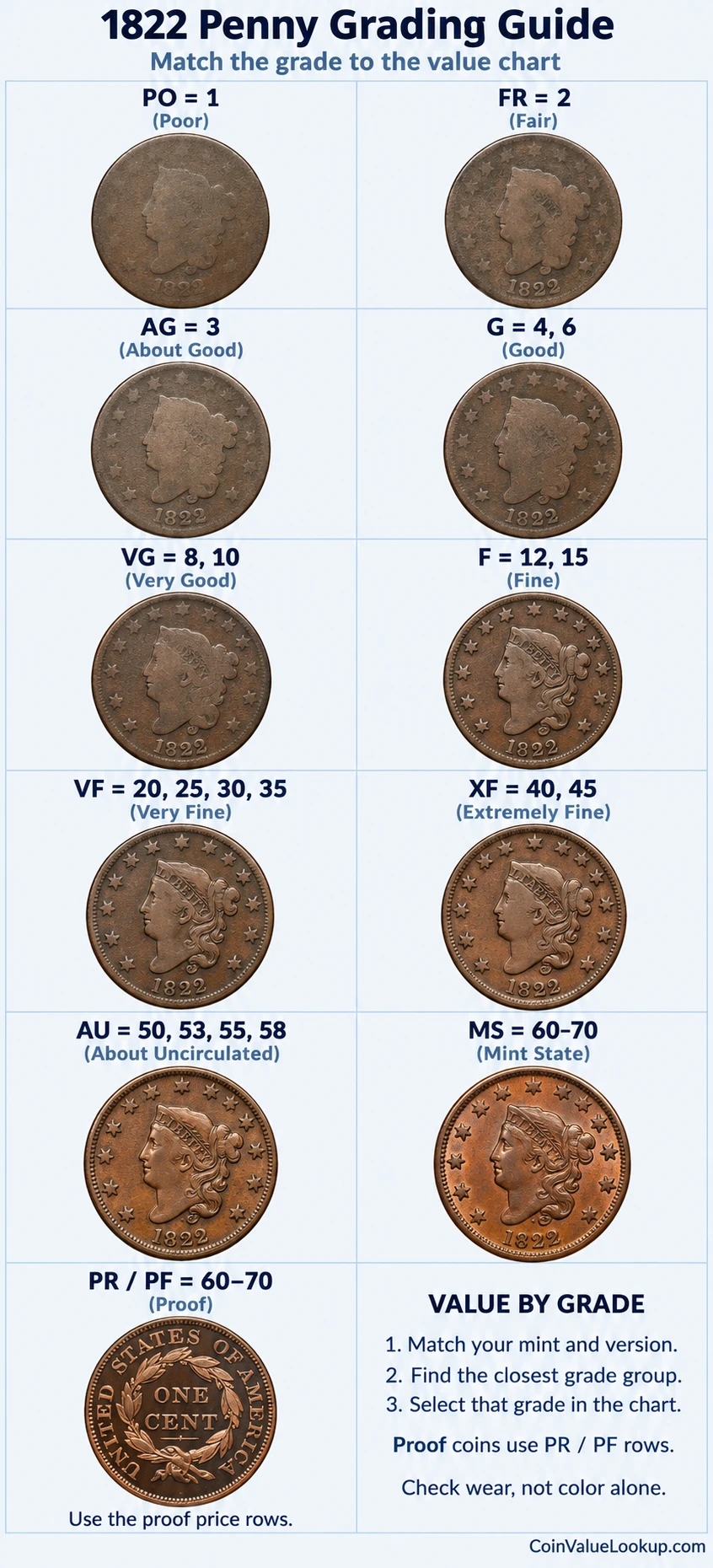
Start with the portrait. On a well-worn coin, Liberty's hair above the forehead and behind the ear loses definition first.
The cheek flattens out next. On the reverse, the highest wreath leaves and the lettering show the earliest signs of contact.
Do not confuse a weakly struck area with honest circulation wear. Early large cents can have soft spots from uneven die pressure that have nothing to do with how long the coin spent in a pocket.
Corrosion, porosity, and old cleaning all reduce market appeal, sometimes dramatically. A coin grading VF by sharpness but showing heavy environmental damage will not bring VF money.
Compare your coin to the reference image of a like-type example to gauge where it falls.
On copper cents, you will see color designations like BN (brown), RB (red-brown), and RD (red). These describe the coin's current color, not different metals.
Almost every surviving 1822 cent is full brown, so do not expect red.
Step 3: Check 1822 Coronet Head Cent Value by Mint and Version
1822 Coronet Head Cent
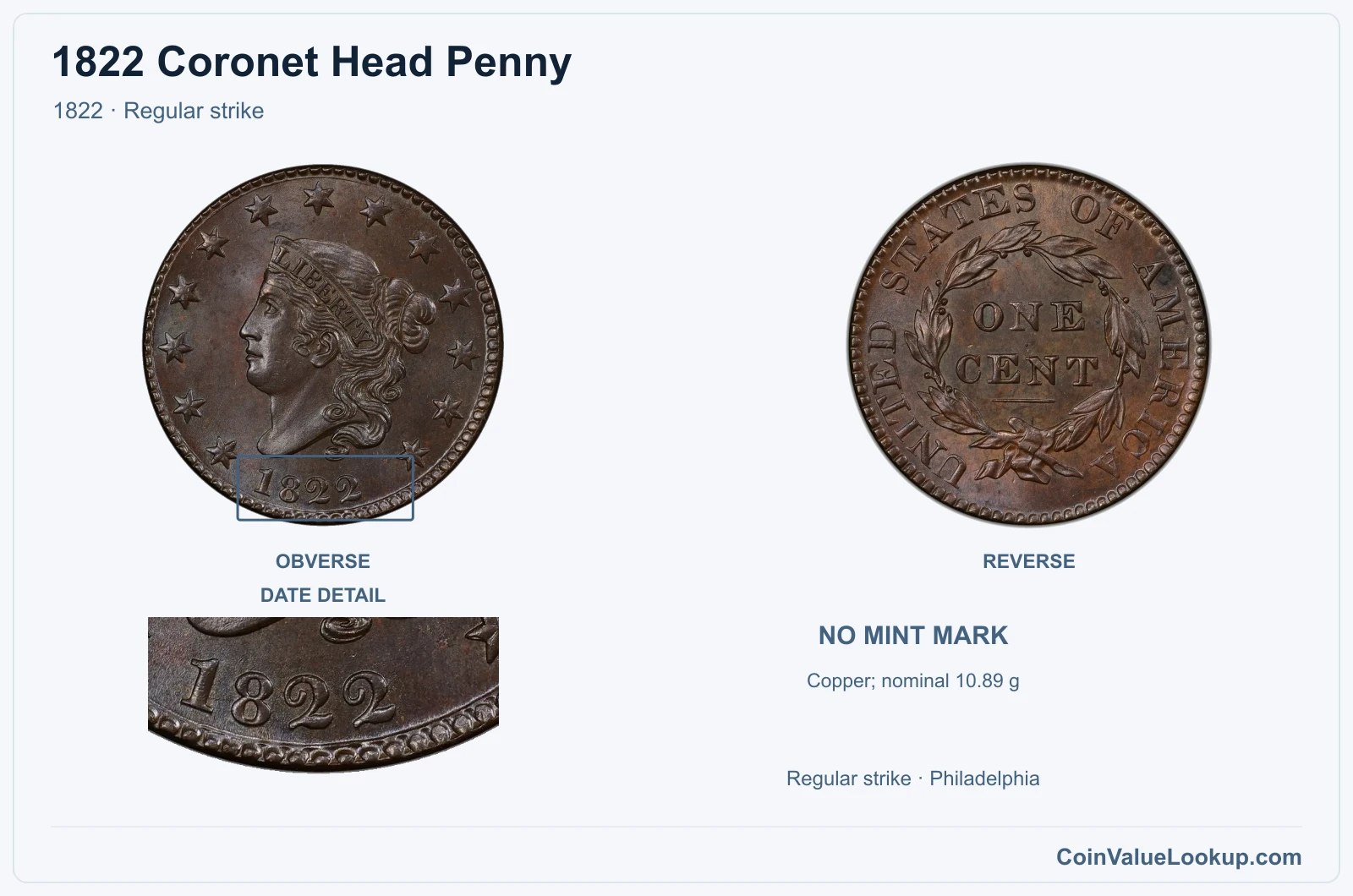
The standard 1822 Coronet Head Cent is a copper business strike from Philadelphia. No mintmark appears on any genuine example.
USA Coin Book guides this variety from approximately $43 in Good-4 to $3,247 in MS63.
Look for the full coronet on Liberty's head, clear stars, and a readable date. On the reverse, confirm the wreath and ONE CENT denomination.
Original brown surfaces with no signs of tooling or cleaning are what the market rewards.
Coin Value Lookup is a handy resource if you want to compare this date against other years in the Coronet Head series or check values for different denominations you might have stashed away.
| Range | Grade | Price | Auction Records | Appraisal |
|---|---|---|---|---|
| PO | PO 1 | — | Coin Identifier | |
| FR | FR 2 | — | Coin Identifier | |
| AG | AG 3 | — | Coin Identifier | |
| G | G 4 | Coin Identifier | ||
| G 6 | Coin Identifier | |||
| VG | VG 8 | Coin Identifier | ||
| VG 10 | Coin Identifier | |||
| F | F 12 | Coin Identifier | ||
| F 15 | Coin Identifier | |||
| VF | VF 20 | Coin Identifier | ||
| VF 25 | Coin Identifier | |||
| VF 30 | Coin Identifier | |||
| VF 35 | Coin Identifier | |||
| XF | XF 40 | Coin Identifier | ||
| XF 45 | Coin Identifier | |||
| AU | AU 50 | Coin Identifier | ||
| AU 53 | Coin Identifier | |||
| AU 55 | Coin Identifier | |||
| AU 58 | Coin Identifier | |||
| MS | MS 60 | Coin Identifier | ||
| MS 61 | Coin Identifier | |||
| MS 62 | Coin Identifier | |||
| MS 63 | Coin Identifier | |||
| MS 64 | Coin Identifier | |||
| MS 65 | Coin Identifier | |||
| MS 66 | — | — | — | |
| MS 67 | — | — | — | |
| MS 68 | — | — | — | |
| MS 69 | — | — | — | |
| MS 70 | — | — | — |
1822 Coronet Head Cent — PR
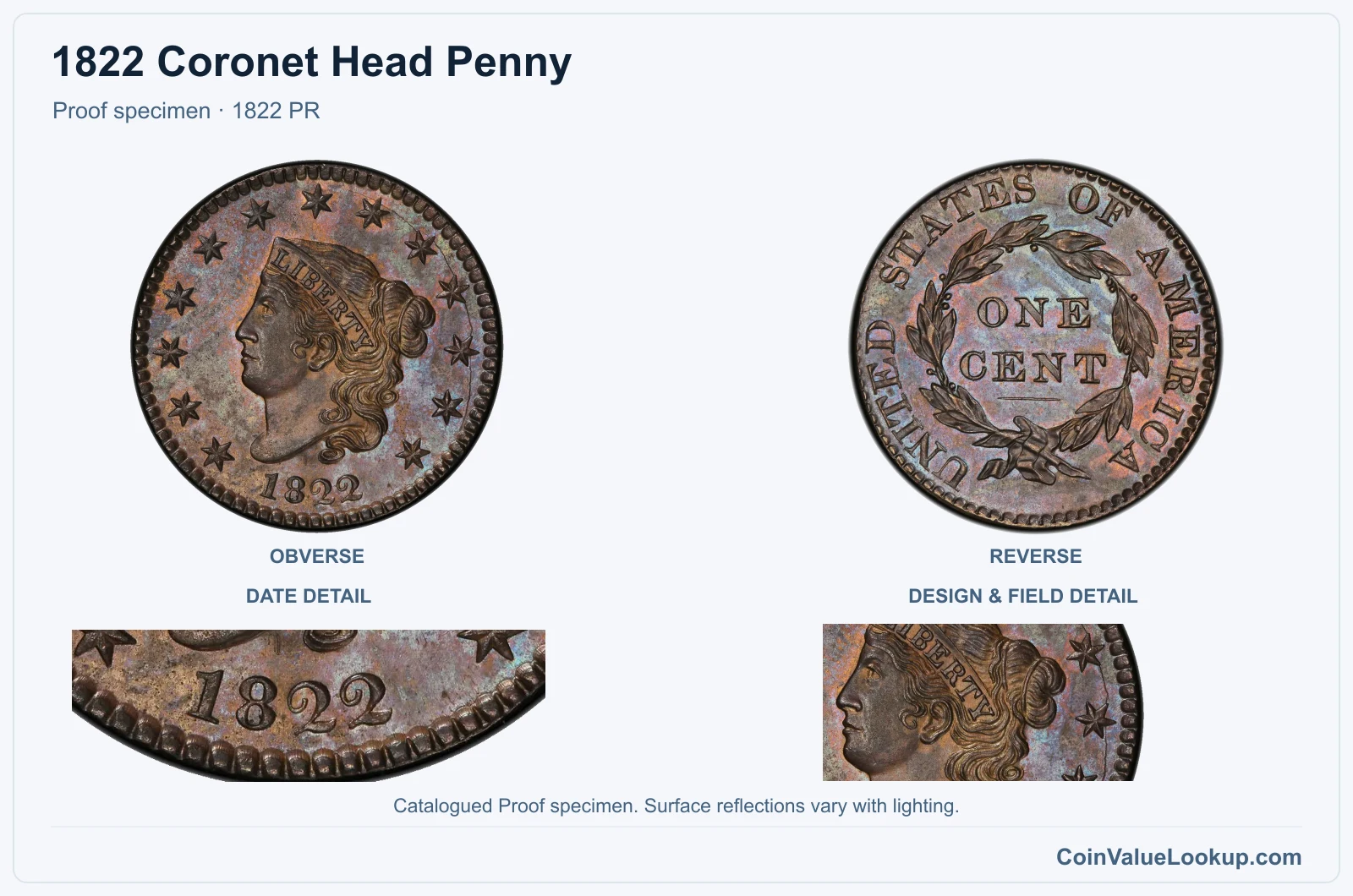
A cataloged Proof 1822 Coronet Head Cent is a genuine rarity from the earliest era of deliberate proof coinage at Philadelphia. These were struck with specially prepared dies and planchets, producing sharp rims, squared-up edges, and mirror-like fields that business strikes simply do not have.
No standard numeric guide price has been adopted for this variety. Each example must be individually assessed based on authenticated identity, die characteristics, surface preservation, and overall condition.
Polishing a business strike does not create a proof, no matter how shiny the result looks.
If you believe you have one, professional third-party authentication is essential. The die diagnostics and rim profiles specific to proof production are what matter, not a subjective impression of shininess.
| Range | Grade | Price | Auction Records | Appraisal |
|---|---|---|---|---|
| PR | PR 1 | — | Coin Identifier | |
| PR 2 | — | Coin Identifier | ||
| PR 3 | — | Coin Identifier | ||
| PR 4 | — | Coin Identifier | ||
| PR 6 | — | Coin Identifier | ||
| PR 8 | — | Coin Identifier | ||
| PR 10 | — | Coin Identifier | ||
| PR 12 | — | Coin Identifier | ||
| PR 15 | — | Coin Identifier | ||
| PR 20 | — | Coin Identifier | ||
| PR 25 | — | Coin Identifier | ||
| PR 30 | — | Coin Identifier | ||
| PR 35 | — | Coin Identifier | ||
| PR 40 | — | Coin Identifier | ||
| PR 45 | — | Coin Identifier | ||
| PR 50 | — | Coin Identifier | ||
| PR 53 | — | Coin Identifier | ||
| PR 55 | — | Coin Identifier | ||
| PR 58 | — | Coin Identifier | ||
| PR 60 | — | Coin Identifier | ||
| PR 61 | — | Coin Identifier | ||
| PR 62 | Coin Identifier | |||
| PR 63 | — | Coin Identifier | ||
| PR 64 | — | Coin Identifier | ||
| PR 65 | — | — | — | |
| PR 66 | — | — | — | |
| PR 67 | — | — | — | |
| PR 68 | — | — | — | |
| PR 69 | — | — | — | |
| PR 70 | — | — | — |
1822 Coronet Head Cent Error List
1. 1822 Coronet Head Cent — Clipped Planchet
A clipped planchet error on an 1822 Coronet Head Cent shows a missing portion of the original copper blank. The clip can be curved, straight, or ragged depending on what went wrong during blank preparation.
Look at the edge where the missing section is. Genuine clips usually show a smooth, tapered boundary where the metal was sheared, and you may notice design weakness on the opposite side of the coin.
That weakness happens because the incomplete blank does not fill the die evenly.
Watch out for lookalikes. A filed notch, a deliberate edge cut, or heavy corrosion can mimic a clip.
Compare the edge texture carefully. No standard guide price is available for this error on the 1822 date, so value depends on the clip size, the coin's overall condition, and authenticated identity.
2. 1822 Coronet Head Cent — Die Crack
Die cracks appear as thin, raised lines running across the surface of the coin. They form when a working die fractures from repeated use and the crack fills with metal during striking.
On an 1822 cent, you might find them crossing fields, cutting through lettering, or running between devices.
The key word is raised. A die crack sits above the coin's surface because metal flowed into the gap.
A scratch, by contrast, is incuse, cutting down into the metal. Corrosion lines and tool marks can also fool you, so examine the feature under magnification and good light.
No adopted guide price exists for die crack errors on the 1822 date. Value depends on the crack's prominence, location, and the coin's overall grade and surface quality.
3. 1822 Coronet Head Cent — Die Break / Cud
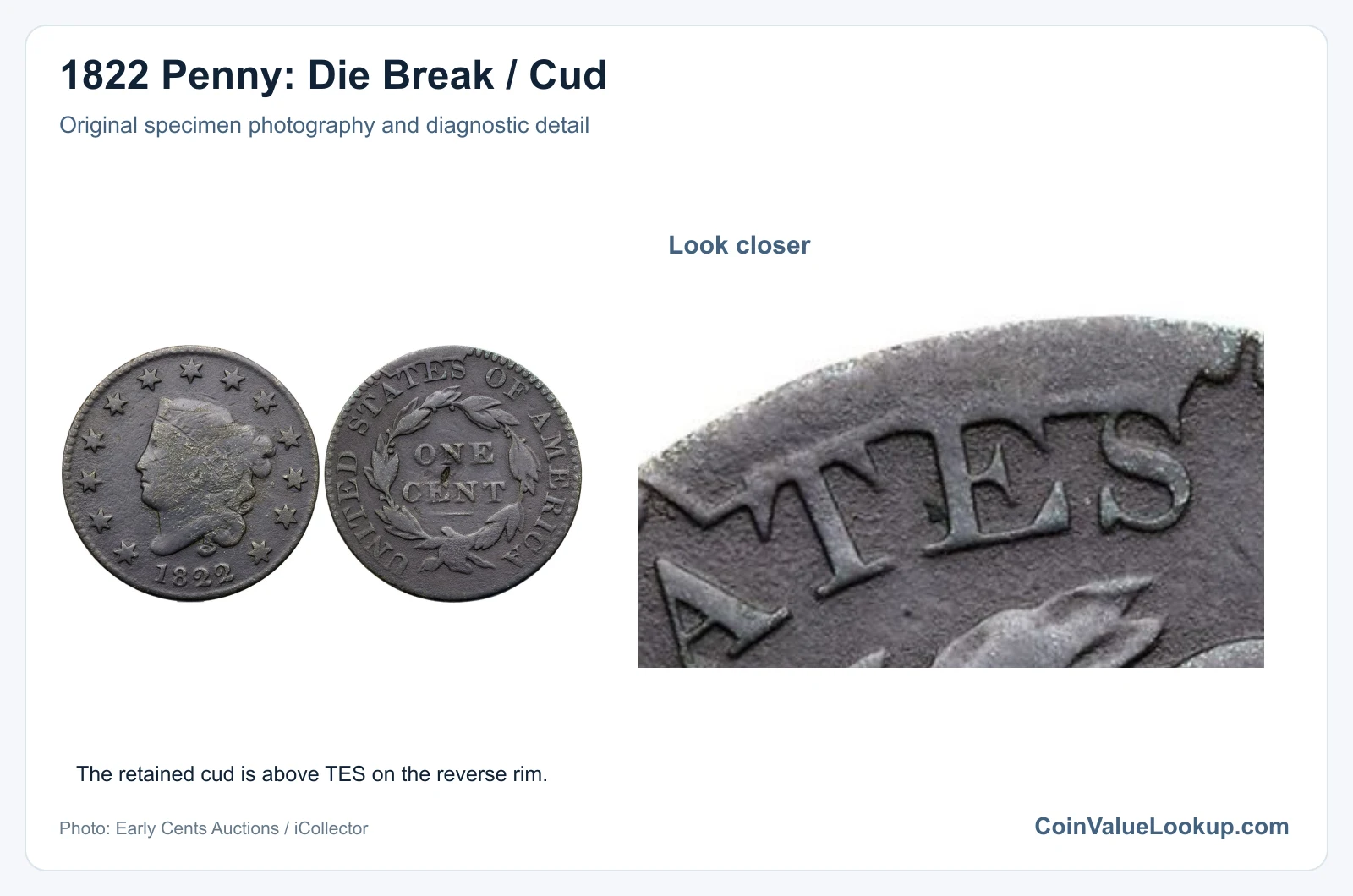
A cud is a specific type of die break where a piece of the die edge breaks away entirely. The result is a raised, featureless blob of metal connected to the rim of the coin, replacing whatever design was supposed to be there.
It is unmistakable once you know what to look for.
Smaller interior die breaks can also occur away from the rim, leaving irregular raised areas within the design. Both types confirm that the die was deteriorating when your coin was struck.
Do not confuse a cud with a rim bump from post-mint damage or a corrosion lump. A genuine cud has a flat or slightly convex surface that blends into the rim, and the surrounding design will show the displaced boundary clearly.
No guide price has been adopted for this error on the 1822 cent, so each piece is evaluated individually based on size, location, and condition.