1830 Coronet Head Cent Coin Value: How Much Is It Worth?
The 1830 Coronet Head Cent is a copper large cent struck at the Philadelphia Mint, and values vary quite a bit depending on which reverse lettering variety you have. Guide estimates range from about $38 in Good-4 condition up to around $30,921 in MS-63 for the Medium Letters variety.
Identifying your exact branch matters before you look at prices.
Fast Way to Identify Your 1830 Coronet Head Cent
The quickest way to start figuring out what your 1830 cent is worth is to upload clear photos of both the front and back. Our identifier can give you a preliminary read on the variety and general condition based on those images.
Grab a well-lit shot of each side and let the tool do the first pass for you.
1830 Coronet Head Cent Value
Upload both sides of your 1830 Coronet Head Cent.
Front Obverse
Upload photo
Back Reverse
Upload photo
Which 1830 Coronet Head Cent Versions Are Worth Money?
- The 1830 Medium Letters variety carries much higher guide values at the top end, reaching about $30,921 in MS-63 compared to $2,171 for the Large Letters in the same grade.
- The 1830 Large Letters variety starts around $38 in G-4, making it the more affordable entry point for circulated examples.
- Proof 1830 cents exist but require professional attribution of die characteristics and surfaces; no standard guide price applies.
- Certain mint errors such as off-center strikes or die breaks on 1830 cents can add collector interest, though each piece needs individual evaluation.
Step 1: Identify Your 1830 Coronet Head Cent Mint Mark and Version
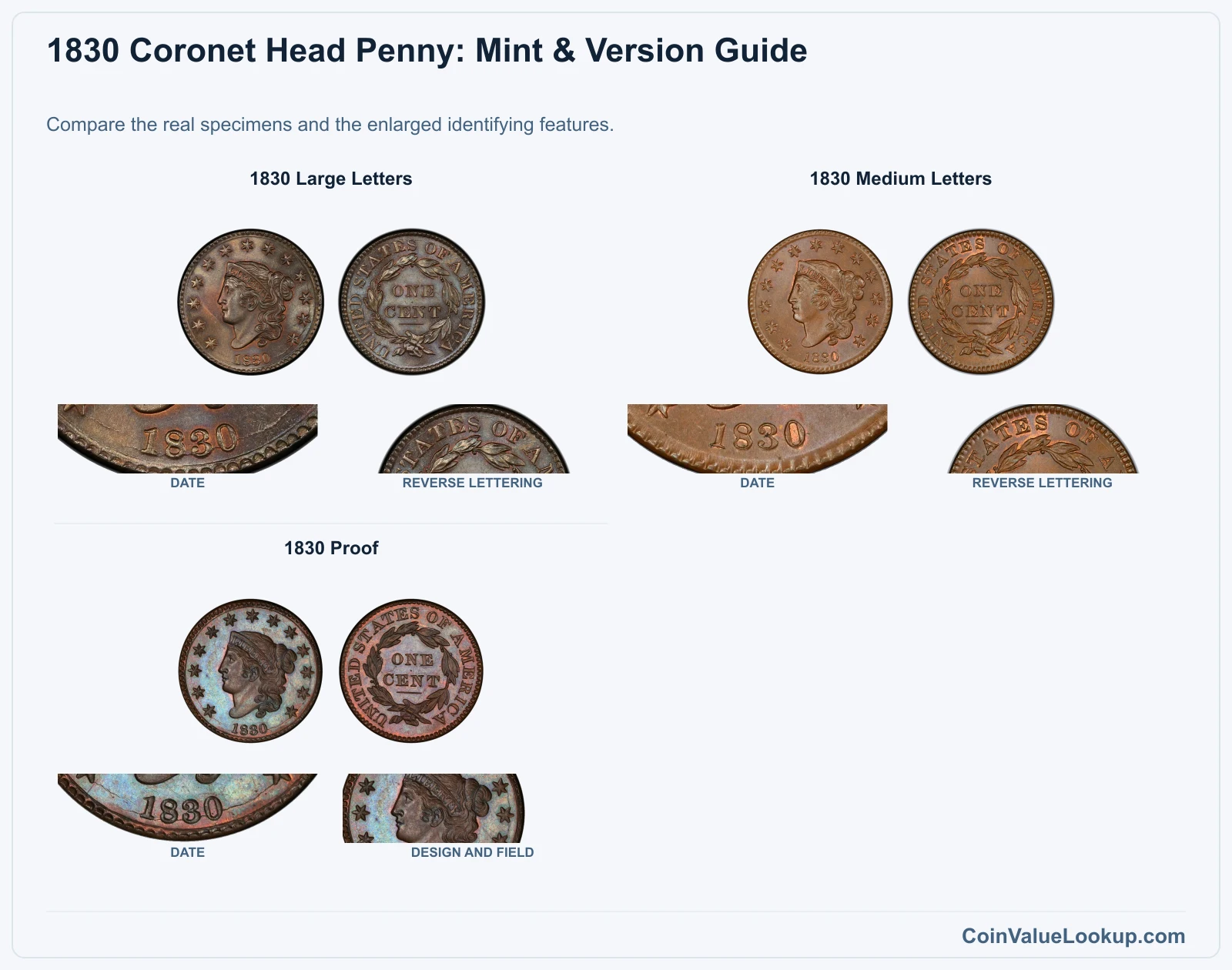
All 1830 Coronet Head Cents were struck at the Philadelphia Mint, so there is no mintmark to hunt for. The critical distinction is on the reverse: compare the size of the lettering around ONE CENT and the wreath.
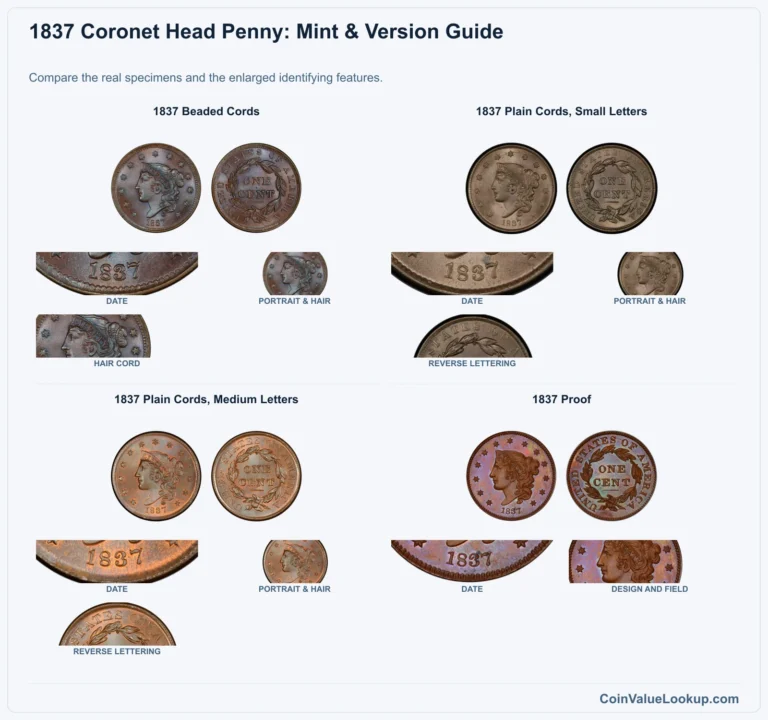
Large Letters coins have noticeably taller, bolder reverse legends. Medium Letters coins use a slightly smaller, more refined font.
Lay the two side by side (or compare to reference images) and the difference becomes obvious once you know what to look for.
Beyond the lettering, check the date-punch shape and the wreath leaf details. These can help confirm which die pairing your coin came from.
Weight should be close to the nominal 10.89 grams for copper, but wear, corrosion, and normal production tolerances mean weight alone will not prove authenticity.
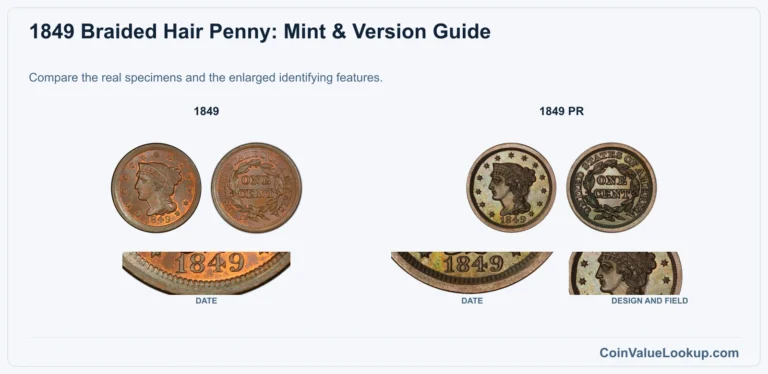
A small number of proofs exist for 1830 as well. Proof is a manufacturing method, not just a high grade, so a shiny coin is not automatically a proof.
Genuine early proofs require attribution of die characteristics, surfaces, and rim quality by someone who knows what to look for.
Step 2: Check Your 1830 Coronet Head Cent Grade
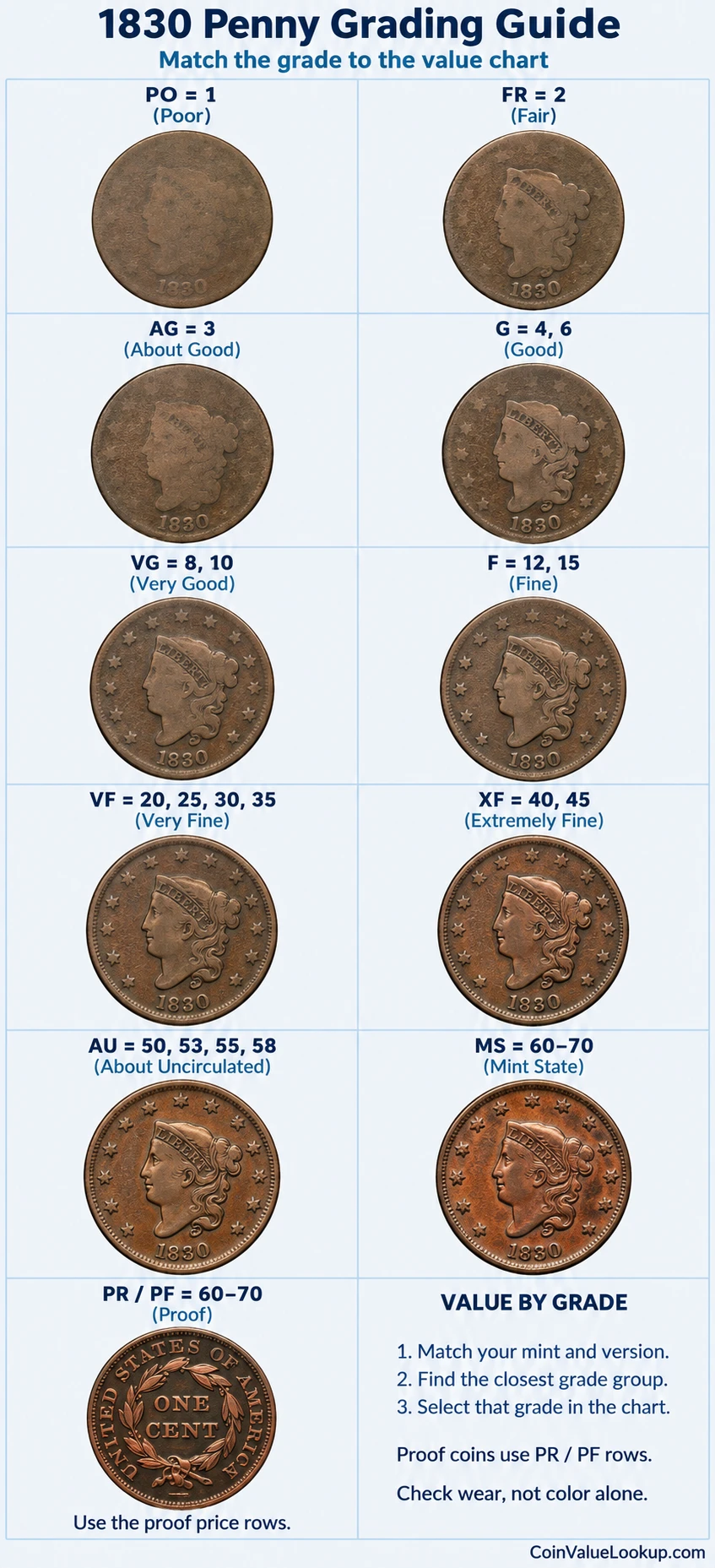
Focus on three main areas when judging wear: the hair detail and cheek on Liberty's portrait, the leaf relief on the reverse wreath, and the sharpness of the lettering. On a well-worn Good-4 coin, Liberty's outline is clear but nearly all hair detail is gone.
Move up to Very Fine and you will see individual curls.
In mint state, look for full luster across both faces. Use the comparison image to match your coin's wear pattern to known grade benchmarks.
Do not confuse a weak strike with honest circulation wear. Some 1830 cents left the press with soft spots, particularly in the hair or wreath, that never had full detail to begin with.
Corrosion and porosity are separate surface problems that can lower market value well below what the grade alone would suggest.
Copper coins are described by color designations: BN (brown), RB (red-brown), and RD (red). These describe how much original mint color remains, not different metals.
More original red generally means higher value at the same grade, but environmental damage that merely looks red does not count.
Step 3: Check 1830 Coronet Head Cent Value by Mint and Version
1830 Coronet Head Cent — Large Letters
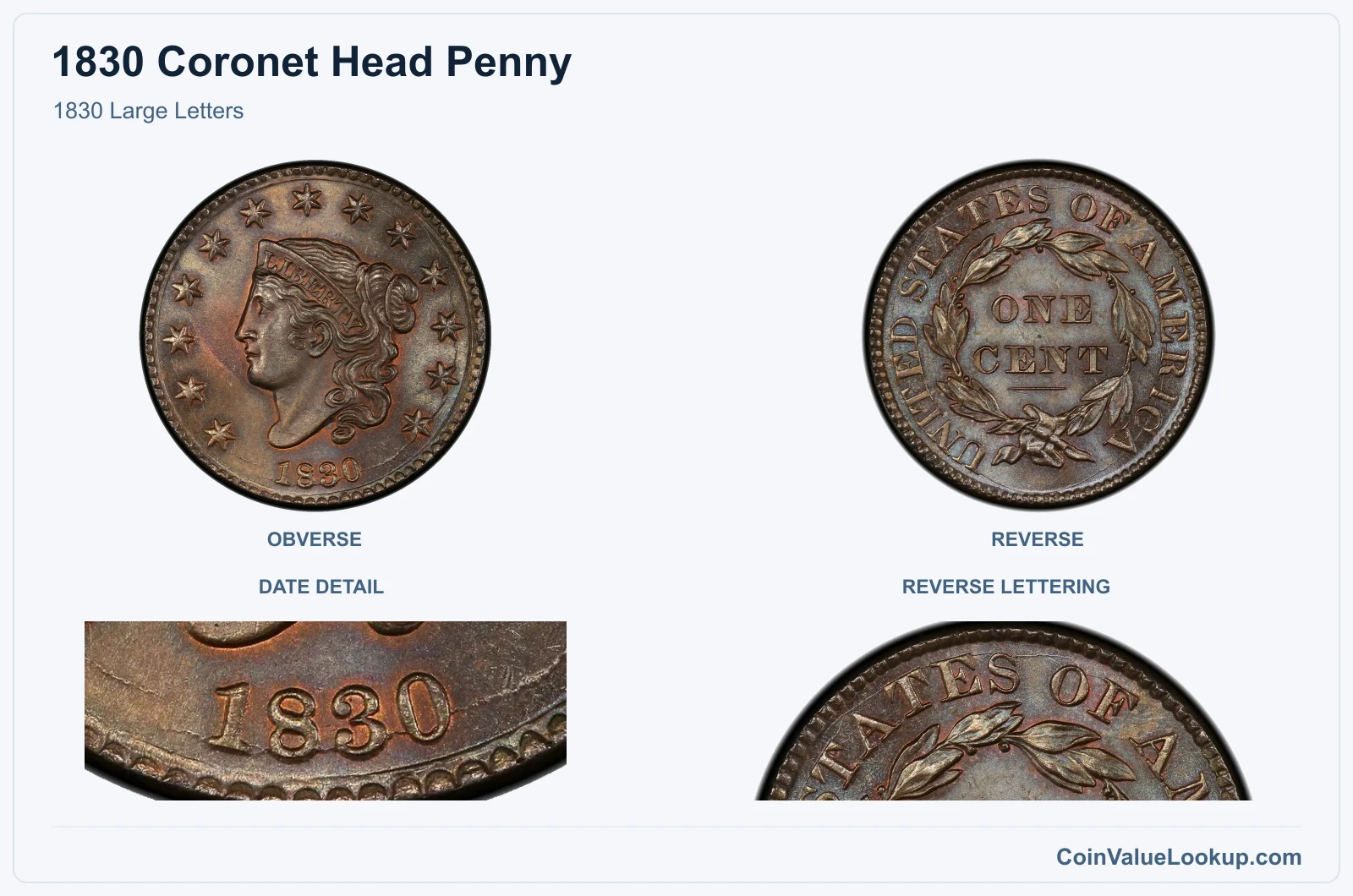
The 1830 Large Letters cent features bold, tall reverse lettering around ONE CENT and the wreath. It was struck in copper at Philadelphia with no mintmark, and should weigh close to 10.89 grams.
Guide estimates from USA Coin Book place this variety at about $38 in Good-4 and around $2,171 in MS-63. That is a wide spread, so condition matters enormously.
Even a moderately circulated example with original surfaces can be a solid pickup for a type set.
Coin Value Lookup is a handy starting point if you want to look up values for other dates in the Coronet Head series or compare your coin against different denominations.
| Range | Grade | Price | Auction Records | Appraisal |
|---|---|---|---|---|
| PO | PO 1 | — | Coin Identifier | |
| FR | FR 2 | — | Coin Identifier | |
| AG | AG 3 | Coin Identifier | ||
| G | G 4 | Coin Identifier | ||
| G 6 | Coin Identifier | |||
| VG | VG 8 | — | Coin Identifier | |
| VG 10 | — | Coin Identifier | ||
| F | F 12 | Coin Identifier | ||
| F 15 | — | Coin Identifier | ||
| VF | VF 20 | Coin Identifier | ||
| VF 25 | Coin Identifier | |||
| VF 30 | Coin Identifier | |||
| VF 35 | Coin Identifier | |||
| XF | XF 40 | Coin Identifier | ||
| XF 45 | Coin Identifier | |||
| AU | AU 50 | Coin Identifier | ||
| AU 53 | Coin Identifier | |||
| AU 55 | Coin Identifier | |||
| AU 58 | Coin Identifier | |||
| MS | MS 60 | — | Coin Identifier | |
| MS 61 | Coin Identifier | |||
| MS 62 | Coin Identifier | |||
| MS 63 | Coin Identifier | |||
| MS 64 | Coin Identifier | |||
| MS 65 | Coin Identifier | |||
| MS 66 | Coin Identifier | |||
| MS 67 | — | — | — | |
| MS 68 | — | — | — | |
| MS 69 | — | — | — | |
| MS 70 | — | — | — |
1830 Coronet Head Cent — Medium Letters
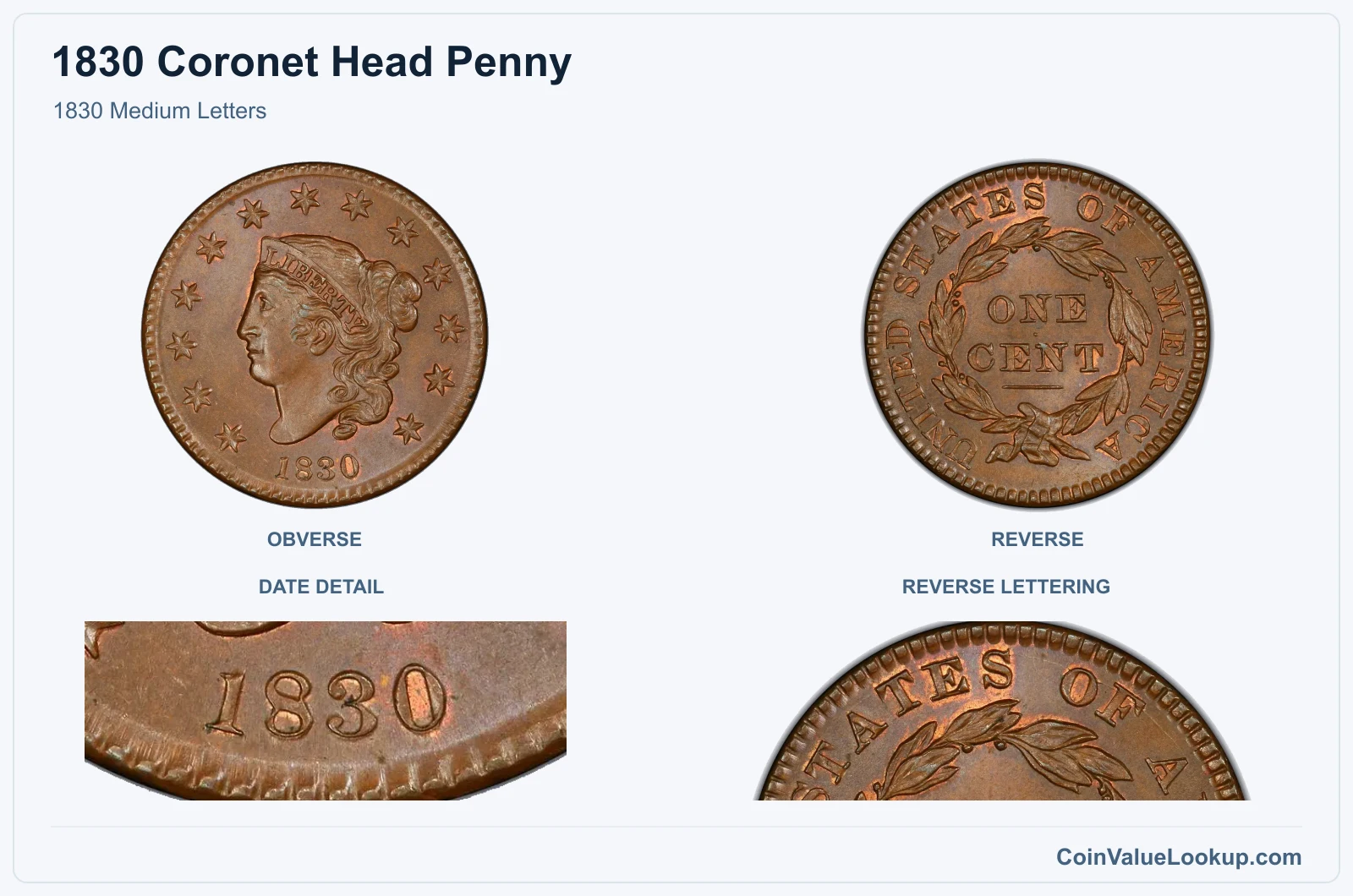
The 1830 Medium Letters variety uses smaller, more refined lettering on the reverse compared to its Large Letters sibling. Same copper composition, same Philadelphia Mint origin, same 10.89-gram nominal weight.
What sets this one apart is the value ceiling. USA Coin Book guide estimates run from about $43 in Good-4 all the way to roughly $30,921 in MS-63.
That top-end figure dwarfs the Large Letters version, reflecting how scarce nice examples are in upper grades. If your coin matches the Medium Letters die, it is worth getting a careful grade assessment before selling.
| Range | Grade | Price | Auction Records | Appraisal |
|---|---|---|---|---|
| PO | PO 1 | — | Coin Identifier | |
| FR | FR 2 | — | Coin Identifier | |
| AG | AG 3 | — | Coin Identifier | |
| G | G 4 | — | Coin Identifier | |
| G 6 | Coin Identifier | |||
| VG | VG 8 | Coin Identifier | ||
| VG 10 | — | Coin Identifier | ||
| F | F 12 | Coin Identifier | ||
| F 15 | Coin Identifier | |||
| VF | VF 20 | — | Coin Identifier | |
| VF 25 | — | Coin Identifier | ||
| VF 30 | — | Coin Identifier | ||
| VF 35 | Coin Identifier | |||
| XF | XF 40 | Coin Identifier | ||
| XF 45 | — | Coin Identifier | ||
| AU | AU 50 | Coin Identifier | ||
| AU 53 | — | Coin Identifier | ||
| AU 55 | Coin Identifier | |||
| AU 58 | Coin Identifier | |||
| MS | MS 60 | — | — | — |
| MS 61 | — | — | — | |
| MS 62 | — | — | — | |
| MS 63 | — | — | — | |
| MS 64 | — | — | — | |
| MS 65 | — | — | — | |
| MS 66 | — | — | — | |
| MS 67 | Coin Identifier | |||
| MS 68 | — | — | — | |
| MS 69 | — | — | — | |
| MS 70 | — | — | — |
1830 Coronet Head Cent — Proof
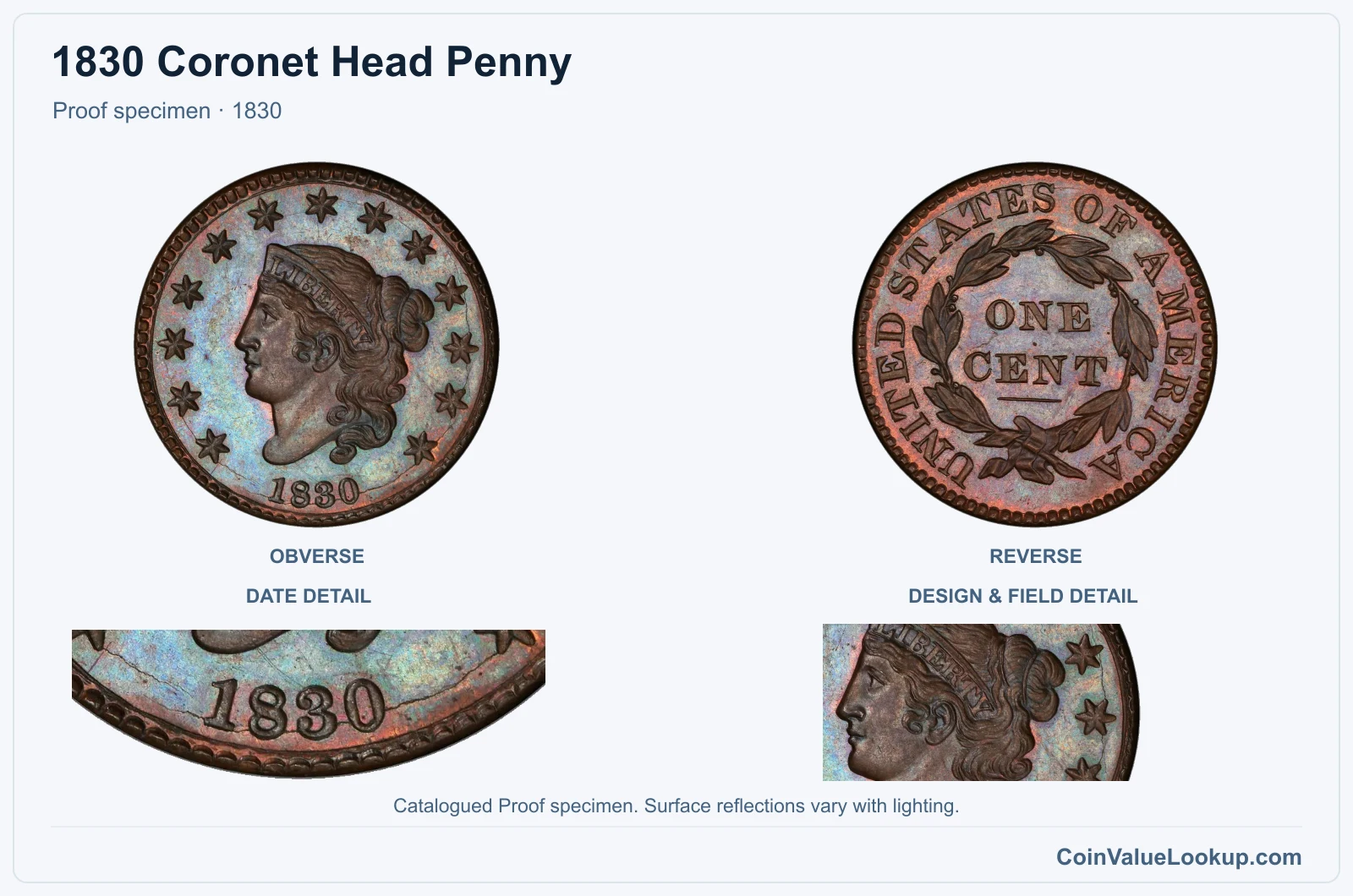
A genuine 1830 Proof Coronet Head Cent is a different animal entirely. These were made using specially prepared dies and planchets, producing sharp rims, full detail, and mirror-like fields.
Polishing a business strike does not create a proof, no matter how shiny the result looks.
No standard guide price is adopted for the 1830 Proof. Each piece needs individual assessment based on authenticated identity, surface quality, and die characteristics.
If you think you have one, professional attribution by a major grading service is the right next step. The number of known survivors is very small, so confirmed examples are handled on a case-by-case basis.
| Range | Grade | Price | Auction Records | Appraisal |
|---|---|---|---|---|
| PR | PR 1 | — | Coin Identifier | |
| PR 2 | — | Coin Identifier | ||
| PR 3 | — | Coin Identifier | ||
| PR 4 | — | Coin Identifier | ||
| PR 6 | — | Coin Identifier | ||
| PR 8 | — | Coin Identifier | ||
| PR 10 | — | Coin Identifier | ||
| PR 12 | — | Coin Identifier | ||
| PR 15 | — | Coin Identifier | ||
| PR 20 | — | Coin Identifier | ||
| PR 25 | — | Coin Identifier | ||
| PR 30 | — | Coin Identifier | ||
| PR 35 | — | Coin Identifier | ||
| PR 40 | — | Coin Identifier | ||
| PR 45 | — | Coin Identifier | ||
| PR 50 | — | Coin Identifier | ||
| PR 53 | — | Coin Identifier | ||
| PR 55 | — | Coin Identifier | ||
| PR 58 | — | Coin Identifier | ||
| PR 60 | — | Coin Identifier | ||
| PR 61 | — | Coin Identifier | ||
| PR 62 | — | Coin Identifier | ||
| PR 63 | — | Coin Identifier | ||
| PR 64 | Coin Identifier | |||
| PR 65 | Coin Identifier | |||
| PR 66 | — | — | — | |
| PR 67 | — | — | — | |
| PR 68 | — | — | — | |
| PR 69 | — | — | — | |
| PR 70 | — | — | — |
1830 Coronet Head Cent Error List
1. 1830 Coronet Head Cent — Off-Center Strike
An off-center strike happens when the planchet is not seated properly between the dies at the moment of impact. On a 1830 Coronet Head Cent, this shows up as a displaced design with an unstruck crescent-shaped blank area along part of the rim.
The key thing collectors want is the date still visible. An off-center cent with the full 1830 date showing is far more desirable than one where the date wandered off the edge.
No standard guide price is adopted for this error on the 1830 cent, so each example needs individual evaluation based on how dramatic the misalignment is, the coin's overall condition, and whether both sides retain identifiable design elements.
Do not confuse a clipped planchet, one-sided die misalignment, or post-mint flattening with a genuine off-center strike. The displaced design should appear on both faces in a consistent direction.
2. 1830 Coronet Head Cent — Die Crack
Die cracks appear as raised, irregular lines running across the coin's surface. On the 1830 Coronet Head Cent, look for thin ridges that cross the fields or cut through design elements like the wreath or lettering.
They are raised because the crack in the die itself is recessed, and metal fills that gap during striking.
These range from faint hairlines to bold connectors running from rim to rim. Minor die cracks are common on early copper coinage and add modest collector interest.
Major die cracks that distort the design are scarcer.
No standard price is adopted for die cracks on 1830 cents; each piece is valued individually based on the crack's size, location, and the coin's overall condition. Watch out for lookalikes: incuse scratches, corrosion channels, and tool marks are recessed into the surface rather than raised above it.
That raised-versus-recessed distinction is the fastest diagnostic.
3. 1830 Coronet Head Cent — Die Break / Cud
A cud is a specific type of die break where a piece of the die rim has broken away, leaving a raised, featureless blob of metal on the coin that connects to the rim. On the 1830 Coronet Head Cent, cuds can appear anywhere along the edge and vary in size from small bumps to large areas that obliterate nearby design.
Smaller interior die breaks that do not connect to the rim are related but technically distinct. For a true cud, look for the characteristic flat or slightly convex raised area touching the rim, with a clear boundary where normal design resumes.
No standard guide price exists for cuds on 1830 cents; value depends on the cud's size, position, and the coin's preservation. A rim dent, localized corrosion, or an interior die chip can mimic a cud at first glance, so examine the area carefully under magnification before drawing conclusions.
4. 1830 Coronet Head Cent — Rotated Dies
On a normally struck US coin, if you hold the obverse upright and flip it top-to-bottom, the reverse should also appear upright. A rotated die error means one die was turned from its correct position, so the reverse appears tilted when you do this test.
For the 1830 Coronet Head Cent, minor rotations of a few degrees are not unusual on early copper. Collectors generally start paying attention once the rotation reaches 15 degrees or more, and dramatically rotated examples (90 or 180 degrees) are genuinely scarce.
No standard guide price is adopted for this error. Value depends on the degree of rotation and the coin's condition.
One easy trap: a photograph taken at an odd angle can make a coin look rotated when it is not. Always test with the physical coin in hand, flipping it on the correct axis.
5. 1830 Coronet Head Cent — Lamination / Split Planchet
A lamination error on an 1830 Coronet Head Cent shows up as peeling, flaking, or separated layers of copper on the coin's surface. You might see a retained flap of metal still partially attached, or a smooth depression where a layer has broken away entirely.
These defects come from impurities or gas pockets trapped in the copper planchet before striking. Photograph the edge alongside the affected face, because the separation is often visible from the side and helps distinguish the error from surface damage.
No standard price is adopted for lamination errors on 1830 cents; each one is assessed individually based on the severity, location, and overall coin condition. Scraping, heavy corrosion, and deliberately cut or shaved coins can look similar to laminations, so examine the edges of the affected area.
A genuine lamination will follow the metal's internal structure rather than showing sharp tool marks or random pitting.