1832 Coronet Head Cent Coin Value: How Much Is It Worth?
The 1832 Coronet Head Cent is a copper large cent struck at Philadelphia, and its value depends on which reverse variety you have and its condition. Guide estimates range from about $38 in Good-4 to $1,445 in MS-63, depending on the exact branch.
Rare proofs and major errors fall outside those figures and need individual assessment.
Fast Way to Identify Your 1832 Coronet Head Cent
The quickest way to start figuring out what your 1832 cent is worth is to upload clear photos of the front and back. Our identifier can give you a preliminary read on the variety and condition, helping you decide whether deeper research or professional grading is worthwhile.
Good lighting and a steady shot of both sides make a big difference.
1832 Coronet Head Cent Value
Upload both sides of your 1832 Coronet Head Cent.
Front Obverse
Upload photo
Back Reverse
Upload photo
Which 1832 Coronet Head Cent Versions Are Worth Money?
- The 1832 Medium Letters variety carries a higher guide estimate at MS-63 ($1,445) compared to the Large Letters branch, so identifying your reverse lettering size matters.
- Both Large Letters and Medium Letters share the same $38 guide value in Good-4, but the gap widens considerably in higher grades.
- Proof examples of the 1832 cent exist but require expert attribution of die characteristics and surfaces — no ordinary business-strike price applies to them.
- Listed mint errors such as die cracks, cuds, clips and off-center strikes on this date deserve closer inspection, though individual assessment determines their worth.
Step 1: Identify Your 1832 Coronet Head Cent Mint Mark and Version
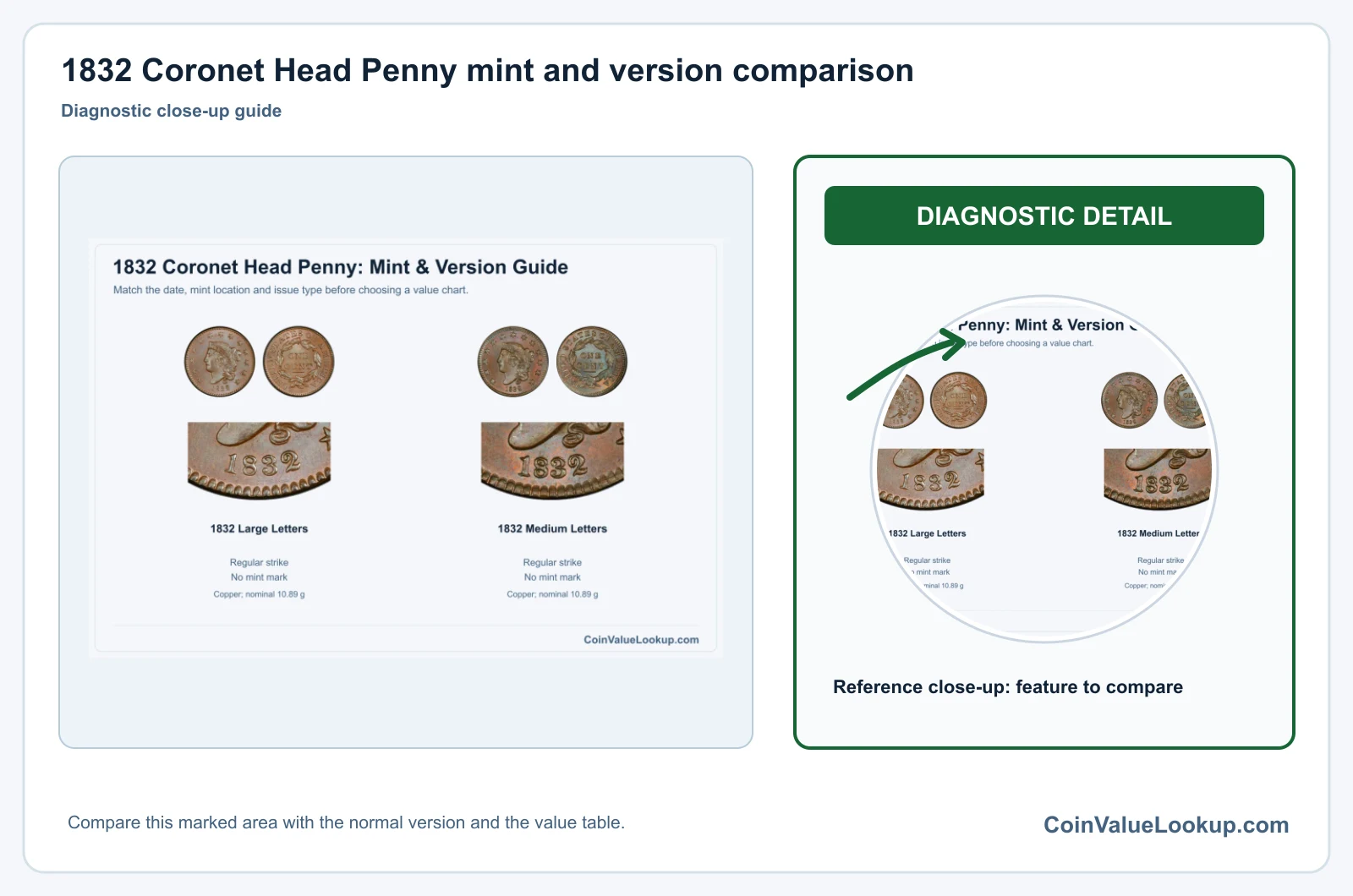
Every 1832 Coronet Head Cent was struck at Philadelphia, so there is no mintmark to look for. The key distinction is on the reverse: Large Letters versus Medium Letters.
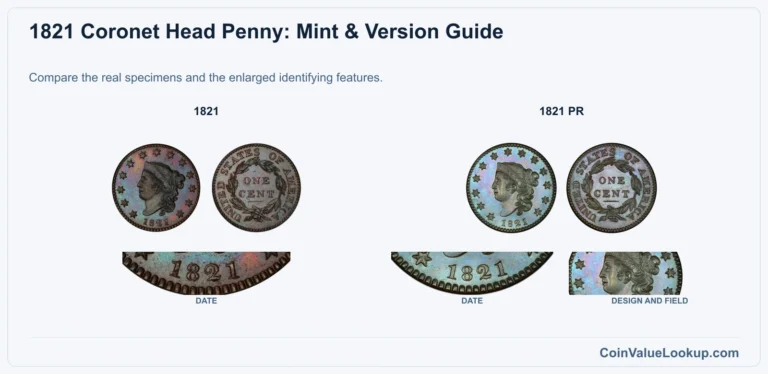
You need to compare the size of the legend lettering around the wreath, ideally at the same scale, because the difference is subtle enough to fool a casual glance.
Look at words like UNITED STATES and ONE CENT on the back. Large Letters are noticeably taller and fill more vertical space between the wreath and the rim.
Medium Letters sit a bit smaller and leave more breathing room.
Weight can support your identification — the nominal spec is 10.89 grams of copper — but wear, corrosion and the production tolerances of the 1830s mean weight alone will not prove a coin genuine. Check the date punch shape, the wreath details and the overall style of the obverse portrait against known examples.
A proof 1832 cent also exists, but that is a manufacturing category requiring expert attribution of surfaces, rims and die characteristics. A polished business strike is not a proof, no matter how shiny it looks.
Step 2: Check Your 1832 Coronet Head Cent Grade
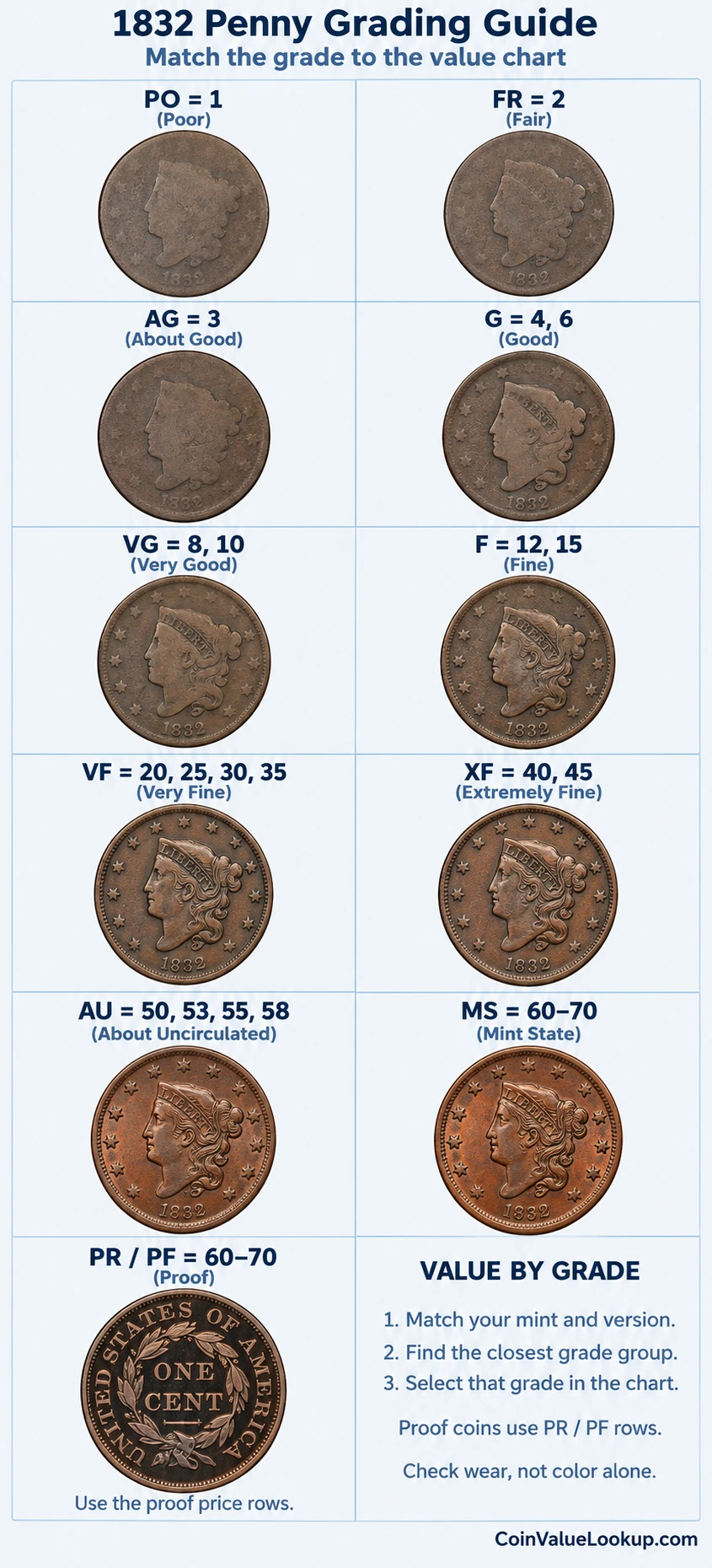
Start with the portrait. On a well-worn coin the hair curls above Liberty's forehead merge together and the cheek flattens.
A mid-grade piece retains separation in those curls but shows smoothing on the highest points. On the reverse, individual leaf veins in the wreath disappear early as wear increases.
Compare your coin against the grading image for like-type examples at each level. A coin grading Good-4 will show a clear outline of the portrait and readable lettering but little interior detail.
By contrast, an MS-63 coin has full original detail with only minor contact marks.
Do not confuse a weak strike with wear. Some 1832 cents left the press without full detail, especially on the hair or wreath tips.
Similarly, corrosion and porosity eat into surfaces in ways that mimic heavy circulation. Those surface problems can lower market value well below what the remaining sharpness might suggest.
Color designations like BN, RB and RD describe how much original red copper color remains. They are color attributes, not different metals.
Most surviving examples show brown toning.
Step 3: Check 1832 Coronet Head Cent Value by Mint and Version
1832 Coronet Head Cent — Large Letters
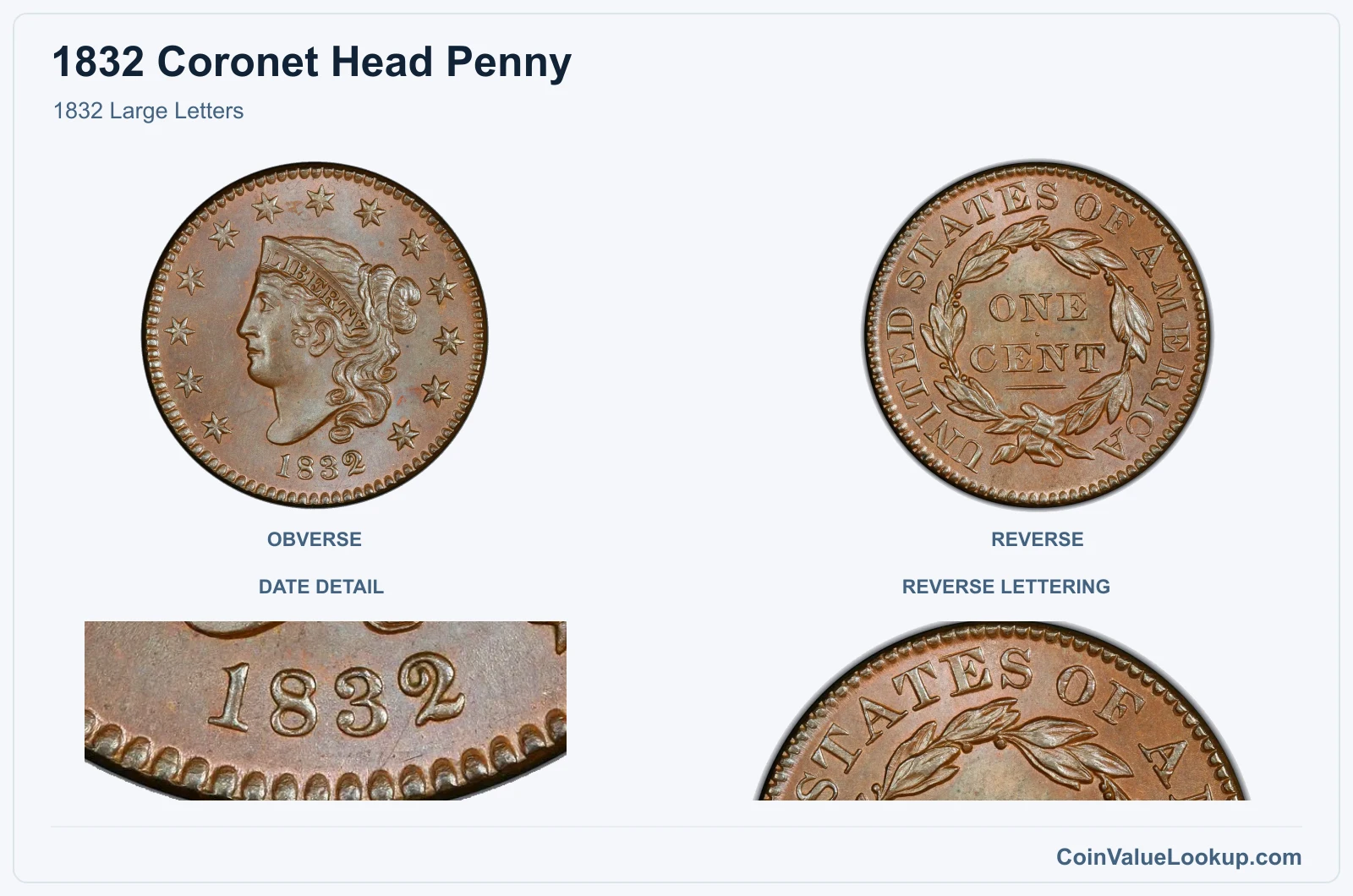
The 1832 Large Letters cent features taller, more prominent lettering on the reverse legend. To confirm this variety, compare the height of letters like UNITED STATES relative to the wreath and rim against a known Medium Letters example at the same scale — photographs side by side are your friend here.
Guide estimates from USA Coin Book place this branch at about $38 in Good-4 and around $1,127 in MS-63. That is a wide spread, and most surviving examples sit somewhere in the lower circulated grades.
Full mint-state pieces with good eye appeal are scarce for any Coronet cent of this era.
All 1832 cents were struck in copper at Philadelphia with no mintmark. If your coin has a letter below the wreath, it is not this issue.
| Range | Grade | Price | Auction Records | Appraisal |
|---|---|---|---|---|
| PO | PO 1 | — | Coin Identifier | |
| FR | FR 2 | — | Coin Identifier | |
| AG | AG 3 | — | Coin Identifier | |
| G | G 4 | — | Coin Identifier | |
| G 6 | — | Coin Identifier | ||
| VG | VG 8 | — | Coin Identifier | |
| VG 10 | — | Coin Identifier | ||
| F | F 12 | — | Coin Identifier | |
| F 15 | — | Coin Identifier | ||
| VF | VF 20 | Coin Identifier | ||
| VF 25 | Coin Identifier | |||
| VF 30 | Coin Identifier | |||
| VF 35 | Coin Identifier | |||
| XF | XF 40 | Coin Identifier | ||
| XF 45 | Coin Identifier | |||
| AU | AU 50 | Coin Identifier | ||
| AU 53 | Coin Identifier | |||
| AU 55 | Coin Identifier | |||
| AU 58 | Coin Identifier | |||
| MS | MS 60 | — | Coin Identifier | |
| MS 61 | Coin Identifier | |||
| MS 62 | Coin Identifier | |||
| MS 63 | Coin Identifier | |||
| MS 64 | Coin Identifier | |||
| MS 65 | Coin Identifier | |||
| MS 66 | Coin Identifier | |||
| MS 67 | — | — | — | |
| MS 68 | — | — | — | |
| MS 69 | — | — | — | |
| MS 70 | — | — | — |
1832 Coronet Head Cent — Medium Letters
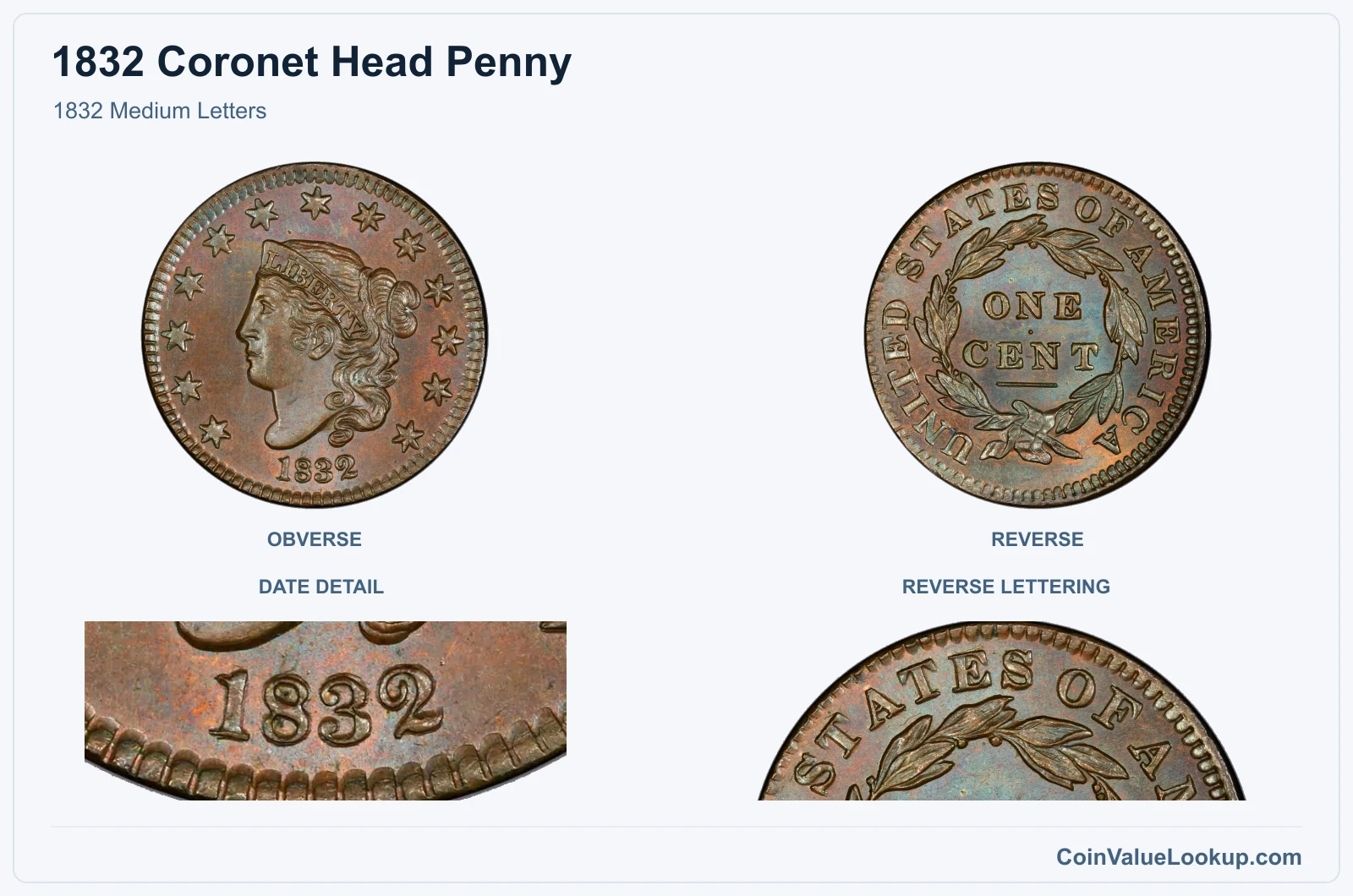
The 1832 Medium Letters variety uses slightly smaller reverse lettering, giving the legend a less crowded look. Side-by-side comparison at the same magnification is really the only reliable way to distinguish it from the Large Letters type — trust your eyes on letter height, not on a gut feeling.
USA Coin Book guide estimates run from about $38 in Good-4 up to roughly $1,445 in MS-63, making the top-grade figure somewhat higher than the Large Letters branch. That said, both varieties share the same lower-grade value, so the difference only becomes significant in nicer condition.
Coin Value Lookup is a useful starting point if you want to compare this cent's guide values against other dates in the Coronet Head series. It can help you quickly find the right guide for your coin.
| Range | Grade | Price | Auction Records | Appraisal |
|---|---|---|---|---|
| PO | PO 1 | — | Coin Identifier | |
| FR | FR 2 | — | Coin Identifier | |
| AG | AG 3 | — | Coin Identifier | |
| G | G 4 | — | Coin Identifier | |
| G 6 | — | Coin Identifier | ||
| VG | VG 8 | — | Coin Identifier | |
| VG 10 | — | Coin Identifier | ||
| F | F 12 | — | Coin Identifier | |
| F 15 | Coin Identifier | |||
| VF | VF 20 | Coin Identifier | ||
| VF 25 | Coin Identifier | |||
| VF 30 | Coin Identifier | |||
| VF 35 | Coin Identifier | |||
| XF | XF 40 | Coin Identifier | ||
| XF 45 | Coin Identifier | |||
| AU | AU 50 | Coin Identifier | ||
| AU 53 | Coin Identifier | |||
| AU 55 | Coin Identifier | |||
| AU 58 | Coin Identifier | |||
| MS | MS 60 | — | Coin Identifier | |
| MS 61 | Coin Identifier | |||
| MS 62 | Coin Identifier | |||
| MS 63 | Coin Identifier | |||
| MS 64 | Coin Identifier | |||
| MS 65 | Coin Identifier | |||
| MS 66 | Coin Identifier | |||
| MS 67 | — | — | — | |
| MS 68 | — | — | — | |
| MS 69 | — | — | — | |
| MS 70 | — | — | — |
1832 Coronet Head Cent — Proof
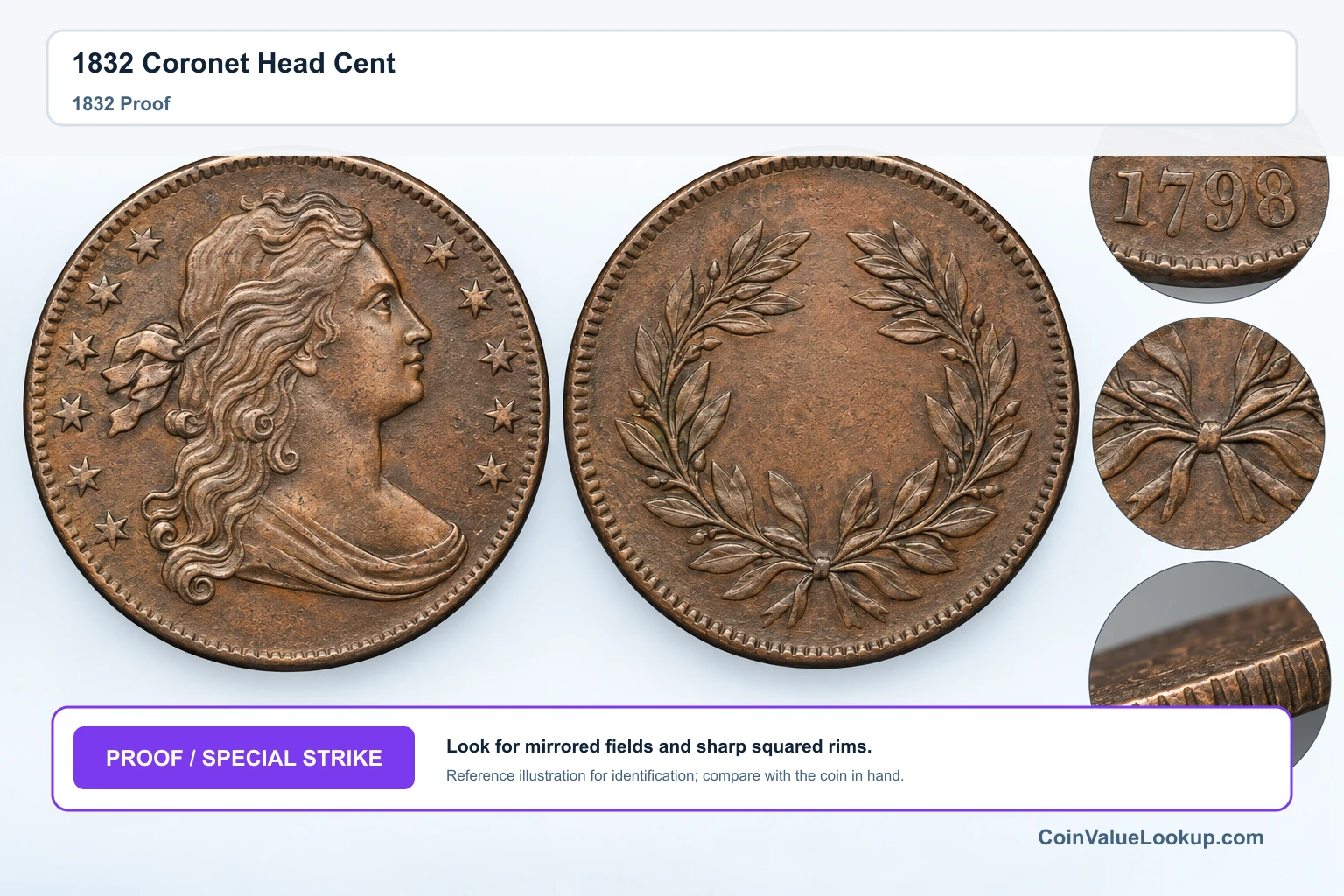
Proof 1832 Coronet Head Cents are genuinely rare early copper proofs. Identifying one requires careful attribution of the coin's surfaces, rims and die characteristics by someone experienced with the series.
A business strike that has been polished to a mirror finish is not a proof, and the market treats the two very differently.
No ordinary business-strike price is transferred to this branch, and no supported numeric range has been adopted for proof examples. The value of a genuine proof depends entirely on its authenticated identity, its surface preservation and any impairments.
Each coin needs individual assessment, typically through a major grading service.
If you suspect you have a proof, high-resolution photos of both faces and the edge are the minimum starting point. Look for squared, well-defined rims, a mirrored field and sharp die detail that goes beyond what a nice uncirculated business strike would show.
Professional authentication is essential before assigning any value.
| Range | Grade | Price | Auction Records | Appraisal |
|---|---|---|---|---|
| PR | PR 1 | — | Coin Identifier | |
| PR 2 | — | Coin Identifier | ||
| PR 3 | — | Coin Identifier | ||
| PR 4 | — | Coin Identifier | ||
| PR 6 | — | Coin Identifier | ||
| PR 8 | — | Coin Identifier | ||
| PR 10 | — | Coin Identifier | ||
| PR 12 | — | Coin Identifier | ||
| PR 15 | — | Coin Identifier | ||
| PR 20 | — | Coin Identifier | ||
| PR 25 | — | Coin Identifier | ||
| PR 30 | — | Coin Identifier | ||
| PR 35 | — | Coin Identifier | ||
| PR 40 | — | Coin Identifier | ||
| PR 45 | — | Coin Identifier | ||
| PR 50 | — | Coin Identifier | ||
| PR 53 | — | Coin Identifier | ||
| PR 55 | — | Coin Identifier | ||
| PR 58 | — | Coin Identifier | ||
| PR 60 | — | Coin Identifier | ||
| PR 61 | — | Coin Identifier | ||
| PR 62 | — | Coin Identifier | ||
| PR 63 | — | Coin Identifier | ||
| PR 64 | Coin Identifier | |||
| PR 65 | — | — | — | |
| PR 66 | — | — | — | |
| PR 67 | — | — | — | |
| PR 68 | — | — | — | |
| PR 69 | — | — | — | |
| PR 70 | — | — | — |
1832 Coronet Head Cent Error List
1. 1832 Coronet Head Cent — Die Crack
A die crack shows up as a thin raised line running across the coin's surface, crossing fields or devices where no line belongs. On an 1832 Coronet cent, look for these lines under magnification — they follow the path of the fracture in the steel die and appear in relief because metal was forced into the crack during striking.
To confirm it is genuine, trace the line with a toothpick or pin. A true die crack is raised above the surface.
If the line is incised or sinks below the field, you are probably looking at a scratch, a corrosion track or a tool mark from someone's old cleaning attempt.
Photograph the full coin with the date visible, then take a closeup of the affected area. No standard price range applies to die cracks on this date; the value depends on the crack's size, location and the coin's overall condition and authenticated variety.
2. 1832 Coronet Head Cent — Die Break / Cud
A cud is a raised, blob-like lump that connects to the rim, caused by a piece of the die breaking away entirely. On an 1832 cent, a cud displaces part of the normal design — you might lose a section of stars, lettering or Liberty's hair.
The missing die fragment means the planchet metal had nothing to press against in that spot, so it bulges outward.
Do not confuse a cud with a simple rim dent or corrosion bump. A genuine cud has a smooth, rounded boundary that transitions into the adjacent design, and the displaced area matches the coin's surface texture.
An interior die chip — a smaller break away from the rim — is a related but different category.
No adopted price range exists for cuds on this date. Value depends on the cud's size, position and the coin's overall grade and authenticated identity.
3. 1832 Coronet Head Cent — Lamination / Split Planchet
A lamination or split planchet error occurs when the copper separates into layers, leaving peeling metal, a retained flap or a visible gap within the coin's thickness. On an 1832 cent, this can look like a thin sheet lifting away from the surface or a portion that appears ready to detach.
Photograph both the affected face and the edge together — edge views are critical for confirming that the separation runs through the metal rather than being surface damage. Scraping from a tool, corrosion that has eaten into the copper, or a deliberately cut coin can all mimic a lamination at first glance.
The difference is that a genuine lamination follows the internal structure of the planchet, often with a slightly irregular boundary, while post-mint damage tends to show sharper or more uniform tool marks. No standard price range is adopted for this error on the 1832 cent; each example needs individual evaluation based on severity and overall condition.
4. 1832 Coronet Head Cent — Clipped Planchet
A clipped planchet means a portion of the original copper blank was missing before the coin was struck. The clip can be curved, straight or ragged, depending on what went wrong during blank production.
On an 1832 cent, look for a missing section along the edge where the rim simply stops and the coin's outline changes shape.
A key confirmation is the Blakesley effect: weakness in the design directly opposite the clip, caused by reduced metal flow during striking. If the missing section has sharp file marks or tool scratches, it is more likely a post-mint alteration — someone trimmed the coin after it left the press.
Compare the edge texture in the clipped zone to the rest of the coin. A genuine clip usually has a different finish there because the edge was never formed by the collar die.
No adopted price range exists for clipped 1832 cents; value depends on clip size, type and the coin's authenticated condition.
5. 1832 Coronet Head Cent — Off-Center Strike
An off-center strike happens when the planchet is not properly seated between the dies, so the design lands shifted to one side and a blank crescent of unstruck metal appears on the opposite edge. On an 1832 Coronet cent, the percentage of off-center shift and whether the date remains visible are the two biggest factors collectors care about.
A coin with a dramatic shift that still shows the full date is far more desirable than one where the date has been lost. Keep that in mind when photographing — capture the full coin so the date area is clear.
Do not confuse an off-center strike with a clipped planchet or one-sided misalignment. A clip removes metal from the blank before striking, while post-mint flattening can push the design sideways in misleading ways.
No standard price range applies to off-center 1832 cents; each piece requires individual assessment based on the degree of shift, date visibility and overall condition.