1796 Draped Bust Cent Coin Value: How Much Is It Worth?
A 1796 Draped Bust Cent is a serious early American copper coin, and its value reflects that. Guide estimates for the ordinary varieties start around $721 in G4 and climb to roughly $11,083 in EF40 for the priciest common reverse type.
The LIHERTY blundered-die variety commands even more, while the rare Stemless Wreath Reverse carries a G4 guide estimate near $42,823. Identify your exact variety before assuming any value.
Fast Way to Identify Your 1796 Draped Bust Cent
The fastest way to narrow down what you have is to snap clear photos of both sides and upload them for a preliminary identification. Focus on the legend spelling, the wreath style, and the overall sharpness.
Good lighting at a slight angle helps capture the relief. This step is not a substitute for professional authentication, but it points you in the right direction.
1796 Draped Bust Cent Value
Upload both sides of your 1796 Draped Bust Cent.
Front Obverse
Upload photo
Back Reverse
Upload photo
Which 1796 Draped Bust Cent Versions Are Worth Money?
- The LIHERTY variety (blundered B resembling H) lists at about $1,243 in G4 and $18,692 in EF40, well above the standard reverse types at the same grades.
- The Stemless Wreath Reverse carries a guide estimate near $42,823 in G4, making it the standout rarity among listed 1796 Draped Bust varieties.
- The Reverse of 1794 variety reaches roughly $11,083 in EF40 guide value, the highest EF40 figure among the three standard reverse types.
- Prominent mint errors such as die cracks, cuds, off-center strikes, clips, and laminations are reported for this date and may add collector interest beyond the base variety value.
Step 1: Identify Your 1796 Draped Bust Cent Mint Mark and Version
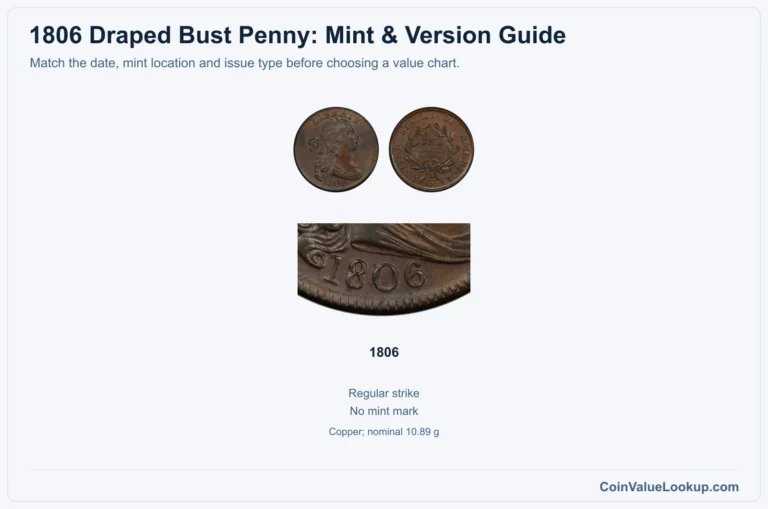
All 1796 Draped Bust Cents were struck at Philadelphia, so there is no mintmark to look for. The year is important because both Liberty Cap and Draped Bust designs exist for 1796; make sure you are looking at the Draped Bust type, which shows Liberty facing right with flowing hair and drapery at her shoulder.
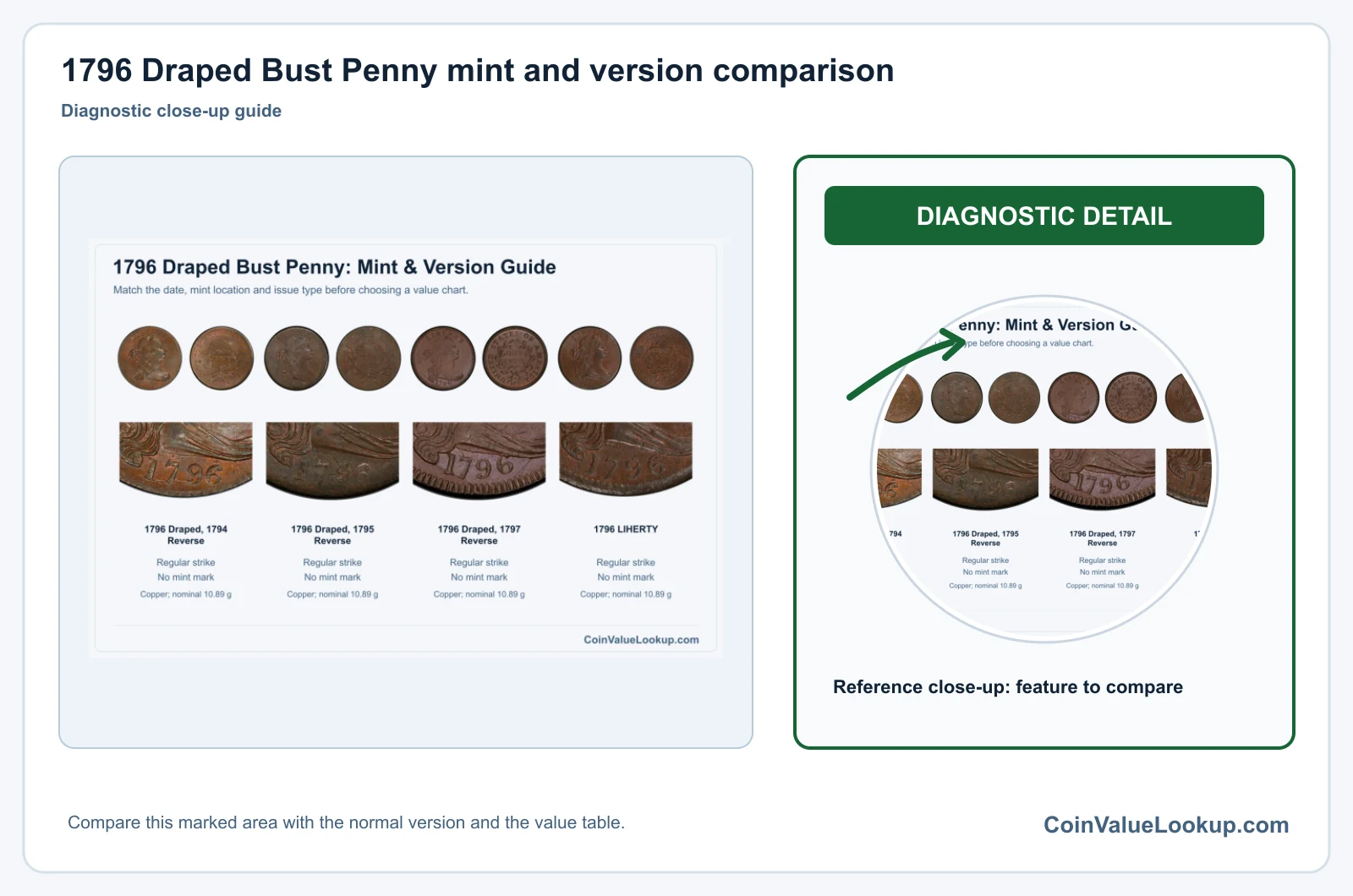
The reverse is where most of the action is. Different wreath die styles correspond to the Reverse of 1794, 1795, or 1797 designations.
Look at the leaf arrangement, the number of berries, and how the stems connect at the base of the wreath. These details determine which variety you hold.
Also check the legend carefully. On the LIHERTY variety, the letter B in LIBERTY was punched with a die that produced something resembling an H.
Under magnification the difference is clear, and it adds real value.
The Stemless Wreath Reverse is a separate, much rarer branch. Compare the wreath base on your coin against images of the ordinary versions at equal magnification.
Weight should be near the nominal 10.89 grams in copper, but wear and old production tolerances mean weight alone does not prove authenticity. When in doubt, seek professional attribution.
Step 2: Check Your 1796 Draped Bust Cent Grade
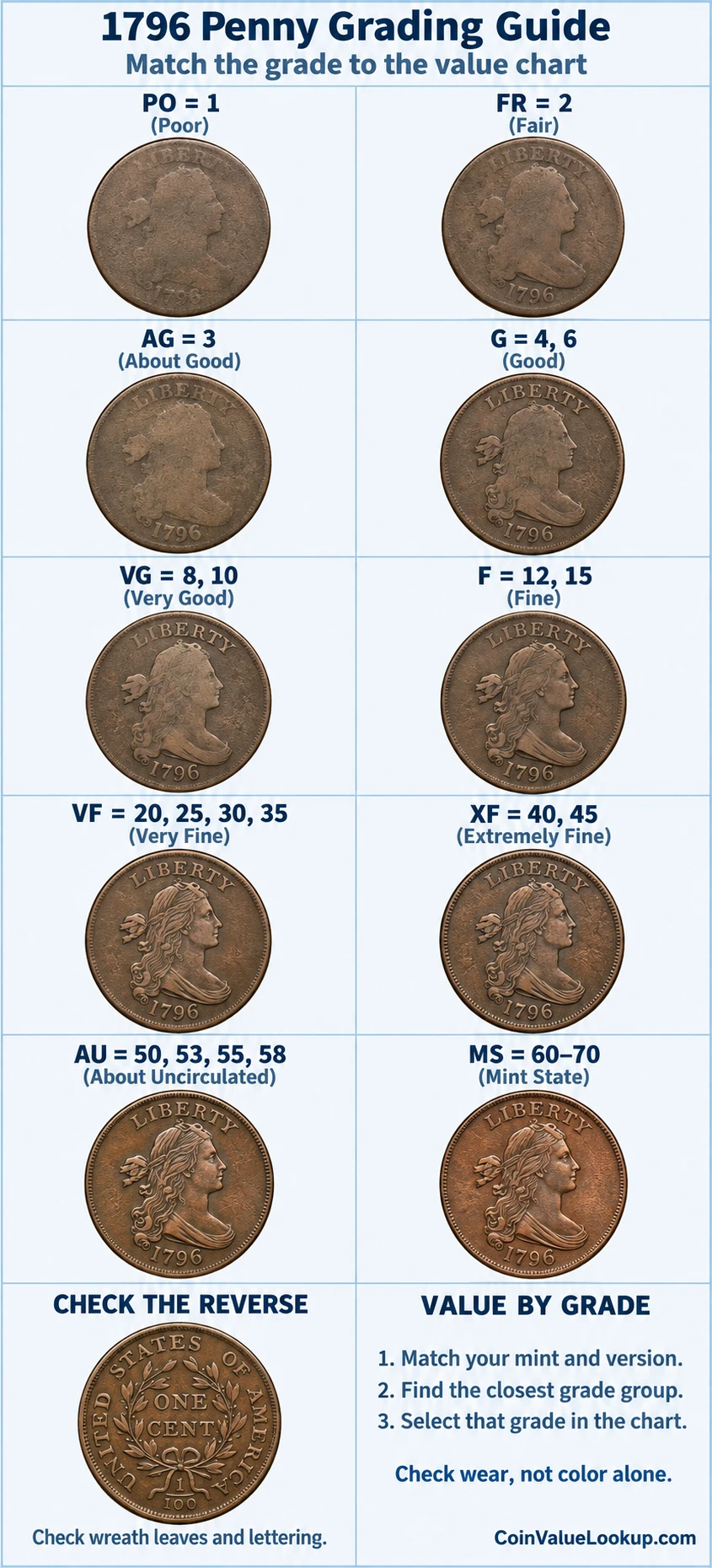
Start with the obverse. In lower grades like G4, you will see a smooth outline of Liberty's bust with almost no hair detail and a flat cheek.
As you move up toward EF40, individual hair strands above the forehead and behind the ear become visible, and the drapery lines sharpen.
On the reverse, leaf veins and berry roundness are your best wear indicators. A well-struck EF example shows distinct leaf edges and full lettering.
Compare your coin to the reference image of like-type grade examples to calibrate your eye.
Do not confuse a weak original strike with wear. Some 1796 cents left the press with soft details, especially at the hair above the ear.
Porosity and old corrosion can also mimic wear but actually represent surface problems, and the market penalizes them.
Color designations like BN, RB, and RD describe how much original red copper tone remains. They are color attributes, not separate alloys or grades.
Most surviving 1796 cents are full brown.
Step 3: Check 1796 Draped Bust Cent Value by Mint and Version
1796 Draped Bust Cent — Draped, 1794 Reverse
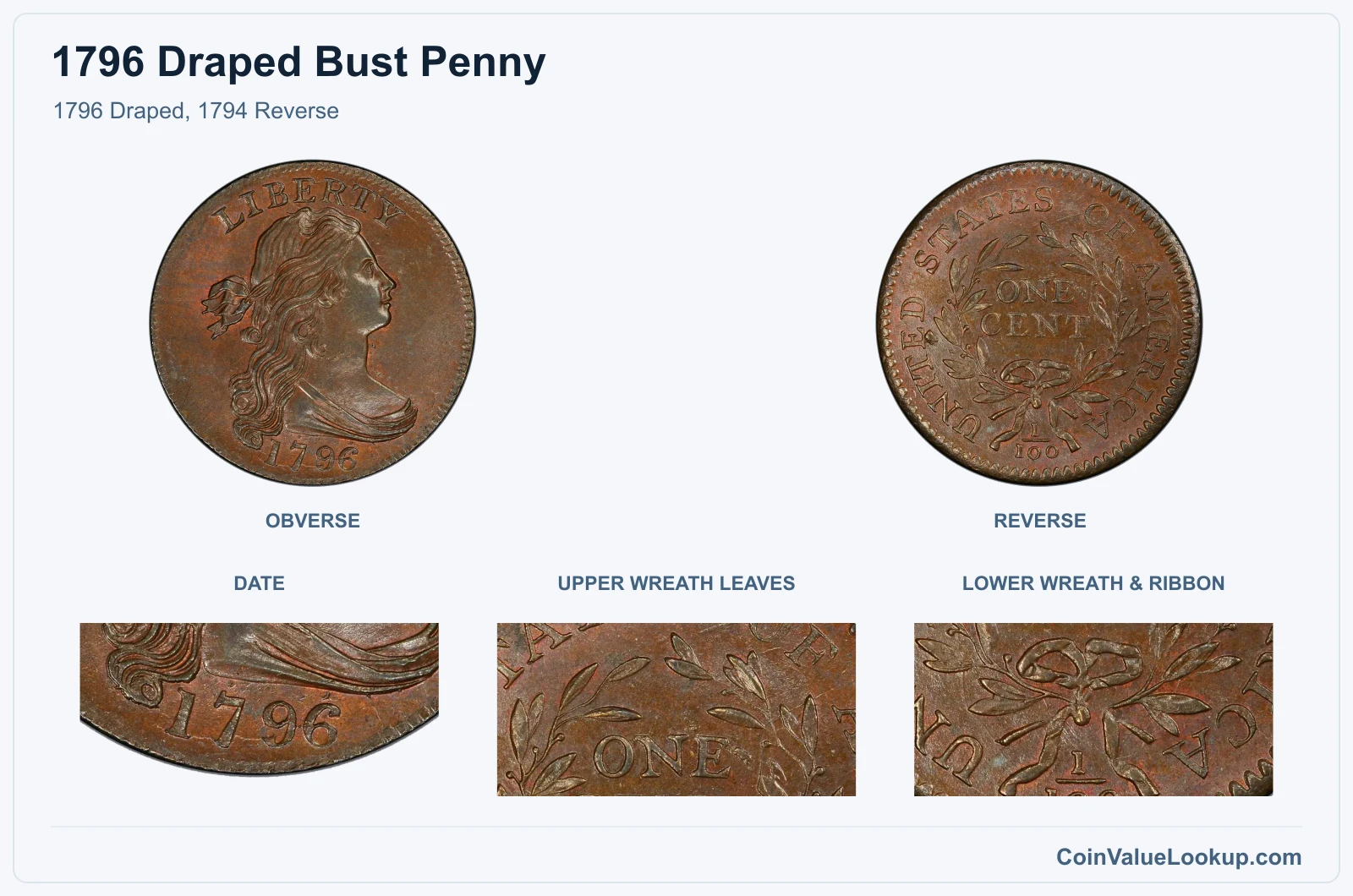
This variety pairs the 1796 Draped Bust obverse with the Reverse of 1794 wreath die. The 1794-style reverse has a distinctive leaf and berry arrangement that differs from the later wreath layouts.
Look closely at how the stems join at the bottom of the wreath and the spacing of the berries along the branches.
USA Coin Book guide estimates place this version at about $721 in G4 and approximately $11,083 in EF40. That EF40 figure is actually the highest among the three standard reverse types, so condition matters a great deal here.
All examples were struck in copper at Philadelphia with no mintmark.
| Range | Grade | Price | Auction Records | Appraisal |
|---|---|---|---|---|
| PO | PO 1 | — | Coin Identifier | |
| FR | FR 2 | Coin Identifier | ||
| AG | AG 3 | Coin Identifier | ||
| G | G 4 | Coin Identifier | ||
| G 6 | Coin Identifier | |||
| VG | VG 8 | Coin Identifier | ||
| VG 10 | Coin Identifier | |||
| F | F 12 | Coin Identifier | ||
| F 15 | Coin Identifier | |||
| VF | VF 20 | Coin Identifier | ||
| VF 25 | Coin Identifier | |||
| VF 30 | Coin Identifier | |||
| VF 35 | Coin Identifier | |||
| XF | XF 40 | Coin Identifier | ||
| XF 45 | — | Coin Identifier | ||
| AU | AU 50 | Coin Identifier | ||
| AU 53 | — | Coin Identifier | ||
| AU 55 | — | Coin Identifier | ||
| AU 58 | — | Coin Identifier | ||
| MS | MS 60 | — | — | — |
| MS 61 | — | — | — | |
| MS 62 | — | Coin Identifier | ||
| MS 63 | — | Coin Identifier | ||
| MS 64 | — | Coin Identifier | ||
| MS 65 | — | — | — | |
| MS 66 | — | Coin Identifier | ||
| MS 67 | — | — | — | |
| MS 68 | — | — | — | |
| MS 69 | — | — | — | |
| MS 70 | — | — | — |
1796 Draped Bust Cent — Draped, 1795 Reverse
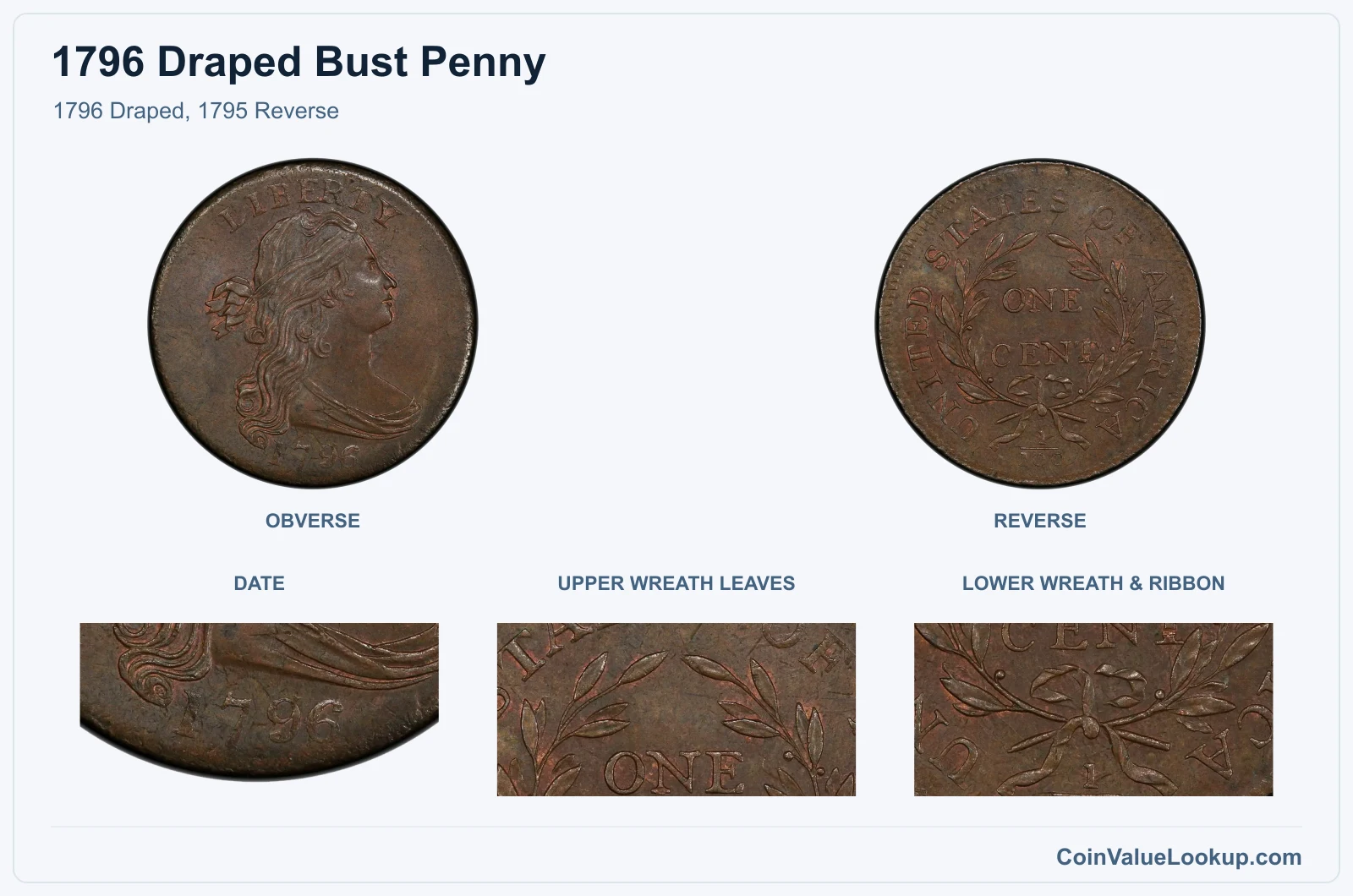
The Reverse of 1795 variety uses a wreath die associated with the prior year's production. The leaf style and berry count differ from both the 1794 and 1797 reverse dies.
Side-by-side comparison at equal scale is the safest way to confirm the attribution.
Guide estimates from USA Coin Book run about $721 in G4 and roughly $9,329 in EF40. Like all 1796 Draped Bust Cents, these are copper coins struck at Philadelphia without a mintmark.
The nominal weight is 10.89 grams, though surviving examples may weigh less after two centuries of handling.
| Range | Grade | Price | Auction Records | Appraisal |
|---|---|---|---|---|
| PO | PO 1 | Coin Identifier | ||
| FR | FR 2 | Coin Identifier | ||
| AG | AG 3 | Coin Identifier | ||
| G | G 4 | Coin Identifier | ||
| G 6 | Coin Identifier | |||
| VG | VG 8 | Coin Identifier | ||
| VG 10 | Coin Identifier | |||
| F | F 12 | Coin Identifier | ||
| F 15 | Coin Identifier | |||
| VF | VF 20 | Coin Identifier | ||
| VF 25 | Coin Identifier | |||
| VF 30 | Coin Identifier | |||
| VF 35 | Coin Identifier | |||
| XF | XF 40 | — | Coin Identifier | |
| XF 45 | Coin Identifier | |||
| AU | AU 50 | Coin Identifier | ||
| AU 53 | — | Coin Identifier | ||
| AU 55 | Coin Identifier | |||
| AU 58 | Coin Identifier | |||
| MS | MS 60 | — | Coin Identifier | |
| MS 61 | — | Coin Identifier | ||
| MS 62 | Coin Identifier | |||
| MS 63 | Coin Identifier | |||
| MS 64 | — | Coin Identifier | ||
| MS 65 | — | Coin Identifier | ||
| MS 66 | — | Coin Identifier | ||
| MS 67 | — | — | — | |
| MS 68 | — | — | — | |
| MS 69 | — | — | — | |
| MS 70 | — | — | — |
1796 Draped Bust Cent — Draped, 1797 Reverse
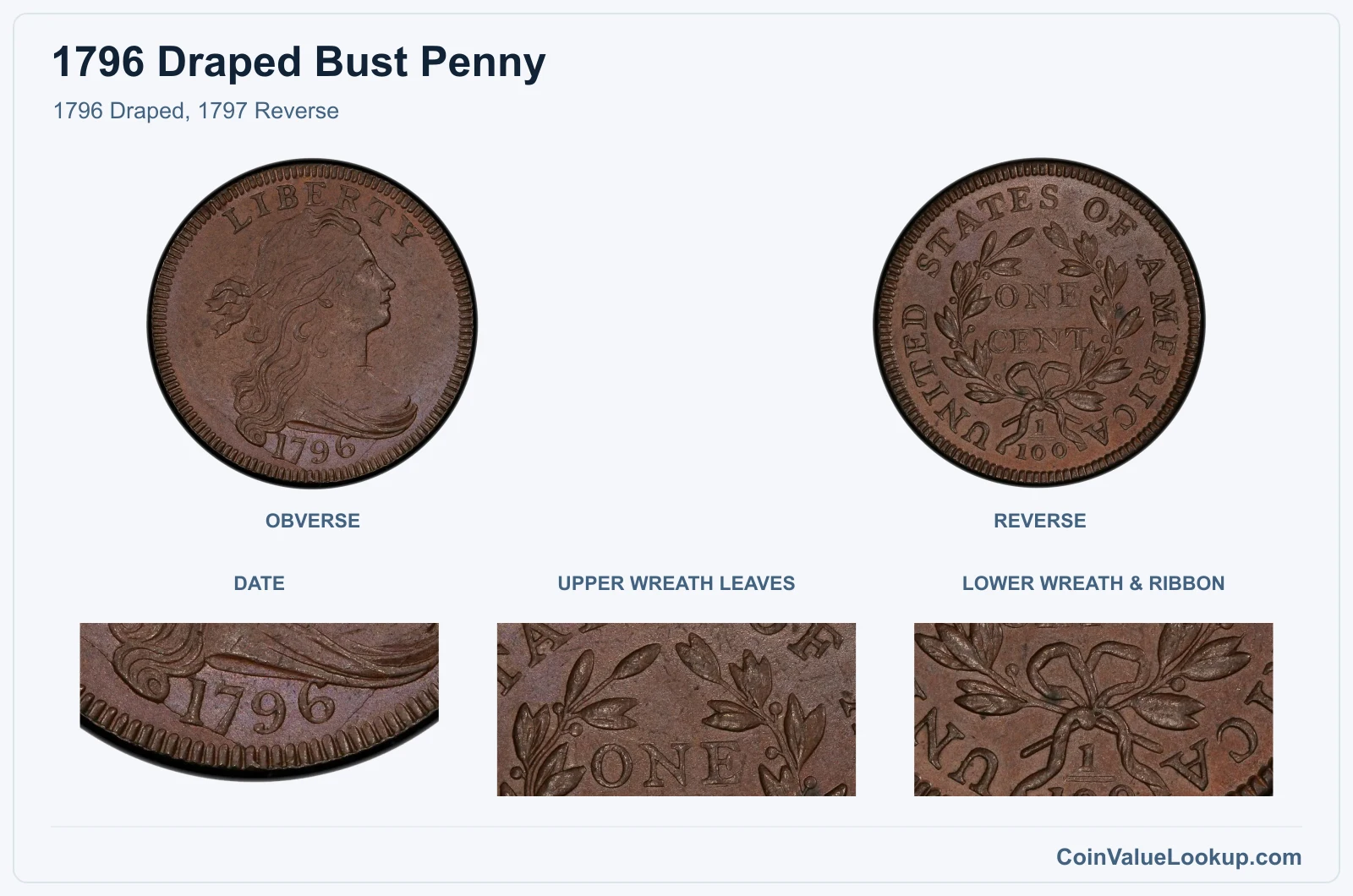
This version uses the Reverse of 1797 wreath die, which has its own leaf configuration and stem treatment at the base. It is the latest reverse style paired with the 1796-dated obverse.
Guide values sit at approximately $721 in G4 and about $6,827 in EF40 per USA Coin Book. That makes it the most affordable of the three standard reverse types in higher grades, though any genuine 1796 Draped Bust Cent is still a significant coin.
Philadelphia origin, copper composition, no mintmark.
| Range | Grade | Price | Auction Records | Appraisal |
|---|---|---|---|---|
| PO | PO 1 | — | Coin Identifier | |
| FR | FR 2 | Coin Identifier | ||
| AG | AG 3 | Coin Identifier | ||
| G | G 4 | Coin Identifier | ||
| G 6 | Coin Identifier | |||
| VG | VG 8 | Coin Identifier | ||
| VG 10 | Coin Identifier | |||
| F | F 12 | Coin Identifier | ||
| F 15 | Coin Identifier | |||
| VF | VF 20 | Coin Identifier | ||
| VF 25 | Coin Identifier | |||
| VF 30 | Coin Identifier | |||
| VF 35 | — | Coin Identifier | ||
| XF | XF 40 | Coin Identifier | ||
| XF 45 | Coin Identifier | |||
| AU | AU 50 | Coin Identifier | ||
| AU 53 | Coin Identifier | |||
| AU 55 | — | Coin Identifier | ||
| AU 58 | Coin Identifier | |||
| MS | MS 60 | — | Coin Identifier | |
| MS 61 | Coin Identifier | |||
| MS 62 | Coin Identifier | |||
| MS 63 | Coin Identifier | |||
| MS 64 | Coin Identifier | |||
| MS 65 | — | Coin Identifier | ||
| MS 66 | — | — | — | |
| MS 67 | — | — | — | |
| MS 68 | — | — | — | |
| MS 69 | — | — | — | |
| MS 70 | — | — | — |
1796 Draped Bust Cent — LIHERTY
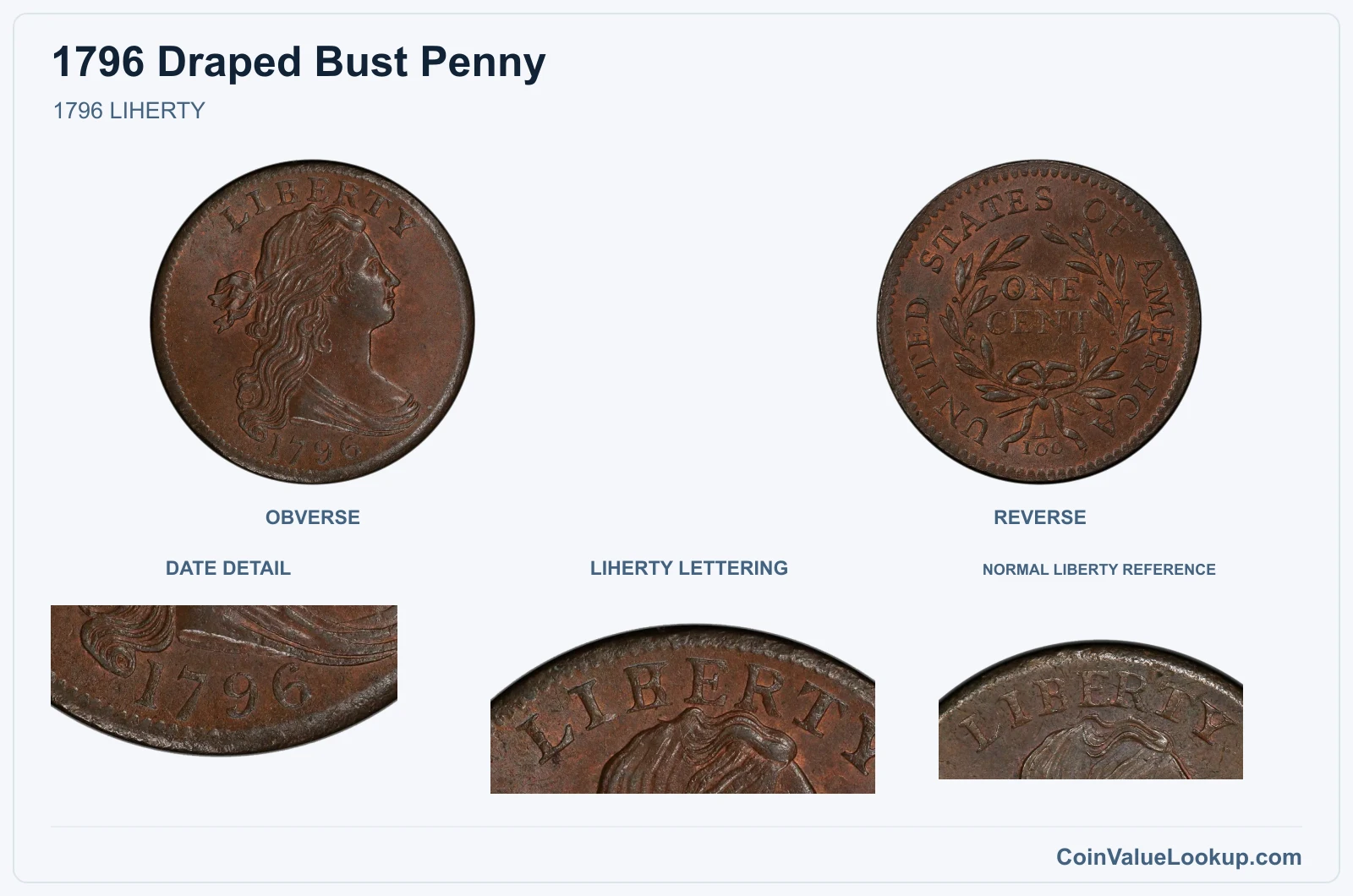
Here is the famous LIHERTY variety. During die preparation, the letter B in LIBERTY was cut in a way that makes it look like an H.
Under a loupe or good magnification the difference jumps out, and it is a die-made feature, not post-strike damage.
This blunder carries a meaningful premium. USA Coin Book lists it at about $1,243 in G4 and roughly $18,692 in EF40.
Those figures dwarf the standard reverse types at the same grades. The coin is copper, struck at Philadelphia, and carries no mintmark.
If your 1796 cent reads LIHERTY, you have something collectors actively pursue.
If you are researching early copper cents or other series, Coin Value Lookup can help you compare guide values across dates and varieties. It is a useful starting point before deciding whether to send a coin in for professional attribution.
| Range | Grade | Price | Auction Records | Appraisal |
|---|---|---|---|---|
| PO | PO 1 | — | Coin Identifier | |
| FR | FR 2 | Coin Identifier | ||
| AG | AG 3 | — | Coin Identifier | |
| G | G 4 | Coin Identifier | ||
| G 6 | — | Coin Identifier | ||
| VG | VG 8 | — | Coin Identifier | |
| VG 10 | Coin Identifier | |||
| F | F 12 | Coin Identifier | ||
| F 15 | Coin Identifier | |||
| VF | VF 20 | Coin Identifier | ||
| VF 25 | — | Coin Identifier | ||
| VF 30 | Coin Identifier | |||
| VF 35 | — | Coin Identifier | ||
| XF | XF 40 | — | Coin Identifier | |
| XF 45 | — | Coin Identifier | ||
| AU | AU 50 | — | Coin Identifier | |
| AU 53 | Coin Identifier | |||
| AU 55 | — | Coin Identifier | ||
| AU 58 | Coin Identifier | |||
| MS | MS 60 | — | Coin Identifier | |
| MS 61 | — | Coin Identifier | ||
| MS 62 | — | Coin Identifier | ||
| MS 63 | — | — | — | |
| MS 64 | — | — | — | |
| MS 65 | — | Coin Identifier | ||
| MS 66 | — | — | — | |
| MS 67 | — | — | — | |
| MS 68 | — | — | — | |
| MS 69 | — | — | — | |
| MS 70 | — | — | — |
1796 Draped Bust Cent — Stemless Wreath Reverse
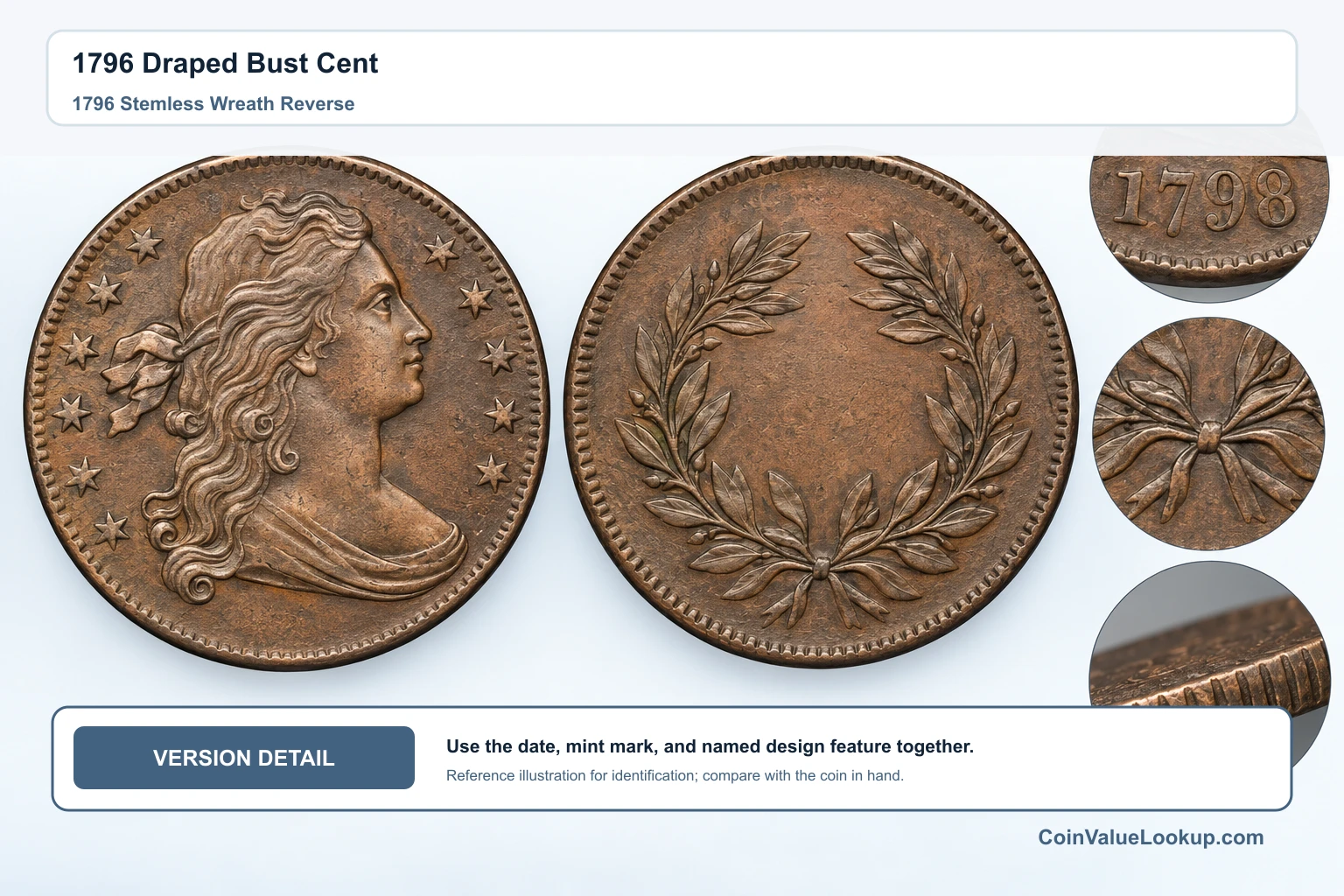
The Stemless Wreath Reverse is the rarest listed branch for this date. On ordinary 1796 reverses, stems extend below the bow at the wreath base.
On this variety, the stems are absent. That single detail makes a dramatic difference in value.
USA Coin Book carries a guide estimate of approximately $42,823 in G4. No higher-grade figure is listed, which underscores how scarce this coin is in any condition.
Exact attribution is critical because the feature can be subtle on heavily worn specimens. Compare at equal magnification against a confirmed ordinary wreath.
This is a copper cent struck at Philadelphia with no mintmark; the weight standard may correspond to either the earlier heavy or later light planchet depending on the specific die pairing.
Reference scope: The table below is for an ordinary 1796 Philadelphia Draped Bust cent with the Reverse of 1797, in Brown (BN). It does not represent the value of the rare Stemless Wreath variety or its rarity premium.
Range Grade
Price Auction Records Appraisal PO PO 1
—
Coin Identifier FR FR 2
Coin Identifier AG AG 3
Coin Identifier G G 4
Coin Identifier
G 6
Coin Identifier VG VG 8
Coin Identifier
VG 10
Coin Identifier F F 12
Coin Identifier
F 15
Coin Identifier VF VF 20
Coin Identifier
VF 25
Coin Identifier
VF 30
Coin Identifier
VF 35
—
Coin Identifier XF XF 40
Coin Identifier
XF 45
Coin Identifier AU AU 50
Coin Identifier
AU 53
Coin Identifier
AU 55
—
Coin Identifier
AU 58
Coin Identifier MS MS 60
—
Coin Identifier
MS 61
Coin Identifier
MS 62
Coin Identifier
MS 63
Coin Identifier
MS 64
Coin Identifier
MS 65
—
Coin Identifier
MS 66
—
—
—
MS 67
—
—
—
MS 68
—
—
—
MS 69
—
—
—
MS 70
—
—
—
1796 Draped Bust Cent Error List
1. 1796 Draped Bust Cent — Die Crack
A die crack shows up as a thin, raised line running across the coin's surface. It follows the path where the steel die fractured during use.
On a 1796 Draped Bust Cent, look for these lines crossing fields or cutting through letters and devices. They are raised because metal filled the crack during striking.
The key distinction is raised versus incuse. A post-mint scratch or tool mark is pressed into the surface, while a die crack sits above it.
Corrosion lines can also mimic cracks but tend to be irregular and pitted rather than sharp. No specific price premium is adopted for die cracks on this date; value depends on the authenticated variety, the crack's prominence, and overall coin condition.
Professional evaluation is the safest route.
2. 1796 Draped Bust Cent — Die Break / Cud
A cud is a raised, featureless blob of metal connected to the rim where a piece of the die broke away entirely. It displaces part of the design.
On a 1796 cent, a cud might obliterate a portion of the legend or wreath edge. Interior die breaks that do not touch the rim are related but technically different.
Do not confuse a cud with a rim dent or corrosion buildup. A genuine cud has a smooth, slightly rounded surface because it formed inside the void left by the missing die fragment.
Rim damage is typically depressed and irregular. No adopted price range exists for cuds on this date; each example needs individual assessment based on size, location, coin grade, and confirmed attribution.
3. 1796 Draped Bust Cent — Off-Center Strike
An off-center strike happens when the planchet is not properly seated between the dies. The result is a design shifted to one side with a blank crescent of unstruck metal on the opposite edge.
On a 1796 Draped Bust Cent, even a modest off-center percentage is unusual and attracts attention.
The date must remain visible for the coin to be attributed and valued. A clipped planchet or one-sided die misalignment can produce a superficially similar look, so examine the blank area carefully.
Genuine off-center coins show a clean, unstruck field, not a flattened or filed edge. No numeric price range is adopted for this error on the 1796 date; each piece is evaluated individually based on the percentage off-center, date visibility, and authenticated condition.
4. 1796 Draped Bust Cent — Clipped Planchet
A clipped planchet error means a portion of the copper blank was missing before the coin was struck. The clip may be curved, straight, or ragged, depending on what went wrong during blank preparation.
On 1796 cents, look for a section of the rim and adjacent design that simply is not there, with metal flow weakness on the opposite side of the coin.
That opposite-side weakness is a good diagnostic. It shows the planchet was already short of metal when the dies came together.
Compare this to a filed notch or edge cut, which will show tool marks and no corresponding weakness elsewhere. Corrosion that eats away an edge is also not a clip.
No adopted price data exists for clipped 1796 Draped Bust Cents; individual assessment by a professional is recommended.
5. 1796 Draped Bust Cent — Lamination / Split Planchet
A lamination error appears as peeling, flaking, or separation within the copper itself. The metal may lift in a thin flap or split apart, revealing a rough interior surface.
On early copper coins like the 1796 Draped Bust Cent, impurities in the planchet stock could cause layers to separate during or after striking.
Photograph both the affected face and the edge together to document the split. A genuine lamination shows a natural separation within the metal, not a sharp cut or scrape mark.
Corrosion can also cause flaking, but corroded surfaces tend to be pitted and granular rather than showing clean layer boundaries. No specific price premium is adopted for laminations on this date.
Value depends on the severity, the underlying variety, and authenticated overall condition.