1793 Flowing Hair Large Cent Coin Value: How Much Is It Worth?
The 1793 Flowing Hair Large Cent is America's first regular-issue cent, and every surviving example carries serious collector demand. Guide estimates range from roughly $4,873 in Good-4 for the most affordable Wreath variety up through $1.71 million in MS-65 for the AMERICA Chain type.
Identifying your exact design and variety is critical, because differences in the legend, edge and wreath can shift value by tens of thousands of dollars.
Fast Way to Identify Your 1793 Flowing Hair Large Cent
The fastest way to start figuring out what you have is to upload clear photos of the front, back and edge of your coin. Our identifier can offer a preliminary identification based on those images, helping you narrow down the design type and variety.
It cannot authenticate, certify or assign an exact grade, but it points you in the right direction.
1793 Flowing Hair Large Cent Value
Upload both sides of your 1793 Flowing Hair Large Cent.
Front Obverse
Upload photo
Back Reverse
Upload photo
Which 1793 Flowing Hair Large Cent Versions Are Worth Money?
- The 1793 AMERI. Chain cent carries guide values from about $12,985 in G-4 to $726,113 in MS-60, reflecting its status as the very first variety struck.
- The 1793 AMERICA Chain cent without periods lists from around $10,013 in G-4 up to roughly $1,713,993 in MS-65, making high-grade survivors exceptionally valuable.
- The 1793 Liberty Cap type starts near $14,877 in G-4 and reaches about $1,061,909 in AU-50; survivors above that grade are essentially absent from guide tables.
- The 1793 Strawberry Leaf Wreath cent is a famous rarity with a guide estimate around $604,169 even in G-4, requiring exact attribution to confirm.
- Wreath cents with a Lettered Edge list up to roughly $393,235 in MS-65, well above the Vine and Bars Edge variety at the same level.
Step 1: Identify Your 1793 Flowing Hair Large Cent Mint Mark and Version
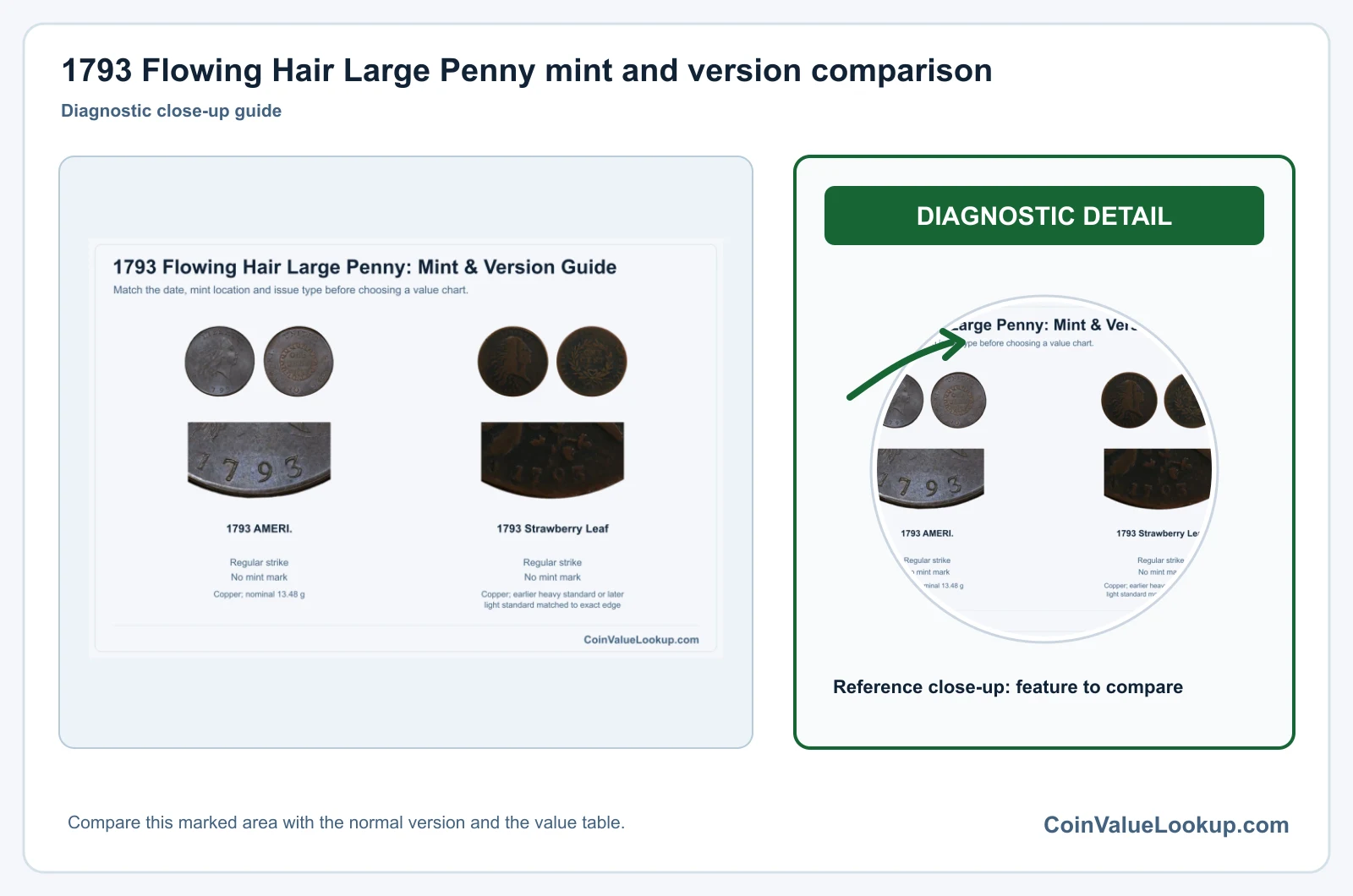
Three distinct designs share the 1793 date: the Chain reverse, the Wreath reverse and the Liberty Cap. Each has its own sub-varieties, so slow down and look carefully.
Chain cents are the earliest. Flip yours over: if the reverse shows a simple chain of links surrounding the denomination, you have a Chain type.
Now read the legend. If it says AMERI.
(abbreviated, with a period), that is the scarce first version. If it reads AMERICA without periods, that is the corrected legend.
If it reads AMERICA flanked by periods after each word in the surrounding text, that is the Periods variety.
Wreath cents replaced the Chain design mid-year. The reverse shows a more elaborate botanical wreath.
To separate Wreath sub-varieties, examine the edge. A vine-and-bars pattern means one variety; a lettered edge reading ONE HUNDRED FOR A DOLLAR means another.
The ultra-rare Strawberry Leaf variant has a distinctive three-leaf sprig below the date on the obverse.
The Liberty Cap type appeared late in 1793 and features a pole and cap behind Liberty's head. All 1793 cents were struck at Philadelphia with no mintmark.
Do not assume a plain-edge coin is authentic without checking weight and other diagnostics; copper corrodes and wears in ways that can obscure edge details.
Step 2: Check Your 1793 Flowing Hair Large Cent Grade
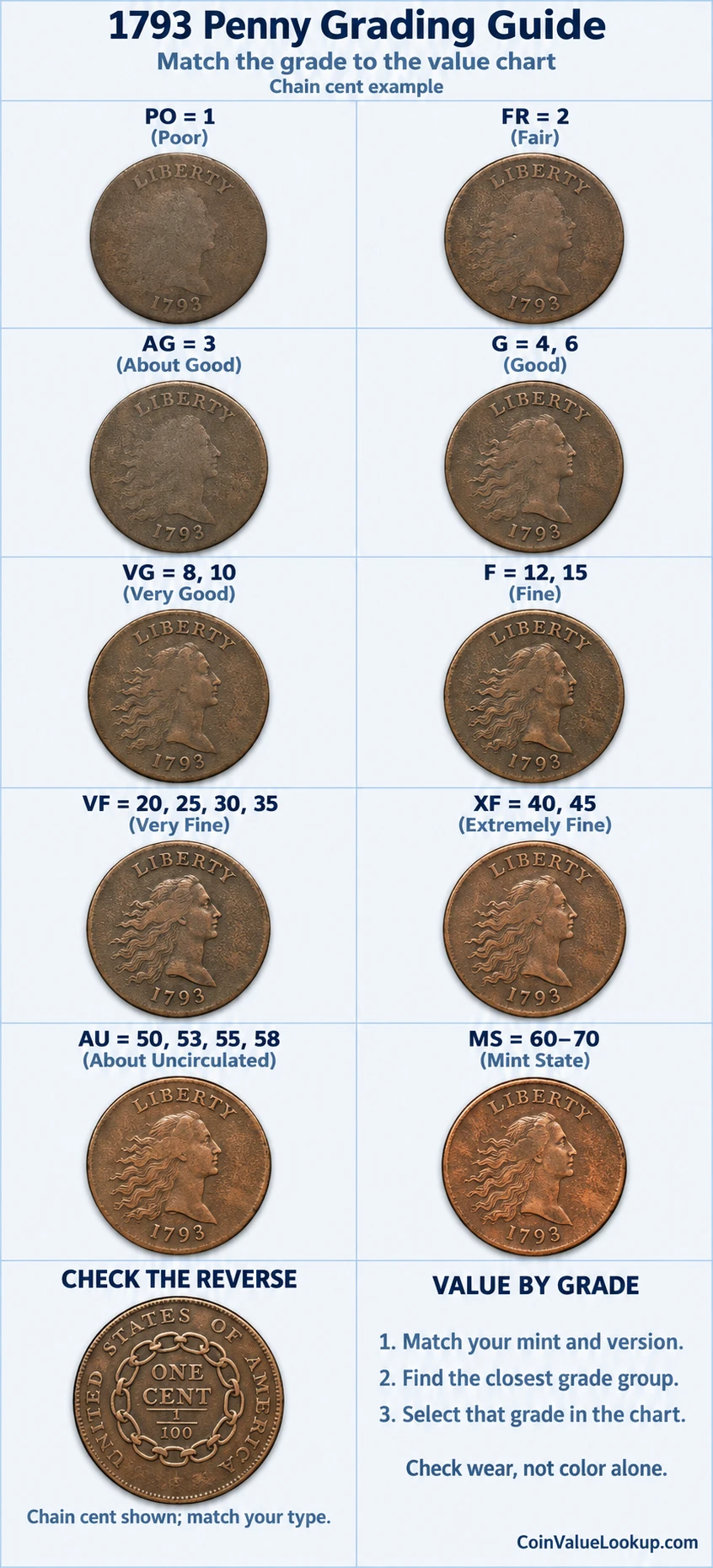
Grading early copper takes patience. Compare your coin's portrait to known grade examples of the same design type, because a Chain cent wears differently than a Wreath or Liberty Cap.
On Chain cents, check the hair detail above Liberty's ear and the chain-link definition. On Wreath cents, look at the hair strands flowing behind the head and the individual leaf veins.
On the Liberty Cap, the cap detail and the ribbon behind the neck are key wear points.
Separate honest wear from problems. Porosity, corrosion and old cleaning can make a coin look lower-grade than its actual wear suggests, and these surface issues reduce market appeal substantially.
A coin with VF detail but heavy corrosion will not sell like a clean VF.
Color designations like BN (brown), RB (red-brown) and RD (red) describe the surface color of the copper, not different alloys or separate grade tracks. Use the comparison image to match your coin's wear pattern against established grade benchmarks for the correct design type.
Step 3: Check 1793 Flowing Hair Large Cent Value by Mint and Version
1793 Flowing Hair Large Cent — AMERI.
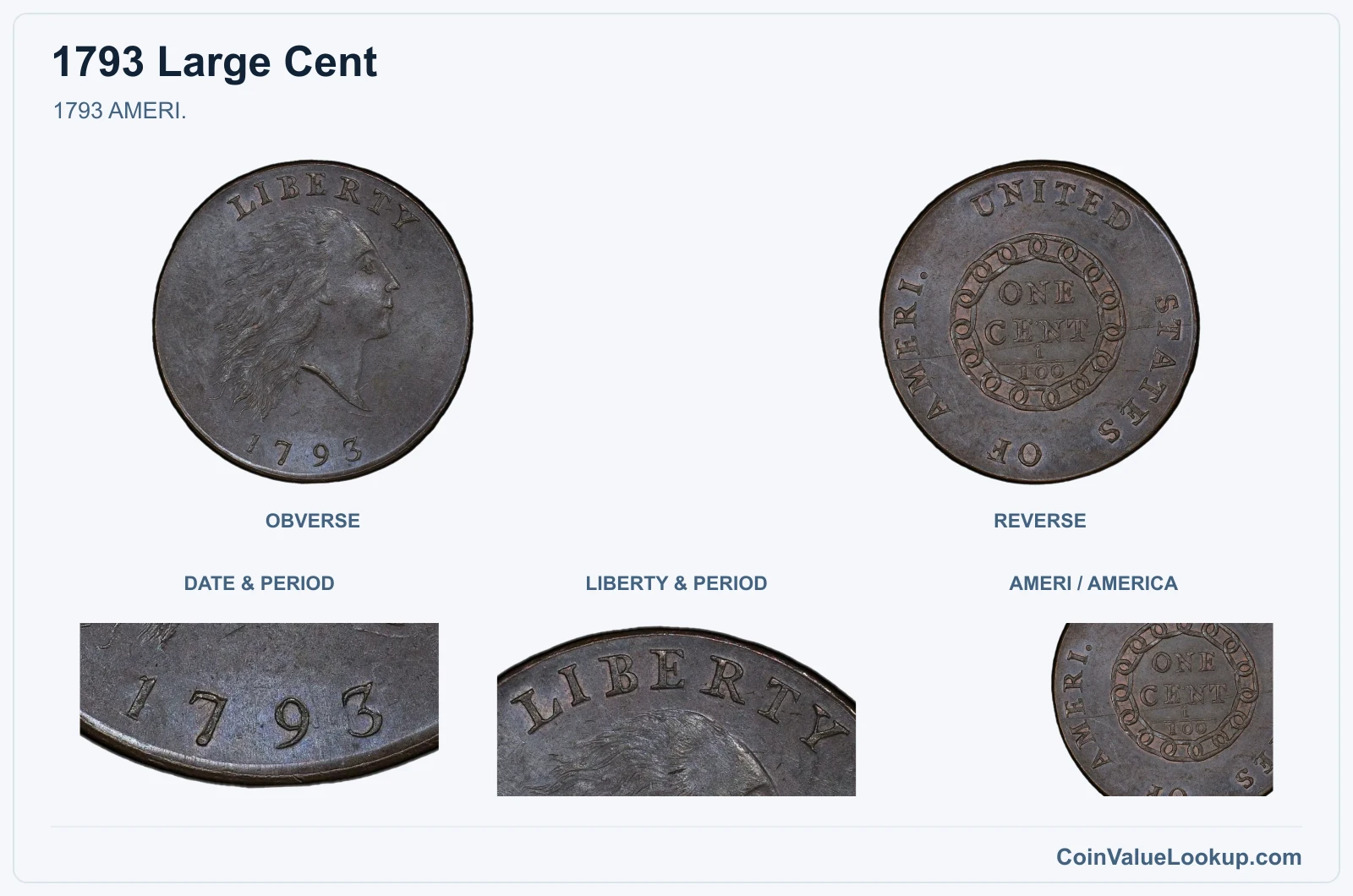
The 1793 AMERI. Chain cent is the very first variety of U.S. cent produced, with the denomination legend abbreviated to AMERI.
followed by a period. Look at the reverse inside the chain: if the word stops at AMERI with a clear period, you have this variety.
Guide estimates place it at roughly $12,985 in G-4 and around $726,113 in MS-60. Survivors are scarce at every level, and the abbreviated legend makes this one of the most historically significant U.S. copper coins.
All examples were struck in copper at Philadelphia with no mintmark.
| Range | Grade | Price | Auction Records | Appraisal |
|---|---|---|---|---|
| PO | PO 1 | Coin Identifier | ||
| FR | FR 2 | Coin Identifier | ||
| AG | AG 3 | Coin Identifier | ||
| G | G 4 | Coin Identifier | ||
| G 6 | Coin Identifier | |||
| VG | VG 8 | Coin Identifier | ||
| VG 10 | Coin Identifier | |||
| F | F 12 | Coin Identifier | ||
| F 15 | Coin Identifier | |||
| VF | VF 20 | Coin Identifier | ||
| VF 25 | Coin Identifier | |||
| VF 30 | Coin Identifier | |||
| VF 35 | Coin Identifier | |||
| XF | XF 40 | Coin Identifier | ||
| XF 45 | — | Coin Identifier | ||
| AU | AU 50 | Coin Identifier | ||
| AU 53 | Coin Identifier | |||
| AU 55 | — | Coin Identifier | ||
| AU 58 | Coin Identifier | |||
| MS | MS 60 | — | Coin Identifier | |
| MS 61 | — | Coin Identifier | ||
| MS 62 | Coin Identifier | |||
| MS 63 | Coin Identifier | |||
| MS 64 | — | — | — | |
| MS 65 | — | Coin Identifier | ||
| MS 66 | — | — | — | |
| MS 67 | — | — | — | |
| MS 68 | — | — | — | |
| MS 69 | — | — | — | |
| MS 70 | — | — | — |
1793 Flowing Hair Large Cent — AMERICA
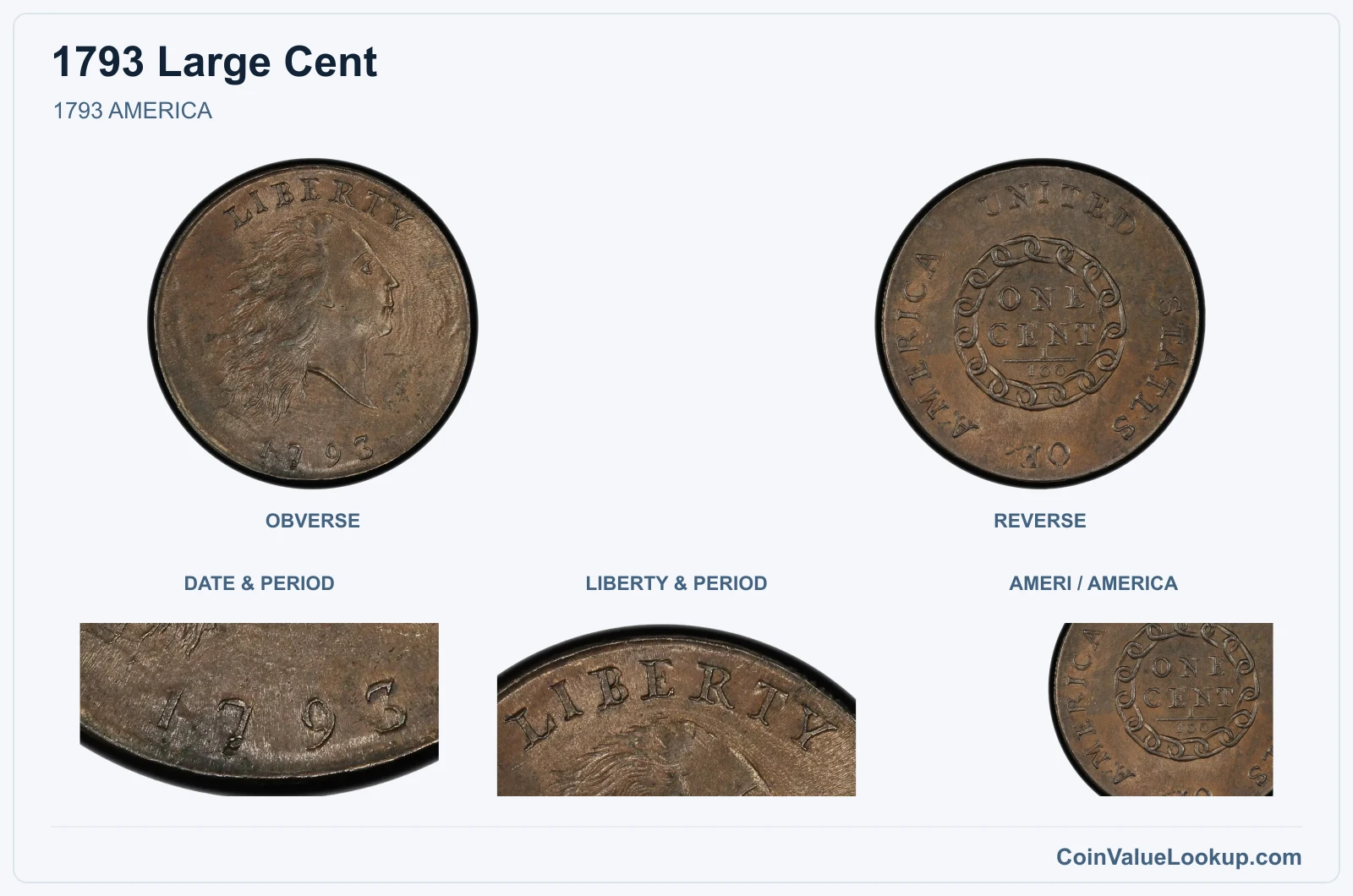
This is the corrected Chain cent with AMERICA spelled out fully and no periods flanking the legend words. Turn the coin over and read the text inside the chain carefully.
If it says AMERICA with no trailing periods on any surrounding words, this is your variety. Guide estimates run from about $10,013 in G-4 to approximately $1,713,993 in MS-65, though surviving examples in that top grade are vanishingly rare.
The full AMERICA spelling is slightly more available than the AMERI. version, but both are serious coins in any grade.
| Range | Grade | Price | Auction Records | Appraisal |
|---|---|---|---|---|
| PO | PO 1 | Coin Identifier | ||
| FR | FR 2 | Coin Identifier | ||
| AG | AG 3 | Coin Identifier | ||
| G | G 4 | Coin Identifier | ||
| G 6 | Coin Identifier | |||
| VG | VG 8 | Coin Identifier | ||
| VG 10 | Coin Identifier | |||
| F | F 12 | Coin Identifier | ||
| F 15 | Coin Identifier | |||
| VF | VF 20 | Coin Identifier | ||
| VF 25 | Coin Identifier | |||
| VF 30 | Coin Identifier | |||
| VF 35 | Coin Identifier | |||
| XF | XF 40 | Coin Identifier | ||
| XF 45 | Coin Identifier | |||
| AU | AU 50 | — | Coin Identifier | |
| AU 53 | Coin Identifier | |||
| AU 55 | — | Coin Identifier | ||
| AU 58 | — | Coin Identifier | ||
| MS | MS 60 | — | Coin Identifier | |
| MS 61 | — | Coin Identifier | ||
| MS 62 | — | Coin Identifier | ||
| MS 63 | — | Coin Identifier | ||
| MS 64 | — | Coin Identifier | ||
| MS 65 | — | Coin Identifier | ||
| MS 66 | — | Coin Identifier | ||
| MS 67 | — | — | — | |
| MS 68 | — | — | — | |
| MS 69 | — | — | — | |
| MS 70 | — | — | — |
1793 Flowing Hair Large Cent — Periods
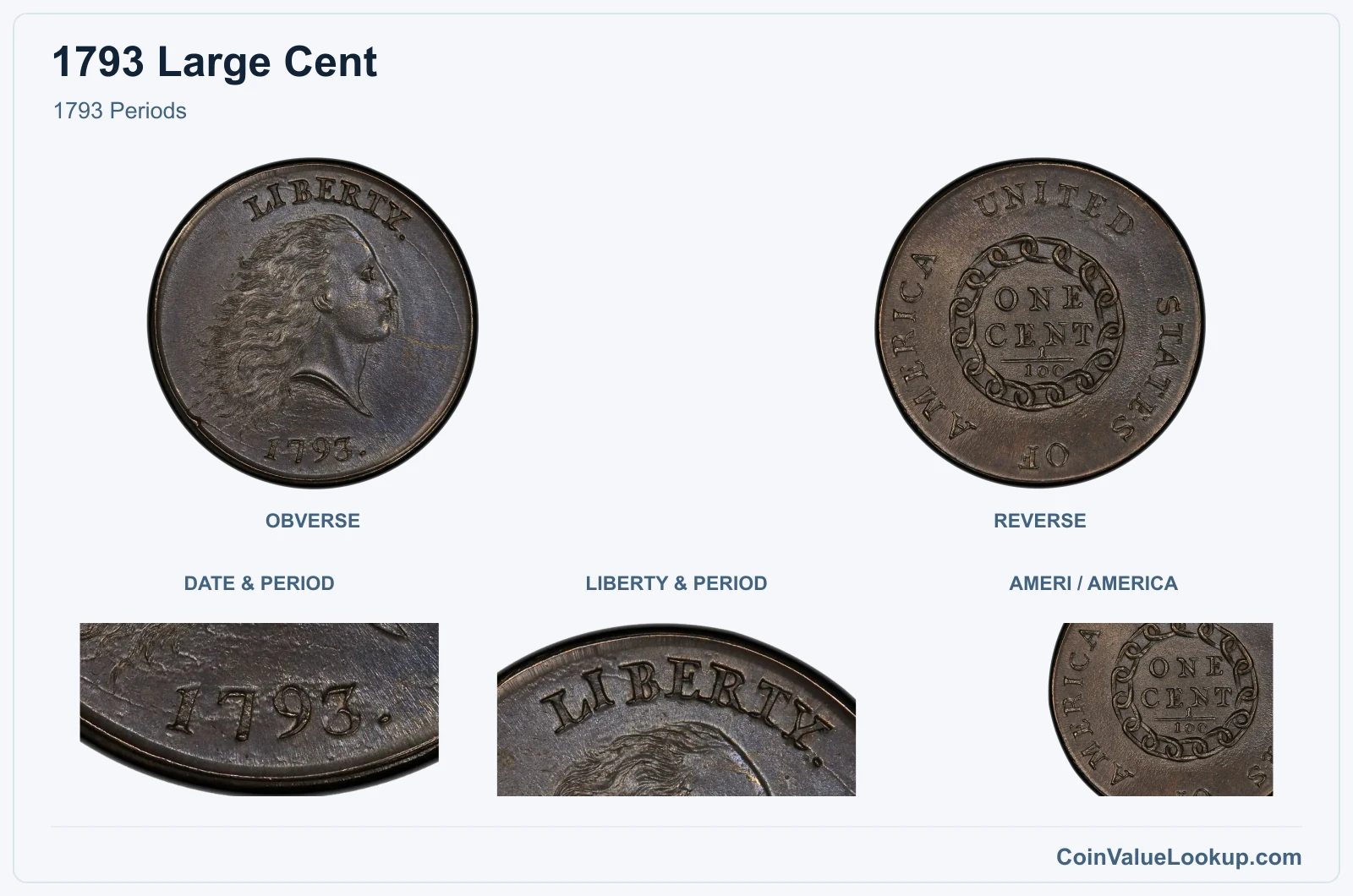
The 1793 Periods variety is another Chain cent, but periods appear after the words in the reverse legend, flanking AMERICA. Compare your coin's reverse lettering closely to known examples, because worn periods can be hard to spot.
Guide estimates run from about $10,013 in G-4 to roughly $361,381 in MS-60. This branch sits between the AMERI.
and plain AMERICA varieties in overall market visibility. All were struck in copper at Philadelphia.
| Range | Grade | Price | Auction Records | Appraisal |
|---|---|---|---|---|
| PO | PO 1 | Coin Identifier | ||
| FR | FR 2 | Coin Identifier | ||
| AG | AG 3 | Coin Identifier | ||
| G | G 4 | Coin Identifier | ||
| G 6 | Coin Identifier | |||
| VG | VG 8 | Coin Identifier | ||
| VG 10 | Coin Identifier | |||
| F | F 12 | Coin Identifier | ||
| F 15 | Coin Identifier | |||
| VF | VF 20 | Coin Identifier | ||
| VF 25 | Coin Identifier | |||
| VF 30 | Coin Identifier | |||
| VF 35 | — | Coin Identifier | ||
| XF | XF 40 | Coin Identifier | ||
| XF 45 | Coin Identifier | |||
| AU | AU 50 | Coin Identifier | ||
| AU 53 | Coin Identifier | |||
| AU 55 | Coin Identifier | |||
| AU 58 | Coin Identifier | |||
| MS | MS 60 | — | — | — |
| MS 61 | — | — | — | |
| MS 62 | — | — | — | |
| MS 63 | — | — | — | |
| MS 64 | — | — | — | |
| MS 65 | Coin Identifier | |||
| MS 66 | — | Coin Identifier | ||
| MS 67 | — | Coin Identifier | ||
| MS 68 | — | — | — | |
| MS 69 | — | — | — | |
| MS 70 | — | — | — |
1793 Flowing Hair Large Cent — Vine and Bars Edge
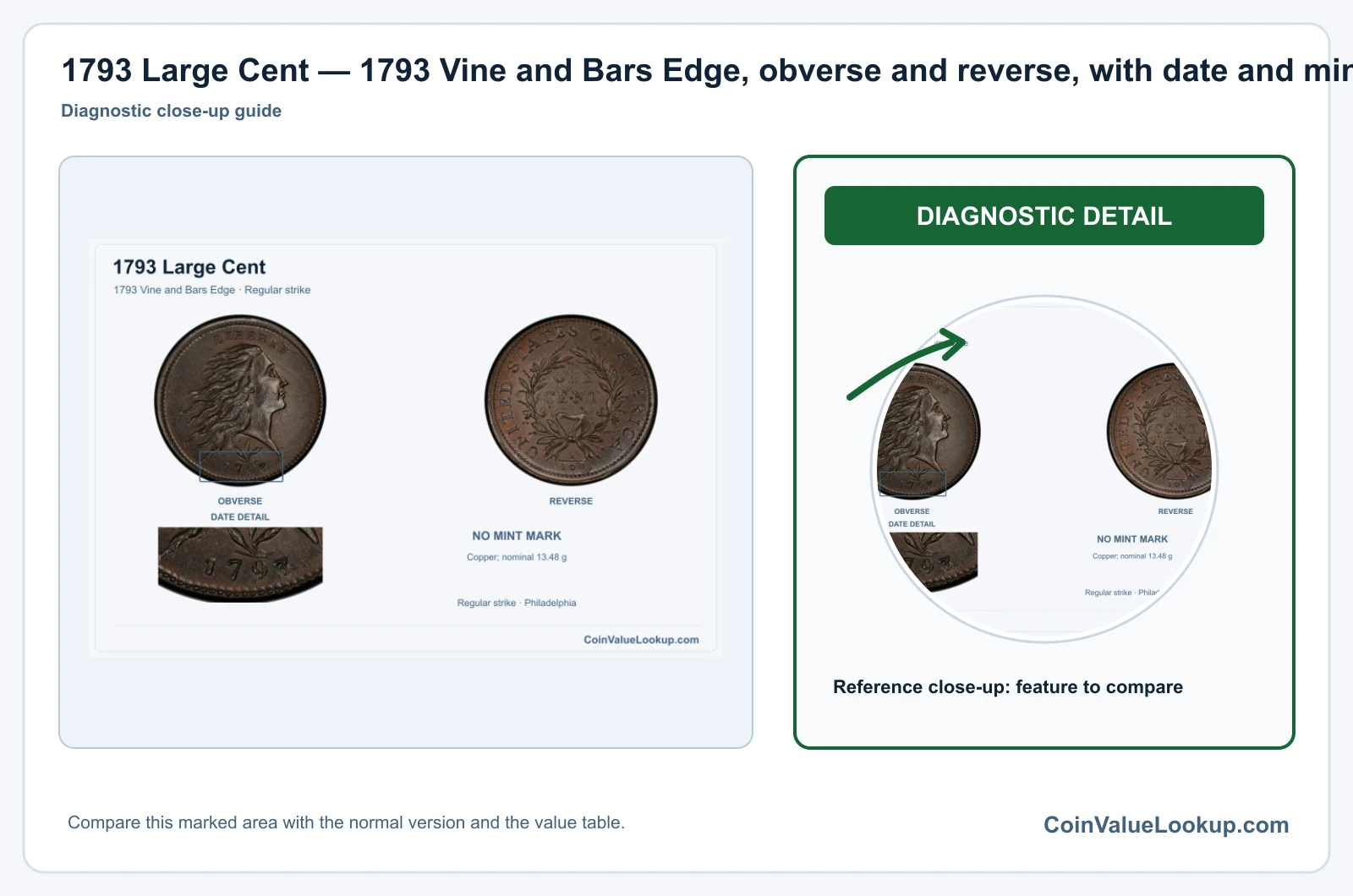
The Wreath cent with a Vine and Bars edge replaced the Chain design in 1793. Flip the coin and look at the edge: you should see a repeating pattern of vines and bars rather than lettering.
The reverse shows a detailed wreath instead of a chain. Guide estimates start around $4,873 in G-4 and reach roughly $89,479 in MS-60, making this the most accessible 1793 variety by entry price.
Do not confuse a corroded or damaged edge with a vine-and-bars pattern; the design elements should be clearly defined and repeating.
If you are exploring values for early U.S. copper or other series, Coin Value Lookup offers a range of coin guides to help with research. It is a useful starting point when you want to compare varieties side by side before consulting a dealer.
| Range | Grade | Price | Auction Records | Appraisal |
|---|---|---|---|---|
| PO | PO 1 | Coin Identifier | ||
| FR | FR 2 | Coin Identifier | ||
| AG | AG 3 | Coin Identifier | ||
| G | G 4 | Coin Identifier | ||
| G 6 | Coin Identifier | |||
| VG | VG 8 | Coin Identifier | ||
| VG 10 | Coin Identifier | |||
| F | F 12 | Coin Identifier | ||
| F 15 | Coin Identifier | |||
| VF | VF 20 | Coin Identifier | ||
| VF 25 | Coin Identifier | |||
| VF 30 | Coin Identifier | |||
| VF 35 | Coin Identifier | |||
| XF | XF 40 | Coin Identifier | ||
| XF 45 | Coin Identifier | |||
| AU | AU 50 | Coin Identifier | ||
| AU 53 | Coin Identifier | |||
| AU 55 | Coin Identifier | |||
| AU 58 | Coin Identifier | |||
| MS | MS 60 | — | Coin Identifier | |
| MS 61 | Coin Identifier | |||
| MS 62 | Coin Identifier | |||
| MS 63 | Coin Identifier | |||
| MS 64 | Coin Identifier | |||
| MS 65 | Coin Identifier | |||
| MS 66 | Coin Identifier | |||
| MS 67 | — | Coin Identifier | ||
| MS 68 | Coin Identifier | |||
| MS 69 | Coin Identifier | |||
| MS 70 | — | — | — |
1793 Flowing Hair Large Cent — Lettered Edge
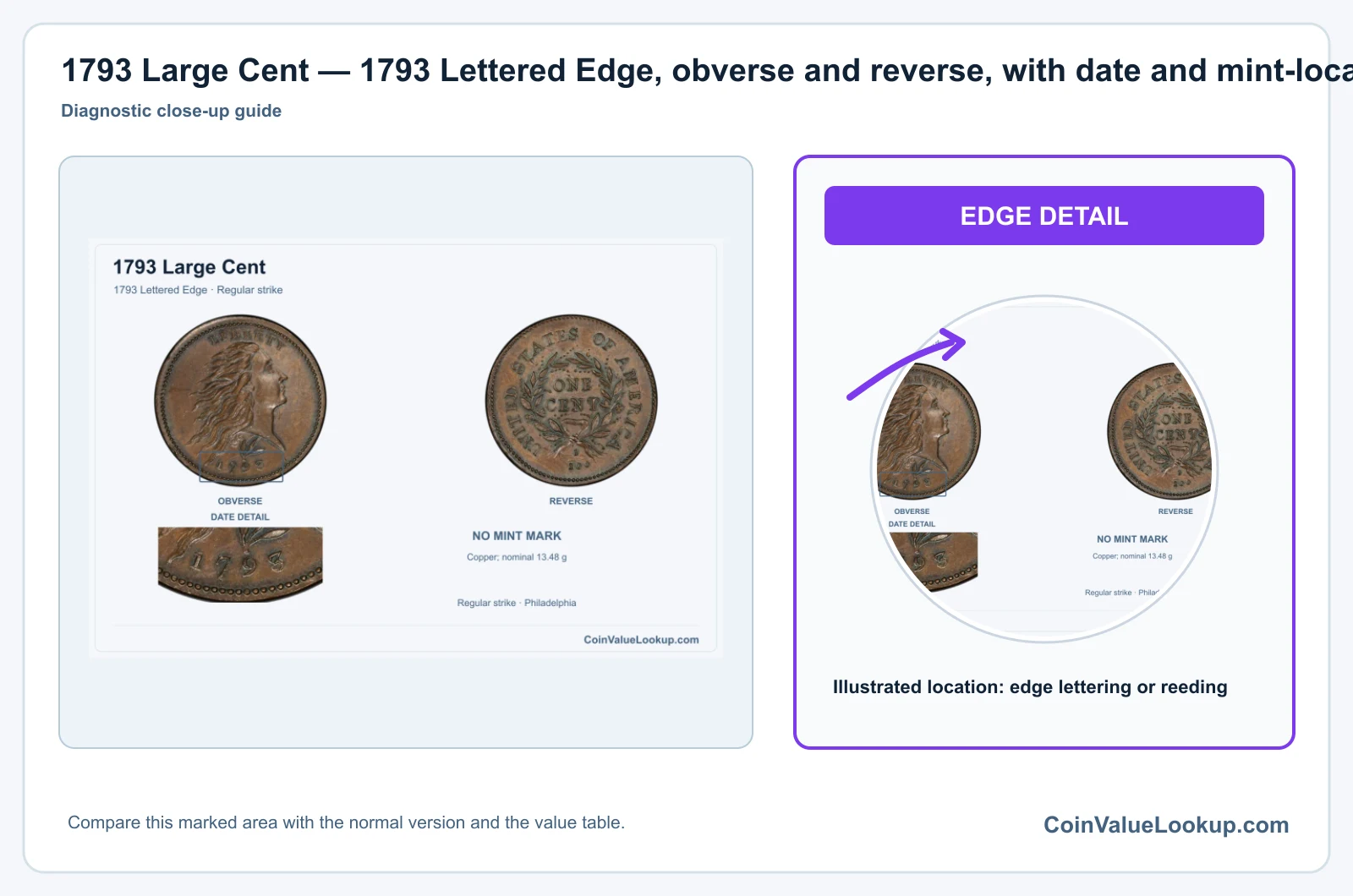
The Wreath cent with a Lettered Edge carries the inscription ONE HUNDRED FOR A DOLLAR around its rim. You need to examine the edge directly, rotating the coin slowly under good light.
Guide estimates range from about $5,503 in G-4 to approximately $393,235 in MS-65. That upper figure dwarfs the Vine and Bars variety at the same grade, so correctly identifying the edge is worth your time.
All 1793 Wreath cents were struck in copper at Philadelphia. Wear and corrosion can obscure edge lettering, so compare against documented examples before concluding.
| Range | Grade | Price | Auction Records | Appraisal |
|---|---|---|---|---|
| PO | PO 1 | — | Coin Identifier | |
| FR | FR 2 | Coin Identifier | ||
| AG | AG 3 | Coin Identifier | ||
| G | G 4 | Coin Identifier | ||
| G 6 | Coin Identifier | |||
| VG | VG 8 | Coin Identifier | ||
| VG 10 | Coin Identifier | |||
| F | F 12 | Coin Identifier | ||
| F 15 | Coin Identifier | |||
| VF | VF 20 | Coin Identifier | ||
| VF 25 | Coin Identifier | |||
| VF 30 | Coin Identifier | |||
| VF 35 | — | Coin Identifier | ||
| XF | XF 40 | — | Coin Identifier | |
| XF 45 | Coin Identifier | |||
| AU | AU 50 | Coin Identifier | ||
| AU 53 | Coin Identifier | |||
| AU 55 | Coin Identifier | |||
| AU 58 | Coin Identifier | |||
| MS | MS 60 | — | Coin Identifier | |
| MS 61 | — | Coin Identifier | ||
| MS 62 | Coin Identifier | |||
| MS 63 | Coin Identifier | |||
| MS 64 | Coin Identifier | |||
| MS 65 | — | — | — | |
| MS 66 | — | — | — | |
| MS 67 | — | — | — | |
| MS 68 | — | — | — | |
| MS 69 | — | — | — | |
| MS 70 | — | — | — |
1793 Flowing Hair Large Cent — Liberty Cap
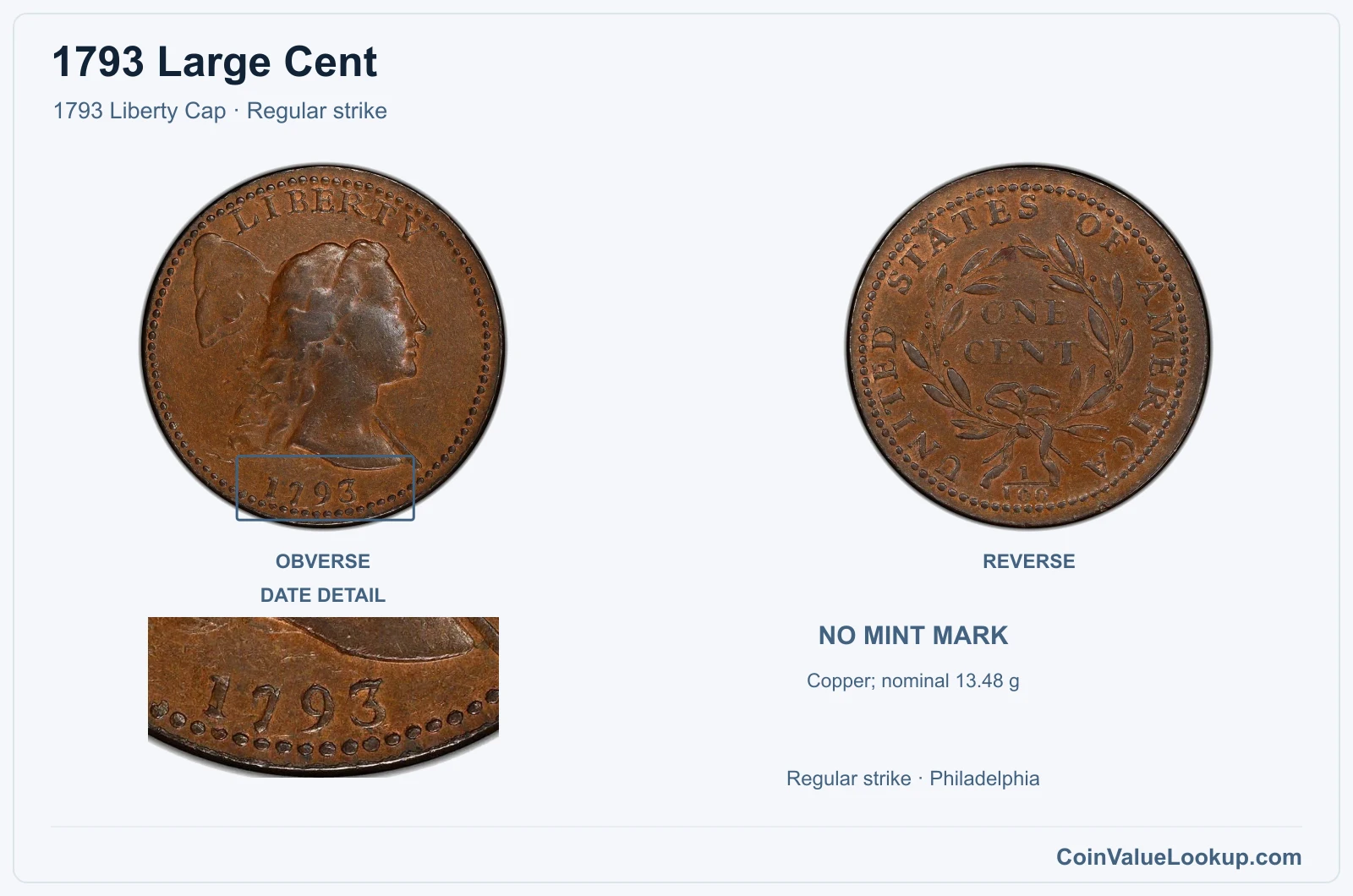
The 1793 Liberty Cap is the third and final design used for large cents that year. Liberty faces right with a pole and Phrygian cap behind her head, a distinctly different portrait from the Flowing Hair types used on Chain and Wreath cents.
Guide estimates begin around $14,877 in G-4 and reach about $1,061,909 in AU-50. No guide figures are listed above AU-50, which tells you how rarely these survive in near-mint condition.
Struck in copper at Philadelphia, this is among the lowest-mintage design types in the early cent series. Confirm the cap and pole are part of the original design and not damage or an added element.
| Range | Grade | Price | Auction Records | Appraisal |
|---|---|---|---|---|
| PO | PO 1 | — | Coin Identifier | |
| FR | FR 2 | Coin Identifier | ||
| AG | AG 3 | Coin Identifier | ||
| G | G 4 | Coin Identifier | ||
| G 6 | Coin Identifier | |||
| VG | VG 8 | — | Coin Identifier | |
| VG 10 | Coin Identifier | |||
| F | F 12 | Coin Identifier | ||
| F 15 | Coin Identifier | |||
| VF | VF 20 | Coin Identifier | ||
| VF 25 | Coin Identifier | |||
| VF 30 | Coin Identifier | |||
| VF 35 | Coin Identifier | |||
| XF | XF 40 | Coin Identifier | ||
| XF 45 | Coin Identifier | |||
| AU | AU 50 | — | Coin Identifier | |
| AU 53 | — | Coin Identifier | ||
| AU 55 | — | Coin Identifier | ||
| AU 58 | — | Coin Identifier | ||
| MS | MS 60 | — | — | — |
| MS 61 | — | — | — | |
| MS 62 | — | Coin Identifier | ||
| MS 63 | — | — | — | |
| MS 64 | — | — | — | |
| MS 65 | — | — | — | |
| MS 66 | — | — | — | |
| MS 67 | — | — | — | |
| MS 68 | — | — | — | |
| MS 69 | — | — | — | |
| MS 70 | — | — | — |
1793 Flowing Hair Large Cent — Strawberry Leaf
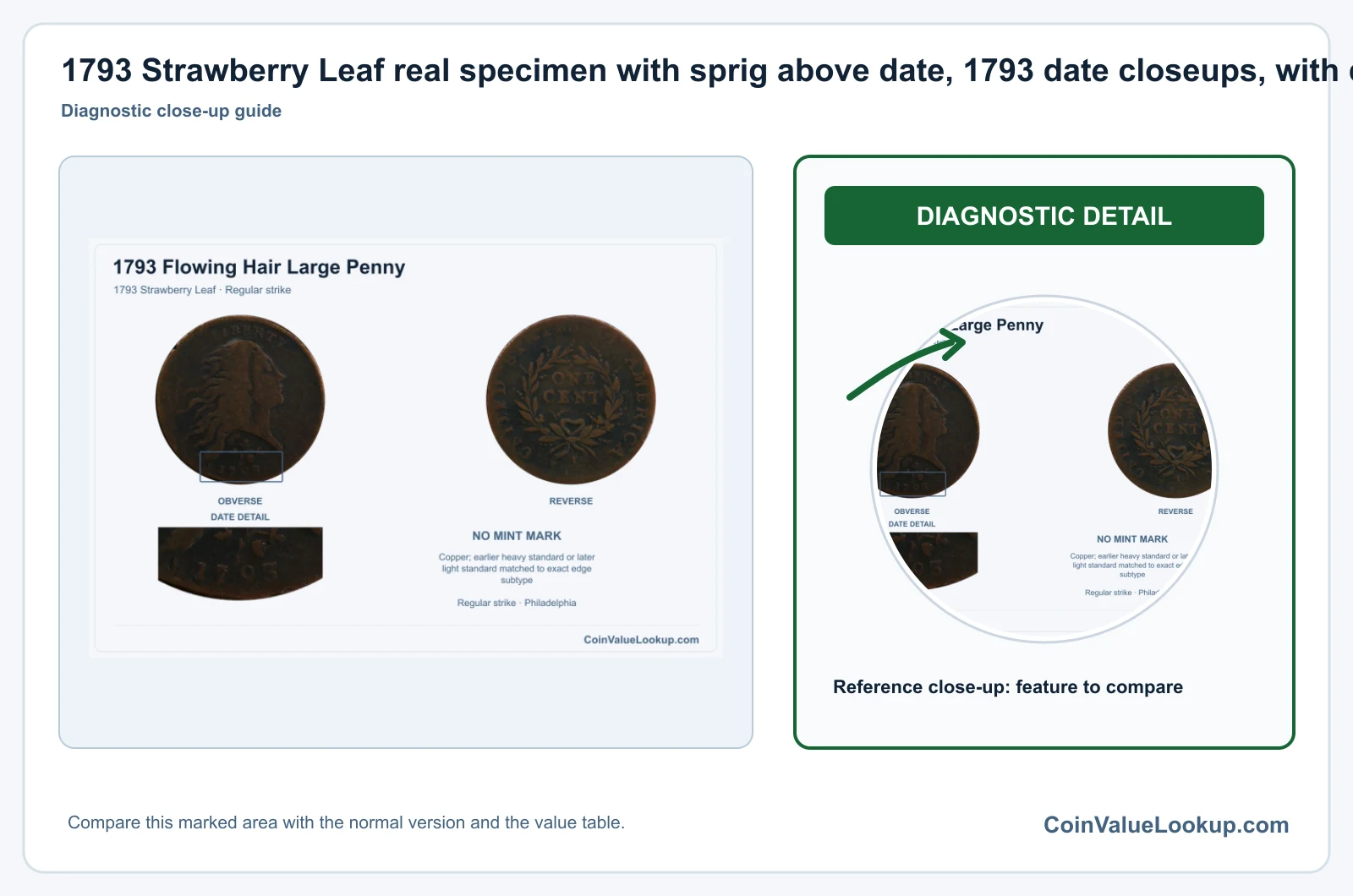
The 1793 Strawberry Leaf is one of the great rarities in American numismatics. It is a Wreath cent variety distinguished by a small three-leaf sprig resembling a strawberry plant positioned below the date on the obverse.
Only a handful of examples are known. The guide estimate sits at roughly $604,169 even in G-4, reflecting extreme rarity rather than condition.
Exact attribution is essential. Compare the sprig against documented examples at equal magnification; do not assume a corroded lump near the date is the strawberry leaf feature.
Because so few exist, any potential example should be examined by a professional authentication service before drawing conclusions about identity or value. This is an intentional design variety, not a die error.
Range Grade
Price Auction Records Appraisal PO PO 1
—
Coin Identifier FR FR 2
—
Coin Identifier AG AG 3
—
Coin Identifier G G 4
—
Coin Identifier
G 6
—
Coin Identifier VG VG 8
—
Coin Identifier
VG 10
—
Coin Identifier F F 12
Coin Identifier
F 15
—
—
— VF VF 20
—
—
—
VF 25
—
—
—
VF 30
—
—
—
VF 35
—
—
— XF XF 40
—
—
—
XF 45
—
—
— AU AU 50
—
—
—
AU 53
—
—
—
AU 55
—
—
—
AU 58
—
—
— MS MS 60
—
—
—
MS 61
—
—
—
MS 62
—
—
—
MS 63
—
—
—
MS 64
—
—
—
MS 65
—
—
—
MS 66
—
—
—
MS 67
—
—
—
MS 68
—
—
—
MS 69
—
—
—
MS 70
—
—
—
1793 Flowing Hair Large Cent Error List
1. 1793 Flowing Hair Large Cent — Die Crack
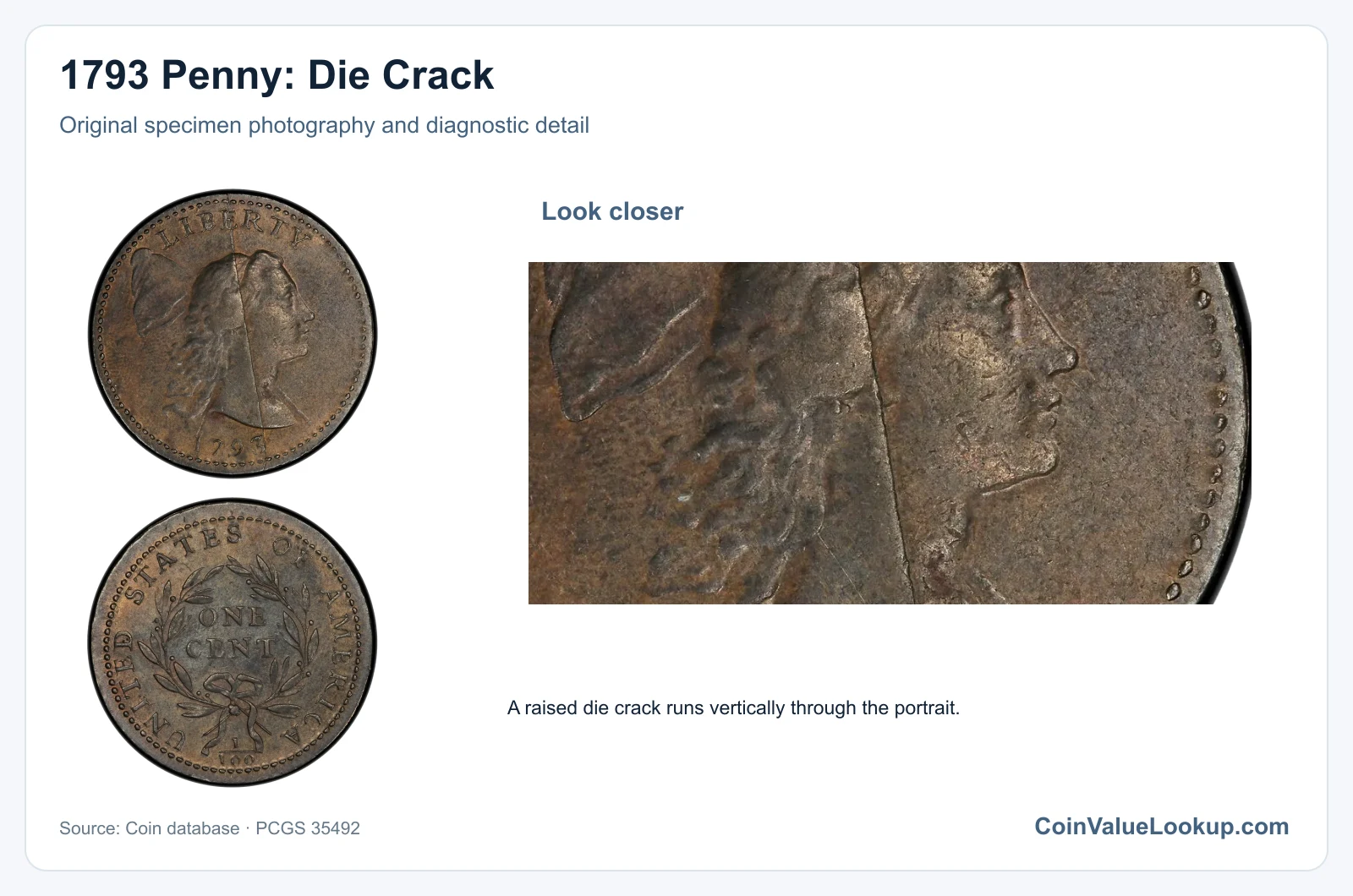
A die crack appears as a thin raised line running across the coin's surface, sometimes connecting design elements or extending from the rim into the field. On 1793 large cents, look for lines that follow no logical part of the design and stand slightly above the surrounding surface.
These formed when the die fractured during use.
Do not confuse a die crack with an incuse scratch, which sits below the surface, or with corrosion lines that tend to be irregular and lack the sharp, continuous profile of a crack. Photograph the full coin alongside a close-up of the affected area.
No specific price premium is adopted for this category; value depends on the authenticated identity of the host coin, the severity and location of the crack, and overall condition.
2. 1793 Flowing Hair Large Cent — Die Break / Cud
A die break or cud shows up as a raised, featureless blob on the coin, usually at the rim where a chunk of the die broke away. The missing die metal means that area received no impression, leaving a flat or slightly domed lump.
On 1793 cents, cuds can be dramatic given the relatively soft die steel of the era.
Distinguish a true cud from a rim dent or a small interior die chip. A rim dent is damaged metal pushed inward after striking, while a cud is raised and connects to the rim.
Interior die chips produce smaller raised areas away from the edge. Value depends on the authenticated host variety, the cud's size and placement, and overall condition.
No adopted numeric range is available for this error on 1793 cents.
3. 1793 Flowing Hair Large Cent — Clashed Dies
Clashed dies occur when the obverse and reverse dies strike each other without a planchet between them, transferring faint mirror-image traces of one side onto the other. On a 1793 cent, you might see ghostly outlines of the wreath on the obverse or hair detail on the reverse, positioned where the opposing die would have made contact.
These traces align with the expected opposite design. Random scratches or raised lines from corrosion will not show that consistent alignment.
A brockage is a different error entirely, involving a previously struck coin rather than direct die-to-die contact. No adopted price range exists for clashed-die examples of this date; value requires individual assessment based on the host coin's identity, the clash's visibility and the coin's overall condition.
4. 1793 Flowing Hair Large Cent — Lamination / Split Planchet
Lamination errors on 1793 cents appear as peeling, flaking or separated layers within the copper planchet. You might see a retained flap of metal lifting from the surface, or a void where material has already detached.
Photograph both the affected face and the edge together so the separation is clearly documented.
Do not mistake scraping, deliberate cuts or heavy corrosion for a lamination. True laminations follow the metal's internal structure and tend to have smooth interior surfaces where the layers parted.
Corrosion pitting is rougher and more random. No specific numeric premium is adopted for this error category on 1793 large cents.
Individual assessment based on authenticated identity, the extent of the lamination and overall coin condition determines market interest.
5. 1793 Flowing Hair Large Cent — Clipped Planchet
A clipped planchet means a portion of the original copper blank was missing before the coin was struck. The clip can be curved, straight or ragged, depending on how it occurred during planchet preparation.
Look for a section of the rim and adjacent design that simply is not there, with metal flow and weakness on the opposite side helping confirm it happened before striking.
An edge that has been filed, cut or corroded after minting will not show that characteristic opposite-side weakness. Post-strike damage also tends to leave tool marks or sharp, unnatural edges.
No adopted numeric range is available for clipped 1793 cents. Value hinges on the host coin's authenticated variety, the clip's size and shape, and overall condition.
6. 1793 Flowing Hair Large Cent — Brockage
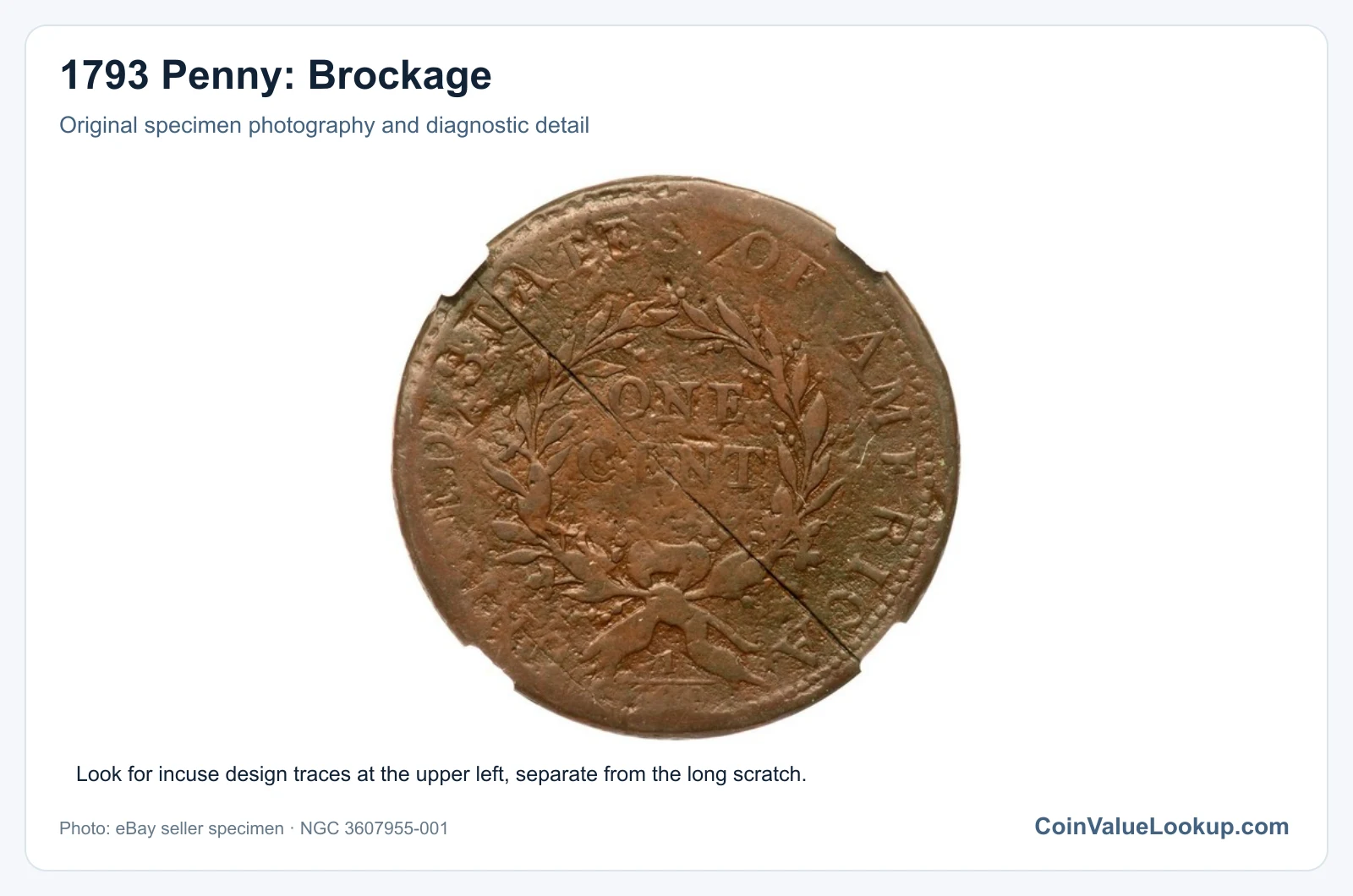
A brockage on a 1793 cent means a previously struck coin remained stuck in the die and acted as a die itself, impressing an incuse, mirror-image version of one design onto the next coin struck. One side of the affected coin will show the normal design in relief, while the other displays a sunken, reversed copy of the same or opposite design.
This is different from a die clash, where die-to-die contact leaves faint traces. A brockage produces a bold, fully incuse impression.
Also watch out for coins that were pressed together after leaving the mint, which can mimic the look but lack proper metal flow. No adopted price premium exists for brockage examples of this date.
Each piece requires individual evaluation based on its authenticated identity, the brockage's completeness and the coin's preservation.
7. 1793 Flowing Hair Large Cent — Double / Multiple Strike
A double or multiple strike occurs when the coin receives two or more impressions from the dies, with the coin shifting or rotating between strikes. The result is two distinct, displaced sets of design elements visible on the same coin.
Look for separate outlines of the date, portrait or wreath that do not simply appear as thickened lines but as clearly shifted duplicates.
Do not confuse this with a doubled die, which is a different error created during die manufacture and shows consistent doubling across every coin struck from that die. Post-mint damage from vises or other pressure can also create false impressions.
No adopted numeric range is available for double-struck 1793 cents. Value depends on authenticated host variety, the degree of displacement between strikes, and overall condition.