1873 Indian Head Penny Coin Value: How Much Is It Worth?
The 1873 Indian Head penny splits into several distinct branches, and knowing which one you hold matters a lot. Guide estimates for regular business strikes range from about $34 at G4 (a well-worn but readable coin) to $612 at MS63 (uncirculated with moderate surface quality), depending on variety.
Proofs, the Doubled LIBERTY variety, and mint errors each require their own valuation.
Fast Way to Identify Your 1873 Indian Head Penny
The fastest way to start figuring out what you have is to upload clear photos of both sides of your coin. A sharp image of the obverse lets us check the date style and headband lettering, while the reverse confirms the wreath type.
Upload your front and back photos for a preliminary identification of your 1873 Indian Head penny.
1873 Indian Head Penny Value
Upload both sides of your 1873 Indian Head Penny.
Front Obverse
Upload photo
Back Reverse
Upload photo
Which 1873 Indian Head Penny Versions Are Worth Money?
- The Doubled LIBERTY variety commands dramatically higher prices, with guide values from $344 at G4 to $15,249 at MS63, so check your headband lettering carefully.
- Closed 3 business strikes guide slightly higher than Open 3 in uncirculated grades, around $612 versus $498 at MS63.
- Proof examples use the Closed 3 date style and carry a guide value near $376 at PR63; confirm genuine proof surfaces before claiming this branch.
- Original uncirculated surfaces with remaining red color can push values well above brown-toned examples in the same technical grade.
Step 1: Identify Your 1873 Indian Head Penny Mint Mark and Version
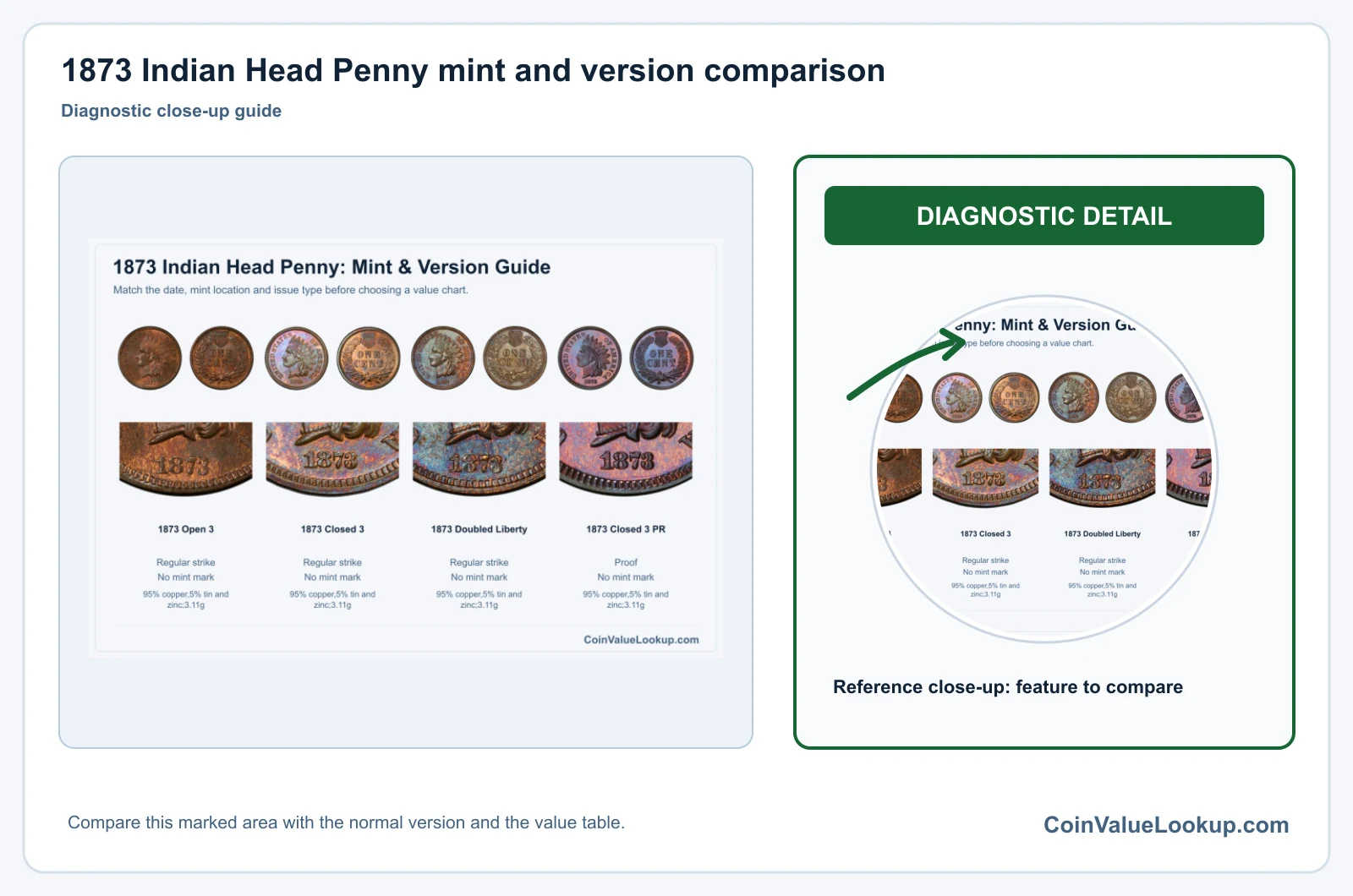
Every regular 1873 Indian Head cent was struck at Philadelphia, so there is no mintmark to look for. The small "L" on the ribbon behind the neck is the engraver's initial, not a mint identifier.
The first thing to check is the shape of the "3" in the date. On the Closed 3 variety, the two rounded bulbs of the "3" nearly touch each other, leaving only a tiny gap.
On the Open 3, there is clear daylight between the upper and lower curves.
Next, examine the headband. The Doubled LIBERTY variety shows distinctly separated, rounded letter impressions on the headband, caused by a doubled die.
This is a different animal from the ordinary Open 3 or Closed 3.
Proof coins exclusively use the Closed 3 date style, but having a Closed 3 does not make your coin a proof. Proof manufacture produces mirrored fields and sharp rims through a specific minting process.
A polished or lightly circulated business strike is not a proof, no matter how shiny it looks.
The obverse features the Indian portrait, and the reverse shows an oak wreath with a shield at top. Make sure you are not confusing this with a Lincoln cent or Flying Eagle cent from a different era before diving into values.
Step 2: Check Your 1873 Indian Head Penny Grade
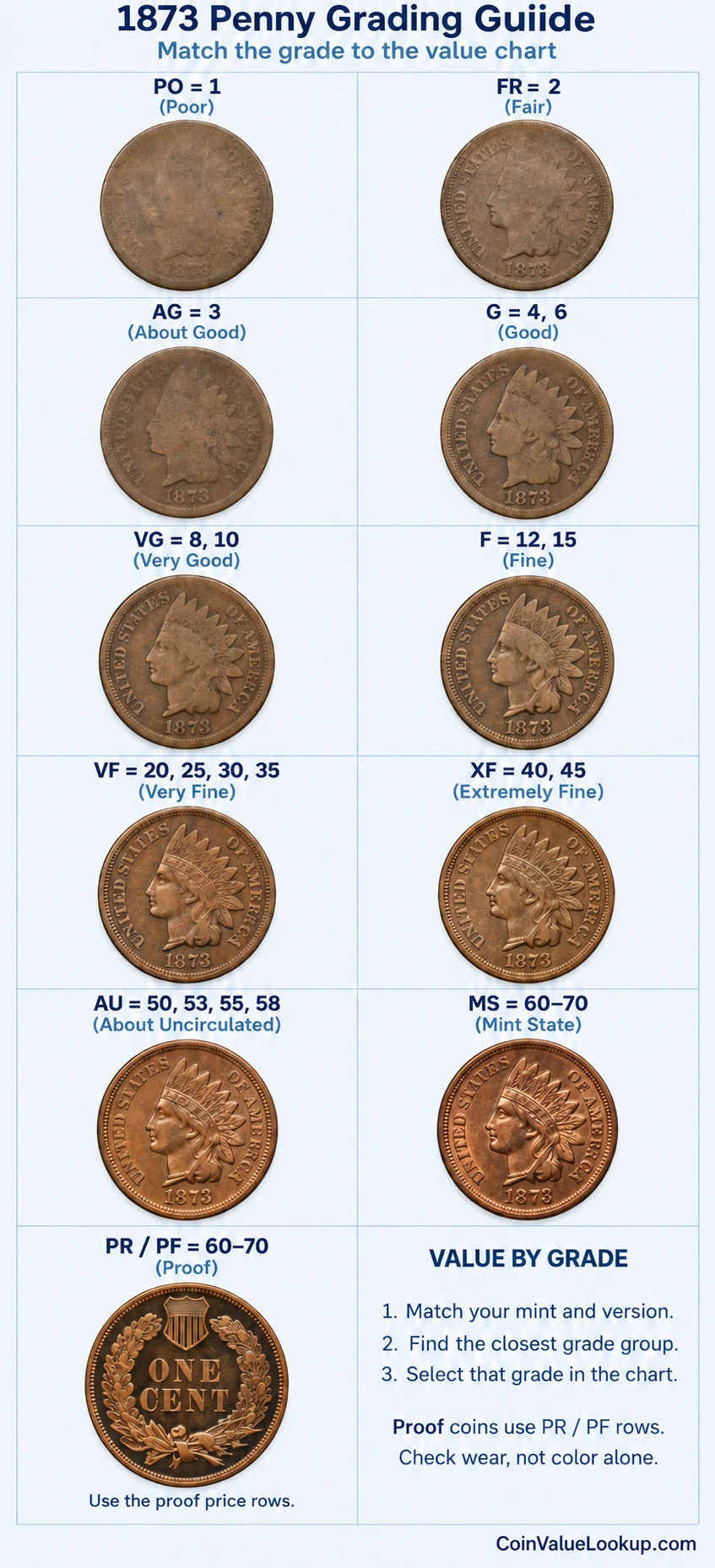
Start by checking the headband. On a well-preserved coin, all letters of LIBERTY should be sharp and fully separated.
As the coin wears, the letters soften and merge, with "I" and "B" typically the last to disappear.
Look at the feather tips above the headband and the hair curls behind the ear. These are high points that show wear first.
On lower grades like G4, the portrait outline is clear but fine detail is mostly gone.
The cheek area smooths out quickly in circulation, so a flat cheek combined with sharp feathers can indicate a soft original strike rather than heavy wear. Do not judge the entire grade from a single feature.
On the reverse, check the leaf tips and shield lines. Compare your coin against the grading comparison image to see where it falls.
Color designations like BN (brown), RB (red-brown), and RD (red) describe how much original copper color remains on a bronze Indian cent. These are color descriptions, not separate materials.
Cleaning, corrosion, and environmental damage all reduce a coin's marketability regardless of its technical grade.
Step 3: Check 1873 Indian Head Penny Value by Mint and Version
1873 Indian Head Penny — Open 3
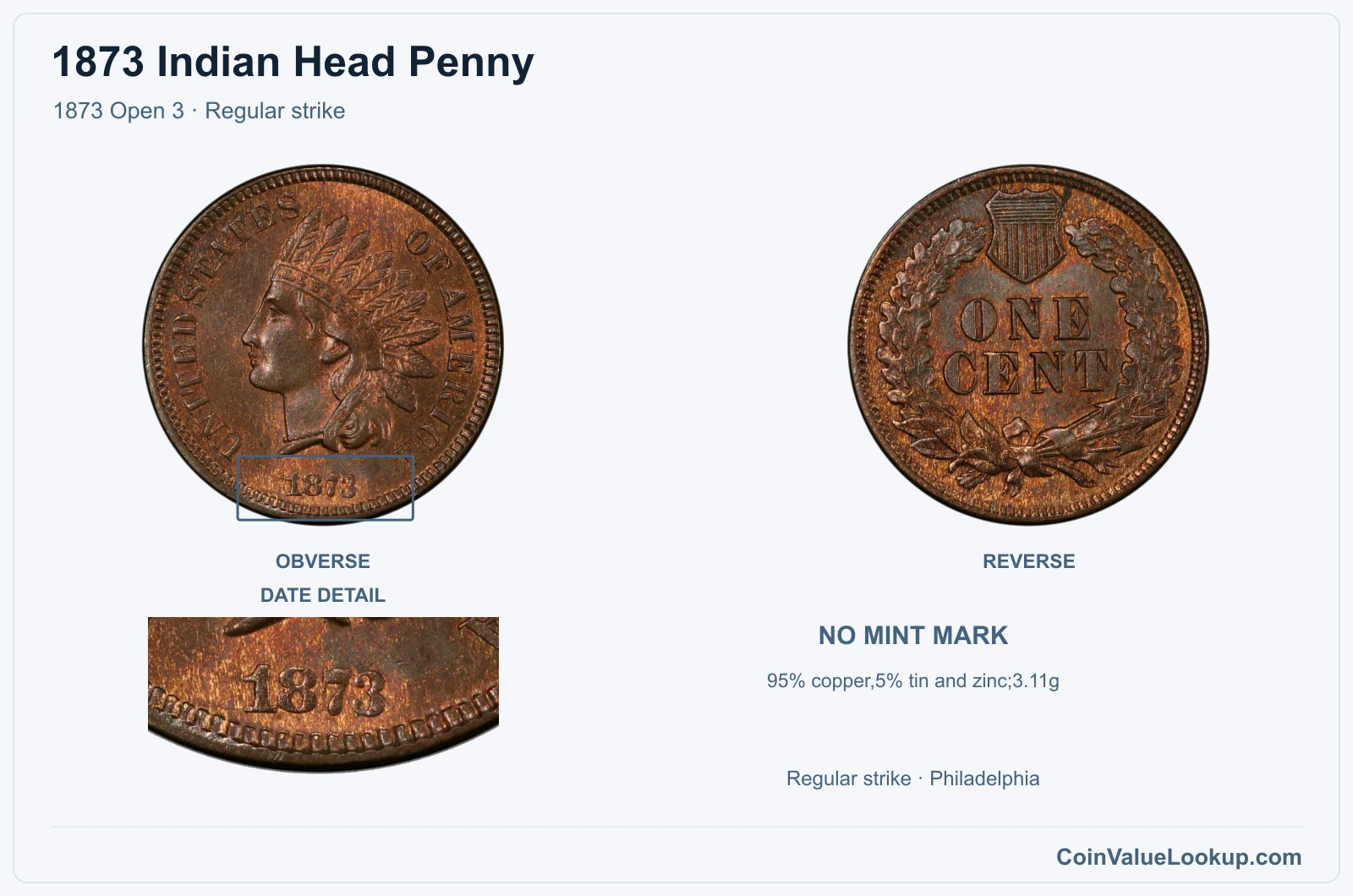
The 1873 Open 3 is the more common business-strike variety. You can spot it by the generous space between the upper and lower curves of the "3" in the date.
This version was struck in bronze (95% copper, 5% tin and zinc) at Philadelphia, weighing 3.11 grams. Guide values from USA Coin Book place it around $34 at G4 and $498 at MS63.
Those are retail estimates for original, problem-free surfaces, not coins that have been cleaned or damaged.
Make sure you have correctly identified the date style before applying these figures. Borrowing prices from the Doubled LIBERTY or proof listings to an ordinary Open 3 will only set you up for disappointment.
| Range | Grade | Price | Auction Records | Appraisal |
|---|---|---|---|---|
| PO | PO 1 | — | Coin Identifier | |
| FR | FR 2 | — | Coin Identifier | |
| AG | AG 3 | — | Coin Identifier | |
| G | G 4 | Coin Identifier | ||
| G 6 | Coin Identifier | |||
| VG | VG 8 | Coin Identifier | ||
| VG 10 | Coin Identifier | |||
| F | F 12 | Coin Identifier | ||
| F 15 | Coin Identifier | |||
| VF | VF 20 | — | Coin Identifier | |
| VF 25 | — | Coin Identifier | ||
| VF 30 | Coin Identifier | |||
| VF 35 | Coin Identifier | |||
| XF | XF 40 | Coin Identifier | ||
| XF 45 | Coin Identifier | |||
| AU | AU 50 | Coin Identifier | ||
| AU 53 | Coin Identifier | |||
| AU 55 | Coin Identifier | |||
| AU 58 | Coin Identifier | |||
| MS | MS 60 | — | Coin Identifier | |
| MS 61 | Coin Identifier | |||
| MS 62 | Coin Identifier | |||
| MS 63 | Coin Identifier | |||
| MS 64 | Coin Identifier | |||
| MS 65 | Coin Identifier | |||
| MS 66 | Coin Identifier | |||
| MS 67 | — | — | — | |
| MS 68 | — | — | — | |
| MS 69 | — | — | — | |
| MS 70 | — | — | — |
1873 Indian Head Penny — Closed 3
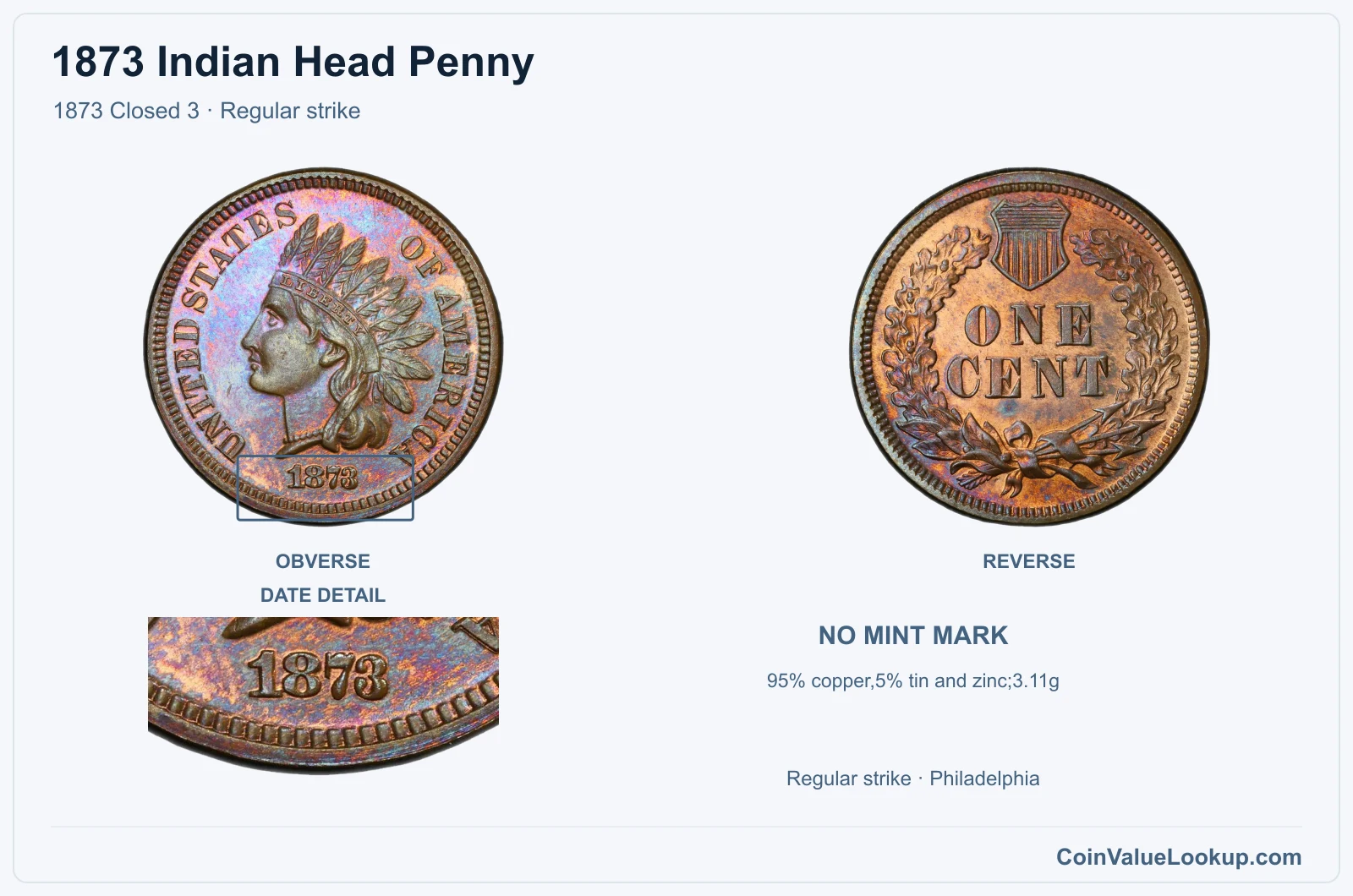
The 1873 Closed 3 is the other main business-strike variety. On this version, the bulbs of the "3" crowd together until they almost touch, leaving just a sliver of space.
Same Philadelphia mint, same bronze composition, same 3.11-gram weight. Guide values sit at roughly $34 in G4 and $612 in MS63, a modest premium over the Open 3 at the uncirculated end.
That MS63 difference reflects collector preference, not extreme rarity.
Compare your coin's surfaces honestly. A coin with problems or questionable originality will not bring guide-level money, regardless of variety.
| Range | Grade | Price | Auction Records | Appraisal |
|---|---|---|---|---|
| PO | PO 1 | — | Coin Identifier | |
| FR | FR 2 | Coin Identifier | ||
| AG | AG 3 | — | Coin Identifier | |
| G | G 4 | Coin Identifier | ||
| G 6 | — | Coin Identifier | ||
| VG | VG 8 | Coin Identifier | ||
| VG 10 | — | Coin Identifier | ||
| F | F 12 | — | Coin Identifier | |
| F 15 | — | Coin Identifier | ||
| VF | VF 20 | — | Coin Identifier | |
| VF 25 | Coin Identifier | |||
| VF 30 | Coin Identifier | |||
| VF 35 | Coin Identifier | |||
| XF | XF 40 | Coin Identifier | ||
| XF 45 | Coin Identifier | |||
| AU | AU 50 | Coin Identifier | ||
| AU 53 | Coin Identifier | |||
| AU 55 | Coin Identifier | |||
| AU 58 | Coin Identifier | |||
| MS | MS 60 | Coin Identifier | ||
| MS 61 | — | Coin Identifier | ||
| MS 62 | Coin Identifier | |||
| MS 63 | Coin Identifier | |||
| MS 64 | Coin Identifier | |||
| MS 65 | Coin Identifier | |||
| MS 66 | — | — | — | |
| MS 67 | — | — | — | |
| MS 68 | — | — | — | |
| MS 69 | — | — | — | |
| MS 70 | — | — | — |
1873 Indian Head Penny — Doubled Liberty
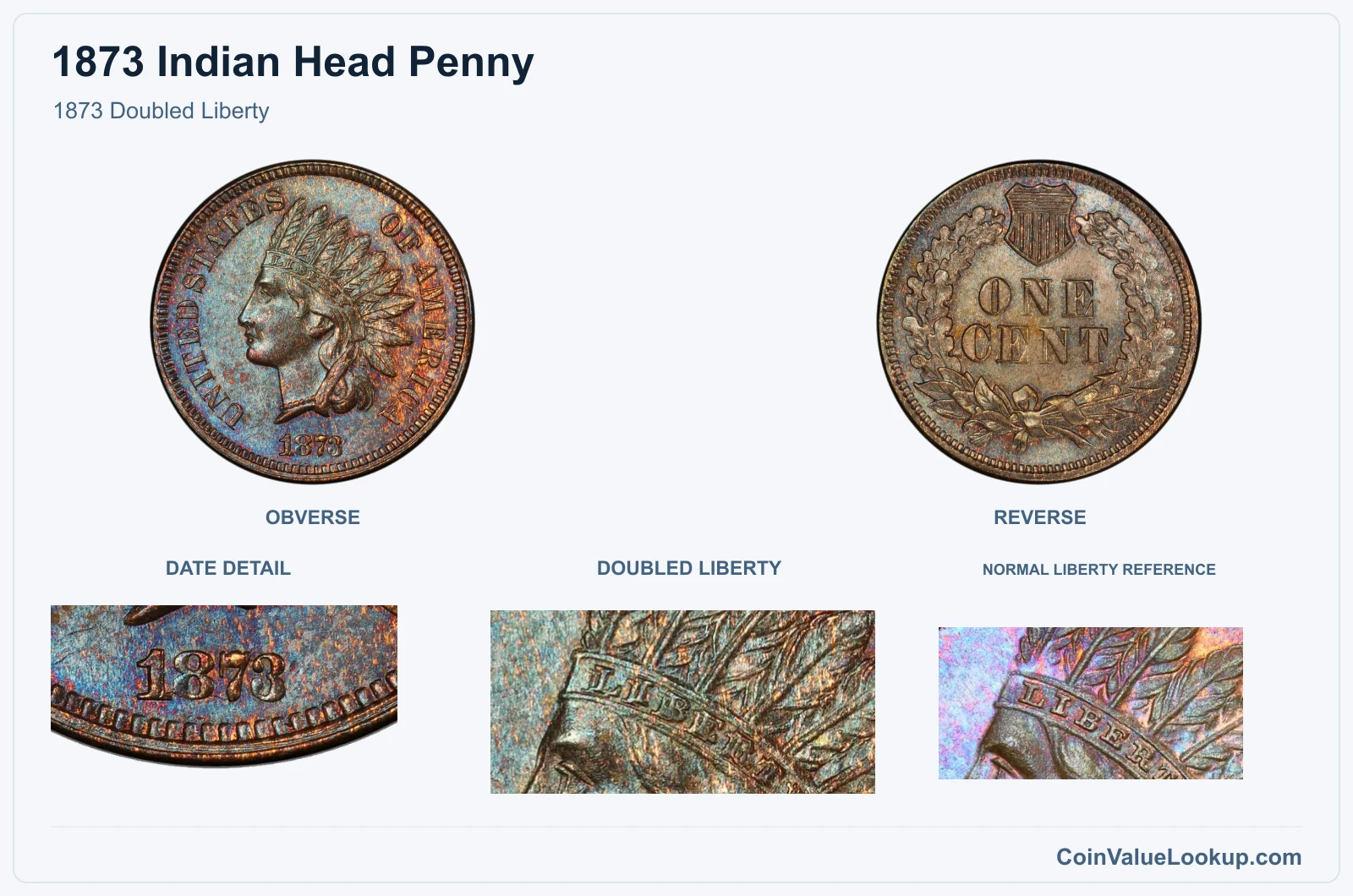
This is the one that gets collectors' attention. The Doubled LIBERTY variety shows clearly doubled letter impressions on the headband, where a doubled die created rounded, separated ghost images alongside the primary letters.
Do not confuse this with general mushiness from a worn die. The doubling here is consistent across the word LIBERTY, with visible secondary outlines that track predictably letter by letter.
Guide estimates reflect the scarcity: $344 at G4 and a steep $15,249 at MS63 per USA Coin Book. Even heavily worn examples carry meaningful premiums.
Authentication by a recognized grading service is strongly recommended before buying or selling at these levels, because the difference between genuine hub doubling and machine-induced artifacts is the difference between a valuable coin and an ordinary one.
Coin Value Lookup is a good starting point if you want to look up guides for other Indian Head cent dates and compare what different years and varieties are bringing.
| Range | Grade | Price | Auction Records | Appraisal |
|---|---|---|---|---|
| PO | PO 1 | — | Coin Identifier | |
| FR | FR 2 | — | Coin Identifier | |
| AG | AG 3 | — | Coin Identifier | |
| G | G 4 | Coin Identifier | ||
| G 6 | Coin Identifier | |||
| VG | VG 8 | Coin Identifier | ||
| VG 10 | Coin Identifier | |||
| F | F 12 | Coin Identifier | ||
| F 15 | Coin Identifier | |||
| VF | VF 20 | Coin Identifier | ||
| VF 25 | Coin Identifier | |||
| VF 30 | Coin Identifier | |||
| VF 35 | Coin Identifier | |||
| XF | XF 40 | Coin Identifier | ||
| XF 45 | Coin Identifier | |||
| AU | AU 50 | Coin Identifier | ||
| AU 53 | Coin Identifier | |||
| AU 55 | Coin Identifier | |||
| AU 58 | Coin Identifier | |||
| MS | MS 60 | Coin Identifier | ||
| MS 61 | Coin Identifier | |||
| MS 62 | Coin Identifier | |||
| MS 63 | Coin Identifier | |||
| MS 64 | Coin Identifier | |||
| MS 65 | — | — | — | |
| MS 66 | — | — | — | |
| MS 67 | — | — | — | |
| MS 68 | — | — | — | |
| MS 69 | — | — | — | |
| MS 70 | — | — | — |
1873 Indian Head Penny — Closed 3 PR
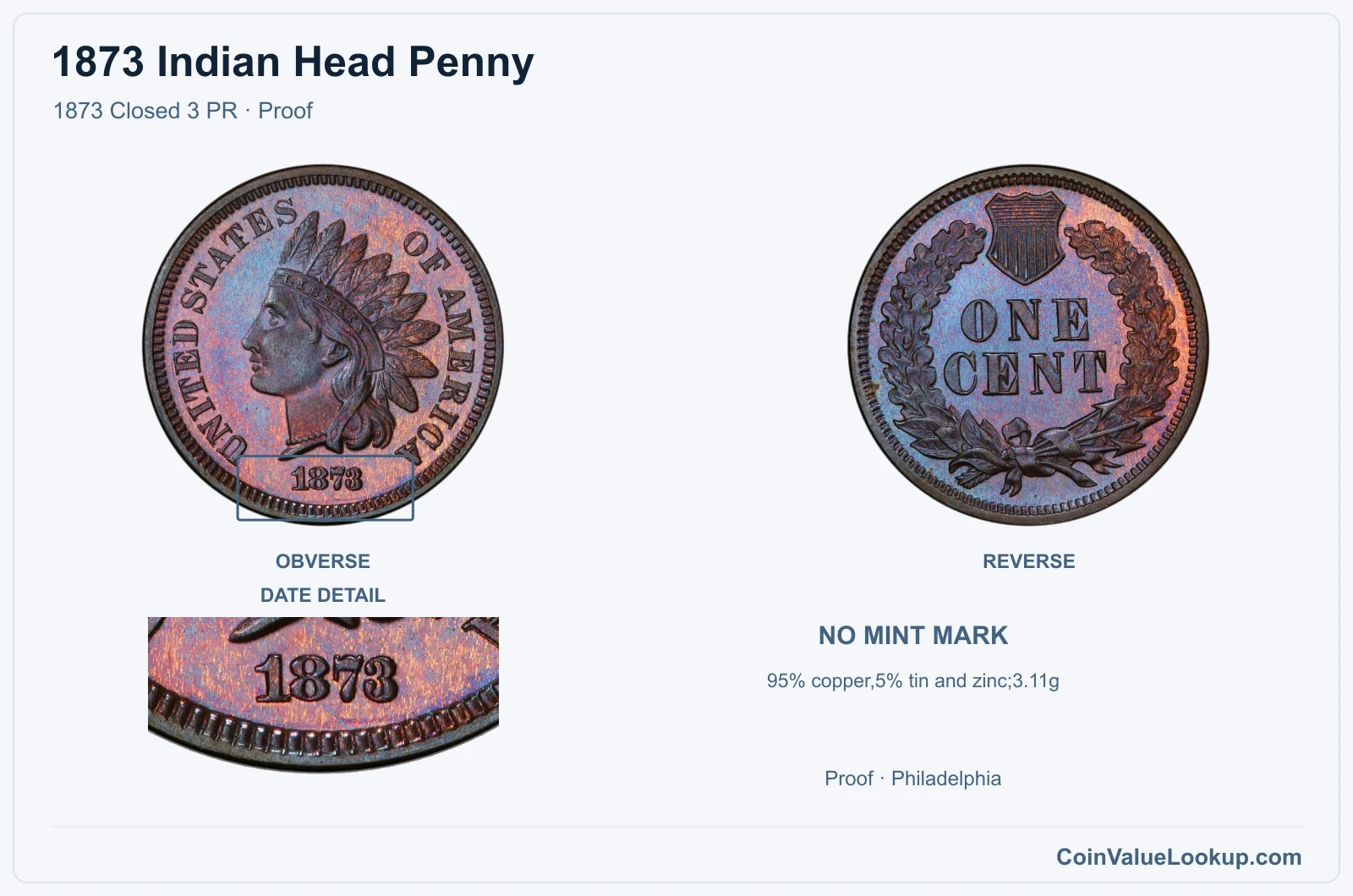
Proof 1873 Indian Head cents exclusively use the Closed 3 date style. These were specially struck for collectors using polished dies and planchets, producing mirror-like fields and crisp design edges.
A proof is a method of manufacture, not a condition above Mint State. You need to verify the coin has squared-off rims, deeply mirrored fields, and sharp detail consistent with proof production.
Simply cleaning a business strike does not create proof surfaces.
USA Coin Book guides the PR63 grade at approximately $376. Proof coins are assessed on their own scale, and condition plays a large role in final value.
Hairlines, haze, and toning all factor into how a proof is graded and priced.
| Range | Grade | Price | Auction Records | Appraisal |
|---|---|---|---|---|
| PR | PR 1 | — | Coin Identifier | |
| PR 2 | — | Coin Identifier | ||
| PR 3 | — | Coin Identifier | ||
| PR 4 | — | Coin Identifier | ||
| PR 6 | — | Coin Identifier | ||
| PR 8 | — | Coin Identifier | ||
| PR 10 | — | Coin Identifier | ||
| PR 12 | — | Coin Identifier | ||
| PR 15 | — | Coin Identifier | ||
| PR 20 | — | Coin Identifier | ||
| PR 25 | — | Coin Identifier | ||
| PR 30 | — | Coin Identifier | ||
| PR 35 | — | Coin Identifier | ||
| PR 40 | — | Coin Identifier | ||
| PR 45 | — | Coin Identifier | ||
| PR 50 | — | Coin Identifier | ||
| PR 53 | — | Coin Identifier | ||
| PR 55 | — | Coin Identifier | ||
| PR 58 | — | Coin Identifier | ||
| PR 60 | — | Coin Identifier | ||
| PR 61 | — | Coin Identifier | ||
| PR 62 | Coin Identifier | |||
| PR 63 | Coin Identifier | |||
| PR 64 | Coin Identifier | |||
| PR 65 | Coin Identifier | |||
| PR 66 | Coin Identifier | |||
| PR 67 | — | — | — | |
| PR 68 | — | — | — | |
| PR 69 | — | — | — | |
| PR 70 | — | — | — |
1873 Indian Head Penny Error List
1. 1873 Indian Head Penny — Doubled Die Obverse
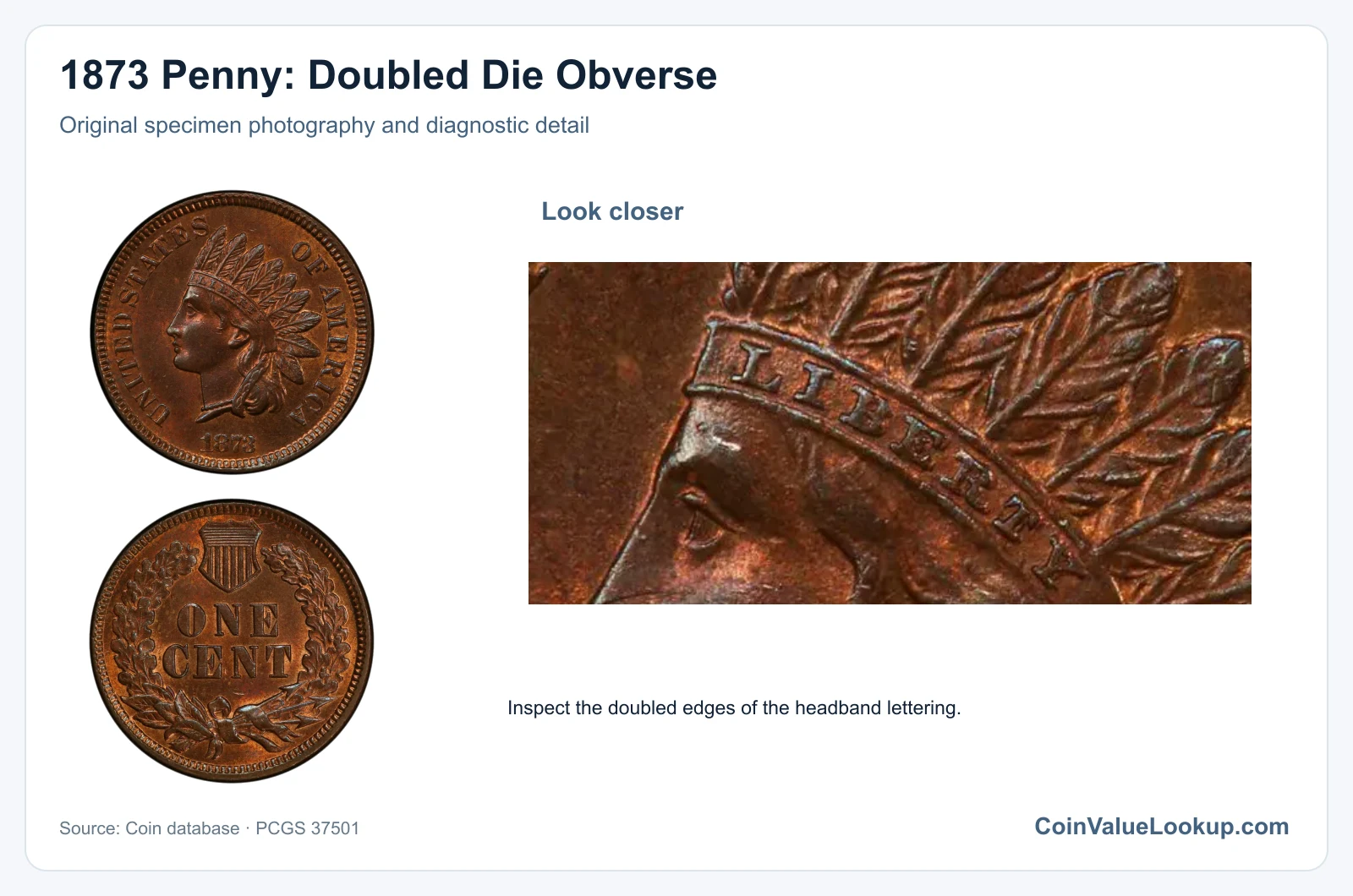
A Doubled Die Obverse on the 1873 Indian Head cent is a recognized error category reported by published variety sources. The key diagnostic is the headband lettering: look at LIBERTY for rounded, clearly separated secondary letter impressions that shadow the primary strike.
This is distinct from machine doubling, which tends to produce flat, shelf-like distortion rather than fully rounded duplicate letters. Worn die contours and light reflections can also mimic doubling at a glance, so examine the coin under magnification and angled lighting.
No specific price range is adopted here because value depends on the authenticated identity, the severity of the doubling, and the coin's overall condition. Professional grading and attribution are the practical path to establishing what a specific doubled die example is worth.
2. 1873 Indian Head Penny — Repunched Date
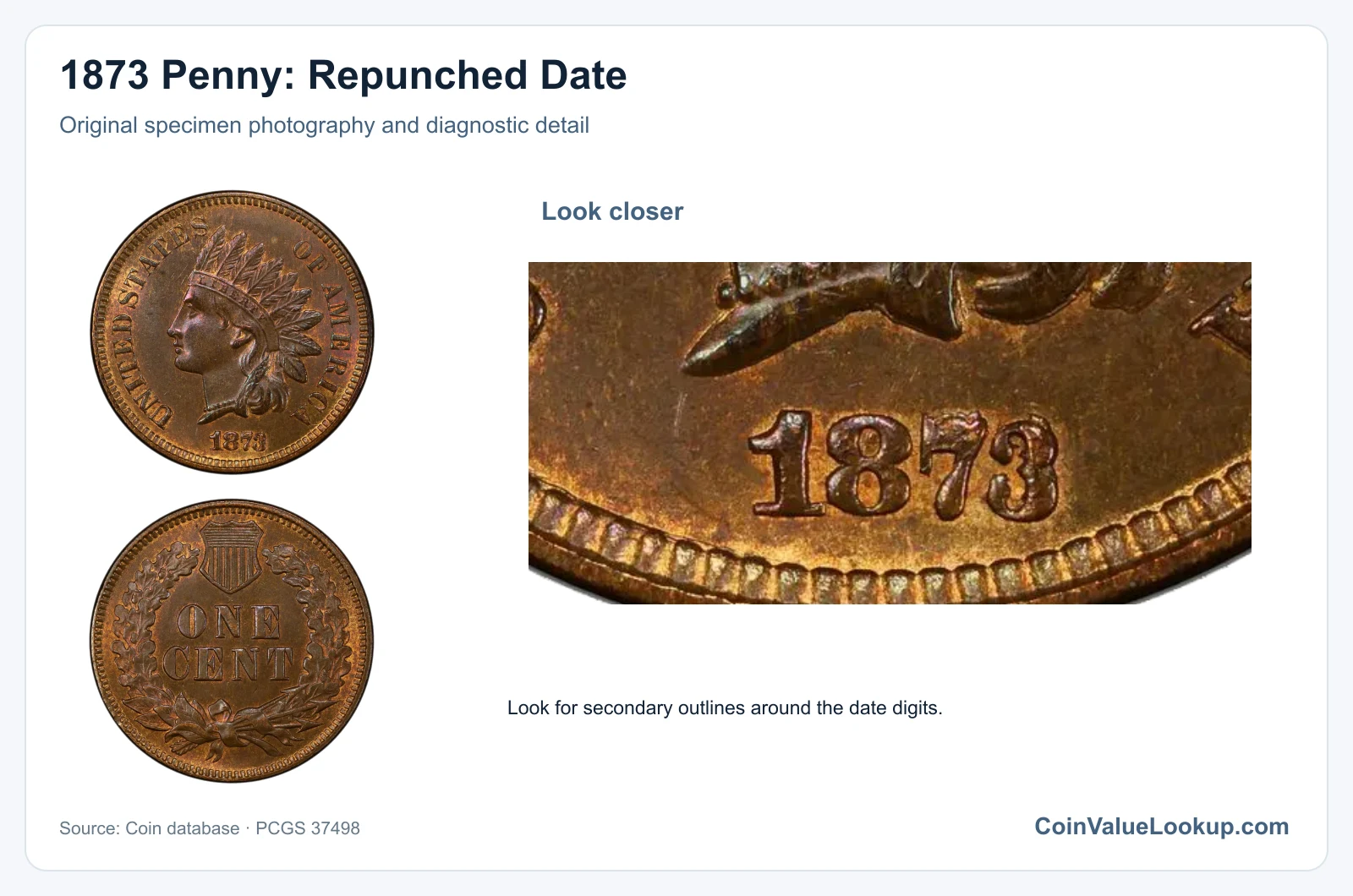
A repunched date on the 1873 Indian Head cent shows remnants of an earlier date-punch position alongside the final numerals. You might see traces of a shifted "1," "8," "7," or "3" partially visible near or beneath the accepted date digits.
This is a die-making variety, not the same thing as a doubled die that affects the entire obverse design. Repunched dates result from the date punch being applied more than once at slightly different positions during die preparation.
Do not confuse a damaged date, post-strike scratches, or machine doubling with a genuine repunched date. The extra digit traces should be consistent with the shape of the original numerals and appear struck into the die, not scratched into the coin's surface.
Value depends on authentication, severity, and condition.
3. 1873 Indian Head Penny — Die Crack
Die cracks appear as raised lines running across the coin's field or through design elements. On an 1873 Indian Head cent, look for a thin ridge that crosses from one point to another, sometimes connecting stars, letters, or the rim.
The line is raised because metal filled the crack in the die during striking. This distinguishes it from a scratch, which is incuse (cut into the surface).
Corrosion lines and displaced-metal scrapes can also look similar, but they lack the consistent raised profile of a true die crack.
Note where the crack begins and ends, and whether it affects the obverse or reverse. Pricing depends on the crack's prominence, location, and the coin's overall grade, and no standard range applies across all examples.
4. 1873 Indian Head Penny — Die Break / Cud
A cud is a specific type of die break where a piece of the die has broken away at the rim, leaving a raised, featureless blob on the finished coin that connects to the edge. The missing die fragment means no design detail is struck in that area.
On an 1873 Indian Head cent, check the rim carefully for any raised lump that replaces normal denticles or adjacent design. Interior die breaks that do not connect to the rim are sometimes called retained breaks and are a related but distinct category.
Do not mistake a rim dent, corrosion buildup, or a die chip for a cud. A genuine cud has a clear boundary where normal struck detail ends and the blank raised area begins.
Value varies by size, location, and coin condition, with no standard price range applicable.
5. 1873 Indian Head Penny — Die Chip
A die chip shows up as a small, localized raised lump on the coin, often filling part of a letter, numeral, or nearby field area. It happens when a tiny fragment breaks out of the die surface, and the resulting void fills with metal during striking.
On an 1873 Indian Head cent, inspect letters, the date digits, and the wreath elements for any spot where the normal recessed detail has been replaced by a raised blob. The surrounding struck detail should flow naturally into the lump, confirming it originated from the die rather than from post-strike damage.
Gouges, glued material, and displaced-metal impacts from contact can imitate die chips. The key difference is that a genuine die chip is part of the struck surface, not sitting on top of it.
Each example is valued individually based on authentication, location, and condition.
6. 1873 Indian Head Penny — Misplaced Date
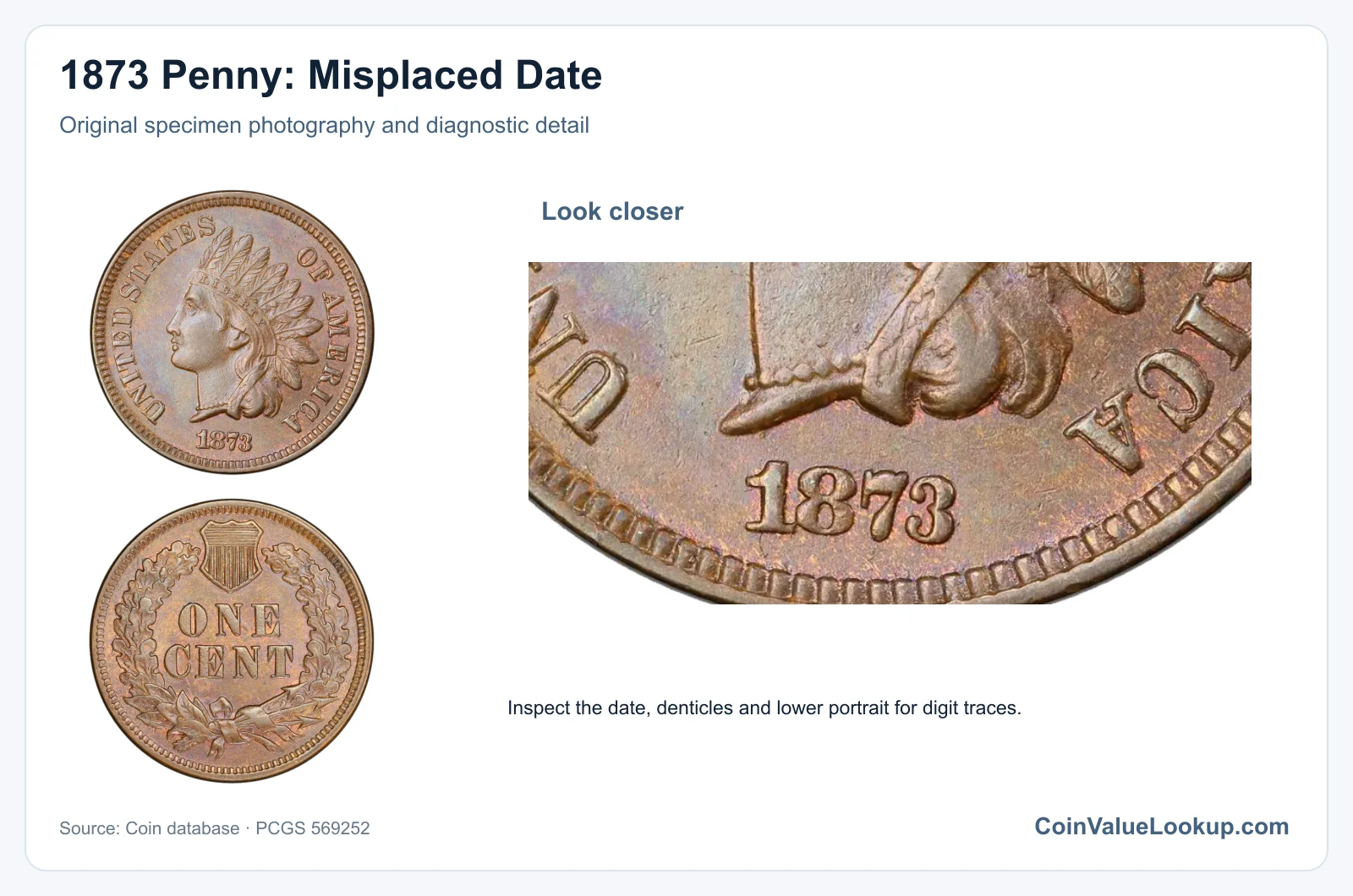
A misplaced date occurs when partial date digits appear in an unintended location on the die, such as within the denticles or near the portrait, away from the normal date position. On an 1873 Indian Head cent, look for faint outlines of numerals embedded where they do not belong.
The shape of the misplaced element should match the style of one of the actual date digits. Compare what you see against reference photographs of confirmed examples, because die chips, random scratches, and small bumps can look deceptively similar under magnification.
A true misplaced date is a die-preparation variety, meaning it is consistent across every coin struck from that die. Value depends on how visible and identifiable the misplaced element is, along with the coin's grade and authenticity, so professional attribution is recommended before assuming a premium.