1875 Indian Head Penny Coin Value: How Much Is It Worth?
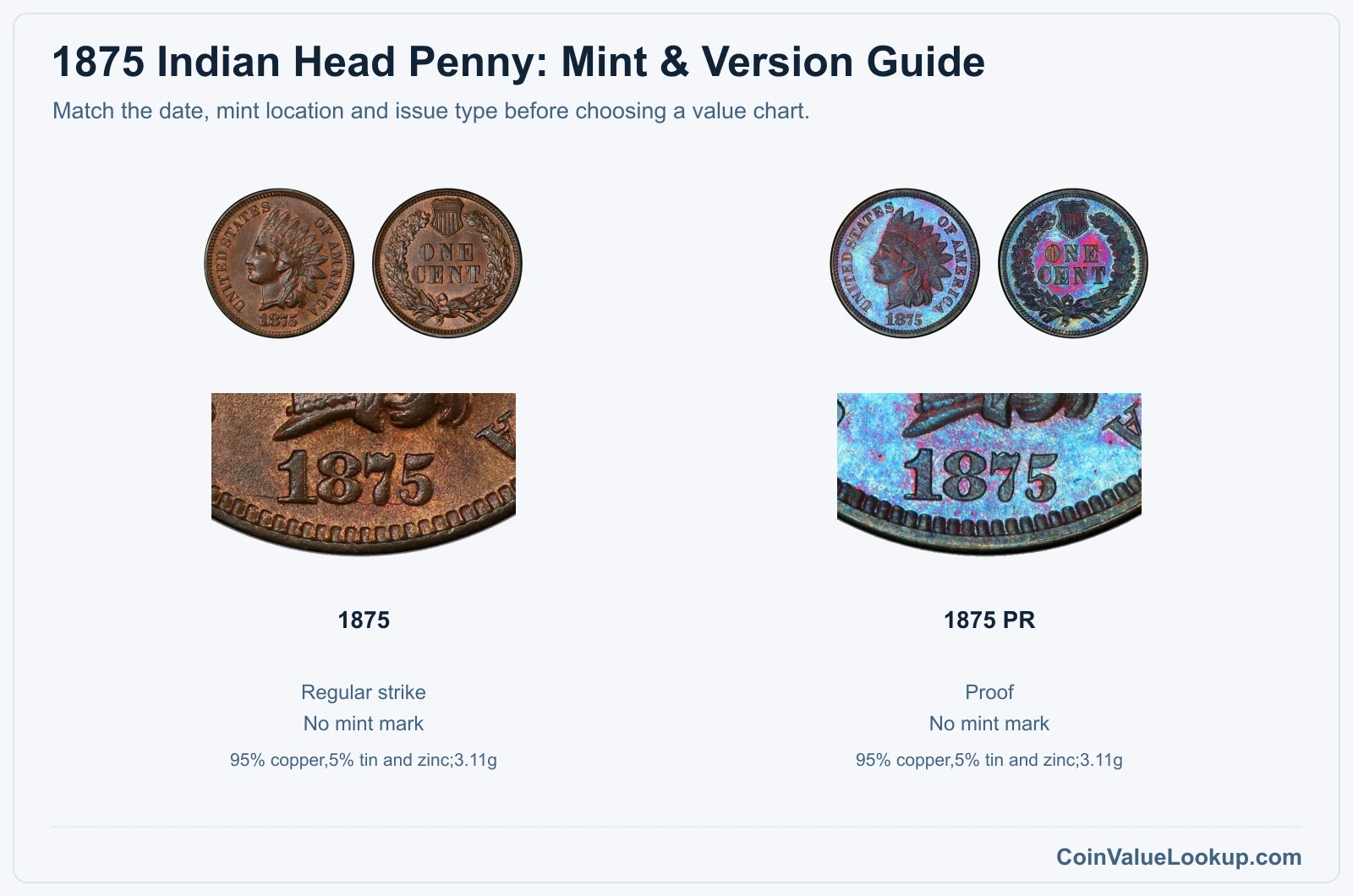
The 1875 Indian Head penny is a solid collector coin from the Philadelphia Mint. Guide estimates for ordinary circulated examples start around $30 at the G4 grade level and climb to roughly $376 at MS63 for uncirculated pieces.
Proofs carry their own pricing. These are retail guide figures from USA Coin Book, not guaranteed buy or sell offers, and major varieties or mint errors require separate evaluation.
Fast Way to Identify Your 1875 Indian Head Penny
Want a quick read on your 1875 Indian Head cent? Upload clear photos of the front and back, and our identifier can give you a preliminary assessment of the coin's type, finish and approximate condition.
Good lighting and a steady shot make a big difference, so skip the blurry phone pics if you can.
1875 Indian Head Penny Value
Upload both sides of your 1875 Indian Head Penny.
Front Obverse
Upload photo
Back Reverse
Upload photo
Which 1875 Indian Head Penny Versions Are Worth Money?
- Business strikes range from about $30 at G4 to $376 at MS63 per USA Coin Book; original uncirculated surfaces with remaining copper color drive the higher end.
- Proofs list around $376 at PR63; confirm proof manufacture through mirror fields and sharp rim geometry, not just a shiny appearance.
- Repunched date varieties show remnants of an earlier punch position and can add collector interest beyond standard pricing.
- Die breaks, cuds and misplaced dates are reported for this date and may carry additional value depending on severity and authentication.
Step 1: Identify Your 1875 Indian Head Penny Mint Mark and Version
Every regular 1875 Indian Head cent was struck at the Philadelphia Mint, and none carry a mintmark. If you see an "L" on the ribbon behind the portrait, that is the designer's initial, not a mint designation.
The obverse shows an idealized portrait wearing a feathered headdress with LIBERTY spelled across the headband. The reverse features an oak wreath surrounding the denomination, topped by a small shield.
Make sure you are looking at this design and not confusing it with a Lincoln cent or an earlier Flying Eagle cent, both of which are entirely different coins.
Business strikes and proofs share the same design, so telling them apart takes more than a glance. Proof coins were made with polished dies and specially prepared planchets, producing mirror-like fields and sharp rims.
A coin that has simply been cleaned or polished is not a proof, no matter how shiny it looks. If you suspect you have a proof, professional authentication is the safest route.
The 1875 cent is composed of 95% copper with 5% tin and zinc, weighing about 3.11 grams. Color designations like BN, RB and RD describe how much original copper-red color remains on the surfaces; they are not different materials.
Step 2: Check Your 1875 Indian Head Penny Grade
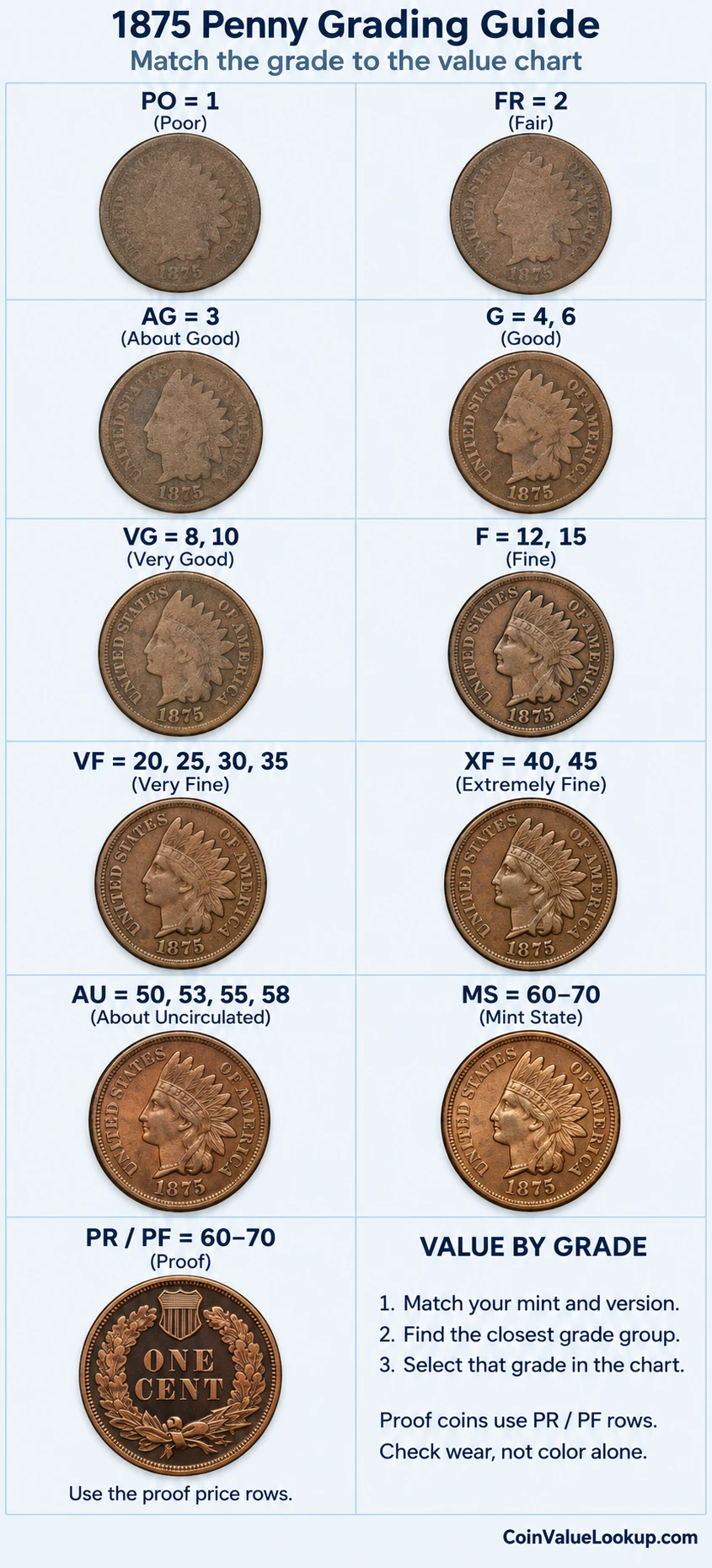
Start by checking the headband. On a well-preserved coin, all letters of LIBERTY should be sharp and fully separated.
As a coin wears, the middle letters fade first.
Next look at the feather tips above the headband and the hair curls below the ear. These are high points that show friction early.
On the reverse, the leaf tips and shield lines lose definition with wear.
Here is the catch: the 1875 issue can come with a soft original strike. That means some feather or hair detail may be mushy even on a coin that never circulated.
Do not downgrade a coin based on one weak area alone. Instead, look at the overall luster and surface quality.
A coin with full mint luster and one slightly soft feather tip is still uncirculated.
Compare your coin against the grading comparison image to get a feel for each wear level. Surface problems like scratches, corrosion, cleaning or environmental damage will reduce a coin's marketability regardless of how much design detail remains.
Original, undamaged surfaces always carry a premium.
Step 3: Check 1875 Indian Head Penny Value by Mint and Version
1875 Indian Head Penny
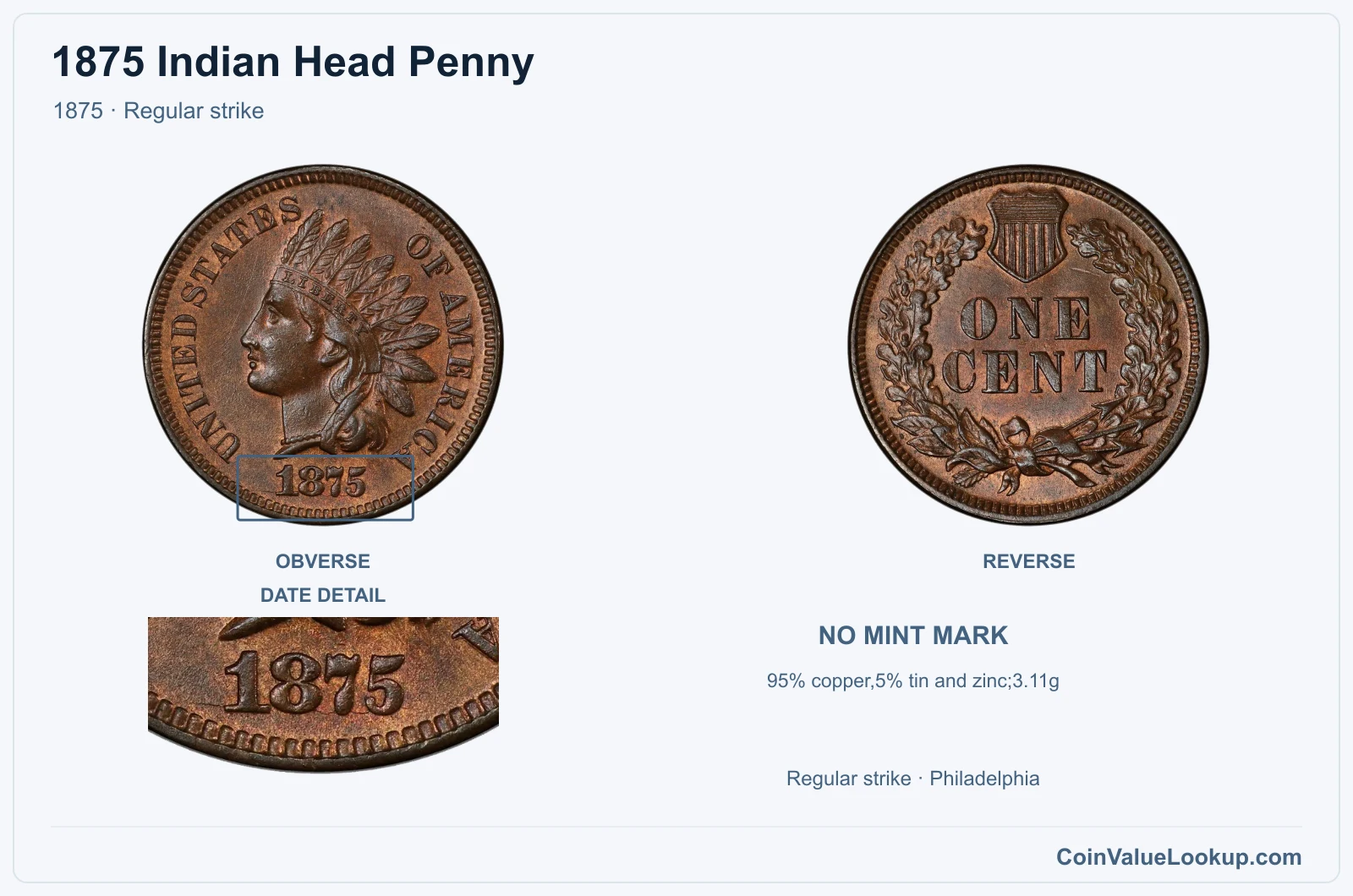
The standard 1875 business strike is the coin most collectors encounter. It was produced at Philadelphia with no mintmark, struck in bronze (95% copper, 5% tin and zinc) at 3.11 grams.
USA Coin Book lists approximately $30 at G4 and $376 at MS63.
Condition matters enormously here. A well-worn example is affordable, but jump to uncirculated territory and the price climbs fast.
Original surfaces without cleaning or corrosion are what buyers want. When comparing prices, stick to like-grade and like-surface coins; borrowing values from rare varieties will only mislead you.
| Range | Grade | Price | Auction Records | Appraisal |
|---|---|---|---|---|
| PO | PO 1 | — | Coin Identifier | |
| FR | FR 2 | — | Coin Identifier | |
| AG | AG 3 | Coin Identifier | ||
| G | G 4 | — | Coin Identifier | |
| G 6 | Coin Identifier | |||
| VG | VG 8 | — | Coin Identifier | |
| VG 10 | Coin Identifier | |||
| F | F 12 | Coin Identifier | ||
| F 15 | Coin Identifier | |||
| VF | VF 20 | Coin Identifier | ||
| VF 25 | Coin Identifier | |||
| VF 30 | Coin Identifier | |||
| VF 35 | Coin Identifier | |||
| XF | XF 40 | Coin Identifier | ||
| XF 45 | Coin Identifier | |||
| AU | AU 50 | Coin Identifier | ||
| AU 53 | Coin Identifier | |||
| AU 55 | Coin Identifier | |||
| AU 58 | Coin Identifier | |||
| MS | MS 60 | Coin Identifier | ||
| MS 61 | Coin Identifier | |||
| MS 62 | Coin Identifier | |||
| MS 63 | Coin Identifier | |||
| MS 64 | Coin Identifier | |||
| MS 65 | Coin Identifier | |||
| MS 66 | Coin Identifier | |||
| MS 67 | — | — | — | |
| MS 68 | — | — | — | |
| MS 69 | — | — | — | |
| MS 70 | — | — | — |
1875 Indian Head Penny — PR
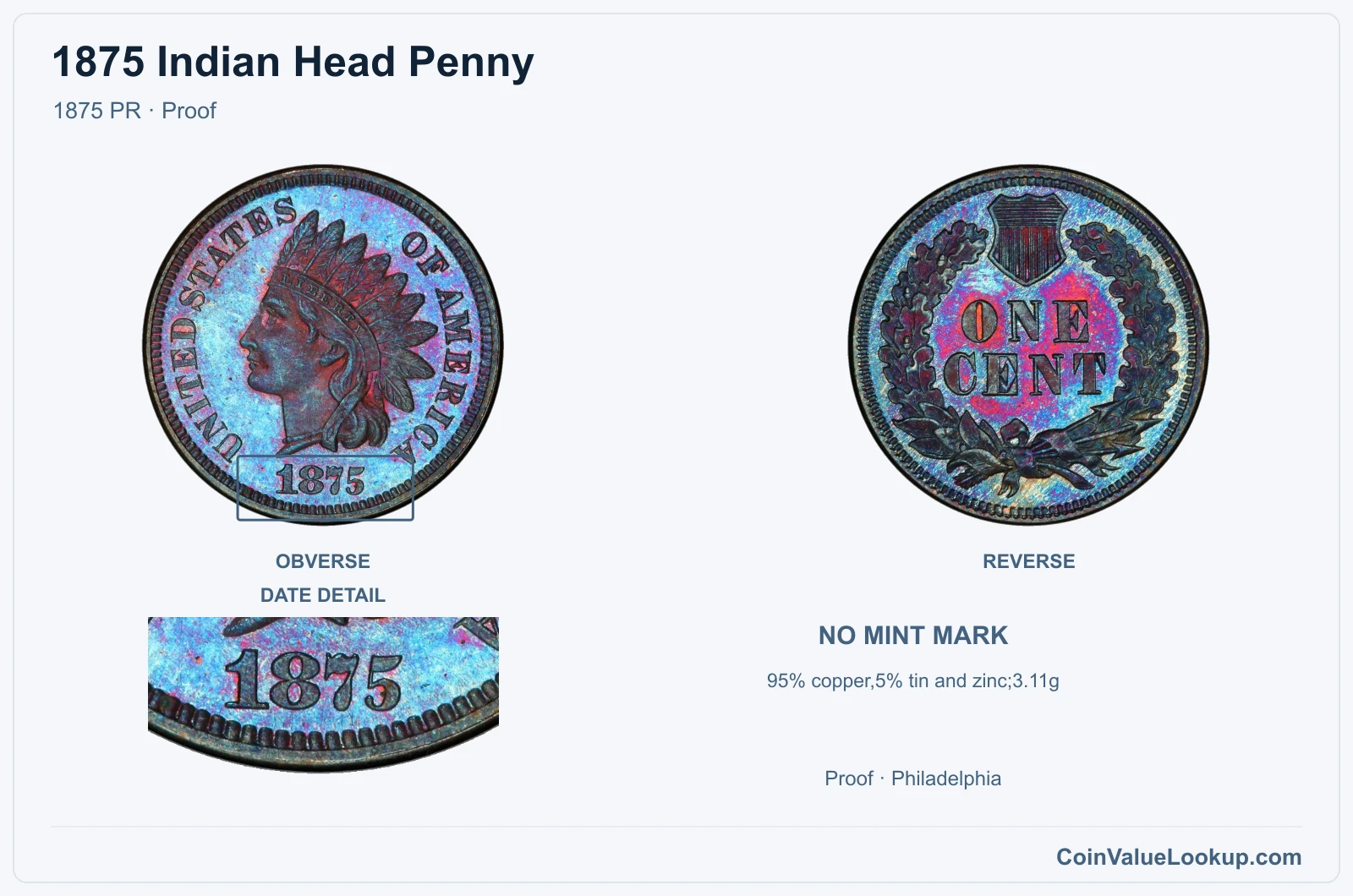
The 1875 proof was a special production intended for collectors, struck from polished dies on carefully prepared planchets. USA Coin Book lists approximately $376 at PR63.
Remember, proof describes how the coin was made, not its state of preservation. A proof can still have contact marks or toning.
Genuine proofs show deeply mirrored fields, squared-off rims, and exceptionally sharp design elements. If your coin simply looks clean or reflective, it may just be a polished business strike.
Verification by a professional grading service is the most reliable way to confirm proof status.
Coin Value Lookup is a good starting point if you want to compare this date with other Indian Head cents or explore values across the full series.
| Range | Grade | Price | Auction Records | Appraisal |
|---|---|---|---|---|
| PR | PR 1 | — | Coin Identifier | |
| PR 2 | — | Coin Identifier | ||
| PR 3 | — | Coin Identifier | ||
| PR 4 | — | Coin Identifier | ||
| PR 6 | — | Coin Identifier | ||
| PR 8 | — | Coin Identifier | ||
| PR 10 | — | Coin Identifier | ||
| PR 12 | — | Coin Identifier | ||
| PR 15 | — | Coin Identifier | ||
| PR 20 | — | Coin Identifier | ||
| PR 25 | — | Coin Identifier | ||
| PR 30 | — | Coin Identifier | ||
| PR 35 | — | Coin Identifier | ||
| PR 40 | — | Coin Identifier | ||
| PR 45 | — | Coin Identifier | ||
| PR 50 | — | Coin Identifier | ||
| PR 53 | — | Coin Identifier | ||
| PR 55 | — | Coin Identifier | ||
| PR 58 | — | Coin Identifier | ||
| PR 60 | — | Coin Identifier | ||
| PR 61 | — | Coin Identifier | ||
| PR 62 | Coin Identifier | |||
| PR 63 | Coin Identifier | |||
| PR 64 | Coin Identifier | |||
| PR 65 | Coin Identifier | |||
| PR 66 | Coin Identifier | |||
| PR 67 | — | — | — | |
| PR 68 | — | — | — | |
| PR 69 | — | — | — | |
| PR 70 | — | — | — |
1875 Indian Head Penny Error List
1. 1875 Indian Head Penny — Die Break / Cud
A cud error occurs when a piece of the die breaks away entirely, leaving a raised, featureless blob on the struck coin that connects to the rim. On an 1875 Indian Head cent, look for a smooth raised area along the rim where design detail has been replaced by a shapeless lump.
The boundary between the cud and the remaining design is usually abrupt.
Do not confuse a cud with a simple rim dent, which is incuse rather than raised, or with interior die chips that do not reach the rim. Corrosion buildup can also mimic the look at first glance, but it lacks the smooth struck-metal texture of a genuine cud.
Value depends on the size, location and sharpness of the cud, so each piece needs individual assessment by a qualified grading service.
2. 1875 Indian Head Penny — Misplaced Date
A misplaced date error shows partial outlines of one or more date digits in an unexpected location, typically embedded among the denticles or close to the portrait, away from the normal date position. On the 1875 cent, look carefully in the denticles below the date area for ghost-like traces of a numeral.
The key is recognizing the shape of an actual digit versus random marks. Die chips, scratches and small bumps can look similar under magnification, but they will not replicate the precise curves and serifs of a punched number.
Compare what you see with known examples from published references. Because no standard price range is established for this category on the 1875 date, each coin should be evaluated individually based on its authenticated identity, clarity of the misplacement and overall condition.
3. 1875 Indian Head Penny — Repunched Date
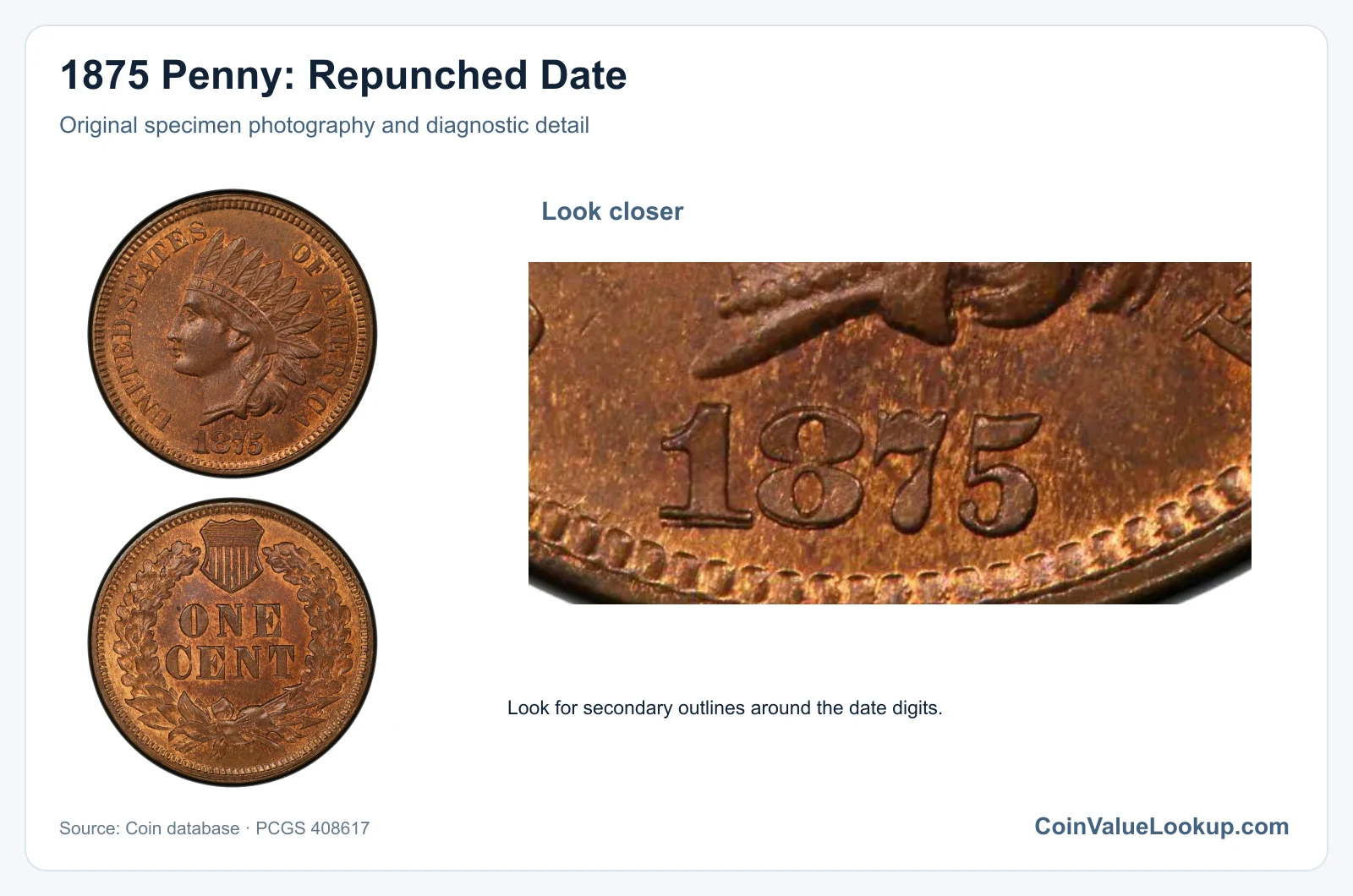
A repunched date shows remnants of an earlier position of one or more date digits alongside the final, accepted numerals. On the 1875 cent, you might spot a faint shadow or partial outline offset slightly from the "1," "8," "7" or "5." This happened when the date punch was applied more than once at slightly different positions on the working die.
This is a die-level variety, distinct from doubled die errors that affect the entire hub design. Do not confuse it with machine doubling, which produces flat, shelf-like doubling, or with simple damage to the date digits.
Each repunched date example should be assessed individually by an authentication service, as there is no adopted standard price range for this category on the 1875 Indian cent.
4. 1875 Indian Head Penny — Die Crack
Die cracks appear as thin, raised lines running across the coin's field or through design elements. They formed when a working die developed a fracture from repeated use.
On the 1875 Indian Head cent, a die crack can cross anywhere, from the portrait across the field to the rim, or snake through the reverse wreath.
The line will be raised, since it represents metal that filled the crack in the die face. This distinguishes it from incuse scratches, which are cut into the surface, and from corrosion lines that lack the clean, continuous profile of a die crack.
A displaced-metal scrape can also mimic a crack, but it usually shows disturbed metal at one end. Value for die crack errors on this date has no established guide range; each coin is assessed on the crack's length, prominence and overall coin condition.
5. 1875 Indian Head Penny — Die Chip
A die chip shows up as a small, raised lump on the coin's surface, usually inside or next to a letter, digit or design element. It forms when a tiny fragment breaks out of the die face, leaving a void that fills with metal during striking.
On the 1875 cent, look inside letters like the "O" of ONE or the loops of the "8" in the date.
The surrounding struck detail should flow smoothly into the raised area, confirming it was created during the striking process. Contrast this with a gouge or impact mark, which will show displaced metal and sharp edges rather than a naturally integrated lump.
Glue residue or debris can also sit on the surface but will not have the metallic continuity of a genuine die chip. No standard price range is established for die chips on this date, so individual assessment based on size, location and authentication is the way to go.