1891 Indian Head Penny Coin Value: How Much Is It Worth?
The 1891 Indian Head penny is a solid Philadelphia-only issue that most collectors can still afford in circulated grades. Guide estimates from USA Coin Book place a worn example around $3.62 at G4, while an uncirculated coin in MS63 condition can reach roughly $100.
Proofs, major die varieties, and mint errors require their own separate evaluation beyond those anchors.
Fast Way to Identify Your 1891 Indian Head Penny
Want a quick read on your 1891 Indian Head cent? Upload clear photos of the front and back, and our identifier can offer a preliminary look at what you have.
Good lighting and a steady shot help distinguish wear from weak strikes, and they let us check for anything unusual in the date or design details.
1891 Indian Head Penny Value
Upload both sides of your 1891 Indian Head Penny.
Front Obverse
Upload photo
Back Reverse
Upload photo
Which 1891 Indian Head Penny Versions Are Worth Money?
- Standard 1891 business strikes range from about $3.62 at G4 to $100 at MS63 per USA Coin Book; original uncirculated surfaces with remaining red color can push values higher.
- 1891 proof cents, struck specially at Philadelphia, carry a guide value near $313 at PR63; confirm genuine proof manufacture before assuming this price applies.
- Die varieties such as doubled dies, repunched dates, and cuds are reported for this date and can add a premium depending on severity and authenticated identity.
- Condition and original surfaces matter most; a cleaned or damaged coin will trade well below guide figures for its apparent grade.
Step 1: Identify Your 1891 Indian Head Penny Mint Mark and Version
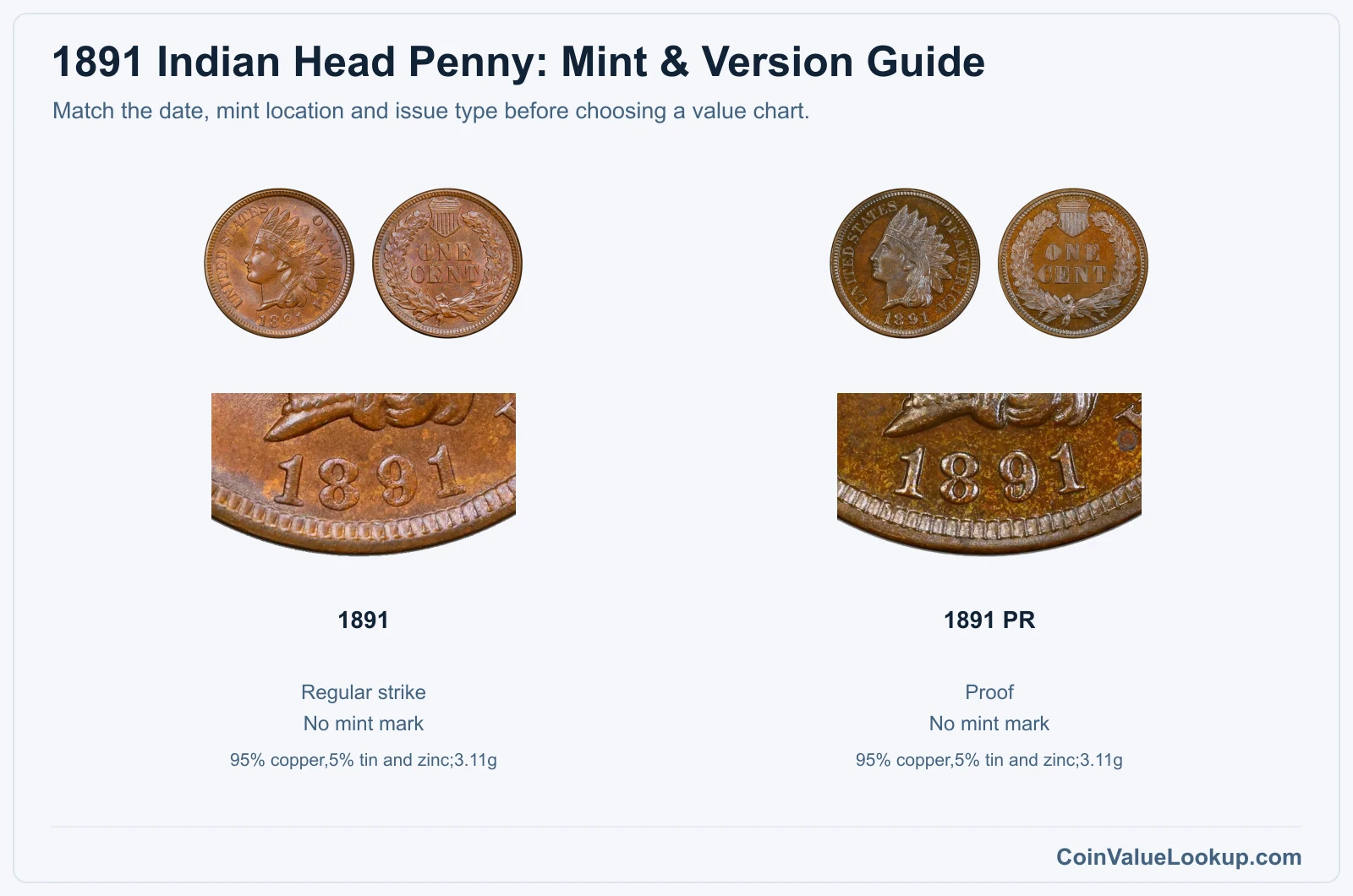
Every regular 1891 Indian Head cent was struck at the Philadelphia Mint. There is no mintmark on this coin, and the small "L" on the headdress ribbon is a designer's initial, not a mint identifier.
The obverse shows a Liberty portrait wearing a Native American feathered headdress with the word LIBERTY on the headband. The reverse features an oak wreath surrounding a shield, with ONE CENT at center.
Before you compare prices, determine whether your coin is a standard business strike or a proof. Proofs were manufactured with polished dies and planchets, producing mirror-like fields and sharp rims.
A business strike that someone has polished at home is not a proof, no matter how shiny it looks.
The composition is bronze: 95% copper with 5% tin and zinc, weighing 3.11 grams. Color matters for uncirculated coins.
BN (brown), RB (red-brown), and RD (red) describe remaining original copper color on the surface, not different metals. More original red generally commands higher prices at the same grade.
Step 2: Check Your 1891 Indian Head Penny Grade
Start with the headband. The word LIBERTY should be your first stop.
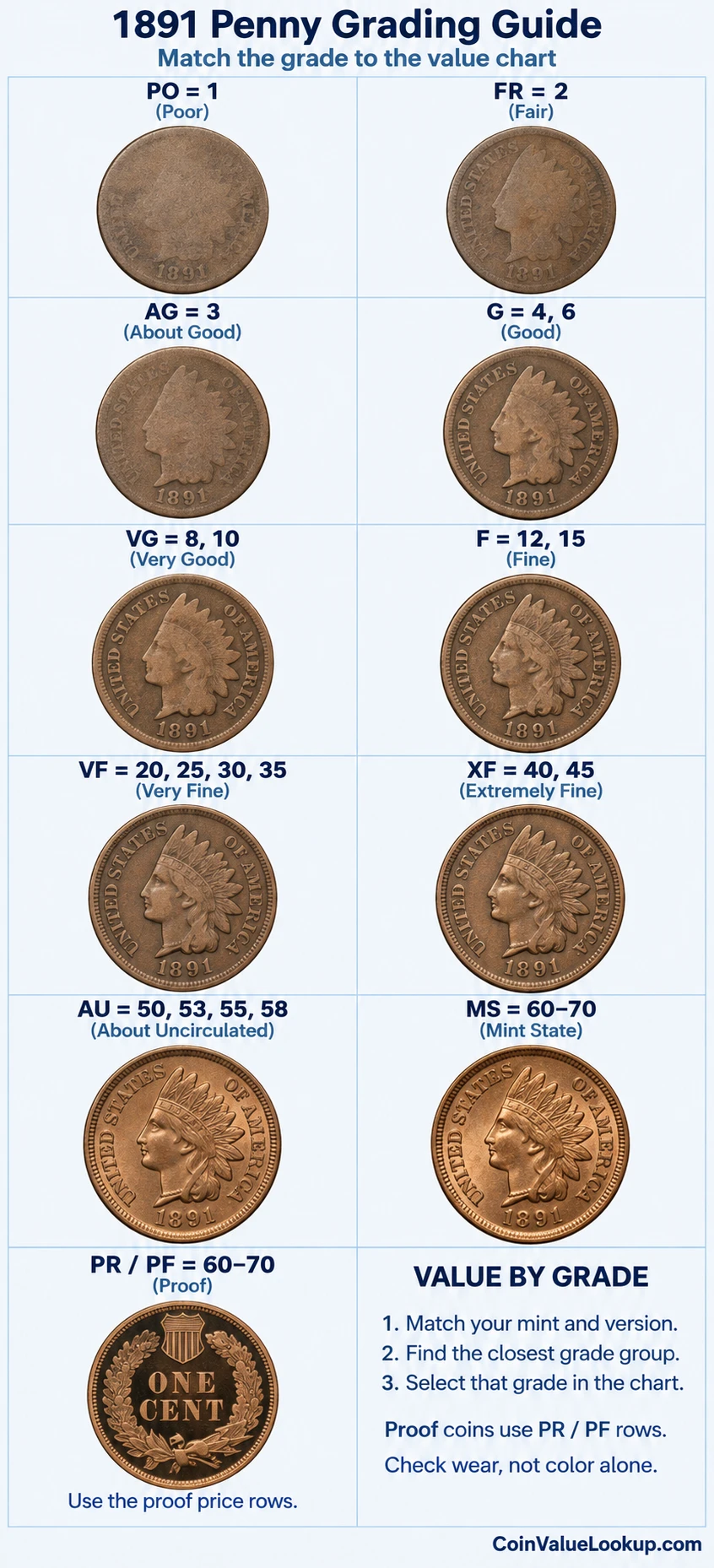
On a well-worn coin grading around Good (G4), only a few letters may remain visible. As condition improves, all letters sharpen and stand clear of the headband.
Next, check the feather tips above the ear and the hair curls below the headdress. These are high points that wear first.
A coin grading Fine will show partial feather separation, while an Extremely Fine piece retains nearly full detail.
Don't grade from one area alone. Some 1891 cents left the press with a soft strike on the feathers or hair, which can mimic wear.
Compare the cheek, the diamond pattern on the headband ribbon, and the wreath leaves together to get the full picture.
On the reverse, look at the leaf veins and the shield's horizontal lines. Use the comparison image to match your coin's detail level against known grade examples.
Surface problems like cleaning, scratches, or green corrosion will lower a coin's marketability regardless of how sharp the design looks.
Step 3: Check 1891 Indian Head Penny Value by Mint and Version
1891 Indian Head Penny
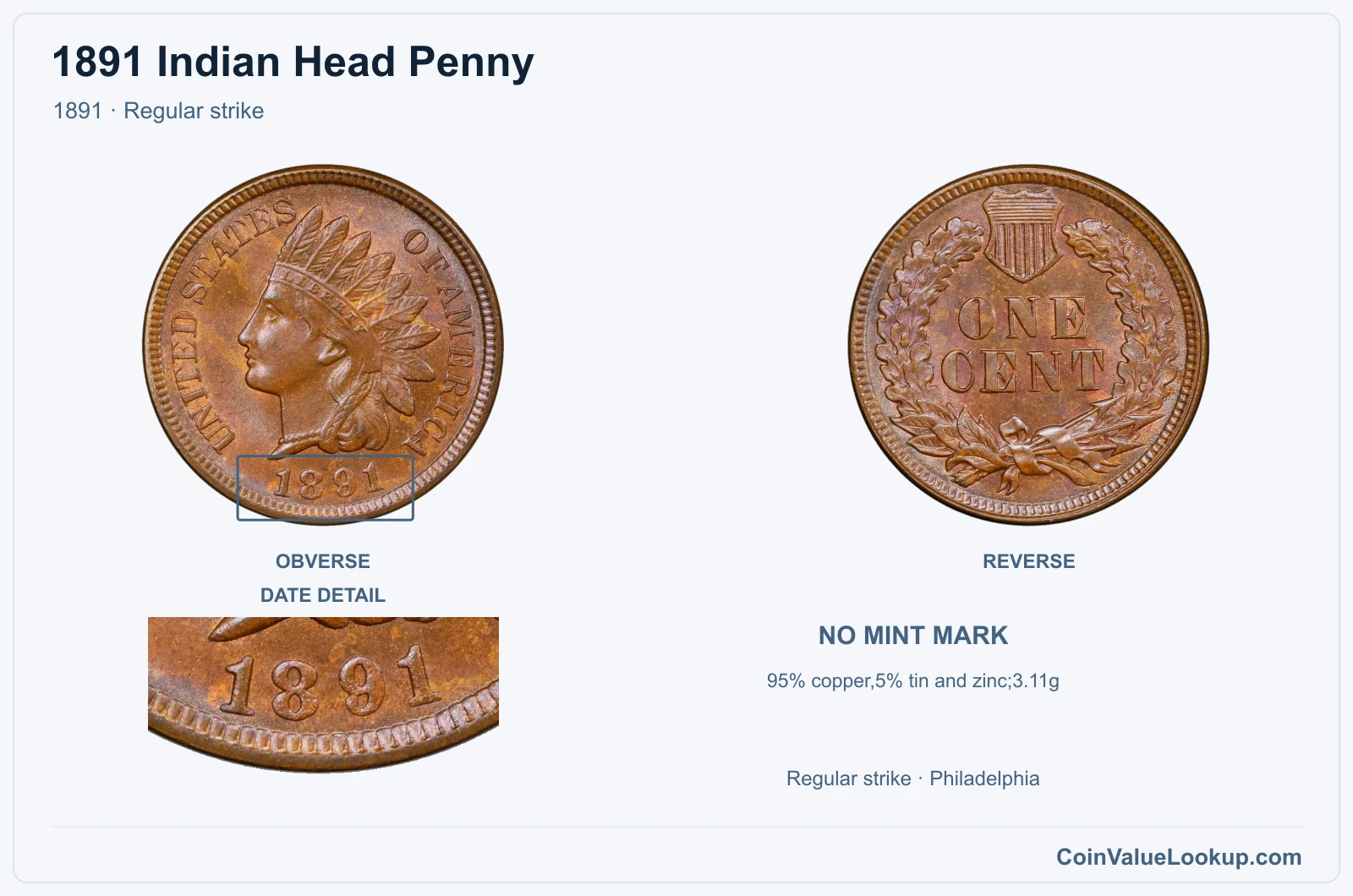
The regular 1891 Indian Head cent is a Philadelphia business strike on a bronze planchet weighing 3.11 grams. No mintmark appears on the coin.
USA Coin Book lists a retail guide value of roughly $3.62 in G4 and around $100 in MS63.
Condition drives everything here. A well-circulated brown example is common and affordable.
An uncirculated coin with original luster and some remaining red color is a different animal entirely. Compare only like grades and original surfaces when shopping; borrowing a rare-variety price for a normal coin is a fast way to overpay.
Coin Value Lookup is a handy starting point if you want to look up guides for other dates and denominations in the Indian cent series or beyond.
| Range | Grade | Price | Auction Records | Appraisal |
|---|---|---|---|---|
| PO | PO 1 | — | Coin Identifier | |
| FR | FR 2 | — | Coin Identifier | |
| AG | AG 3 | — | Coin Identifier | |
| G | G 4 | Coin Identifier | ||
| G 6 | — | Coin Identifier | ||
| VG | VG 8 | — | Coin Identifier | |
| VG 10 | — | Coin Identifier | ||
| F | F 12 | — | Coin Identifier | |
| F 15 | — | Coin Identifier | ||
| VF | VF 20 | — | Coin Identifier | |
| VF 25 | — | Coin Identifier | ||
| VF 30 | — | Coin Identifier | ||
| VF 35 | Coin Identifier | |||
| XF | XF 40 | Coin Identifier | ||
| XF 45 | Coin Identifier | |||
| AU | AU 50 | Coin Identifier | ||
| AU 53 | — | Coin Identifier | ||
| AU 55 | — | Coin Identifier | ||
| AU 58 | Coin Identifier | |||
| MS | MS 60 | — | Coin Identifier | |
| MS 61 | — | Coin Identifier | ||
| MS 62 | Coin Identifier | |||
| MS 63 | Coin Identifier | |||
| MS 64 | Coin Identifier | |||
| MS 65 | Coin Identifier | |||
| MS 66 | Coin Identifier | |||
| MS 67 | — | — | — | |
| MS 68 | — | — | — | |
| MS 69 | — | — | — | |
| MS 70 | — | — | — |
1891 Indian Head Penny — PR
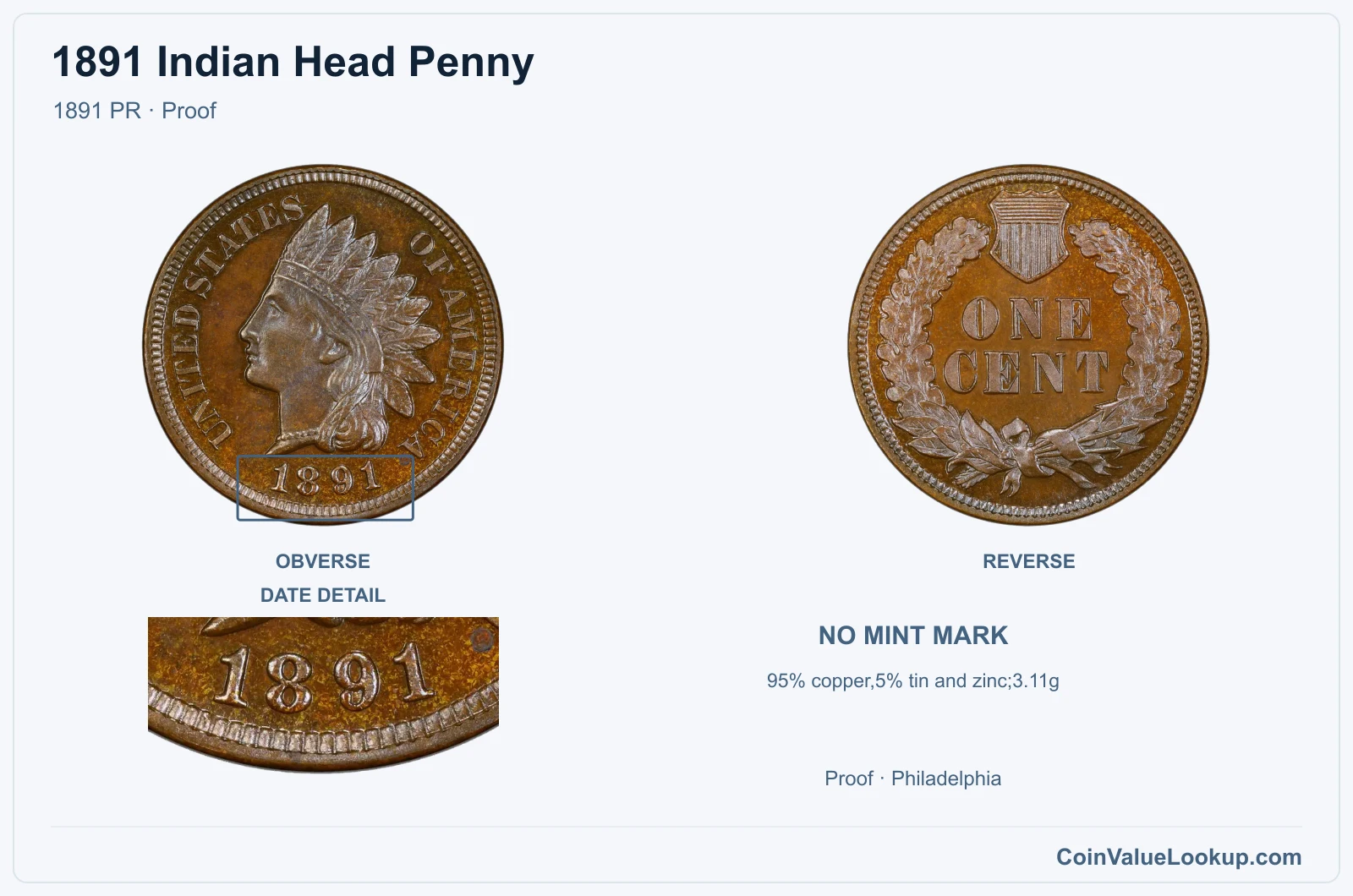
The 1891 proof Indian Head cent was a special striking produced at Philadelphia for collectors, not for circulation. It shares the same bronze composition and design as the business strike, but proof coins exhibit mirror-like fields, squared-off rims, and exceptionally sharp detail from polished dies and planchets.
USA Coin Book places the PR63 guide value at about $313. That is a significant jump over the business strike, so confirming proof origin matters.
A polished circulation coin can fool beginners. Genuine proofs show consistent reflective surfaces in the fields, distinct from any amount of household buffing.
Rim geometry and overall sharpness are additional clues. If you are unsure, third-party grading services can make the call with certainty.
| Range | Grade | Price | Auction Records | Appraisal |
|---|---|---|---|---|
| PR | PR 1 | — | Coin Identifier | |
| PR 2 | — | Coin Identifier | ||
| PR 3 | — | Coin Identifier | ||
| PR 4 | — | Coin Identifier | ||
| PR 6 | — | Coin Identifier | ||
| PR 8 | — | Coin Identifier | ||
| PR 10 | — | Coin Identifier | ||
| PR 12 | — | Coin Identifier | ||
| PR 15 | — | Coin Identifier | ||
| PR 20 | — | Coin Identifier | ||
| PR 25 | — | Coin Identifier | ||
| PR 30 | — | Coin Identifier | ||
| PR 35 | — | Coin Identifier | ||
| PR 40 | — | Coin Identifier | ||
| PR 45 | — | Coin Identifier | ||
| PR 50 | — | Coin Identifier | ||
| PR 53 | — | Coin Identifier | ||
| PR 55 | — | Coin Identifier | ||
| PR 58 | — | Coin Identifier | ||
| PR 60 | — | Coin Identifier | ||
| PR 61 | — | Coin Identifier | ||
| PR 62 | Coin Identifier | |||
| PR 63 | Coin Identifier | |||
| PR 64 | Coin Identifier | |||
| PR 65 | Coin Identifier | |||
| PR 66 | Coin Identifier | |||
| PR 67 | — | — | — | |
| PR 68 | — | — | — | |
| PR 69 | — | — | — | |
| PR 70 | — | — | — |
1891 Indian Head Penny Error List
1. 1891 Indian Head Penny — Die Break / Cud
A die break or cud on an 1891 Indian Head cent appears as a raised, featureless blob of metal, usually connected to the rim. It forms when a chunk of the die breaks away, leaving the planchet metal with nothing to press against in that area.
The result is a smooth, rounded lump that disrupts the normal design.
To spot one, look along the rim for any area where the design abruptly stops and a raised mass takes over. A true cud will connect to the rim and have a distinctly different texture from the surrounding detail.
Do not confuse it with a rim dent, localized corrosion, or an interior die chip that sits away from the edge.
No specific price range is adopted for this variety. Value depends on the size, location, and overall coin condition, and authentication helps establish exactly what you have.
2. 1891 Indian Head Penny — Doubled Die Obverse
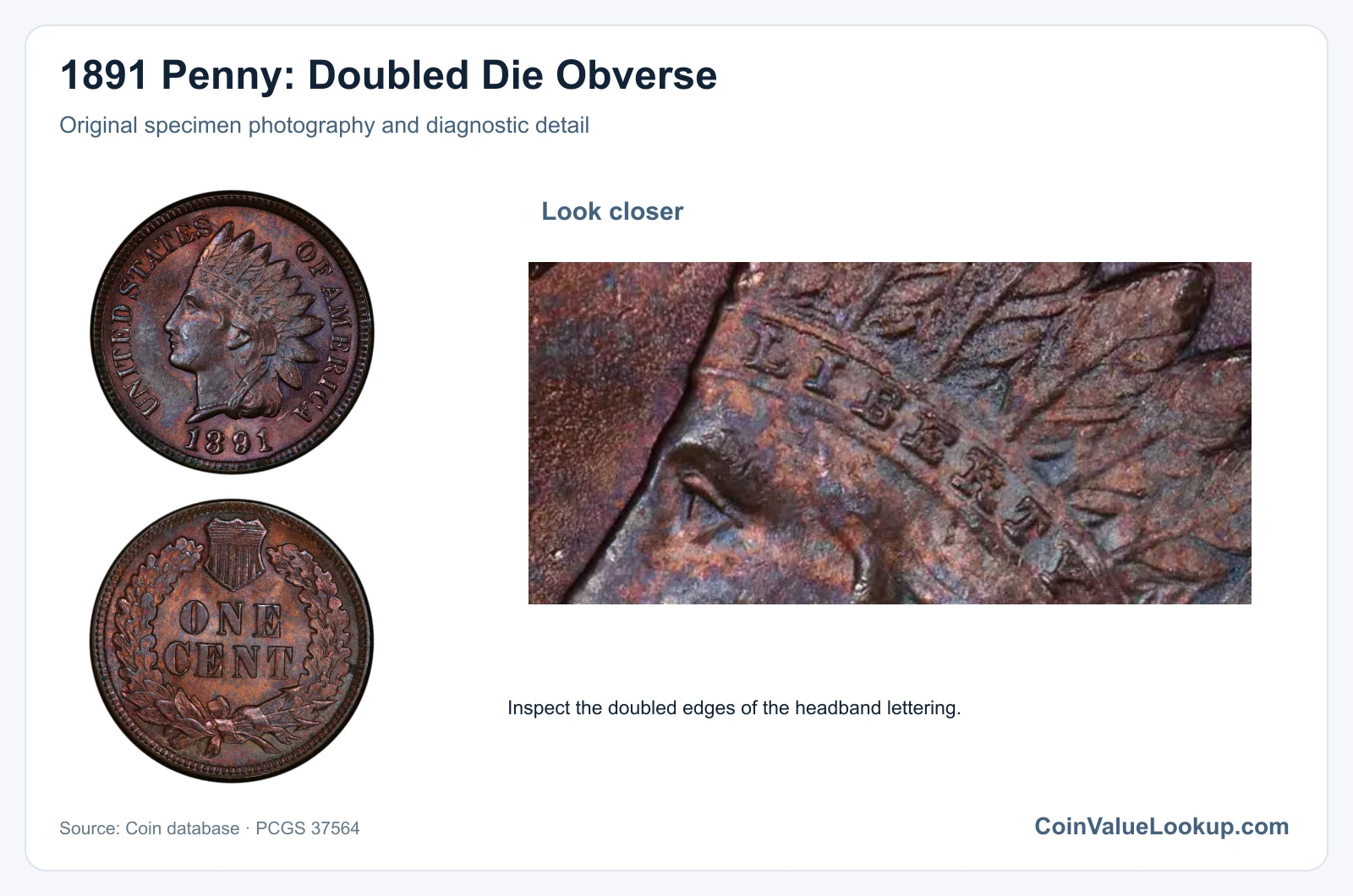
A doubled die obverse on the 1891 Indian Head cent shows consistent doubling of design elements on the front of the coin. This is a die-manufacturing variety, not damage that happened after striking.
Look for separation, notching, or a secondary image on the date digits, LIBERTY letters, or other obverse inscriptions.
The key word is consistent. True hub doubling repeats in the same direction across multiple elements.
Machine doubling, by contrast, tends to produce a flat, shelf-like displacement that lacks the rounded profile of genuine doubled-die lettering.
Compare your coin to a known normal example under the same lighting. Reflections and worn die contours can sometimes mimic doubling to the untrained eye.
No supported price range is adopted here; each coin's premium depends on its authenticated identity, the strength of the doubling, and its overall condition.
3. 1891 Indian Head Penny — Doubled Die Reverse
A doubled die reverse involves the back of the coin rather than the front. On an 1891 Indian Head cent, check the reverse legends and the wreath details for signs of a secondary impression.
Genuine doubling will show consistent separation across multiple design elements rather than a random shift in one spot.
Use magnification and compare directly against a normal reverse. Machine doubling leaves flat, shelf-like traces, while true doubled-die features tend to show rounded, distinct secondary contours.
Random post-strike damage will not follow a uniform direction.
No specific price range is adopted for this category. Assessment depends on authenticated identification, the visibility of the doubling, and the coin's grade and surface quality.
4. 1891 Indian Head Penny — Misplaced Date
A misplaced date variety occurs when partial impressions of one or more date digits appear somewhere they do not belong, such as within the denticles near the rim or partly embedded in the portrait. On the 1891 Indian Head cent, this means you might find a ghostly outline of a numeral below or beside the final, correctly positioned date.
The shapes should clearly resemble parts of actual numerals. Die chips, scratches, and random bumps can look suspicious, but they will not match the contour of a specific digit when examined under magnification.
Compare any candidate mark against a reference photograph of the known variety.
No supported price range is available for this category. Value is assessed individually based on authenticated identity, how visible the misplaced digit is, and the coin's overall condition.
5. 1891 Indian Head Penny — Repunched Date
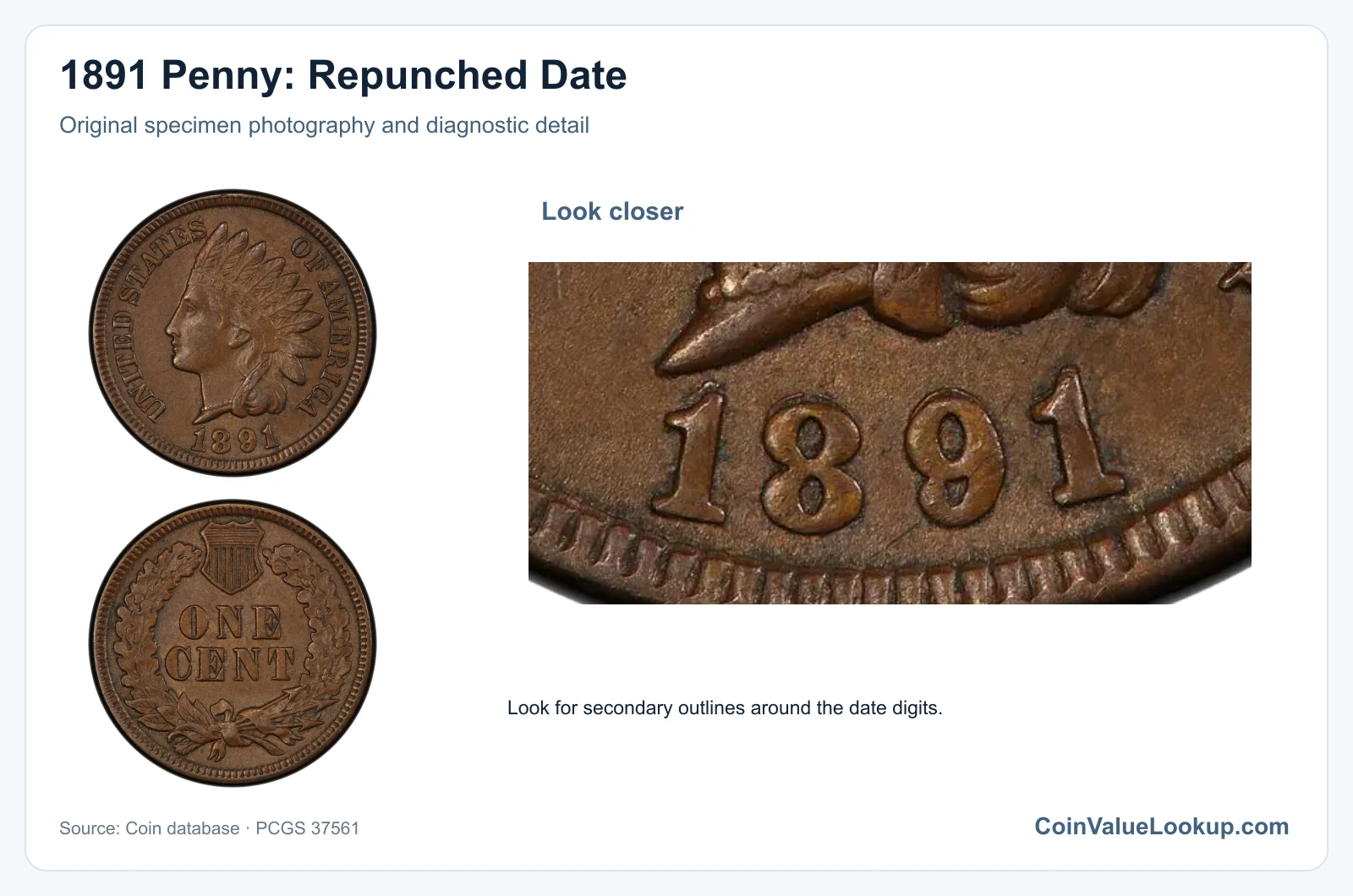
A repunched date on the 1891 Indian Head cent shows remnants of an earlier date-punch position next to the final numerals. During manufacture, date digits were individually punched into the working die.
If the punch landed slightly off on the first attempt, a corrective second impression left traces of the initial placement.
Look for secondary outlines or extra serifs beside the 1, 8, 9, or final 1 in the date. This is different from doubled-die varieties, which involve the entire hub design, not just the date punches.
It is also different from machine doubling, which produces flat shelf-like distortions.
A damaged or corroded date can sometimes mimic repunching, so careful comparison with a normal specimen is important. No numeric price range is adopted; value depends on authenticated identification, the clarity of the repunching, and the coin's grade.
6. 1891 Indian Head Penny — Die Crack
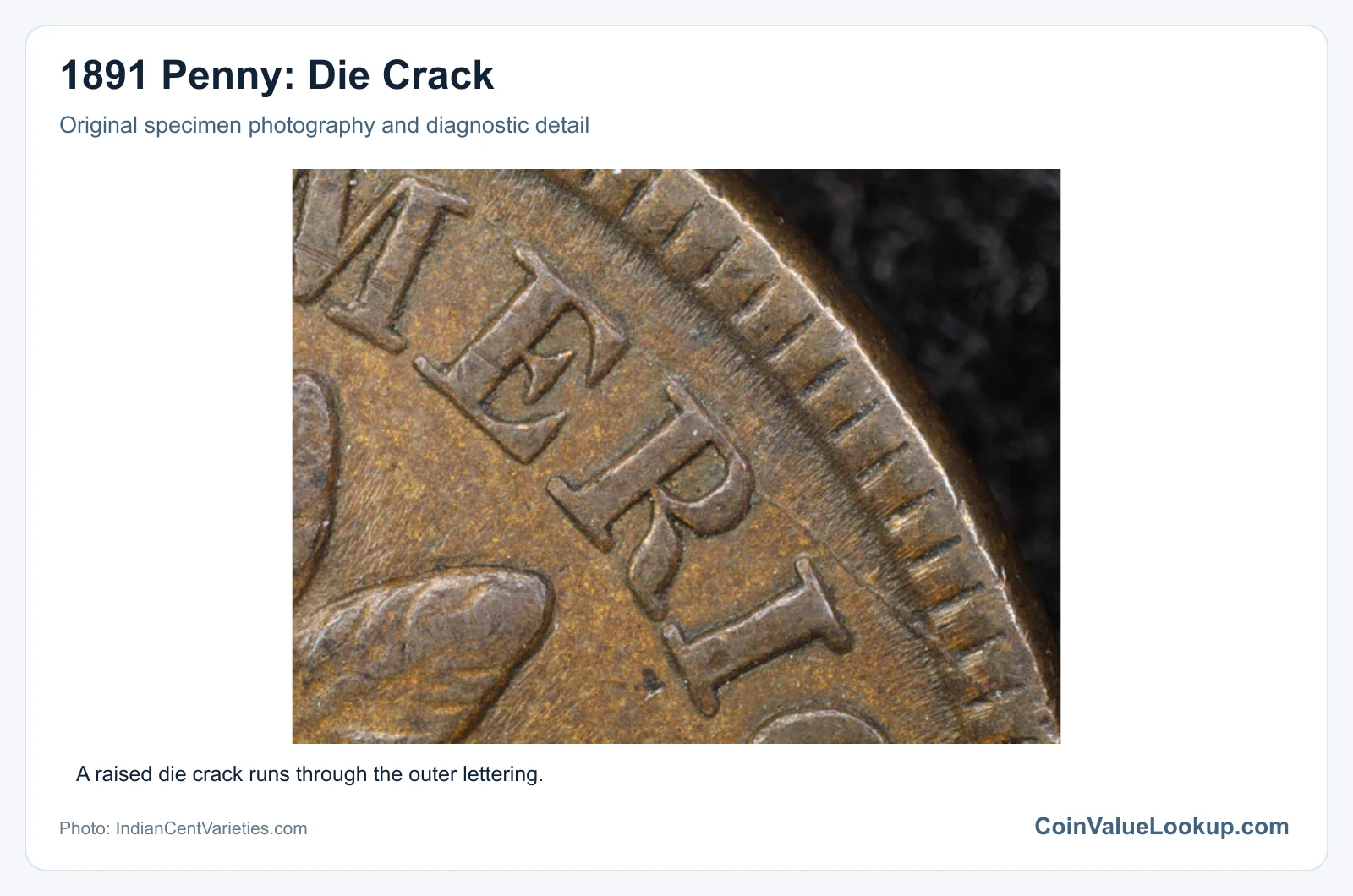
Die cracks appear as thin, raised lines running across the surface of the coin. On an 1891 Indian Head cent, a crack can cross open fields, cut through lettering, or travel from the rim through the design.
Because the line is raised, it was part of the die, not post-strike damage.
To confirm a die crack, run a fingernail or toothpick across it. A raised line suggests a crack in the die transferred to the coin during striking.
An incuse scratch, corrosion track, or displaced-metal scrape will feel sunken or rough rather than raised.
Note where the crack starts and ends. Larger, more dramatic cracks affecting major design elements tend to attract more collector interest.
No specific price range is adopted for this category; premiums depend on the crack's extent, the coin's authenticated identity, and its overall condition.