2001 Lincoln Penny Coin Value: How Much Is It Worth?
Most 2001 Lincoln pennies you pull from a jar are worth face value — one cent. In uncirculated condition around MS65, a guide estimate puts the regular Philadelphia or Denver strike at about $0.36.
San Francisco proof examples carry a guide estimate near $4.96 at PR65. Special varieties and mint errors occupy their own markets, and there is no single universal ceiling for every 2001 cent.
Fast Way to Identify Your 2001 Lincoln Penny
The quickest way to start figuring out what you have is to upload clear photos of the front and back of your coin. That lets the identifier give you a preliminary read on the mint, version, and general condition.
Snap both sides in even lighting, and keep fingers off the surfaces if you can help it.
2001 Penny Value
Upload both sides of your 2001 Lincoln Penny.
Front Obverse
Upload photo
Back Reverse
Upload photo
Which 2001 Lincoln Penny Versions Are Worth Money?
- Clean, original surfaces and strong preservation matter more than which mintmark a 2001 cent carries — an MS65 Philadelphia or Denver coin both guide around $0.36, while heavily circulated examples stay at face value.
- San Francisco proofs should be compared using proof grades and cameo designations, not circulation-strike grades — a PR65 example guides at roughly $4.96, and cameo or deep-cameo surfaces can shift the conversation further.
Step 1: Identify Your 2001 Lincoln Penny Mint Mark and Version
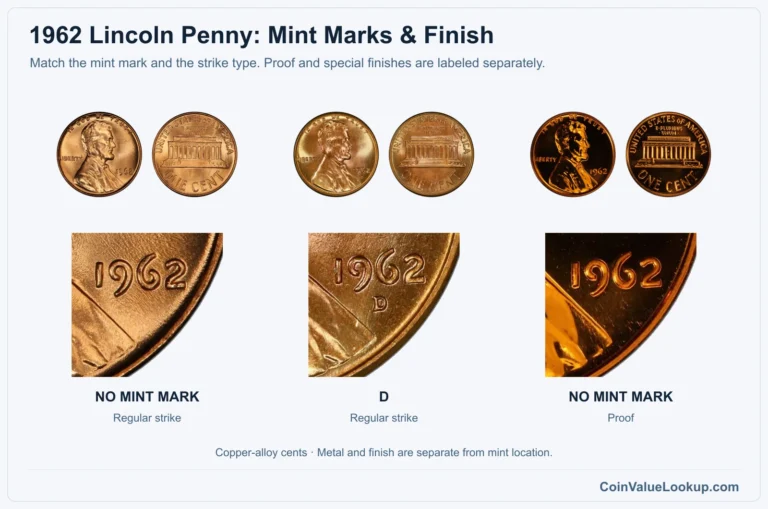
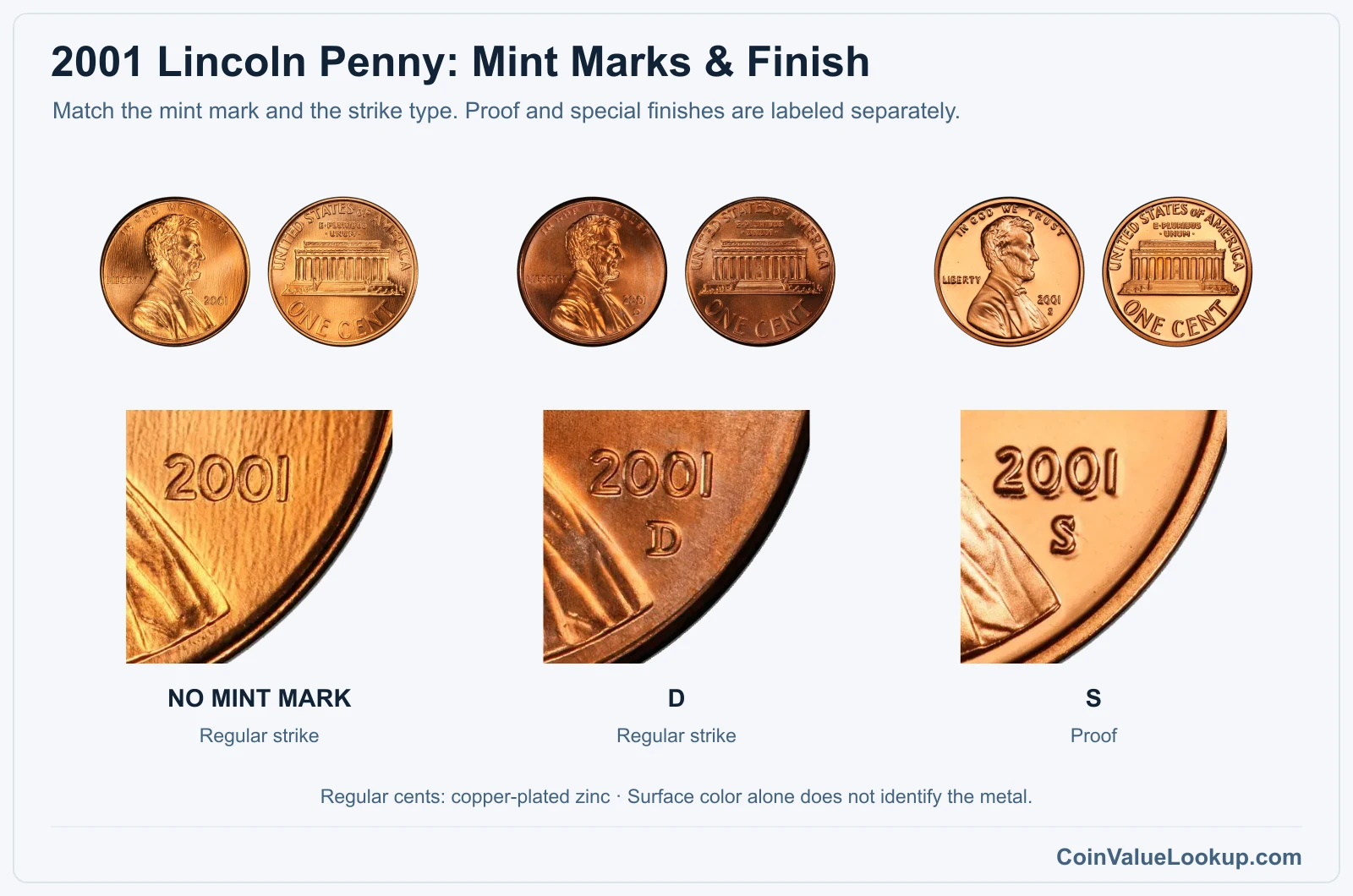
Flip your 2001 penny to the obverse and look just below the date. No letter means Philadelphia.
A small "D" means Denver. An "S" means a San Francisco proof, which was sold in collector sets, not released into circulation.
The reverse shows the Lincoln Memorial. All three versions are copper-plated zinc, weighing a nominal 2.50 grams with a plain edge and 19.05 mm diameter.
Color alone — whether it looks copper, brown, or oddly silver — cannot prove a different alloy. If the weight feels wrong, that is worth investigating, but eyeballing the color is unreliable.
Separate circulation strikes from proofs before comparing values. A proof has mirrored fields and sharply defined devices because the planchet and dies were specially prepared.
It is a manufacturing method, not a grade above Mint State.
Step 2: Check Your 2001 Lincoln Penny Grade
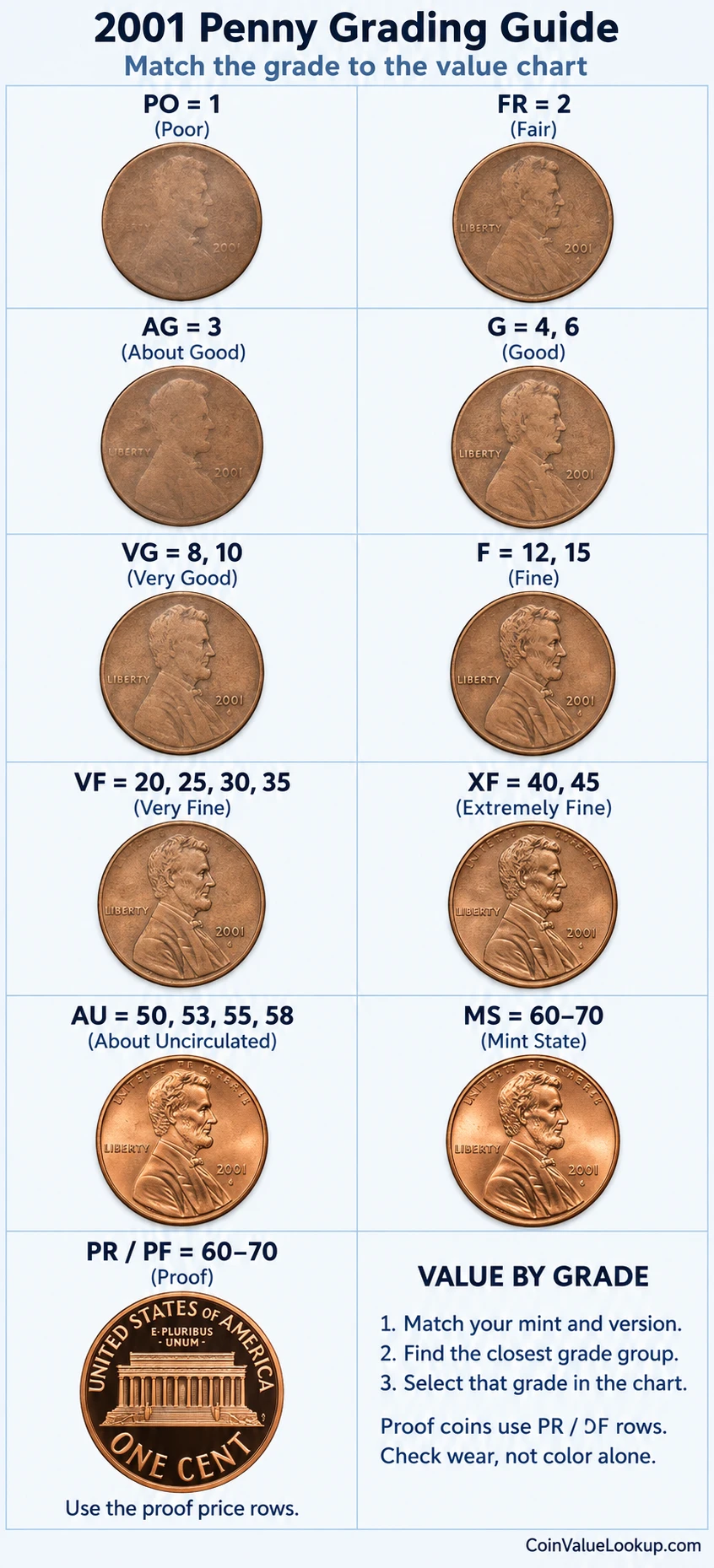
Start with Lincoln's cheek, jawline, and the hair detail above his ear. On a well-worn coin those areas flatten first and merge together.
On the reverse, check the columns and horizontal lines of the Memorial — they fade as the grade drops.
Luster matters a lot for uncirculated pieces. An MS65 coin should have original, unbroken cartwheel luster with only minor contact marks.
Red, red-brown, and brown describe how much original copper color remains; they are separate from the numerical grade.
Corrosion spots, cleaning scratches, and heavy bag marks all drag value down regardless of wear. Compare your coin against the reference image to get a realistic sense of where it falls.
Step 3: Check 2001 Lincoln Penny Value by Mint and Version
2001 Lincoln Penny
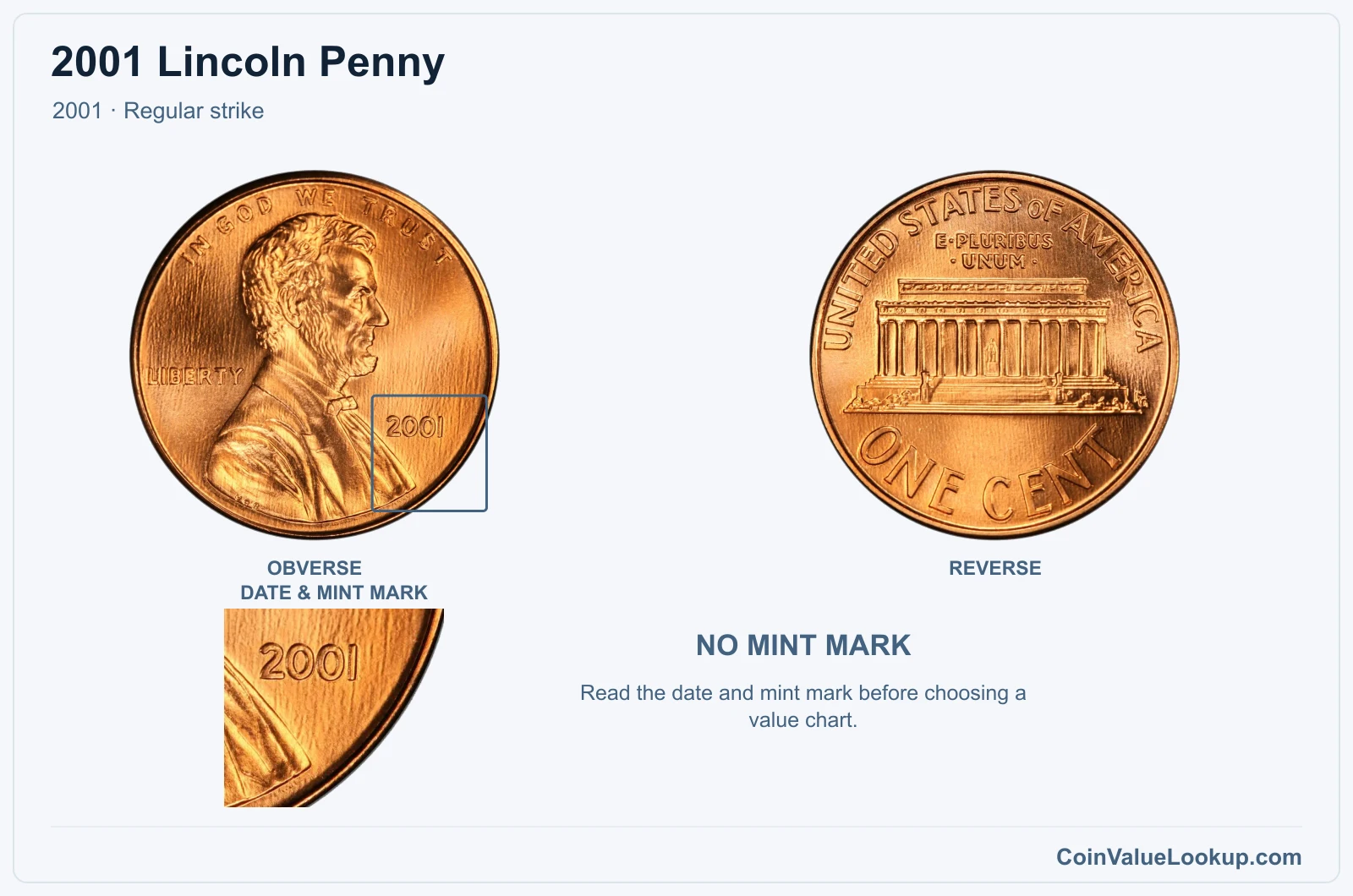
The 2001 Philadelphia cent has no mintmark below the date. It is a regular business strike on a copper-plated zinc planchet — 97.5 percent zinc, 2.5 percent copper overall, weighing about 2.50 grams.
Billions were made, and the vast majority are worth one cent in pocket change.
At MS65, a guide estimate is around $0.36. To reach that level the coin needs full original luster, minimal contact marks, and no cleaning or corrosion.
Being uncirculated alone does not make it a special finish — it just means nobody spent it yet.
| Range | Grade | Price | Auction Records | Appraisal |
|---|---|---|---|---|
| PO | PO 1 | — | Coin Identifier | |
| FR | FR 2 | — | Coin Identifier | |
| AG | AG 3 | — | Coin Identifier | |
| G | G 4 | — | Coin Identifier | |
| G 6 | — | Coin Identifier | ||
| VG | VG 8 | — | Coin Identifier | |
| VG 10 | — | Coin Identifier | ||
| F | F 12 | — | Coin Identifier | |
| F 15 | — | Coin Identifier | ||
| VF | VF 20 | — | Coin Identifier | |
| VF 25 | — | Coin Identifier | ||
| VF 30 | — | Coin Identifier | ||
| VF 35 | — | Coin Identifier | ||
| XF | XF 40 | — | Coin Identifier | |
| XF 45 | — | Coin Identifier | ||
| AU | AU 50 | — | Coin Identifier | |
| AU 53 | — | Coin Identifier | ||
| AU 55 | — | Coin Identifier | ||
| AU 58 | — | Coin Identifier | ||
| MS | MS 60 | — | Coin Identifier | |
| MS 61 | — | Coin Identifier | ||
| MS 62 | — | Coin Identifier | ||
| MS 63 | — | Coin Identifier | ||
| MS 64 | — | Coin Identifier | ||
| MS 65 | Coin Identifier | |||
| MS 66 | Coin Identifier | |||
| MS 67 | Coin Identifier | |||
| MS 68 | Coin Identifier | |||
| MS 69 | Coin Identifier | |||
| MS 70 | — | — | — |
2001 Lincoln Penny — D
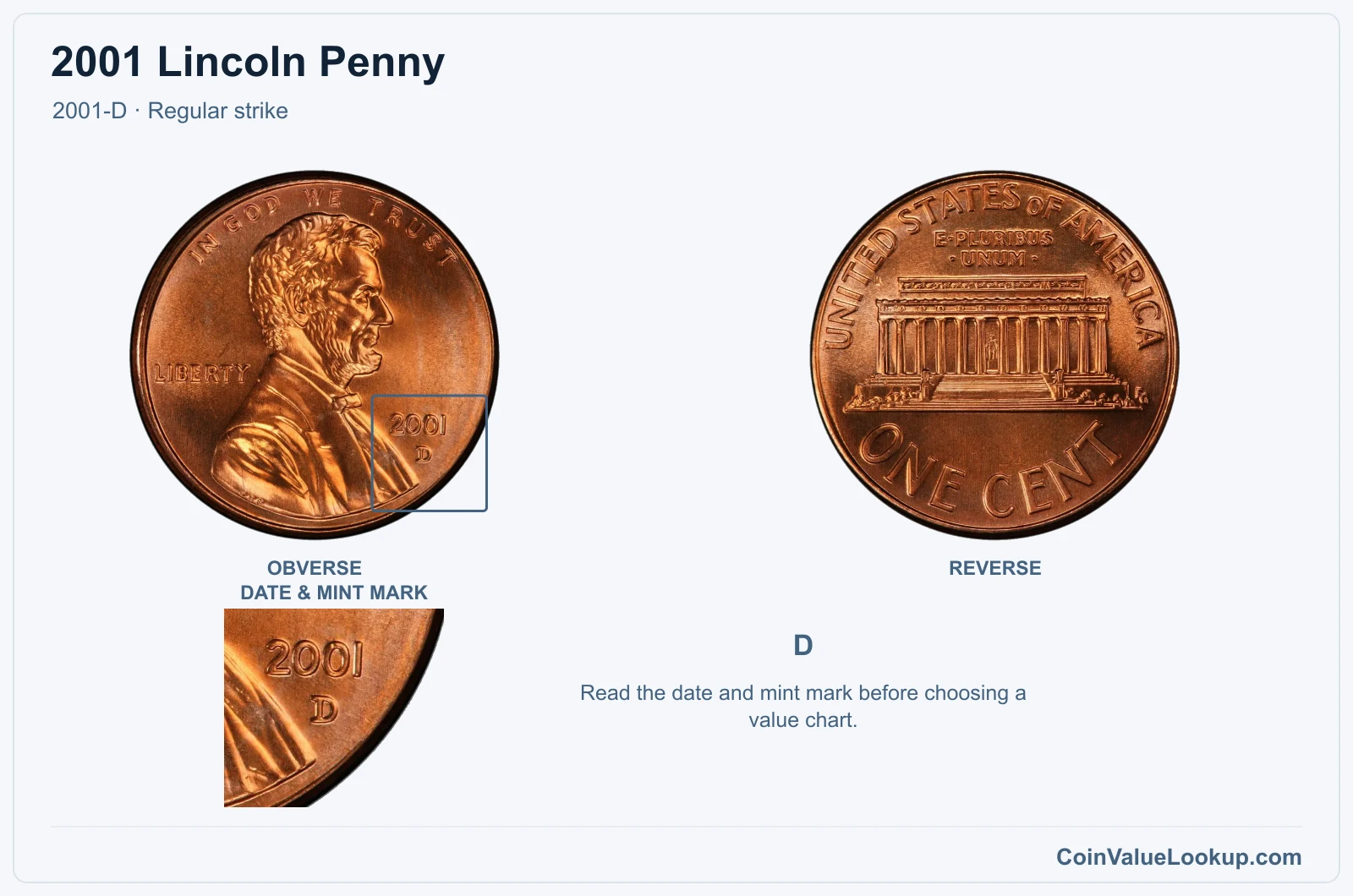
Look for a small "D" below the date. This is the Denver business strike, same copper-plated zinc composition and 2.50-gram weight as the Philadelphia version.
In circulated grades it is a one-cent coin, plain and simple.
The MS65 guide estimate is also about $0.36, identical to the Philadelphia issue. Original color and clean surfaces are what separate a coin worth a few dimes from one worth a penny.
Match your coin's preservation carefully before assuming value.
Coin Value Lookup is a good starting point if you want to compare this penny's guide values alongside other dates and denominations in the Lincoln series.
| Range | Grade | Price | Auction Records | Appraisal |
|---|---|---|---|---|
| PO | PO 1 | — | Coin Identifier | |
| FR | FR 2 | — | Coin Identifier | |
| AG | AG 3 | — | Coin Identifier | |
| G | G 4 | — | Coin Identifier | |
| G 6 | — | Coin Identifier | ||
| VG | VG 8 | — | Coin Identifier | |
| VG 10 | — | Coin Identifier | ||
| F | F 12 | — | Coin Identifier | |
| F 15 | — | Coin Identifier | ||
| VF | VF 20 | — | Coin Identifier | |
| VF 25 | — | Coin Identifier | ||
| VF 30 | — | Coin Identifier | ||
| VF 35 | — | Coin Identifier | ||
| XF | XF 40 | — | Coin Identifier | |
| XF 45 | — | Coin Identifier | ||
| AU | AU 50 | — | Coin Identifier | |
| AU 53 | — | Coin Identifier | ||
| AU 55 | — | Coin Identifier | ||
| AU 58 | — | Coin Identifier | ||
| MS | MS 60 | — | Coin Identifier | |
| MS 61 | — | Coin Identifier | ||
| MS 62 | — | Coin Identifier | ||
| MS 63 | — | Coin Identifier | ||
| MS 64 | — | Coin Identifier | ||
| MS 65 | — | Coin Identifier | ||
| MS 66 | Coin Identifier | |||
| MS 67 | Coin Identifier | |||
| MS 68 | Coin Identifier | |||
| MS 69 | Coin Identifier | |||
| MS 70 | — | — | — |
2001 Lincoln Penny — S PR
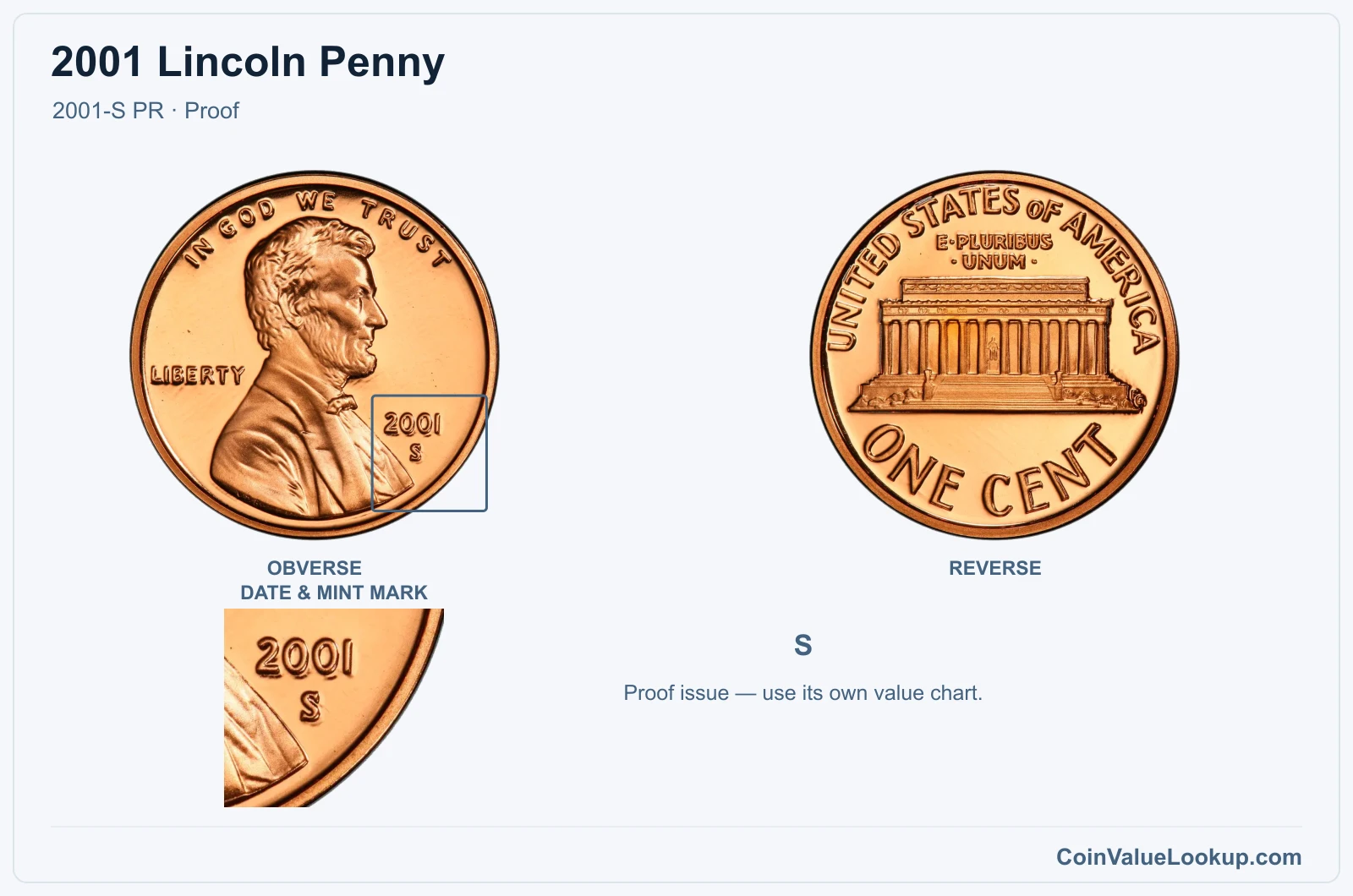
The 2001-S proof was struck at San Francisco for collector sets and carries an "S" mintmark. Proof cents have mirror-like fields and crisp, well-defined design elements because both the dies and planchets received special preparation.
At PR65, the guide estimate is approximately $4.96. Cameo and deep-cameo designations — describing the contrast between frosty devices and reflective fields — are graded separately and can affect desirability.
Compare your proof against known examples at the same proof grade before drawing conclusions. These are retail guide estimates, not guaranteed purchase offers.
| Range | Grade | Price | Auction Records | Appraisal |
|---|---|---|---|---|
| PR | PR 1 | — | Coin Identifier | |
| PR 2 | — | Coin Identifier | ||
| PR 3 | — | Coin Identifier | ||
| PR 4 | — | Coin Identifier | ||
| PR 6 | — | Coin Identifier | ||
| PR 8 | — | Coin Identifier | ||
| PR 10 | — | Coin Identifier | ||
| PR 12 | — | Coin Identifier | ||
| PR 15 | — | Coin Identifier | ||
| PR 20 | — | Coin Identifier | ||
| PR 25 | — | Coin Identifier | ||
| PR 30 | — | Coin Identifier | ||
| PR 35 | — | Coin Identifier | ||
| PR 40 | — | Coin Identifier | ||
| PR 45 | — | Coin Identifier | ||
| PR 50 | — | Coin Identifier | ||
| PR 53 | — | Coin Identifier | ||
| PR 55 | — | Coin Identifier | ||
| PR 58 | — | Coin Identifier | ||
| PR 60 | Coin Identifier | |||
| PR 61 | — | Coin Identifier | ||
| PR 62 | — | Coin Identifier | ||
| PR 63 | — | Coin Identifier | ||
| PR 64 | — | Coin Identifier | ||
| PR 65 | — | Coin Identifier | ||
| PR 66 | — | Coin Identifier | ||
| PR 67 | Coin Identifier | |||
| PR 68 | Coin Identifier | |||
| PR 69 | Coin Identifier | |||
| PR 70 | Coin Identifier |
2001 Lincoln Penny Error List
1. 2001 Lincoln Penny — BIE Die Break
A BIE die break shows up as a small raised vertical bar or blob between the letters B and E in LIBERTY. It is caused by a tiny piece of the die surface breaking away, leaving a void that fills with metal during striking.
To check, look closely at LIBERTY under magnification. The raised element should appear naturally connected to the surrounding letter surfaces, not sitting on top like a glob.
Dirt, a scratch, or a piece of foreign material glued to the surface can mimic the look, so compare the texture of the raised area to the normal lettering around it.
No specific price range is supported for this variety. Value depends on the authenticated identity of the die break, its size and sharpness, and the coin's overall condition.
2. 2001 Lincoln Penny — Clipped Planchet
A clipped planchet means part of the original metal blank was missing before the coin was struck. You will see a curved, straight, or ragged absence along the edge, and the design in that area may be incomplete or distorted.
Check for a characteristic weakness in the design opposite the clip — this is sometimes called the Blakesley effect and can help confirm the clip happened before striking. An edge that was cut, filed, or corroded after minting will typically look different: sharper, more uniform, or with visible tool marks rather than natural metal flow.
No specific price data is available for 2001 cent clips. The value of any particular example depends on its authenticated identity, the size and type of clip, and overall condition.
3. 2001 Lincoln Penny — Doubled Die
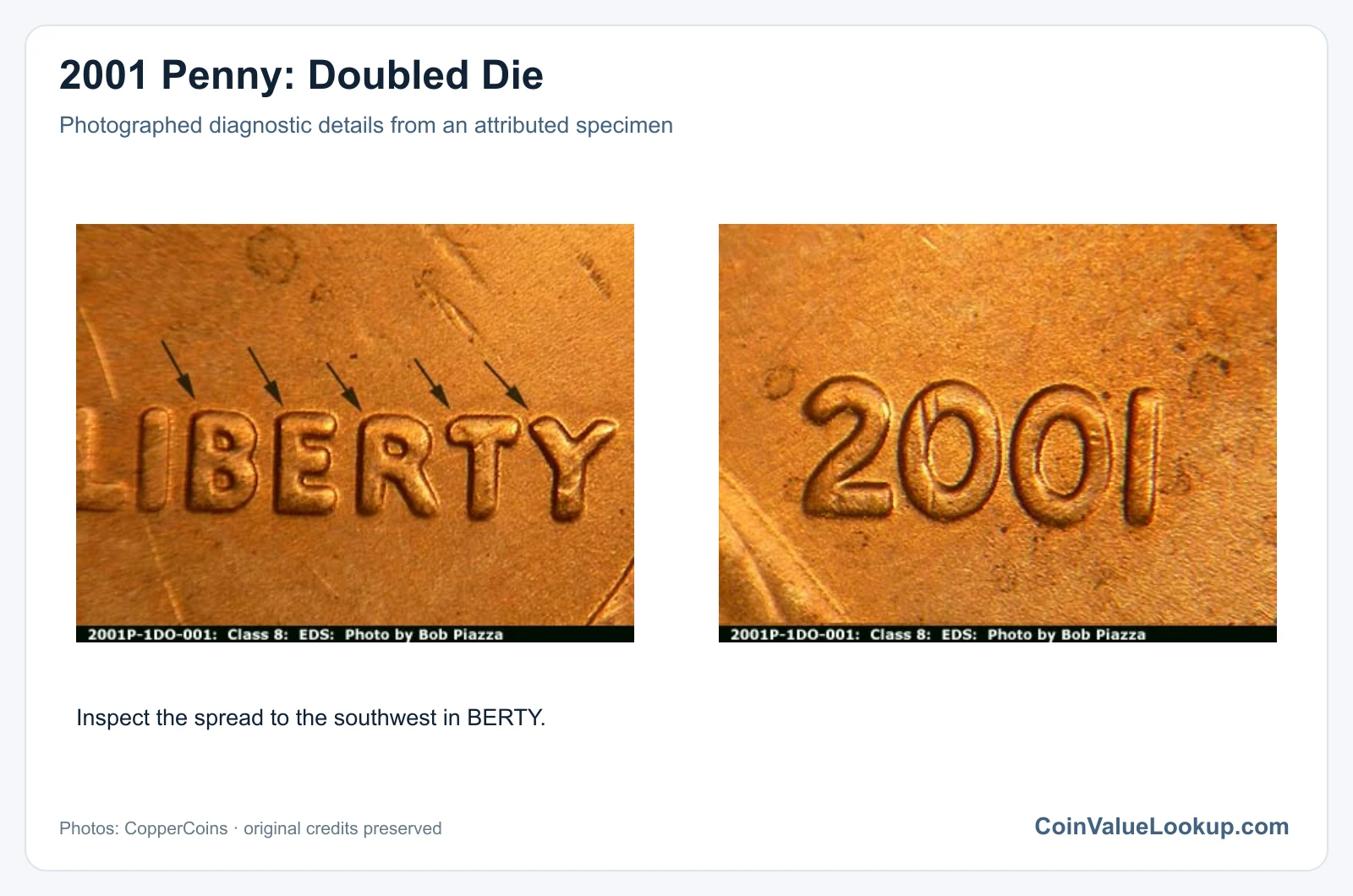
A doubled die produces consistent doubling in the design elements because the die itself carried a doubled image. Look for separation, notching, or shelf-like doubling on letters, the date, or Lincoln's profile.
The key word is consistent — genuine doubled-die features repeat the same way on every coin struck by that die.
Machine doubling is the usual lookalike. It tends to create flat, shelf-like distortion on one side of a letter rather than the clear design separation of a true doubled die.
Reflections under certain lighting and post-mint impressions from contact with other coins can also fool you.
No supported price range exists for 2001 cent doubled dies. Individual assessment based on the authenticated variety, its strength, and the coin's grade determines value.
4. 2001 Lincoln Penny — Struck-Through Error
A struck-through error happens when debris — grease, cloth fibers, wire, or another foreign object — gets between the die and the planchet during striking. The result is a localized depression or an impression of the obstruction in the coin's surface, with the normal design weakened or absent in that spot.
Grease fill-ins tend to produce smooth, shallow depressions. A retained foreign object might leave a textured impression or even remain embedded.
Either way, the affected area should look recessed into the coin's surface, not scratched or worn away.
Wear, cleaning marks, and ordinary weak strikes from a tired die can all resemble struck-through areas. No price data is supported for this category on 2001 cents; each example is assessed individually based on the nature of the obstruction and the coin's condition.
5. 2001 Lincoln Penny — Broadstrike
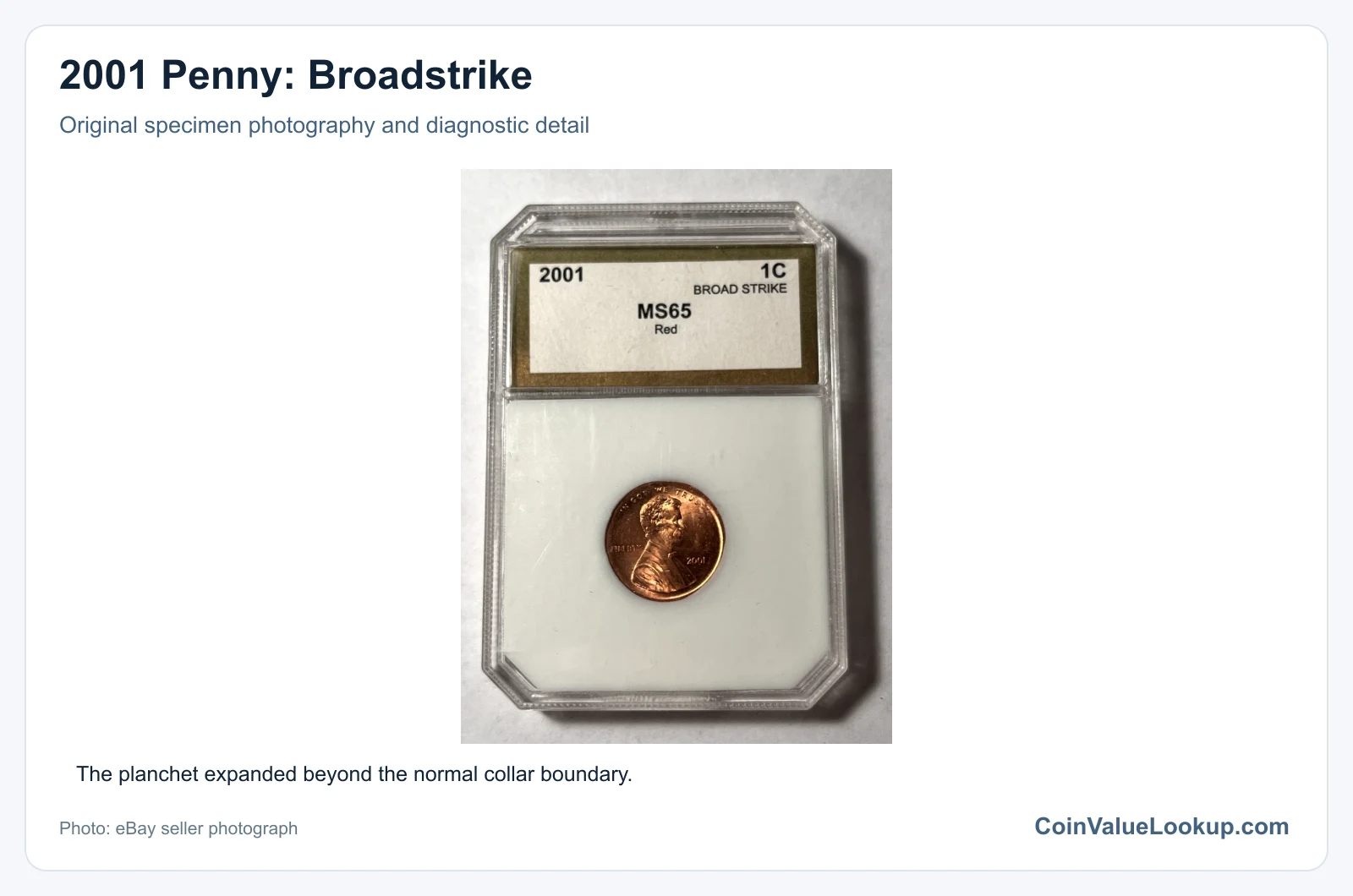
A broadstrike occurs when a coin is struck without the retaining collar that normally constrains the planchet's edge. The result is a coin that spreads outward, appearing wider than normal with a distorted or absent rim, while the design remains roughly centered.
Check the edge profile. A broadstruck coin will lack the sharp, uniform rim of a normal cent, and the diameter will measure larger than the standard 19.05 mm.
The design itself should still be mostly complete, just expanded.
Do not confuse this with a coin that was flattened by a train or a hammer after leaving the mint — post-mint damage usually shows uneven distortion and surface scarring. Off-center strikes also look different because the design is shifted, not uniformly spread.
No supported price range is available; individual assessment by authenticated identity and condition applies.
6. 2001 Lincoln Penny — Clashed Dies
Clashed dies result when the obverse and reverse dies strike each other without a planchet between them. The impact transfers faint ghost images of each die's design onto the opposite die.
Coins subsequently struck by those damaged dies carry traces of the wrong design in their fields.
On a 2001 cent, look for faint outlines of the Memorial on the obverse field or Lincoln's profile ghosted onto the reverse. These traces should align with where the opposite design would naturally fall.
Random scratches, raised lines from die polish, and brockage errors can all look similar at first glance. A die clash will be consistent and positioned logically relative to the opposing design.
No price data is supported for this error on 2001 cents; value depends on the clarity of the clash and the coin's authenticated condition.
7. 2001 Lincoln Penny — Die Crack / Die Chip
Die cracks appear as raised lines on the coin's surface, created when a crack forms in the steel die. Die chips produce small raised blobs from a localized piece of the die breaking away.
Both are fairly common on high-production dates like 2001.
A crack that connects to the rim is sometimes called a cud — these can be more dramatic and cover a larger area. Interior cracks typically appear as thin raised lines running across the design.
Look at the feature under magnification: it should be raised, not incused.
Incuse scratches, corrosion, or deposits of foreign material on the surface can mimic die cracks. Genuine cracks will be consistent across the coin's natural contours.
No specific price data is supported for 2001 cent die cracks; value hinges on size, location, and the coin's overall grade.
8. 2001 Lincoln Penny — Double / Multiple Strike
A double or multiple strike means the coin was struck more than once by the dies, with the planchet shifting or rotating between impacts. You will see two or more distinct, displaced impressions of the design overlapping on the same coin.
This is different from a doubled die, which shows consistent doubling from a single strike using a defective die. A double strike produces visibly separate design images — sometimes dramatically rotated or offset from each other — because the entire coin moved between hits.
Post-mint impressions, where a coin is squeezed against another coin or object, can leave marks that resemble a second strike. No price data is supported for this category on 2001 cents.
Each piece is assessed individually by its authenticated identity and the visual severity of the multiple strike.
9. 2001 Lincoln Penny — Off-Center Strike
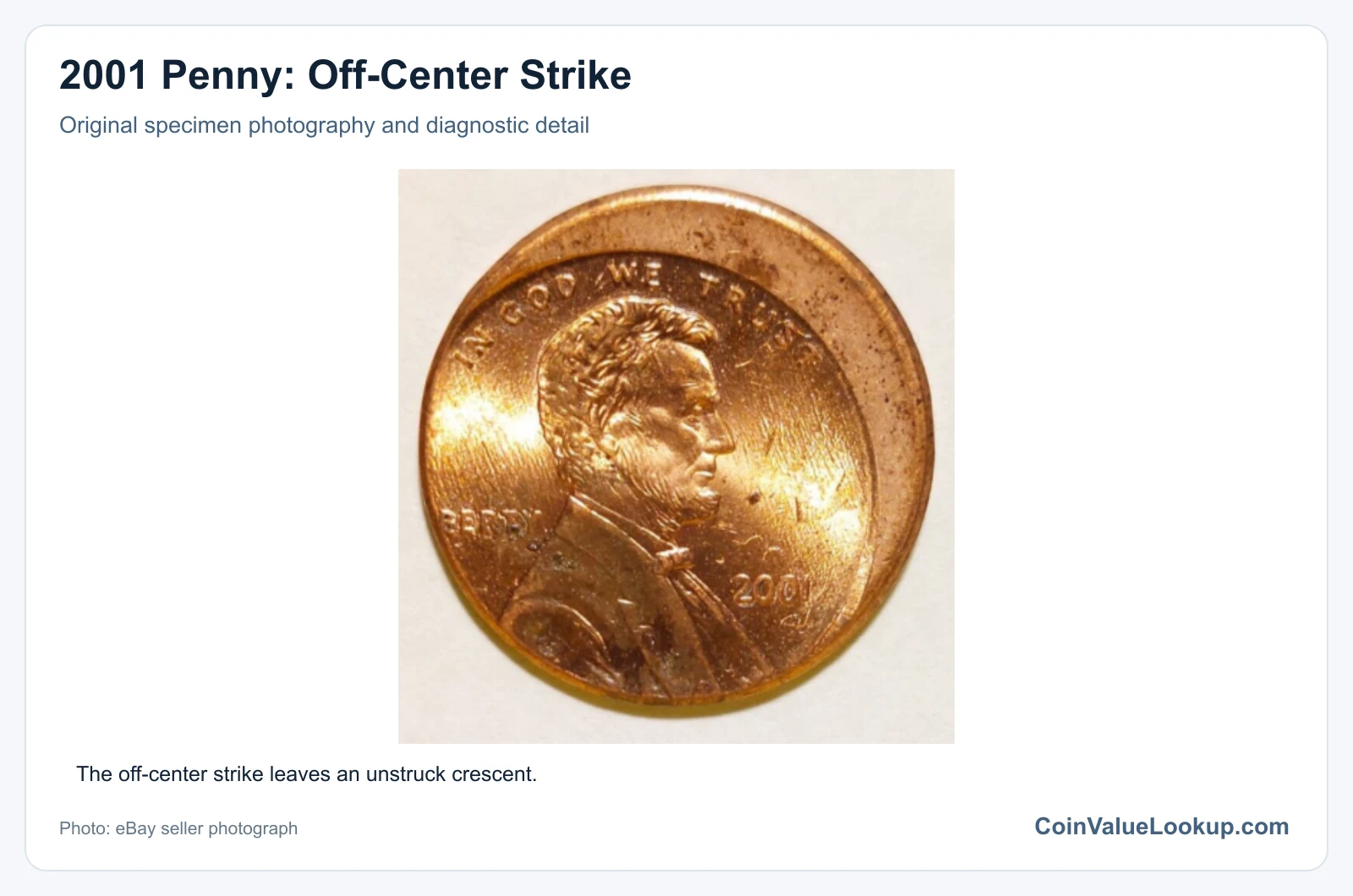
An off-center strike happens when the planchet is not properly seated between the dies, so part of the design is struck onto empty space. The result is a crescent-shaped blank area on one side and a shifted but otherwise sharp design on the other.
The percentage off-center and whether the date remains visible are the two biggest factors collectors care about. A 2001 cent struck 5 percent off-center is mildly interesting; one struck 50 percent off-center with a readable date is a different conversation entirely.
Do not confuse this with a clipped planchet, which is missing metal, or with a misaligned die, which shifts only one side. Post-mint flattening also distorts the design but typically damages surfaces in ways inconsistent with a press strike.
No supported price data exists for this error; assessment depends on authenticated identity, percentage, and condition.
10. 2001 Lincoln Penny — Wrong Planchet / Off-Metal Strike
A wrong-planchet error means the cent design was struck onto a blank intended for a different denomination or even a foreign coin. The result is a coin that looks like a Lincoln cent but has an unexpected weight, diameter, or edge.
If you suspect this, weigh and measure your coin carefully. A normal 2001 cent should be about 2.50 grams and 19.05 mm across with a plain edge.
Significant deviation from those specs — combined with a complete or nearly complete cent design — could indicate a wrong-planchet strike.
Plating loss, corrosion, acid treatment, and deliberate alteration can all make a normal cent look and weigh differently. Do not assume a funny-looking surface proves an off-metal strike.
No price data is supported; individual authentication and assessment of the specific blank and condition are required.
11. 2001 Lincoln Penny — Cent obverse / Dime reverse mule
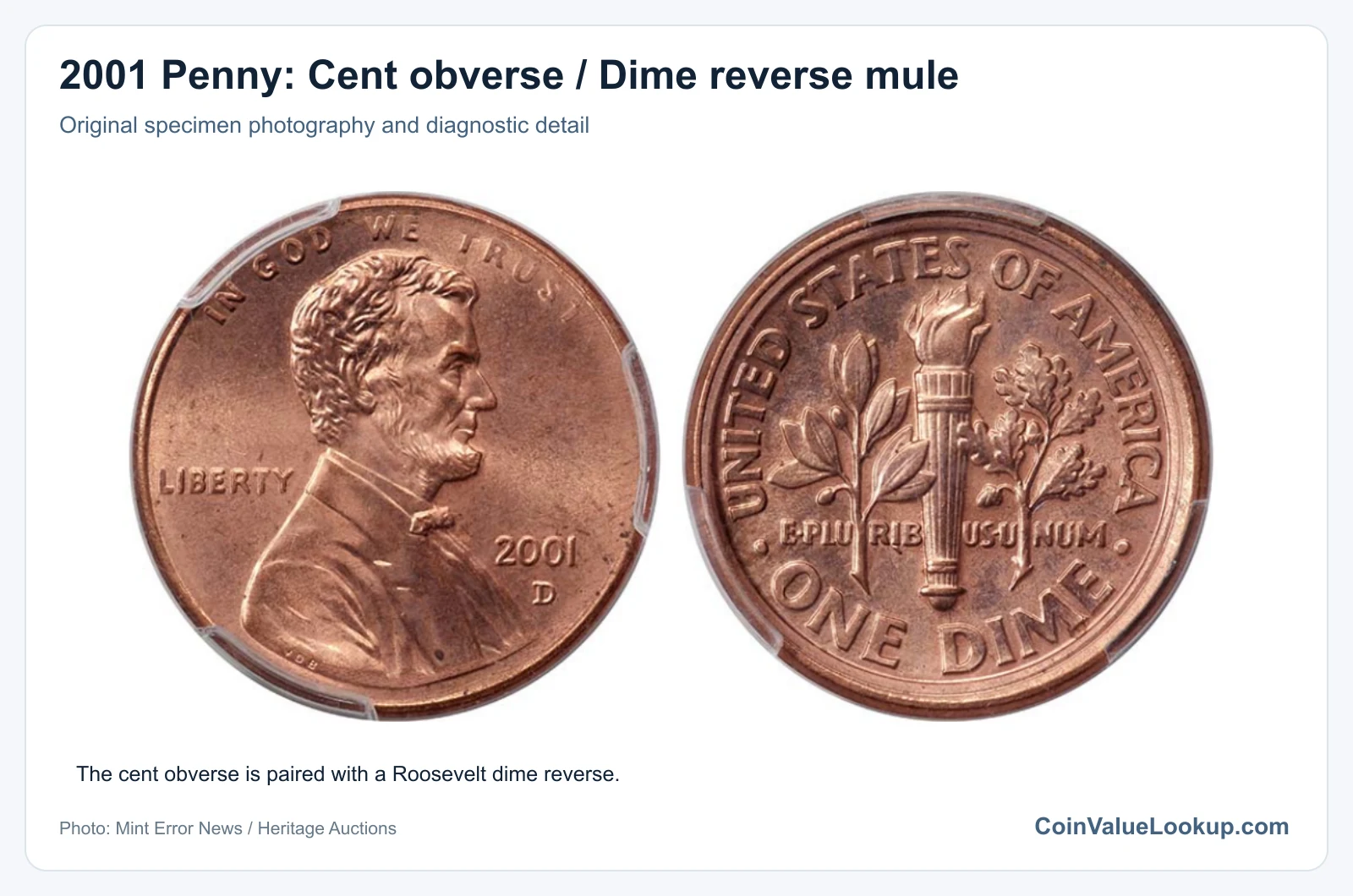
A mule error pairs two dies that were never intended to be used together. For the 2001-D cent, sources have reported a mule combining the Lincoln cent obverse with a Roosevelt dime reverse featuring the torch-and-branches design, instead of the expected Lincoln Memorial.
If you think you have one, photograph both sides and the edge carefully. The obverse should show Lincoln with the D mintmark and 2001 date, while the reverse would display the dime's torch and olive-oak branch design rather than the Memorial building.
Novelty coins made by gluing or machining two different coins together are the primary lookalike. Check the edge for a visible seam, unusual thickness, or signs of adhesive.
Do not assume authenticity from appearance alone — professional authentication is essential for a claim this significant. No supported price data or population information is available for this reported variety.