1898 Barber Dime Coin Value: How Much Is It Worth?
The 1898 Barber Dime was struck at three mints and also produced as a Philadelphia proof. Guide estimates for ordinary business strikes range from about $12.26 in G4 to $1,603 in MS63, depending on the mint.
A documented die-cap error exists for this date, but that is an exceptional piece, not something you will find in a typical junk-silver box.
Fast Way to Identify Your 1898 Barber Dime
Want a quick read on your 1898 dime? Upload clear photos of the front and back, and our identifier can give you a preliminary take on which mint and version you have.
Good lighting and a sharp image of any mintmark below the wreath on the reverse will help the most.
1898 Barber Dime Value
Upload both sides of your 1898 Barber Dime.
Front Obverse
Upload photo
Back Reverse
Upload photo
Which 1898 Barber Dime Versions Are Worth Money?
- The San Francisco (S) mint issue carries the highest guide value at MS63, listed at about $1,603, reflecting lower survival in top grades.
- The New Orleans (O) mint coin is valued around $1,348 at MS63, well above the Philadelphia issue in the same grade.
- Philadelphia proofs in PR63 are listed near $616; cameo or deep-cameo contrast examples are a separate category and should not be priced at this baseline.
- A documented off-center obverse die cap exists for the 1898 date and is a genuinely unusual error worth investigating if your coin looks dramatically cupped or misaligned.
Step 1: Identify Your 1898 Barber Dime Mint Mark and Version
The 1898 Barber Dime shows Charles Barber's right-facing Liberty head on the obverse and the words ONE DIME inside a cereal wreath on the reverse. Do not confuse it with the later Mercury (Winged Liberty) design or an older half dime.
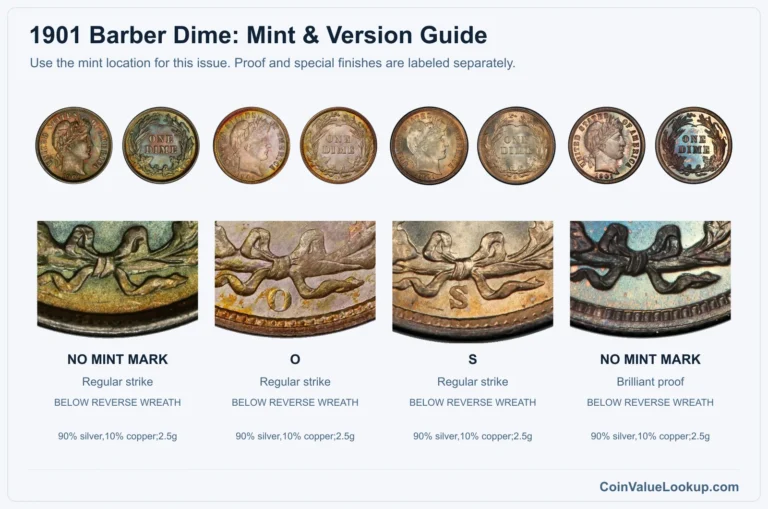
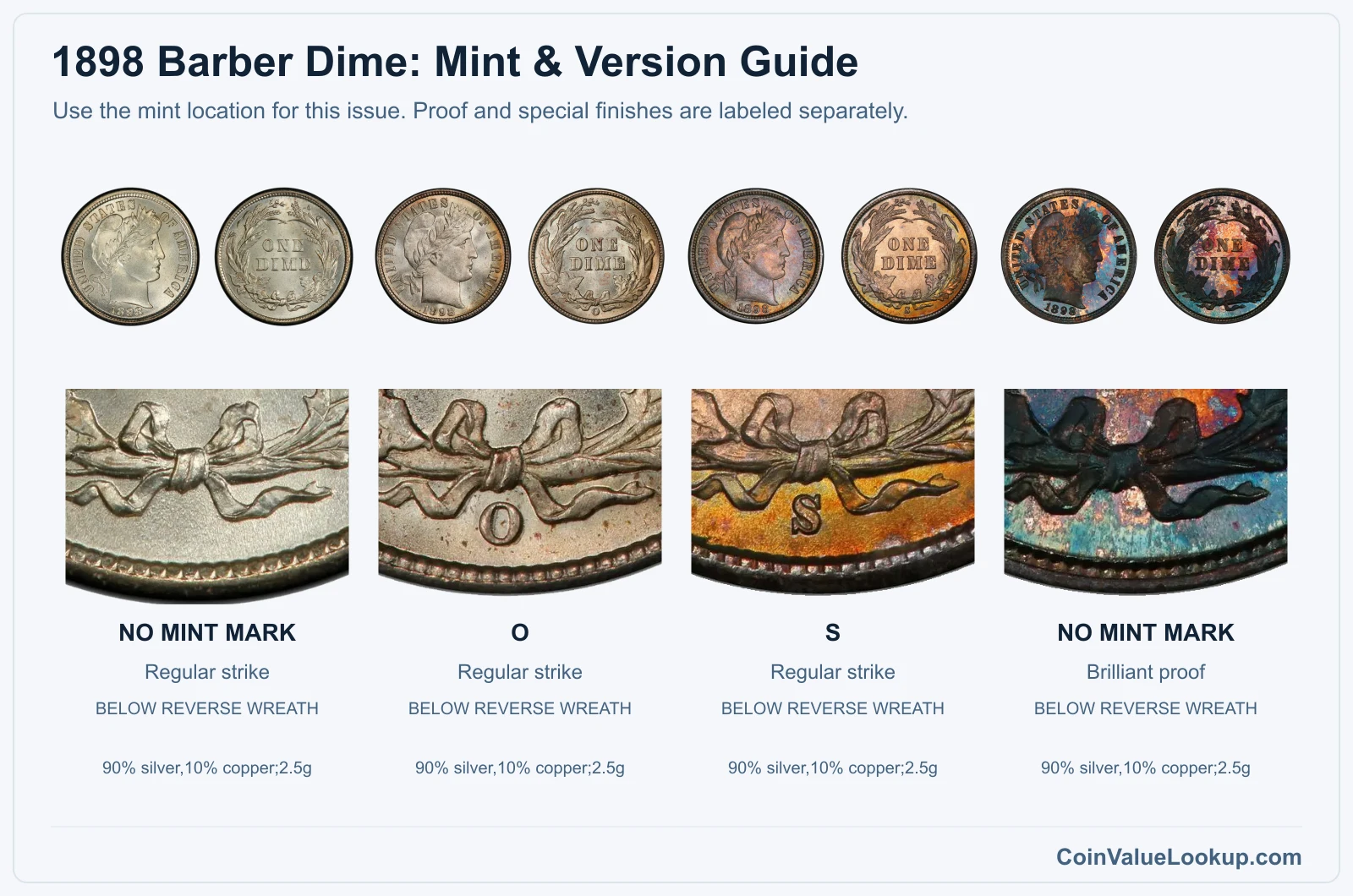
Three mints produced business strikes this year: Philadelphia, New Orleans, and San Francisco. The mintmark sits just below the ribbon bow at the bottom of the reverse wreath.
If there is no mintmark, it is a Philadelphia coin.
All normal 1898 dimes are 90% silver and 10% copper, weighing 2.5 grams with a diameter of 17.9 mm and a reeded edge. These specs apply to every mint and to the proof issue as well.
Coin Value Lookup is a handy starting point if you are trying to look up values for other dates or denominations in the Barber series. You can browse guides organized by coin type without needing to dig through auction archives.
Step 2: Check Your 1898 Barber Dime Grade
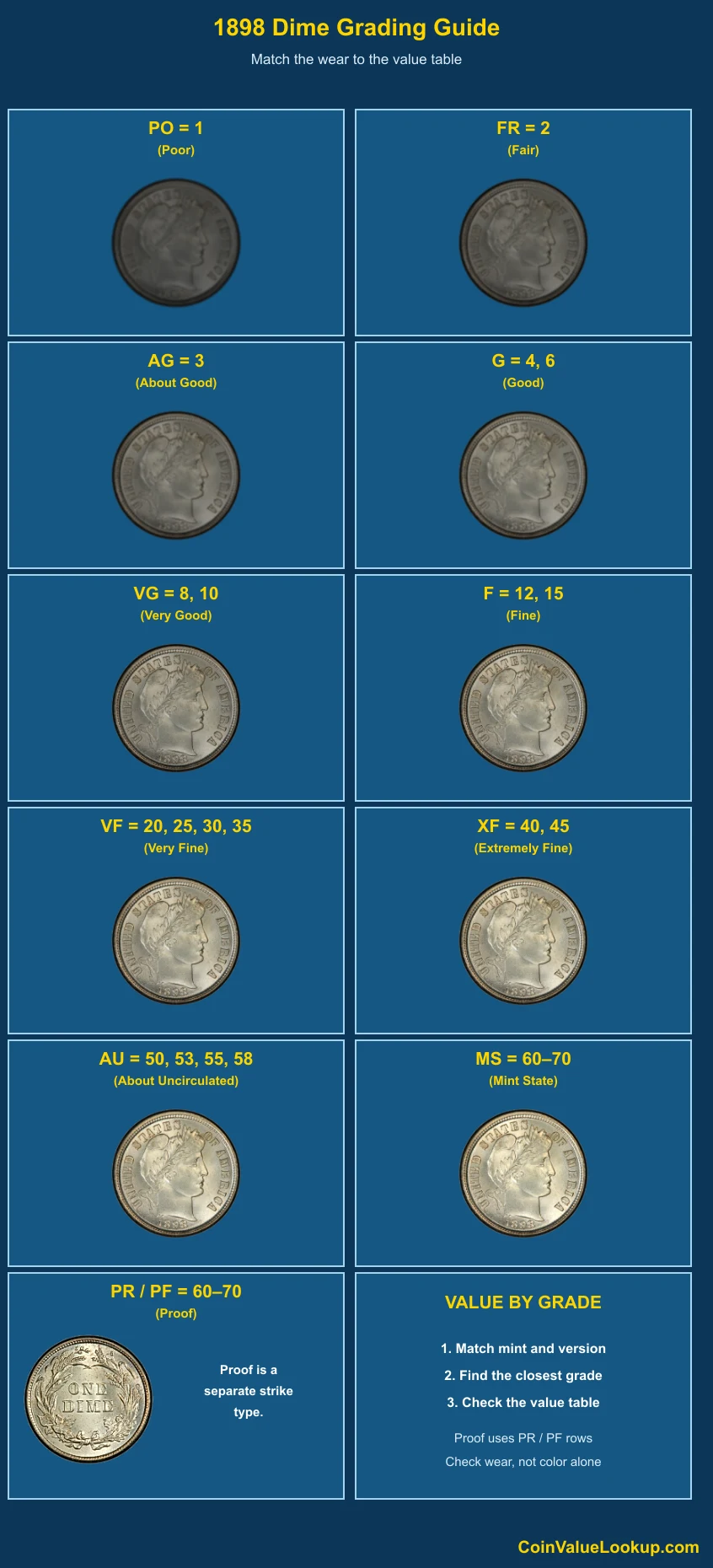
Grading a Barber Dime means looking at several areas together, not just counting how many letters of LIBERTY survive on the headband. Check the hair above the ear, the smoothness of the cheek, and the detail in the wreath leaves and ribbon on the reverse.
A coin in Good condition (G4) will have a clear date and outline of Liberty but most interior detail will be flat. By contrast, Mint State means full, unbroken luster across both sides with no wear on the high points at all.
New Orleans coins are sometimes softly struck from the factory, so a mushy headband does not always mean heavy circulation. Compare your coin to the reference image to judge actual wear versus original strike weakness.
Proof is not a grade above Mint State. It is a special manufacturing process producing mirrored fields and sharp rims.
Clean hairlines under magnification, even on a shiny coin, can indicate a cleaned or impaired proof rather than an untouched one.
Step 3: Check 1898 Barber Dime Value by Mint and Version
1898 Barber Dime — No Mint Mark — Silver Circulation
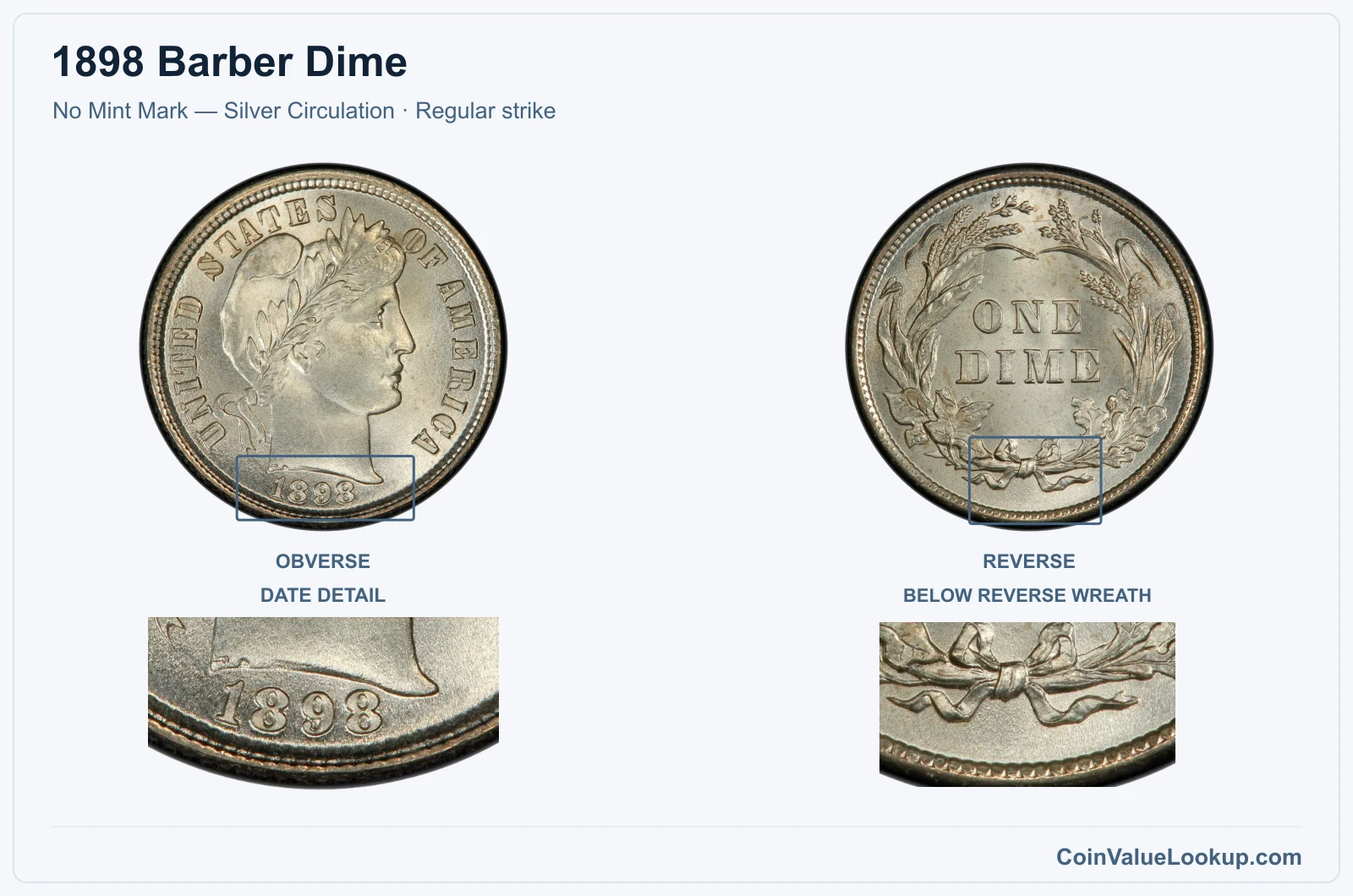
The Philadelphia 1898 Barber Dime has no mintmark. Look below the wreath bow on the reverse and you should see bare metal, nothing stamped there.
Guide estimates place this coin at about $12.26 in G4 and around $253 in MS63. That makes it the most affordable of the three mints at both ends.
Still, a well-preserved example with original toning and full luster is a solid coin. Check the actual surface for cleaning, scratches, or retoning before assuming grade.
Range Grade
Price Auction Records Appraisal PO PO 1
—
Coin Identifier FR FR 2
—
Coin Identifier AG AG 3
—
Coin Identifier G G 4
—
Coin Identifier
G 6
—
Coin Identifier VG VG 8
—
Coin Identifier
VG 10
—
Coin Identifier F F 12
—
Coin Identifier
F 15
—
Coin Identifier VF VF 20
—
Coin Identifier
VF 25
—
Coin Identifier
VF 30
—
Coin Identifier
VF 35
—
Coin Identifier XF XF 40
Coin Identifier
XF 45
—
Coin Identifier AU AU 50
—
Coin Identifier
AU 53
Coin Identifier
AU 55
Coin Identifier
AU 58
Coin Identifier MS MS 60
Coin Identifier
MS 61
Coin Identifier
MS 62
Coin Identifier
MS 63
Coin Identifier
MS 64
Coin Identifier
MS 65
Coin Identifier
MS 66
Coin Identifier
MS 67
Coin Identifier
MS 68
Coin Identifier
MS 69
—
—
—
MS 70
—
—
—
1898 Barber Dime — O — Silver Circulation
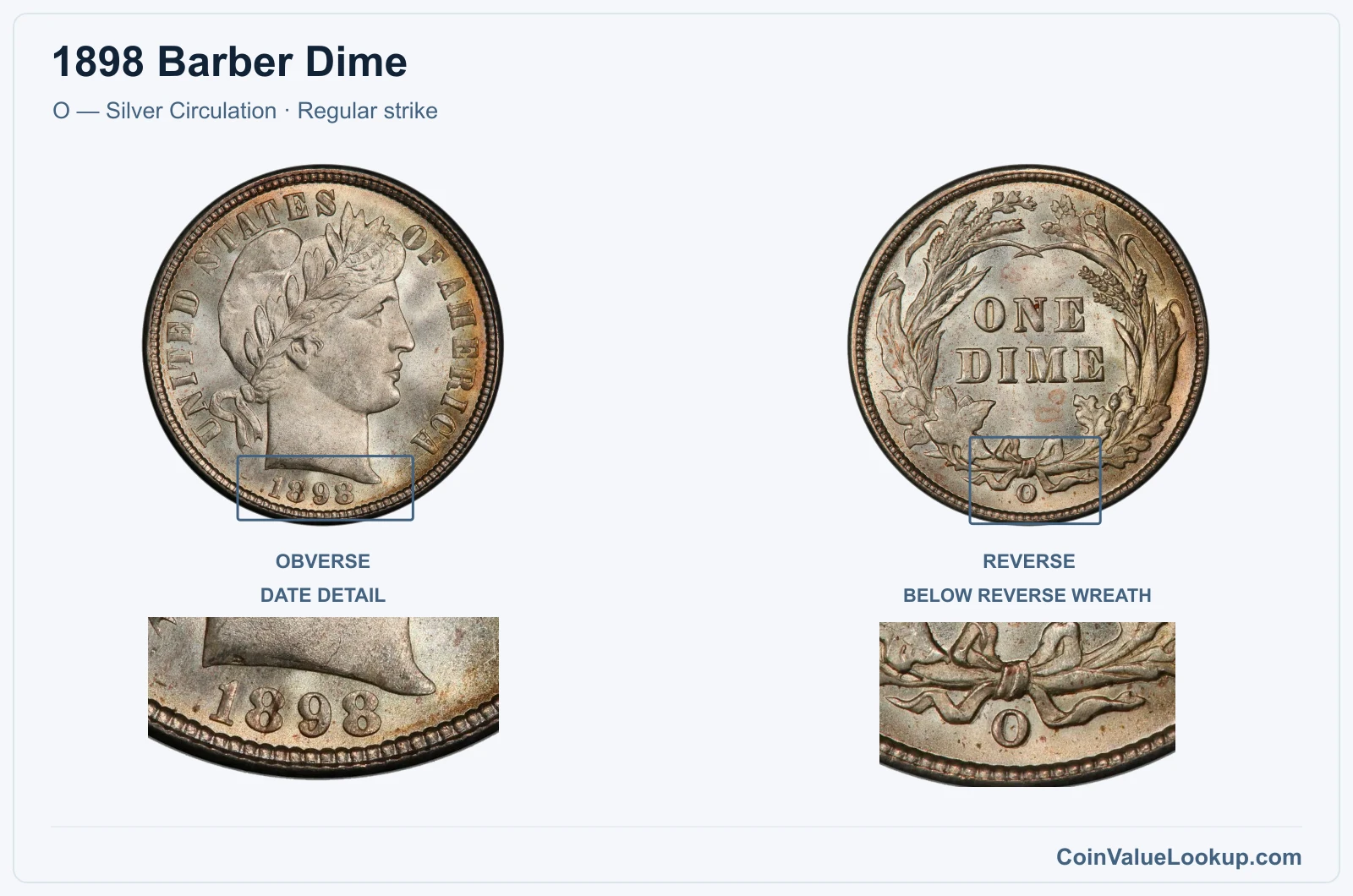
The New Orleans issue carries a small "O" mintmark below the wreath bow on the reverse. These coins are often found with softer strikes than their Philadelphia counterparts, so some loss of headband detail may be original.
Guide values run from about $22 at G4 up to roughly $1,348 at MS63, a significant jump that reflects how few survived in truly uncirculated condition. When grading an O-mint Barber Dime, compare strike sharpness carefully against known examples before downgrading for wear that might actually be a strike issue.
Range Grade
Price Auction Records Appraisal PO PO 1
—
Coin Identifier FR FR 2
—
Coin Identifier AG AG 3
—
Coin Identifier G G 4
—
Coin Identifier
G 6
Coin Identifier VG VG 8
—
Coin Identifier
VG 10
—
Coin Identifier F F 12
—
Coin Identifier
F 15
Coin Identifier VF VF 20
Coin Identifier
VF 25
Coin Identifier
VF 30
Coin Identifier
VF 35
Coin Identifier XF XF 40
Coin Identifier
XF 45
Coin Identifier AU AU 50
Coin Identifier
AU 53
Coin Identifier
AU 55
Coin Identifier
AU 58
Coin Identifier MS MS 60
Coin Identifier
MS 61
Coin Identifier
MS 62
Coin Identifier
MS 63
Coin Identifier
MS 64
Coin Identifier
MS 65
Coin Identifier
MS 66
Coin Identifier
MS 67
Coin Identifier
MS 68
Coin Identifier
MS 69
—
—
—
MS 70
—
—
—
1898 Barber Dime — S — Silver Circulation
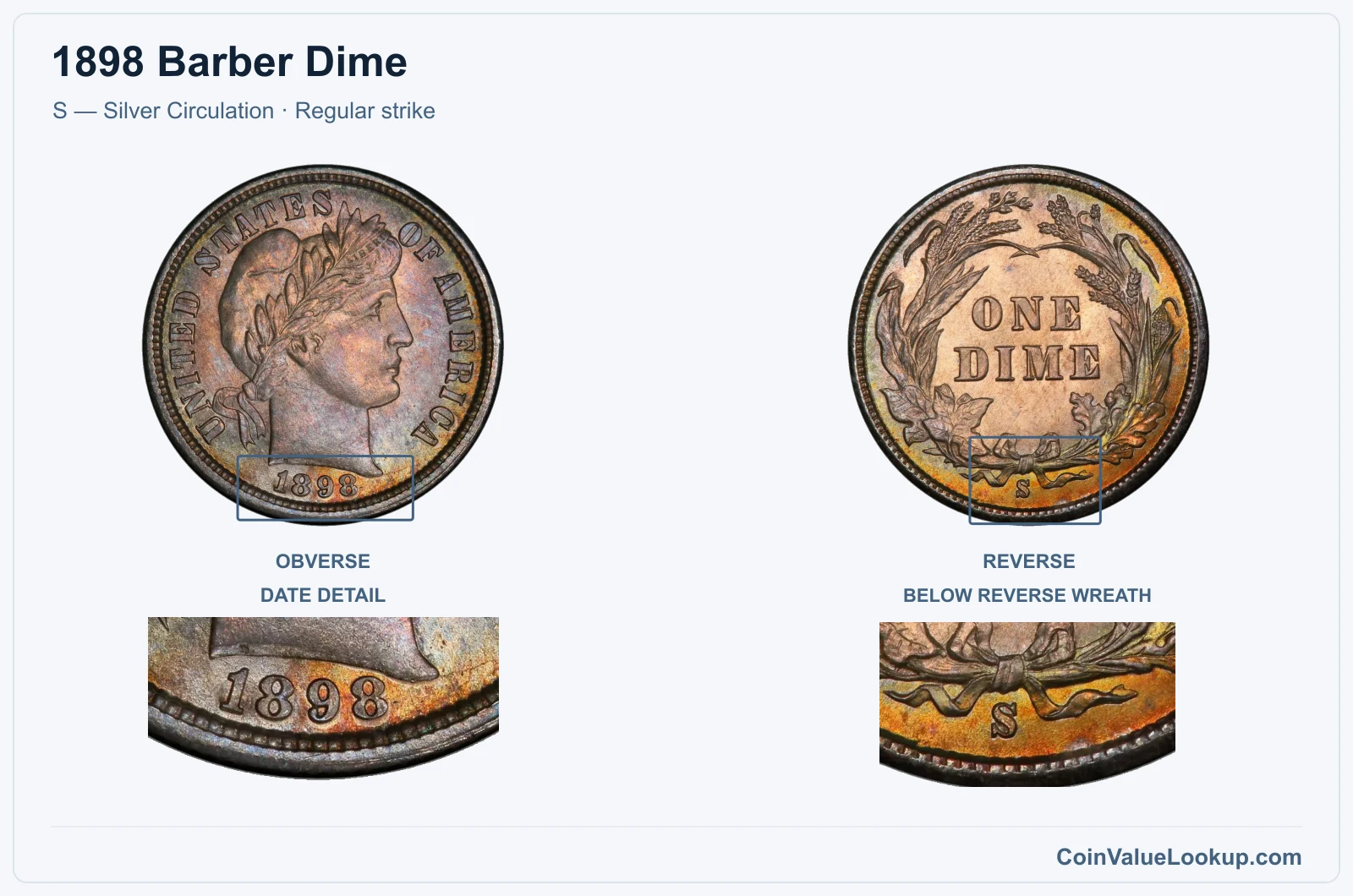
San Francisco coins show an "S" mintmark below the reverse wreath bow. This mint's 1898 dime carries the highest business-strike guide estimate at MS63, listed around $1,603.
At G4, the guide places it at about $16, which is modest. The spread between low-grade and high-grade values tells you that survivors in top condition are scarce.
A genuine MS63 example should have full, uninterrupted luster and minimal contact marks. If the coin looks cleaned or has muted surfaces, it will not command anywhere near that estimate.
Range Grade
Price Auction Records Appraisal PO PO 1
—
Coin Identifier FR FR 2
—
Coin Identifier AG AG 3
—
Coin Identifier G G 4
—
Coin Identifier
G 6
—
Coin Identifier VG VG 8
—
Coin Identifier
VG 10
—
Coin Identifier F F 12
—
Coin Identifier
F 15
—
Coin Identifier VF VF 20
—
Coin Identifier
VF 25
—
Coin Identifier
VF 30
Coin Identifier
VF 35
Coin Identifier XF XF 40
Coin Identifier
XF 45
Coin Identifier AU AU 50
Coin Identifier
AU 53
Coin Identifier
AU 55
Coin Identifier
AU 58
Coin Identifier MS MS 60
Coin Identifier
MS 61
—
Coin Identifier
MS 62
Coin Identifier
MS 63
Coin Identifier
MS 64
Coin Identifier
MS 65
Coin Identifier
MS 66
Coin Identifier
MS 67
Coin Identifier
MS 68
—
—
—
MS 69
—
—
—
MS 70
—
—
—
1898 Barber Dime — No Mint Mark — Brilliant Silver Proof
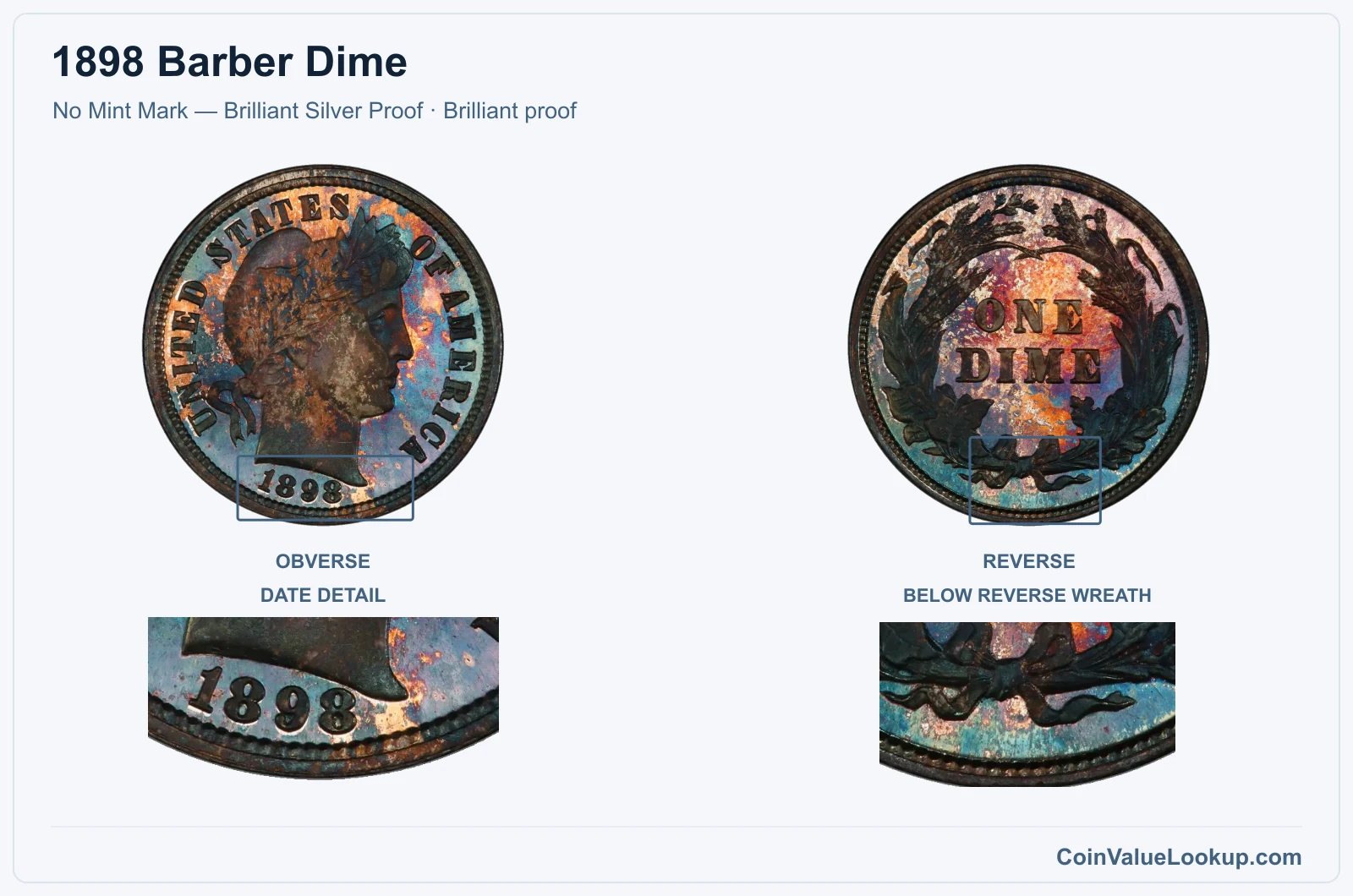
Philadelphia struck proof Barber Dimes for collectors throughout the series run. The 1898 proof has mirrored fields and crisply defined rims that distinguish it immediately from even a nice business strike.
A PR63 example is listed at approximately $616 in guide estimates. Cameo and Deep Cameo designations refer to the degree of frost contrast on the devices against the mirror fields; they are separate categories with their own pricing and should not be confused with the standard PR63 figure.
When examining a suspected proof, look for squared-off rims and fully reflective surfaces under a direct light source. Hairlines from old cleaning are the most common impairment.
Range Grade
Price Auction Records Appraisal PR PR 1
—
Coin Identifier
PR 2
—
Coin Identifier
PR 3
—
Coin Identifier
PR 4
—
Coin Identifier
PR 6
—
Coin Identifier
PR 8
—
Coin Identifier
PR 10
—
Coin Identifier
PR 12
—
Coin Identifier
PR 15
—
Coin Identifier
PR 20
—
Coin Identifier
PR 25
—
Coin Identifier
PR 30
—
Coin Identifier
PR 35
—
Coin Identifier
PR 40
—
Coin Identifier
PR 45
—
Coin Identifier
PR 50
—
Coin Identifier
PR 53
—
Coin Identifier
PR 55
—
Coin Identifier
PR 58
—
Coin Identifier
PR 60
Coin Identifier
PR 61
Coin Identifier
PR 62
Coin Identifier
PR 63
Coin Identifier
PR 64
Coin Identifier
PR 65
Coin Identifier
PR 66
Coin Identifier
PR 67
Coin Identifier
PR 68
Coin Identifier
PR 69
—
—
—
PR 70
—
—
—
1898 Barber Dime Error List
1. 1898 Barber Dime — Off-Center Obverse Die Cap
A die cap forms when a struck coin sticks to the upper (hammer) die and is struck repeatedly into subsequent blanks. Over time the trapped coin cups upward around the die, producing a distinctive bowl shape with a spread, off-center obverse design and a slightly misaligned reverse impression on the concave side.
This error has been reported specifically for the 1898 Dime date. If your coin is dramatically cupped with an expanded rim and distorted obverse lettering, it could be this type of piece.
Do not confuse a die cap with a coin that has been bent in a vise, sat under a heavy object, or simply received a weak strike. Post-mint damage lacks the progressive metal flow and die-impression transfer that a genuine cap displays.
No specific price range is available for this error; value depends heavily on the condition, the degree of the cap, and authentication by a professional grading service.