1903 Barber Dime Coin Value: How Much Is It Worth?
A 1903 Barber Dime can range from around $12.26 in well-worn Good-4 condition for a Philadelphia strike up to roughly $2,037 at MS63 for the scarcer San Francisco issue. Proofs and error varieties sit on their own pricing tracks.
Three mints produced business strikes this year, and the 1903-S stands out as a semi-key date in the series.
Whether you pulled this coin from a junk-silver lot or inherited a collection, knowing which mint and condition you have makes all the difference.
Fast Way to Identify Your 1903 Barber Dime
The quickest way to start figuring out what you have is to upload clear photos of both the front and back of your coin. Our identifier can give you a preliminary read on the mint, design type, and general condition from those images.
Snap them in good lighting, avoid glare, and try to keep the coin flat and centered.
1903 Barber Dime Value
Upload both sides of your 1903 Barber Dime.
Front Obverse
Upload photo
Back Reverse
Upload photo
Which 1903 Barber Dime Versions Are Worth Money?
- The 1903-S (San Francisco) is a semi-key date, with guide values around $121 at G4 and roughly $2,037 at MS63, making it the standout business strike this year.
- The 1903-O (New Orleans) carries a moderate premium over Philadelphia, listed near $15 at G4 and about $616 at MS63 in guide estimates.
- Philadelphia Proof examples in PR63 condition are listed around $616; contrast designations like Cameo or Deep Cameo are priced separately and should not be confused with a standard proof value.
- Repunched Date and Repunched Mintmark varieties have been reported for 1903 and can carry additional premiums depending on visibility and condition.
Step 1: Identify Your 1903 Barber Dime Mint Mark and Version
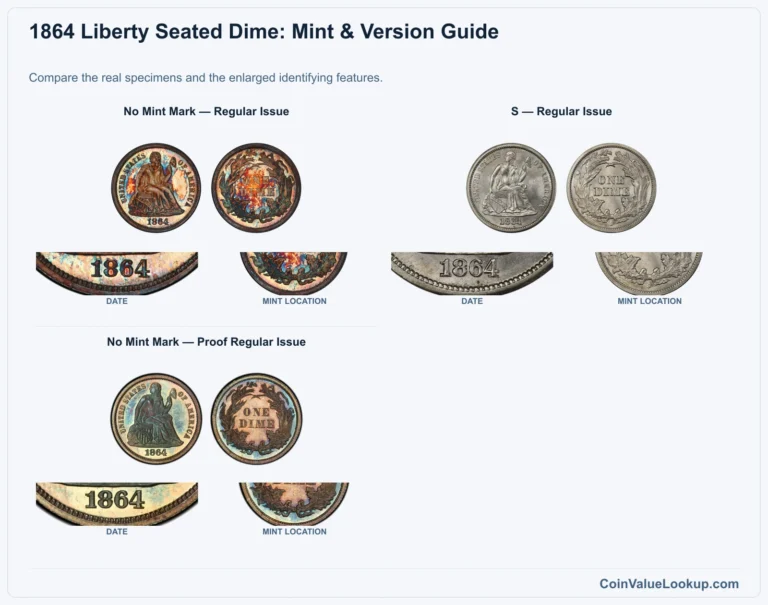
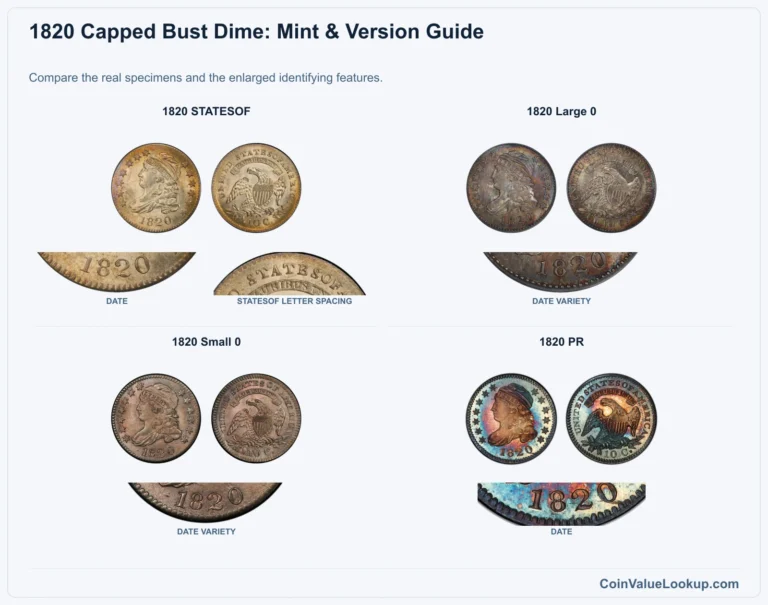
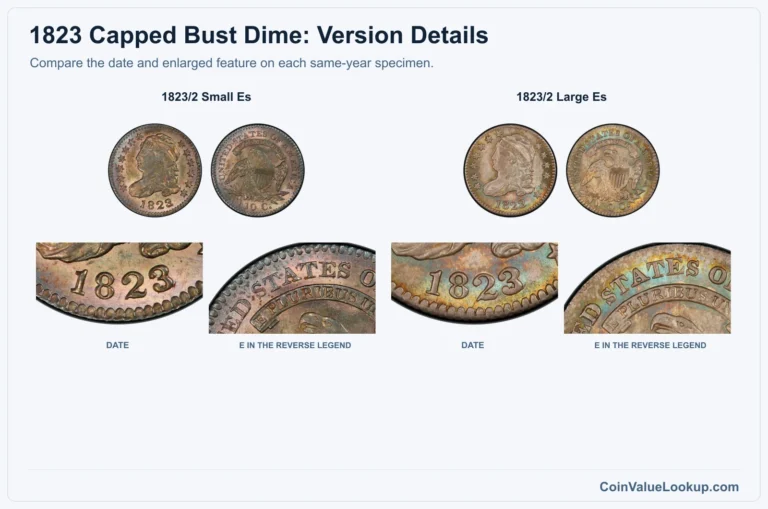
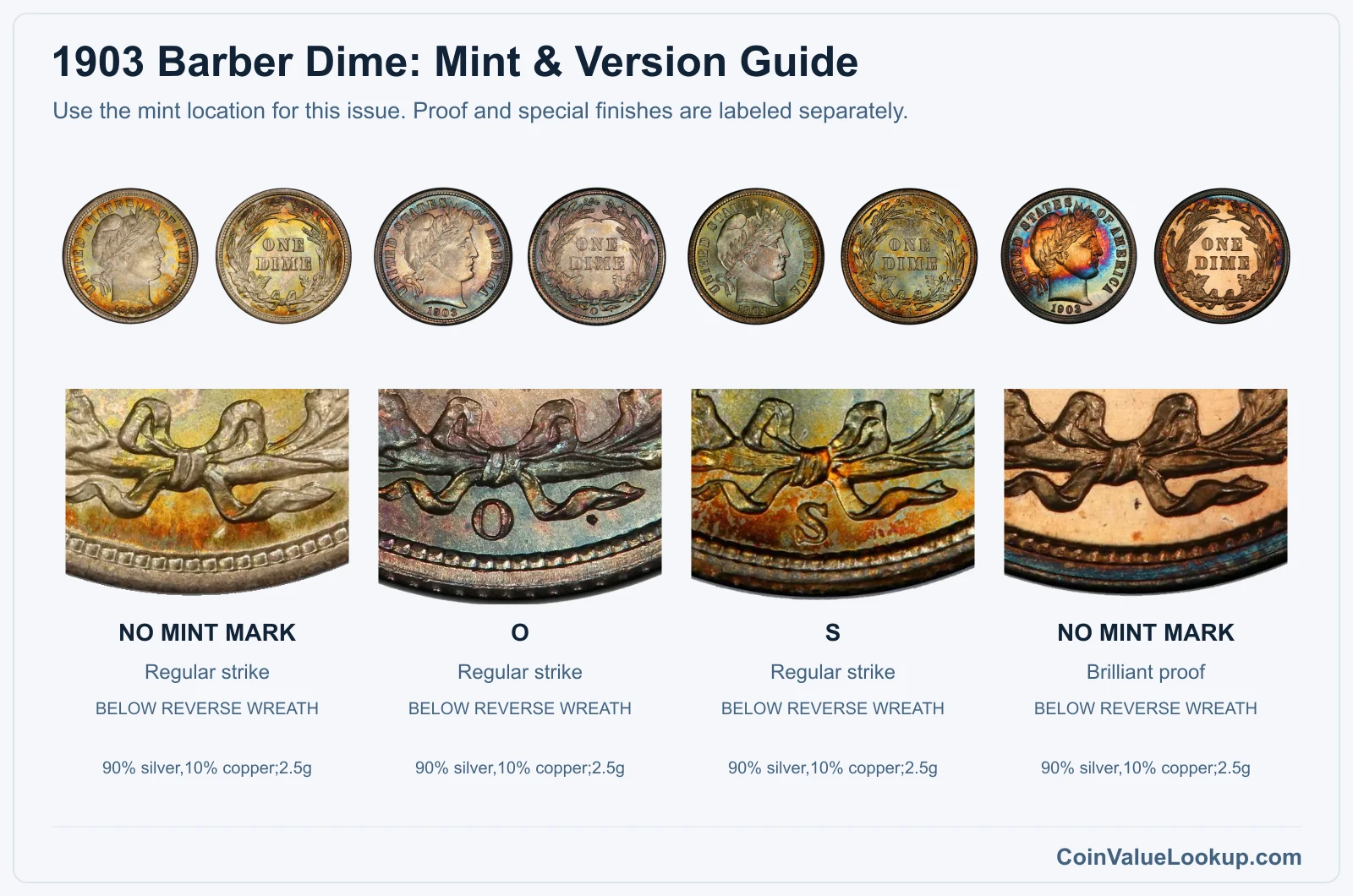
The 1903 Barber Dime shows Charles Barber's Liberty head facing right on the obverse, with "UNITED STATES OF AMERICA" around the rim. The reverse displays "ONE DIME" inside an open wreath tied with a bow at the bottom.
Do not confuse it with the later Mercury (Winged Liberty) dime or the much smaller half dime from earlier decades.
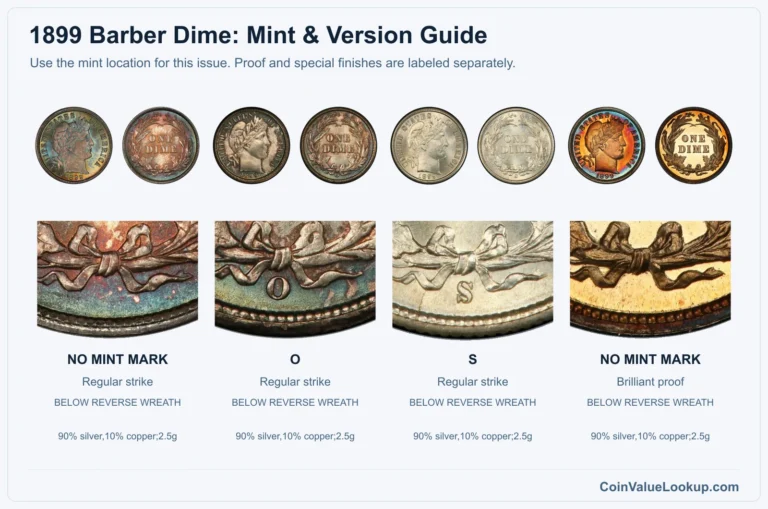
Three mints struck this coin for circulation: Philadelphia, New Orleans, and San Francisco. The mintmark sits on the reverse, just below the wreath's bow knot.
No mintmark means Philadelphia. An "O" means New Orleans, and an "S" means San Francisco.
All normal 1903 Barber Dimes are 90% silver and 10% copper, weighing 2.5 grams with a diameter of 17.9 mm and a reeded edge. The 1903-S is considered a semi-key date in the series because of its lower survival rate in higher grades.
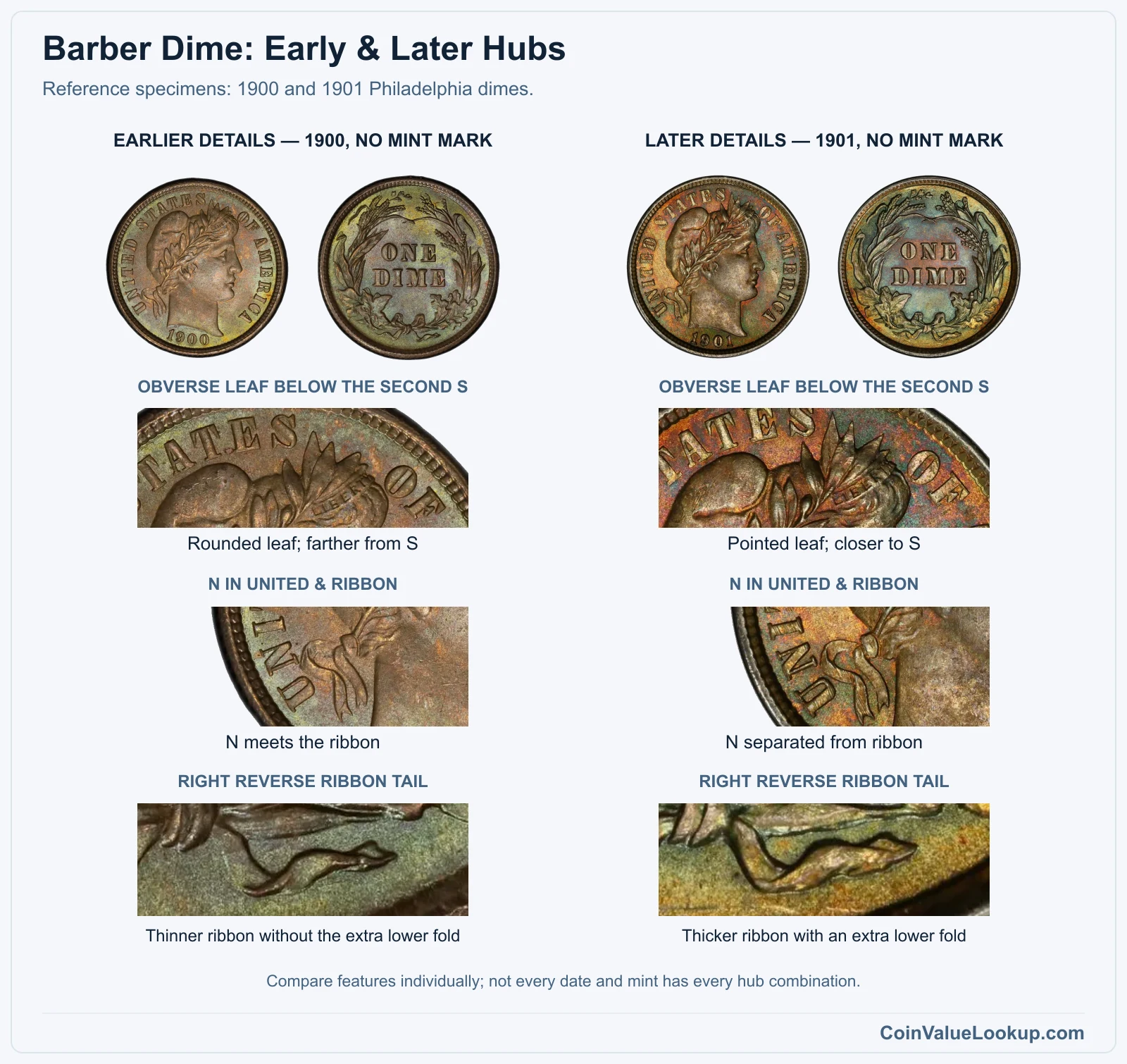
One thing to be aware of: an earlier reverse hub style can appear on some 1903 dimes due to the Mint's transition around 1900-1901 that changed small details in the ribbon and leaf tips. Inspect your actual coin rather than assuming every example from a given mint uses the same hub combination.
Repunched date and repunched mintmark varieties also exist for this year and are separate from normal hub styles.
Step 2: Check Your 1903 Barber Dime Grade
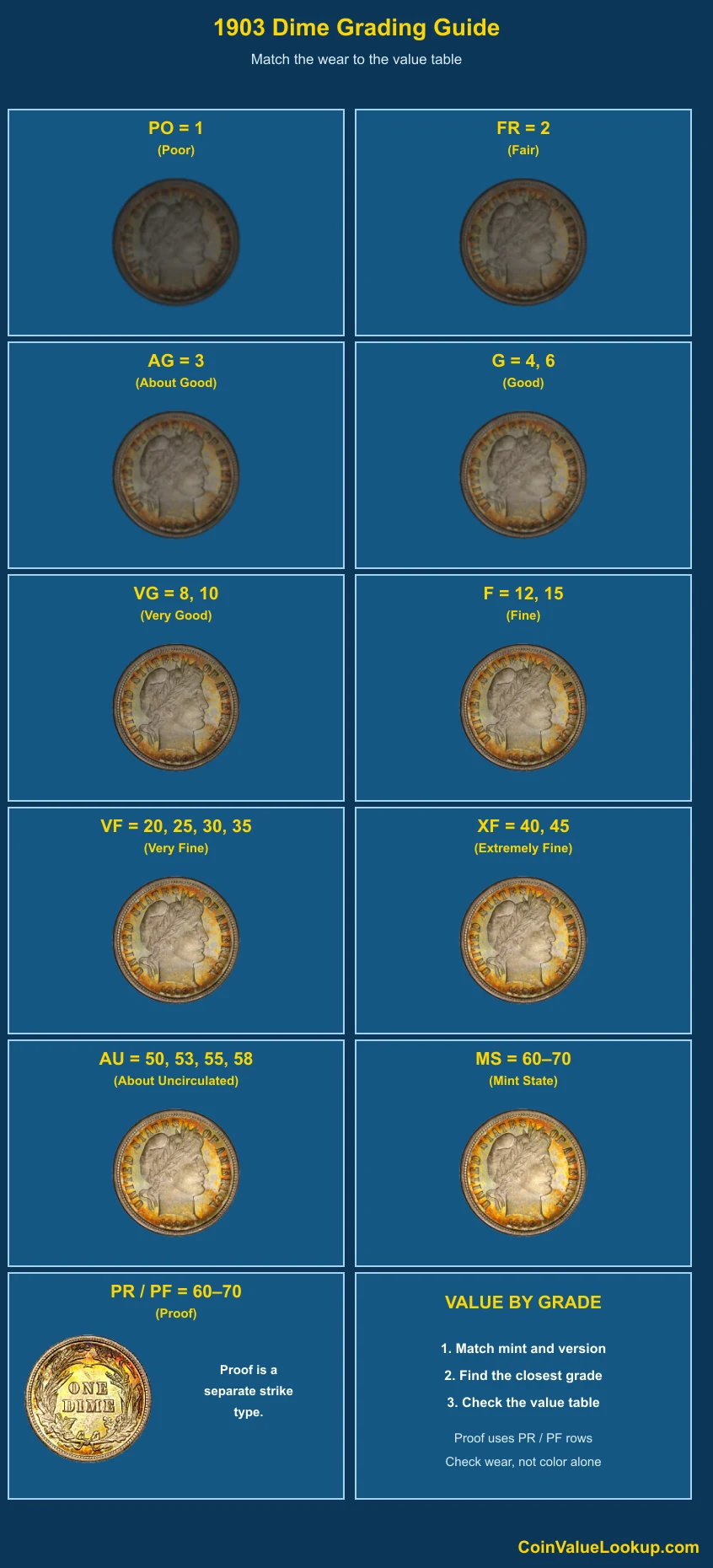
Grading a Barber Dime means reading the wear across several areas at once, not just counting letters in "LIBERTY" on the headband. Start with the headband itself: on a sharp example every letter is complete, while on a well-circulated coin they blur or vanish entirely.
Then check the hair above the ear, the smoothness of the cheek, and the leaf detail in the reverse wreath.
A coin grading around Good-4 will show a clear outline of Liberty's head and the date, but most interior detail is gone. At Fine-12, partial letters in "LIBERTY" appear, and the wreath shows moderate detail.
Mint State requires unbroken original luster across both sides. Look carefully for hairlines from old cleanings, which kill luster and lower the grade.
New Orleans strikes can come softly struck from the factory, so weak detail on an O-mint coin does not always mean heavy wear. Compare your coin against the reference image to see how wear progresses on this specific type.
Proof is a manufacturing method, not a grade above Mint State. Proofs have mirrored fields and sharply defined rims from specially prepared dies and planchets.
Step 3: Check 1903 Barber Dime Value by Mint and Version
1903 Barber Dime — No Mint Mark — Silver Circulation
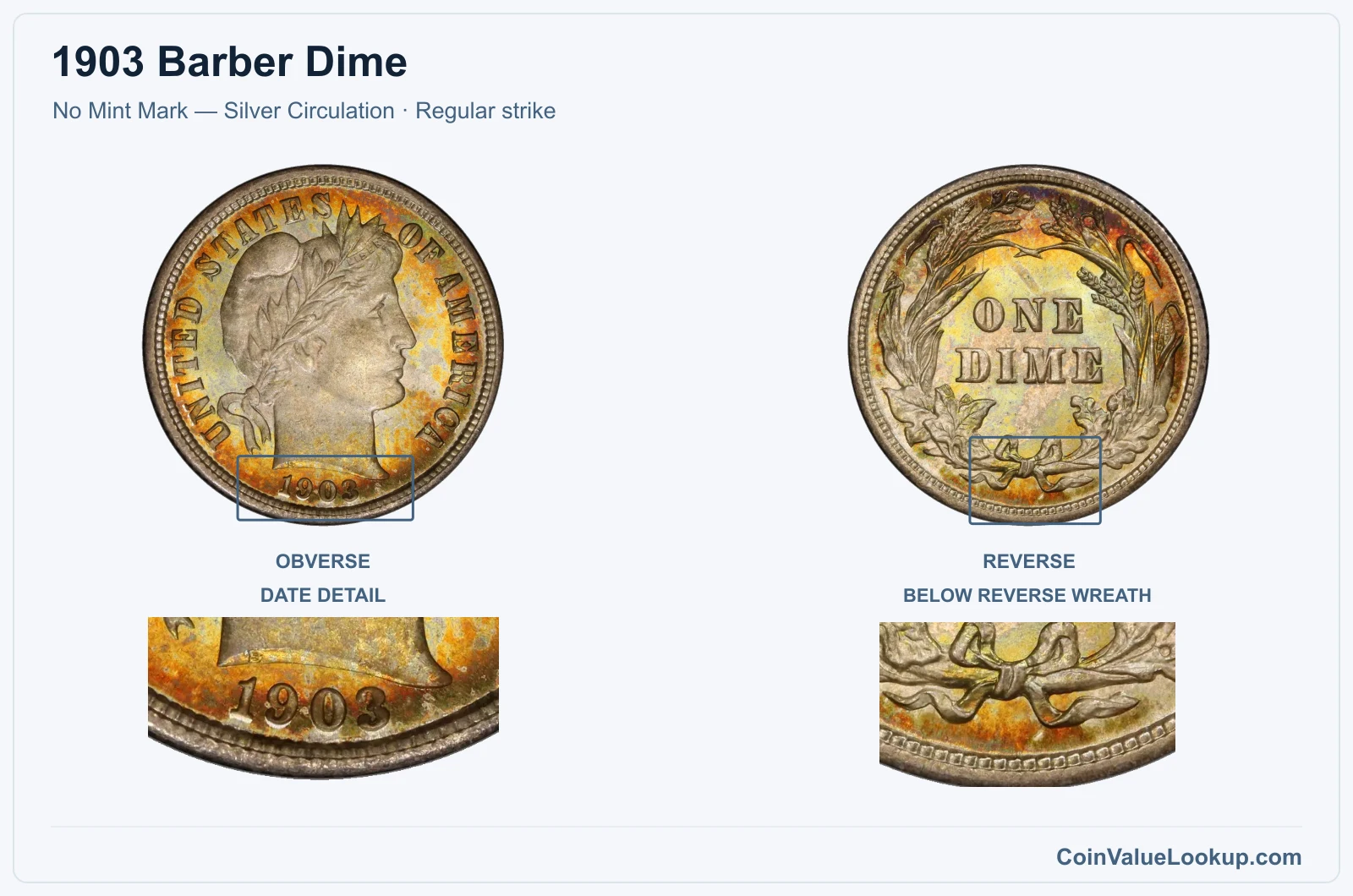
The 1903 Philadelphia Barber Dime has no mintmark on the reverse. It is the most common issue this year and the easiest to find in circulated grades.
USA Coin Book guide estimates place this coin at about $12.26 in G4 and around $253 at MS63. Those figures are retail snapshots, not guaranteed sale prices.
Much of the value in lower grades comes from the silver content alone, so condition really matters here.
Look for a fully dated obverse and check the reverse below the wreath bow to confirm no mintmark is present. Eye appeal, original surfaces, and the absence of cleaning all affect what a given coin will bring.
Range Grade
Price Auction Records Appraisal PO PO 1
—
Coin Identifier FR FR 2
—
Coin Identifier AG AG 3
—
Coin Identifier G G 4
—
Coin Identifier
G 6
—
Coin Identifier VG VG 8
—
Coin Identifier
VG 10
—
Coin Identifier F F 12
—
Coin Identifier
F 15
—
Coin Identifier VF VF 20
—
Coin Identifier
VF 25
—
Coin Identifier
VF 30
—
Coin Identifier
VF 35
—
Coin Identifier XF XF 40
Coin Identifier
XF 45
Coin Identifier AU AU 50
Coin Identifier
AU 53
—
Coin Identifier
AU 55
Coin Identifier
AU 58
Coin Identifier MS MS 60
—
Coin Identifier
MS 61
Coin Identifier
MS 62
Coin Identifier
MS 63
Coin Identifier
MS 64
Coin Identifier
MS 65
Coin Identifier
MS 66
Coin Identifier
MS 67
Coin Identifier
MS 68
—
—
—
MS 69
—
—
—
MS 70
—
—
—
1903 Barber Dime — O — Silver Circulation
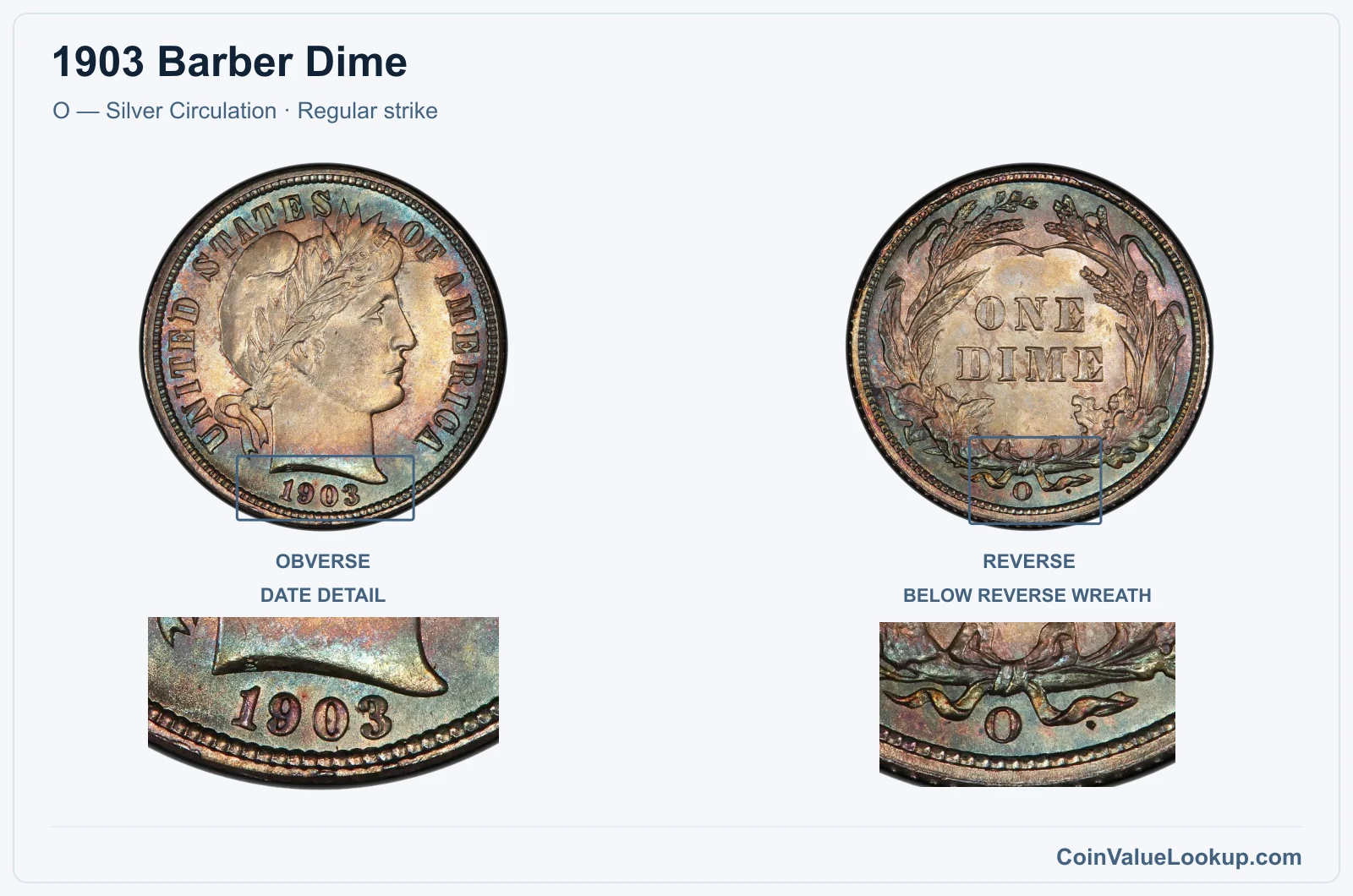
The 1903-O was struck at New Orleans and carries a small "O" mintmark below the wreath bow on the reverse. Guide estimates from USA Coin Book put it near $15 at G4 and roughly $616 at MS63, a meaningful step above the Philadelphia issue.
New Orleans Barber Dimes are notorious for soft strikes that can make the headband and hair detail look more worn than they actually are. Do not downgrade a coin just because the strike is mushy; compare it to known O-mint examples rather than sharp Philadelphia pieces.
Make sure you see a clear "O" mintmark, since a worn or damaged area can sometimes be misread. A genuine O-mint coin in nice condition is worth the extra attention.
Range Grade
Price Auction Records Appraisal PO PO 1
—
Coin Identifier FR FR 2
—
Coin Identifier AG AG 3
—
Coin Identifier G G 4
—
Coin Identifier
G 6
—
Coin Identifier VG VG 8
—
Coin Identifier
VG 10
—
Coin Identifier F F 12
—
Coin Identifier
F 15
—
Coin Identifier VF VF 20
—
Coin Identifier
VF 25
Coin Identifier
VF 30
—
Coin Identifier
VF 35
Coin Identifier XF XF 40
Coin Identifier
XF 45
Coin Identifier AU AU 50
Coin Identifier
AU 53
Coin Identifier
AU 55
Coin Identifier
AU 58
Coin Identifier MS MS 60
Coin Identifier
MS 61
Coin Identifier
MS 62
Coin Identifier
MS 63
Coin Identifier
MS 64
Coin Identifier
MS 65
Coin Identifier
MS 66
Coin Identifier
MS 67
Coin Identifier
MS 68
—
—
—
MS 69
—
—
—
MS 70
—
—
—
1903 Barber Dime — S — Silver Circulation
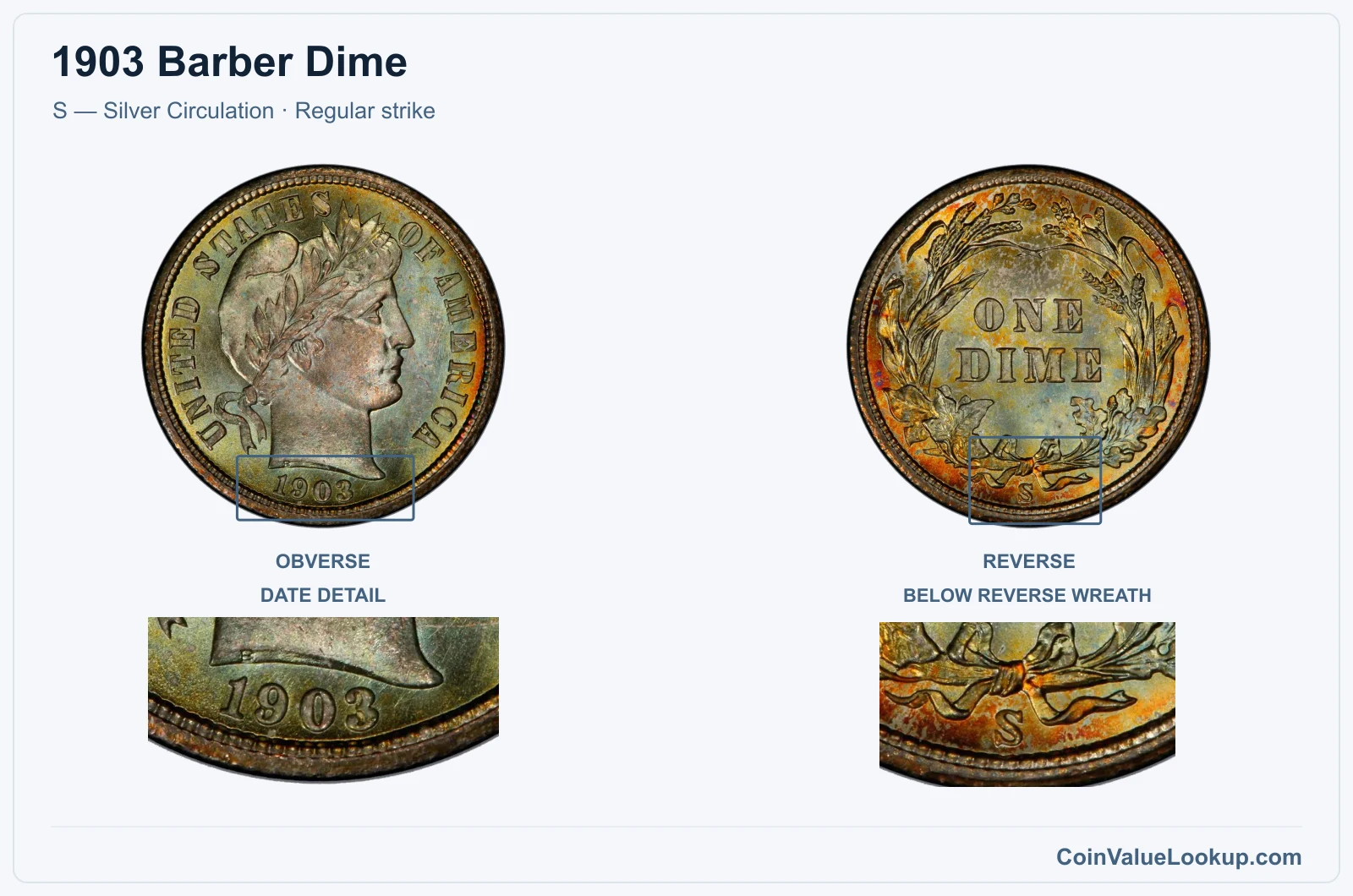
This is the one to watch. The 1903-S is a semi-key date in the Barber Dime series, and it carries the highest business-strike premiums for the year.
USA Coin Book guide values list it at about $121 in G4 and roughly $2,037 at MS63.
The "S" mintmark sits below the wreath bow on the reverse. Confirm it is a clear "S" and not a damaged area or environmental buildup.
Surviving examples in Mint State are genuinely scarce, which is why the jump from circulated to uncirculated pricing is so steep.
If you suspect you have a 1903-S, handle it carefully and avoid cleaning. Even a lightly circulated example is worth substantially more than its Philadelphia or New Orleans counterparts in the same grade.
Coin Value Lookup is a good starting point if you want to compare this coin against other dates and mints in the Barber Dime series.
Range Grade
Price Auction Records Appraisal PO PO 1
—
Coin Identifier FR FR 2
—
Coin Identifier AG AG 3
Coin Identifier G G 4
Coin Identifier
G 6
Coin Identifier VG VG 8
Coin Identifier
VG 10
Coin Identifier F F 12
Coin Identifier
F 15
Coin Identifier VF VF 20
Coin Identifier
VF 25
Coin Identifier
VF 30
Coin Identifier
VF 35
Coin Identifier XF XF 40
Coin Identifier
XF 45
Coin Identifier AU AU 50
Coin Identifier
AU 53
Coin Identifier
AU 55
Coin Identifier
AU 58
Coin Identifier MS MS 60
—
Coin Identifier
MS 61
Coin Identifier
MS 62
Coin Identifier
MS 63
Coin Identifier
MS 64
Coin Identifier
MS 65
Coin Identifier
MS 66
Coin Identifier
MS 67
Coin Identifier
MS 68
—
—
—
MS 69
—
—
—
MS 70
—
—
—
1903 Barber Dime — No Mint Mark — Brilliant Silver Proof
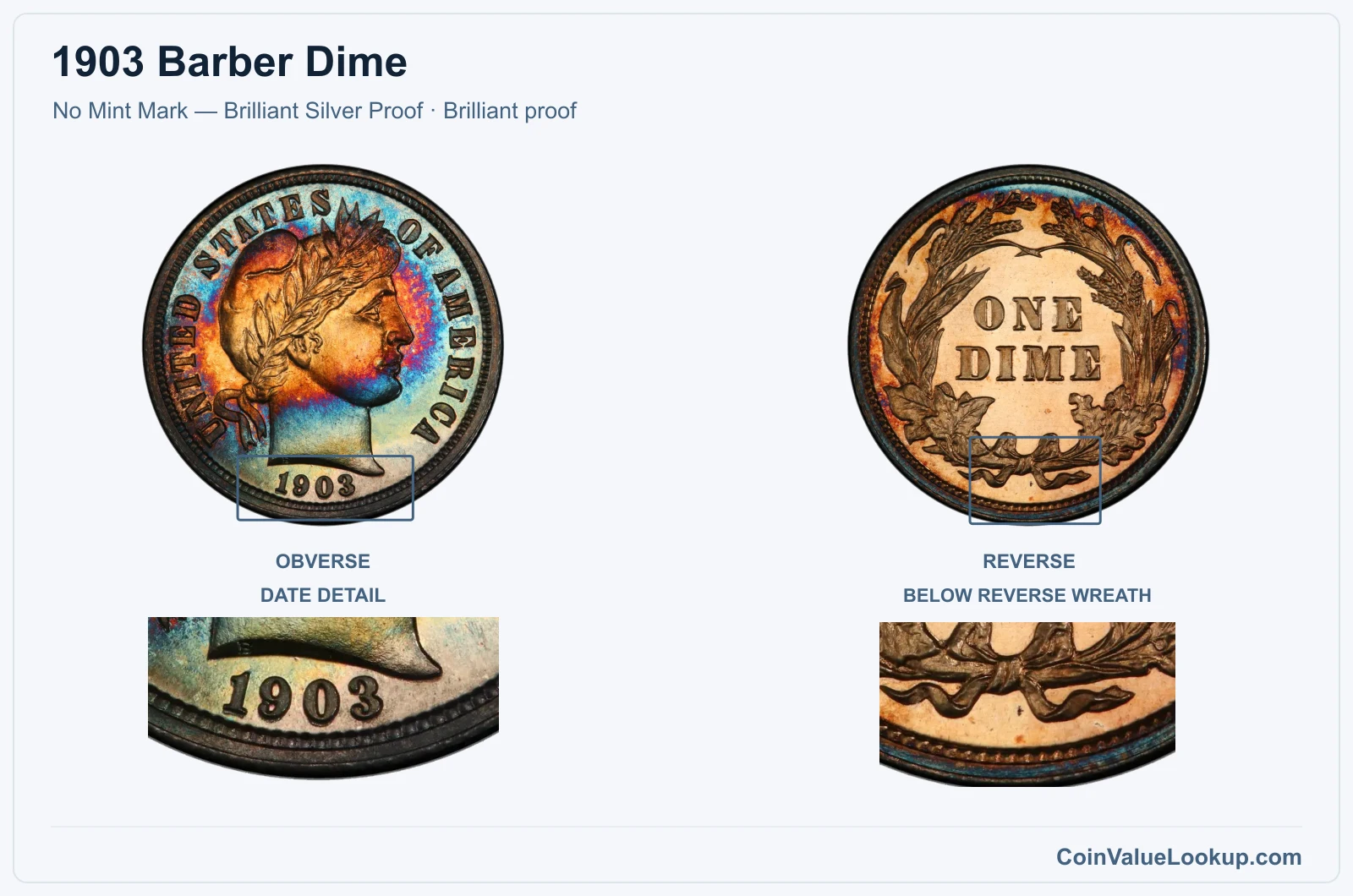
Philadelphia struck proof Barber Dimes from 1892 through 1915, and the 1903 is part of that run. These coins have mirrored fields and sharp rims produced by specially prepared dies.
USA Coin Book lists the 1903 Proof at about $616 in PR63. Cameo and Deep Cameo designations reflect the degree of contrast between frosted devices and mirror fields; they carry different premiums and should not be priced using the standard PR63 figure.
Contrast on proofs from this era tends to be weaker compared to earlier dates in the series. A genuine proof will show squared-off rims and a glassy field finish that circulated coins simply do not have, regardless of how well preserved they appear.
Range Grade
Price Auction Records Appraisal PR PR 1
—
Coin Identifier
PR 2
—
Coin Identifier
PR 3
—
Coin Identifier
PR 4
—
Coin Identifier
PR 6
—
Coin Identifier
PR 8
—
Coin Identifier
PR 10
—
Coin Identifier
PR 12
—
Coin Identifier
PR 15
—
Coin Identifier
PR 20
—
Coin Identifier
PR 25
—
Coin Identifier
PR 30
—
Coin Identifier
PR 35
—
Coin Identifier
PR 40
—
Coin Identifier
PR 45
—
Coin Identifier
PR 50
—
Coin Identifier
PR 53
—
Coin Identifier
PR 55
—
Coin Identifier
PR 58
—
Coin Identifier
PR 60
Coin Identifier
PR 61
Coin Identifier
PR 62
Coin Identifier
PR 63
Coin Identifier
PR 64
Coin Identifier
PR 65
Coin Identifier
PR 66
Coin Identifier
PR 67
Coin Identifier
PR 68
Coin Identifier
PR 69
—
—
—
PR 70
—
—
—
1903 Barber Dime Error List
1. 1903 Barber Dime — Repunched Date
A Repunched Date (RPD) on a 1903 Barber Dime shows remnants of an earlier date-punch position visible beside or beneath the final numerals. The die was punched more than once during setup, and the first impression was not perfectly aligned with the second.
You will see faint traces of extra digits, often most visible on the "9" or "3."
This is different from doubling of the entire design, which involves the hub rather than the individual date punch. Look under magnification for ghost-like outlines near the date that do not match the final position.
Do not confuse this with a damaged date caused by a hit or scratch on the coin itself, or with flat machine doubling that shows shelf-like displacement without distinct separation. The value of a repunched date depends on visibility, the specific variety, and the coin's overall condition.
2. 1903 Barber Dime — Repunched Mintmark
A Repunched Mintmark (RPM) on a 1903 Barber Dime means the mintmark punch was applied to the working die more than once, leaving traces of a prior position near the final letter. Look at the mintmark area below the reverse wreath bow under magnification for a faint secondary impression offset from the primary mark.
Compare your coin at the same magnification to a normal example so you can see the difference clearly. A genuine RPM shows a distinct second outline of the letter, not just a fuzzy edge.
This should not be confused with machine doubling, which produces flat shelf-like distortion, or with die chips and corrosion that can create bumps or pitting around the mintmark. The premium for an RPM depends on how dramatic the repunching is, the coin's grade, and collector demand for that specific variety.