1915 Barber Dime Coin Value: How Much Is It Worth?
The 1915 Barber dime is the final year this design appeared alongside proof production at Philadelphia. Guide estimates for ordinary business strikes range from about $10.42 in G4 to $441 in MS63, depending on the mint.
Only Philadelphia and San Francisco produced circulation strikes this year, so the field is narrow but worth understanding.
Fast Way to Identify Your 1915 Barber Dime
Upload clear photos of both the front and back of your coin. This gives a preliminary identification of the mint, general condition, and whether any obvious variety or error is present.
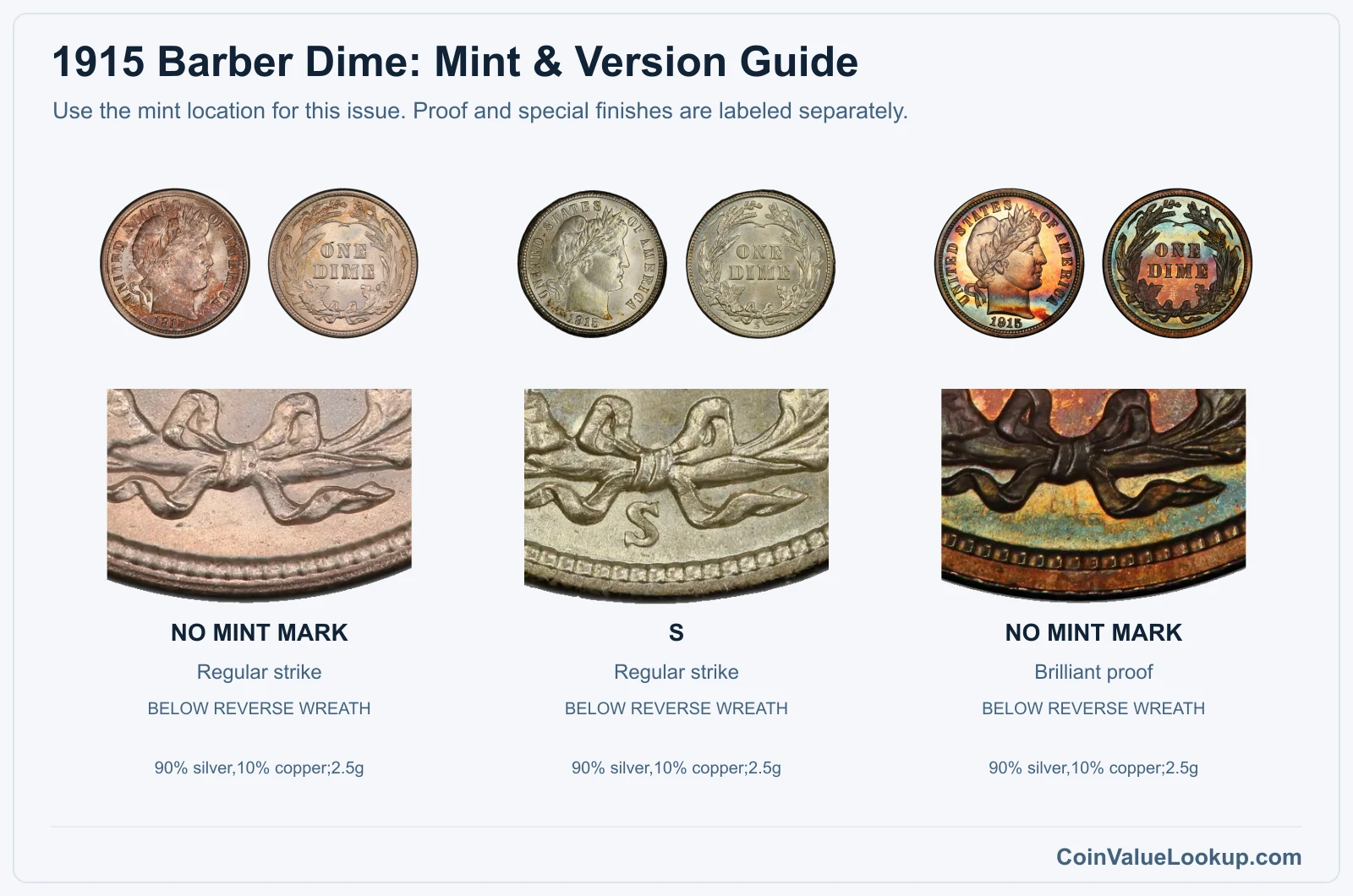
Make sure the mintmark area below the wreath bow on the reverse is in focus, since that small detail matters for sorting your coin.
1915 Barber Dime Value
Upload both sides of your 1915 Barber Dime.
Front Obverse
Upload photo
Back Reverse
Upload photo
Which 1915 Barber Dime Versions Are Worth Money?
- Philadelphia business strikes range from about $10.42 at G4 to $253 at MS63 — uncirculated examples with original surfaces carry the strongest premiums.
- San Francisco (S mint) business strikes guide higher, from about $18 at G4 to $441 at MS63, reflecting the mintmark premium.
- Philadelphia proofs from 1915, the final Barber proof year, guide around $616 at PR63.
- Check for repunched mintmarks, off-center strikes, and lamination errors, which are reported for this date and can add value depending on condition and visibility.
Step 1: Identify Your 1915 Barber Dime Mint Mark and Version
The 1915 Barber dime shows Liberty facing right on the obverse, wearing a cap with a headband inscribed LIBERTY. The reverse reads ONE DIME inside an open wreath tied with a bow at the bottom.
Only two mints struck circulation coins this year: Philadelphia (no mintmark) and San Francisco (S). Look on the reverse, just below the wreath bow, for the small S.
If there is no letter, you have a Philadelphia coin.
The coin is 90% silver and 10% copper, weighs 2.5 grams, and measures 17.9 mm across with a reeded edge. Do not confuse it with the Mercury dime, which replaced the Barber design starting in late 1916, or with earlier half-dime types.
Philadelphia also struck proof versions in 1915, making this the last year for Barber dime proofs. That distinction is covered separately below.
Step 2: Check Your 1915 Barber Dime Grade
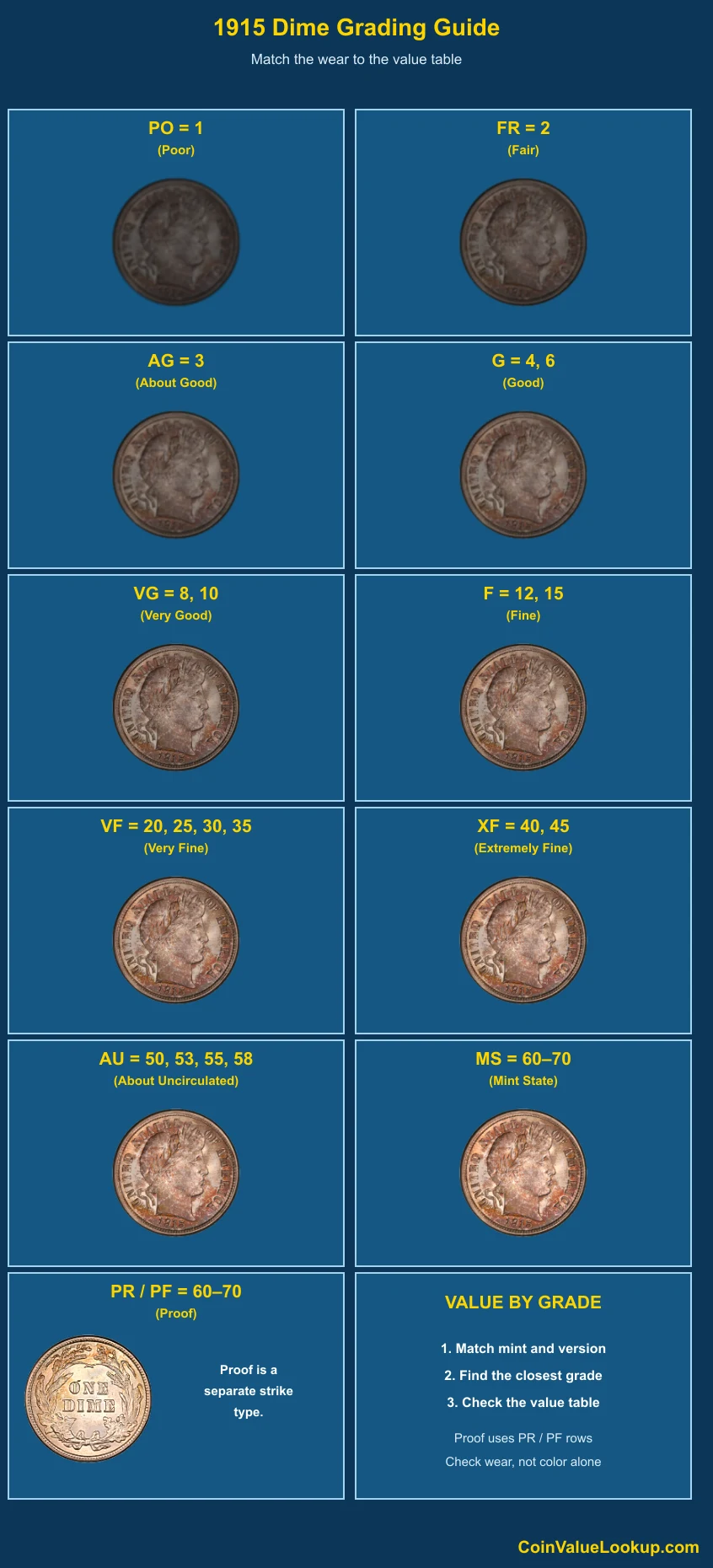
Grading a Barber dime means reading actual wear across several areas, not just counting letters on the headband. Start with the LIBERTY inscription: on a well-worn coin those letters disappear from the top down, but a softly struck example can look weak even without much circulation.
Check Liberty's cheek and the hair above her ear. Flat spots there signal real wear.
On the reverse, look at the wreath leaves for loss of detail.
Mint State requires unbroken original luster across the entire coin. Hairlines from cleaning or wiping reduce the grade even if no wear is present.
Use the comparison image to match your coin's surface against known grade benchmarks.
Proof is not a grade above Mint State. It is a manufacturing method using polished dies and planchets.
A proof can still be damaged or impaired, so condition within the proof category still matters.
Step 3: Check 1915 Barber Dime Value by Mint and Version
1915 Barber Dime — No Mint Mark — Silver Circulation
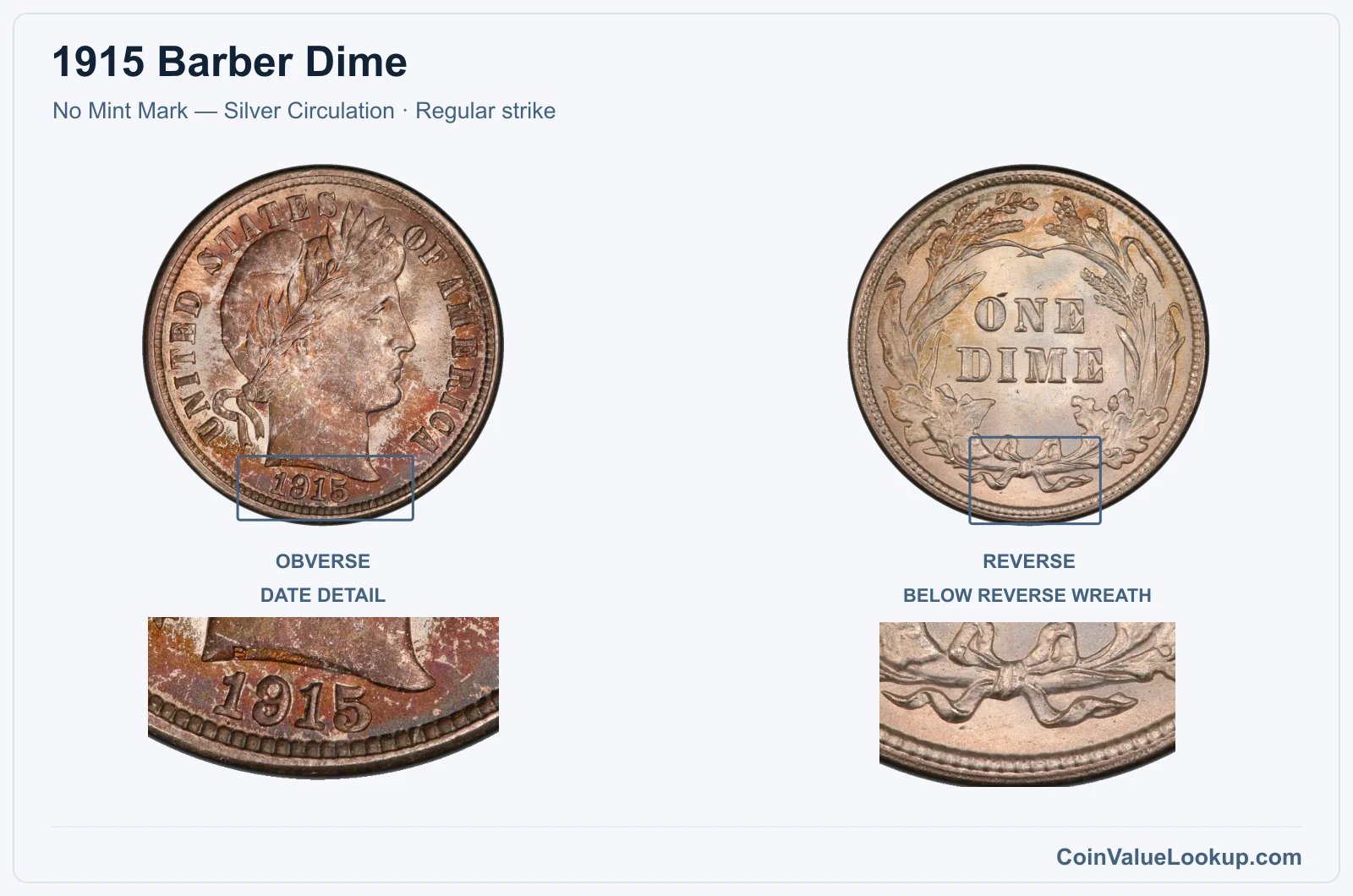
The 1915 Philadelphia dime carries no mintmark. Look below the wreath bow on the reverse: blank space means Philly.
Guide estimates place this coin at roughly $10.42 in G4 and around $253 in MS63. The jump is steep because surviving uncirculated examples with full, unbroken luster are far less common than worn pocket pieces.
Clean, original surfaces matter more than a single grade point at the upper end.
If you find one with sharp detail across Liberty's headband and a complete wreath, that is worth a closer look for condition.
Range Grade
Price Auction Records Appraisal PO PO 1
—
Coin Identifier FR FR 2
—
Coin Identifier AG AG 3
—
Coin Identifier G G 4
—
Coin Identifier
G 6
—
Coin Identifier VG VG 8
—
Coin Identifier
VG 10
—
Coin Identifier F F 12
—
Coin Identifier
F 15
—
Coin Identifier VF VF 20
—
Coin Identifier
VF 25
—
Coin Identifier
VF 30
Coin Identifier
VF 35
—
Coin Identifier XF XF 40
—
Coin Identifier
XF 45
Coin Identifier AU AU 50
Coin Identifier
AU 53
Coin Identifier
AU 55
Coin Identifier
AU 58
Coin Identifier MS MS 60
Coin Identifier
MS 61
Coin Identifier
MS 62
Coin Identifier
MS 63
Coin Identifier
MS 64
Coin Identifier
MS 65
Coin Identifier
MS 66
Coin Identifier
MS 67
Coin Identifier
MS 68
—
—
—
MS 69
—
—
—
MS 70
—
—
—
1915 Barber Dime — S — Silver Circulation
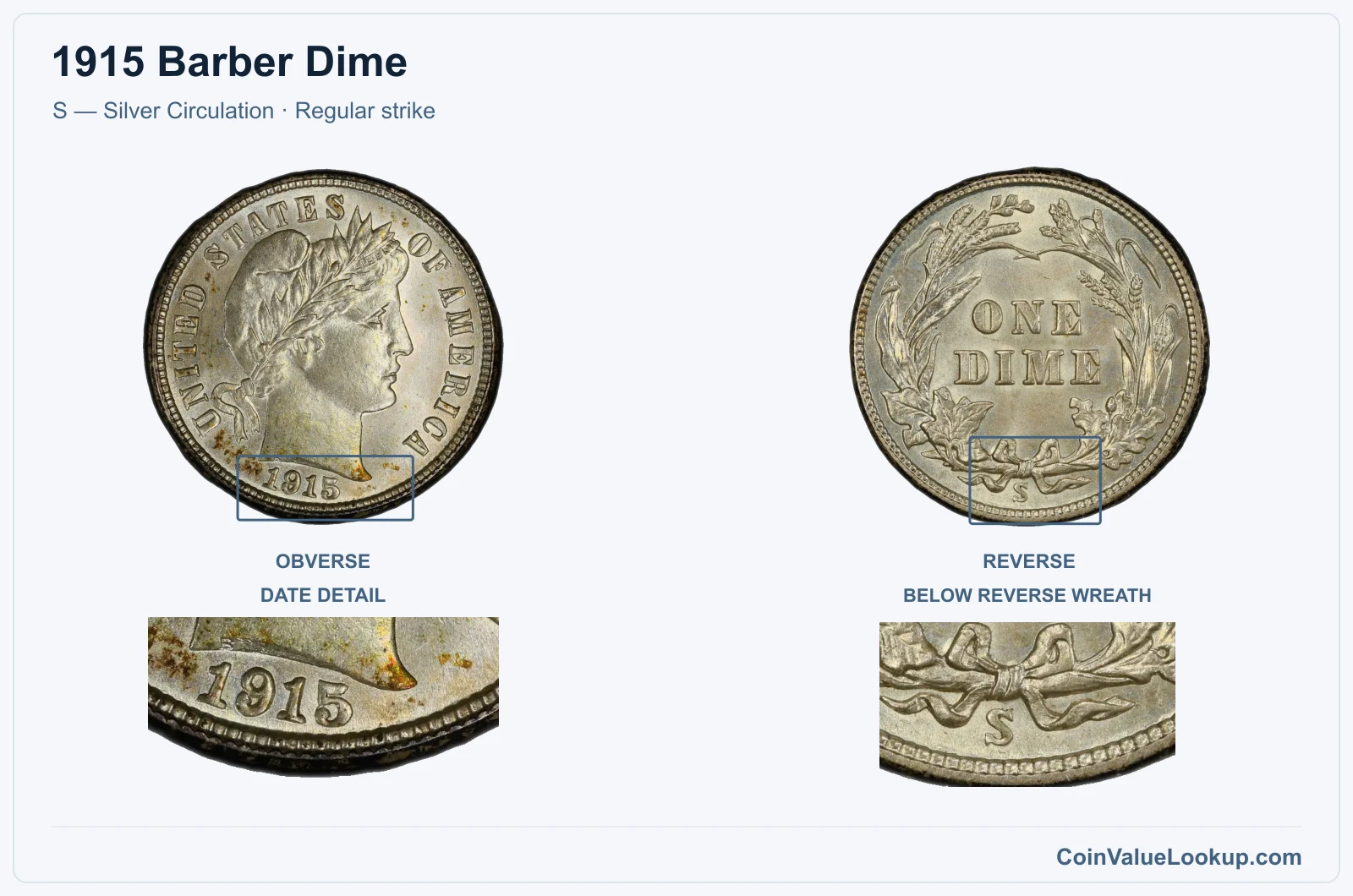
San Francisco strikes carry a small S mintmark below the wreath bow on the reverse. That single letter bumps guide values: about $18 at G4, rising to roughly $441 at MS63.
The S-mint premium reflects lower survival rates in high grades. Many of these coins circulated heavily in the West.
Finding one with genuinely unbroken luster is tougher than for the Philadelphia issue.
Coin Value Lookup is a useful starting point if you want to compare this coin against other Barber dime dates and mints in the series.
Range Grade
Price Auction Records Appraisal PO PO 1
—
Coin Identifier FR FR 2
—
Coin Identifier AG AG 3
—
Coin Identifier G G 4
—
Coin Identifier
G 6
—
Coin Identifier VG VG 8
—
Coin Identifier
VG 10
—
Coin Identifier F F 12
Coin Identifier
F 15
—
Coin Identifier VF VF 20
—
Coin Identifier
VF 25
—
Coin Identifier
VF 30
Coin Identifier
VF 35
Coin Identifier XF XF 40
Coin Identifier
XF 45
Coin Identifier AU AU 50
Coin Identifier
AU 53
Coin Identifier
AU 55
Coin Identifier
AU 58
Coin Identifier MS MS 60
—
Coin Identifier
MS 61
Coin Identifier
MS 62
Coin Identifier
MS 63
Coin Identifier
MS 64
Coin Identifier
MS 65
Coin Identifier
MS 66
Coin Identifier
MS 67
Coin Identifier
MS 68
—
—
—
MS 69
—
—
—
MS 70
—
—
—
1915 Barber Dime — No Mint Mark — Brilliant Silver Proof
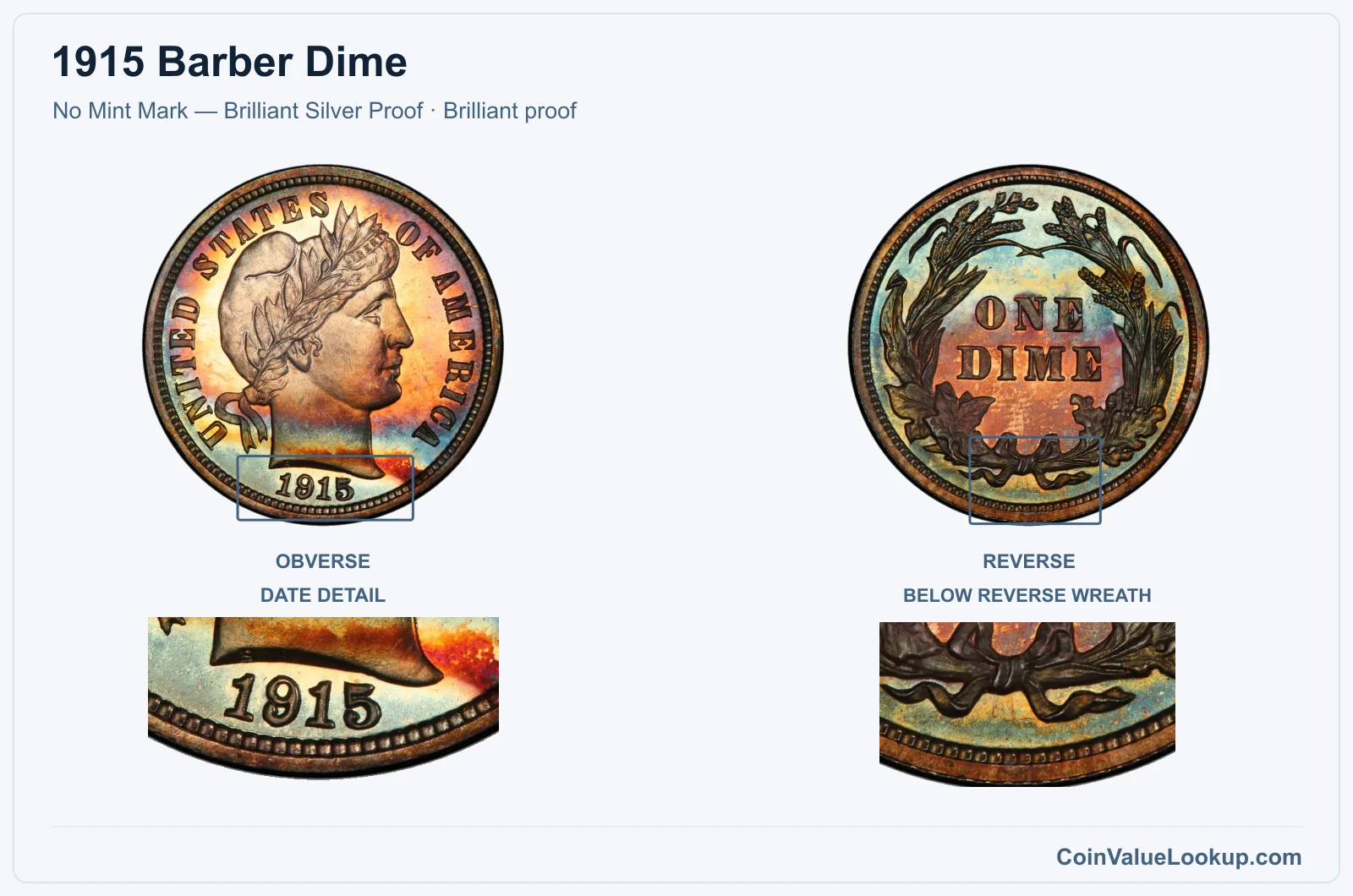
Philadelphia produced proof Barber dimes from 1892 through 1915, making this the last proof year for the type. These coins were struck on polished planchets with specially prepared dies, giving them mirrored fields and sharply defined rims.
A PR63 example guides around $616. Cameo and Deep Cameo designations reflect the contrast between frosted devices and mirror fields, and those carry their own market.
Do not assume a bright coin is automatically cameo, and do not apply the PR63 price to a Deep Cameo piece — they are separate categories.
Look for hairlines and handling marks in the mirrored fields, since those are the first things graders check on a proof.
Range Grade
Price Auction Records Appraisal PR PR 1
—
Coin Identifier
PR 2
—
Coin Identifier
PR 3
—
Coin Identifier
PR 4
—
Coin Identifier
PR 6
—
Coin Identifier
PR 8
—
Coin Identifier
PR 10
—
Coin Identifier
PR 12
—
Coin Identifier
PR 15
—
Coin Identifier
PR 20
—
Coin Identifier
PR 25
—
Coin Identifier
PR 30
—
Coin Identifier
PR 35
—
Coin Identifier
PR 40
—
Coin Identifier
PR 45
—
Coin Identifier
PR 50
—
Coin Identifier
PR 53
—
Coin Identifier
PR 55
—
Coin Identifier
PR 58
—
Coin Identifier
PR 60
Coin Identifier
PR 61
—
Coin Identifier
PR 62
Coin Identifier
PR 63
Coin Identifier
PR 64
Coin Identifier
PR 65
Coin Identifier
PR 66
Coin Identifier
PR 67
Coin Identifier
PR 68
—
—
—
PR 69
—
—
—
PR 70
—
—
—
1915 Barber Dime Error List
1. 1915 Barber Dime — Repunched Mintmark
A repunched mintmark on the 1915 dime shows traces of a second, slightly offset position of the mintmark letter beneath or beside the primary punch. You need magnification to see this — look for a shadow image, a notch, or a partial doubling of the letter shape at the mintmark location below the wreath bow.
This category has been reported for the 1915 dime. The value depends on how visible the repunching is and the overall condition of the coin.
Do not confuse a repunched mintmark with machine doubling, which produces flat, shelf-like distortion. Die chips or corrosion around the mintmark area can also mimic a repunch.
Compare your coin to a normal example at the same magnification before drawing conclusions.
2. 1915 Barber Dime — Off-Center Strike
An off-center strike happens when the planchet is not properly seated between the dies. The result is a design shifted to one side with an unstruck crescent of blank metal on the opposite edge.
This error has been reported for the 1915 dime. Value depends heavily on the percentage of misalignment and whether the date remains fully visible — a dateless off-center coin is far less desirable.
Watch out for lookalikes. A clipped planchet removes a section of metal but does not shift the design.
Post-mint damage from a vise or hammer can flatten one side and fake the appearance. One-sided die misalignment produces a different visual effect.
Compare the coin's rim and design position carefully before calling it off-center.
3. 1915 Barber Dime — Lamination / Split Planchet
A lamination error appears as peeling, flaking, or splitting within the metal of the planchet itself. On a 1915 Barber dime you might see a thin flap of metal lifting away from the surface, or a visible seam along the edge where layers have separated.
This category has been reported for the 1915 dime. Pricing depends on the size, location, and visibility of the defect, along with the coin's overall condition.
Photograph the edge and the affected face together for the best documentation. Do not confuse lamination with surface scraping, environmental corrosion, or a deliberately altered coin.
Corrosion tends to pit the surface rather than lift clean layers, and tool marks from scraping will show directional scratches rather than natural separation within the alloy.