1834 Capped Bust Dime Coin Value: How Much Is It Worth?
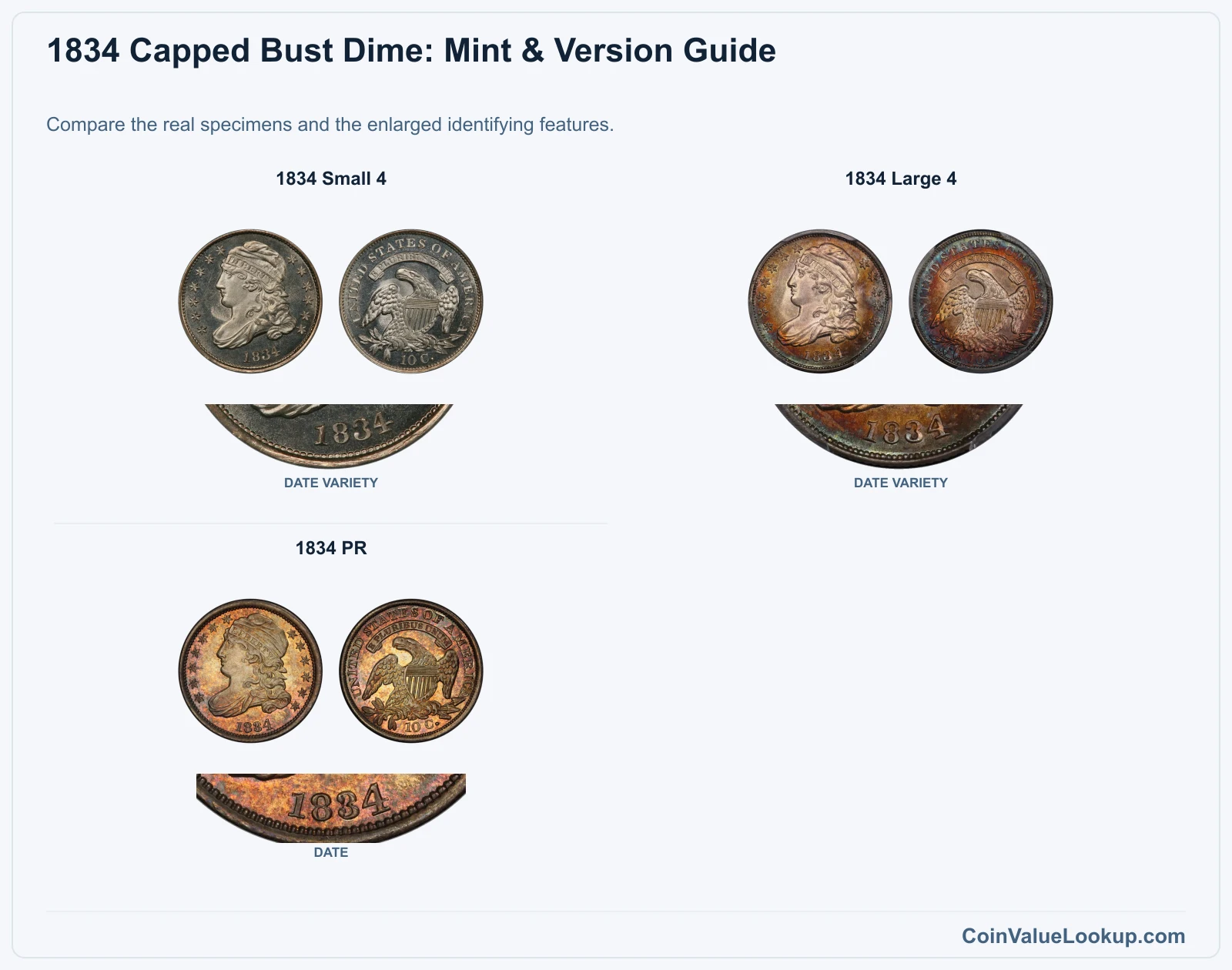
The 1834 Capped Bust Dime is a genuine early American silver coin, struck at the Philadelphia Mint nearly two centuries ago. Guide estimates for the main business-strike varieties range from about $54.00 in well-worn Good-4 condition up to roughly $2,771.00 for a choice Mint State example, depending on the specific date variety and grade.
Your coin's exact worth hinges on which variety it is, how much original detail survives, and whether the surfaces remain untouched. Those guide figures are reference anchors, not guaranteed buy prices.
Fast Way to Identify Your 1834 Capped Bust Dime
Snap a clear photo of the front and back of your 1834 dime and upload both images here. Our identifier can give you a preliminary read on the variety and approximate condition.
Good lighting at a slight angle helps capture surface detail. This is a starting point for identification, not a certified authentication or precise grade assignment.
1834 Capped Bust Dime Value
Upload both sides of your 1834 Capped Bust Dime.
Front Obverse
Upload photo
Back Reverse
Upload photo
Which 1834 Capped Bust Dime Versions Are Worth Money?
- The 1834 Small 4 variety ranges from about $54 at Good-4 to roughly $2,771 at MS63 in guide estimates, making higher-grade examples the standout for this date.
- The 1834 Large 4 variety guides from about $54 at Good-4 to roughly $2,344 at MS63, slightly lower at the top end than the Small 4.
- The 1834 Proof is extremely scarce early proof coinage; no standard guide range is adopted, and each coin requires individual expert assessment.
- Confirm which date-numeral variety you have before applying any value; the two business strikes look similar at a glance but track differently in higher grades.
Step 1: Identify Your 1834 Capped Bust Dime Mint Mark and Version
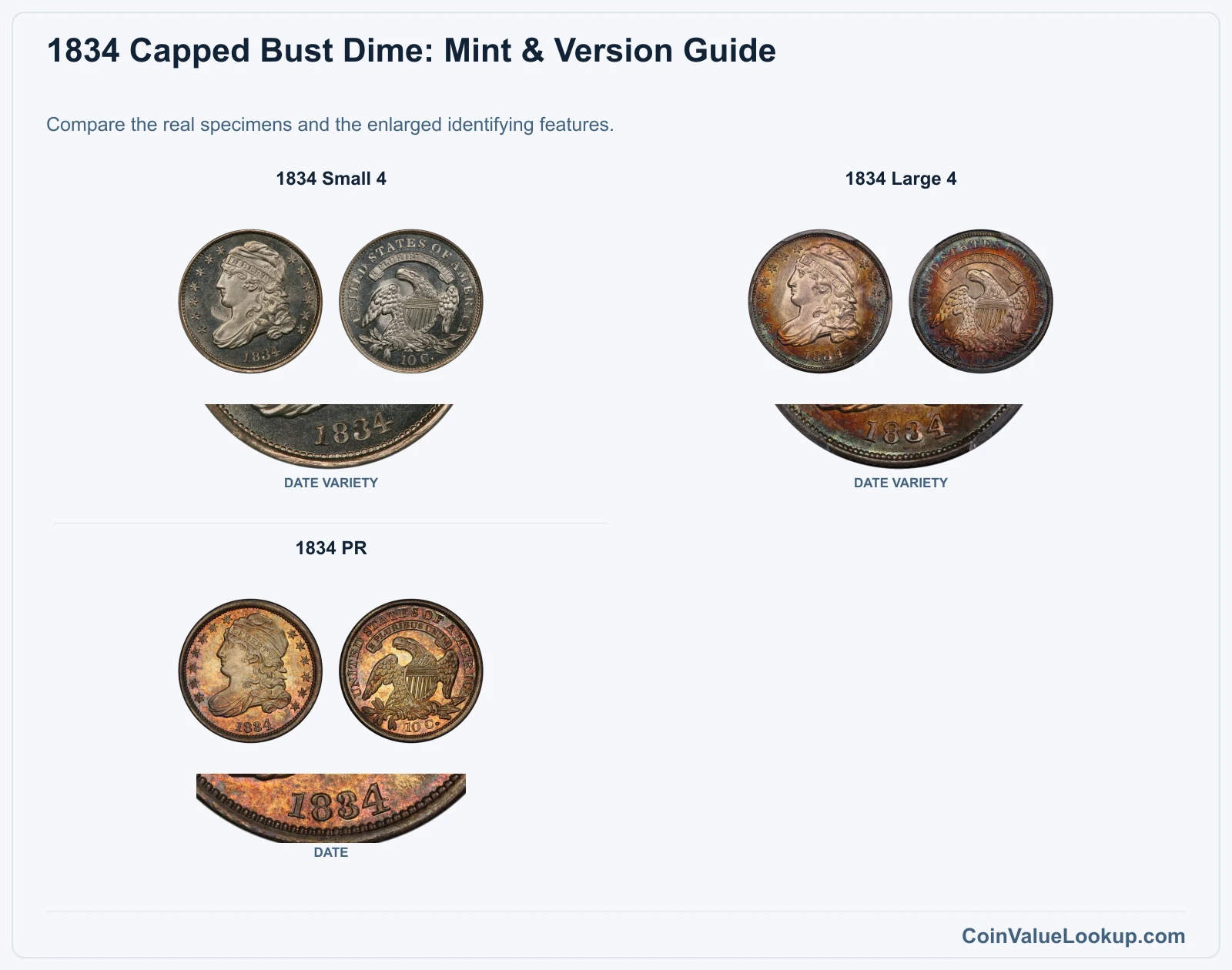
Every 1834 Capped Bust Dime was struck in Philadelphia. There is no mintmark to look for.
The coin is a silver-copper alloy, roughly 89.24% silver. It uses the closed-collar, small-dentils version of the Capped Bust design, which is distinct from the earlier, wider format.
Three branches exist for this date. The two business strikes are the Small 4 and the Large 4, distinguished by the size and shape of the final digit in the date.
You need a correctly labeled reference image of each numeral style side by side; simply zooming in on your coin is not enough, because camera angle and magnification can mislead you. The third branch is the proof, which is extremely scarce and requires authenticated attribution rather than a guess based on shiny surfaces.
Do not confuse this coin with a Capped Bust half dime. The half dime is a different, smaller denomination entirely.
Step 2: Check Your 1834 Capped Bust Dime Grade
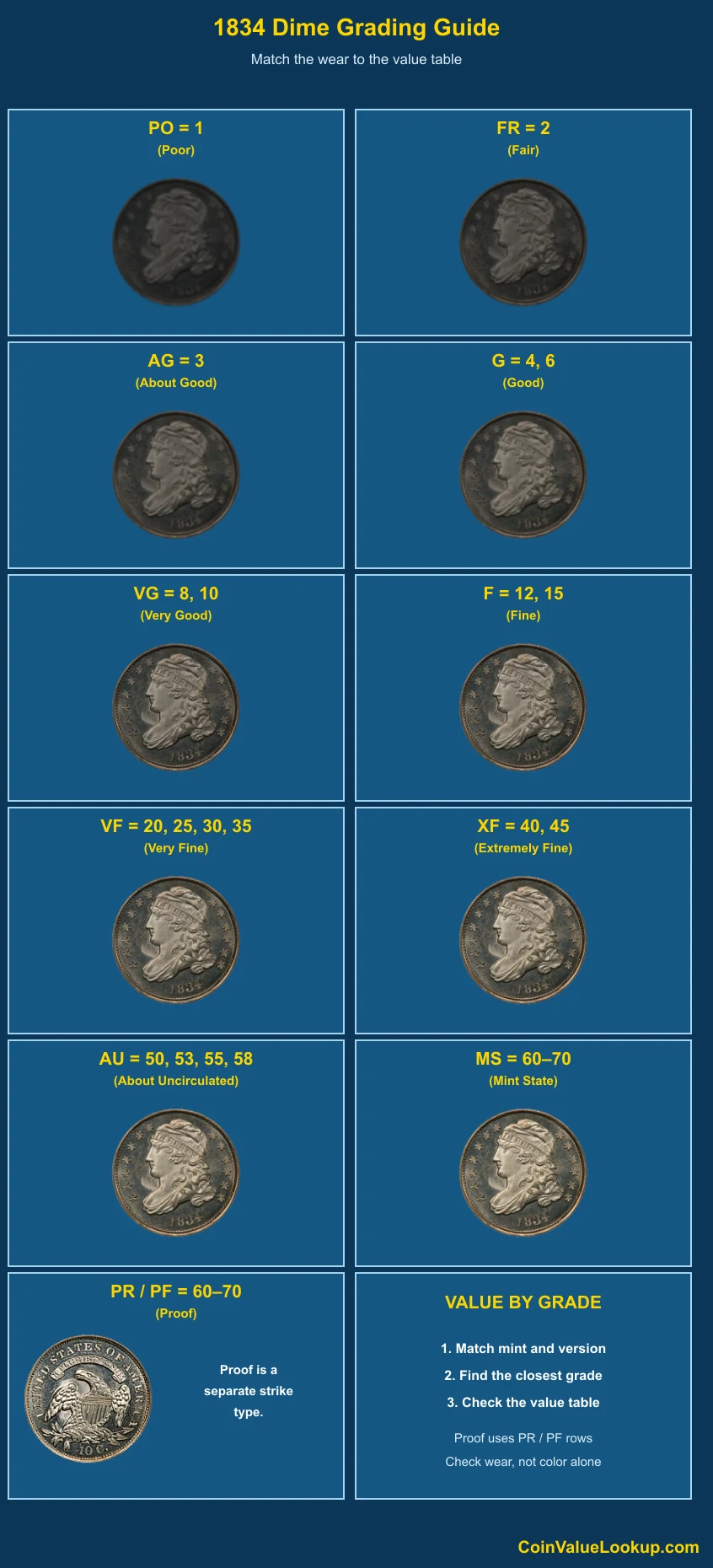
Start with Liberty's hair curls above the forehead and ear. On a lightly worn coin those curls show soft flattening first, then the cheek loses its roundness as wear increases.
The cap and shoulder drapery follow.
Flip to the reverse. The eagle's breast feathers and the tops of the wing feathers are the highest points and wear down in the same sequence.
These were struck on hand-operated presses, so even a brand-new coin can show uneven or slightly weak areas. That is not the same as wear.
Look for luster in the protected areas around letters and stars. If luster is gone everywhere and the high points are smooth, you are looking at honest circulation wear.
Use the comparison image of a same-type Capped Bust dime to calibrate your eye. Contact marks, scratches and any evidence of cleaning all pull a coin below what its wear alone might suggest.
A dull, original coin almost always beats a shiny, cleaned one in the marketplace.
Step 3: Check 1834 Capped Bust Dime Value by Mint and Version
1834 Capped Bust Dime — Small 4
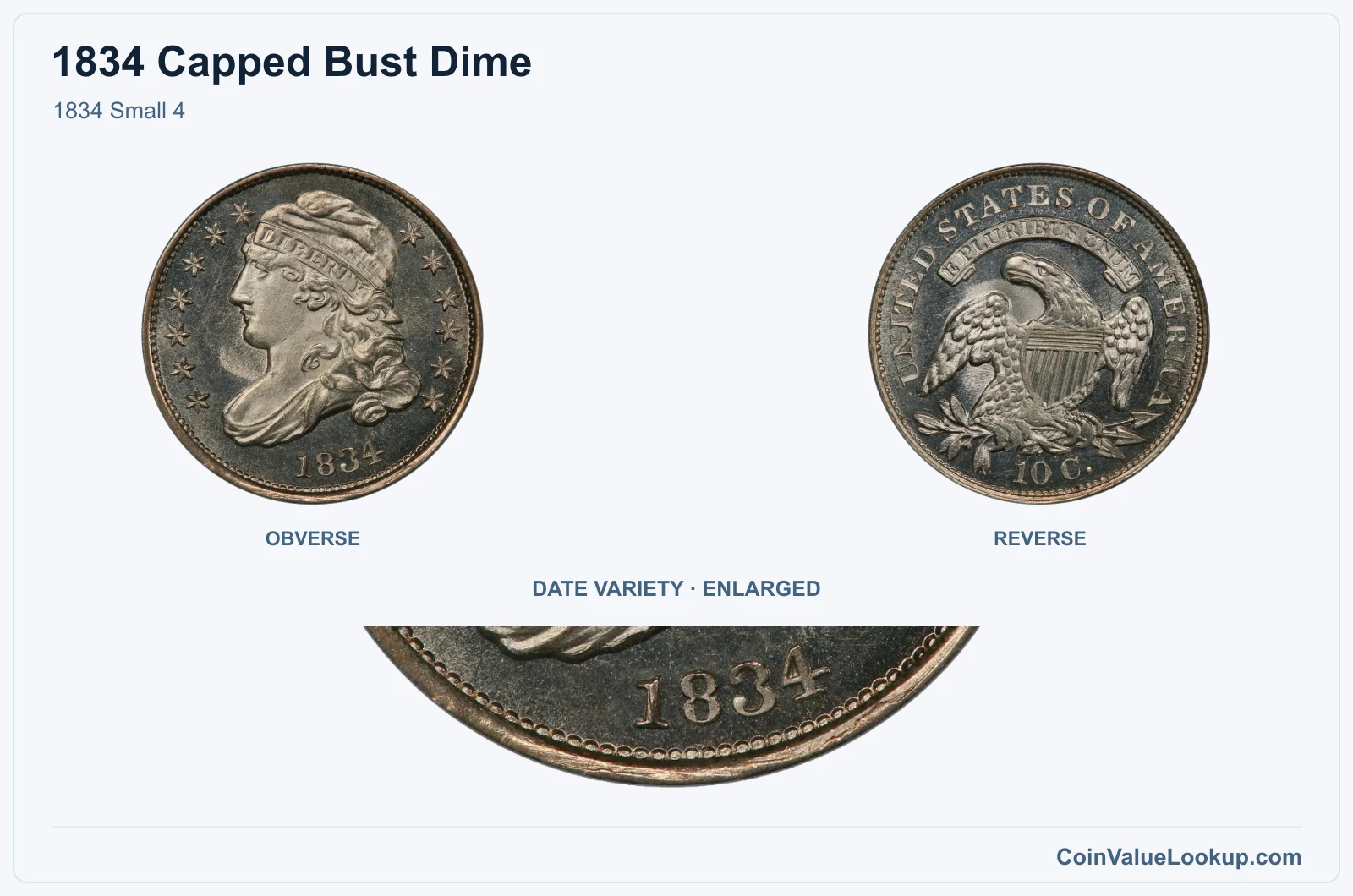
The 1834 Small 4 is the business-strike variety where the final digit of the date is noticeably smaller and more slender. Match this detail against a labeled reference image before assigning a value.
Philadelphia struck all examples with no mintmark.
Guide estimates place this variety at about $54.00 in Good-4 and around $2,771.00 in MS63, per USA Coin Book. Those figures assume original, uncleaned surfaces and accurate grading.
Cleaning, scratches or corrosion will pull any coin below its grade-comparable anchor.
Coin Value Lookup is a handy place to look up additional coin guides when you are sorting through a collection and need quick reference points for different dates or denominations.
Range Grade
Price Auction Records Appraisal PO PO 1
—
Coin Identifier FR FR 2
—
Coin Identifier AG AG 3
—
Coin Identifier G G 4
—
Coin Identifier
G 6
Coin Identifier VG VG 8
Coin Identifier
VG 10
—
Coin Identifier F F 12
—
Coin Identifier
F 15
Coin Identifier VF VF 20
Coin Identifier
VF 25
Coin Identifier
VF 30
Coin Identifier
VF 35
Coin Identifier XF XF 40
Coin Identifier
XF 45
Coin Identifier AU AU 50
Coin Identifier
AU 53
Coin Identifier
AU 55
Coin Identifier
AU 58
Coin Identifier MS MS 60
Coin Identifier
MS 61
Coin Identifier
MS 62
Coin Identifier
MS 63
Coin Identifier
MS 64
Coin Identifier
MS 65
Coin Identifier
MS 66
Coin Identifier
MS 67
Coin Identifier
MS 68
—
—
—
MS 69
—
—
—
MS 70
—
—
—
1834 Capped Bust Dime — Large 4
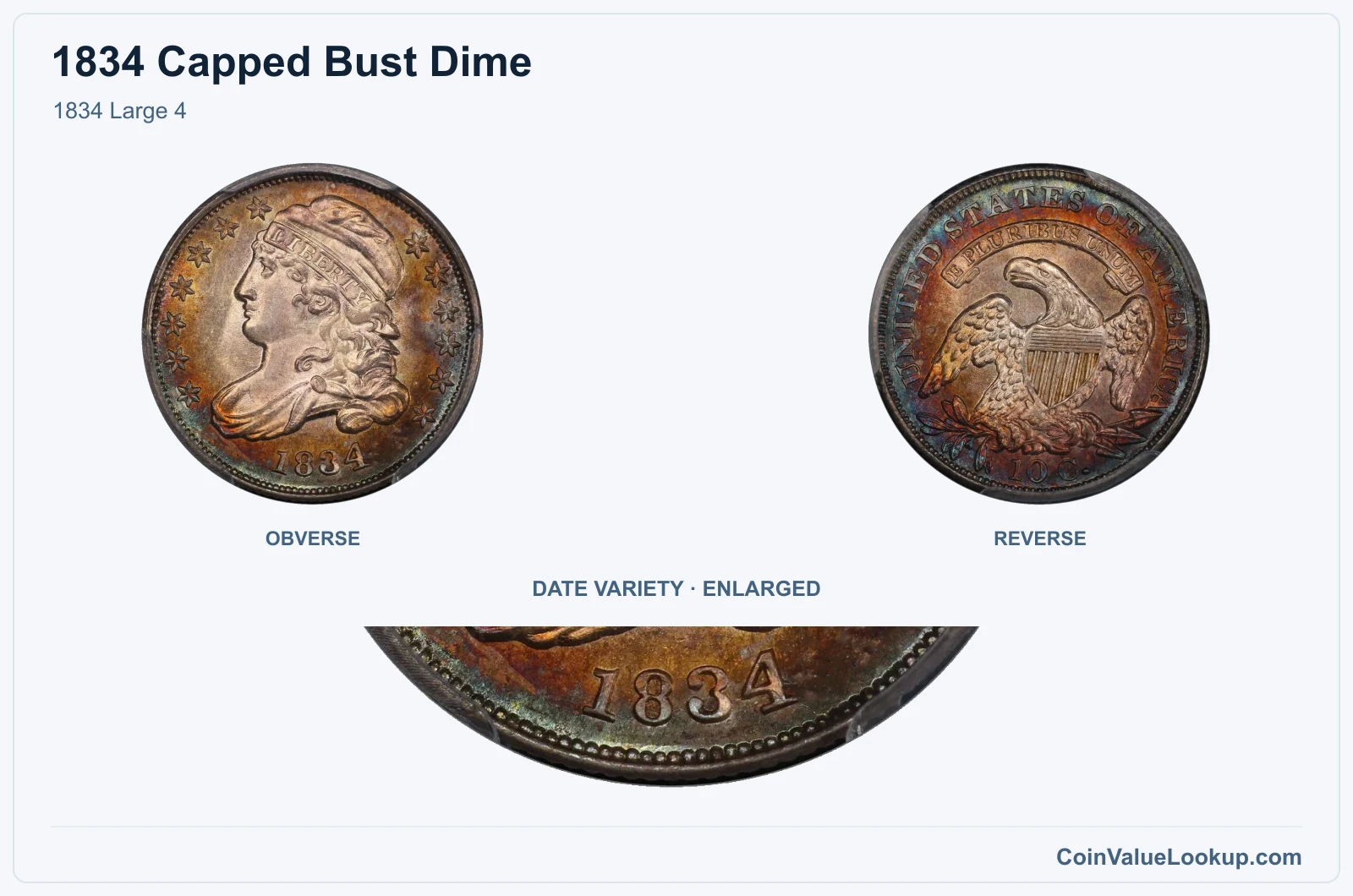
The 1834 Large 4 carries a visibly taller, broader final digit in the date compared to the Small 4. Side-by-side labeled images are the reliable way to confirm which you have; do not rely on magnification alone.
All examples were struck at Philadelphia with no mintmark. The silver-copper alloy and closed-collar design are identical to the Small 4, so the date numeral is really the only distinguishing feature.
USA Coin Book guide estimates put this variety at about $54.00 in Good-4 and roughly $2,344.00 in MS63. That top-end figure trails the Small 4 by a few hundred dollars in the same grade.
Original surfaces matter more than brightness when comparing your coin to these anchors.
Range Grade
Price Auction Records Appraisal PO PO 1
—
Coin Identifier FR FR 2
—
Coin Identifier AG AG 3
—
Coin Identifier G G 4
—
Coin Identifier
G 6
Coin Identifier VG VG 8
Coin Identifier
VG 10
Coin Identifier F F 12
Coin Identifier
F 15
—
Coin Identifier VF VF 20
Coin Identifier
VF 25
Coin Identifier
VF 30
Coin Identifier
VF 35
Coin Identifier XF XF 40
Coin Identifier
XF 45
Coin Identifier AU AU 50
Coin Identifier
AU 53
Coin Identifier
AU 55
Coin Identifier
AU 58
Coin Identifier MS MS 60
—
Coin Identifier
MS 61
Coin Identifier
MS 62
Coin Identifier
MS 63
Coin Identifier
MS 64
Coin Identifier
MS 65
Coin Identifier
MS 66
Coin Identifier
MS 67
Coin Identifier
MS 68
—
—
—
MS 69
—
—
—
MS 70
—
—
—
1834 Capped Bust Dime — PR
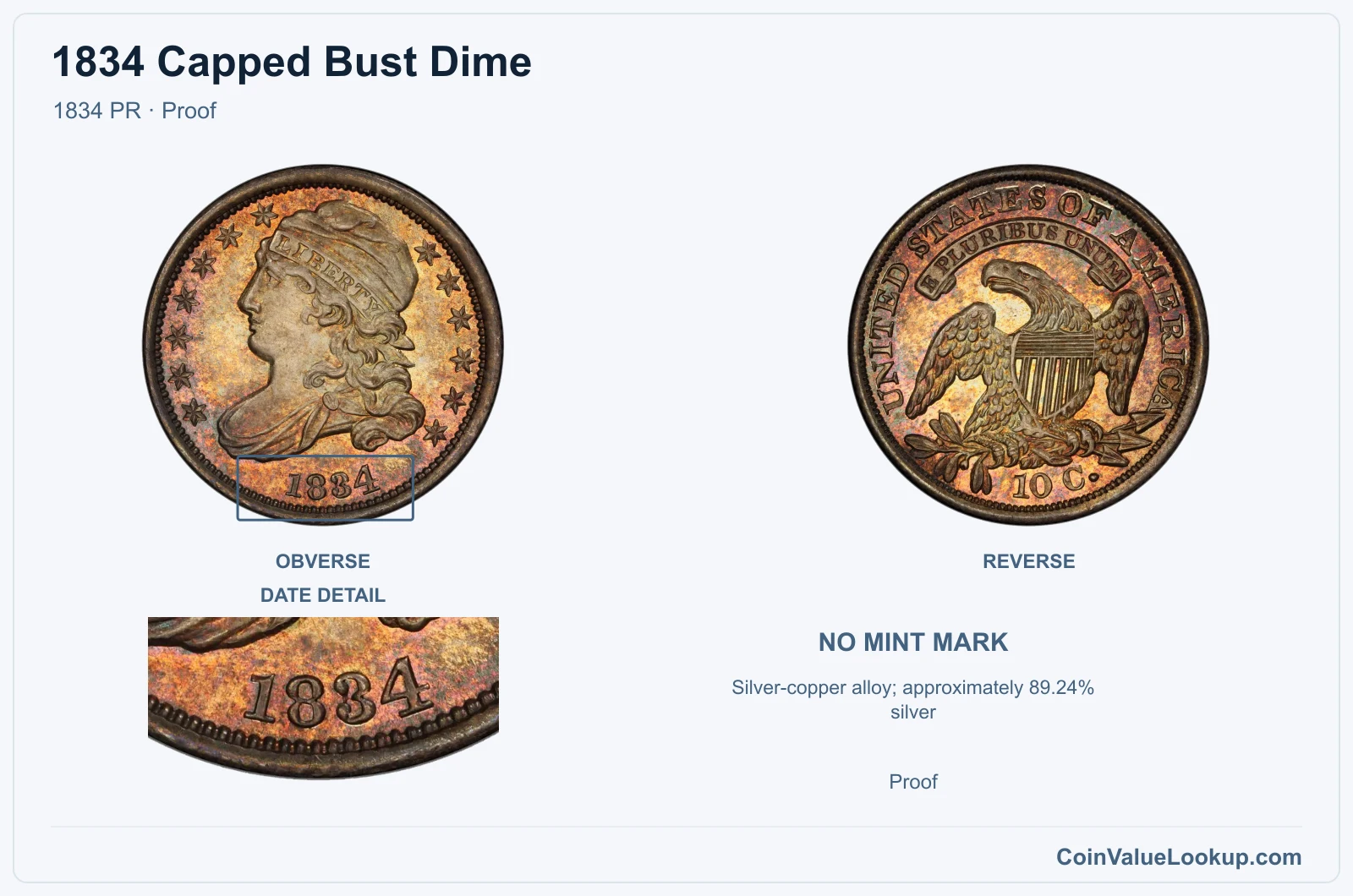
The 1834 Proof is an extremely scarce early proof striking. Philadelphia produced a tiny number of these by hand for presentation or collector purposes, and surviving examples are seldom offered.
A reflective surface or a strongly struck circulation coin is not automatically a proof. Genuine proofs from this era carry specific die characteristics and surface qualities that require expert authentication.
Do not assume proof status based on appearance alone.
No standard guide price range is adopted for this branch. Each authenticated example must be evaluated individually based on its confirmed identity, condition, surface quality and provenance.
If you suspect you have one, professional third-party attribution is the appropriate next step rather than any guide estimate.
Range Grade
Price Auction Records Appraisal PR PR 1
—
Coin Identifier
PR 2
—
Coin Identifier
PR 3
—
Coin Identifier
PR 4
—
Coin Identifier
PR 6
—
Coin Identifier
PR 8
—
Coin Identifier
PR 10
—
Coin Identifier
PR 12
—
Coin Identifier
PR 15
—
Coin Identifier
PR 20
—
Coin Identifier
PR 25
—
Coin Identifier
PR 30
—
Coin Identifier
PR 35
—
Coin Identifier
PR 40
—
Coin Identifier
PR 45
—
Coin Identifier
PR 50
—
Coin Identifier
PR 53
—
Coin Identifier
PR 55
—
Coin Identifier
PR 58
—
Coin Identifier
PR 60
—
Coin Identifier
PR 61
—
Coin Identifier
PR 62
—
Coin Identifier
PR 63
—
Coin Identifier
PR 64
Coin Identifier
PR 65
Coin Identifier
PR 66
—
Coin Identifier
PR 67
—
Coin Identifier
PR 68
—
—
—
PR 69
—
—
—
PR 70
—
—
—