1863 Liberty Seated Dime Coin Value: How Much Is It Worth?
The 1863 Liberty Seated Dime is a genuinely scarce Civil War-era coin. Guide estimates for the San Francisco issue run from about $189 at G4 to $11,486 at MS63, while the Philadelphia business strike — a much rarer coin — lists around $1,131 at G4 and $4,073 at MS63.
Proofs carry their own separate pricing. Condition, mint, and finish all matter here, so read on before assuming what yours is worth.
Fast Way to Identify Your 1863 Liberty Seated Dime
Snap a clear photo of the front and a separate photo of the back of your coin, then upload both for a preliminary identification. This can help you figure out which mint and version you have.
It will not authenticate, certify, or precisely grade your coin, but it is a solid first step toward understanding what you are holding.
1863 Liberty Seated Dime Value
Upload both sides of your 1863 Liberty Seated Dime.
Front Obverse
Upload photo
Back Reverse
Upload photo
Which 1863 Liberty Seated Dime Versions Are Worth Money?
- The 1863 Philadelphia business strike (no mintmark) is the rarer circulation issue, with guide values starting around $1,131 at G4 — check your reverse for the absence of a mintmark.
- The 1863-S (San Francisco) business strike can reach approximately $11,486 at MS63 according to guide estimates, making high-grade survivors especially worth identifying.
- Philadelphia Proofs exist but are priced on a separate scale — about $933 at PR63 — and require proper attribution, not just a reflective surface.
- Original, unaltered surfaces matter more than shine; a polished coin is not a Proof and typically loses value relative to an honest, naturally worn example.
Step 1: Identify Your 1863 Liberty Seated Dime Mint Mark and Version
Start by confirming you have a seated Liberty on the obverse and the words ONE DIME inside a large agricultural wreath on the reverse. Half dimes are smaller and say HALF DIME — set those aside.
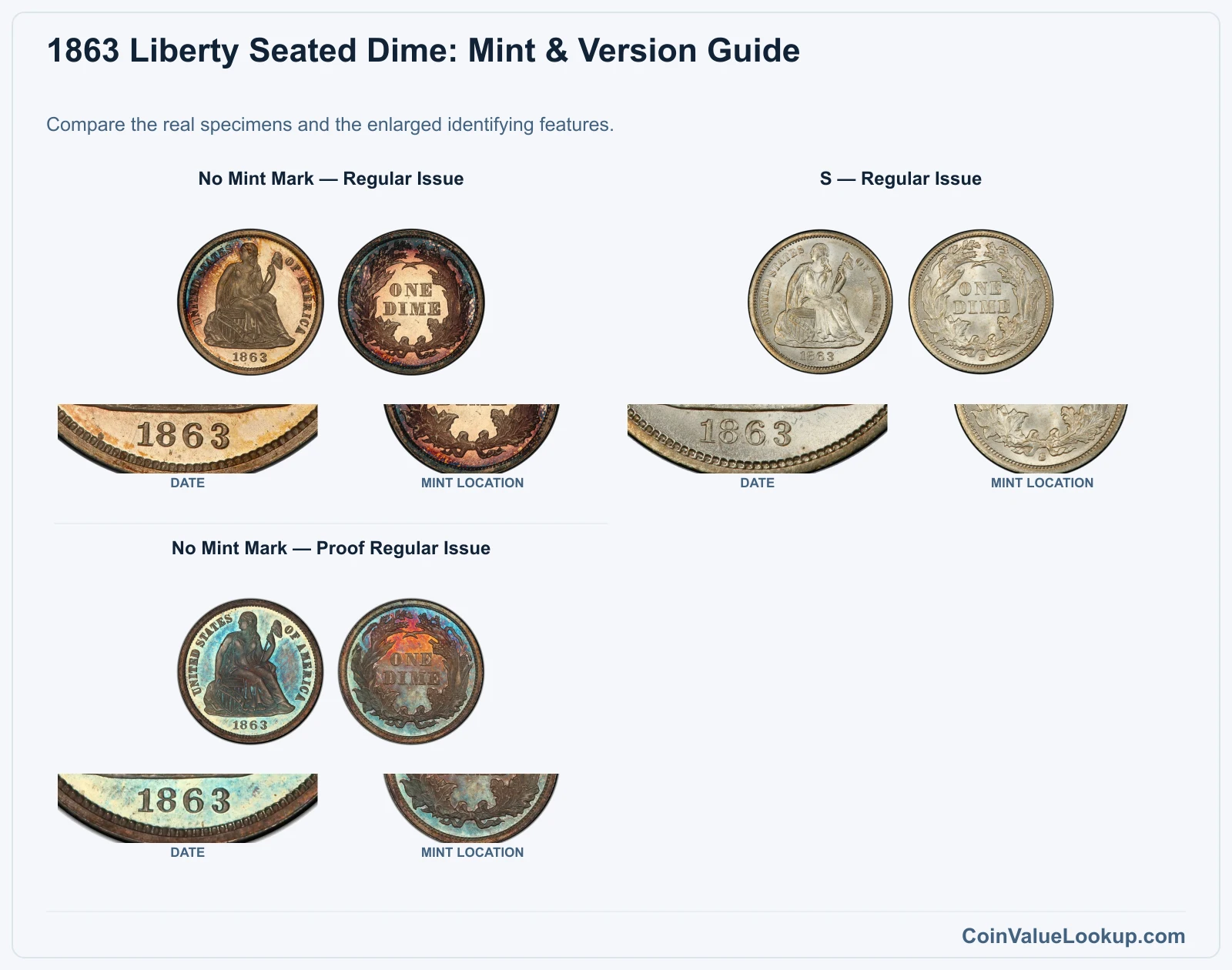
Next, check the reverse below the wreath for a mintmark. An "S" means San Francisco.
No letter means Philadelphia. That single detail changes the coin's rarity and value dramatically.
The design is the Legend Obverse type with stars around the border and UNITED STATES OF AMERICA on the obverse. The coin is 90% silver and 10% copper, weighs nominally 2.49 grams, measures 17.9 mm across, and has a reeded edge.
Philadelphia struck both business strikes and Proofs in 1863. A shiny or reflective surface alone does not make a coin Proof — shared dies were used, and polished circulated coins can mimic mirror fields.
Proof is a manufacturing finish, not a higher grade than Mint State, and proper attribution matters.
Step 2: Check Your 1863 Liberty Seated Dime Grade
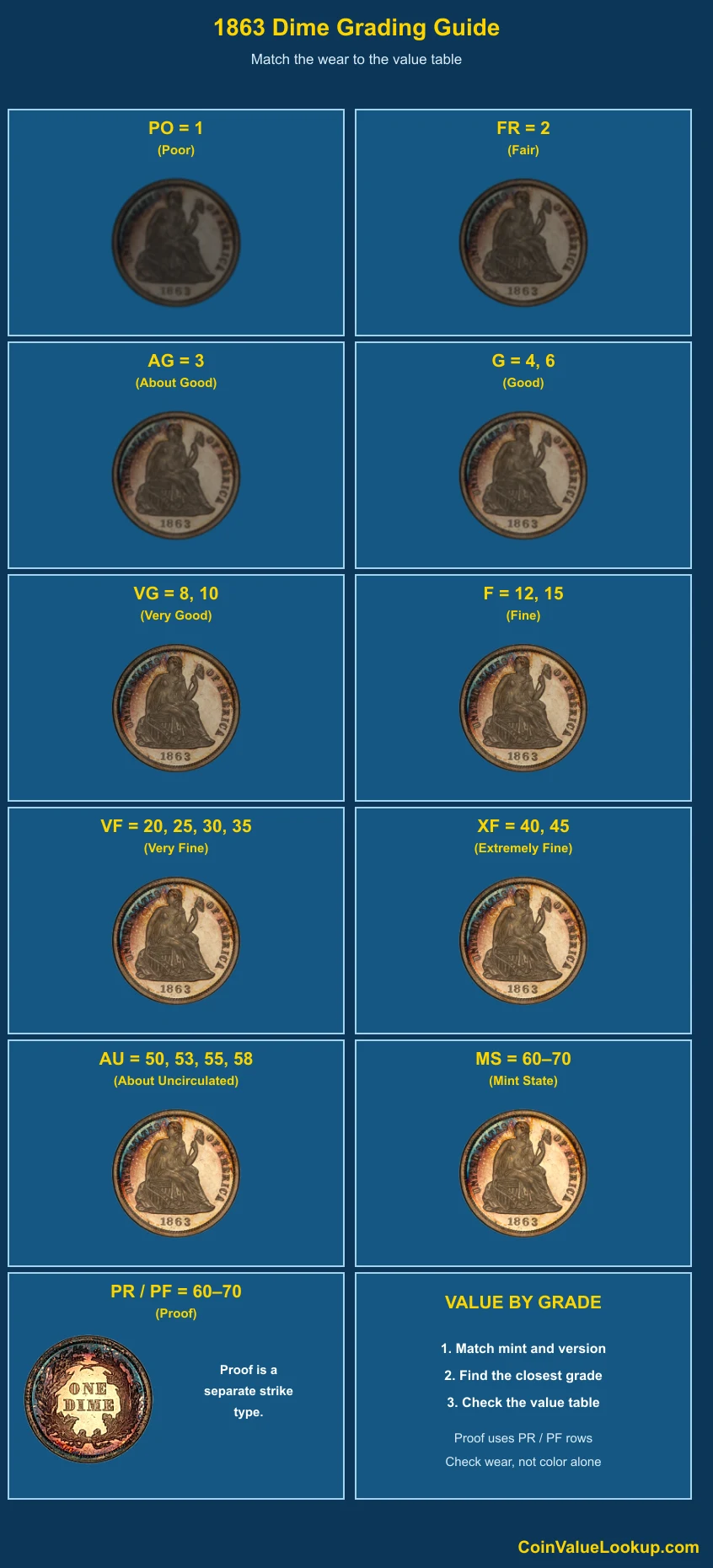
Compare your coin's shield detail, Liberty's gown folds, her head, and her feet against the correct Legend Obverse grading references. On the reverse, check the wreath opposite the base for wear.
Separate actual circulation wear from original strike weakness or tired dies. A softly struck coin and a worn coin look different if you know what to check — luster survives on a weak strike but vanishes where metal actually rubbed against another surface.
Luster and surface condition should be judged together. Cleaned or polished coins lose original skin and often show fine hairlines under magnification.
Proofs must be evaluated on their own scale. Hairlines on a Proof field are graded differently than bag marks on a business strike.
A circulated coin someone buffed on a cloth is not a Proof, no matter how mirror-like it appears. Use the comparison image provided to calibrate your eye for each grade level.
Step 3: Check 1863 Liberty Seated Dime Value by Mint and Version
1863 Liberty Seated Dime — No Mint Mark — Regular Issue
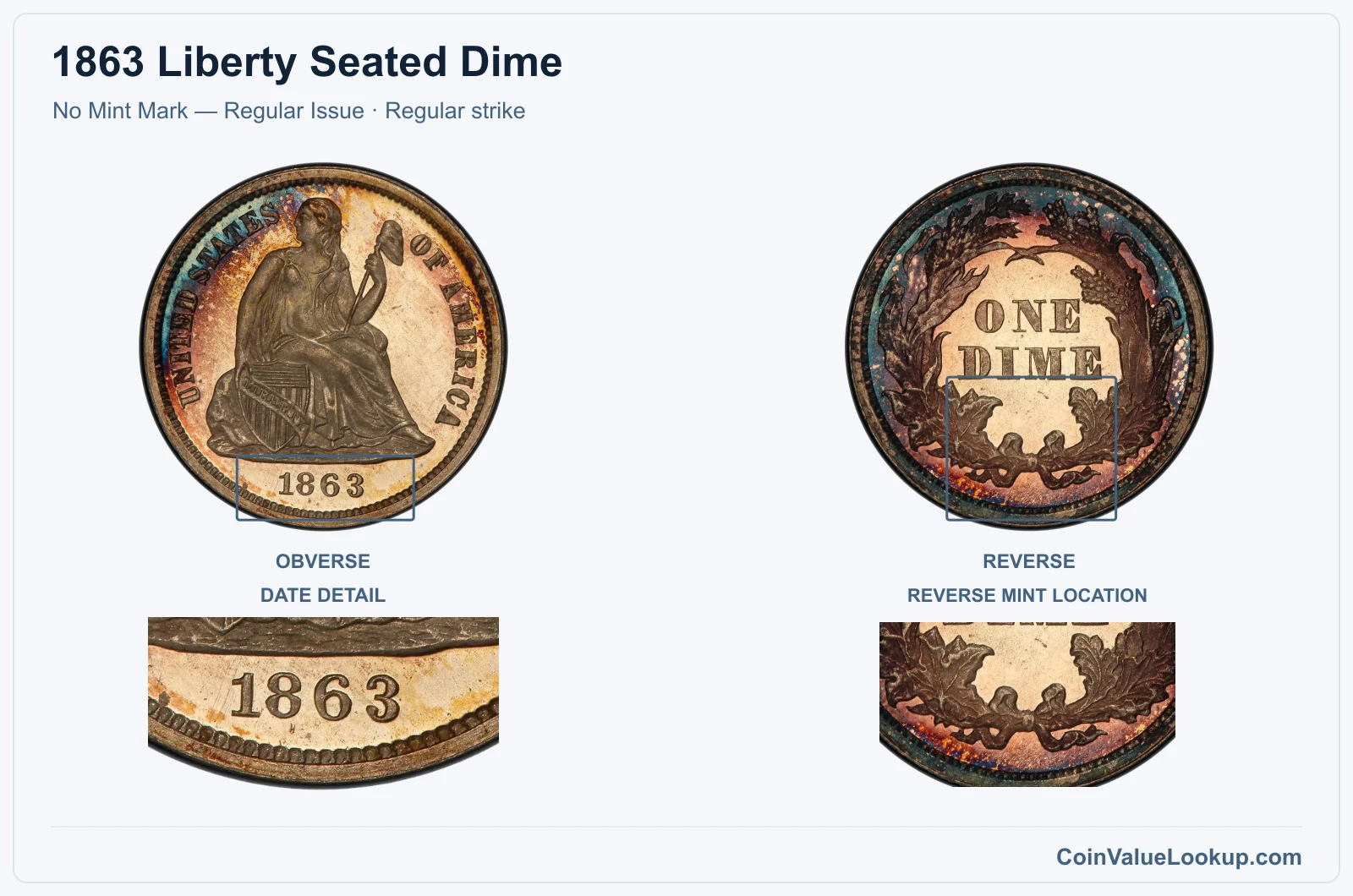
The 1863 Philadelphia business strike carries no mintmark — the reverse below the wreath is blank. This is the scarcer of the two circulation issues for the year.
Guide estimates place this coin at roughly $1,131 in G4 and around $4,073 in MS63, according to USA Coin Book. Those figures reflect how few were made and how few survived.
The Legend Obverse design shows stars around Liberty with UNITED STATES OF AMERICA on the obverse; the reverse features the large agricultural wreath framing ONE DIME.
Because Philadelphia used shared dies for both business strikes and Proofs, some business strikes show reflective fields. That does not make them Proofs.
Confirm the finish before jumping to conclusions.
Range Grade
Price Auction Records Appraisal PO PO 1
—
Coin Identifier FR FR 2
—
Coin Identifier AG AG 3
—
Coin Identifier G G 4
—
Coin Identifier
G 6
Coin Identifier VG VG 8
Coin Identifier
VG 10
Coin Identifier F F 12
Coin Identifier
F 15
—
Coin Identifier VF VF 20
Coin Identifier
VF 25
Coin Identifier
VF 30
—
Coin Identifier
VF 35
—
Coin Identifier XF XF 40
Coin Identifier
XF 45
Coin Identifier AU AU 50
Coin Identifier
AU 53
—
Coin Identifier
AU 55
Coin Identifier
AU 58
Coin Identifier MS MS 60
Coin Identifier
MS 61
—
Coin Identifier
MS 62
Coin Identifier
MS 63
Coin Identifier
MS 64
Coin Identifier
MS 65
Coin Identifier
MS 66
Coin Identifier
MS 67
Coin Identifier
MS 68
—
—
—
MS 69
—
—
—
MS 70
—
—
—
1863 Liberty Seated Dime — S — Regular Issue
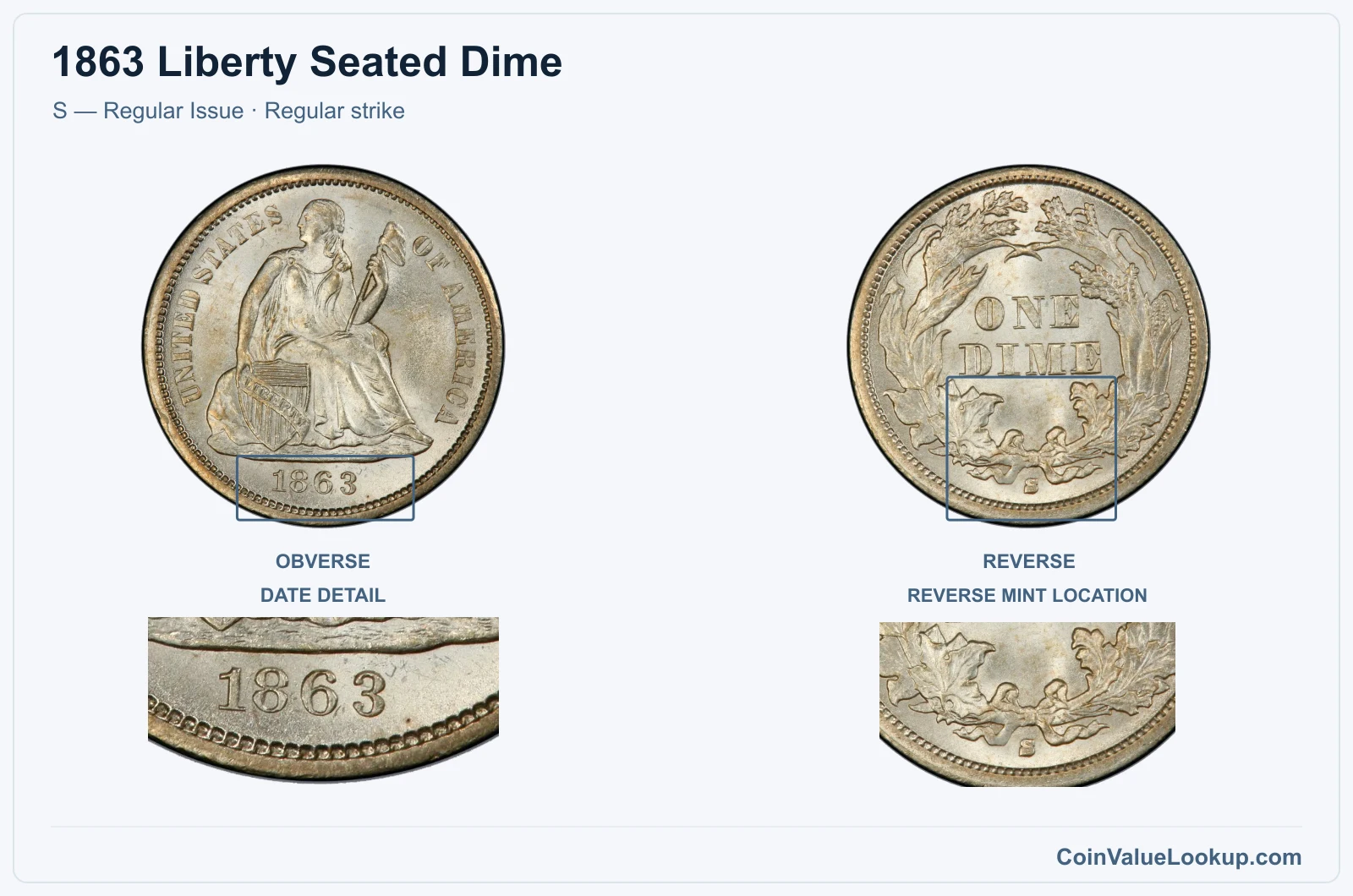
Look for a small "S" mintmark on the reverse, positioned below the wreath. That marks the San Francisco issue.
At lower grades this is the more affordable 1863 dime, with guide values near $189 at G4. Survivors in high grades are another story — the MS63 guide estimate sits around $11,486.
The jump tells you how rarely these coins escaped heavy use during the Civil War era.
Same specs as Philadelphia: 90% silver, 10% copper, 2.49 grams, reeded edge. The design is identical — Legend Obverse with the large agricultural wreath reverse.
Condition is everything with this date, so examine wear carefully before estimating value.
Coin Value Lookup is a good starting point if you want to look up guides for other dates and denominations in the Seated Dime series or beyond.
Range Grade
Price Auction Records Appraisal PO PO 1
—
Coin Identifier FR FR 2
—
Coin Identifier AG AG 3
Coin Identifier G G 4
Coin Identifier
G 6
Coin Identifier VG VG 8
Coin Identifier
VG 10
Coin Identifier F F 12
Coin Identifier
F 15
Coin Identifier VF VF 20
—
Coin Identifier
VF 25
Coin Identifier
VF 30
Coin Identifier
VF 35
Coin Identifier XF XF 40
Coin Identifier
XF 45
Coin Identifier AU AU 50
Coin Identifier
AU 53
Coin Identifier
AU 55
Coin Identifier
AU 58
Coin Identifier MS MS 60
Coin Identifier
MS 61
—
Coin Identifier
MS 62
Coin Identifier
MS 63
Coin Identifier
MS 64
Coin Identifier
MS 65
Coin Identifier
MS 66
—
—
—
MS 67
—
—
—
MS 68
—
—
—
MS 69
—
—
—
MS 70
—
—
—
1863 Liberty Seated Dime — No Mint Mark — Proof Regular Issue
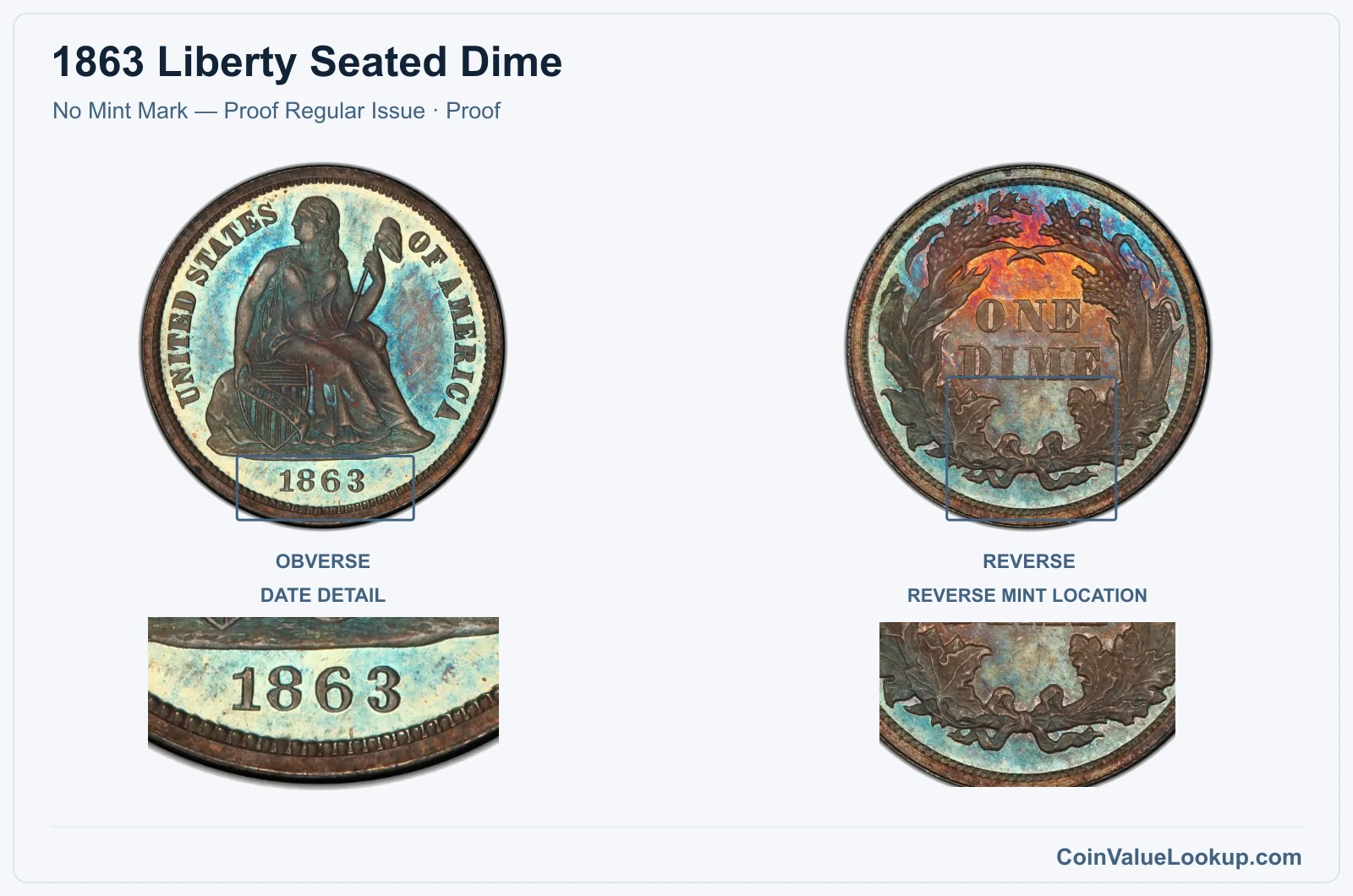
Philadelphia Proofs of 1863 were struck with specially prepared dies on polished planchets, producing mirror-like fields. These are genuinely rare early-date Proofs, not routine annual collector products.
The PCGS guide places a PR63 example at approximately $933. That is a single grade anchor, not a guaranteed sale price, and individual coins may realize more or less depending on eye appeal, toning, and hairline severity.
The critical point: shared dies between business strikes and Proofs mean some circulation strikes look reflective. A mirror surface alone is not enough.
Proof attribution requires examining the strike character, edge finish, and field quality under magnification — or better yet, professional certification. Polishing a worn coin creates hairlines and a waxy sheen that experienced graders spot immediately.
Do not confuse cameo contrast, which is a visual filter within the Proof category, with a separate mint or variety.
Range Grade
Price Auction Records Appraisal PR PR 1
—
Coin Identifier
PR 2
—
Coin Identifier
PR 3
—
Coin Identifier
PR 4
—
Coin Identifier
PR 6
—
Coin Identifier
PR 8
—
Coin Identifier
PR 10
—
Coin Identifier
PR 12
—
Coin Identifier
PR 15
—
Coin Identifier
PR 20
—
Coin Identifier
PR 25
—
Coin Identifier
PR 30
—
Coin Identifier
PR 35
—
Coin Identifier
PR 40
—
Coin Identifier
PR 45
—
Coin Identifier
PR 50
—
Coin Identifier
PR 53
—
Coin Identifier
PR 55
—
Coin Identifier
PR 58
—
Coin Identifier
PR 60
Coin Identifier
PR 61
Coin Identifier
PR 62
Coin Identifier
PR 63
Coin Identifier
PR 64
Coin Identifier
PR 65
Coin Identifier
PR 66
Coin Identifier
PR 67
—
—
—
PR 68
—
—
—
PR 69
—
—
—
PR 70
—
—
—
1863 Liberty Seated Dime Error List
1. 1863 Liberty Seated Dime — Reverse Die Defects
A documented shared business/Proof die pair for the 1863 dime shows small die-produced irregularities on the reverse, specifically near the "O" of ONE and around the "I" and "M" of DIME. These are minor raised or incused marks created during the die's working life, not damage inflicted after the coin left the press.
To spot them, examine those letter areas under magnification. The defects should appear consistent in location across multiple examples from the same die — that is what separates a die defect from a random scratch.
Lookalikes include post-mint scratches, accumulated dirt, or localized corrosion, all of which are unique to a single coin rather than repeatable across a die run. These minor attribution features help specialists identify specific die marriages, but they may not carry an independent price premium.
Value depends on the visibility of the defect, overall coin condition, and collector demand for die-variety attribution on this date.