1875 Liberty Seated Dime Coin Value: How Much Is It Worth?
The 1875 Liberty Seated Dime spans a wide value range depending on mint, mintmark position and condition. USA Coin Book guide estimates place these coins from about $22 at G4 for the more common issues up to around $1,939 at MS63 for the scarcer Carson City "Under Bow" version.
This is the first year without the arrows at the date, though the weight stays at 2.50 grams.
Fast Way to Identify Your 1875 Liberty Seated Dime
Want a quick read on what you have? Upload clear photos of the front and back of your 1875 dime, and our identifier will give you a preliminary identification of the mint, version and approximate condition.
Good lighting and a straight-on angle help the most — blurry shots make even easy calls tough.
1875 Liberty Seated Dime Value
Upload both sides of your 1875 Liberty Seated Dime.
Front Obverse
Upload photo
Back Reverse
Upload photo
Which 1875 Liberty Seated Dime Versions Are Worth Money?
- Carson City "Mint Mark Under Bow" dimes guide around $77 at G4 and up to $1,939 at MS63, making them the priciest regular business strike for the date.
- Carson City "Mint Mark Above Bow" examples guide about $60 at G4 and $1,191 at MS63 — still a meaningful premium over Philadelphia or San Francisco issues.
- Philadelphia Proofs guide around $725 at PR63, a distinct collectible with mirror fields that should not be confused with cleaned business strikes.
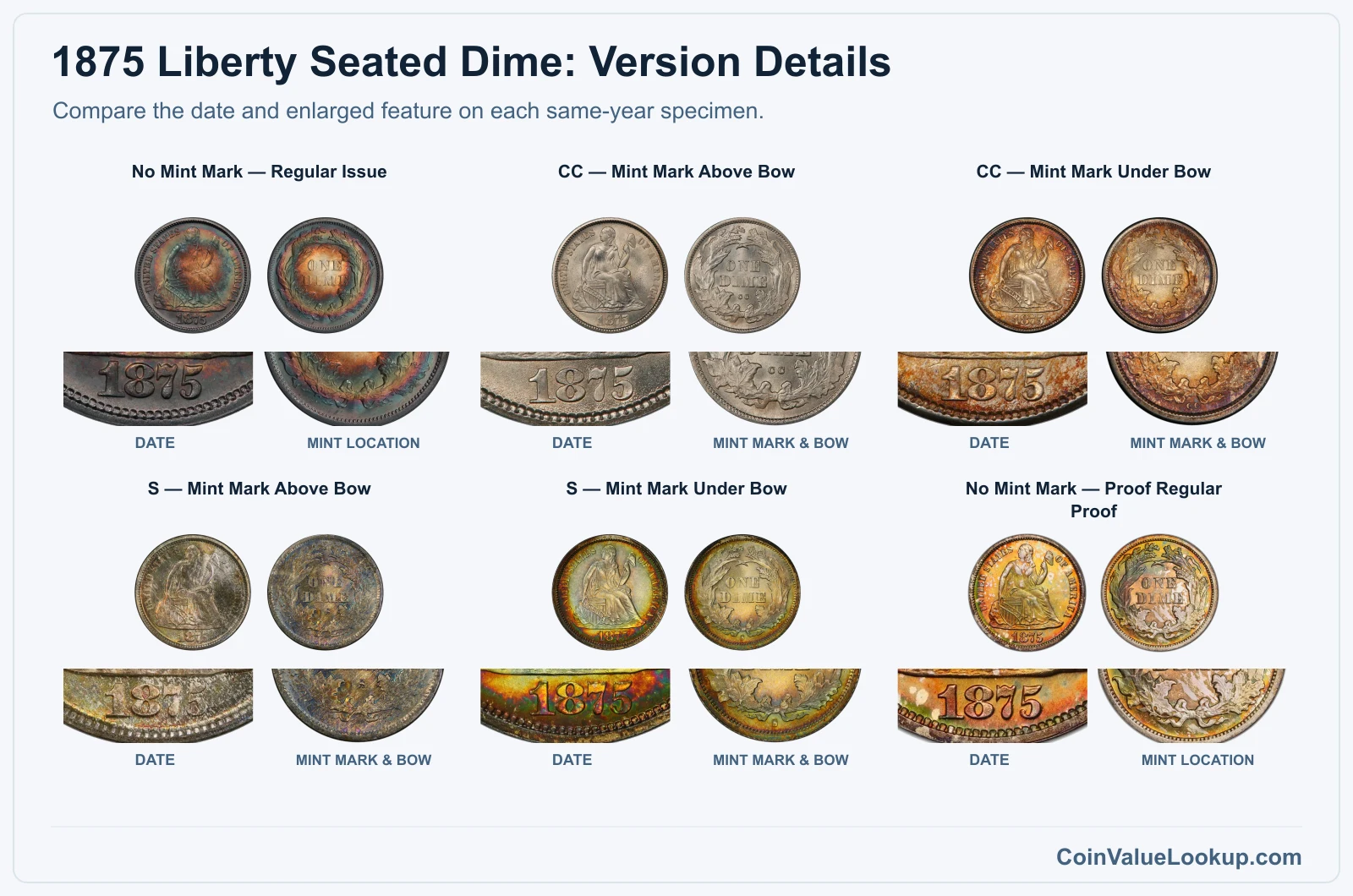
- Mintmark position matters: check whether the CC or S sits above or below the wreath bow, because each position carries a different value track.
Step 1: Identify Your 1875 Liberty Seated Dime Mint Mark and Version
Start with the obverse: you should see a seated Liberty facing left, stars around the border and the date 1875 at the bottom. No arrows flank the date this year.
The reverse shows an agricultural wreath enclosing the words ONE DIME.
Philadelphia issues carry no mintmark at all. For branch mints, flip to the reverse and look inside the wreath near the bow at the bottom.
Carson City coins show a small "CC" and San Francisco coins show an "S" in that area.
Here is the critical detail for 1875: both CC and S mintmarks come in two positions. "Above Bow" means the mintmark sits inside the wreath, roughly level with or above the ribbon bow.
"Under Bow" means it sits below the bow knot. This is a normal, recognized major variety for the date, not an error.
Get a loupe and compare yours carefully.
All regular 1875 dimes are struck in 90% silver and 10% copper, measure 17.9mm across with a reeded edge and weigh 2.50 grams. If yours is noticeably lighter, it may be damaged or a different denomination — half dimes are smaller and lighter, so do not confuse the two.
Step 2: Check Your 1875 Liberty Seated Dime Grade
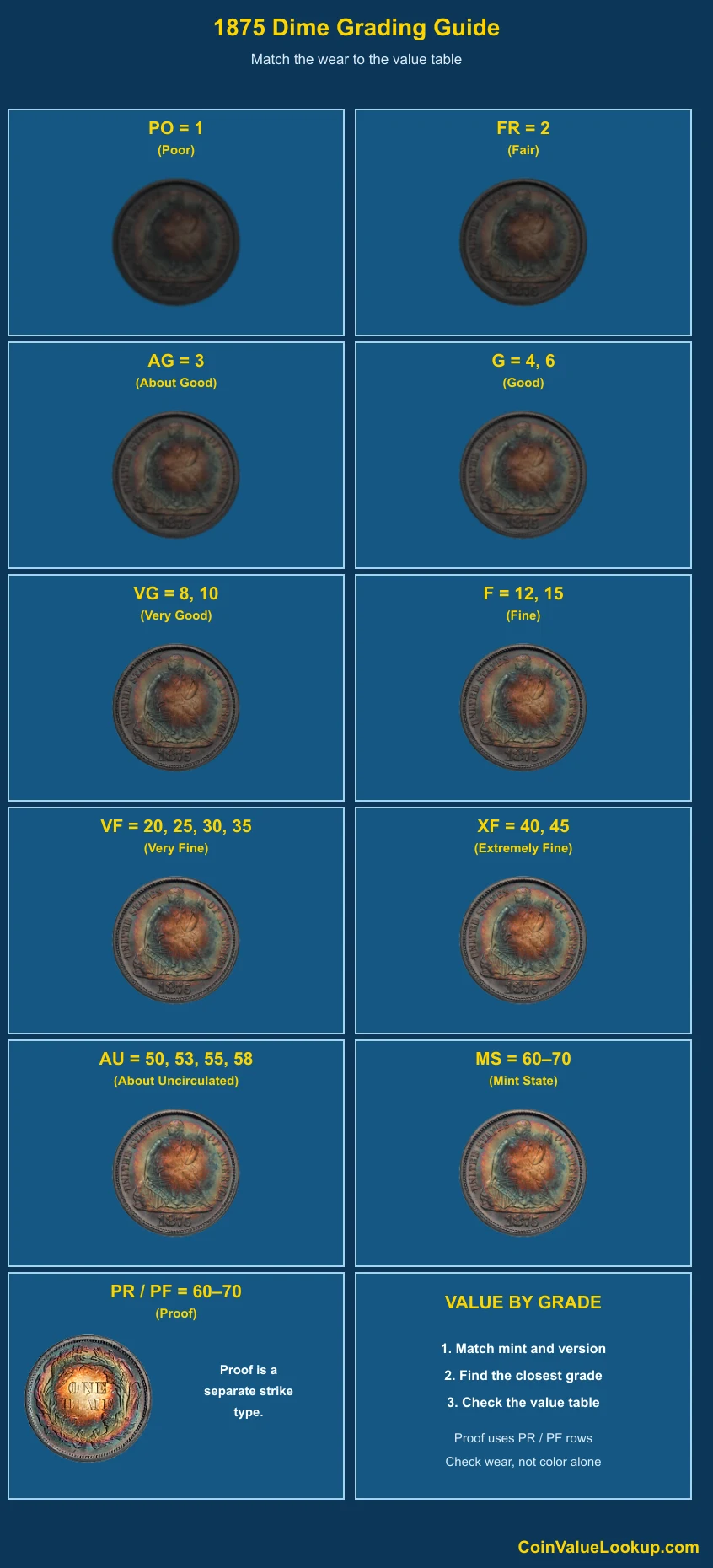
Look at the high points first. On the obverse, Liberty's head, her knee and the horizontal lines of the shield wear earliest.
On the reverse, check the tips of the wreath leaves.
A coin grading around Good (G4) will show a flat Liberty outline with little interior detail, while a Fine example retains clear shield lines and knee contour. At Extremely Fine you should see nearly full feather and drapery detail with only slight friction on the highest spots.
Mint State coins retain full original luster across both faces. Weak strikes and tired dies can make a coin look softer than its actual wear level, so always judge luster alongside detail.
Compare your coin to the reference image to calibrate your eye.
Proof coins are a separate manufacturing finish, not a grade above Mint State. A polished or cleaned business strike is not a Proof, no matter how shiny it looks.
Step 3: Check 1875 Liberty Seated Dime Value by Mint and Version
1875 Liberty Seated Dime — No Mint Mark — Regular Issue
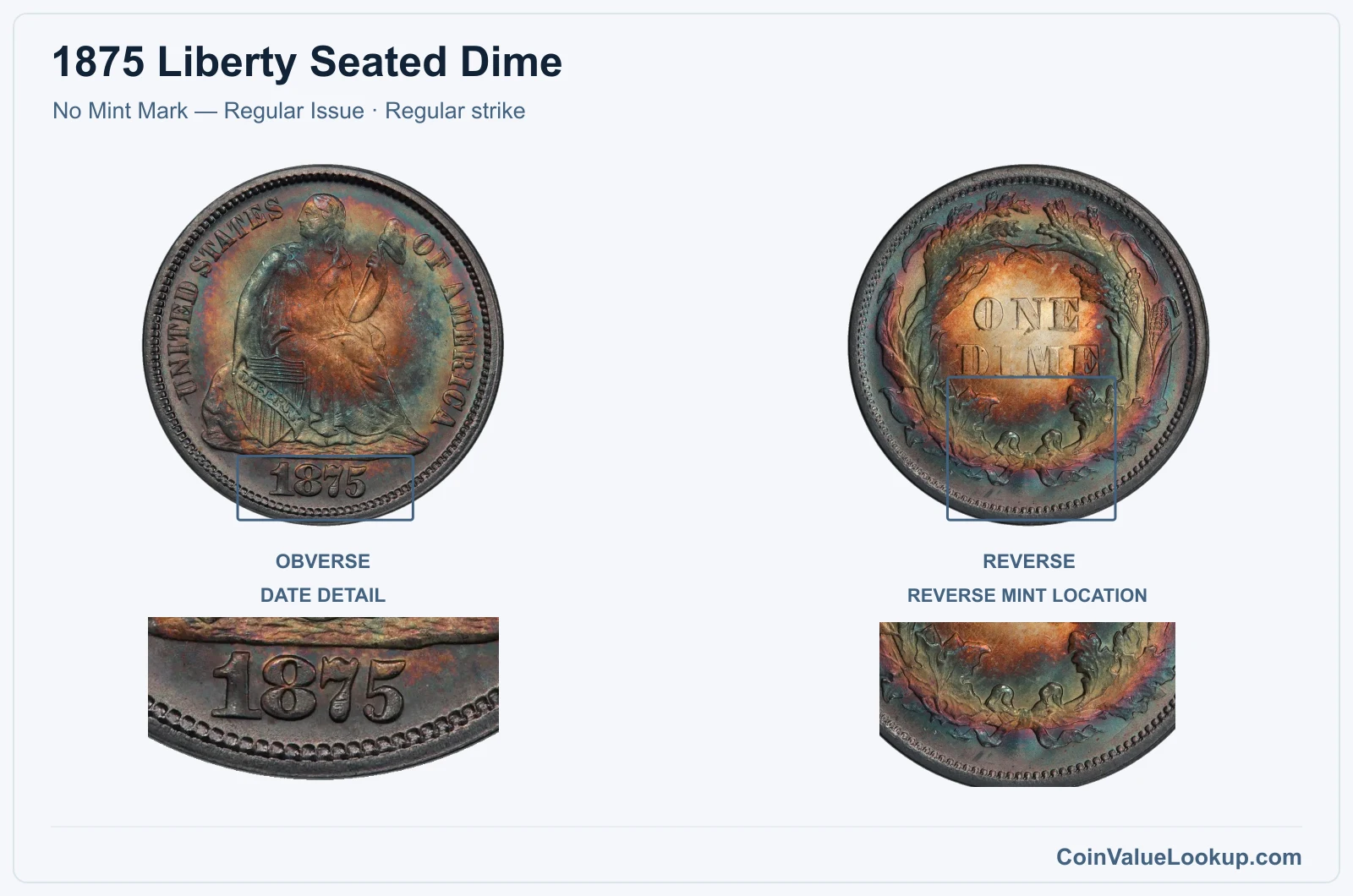
The Philadelphia issue has no mintmark anywhere on the coin. This is the first year arrows are absent after the 1873–74 weight-change period, yet the coin still weighs 2.50 grams.
USA Coin Book guide estimates place this version at about $22 in G4 and around $316 in MS63.
Look at the reverse field inside the wreath: it should be clean with no letters below the bow. If you see any small letter there, you have a branch-mint coin instead.
Philadelphia struck a healthy number of these, so circulated examples are among the most affordable ways into this date.
Range Grade
Price Auction Records Appraisal PO PO 1
—
Coin Identifier FR FR 2
—
Coin Identifier AG AG 3
—
Coin Identifier G G 4
Coin Identifier
G 6
—
Coin Identifier VG VG 8
—
Coin Identifier
VG 10
—
Coin Identifier F F 12
—
Coin Identifier
F 15
—
Coin Identifier VF VF 20
Coin Identifier
VF 25
Coin Identifier
VF 30
—
Coin Identifier
VF 35
—
Coin Identifier XF XF 40
—
Coin Identifier
XF 45
Coin Identifier AU AU 50
Coin Identifier
AU 53
Coin Identifier
AU 55
Coin Identifier
AU 58
Coin Identifier MS MS 60
Coin Identifier
MS 61
Coin Identifier
MS 62
Coin Identifier
MS 63
Coin Identifier
MS 64
Coin Identifier
MS 65
Coin Identifier
MS 66
Coin Identifier
MS 67
Coin Identifier
MS 68
—
—
—
MS 69
—
—
—
MS 70
—
—
—
1875 Liberty Seated Dime — CC — Mint Mark Above Bow
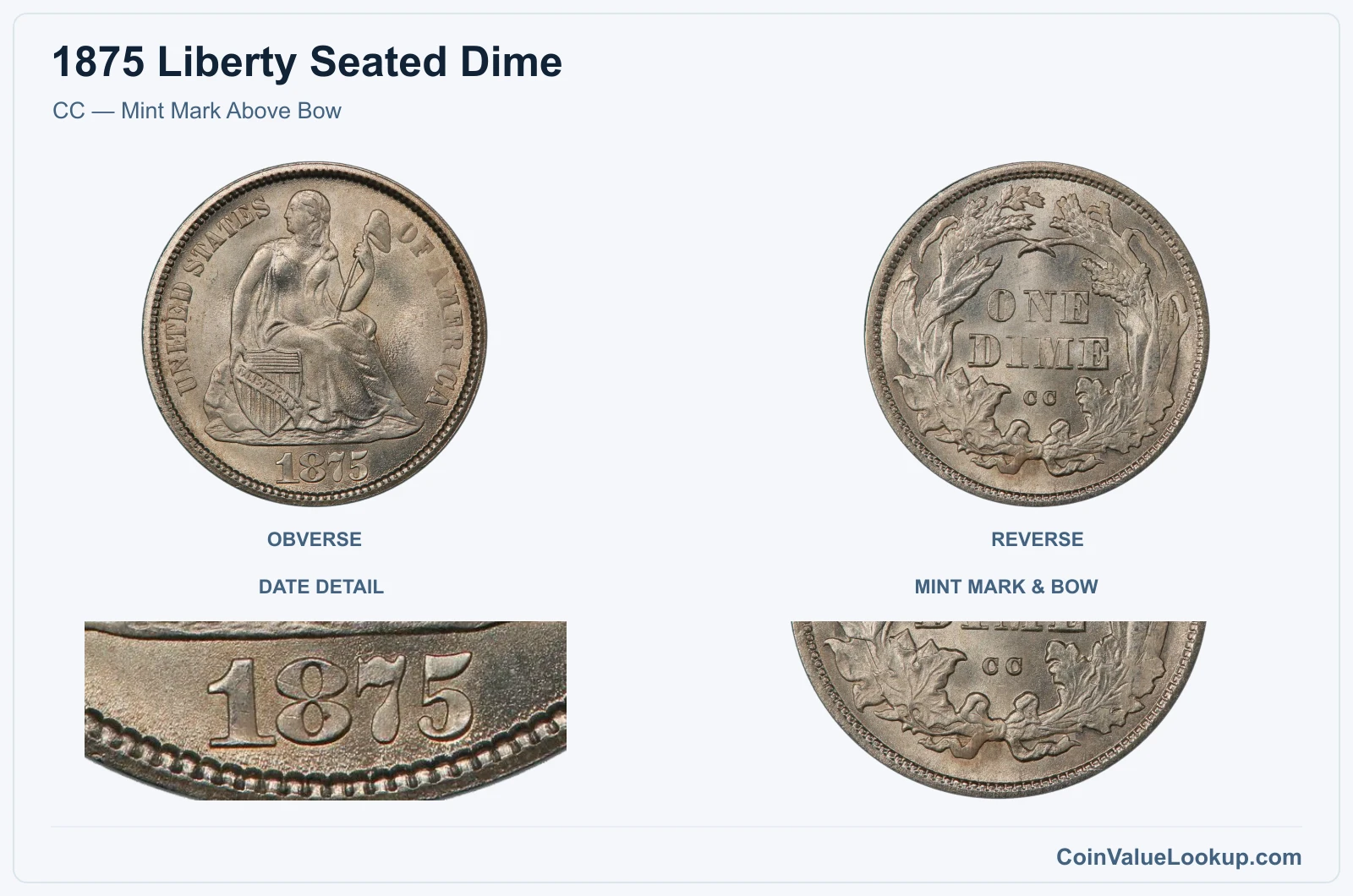
Carson City dimes always carry collector interest, and the 1875 CC with the mintmark positioned above the wreath bow is no exception. To confirm this variety, locate the small "CC" on the reverse inside the wreath — it should sit at or above the level of the ribbon bow knot.
USA Coin Book guides estimate about $60 at G4 and roughly $1,191 at MS63. That is a significant step up from Philadelphia.
Carson City's relatively modest output and the city's Old West mystique keep demand steady. Make sure you compare the mintmark height carefully against the "Under Bow" position before settling on which version you hold.
Range Grade
Price Auction Records Appraisal PO PO 1
—
Coin Identifier FR FR 2
—
Coin Identifier AG AG 3
—
Coin Identifier G G 4
—
Coin Identifier
G 6
—
Coin Identifier VG VG 8
—
Coin Identifier
VG 10
—
Coin Identifier F F 12
Coin Identifier
F 15
Coin Identifier VF VF 20
Coin Identifier
VF 25
Coin Identifier
VF 30
Coin Identifier
VF 35
Coin Identifier XF XF 40
Coin Identifier
XF 45
Coin Identifier AU AU 50
Coin Identifier
AU 53
Coin Identifier
AU 55
Coin Identifier
AU 58
Coin Identifier MS MS 60
Coin Identifier
MS 61
Coin Identifier
MS 62
Coin Identifier
MS 63
Coin Identifier
MS 64
Coin Identifier
MS 65
Coin Identifier
MS 66
Coin Identifier
MS 67
Coin Identifier
MS 68
—
—
—
MS 69
—
—
—
MS 70
—
—
—
1875 Liberty Seated Dime — CC — Mint Mark Under Bow
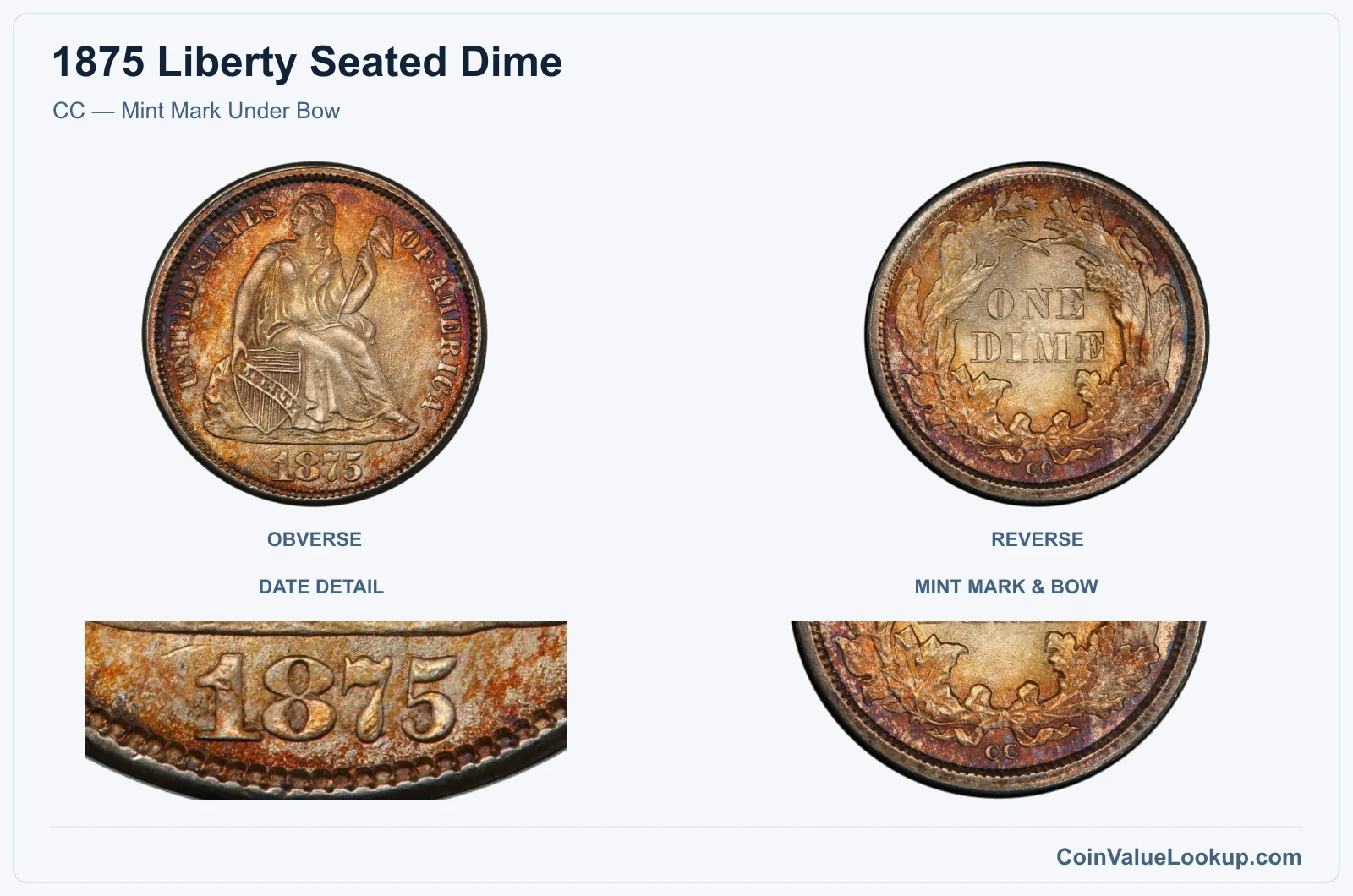
This is the version where the CC mintmark sits noticeably below the ribbon bow on the reverse. It guides higher than its Above Bow sibling: about $77 at G4 climbing to around $1,939 at MS63 per USA Coin Book estimates.
The difference in mintmark placement is small but real. Use a loupe and compare the top of the CC letters against the lowest loop of the bow.
If the CC is clearly beneath it, you have the Under Bow variety. Given the premium this version commands across all grades, getting the call right is worth the extra minute of squinting.
Coin Value Lookup is a good starting point if you want to look up guide values for other dates and mints in the Liberty Seated Dime series.
Range Grade
Price Auction Records Appraisal PO PO 1
—
Coin Identifier FR FR 2
—
Coin Identifier AG AG 3
Coin Identifier G G 4
—
Coin Identifier
G 6
—
Coin Identifier VG VG 8
—
Coin Identifier
VG 10
—
Coin Identifier F F 12
—
Coin Identifier
F 15
—
Coin Identifier VF VF 20
—
Coin Identifier
VF 25
Coin Identifier
VF 30
Coin Identifier
VF 35
Coin Identifier XF XF 40
Coin Identifier
XF 45
Coin Identifier AU AU 50
Coin Identifier
AU 53
Coin Identifier
AU 55
Coin Identifier
AU 58
Coin Identifier MS MS 60
—
Coin Identifier
MS 61
Coin Identifier
MS 62
Coin Identifier
MS 63
Coin Identifier
MS 64
Coin Identifier
MS 65
Coin Identifier
MS 66
Coin Identifier
MS 67
—
—
—
MS 68
—
—
—
MS 69
—
—
—
MS 70
—
—
—
1875 Liberty Seated Dime — S — Mint Mark Above Bow
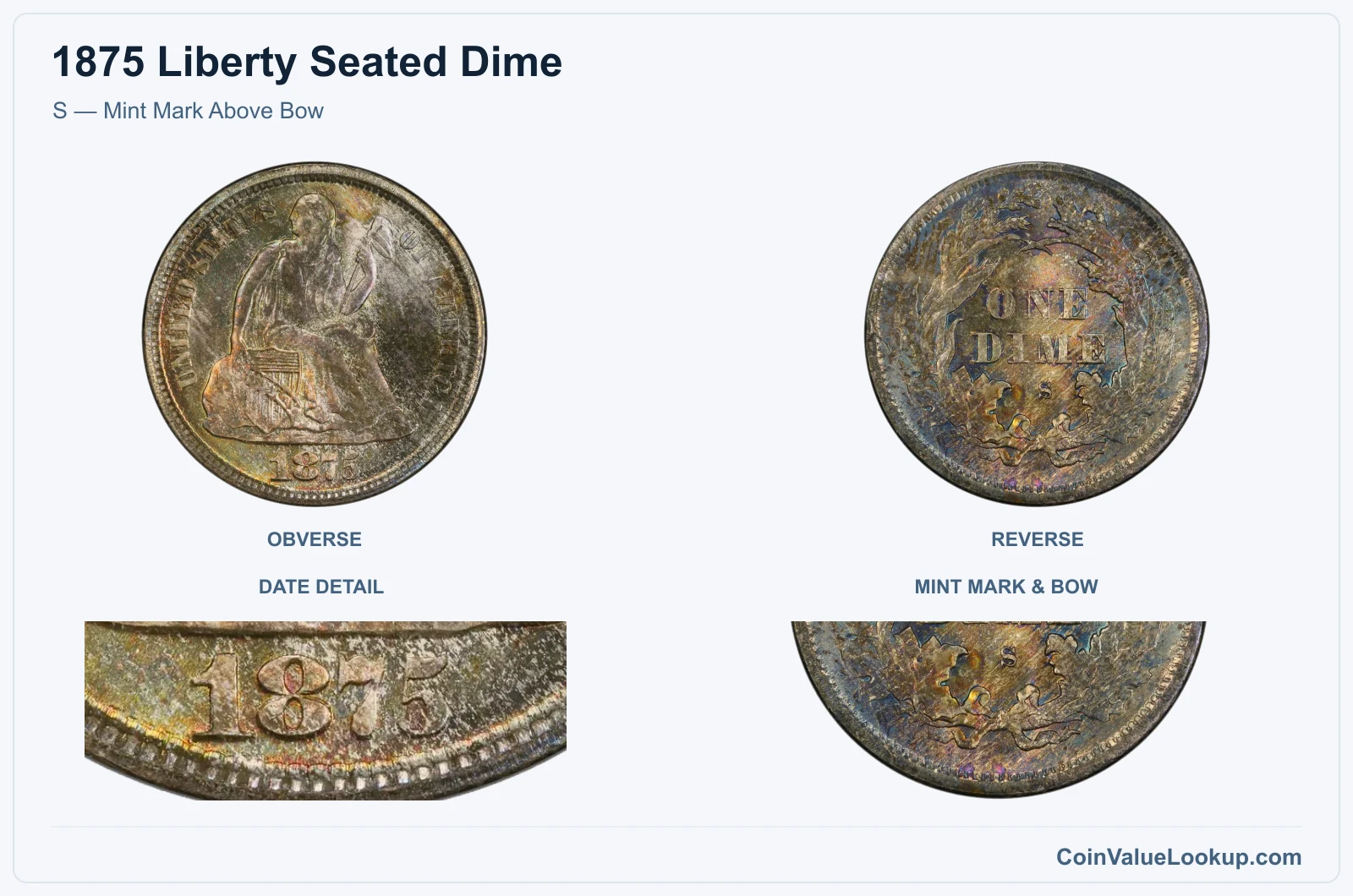
San Francisco also produced 1875 dimes with two mintmark positions. The Above Bow version has the "S" sitting inside the wreath at or above the ribbon bow.
USA Coin Book estimates run about $22 at G4 and around $348 at MS63.
These track close to Philadelphia prices in lower grades, so the mintmark position matters more as condition improves. Confirm the S is genuinely above the bow's knot — not just centered on it — before classifying.
Range Grade
Price Auction Records Appraisal PO PO 1
—
Coin Identifier FR FR 2
—
Coin Identifier AG AG 3
—
Coin Identifier G G 4
—
Coin Identifier
G 6
—
Coin Identifier VG VG 8
—
Coin Identifier
VG 10
—
Coin Identifier F F 12
—
Coin Identifier
F 15
—
Coin Identifier VF VF 20
Coin Identifier
VF 25
—
Coin Identifier
VF 30
—
Coin Identifier
VF 35
—
Coin Identifier XF XF 40
—
Coin Identifier
XF 45
Coin Identifier AU AU 50
—
Coin Identifier
AU 53
Coin Identifier
AU 55
Coin Identifier
AU 58
Coin Identifier MS MS 60
—
Coin Identifier
MS 61
—
Coin Identifier
MS 62
Coin Identifier
MS 63
Coin Identifier
MS 64
Coin Identifier
MS 65
Coin Identifier
MS 66
Coin Identifier
MS 67
—
Coin Identifier
MS 68
—
—
—
MS 69
—
—
—
MS 70
—
—
—
1875 Liberty Seated Dime — S — Mint Mark Under Bow
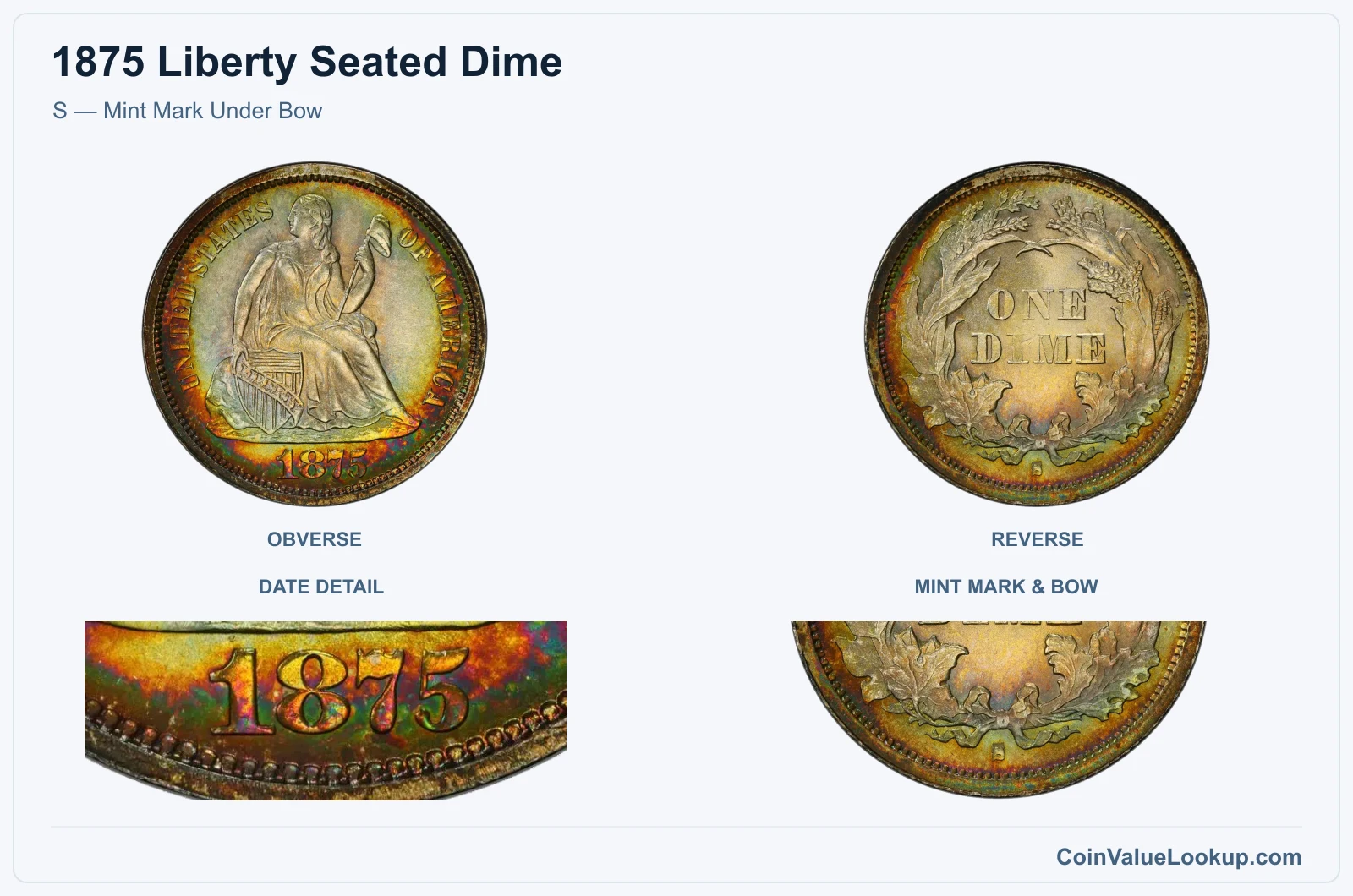
The San Francisco Under Bow variety shows the "S" mintmark positioned below the ribbon bow on the reverse. Guide estimates from USA Coin Book are roughly $22 at G4 and about $357 at MS63, just a shade above the Above Bow version in higher grades.
Because the two S varieties track so closely in value, some collectors focus on assembling both for completeness rather than chasing one over the other. Still, accurate identification matters for registry sets and proper attribution.
Use magnification and compare directly.
Range Grade
Price Auction Records Appraisal PO PO 1
—
Coin Identifier FR FR 2
—
Coin Identifier AG AG 3
—
Coin Identifier G G 4
—
Coin Identifier
G 6
—
Coin Identifier VG VG 8
—
Coin Identifier
VG 10
—
Coin Identifier F F 12
—
Coin Identifier
F 15
—
Coin Identifier VF VF 20
—
Coin Identifier
VF 25
—
Coin Identifier
VF 30
—
Coin Identifier
VF 35
—
Coin Identifier XF XF 40
Coin Identifier
XF 45
Coin Identifier AU AU 50
—
Coin Identifier
AU 53
Coin Identifier
AU 55
Coin Identifier
AU 58
Coin Identifier MS MS 60
—
Coin Identifier
MS 61
Coin Identifier
MS 62
Coin Identifier
MS 63
Coin Identifier
MS 64
Coin Identifier
MS 65
Coin Identifier
MS 66
Coin Identifier
MS 67
Coin Identifier
MS 68
—
—
—
MS 69
—
—
—
MS 70
—
—
—
1875 Liberty Seated Dime — No Mint Mark — Proof Regular Proof
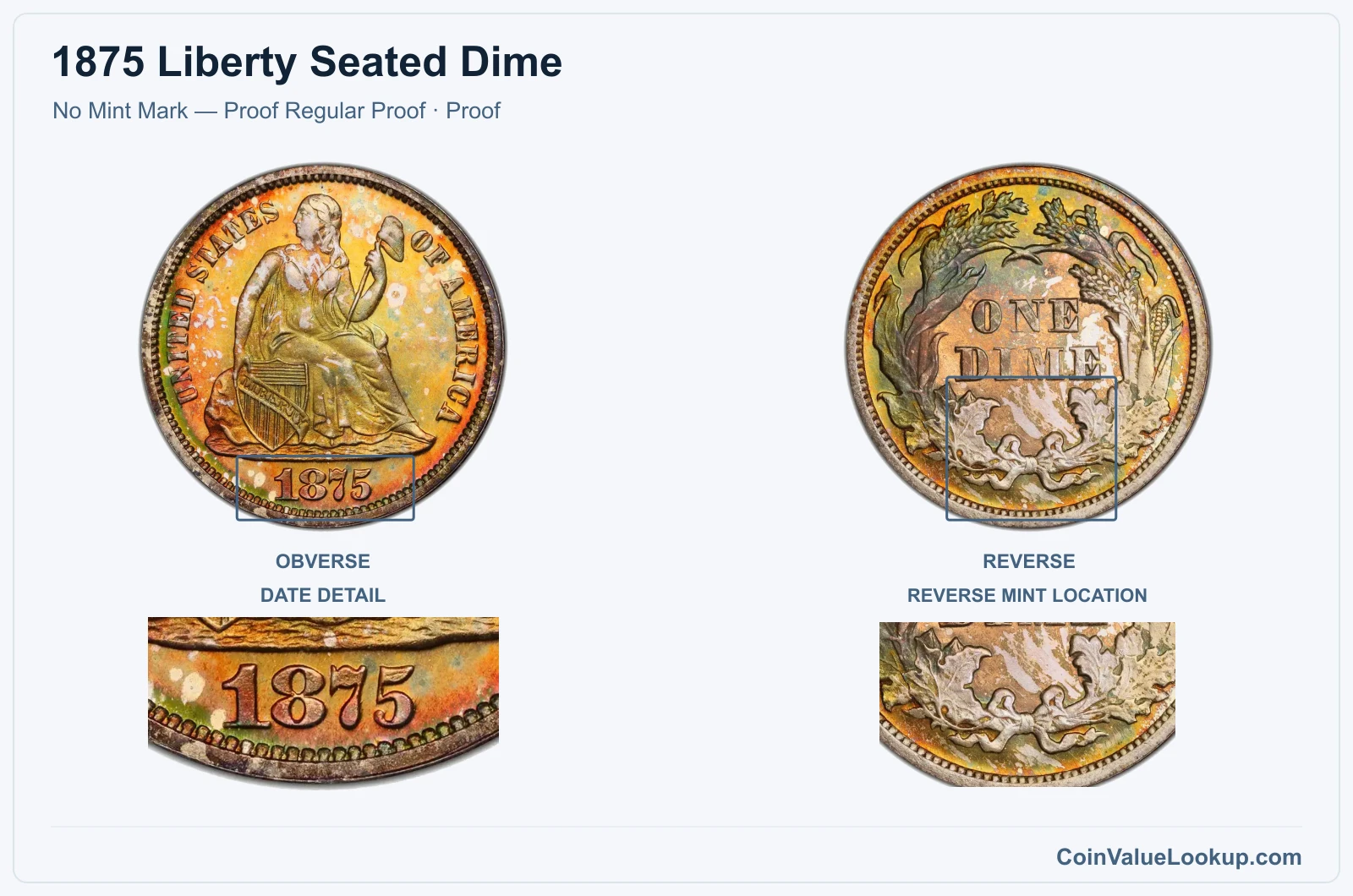
Philadelphia struck Proof dimes in 1875 using specially prepared dies and polished planchets. Genuine Proofs show deeply mirrored fields and sharp, fully formed design details that business strikes rarely match.
USA Coin Book guides this version at about $725 in PR63.
Hairlines from old cleaning are common on Proofs of this era and will affect the grade. The key diagnostic is the mirror-like field — but brilliance alone does not make a Proof.
A cleaned or polished business strike can look shiny without having the squared-off rims and precise die finish of a true Proof. Third-party certification is the safest way to confirm Proof status.
Range Grade
Price Auction Records Appraisal PR PR 1
—
Coin Identifier
PR 2
—
Coin Identifier
PR 3
—
Coin Identifier
PR 4
—
Coin Identifier
PR 6
—
Coin Identifier
PR 8
—
Coin Identifier
PR 10
—
Coin Identifier
PR 12
—
Coin Identifier
PR 15
—
Coin Identifier
PR 20
—
Coin Identifier
PR 25
—
Coin Identifier
PR 30
—
Coin Identifier
PR 35
—
Coin Identifier
PR 40
—
Coin Identifier
PR 45
—
Coin Identifier
PR 50
—
Coin Identifier
PR 53
—
Coin Identifier
PR 55
—
Coin Identifier
PR 58
—
Coin Identifier
PR 60
Coin Identifier
PR 61
Coin Identifier
PR 62
Coin Identifier
PR 63
Coin Identifier
PR 64
Coin Identifier
PR 65
Coin Identifier
PR 66
Coin Identifier
PR 67
Coin Identifier
PR 68
—
Coin Identifier
PR 69
—
—
—
PR 70
—
—
—
1875 Liberty Seated Dime Error List
1. 1875 Liberty Seated Dime — Repunched Date
A repunched date on an 1875 dime shows remnants of an earlier date-punch impression alongside the final numerals. You might see a ghostly second "1" or "8" slightly offset from the accepted position.
This is a die variety created during manufacture, not post-mint damage.
Do not confuse this with doubling of the entire design (a doubled die) or with flat, shelf-like machine doubling that lacks separation between impressions. Damage to the date area from circulation hits can also mimic a repunched date, so look for consistent, raised contours that follow the shape of a numeral.
Condition, the clarity of the remnant and the specific die involved all affect value; no single price applies to every example.
2. 1875 Liberty Seated Dime — Misplaced Date
A misplaced date occurs when part of a date digit appears outside its normal position — typically down among the denticles below the date. On an 1875 dime, inspect the denticle area beneath the numerals for traces of an extra "1" or other recognizable numeral fragment.
The key is that the stray impression matches the contour of a date digit, not a random scratch or die-polishing line. Scratches tend to be incuse and irregular; a misplaced numeral fragment is raised and follows the shape of a specific number.
The value of such a coin depends on how visible the misplacement is and the coin's overall condition. No standard price range is established for this category on the 1875 date.
3. 1875 Liberty Seated Dime — Rotated Dies
Normal United States coins are struck in "coin alignment," meaning if you hold the obverse upright and flip the coin top-to-bottom, the reverse should also appear upright. A rotated die error means the reverse is turned some number of degrees off that standard.
To test, hold your 1875 dime with Liberty right-side-up. Flip it along a vertical axis (like turning a page).
If ONE DIME on the back is tilted, you may have a rotation. Be careful — a photograph taken at an angle can fake this effect.
Only a physical check confirms it. The degree of rotation and the coin's condition both influence collector interest; minor rotations attract less attention than dramatic ones.
4. 1875 Liberty Seated Dime — Die Crack / Die Chip
Die cracks appear as thin, raised lines on the coin's surface, created when the steel die itself developed a fracture during use. Die chips are small raised blobs from a tiny piece of the die breaking away.
Both are common on well-used dies of this era.
On an 1875 dime, look for fine raised lines that cut across the design or connect letters. These should be raised above the field — not incuse.
Incuse lines are scratches from contact damage, and lumpy surface buildup may be corrosion or foreign material. A die crack that extends from the design to the rim and leaves a larger raised area is technically a cud, which is a separate category.
Value depends on size, location and the coin's grade.
5. 1875 Liberty Seated Dime — Clashed Dies
Clashed dies result when the obverse and reverse dies strike each other without a planchet between them. The impact transfers faint traces of each die's design onto the other.
On an 1875 Philadelphia dime, look for ghost-like impressions of wreath elements in Liberty's open field, or traces of Liberty's outline among the reverse wreath.
These transferred images should align with where the opposite die's features would naturally contact. Random raised lines, scratches or a brockage (a struck coin used as a die) can look similar but lack that consistent positional alignment.
The strength of the clash impression and the coin's overall condition determine collector interest; no standard price is established for this error on the 1875 date.
6. 1875 Liberty Seated Dime — Doubled Die Reverse
A doubled die reverse on an 1875 dime shows separated or overlapping contours on reverse design elements — reported specifically on the letters of ONE. Look for clear doubling with distinct raised outlines that do not flatten into a shelf.
Machine doubling, which is far more common and less valuable, typically shows flat, shelf-like displacement without the sharp secondary contour of a true doubled die. Reflections under certain lighting angles can also trick your eye.
Compare suspected doubling against a known normal example at the same magnification. The value of a doubled die reverse depends on the strength and visibility of the doubling as well as the coin's condition.
7. 1875 Liberty Seated Dime — Off-Center Strike
An off-center strike happens when the planchet is not properly seated between the dies at the moment of striking. The result is a design that is shifted to one side, leaving an unstruck crescent of blank metal on the opposite edge.
On an 1875 dime, the most collectible off-center examples still show a full, readable date — without the date, attribution to a specific year is impossible, and value drops sharply. Do not confuse an off-center strike with a clipped planchet (which has a curved bite taken from the edge) or with post-mint flattening from a vise or similar tool.
Condition, the percentage of offset and date visibility all affect what an off-center 1875 dime is worth.
8. 1875 Liberty Seated Dime — Die Break / Cud
A cud is a specific type of die break where a piece of the die along the rim breaks away entirely. The missing die section leaves a raised, featureless blob on the coin that connects to the rim.
It differs from an interior die chip, which sits within the field away from the edge.
On an 1875 dime, check the rim area on both sides for any raised lump that interrupts the normal denticle pattern and adjacent design. A rim dent from post-mint damage is incuse (pushed in), while a cud is raised and flat-topped.
Corrosion can also build up along a rim and mimic a cud's appearance, so look for the sharp boundary where normal design abruptly stops. Value depends on the cud's size, location and the coin's overall condition.