1886 Liberty Seated Dime Coin Value: How Much Is It Worth?
The 1886 Liberty Seated Dime spans a wide range depending on mint, grade and finish. USA Coin Book guide estimates place circulated Philadelphia pieces around $22 at G4, while a San Francisco example can reach roughly $1,247 at MS63.
Philadelphia Proofs carry their own pricing near $725 at PR63. Three distinct collectible branches exist for this date: Philadelphia and San Francisco business strikes, plus Philadelphia Proofs.
Fast Way to Identify Your 1886 Liberty Seated Dime
Want a quick read on what you have? Upload clear photos of both the front and back of your 1886 dime, and our identifier can offer a preliminary take on the mint, finish and general version.
This is not a substitute for professional authentication or grading, but it is a solid first step toward understanding your coin.
1886 Liberty Seated Dime Value
Upload both sides of your 1886 Liberty Seated Dime.
Front Obverse
Upload photo
Back Reverse
Upload photo
Which 1886 Liberty Seated Dime Versions Are Worth Money?
- The San Francisco (S mintmark) business strike commands the highest guide values of the regular issues, listed around $41 at G4 and approximately $1,247 at MS63 per USA Coin Book.
- Philadelphia Proofs, struck in limited numbers with specially prepared dies, carry a guide estimate near $725 at PR63 and are a distinct collectible branch from regular Philadelphia strikes.
- Repunched Date and Misplaced Date varieties are reported for the 1886 date and can carry premiums depending on visibility and condition.
- Die cracks, die clashes and off-center strikes are documented error categories for 1886 Philadelphia dimes and may add collector interest beyond standard pricing.
Step 1: Identify Your 1886 Liberty Seated Dime Mint Mark and Version
The 1886 Liberty Seated Dime shows a seated Liberty figure on the obverse and the words ONE DIME inside an agricultural wreath on the reverse. The coin is 90% silver and 10% copper, weighs a nominal 2.50 grams, measures 17.9mm across, and has a reeded edge.
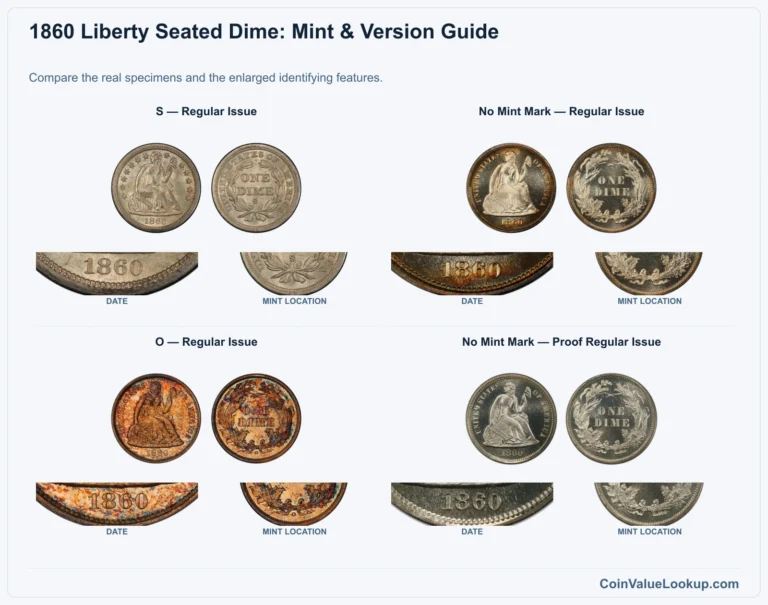
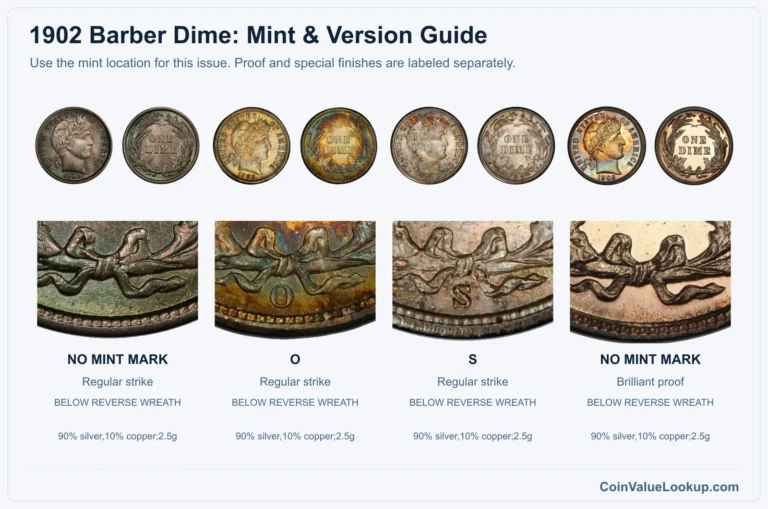
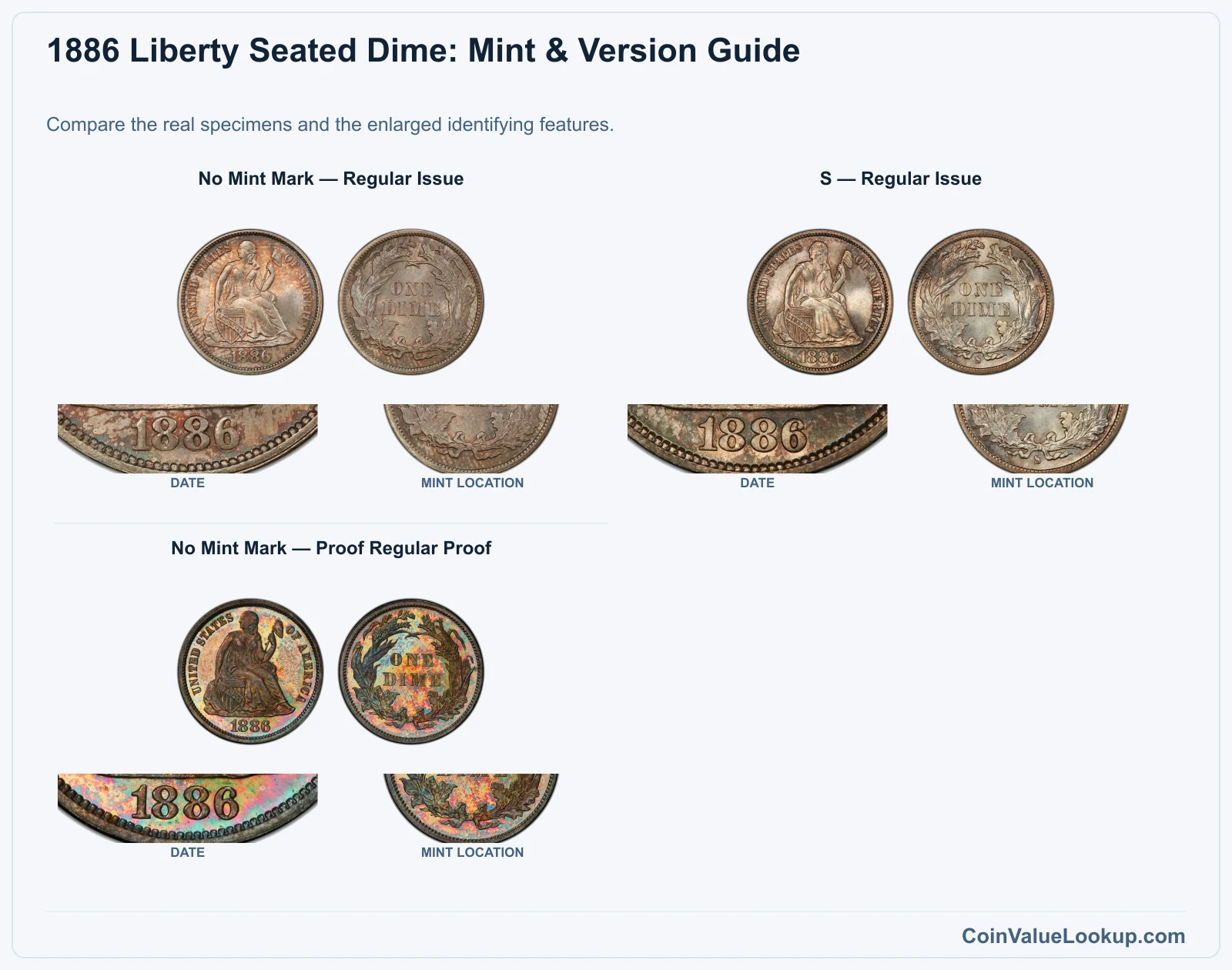
Philadelphia strikes carry no mintmark at all. San Francisco pieces show a small "S" on the reverse, located within or near the wreath.
If you see a mintmark other than S, you are looking at a different year or denomination.
Do not confuse this coin with a half dime. The half dime is smaller, lighter and had ceased production by 1873.
If the reverse says HALF DIME, set it aside for a different guide.
Strike quality on Seated dimes varies a lot, and a softly struck coin from Philadelphia can look worn even when it is not. Pay attention to the overall surface luster and whether the high points show actual friction before assuming your coin is heavily circulated.
Step 2: Check Your 1886 Liberty Seated Dime Grade
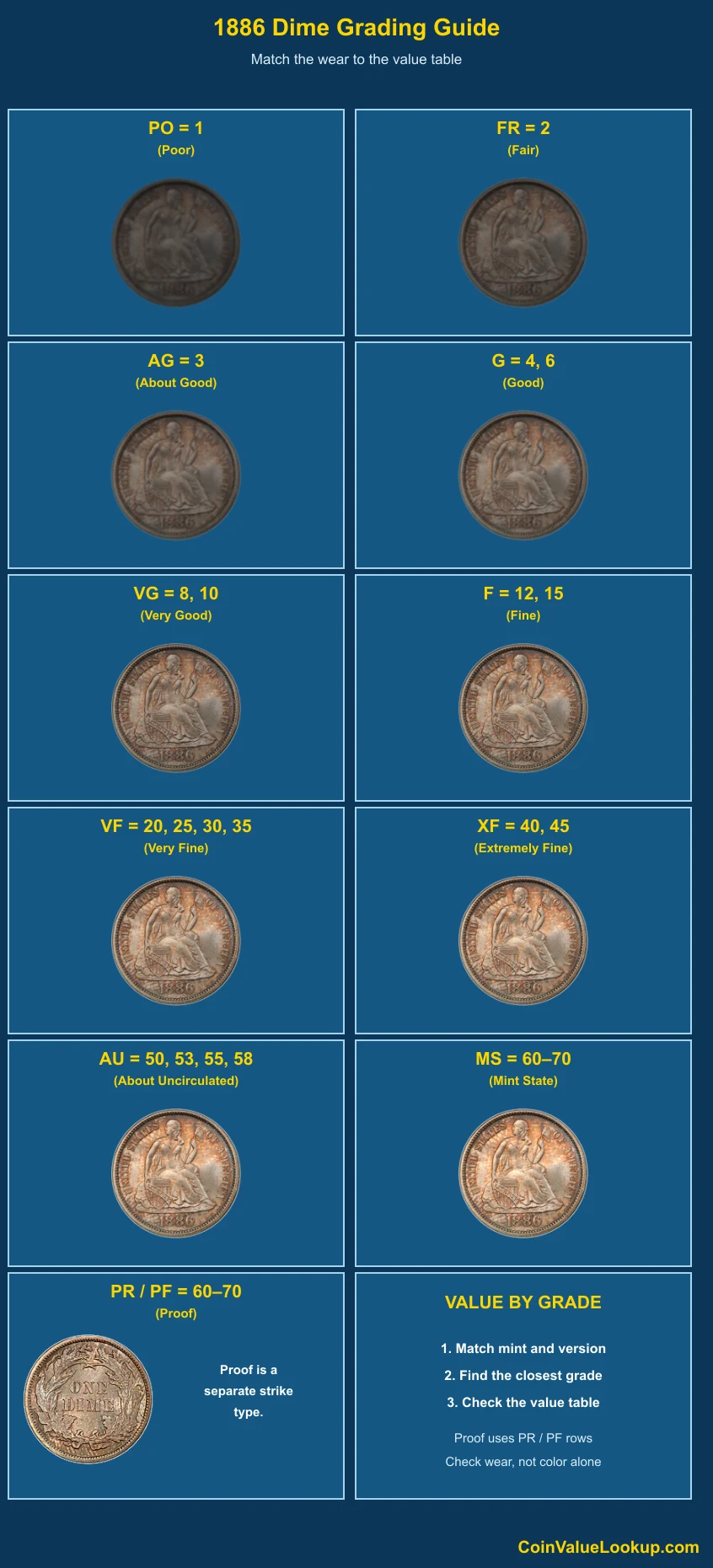
Start with the obverse. On a well-worn example, Liberty's head loses its fine hair detail first, followed by the breast, knee and horizontal shield lines.
These are your checkpoints from About Good through Very Fine.
At Extremely Fine and above, most shield lines remain distinct and the knee shows only slight friction. Full, unbroken luster across both faces generally means Mint State territory.
On the reverse, inspect the wreath leaves. The highest leaf clusters wear first.
A coin with sharp leaves but a flat obverse knee has likely been cleaned or experienced uneven wear.
Weak strikes can mimic wear. The difference is that a weakly struck coin still has original mint luster in the soft areas, while a worn coin does not.
Compare your piece to the grading image for this type, checking both sides together before drawing conclusions.
A polished coin is not a Proof. Proofs have mirror-like fields from specially prepared dies, not from someone buffing a business strike with a cloth.
Step 3: Check 1886 Liberty Seated Dime Value by Mint and Version
1886 Liberty Seated Dime — No Mint Mark — Regular Issue
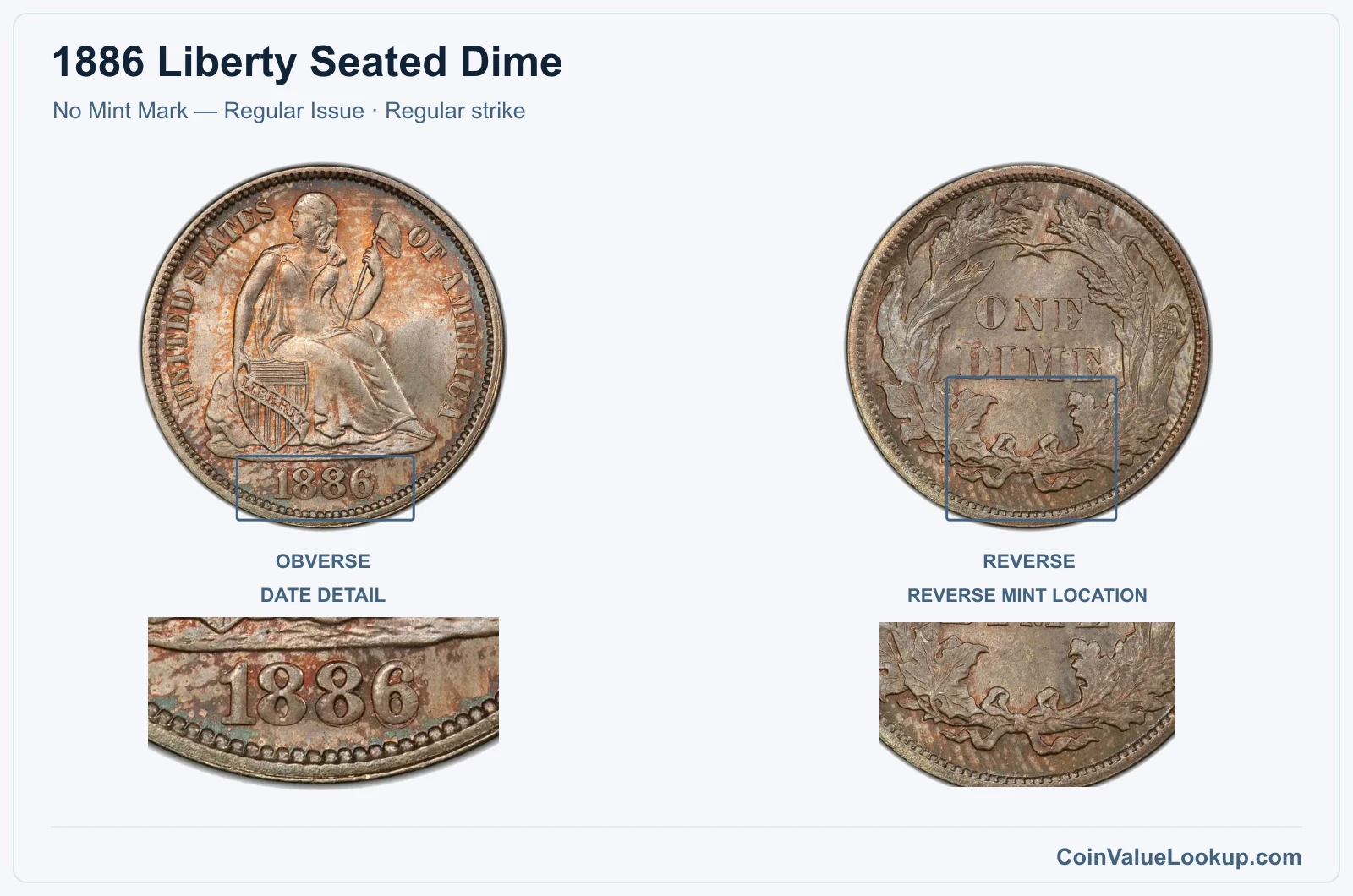
The Philadelphia regular issue has no mintmark. Look at the reverse near the wreath bow area; it should be clean of any letter.
This is the most available version of the 1886 Seated dime.
USA Coin Book lists a guide estimate of about $22 at G4 and around $316 at MS63. The design uses the Legend Obverse paired with the agricultural wreath reverse.
Strike quality can be uneven on Philadelphia dies this year, so softness on the stars or Liberty's head does not automatically mean heavy wear. Check for original luster before downgrading.
Range Grade
Price Auction Records Appraisal PO PO 1
—
Coin Identifier FR FR 2
—
Coin Identifier AG AG 3
—
Coin Identifier G G 4
—
Coin Identifier
G 6
—
Coin Identifier VG VG 8
—
Coin Identifier
VG 10
—
Coin Identifier F F 12
—
Coin Identifier
F 15
—
Coin Identifier VF VF 20
—
Coin Identifier
VF 25
—
Coin Identifier
VF 30
—
Coin Identifier
VF 35
—
Coin Identifier XF XF 40
—
Coin Identifier
XF 45
Coin Identifier AU AU 50
Coin Identifier
AU 53
Coin Identifier
AU 55
Coin Identifier
AU 58
Coin Identifier MS MS 60
Coin Identifier
MS 61
Coin Identifier
MS 62
Coin Identifier
MS 63
Coin Identifier
MS 64
Coin Identifier
MS 65
Coin Identifier
MS 66
Coin Identifier
MS 67
Coin Identifier
MS 68
—
—
—
MS 69
—
—
—
MS 70
—
—
—
1886 Liberty Seated Dime — S — Regular Issue
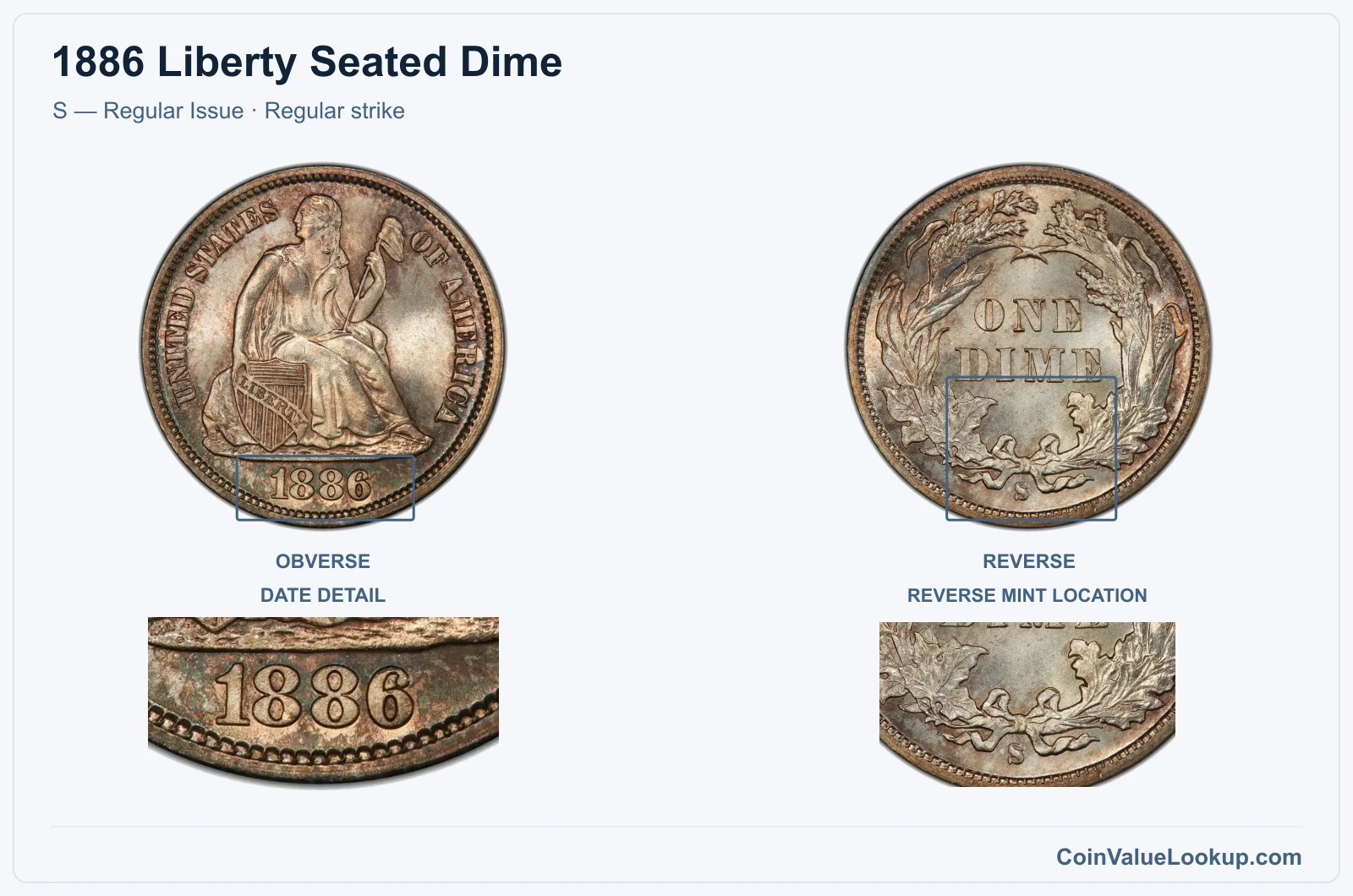
The San Francisco issue carries a small "S" mintmark on the reverse. This is the pricier of the two business-strike mints for 1886.
USA Coin Book places a guide estimate of about $41 at G4 and roughly $1,247 at MS63.
That jump in value compared to Philadelphia reflects lower survival rates in higher grades. San Francisco coins often entered commerce immediately and stayed there.
Finding one with original surfaces and minimal marks in the upper circulated grades is tougher than it sounds. Same 90% silver composition and 2.50-gram weight as Philadelphia.
Coin Value Lookup is a good starting point if you want to compare guide values across other Seated dime dates and mints. You can look up individual years to see where your coin fits in the broader series.
Range Grade
Price Auction Records Appraisal PO PO 1
—
Coin Identifier FR FR 2
—
Coin Identifier AG AG 3
—
Coin Identifier G G 4
—
Coin Identifier
G 6
—
Coin Identifier VG VG 8
—
Coin Identifier
VG 10
—
Coin Identifier F F 12
—
Coin Identifier
F 15
—
Coin Identifier VF VF 20
—
Coin Identifier
VF 25
—
Coin Identifier
VF 30
Coin Identifier
VF 35
—
Coin Identifier XF XF 40
Coin Identifier
XF 45
Coin Identifier AU AU 50
Coin Identifier
AU 53
Coin Identifier
AU 55
Coin Identifier
AU 58
Coin Identifier MS MS 60
—
Coin Identifier
MS 61
—
Coin Identifier
MS 62
Coin Identifier
MS 63
Coin Identifier
MS 64
Coin Identifier
MS 65
Coin Identifier
MS 66
Coin Identifier
MS 67
Coin Identifier
MS 68
Coin Identifier
MS 69
—
—
—
MS 70
—
—
—
1886 Liberty Seated Dime — No Mint Mark — Proof Regular Proof
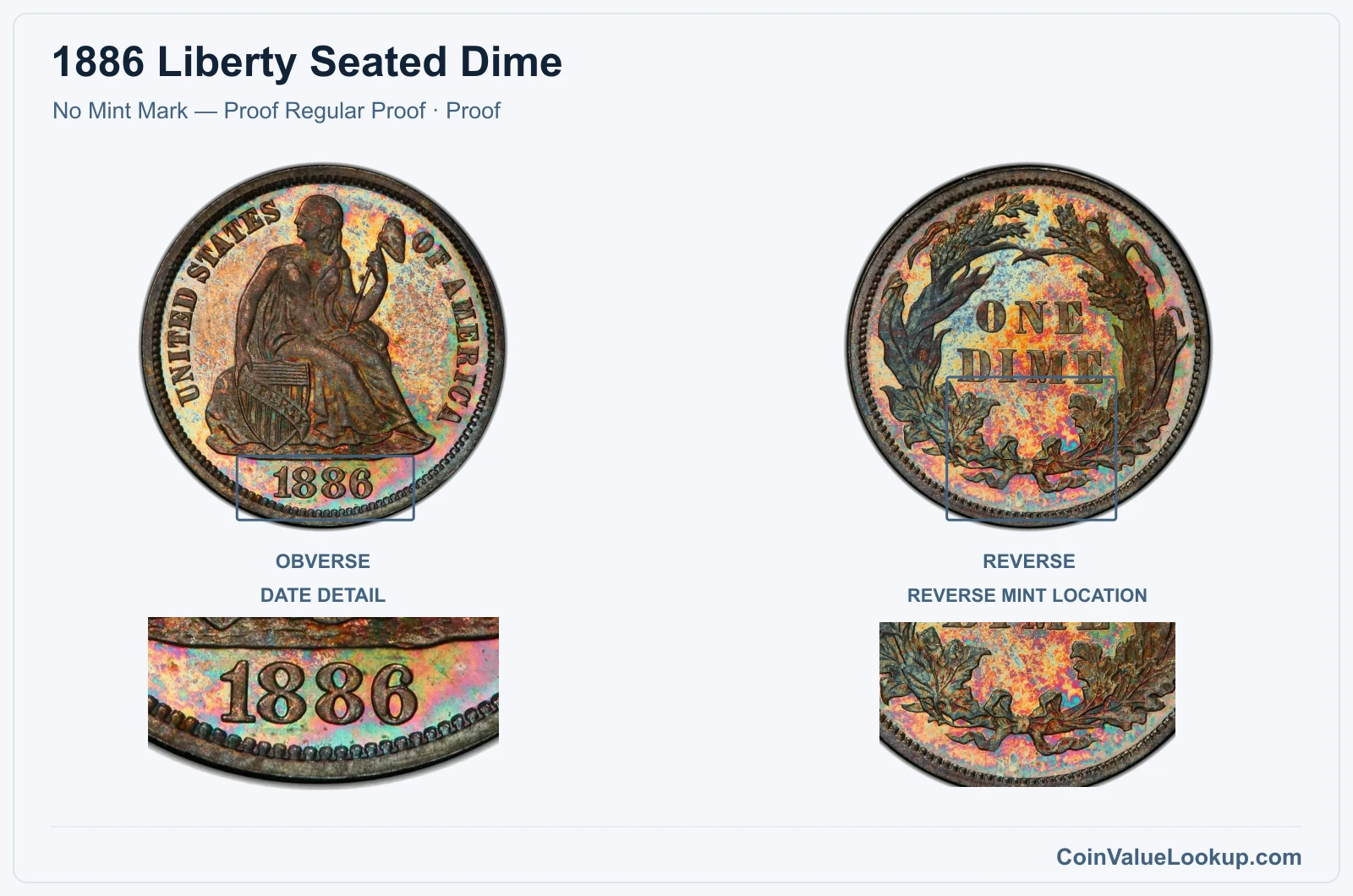
Philadelphia Proofs were struck from specially prepared dies onto polished planchets, producing deep mirror fields. These are collectible as a separate finish from business strikes, not as a higher grade of the same coin.
USA Coin Book lists a guide estimate near $725 at PR63 for the 1886 Proof. Examine the fields carefully under angled light.
Genuine Proofs show reflective, glassy surfaces, and any hairlines from handling will be visible in those mirrors. A brilliant business strike that someone cleaned is not a Proof.
If the devices lack sharp, squared-off edges and the fields are not uniformly mirrored, you likely have a polished regular issue.
Range Grade
Price Auction Records Appraisal PR PR 1
—
Coin Identifier
PR 2
—
Coin Identifier
PR 3
—
Coin Identifier
PR 4
—
Coin Identifier
PR 6
—
Coin Identifier
PR 8
—
Coin Identifier
PR 10
—
Coin Identifier
PR 12
—
Coin Identifier
PR 15
—
Coin Identifier
PR 20
—
Coin Identifier
PR 25
—
Coin Identifier
PR 30
—
Coin Identifier
PR 35
—
Coin Identifier
PR 40
—
Coin Identifier
PR 45
—
Coin Identifier
PR 50
—
Coin Identifier
PR 53
—
Coin Identifier
PR 55
—
Coin Identifier
PR 58
—
Coin Identifier
PR 60
—
Coin Identifier
PR 61
Coin Identifier
PR 62
Coin Identifier
PR 63
Coin Identifier
PR 64
Coin Identifier
PR 65
Coin Identifier
PR 66
Coin Identifier
PR 67
Coin Identifier
PR 68
—
—
—
PR 69
—
—
—
PR 70
—
—
—
1886 Liberty Seated Dime Error List
1. 1886 Liberty Seated Dime — Repunched Date
A repunched date on the 1886 dime shows remnants of an earlier position of one or more date numerals alongside the final placement. Look for faint outlines or extra thickness on specific digits, particularly where the initial punch landed slightly off from where the engraver intended.
This is not the same as doubled die doubling, which affects the entire design. Repunched dates are localized to the numerals and result from the date punch being applied more than once during die preparation.
Do not confuse a repunched date with post-strike damage to the date area or with machine doubling, which produces flat, shelf-like distortion rather than distinct secondary outlines. Condition, the clarity of the extra punch and overall eye appeal all affect what collectors will pay, so no single price applies across the board.
2. 1886 Liberty Seated Dime — Misplaced Date
A misplaced date occurs when part of a date digit appears outside the intended date position, typically among the denticles at the rim. On the 1886 dime, inspect the denticles beneath the second "8" for recognizable fragments of a numeral.
What you are looking for is a raised contour that matches the shape of a date digit. This is different from a random scratch or die line, which will not consistently trace the outline of a specific number.
Do not mistake surface damage or corrosion pits for a misplaced digit. The key is that the shape is raised, consistent with a die element, and located outside the normal date area.
Value depends on how visible the misplaced fragment is and the overall condition of the coin. No standard price range applies.
3. 1886 Liberty Seated Dime — Die Crack / Die Chip
Die cracks appear as thin, raised lines on the coin's surface, running from one design element to another or from the rim inward. Die chips show up as small raised blobs, usually within a letter or design feature.
Both result from fractures in the steel die during its working life.
On 1886 Philadelphia dimes, these are documented die states. A crack connecting the rim to a letter is different from a retained interior cud, which is a larger area of raised metal where a piece of the die broke away but stayed in place.
Do not confuse die cracks with incuse scratches, which are recessed into the surface rather than raised. Corrosion or foreign deposits can also mimic a crack at first glance.
Run a fingernail across the mark: a genuine die crack is raised. Value depends on the crack's prominence and the coin's grade.
4. 1886 Liberty Seated Dime — Clashed Dies
Clashed dies occur when the obverse and reverse dies strike each other without a planchet between them. The impact transfers faint impressions of one die's design onto the other.
On the struck coin, you will see ghostly traces of the opposite side's design in the fields.
On the 1886 Philadelphia dime, look for faint outlines of wreath elements on the obverse field around Liberty, or traces of the seated figure on the reverse. These impressions align with where the opposing design would contact the die face.
Do not mistake random scratches, contact marks or raised lines from a different cause for clash marks. A brockage, where an already-struck coin acts as a die, produces a much more dramatic and mirror-image effect.
True clash marks are subtle and positioned exactly where the opposing design would land. Value varies with visibility and coin condition.
5. 1886 Liberty Seated Dime — Off-Center Strike
An off-center strike happens when the planchet is not properly centered between the dies at the moment of impact. The result is a displaced design with an unstruck crescent of blank metal along part of the rim.
For the 1886 Seated dime, off-center examples have been cataloged by dealers. The percentage of off-center displacement and whether the full date remains visible are the two biggest factors in desirability.
A coin with the date struck off the edge loses much of its appeal.
Do not confuse an off-center strike with a clipped planchet, which shows a curved bite out of the blank before striking. Post-mint damage that flattens one side of the rim is also not the same thing.
A genuine off-center coin will have a clean, unstruck area with the original planchet edge intact. Value depends on the degree of displacement, date visibility and overall condition.