1919 Mercury Dime Coin Value: How Much Is It Worth?
A 1919 Mercury Dime in well-worn condition starts around $7 to $9 depending on the mint, while pristine examples can climb into the hundreds or even low thousands. Guide estimates for this year range from about $7.16 in G4 for Philadelphia strikes up to $1,882 in MS65 for San Francisco coins.
Full Bands designations and the known Doubled Die Obverse variety can push values further.
Fast Way to Identify Your 1919 Mercury Dime
Want a quick read on your 1919 Mercury Dime? Upload clear photos of both the front and back, and our identifier can offer a preliminary take on which mint version you have and its general condition.
This is not a certified authentication or exact grade assignment, but it gives you a solid starting point before deciding on next steps.
1919 Mercury Dime Value
Upload both sides of your 1919 Mercury Dime.
Front Obverse
Upload photo
Back Reverse
Upload photo
Which 1919 Mercury Dime Versions Are Worth Money?
- Philadelphia Doubled Die Obverse: The motto IN GOD WE TRUST shows pronounced doubling on confirmed examples. One XF40 example reportedly sold for $7,800 at auction.
- San Francisco MS65 coins carry the highest regular guide estimate at about $1,882, reflecting lower survival rates in top grades for this mint.
- Denver MS65 examples follow closely at roughly $1,678 in guide estimates, well above their circulated value of around $8.50 in G4.
- Full Bands designation on any mint's coin adds a premium over the regular Mint State value, since clean band separation was difficult to achieve on 1919 strikes.
- Even heavily worn examples contain 90% silver, so melt value provides a baseline floor for all 1919 Mercury Dimes.
Step 1: Identify Your 1919 Mercury Dime Mint Mark and Version
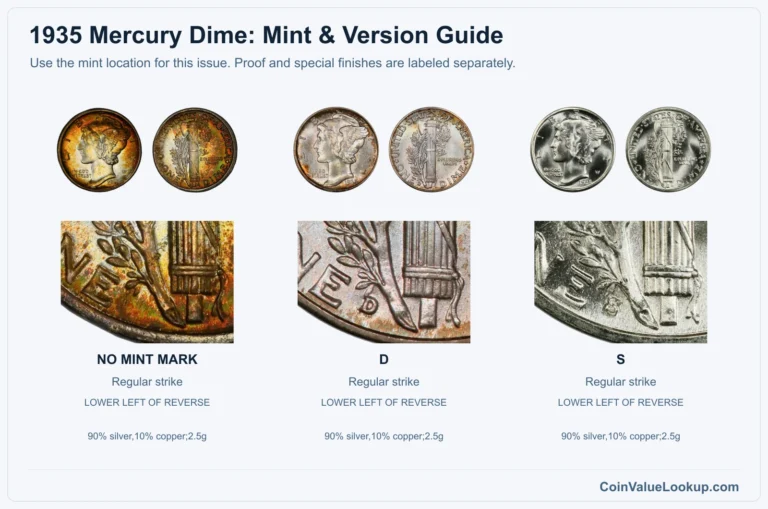
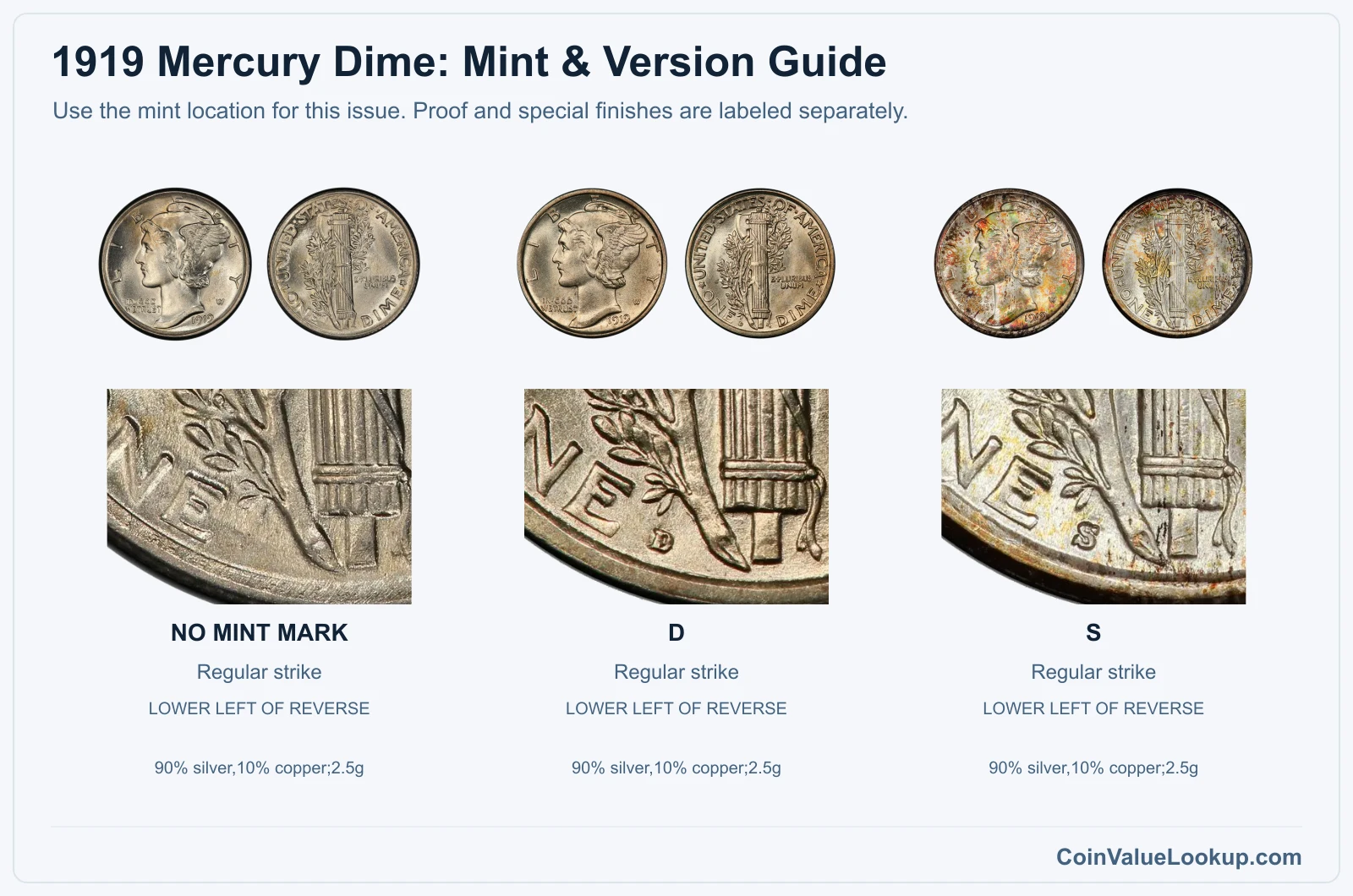
Three mints produced 1919 Mercury Dimes: Philadelphia, Denver, and San Francisco. Philadelphia coins carry no mintmark at all.
Denver and San Francisco pieces show a small D or S on the lower left of the reverse, just beside the word ONE.
Don't confuse the AW monogram on the obverse with a mintmark. Those are designer Adolph Weinman's initials, and they appear on every example regardless of mint.
All 1919 dimes are struck in 90% silver and 10% copper, weighing about 2.5 grams with a 17.9 mm diameter and a reeded edge. There were no proof strikes this year; Philadelphia proofs in the Mercury series ran from 1936 through 1942.
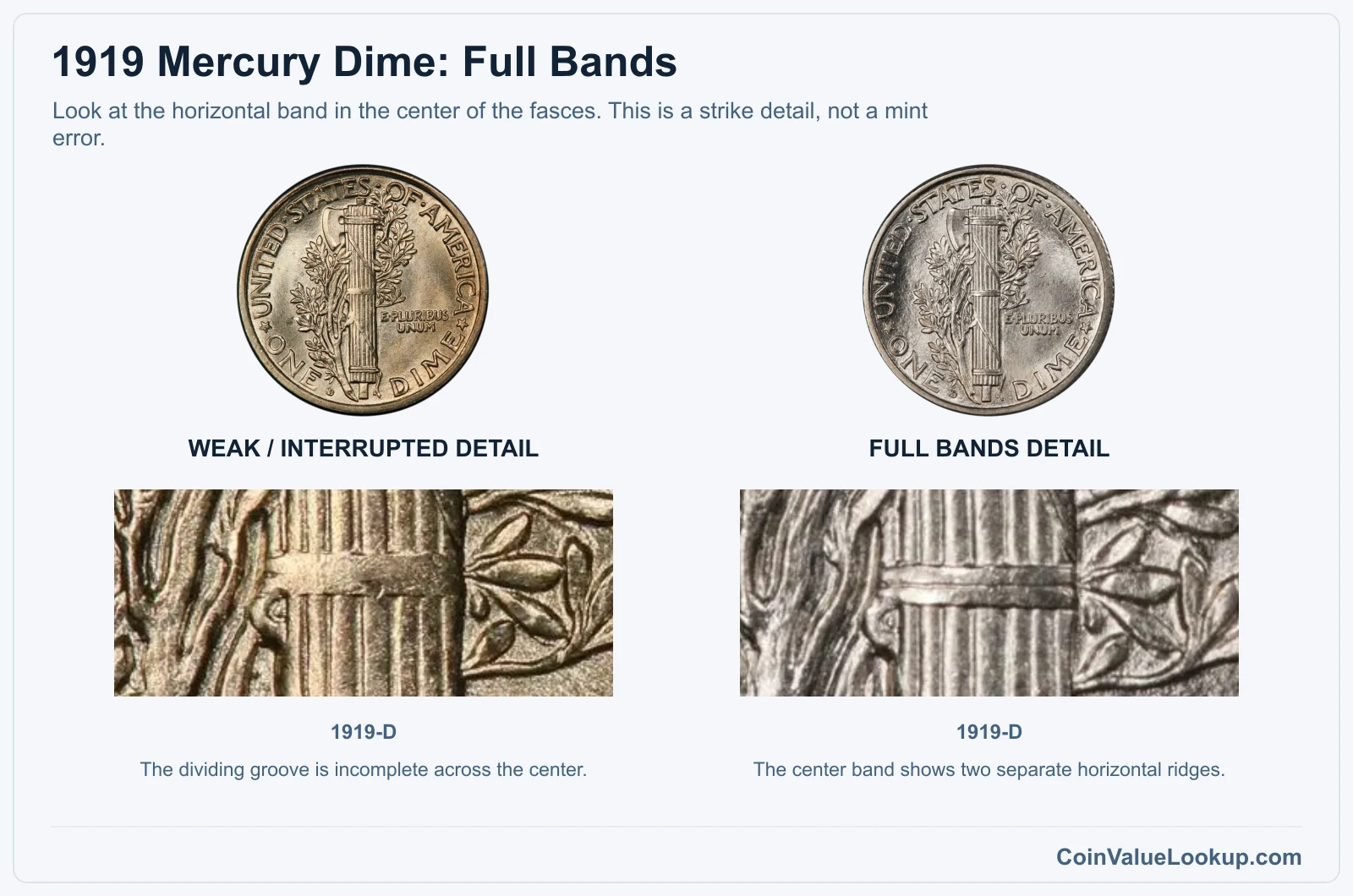
The Philadelphia Doubled Die Obverse motto variety is the main identified variety for 1919. Full Bands is a strike-quality designation, not a separate variety or error.
It refers to clearly separated horizontal bands on the reverse fasces and commands a premium when present on any mint's coin.
Step 2: Check Your 1919 Mercury Dime Grade
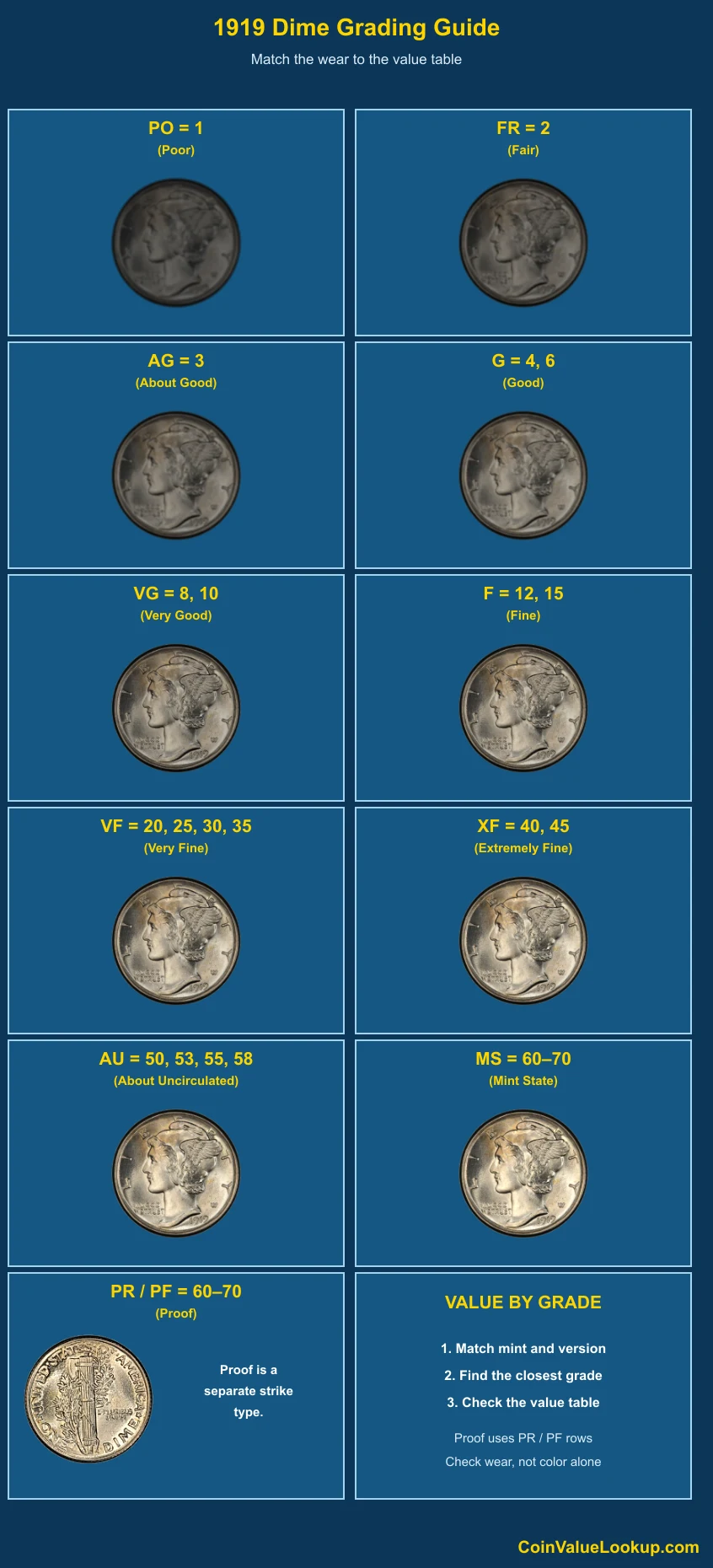
Start by looking at Liberty's hair detail above and in front of the ear. On a well-worn coin, this area blends into a smooth surface.
A mid-grade piece retains some strands but loses the sharpest definition. The cap and wing feathers are next to check; they wear progressively from the highest points inward.
Flip the coin over and examine the fasces. The horizontal bands across the center are the first reverse detail to soften.
Weak bands do not automatically mean heavy circulation, though. Many 1919 dimes, especially branch-mint strikes, left the press with mushy bands due to strike weakness rather than wear.
Luster matters a lot on Mint State coins. Look for original cartwheel reflectivity under a single light source.
Contact marks, hairlines from cleaning, and dull or hazy surfaces all reduce the grade.
Use the comparison image to match your coin's wear pattern against known grade benchmarks. For Full Bands evaluation, NGC checks both central and outer band separation, and different grading services may apply slightly different criteria.
A coin can be MS65 without qualifying for Full Bands if the strike was soft in that area.
Step 3: Check 1919 Mercury Dime Value by Mint and Version
1919 Mercury Dime — No Mint Mark — Silver Circulation
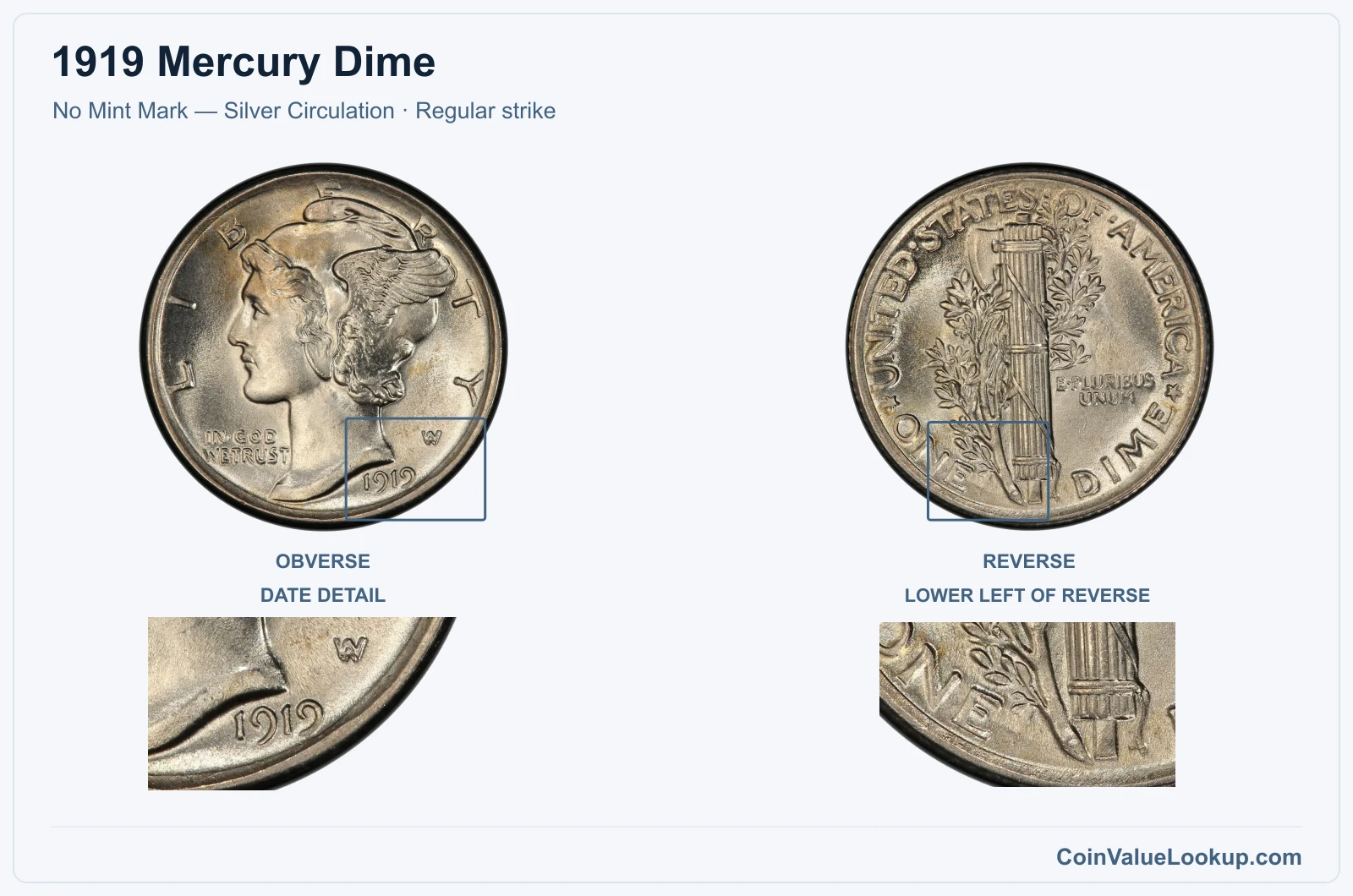
The 1919 Philadelphia dime has no mintmark. Look at the reverse near ONE and you should see bare space where Denver or San Francisco coins display their letter.
Guide estimates place this version at about $7.16 in G4 and around $441 in MS65. That MS65 figure is for a standard strike without a Full Bands designation; FB coins are evaluated separately based on band clarity.
Philadelphia is also home to the known Doubled Die Obverse variety affecting the motto, which is a distinct collectible worth checking for on any no-mintmark 1919 dime.
Coin Value Lookup is a good place to look up guides for other dates and mints in the Mercury Dime series if you are working through a collection.
Range Grade
Price Auction Records Appraisal PO PO 1
—
Coin Identifier FR FR 2
—
Coin Identifier AG AG 3
—
Coin Identifier G G 4
—
Coin Identifier
G 6
—
Coin Identifier VG VG 8
—
Coin Identifier
VG 10
—
Coin Identifier F F 12
—
Coin Identifier
F 15
—
Coin Identifier VF VF 20
—
Coin Identifier
VF 25
—
Coin Identifier
VF 30
—
Coin Identifier
VF 35
—
Coin Identifier XF XF 40
—
Coin Identifier
XF 45
—
Coin Identifier AU AU 50
Coin Identifier
AU 53
—
Coin Identifier
AU 55
Coin Identifier
AU 58
Coin Identifier MS MS 60
—
Coin Identifier
MS 61
Coin Identifier
MS 62
Coin Identifier
MS 63
Coin Identifier
MS 64
Coin Identifier
MS 65
Coin Identifier
MS 66
Coin Identifier
MS 67
—
Coin Identifier
MS 68
—
—
—
MS 69
—
—
—
MS 70
—
—
—
1919 Mercury Dime — D — Silver Circulation
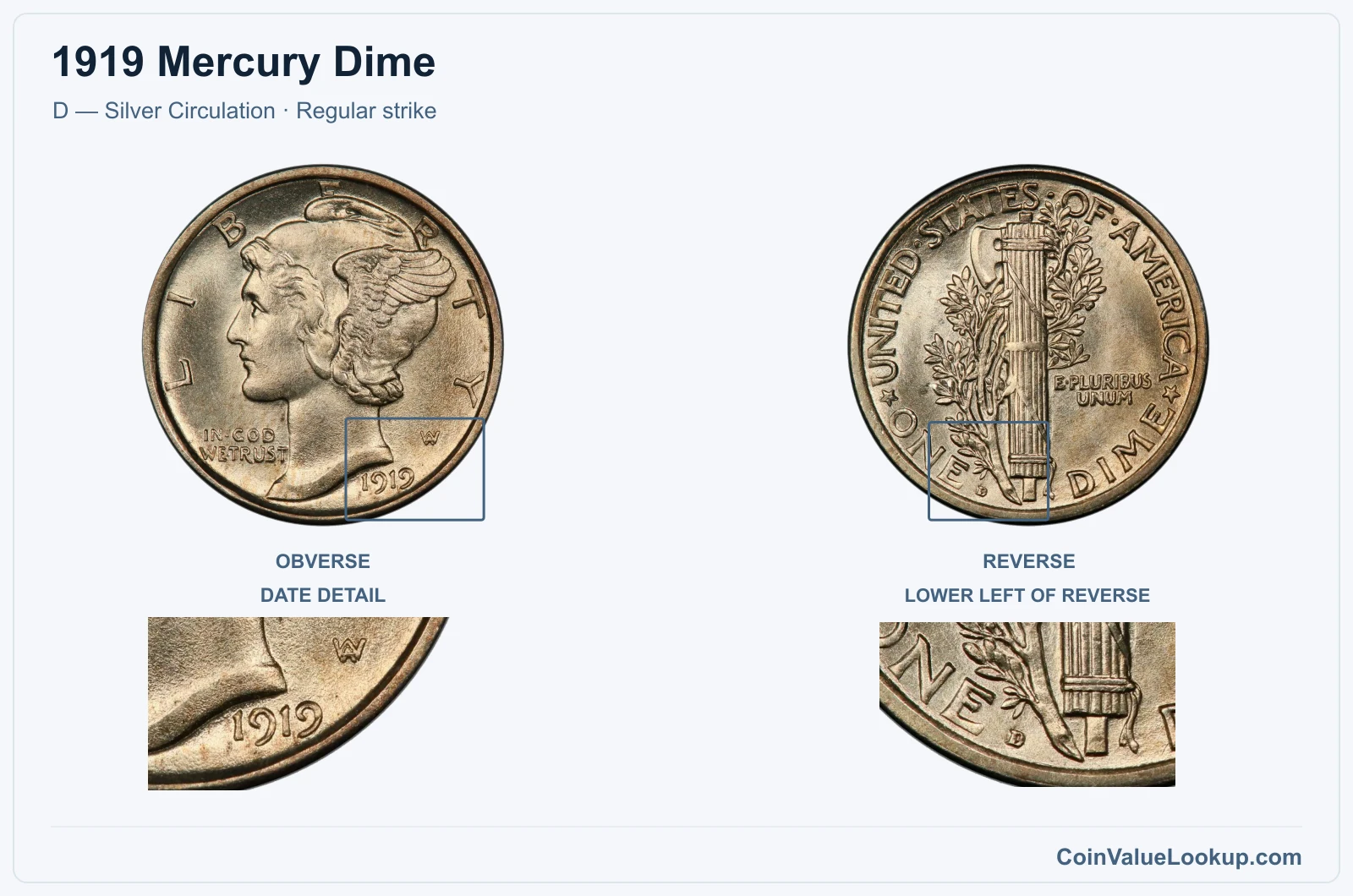
Denver's 1919 dime carries a small D on the lower left reverse. Guide estimates run from about $8.50 in G4 to roughly $1,678 in MS65, a steep jump that reflects how few Denver coins survived in top condition.
Strike quality varied at Denver, so many otherwise high-grade survivors lack full band separation. That makes the regular MS65 price a baseline; a confirmed Full Bands example would be assessed on its own merits.
Always confirm the D is actually a mintmark and not a ding or corrosion spot. Under magnification it should be a clean, slightly raised letter with consistent font style.
Range Grade
Price Auction Records Appraisal PO PO 1
—
Coin Identifier FR FR 2
—
Coin Identifier AG AG 3
—
Coin Identifier G G 4
—
Coin Identifier
G 6
—
Coin Identifier VG VG 8
—
Coin Identifier
VG 10
—
Coin Identifier F F 12
—
Coin Identifier
F 15
—
Coin Identifier VF VF 20
—
Coin Identifier
VF 25
—
Coin Identifier
VF 30
Coin Identifier
VF 35
—
Coin Identifier XF XF 40
Coin Identifier
XF 45
Coin Identifier AU AU 50
Coin Identifier
AU 53
—
Coin Identifier
AU 55
Coin Identifier
AU 58
Coin Identifier MS MS 60
Coin Identifier
MS 61
Coin Identifier
MS 62
Coin Identifier
MS 63
Coin Identifier
MS 64
Coin Identifier
MS 65
Coin Identifier
MS 66
Coin Identifier
MS 67
—
Coin Identifier
MS 68
—
—
—
MS 69
—
—
—
MS 70
—
—
—
1919 Mercury Dime — S — Silver Circulation
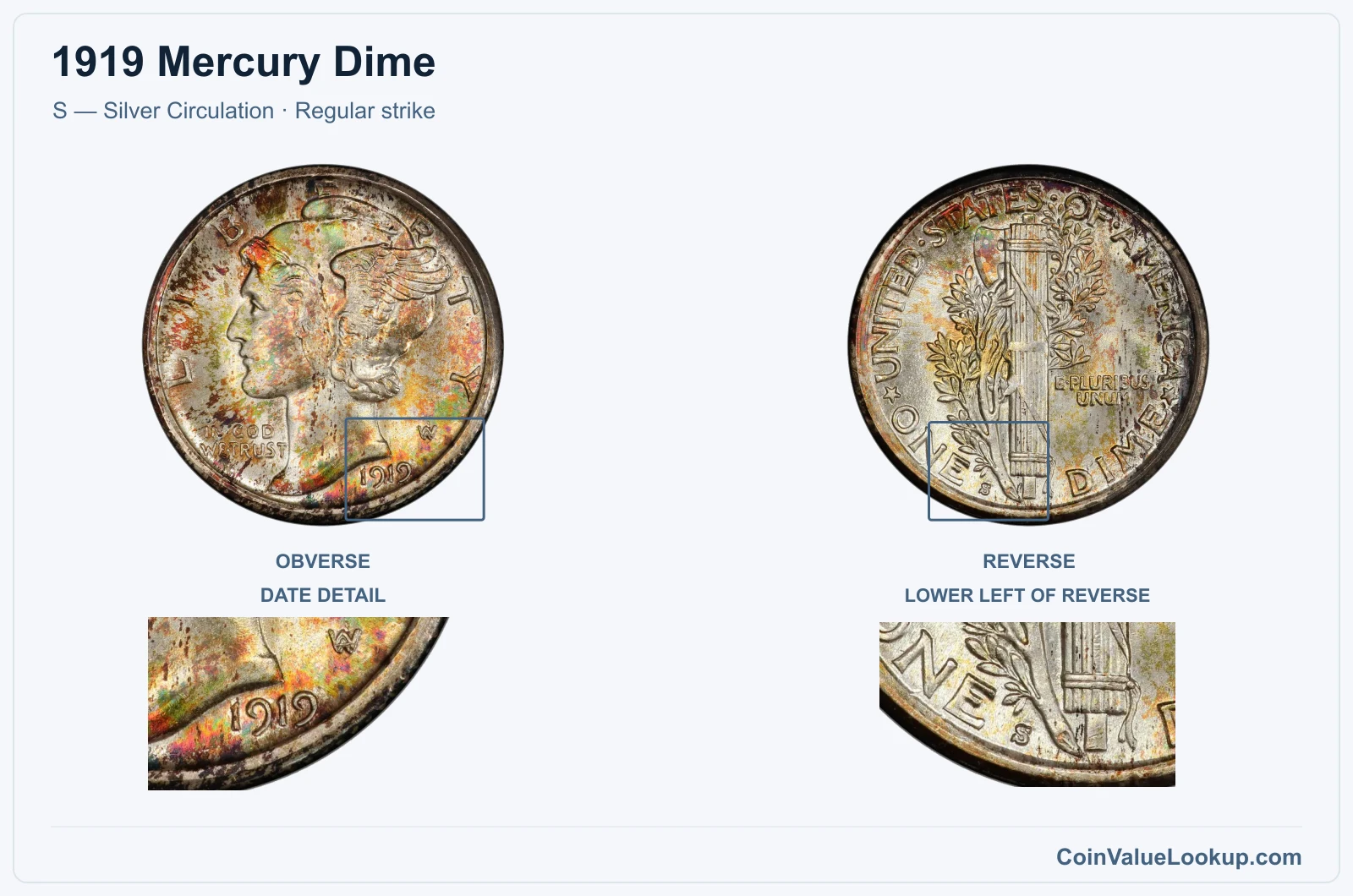
San Francisco struck 1919 dimes with an S mintmark in the same lower-left reverse position. Guide estimates for this version range from about $7.80 in G4 to approximately $1,882 in MS65, the highest regular guide figure among the three mints for this date.
San Francisco coins from this era often come weakly struck, particularly on the reverse bands. A soft strike does not equal wear, so compare the obverse hair detail before downgrading.
The combination of lower high-grade survival and frequent strike softness makes a fully lustrous, well-struck S-mint 1919 dime a genuinely scarce find.
Range Grade
Price Auction Records Appraisal PO PO 1
—
Coin Identifier FR FR 2
—
Coin Identifier AG AG 3
—
Coin Identifier G G 4
—
Coin Identifier
G 6
—
Coin Identifier VG VG 8
—
Coin Identifier
VG 10
—
Coin Identifier F F 12
—
Coin Identifier
F 15
—
Coin Identifier VF VF 20
—
Coin Identifier
VF 25
—
Coin Identifier
VF 30
—
Coin Identifier
VF 35
—
Coin Identifier XF XF 40
—
Coin Identifier
XF 45
Coin Identifier AU AU 50
Coin Identifier
AU 53
Coin Identifier
AU 55
Coin Identifier
AU 58
Coin Identifier MS MS 60
Coin Identifier
MS 61
Coin Identifier
MS 62
Coin Identifier
MS 63
Coin Identifier
MS 64
Coin Identifier
MS 65
Coin Identifier
MS 66
Coin Identifier
MS 67
Coin Identifier
MS 68
—
—
—
MS 69
—
—
—
MS 70
—
—
—
1919 Mercury Dime Error List
1. 1919 Mercury Dime — Doubled Die Obverse
The 1919 Philadelphia Doubled Die Obverse is the marquee error for this date. The diagnostic feature is pronounced separation in the motto IN GOD WE TRUST on the obverse.
Under magnification, the affected letters show a clear secondary impression offset from the primary strike, giving them a shadowed or shelf-like appearance.
PCGS reports one auction result for this variety: an XF40 example that sold for $7,800. That is a single recorded sale, not a guaranteed market range.
Your coin's value would depend on its specific condition and the strength of the doubling.
Be careful with lookalikes. Machine doubling, which is flat and shelf-like without raised secondary lettering, is far more common and carries little premium.
Worn die impressions and lighting reflections can also mimic doubling to the naked eye. Compare your motto lettering against a confirmed normal 1919 obverse side by side before drawing conclusions.
2. 1919 Mercury Dime — Die Crack / Spiked Head
Die cracks and the related "spiked head" variety have been reported on 1919 dimes. These show up as thin raised lines running across the coin's surface where the steel die fractured during use.
A spiked head specifically refers to a raised blob or spike protruding from Liberty's head, caused by a chip or crack in the die at that location.
An interior crack differs from a rim cud. Cuds connect to the rim and create a raised, featureless blob at the edge; interior cracks stay within the design and appear as fine raised threads.
Both are genuine die damage transferred to the coin during striking.
Lookalikes include incuse scratches, corrosion deposits, and foreign material stuck to the surface. Scratches are recessed into the metal rather than raised.
Corrosion tends to be irregular and porous rather than linear. No specific price range is adopted for this category because value depends on the crack's visibility, location, and the coin's overall condition.