1924 Mercury Dime Coin Value: How Much Is It Worth?
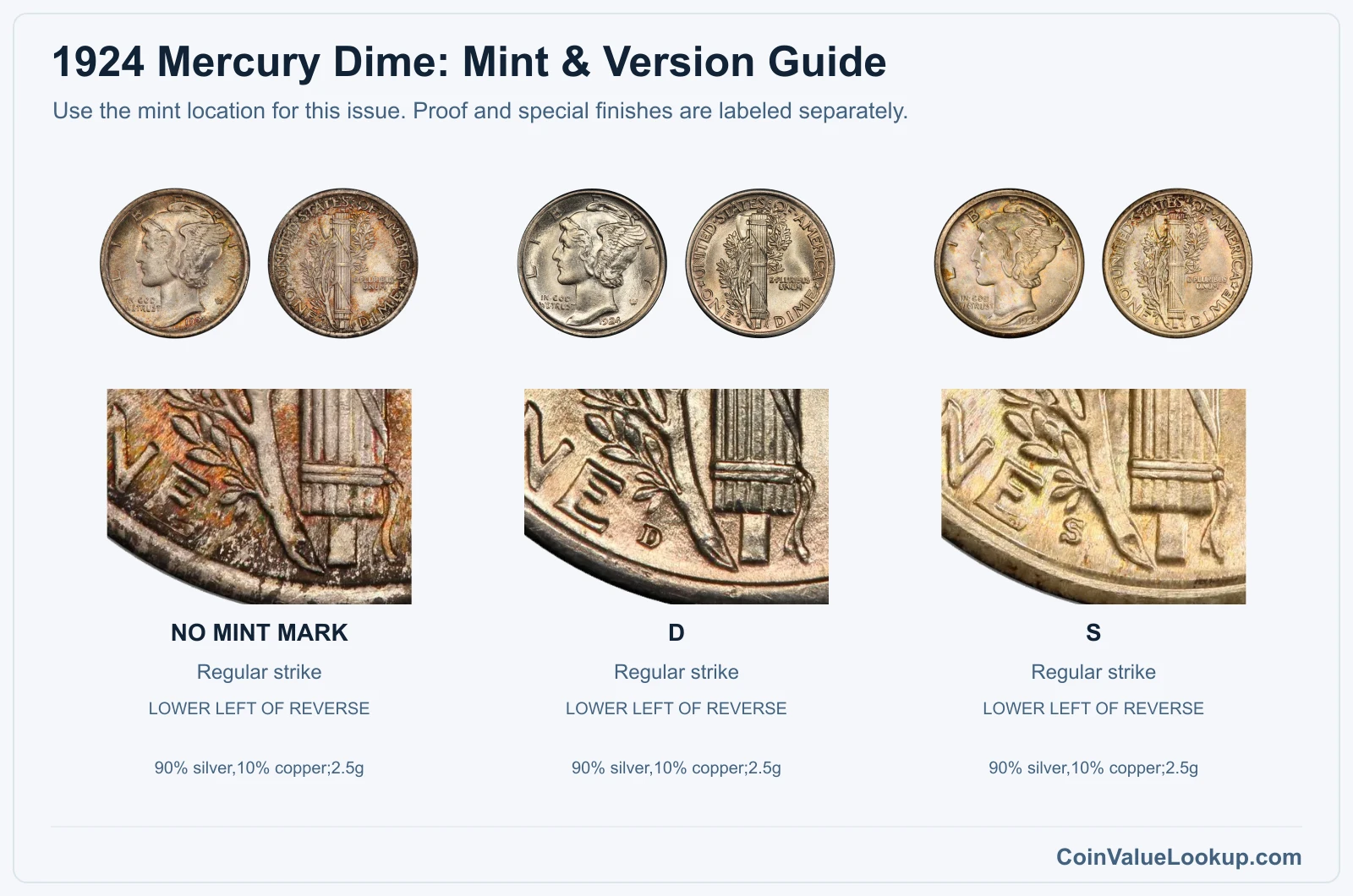
A 1924 Mercury dime in well-worn condition starts around $7.16 in Good-4, while top-end uncirculated examples can reach into the low-to-mid four figures depending on mint and surface quality. Three mints struck dimes this year — Philadelphia, Denver, and San Francisco — and the branch-mint coins behave quite differently as grades climb.
Full Bands designation, original luster, and identified varieties all influence what a given piece is worth.
Fast Way to Identify Your 1924 Mercury Dime
Snap clear photos of the front and back of your 1924 Mercury dime and upload them here for a preliminary identification. The tool can help distinguish your mint facility and give you a starting point on condition.
Good lighting at a slight angle brings out the details that matter most — the hair above Liberty's ear, the fasces bands, and the mintmark location.
1924 Mercury Dime Value
Upload both sides of your 1924 Mercury Dime.
Front Obverse
Upload photo
Back Reverse
Upload photo
Which 1924 Mercury Dime Versions Are Worth Money?
- Philadelphia, Denver, and San Francisco issues each have distinct guide values — check your mintmark first.
- Uncirculated coins with original surfaces and fully separated fasces bands can command meaningful premiums over typical examples.
- Branch-mint strikes (D and S) tend to be softer, making sharp high-grade survivors scarcer and more desirable.
- Doubled die obverse, repunched mintmark, off-center, and lamination errors have been reported for this date — condition and visibility of any error affect value individually.
Step 1: Identify Your 1924 Mercury Dime Mint Mark and Version
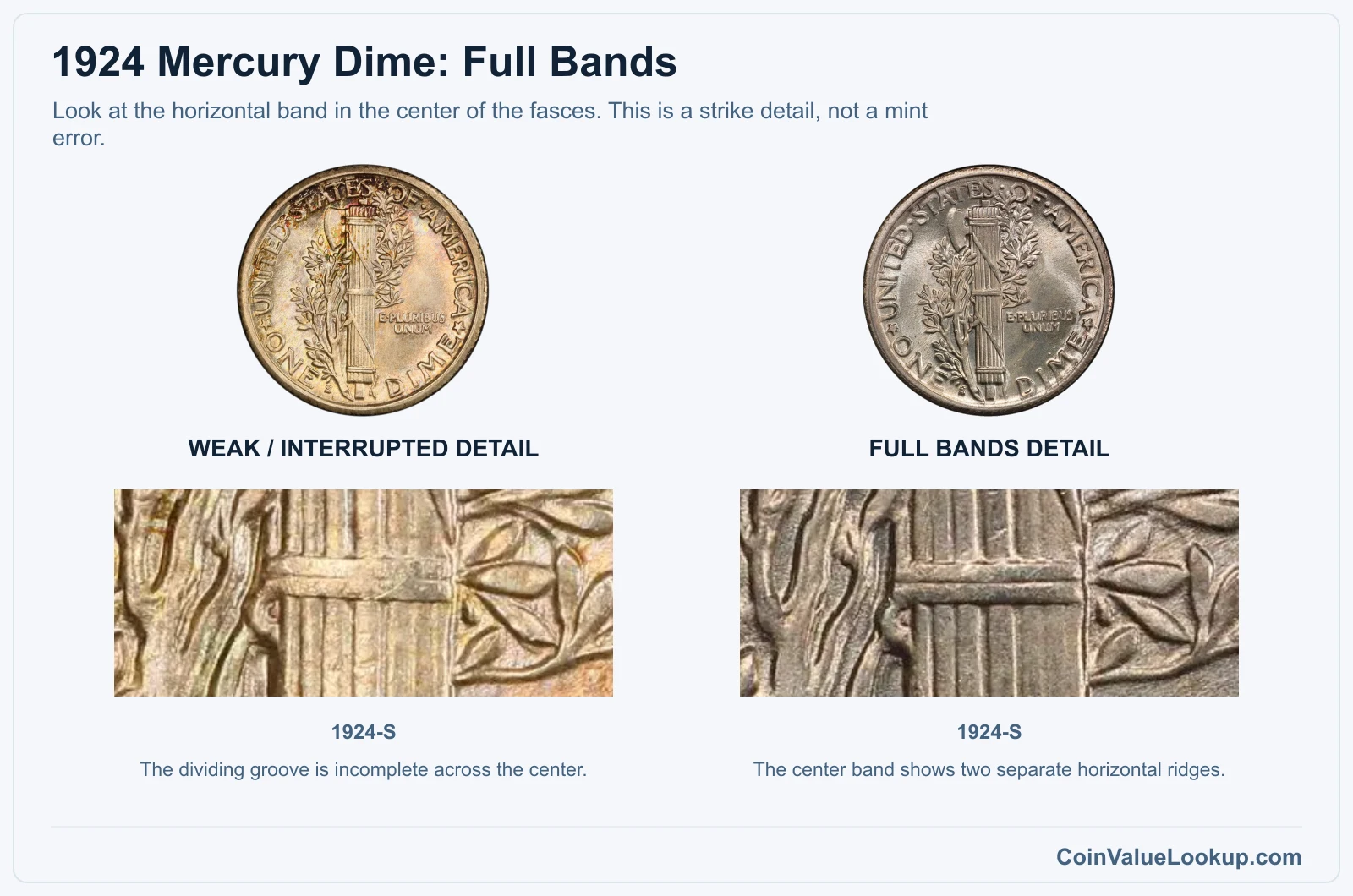
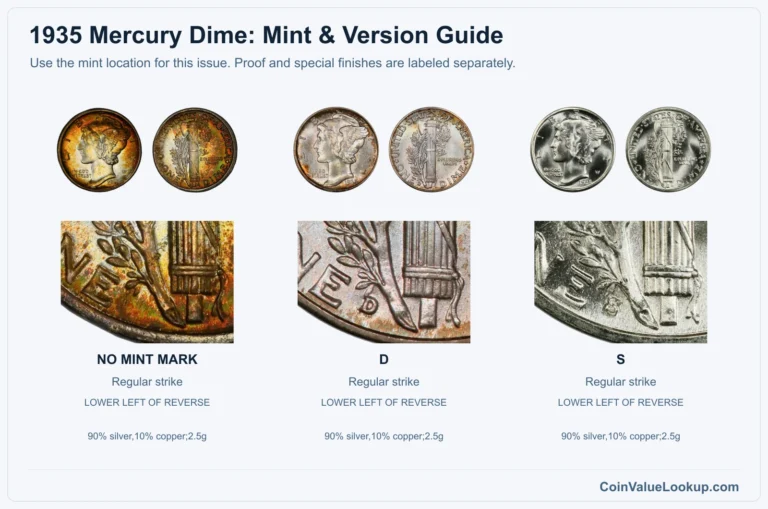
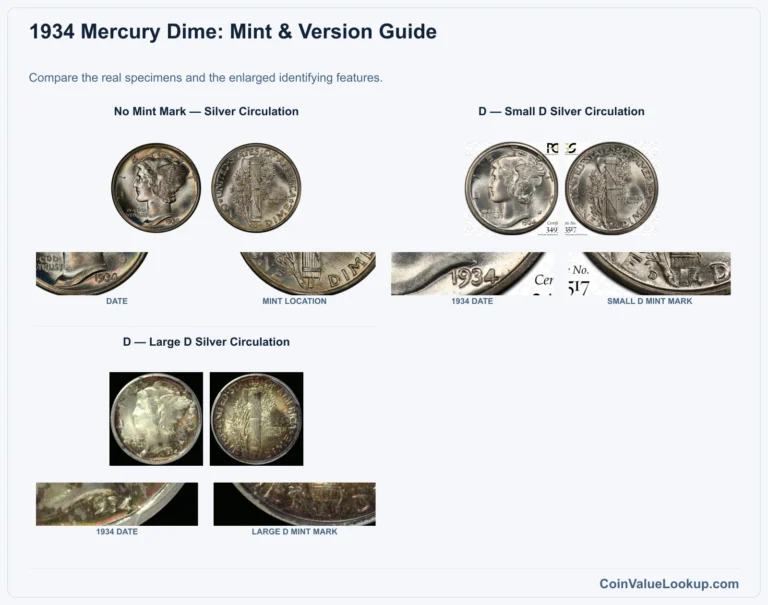
All 1924 Mercury dimes are struck in 90% silver and 10% copper, weigh about 2.5 grams, and measure 17.9 mm with a reeded edge. Three mints produced them: Philadelphia (no mintmark), Denver (D), and San Francisco (S).
The mintmark sits on the reverse, at the lower left beside the word ONE. If you see nothing there, it is a Philadelphia coin.
The small "AW" monogram on the obverse near the date is designer Adolph Weinman's initials — not a mintmark and definitely not a West Point indicator.
Strike quality varies significantly across the three facilities. Denver and San Francisco pieces are often softer in the central bands of the fasces, which makes high-grade examples with fully separated bands harder to come by from those mints.
That difference in strike sharpness is a big part of what drives collector demand at the upper end of the grading scale.
Step 2: Check Your 1924 Mercury Dime Grade
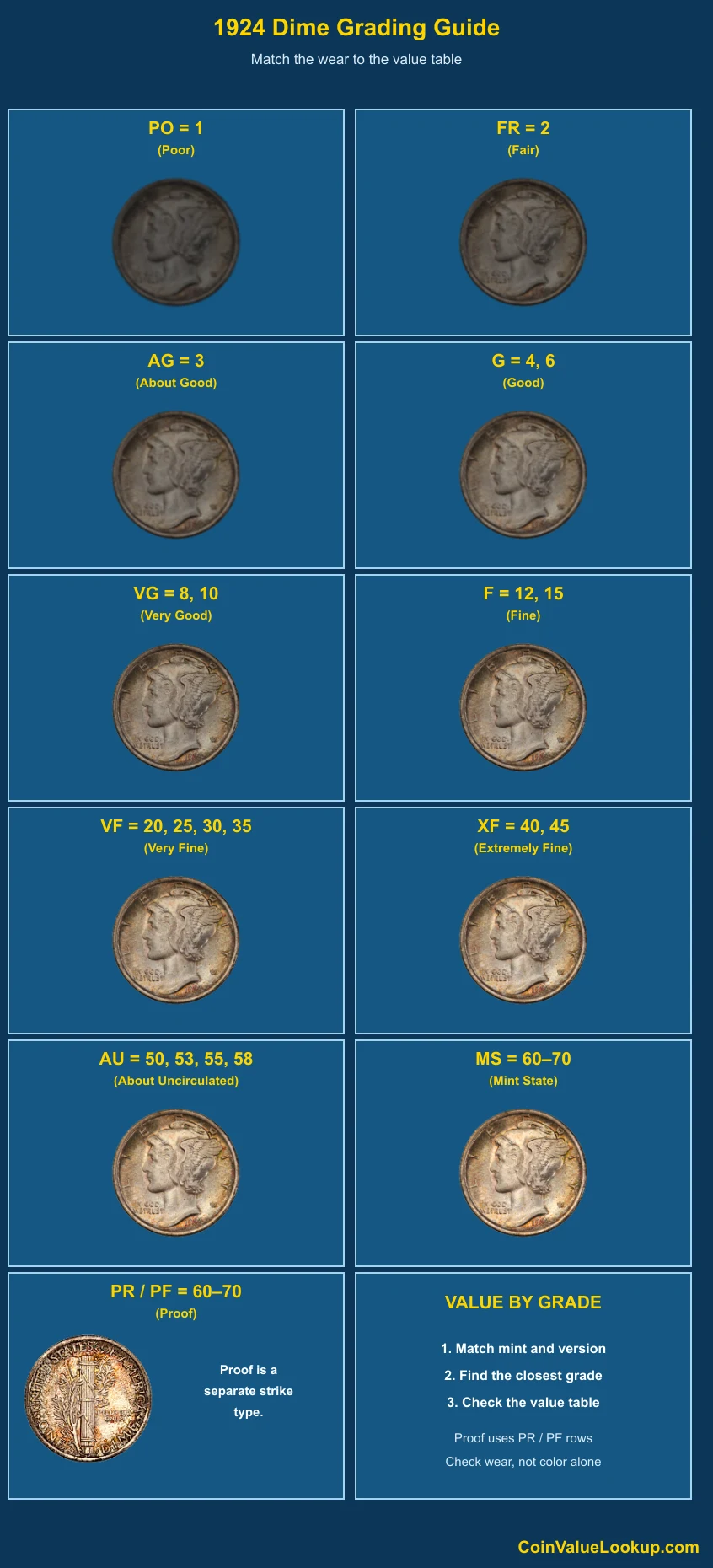
Start by checking Liberty's hair detail above and directly in front of the ear. On a well-preserved coin, individual strands are distinct there.
As the coin wears, those strands merge into a flat area — that is the first reliable checkpoint.
Next, look at the wings on Liberty's cap. The feather tips lose separation early in circulation.
On the reverse, the horizontal bands across the fasces are the other key wear zone.
Don't confuse a weak strike with actual wear. Many 1924 dimes, especially branch-mint pieces, left the press with soft central details.
Luster is your friend here: a coin that still has cartwheel reflections across the fields but mushy bands was probably struck that way, not worn down.
Use the comparison image to match your coin's overall detail against known grade benchmarks. Look for contact marks in the open fields and any signs of cleaning — hairline scratches running in one direction under light are a giveaway.
Full Bands is a separate designation evaluated by grading services like NGC, which checks both central and outer band separation. Different services may apply slightly different criteria, so FB on one holder does not automatically guarantee the same call elsewhere.
Step 3: Check 1924 Mercury Dime Value by Mint and Version
1924 Mercury Dime — No Mint Mark — Silver Circulation
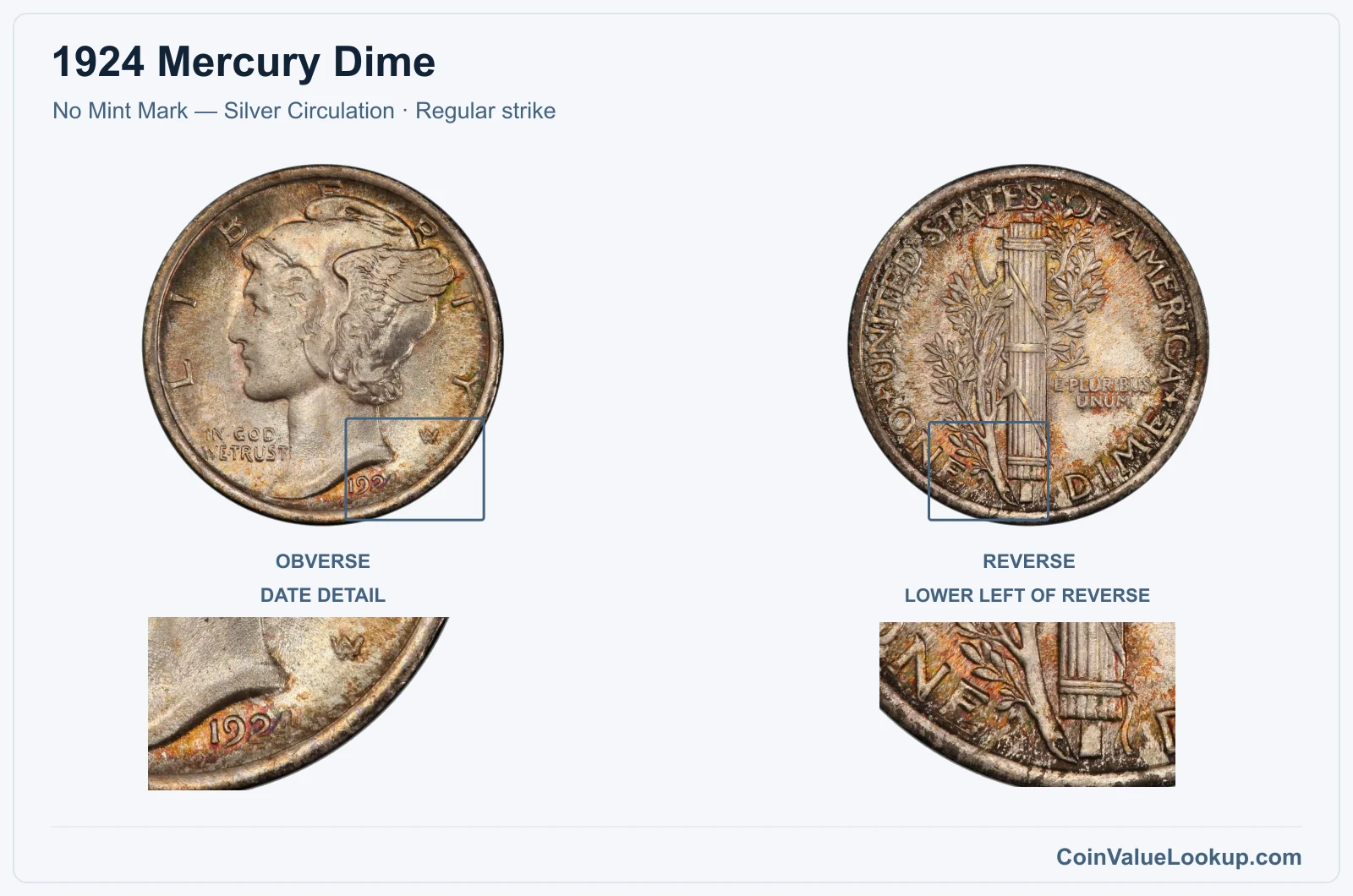
The 1924 Philadelphia dime carries no mintmark. Flip to the reverse and look beside ONE — if the space is empty, this is your coin.
Guide estimates place it around $7.16 in Good-4 and about $221 in MS-65, per USA Coin Book.
Philadelphia generally delivered better strikes than the branch mints this year, so finding sharp fasces bands is more realistic here. Full Bands pieces exist but are tracked separately, and the standard MS-65 guide figure does not include that designation.
Original luster and clean fields matter a lot once you cross into Mint State territory.
Range Grade
Price Auction Records Appraisal PO PO 1
—
Coin Identifier FR FR 2
—
Coin Identifier AG AG 3
—
Coin Identifier G G 4
—
Coin Identifier
G 6
—
Coin Identifier VG VG 8
—
Coin Identifier
VG 10
—
Coin Identifier F F 12
—
Coin Identifier
F 15
—
Coin Identifier VF VF 20
—
Coin Identifier
VF 25
—
Coin Identifier
VF 30
—
Coin Identifier
VF 35
—
Coin Identifier XF XF 40
—
Coin Identifier
XF 45
—
Coin Identifier AU AU 50
—
Coin Identifier
AU 53
—
Coin Identifier
AU 55
—
Coin Identifier
AU 58
Coin Identifier MS MS 60
—
Coin Identifier
MS 61
—
Coin Identifier
MS 62
Coin Identifier
MS 63
Coin Identifier
MS 64
Coin Identifier
MS 65
Coin Identifier
MS 66
Coin Identifier
MS 67
Coin Identifier
MS 68
—
—
—
MS 69
—
—
—
MS 70
—
—
—
1924 Mercury Dime — D — Silver Circulation
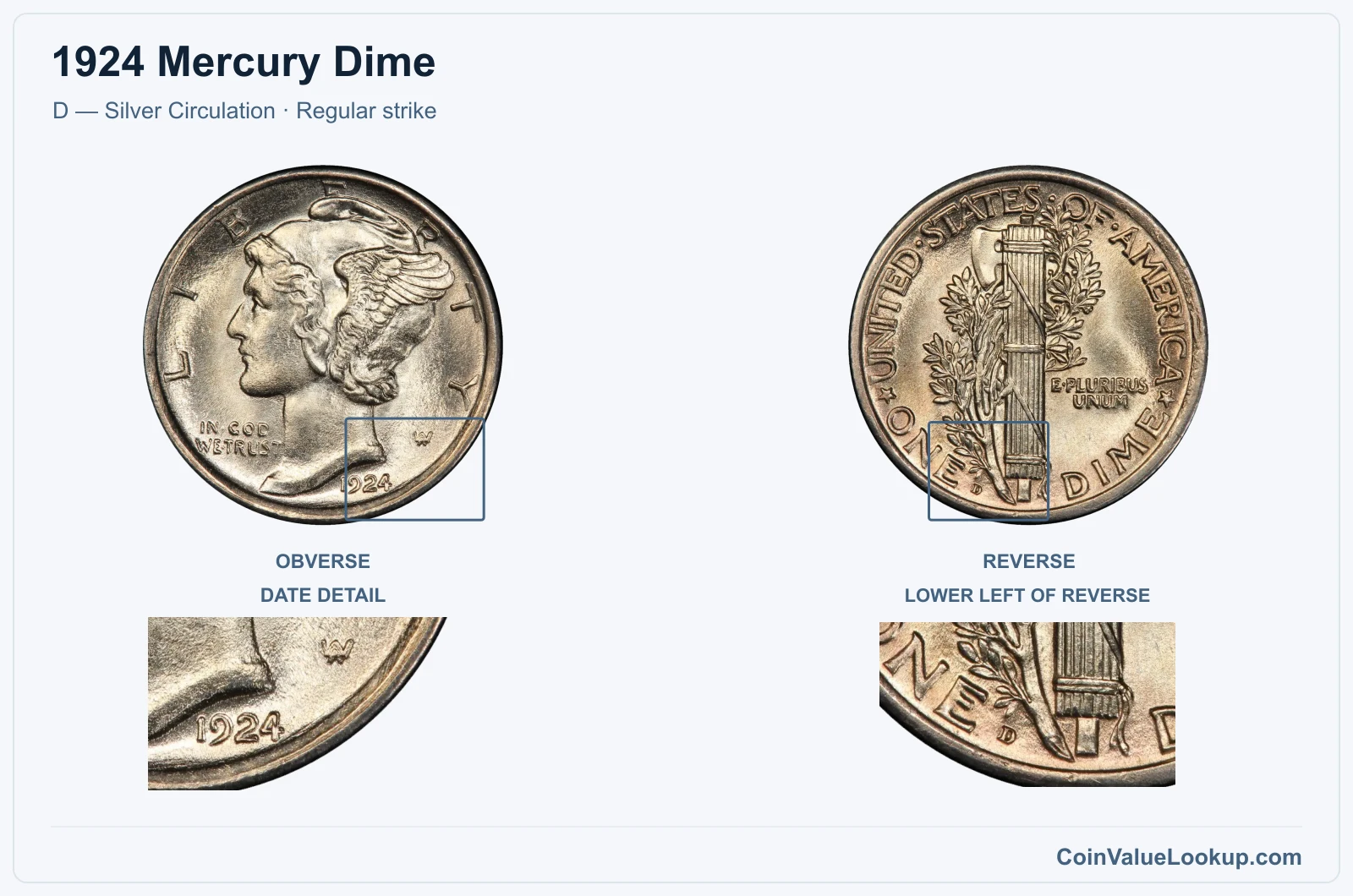
Look for a small "D" on the lower left reverse next to ONE. The Denver facility struck 1924 dimes with a reputation for softer detail, particularly in the fasces bands.
Guide estimates run about $7.80 in Good-4 and around $1,191 in MS-65 according to USA Coin Book.
That jump from the Philadelphia price at MS-65 reflects how much harder it is to find a Denver piece with strong surfaces and minimal marks at that level. If you have one with full, crisp luster and no distracting hits in the fields, it is worth a closer look.
Full Bands examples are tracked as a separate category, and no FB price is inferred from the regular MS-65 figure here.
Coin Value Lookup is a good starting point if you want to compare this date against other Mercury dime years and mints.
Range Grade
Price Auction Records Appraisal PO PO 1
—
Coin Identifier FR FR 2
—
Coin Identifier AG AG 3
—
Coin Identifier G G 4
—
Coin Identifier
G 6
—
Coin Identifier VG VG 8
—
Coin Identifier
VG 10
Coin Identifier F F 12
—
Coin Identifier
F 15
Coin Identifier VF VF 20
—
Coin Identifier
VF 25
Coin Identifier
VF 30
—
Coin Identifier
VF 35
Coin Identifier XF XF 40
Coin Identifier
XF 45
—
Coin Identifier AU AU 50
Coin Identifier
AU 53
Coin Identifier
AU 55
Coin Identifier
AU 58
Coin Identifier MS MS 60
Coin Identifier
MS 61
Coin Identifier
MS 62
Coin Identifier
MS 63
Coin Identifier
MS 64
Coin Identifier
MS 65
Coin Identifier
MS 66
Coin Identifier
MS 67
Coin Identifier
MS 68
—
—
—
MS 69
—
—
—
MS 70
—
—
—
1924 Mercury Dime — S — Silver Circulation
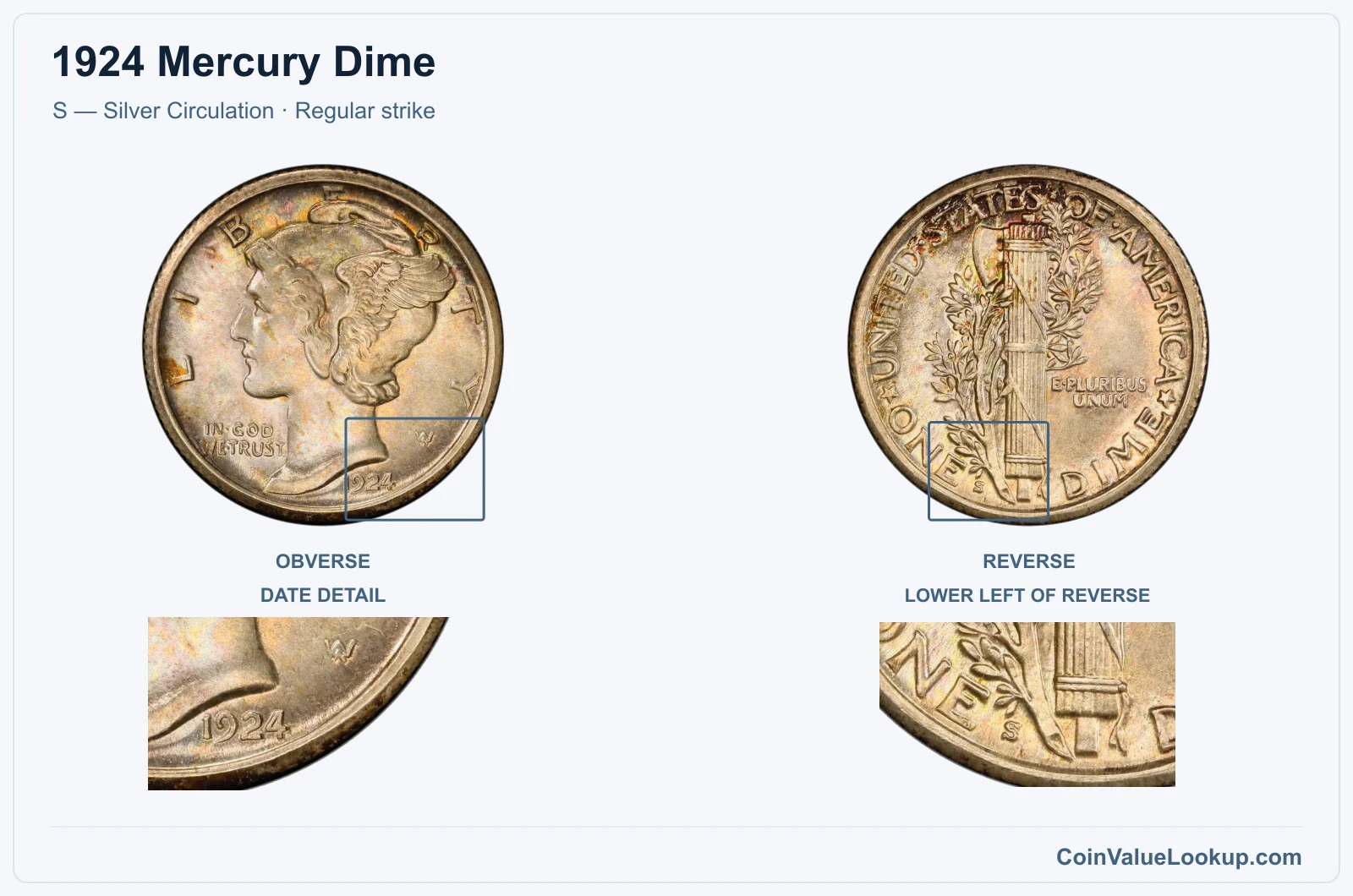
San Francisco coins show an "S" mintmark at the same lower-left reverse position. Guide estimates from USA Coin Book put the 1924-S at about $7.80 in Good-4 and roughly $1,526 in MS-65 — the highest regular guide figure among the three mints for this date at that grade.
San Francisco strikes often came with weak central bands, so surviving Mint State coins with sharp detail are genuinely scarce. The MS-65 figure applies to coins graded at that level without the Full Bands designation; FB examples carry their own market.
If your coin still shows full cartwheel luster and clean, mark-free surfaces, it is worth professional evaluation.
Range Grade
Price Auction Records Appraisal PO PO 1
—
Coin Identifier FR FR 2
—
Coin Identifier AG AG 3
—
Coin Identifier G G 4
—
Coin Identifier
G 6
—
Coin Identifier VG VG 8
—
Coin Identifier
VG 10
—
Coin Identifier F F 12
—
Coin Identifier
F 15
—
Coin Identifier VF VF 20
—
Coin Identifier
VF 25
—
Coin Identifier
VF 30
Coin Identifier
VF 35
—
Coin Identifier XF XF 40
—
Coin Identifier
XF 45
Coin Identifier AU AU 50
Coin Identifier
AU 53
Coin Identifier
AU 55
Coin Identifier
AU 58
Coin Identifier MS MS 60
Coin Identifier
MS 61
Coin Identifier
MS 62
Coin Identifier
MS 63
Coin Identifier
MS 64
Coin Identifier
MS 65
Coin Identifier
MS 66
Coin Identifier
MS 67
Coin Identifier
MS 68
—
—
—
MS 69
—
—
—
MS 70
—
—
—
1924 Mercury Dime Error List
1. 1924 Mercury Dime — Doubled Die Obverse
A Doubled Die Obverse on a 1924 Mercury dime shows consistent doubling on obverse design elements — typically letters or parts of Liberty's profile. The key word is consistent: every instance of the affected element should show the same direction and degree of separation or notching.
Compare your coin to a normal 1924 dime under the same lighting. Look for a secondary outline or shelf on letters like LIBERTY or IN GOD WE TRUST.
If the doubling appears only on one letter, or shifts direction across the coin, you are more likely seeing machine doubling or a worn die, neither of which carries the same collector interest.
Machine doubling tends to produce a flat, shelf-like distortion rather than distinct notching. No specific price has been adopted for this variety; value depends on the strength of the doubling, overall coin condition, and individual buyer interest.
2. 1924 Mercury Dime — Repunched Mintmark
A repunched mintmark occurs when the mintmark punch was applied more than once in slightly different positions on the working die. On a 1924-D or 1924-S dime, look at the mintmark itself under magnification for traces of a second impression — a partial letter offset from the primary mark.
The remnant punch is usually visible as a notch, a shadow letter, or extra serifs that do not belong. Compare your mintmark against a normal example photographed at the same magnification to see whether the extra detail is genuinely part of the die or just surface damage.
Die chips, corrosion around the mintmark, and machine doubling can all mimic a repunched mintmark at first glance. Corrosion tends to be irregular and pitted, while a genuine RPM shows clean, die-struck contours.
No fixed price applies; value depends on the visibility of the repunch and the coin's condition.
3. 1924 Mercury Dime — Off-Center Strike
An off-center strike happens when the planchet is not seated correctly between the dies at the moment of striking. The result is a design that is shifted to one side, leaving an unstruck crescent of blank metal on the opposite edge.
For a 1924 Mercury dime, the date must remain visible on the struck portion for the coin to be identifiable — and identification is what makes these collectible. A piece that is 5% off-center is mildly interesting; one that is 15–20% off-center with a full date is a different conversation.
Do not confuse an off-center strike with a clipped planchet, a misaligned die (which shifts only one side's design), or post-mint damage from being flattened unevenly. No specific price has been adopted; the percentage of displacement, date visibility, and overall condition all factor into individual value.
4. 1924 Mercury Dime — Lamination / Split Planchet
Lamination errors appear as peeling, flaking, or splitting within the metal of the planchet. On a 90% silver dime like the 1924, this can show up as a retained flap of metal lifting away from the surface, or a visible separation along the coin's edge.
Photograph both the affected face and the edge together — that combination helps distinguish a genuine lamination from surface scraping, corrosion, or deliberate alteration. A true lamination follows the metal's internal structure and usually has smooth, rounded edges where the layers separated, rather than sharp gouges or tool marks.
Corrosion pits and scratches from mishandling are the most common lookalikes. Someone who has scraped a coin with a hard object can create a flap-like appearance, but the underlying surface will show unnatural tool patterns.
No adopted price is available for this variety; value depends on the size and location of the lamination and the coin's overall preservation.