1956 Roosevelt Dime Coin Value: How Much Is It Worth?
The 1956 Roosevelt Dime is a 90% silver coin that still turns up in inherited collections and old rolls. According to USA Coin Book guide estimates, ordinary circulated examples start around $5.81 at G4, while uncirculated pieces reach about $12.26 at MS65.
Philadelphia proofs carry a guide value near $14 at PR65. Actual silver content adds a moving floor to every piece, so metal prices matter too.
Before assuming yours is common, check for the mint, finish, and any striking errors that can push a coin well above those baseline numbers.
Fast Way to Identify Your 1956 Roosevelt Dime
Snap a clear photo of both the front and back of your 1956 dime and upload them here for a preliminary identification. Good lighting at a slight angle helps reveal surface details, mintmark position, and any oddities in the strike.
This is not a substitute for professional authentication, but it is a solid first step toward figuring out what you have.
1956 Roosevelt Dime Value
Upload both sides of your 1956 Roosevelt Dime.
Front Obverse
Upload photo
Back Reverse
Upload photo
Which 1956 Roosevelt Dime Versions Are Worth Money?
- Philadelphia and Denver business strikes in original uncirculated condition with full torch band separation can command premiums over base silver value.
- Philadelphia proofs with undisturbed mirror fields deserve separate evaluation; cameo contrast, if present, requires its own comparison.
- Off-center strikes on 1956 no-mintmark business strikes are confirmed mint errors worth individual assessment based on severity and condition.
- A straight clip combined with a broadstrike on a 1956 no-mintmark dime is a compound error; each authenticated example is evaluated on its own merits.
- Straight clipped planchets on 1956 no-mintmark dimes show a straight missing edge and need authentication to rule out post-mint damage.
- Doubled die obverse and repunched mintmark varieties have been reported for 1956 dimes and may carry premiums depending on visibility and condition.
Step 1: Identify Your 1956 Roosevelt Dime Mint Mark and Version
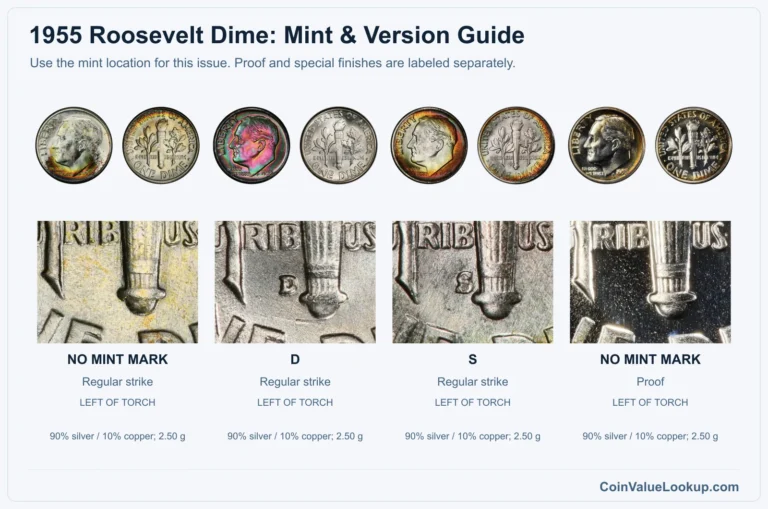
Start with the basics: the obverse shows Roosevelt's portrait facing left with the date 1956, and the reverse features a torch flanked by olive and oak branches. All regular 1956 dimes are struck in 90% silver and 10% copper, weigh about 2.50 grams, and measure roughly 17.9 mm across.
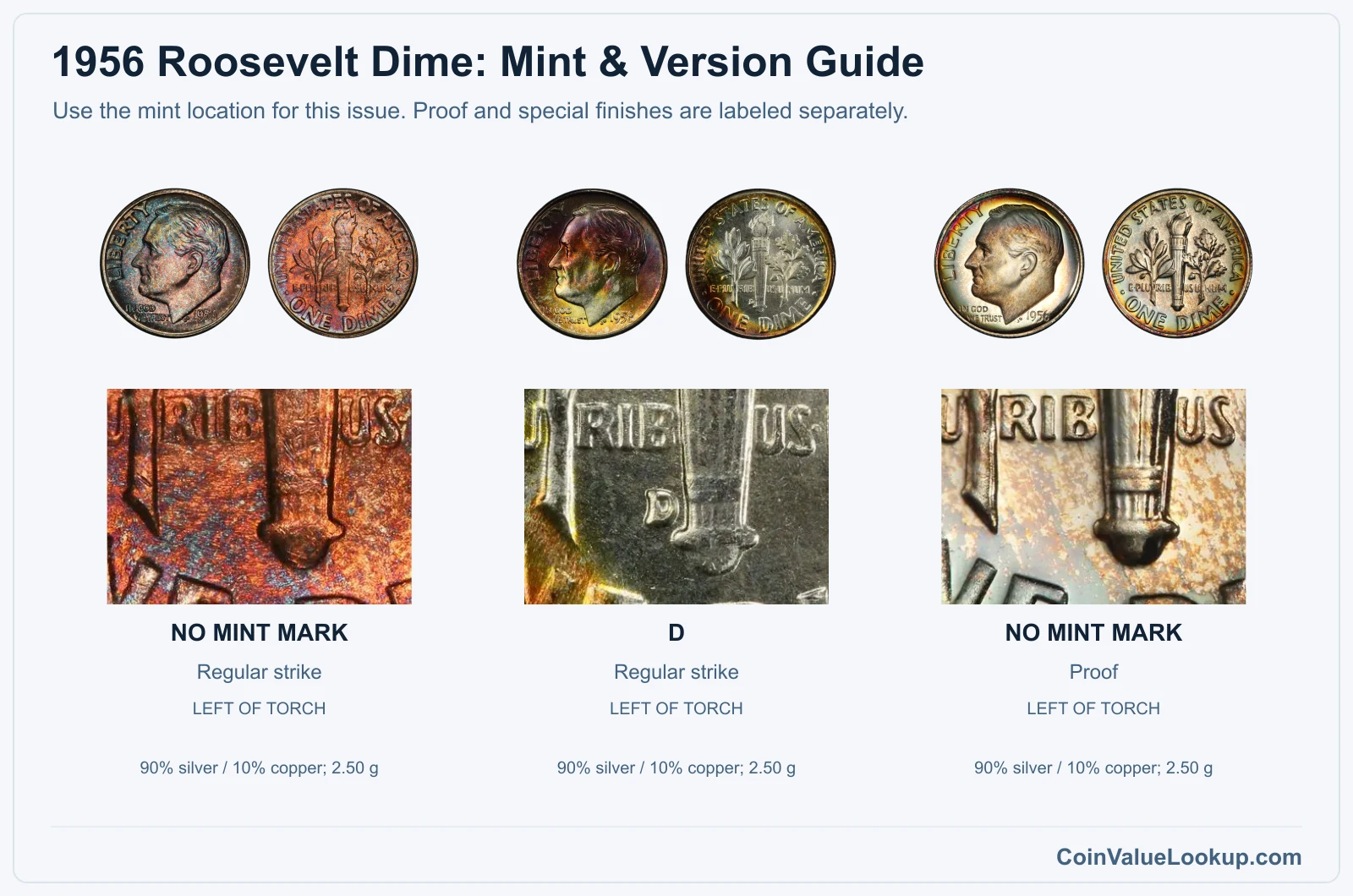
Three branches exist for this year. Philadelphia business strikes carry no mintmark.
Denver strikes show a small "D" beside the torch base on the reverse. Philadelphia proofs also lack a mintmark but are distinguished by their mirror-like fields and sharper detail, struck with specially prepared dies.
There is no San Francisco issue for 1956. If you see an "S" mintmark, you are looking at a different date.
Flip your coin to the reverse, look right of the torch near the bottom, and confirm the presence or absence of a "D" to sort your coin into the correct branch.
Step 2: Check Your 1956 Roosevelt Dime Grade
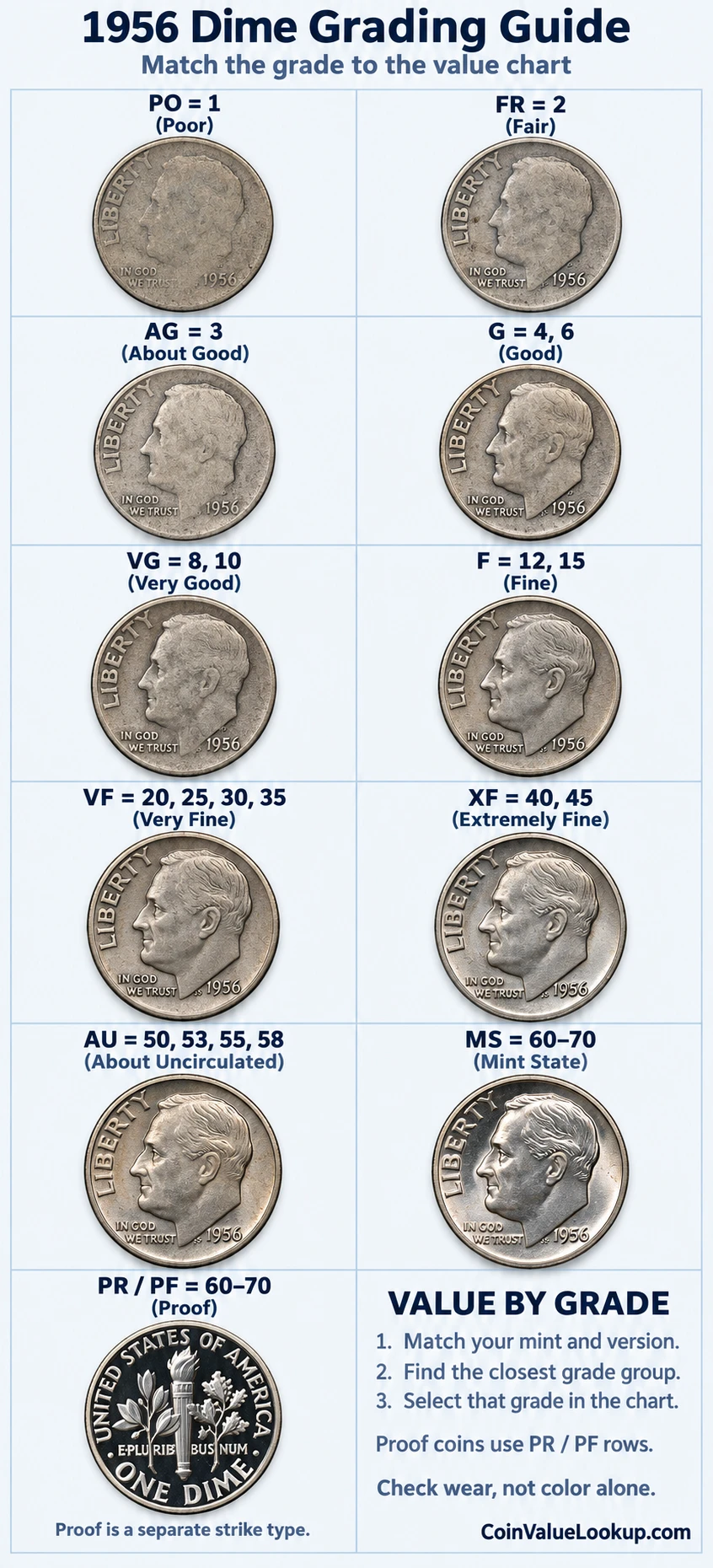
Hold the coin at an angle under a single light source. On a well-worn piece, Roosevelt's cheekbone and the hair above his ear flatten first, followed by the torch bands and leaf details on the reverse.
A coin grading around G4 will show a smooth portrait with an outline still visible, while an MS65 example retains full original luster with only minor contact marks under magnification.
Tilt the coin slowly. Unbroken cartwheel luster across the fields signals a coin that never circulated, but weak luster in isolated spots can also come from a soft strike rather than wear.
Cleaning hairlines, which often appear as fine parallel scratches visible under a light, reduce both grade and collector appeal even if the coin otherwise looks bright.
Full Bands is a strike designation, not a grade. It refers to complete separation of both horizontal band pairs on the torch.
A coin can be MS65 without Full Bands or MS63 with them. Use the comparison image to gauge where your coin falls, and always compare within the same mint and designation.
Step 3: Check 1956 Roosevelt Dime Value by Mint and Version
1956 Roosevelt Dime — No Mintmark / Philadelphia Business Strike
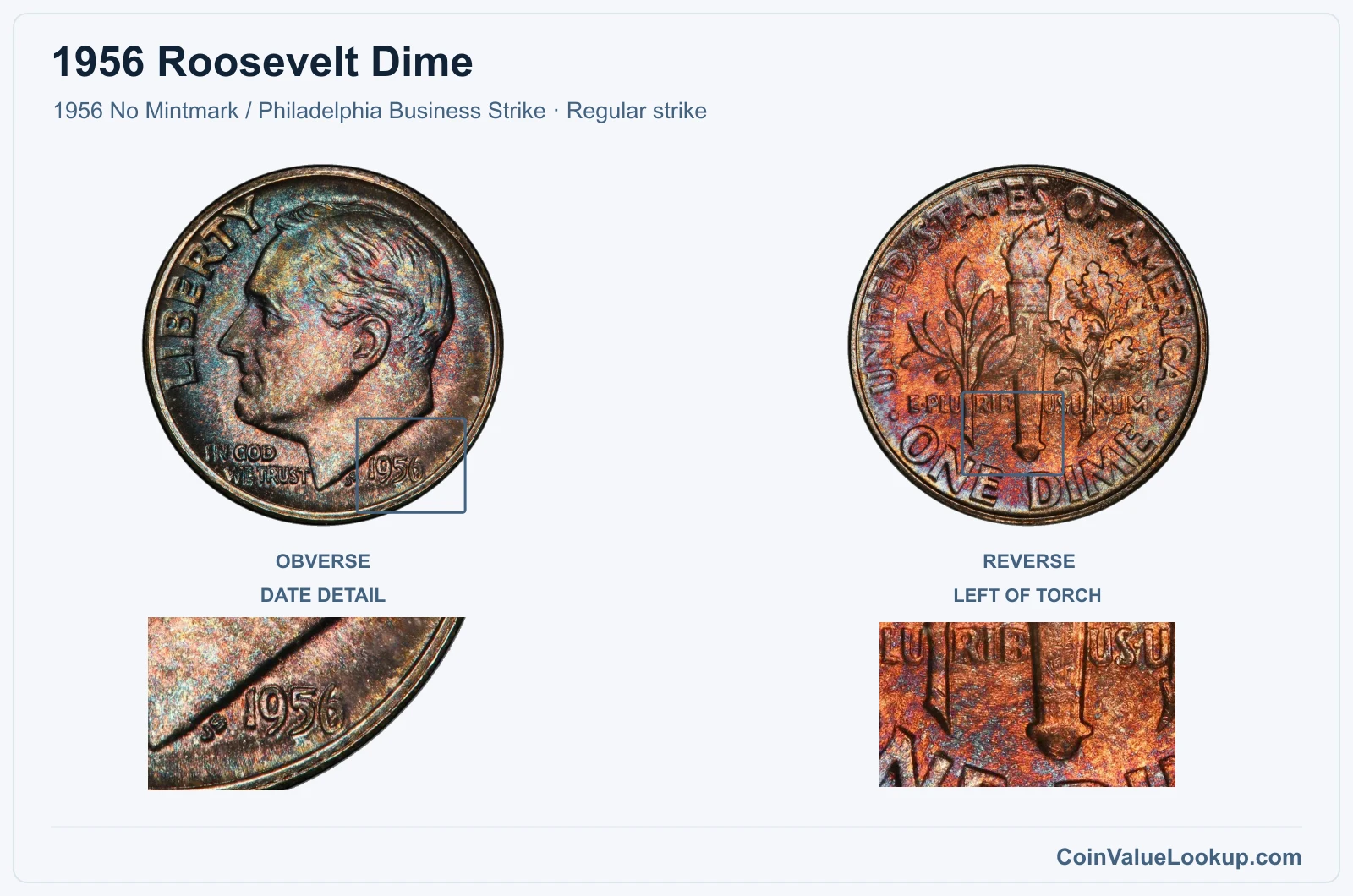
The 1956 Philadelphia business strike has no mintmark on the reverse. This is the most commonly encountered branch for the year.
USA Coin Book lists guide values of about $5.81 at G4 and $12.26 at MS65, though silver melt value creates a price floor that shifts with the metal market.
When evaluating one of these, original surfaces matter. A lightly toned piece with full luster will always beat a cleaned coin of equal technical grade.
If the torch bands show complete separation, the Full Bands designation applies and collectors pay a premium for it at the same certified grade. Compare your coin against others of the same mint, grade, and designation to get a realistic picture of value.
Range Grade
Price Auction Records Appraisal PO PO 1
—
Coin Identifier FR FR 2
—
Coin Identifier AG AG 3
—
Coin Identifier G G 4
—
Coin Identifier
G 6
—
Coin Identifier VG VG 8
—
Coin Identifier
VG 10
—
Coin Identifier F F 12
—
Coin Identifier
F 15
—
Coin Identifier VF VF 20
—
Coin Identifier
VF 25
—
Coin Identifier
VF 30
—
Coin Identifier
VF 35
—
Coin Identifier XF XF 40
—
Coin Identifier
XF 45
—
Coin Identifier AU AU 50
—
Coin Identifier
AU 53
—
Coin Identifier
AU 55
—
Coin Identifier
AU 58
Coin Identifier MS MS 60
—
Coin Identifier
MS 61
—
Coin Identifier
MS 62
—
Coin Identifier
MS 63
—
Coin Identifier
MS 64
Coin Identifier
MS 65
Coin Identifier
MS 66
Coin Identifier
MS 67
Coin Identifier
MS 68
Coin Identifier
MS 69
—
—
—
MS 70
—
—
—
1956 Roosevelt Dime — D Mintmark Business Strike
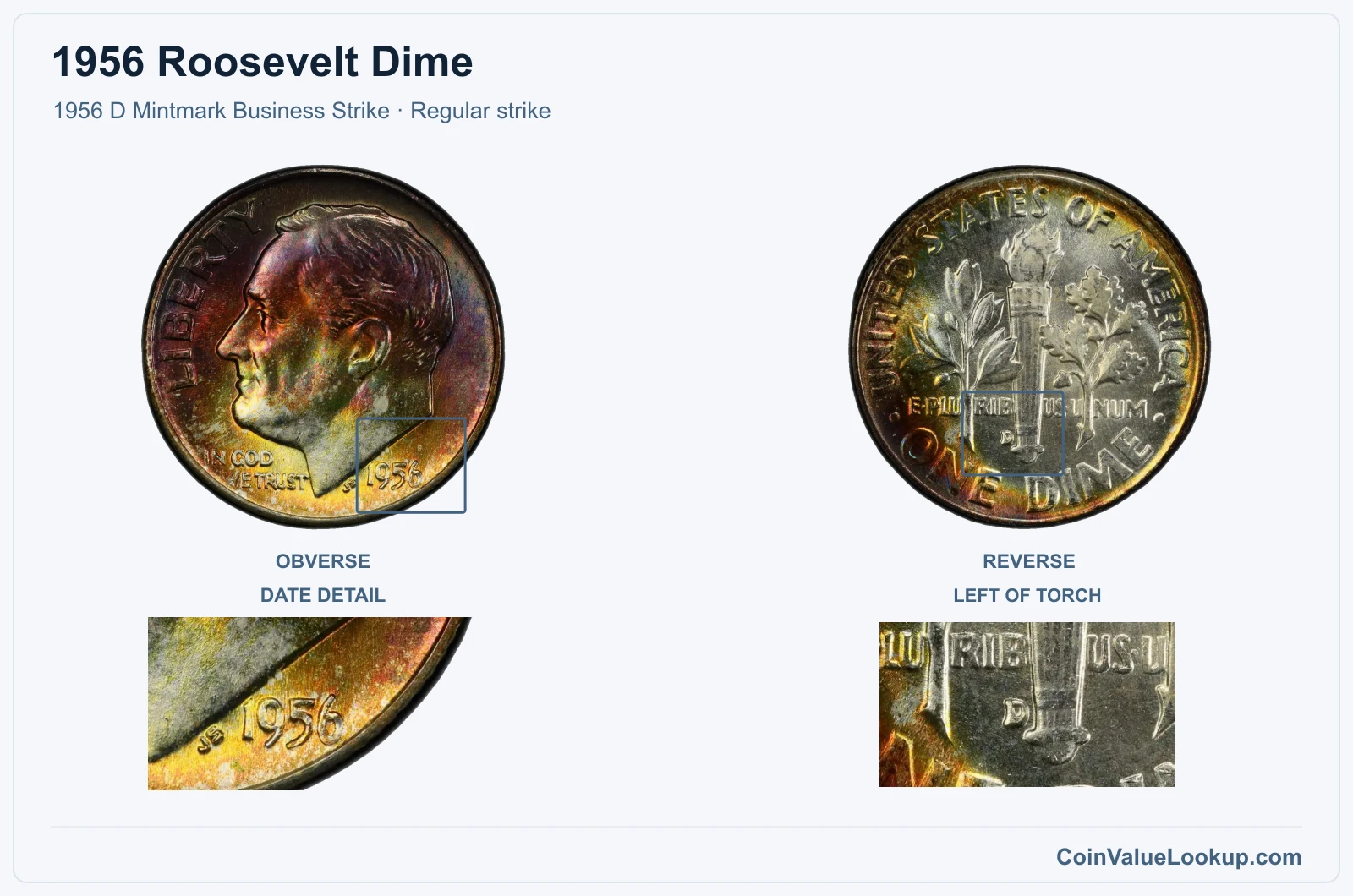
Look for the small "D" mintmark beside the torch base. The Denver issue shares the same 90% silver composition, 2.50-gram weight, and design as its Philadelphia counterpart.
USA Coin Book guide values mirror the Philadelphia branch: roughly $5.81 at G4 and $12.26 at MS65.
Denver strikes sometimes show softer detail on the bands, so achieving a Full Bands designation can be trickier. That makes a well-struck, fully banded Denver coin worth comparing against Philadelphia equivalents at the same grade.
As always, original surfaces and the absence of cleaning hairlines are what separate a desirable coin from a common one.
Coin Value Lookup is a handy place to look up guides for other Roosevelt Dime dates and mints if you are working through a collection.
Range Grade
Price Auction Records Appraisal PO PO 1
—
Coin Identifier FR FR 2
—
Coin Identifier AG AG 3
—
Coin Identifier G G 4
—
Coin Identifier
G 6
—
Coin Identifier VG VG 8
—
Coin Identifier
VG 10
—
Coin Identifier F F 12
—
Coin Identifier
F 15
—
Coin Identifier VF VF 20
—
Coin Identifier
VF 25
—
Coin Identifier
VF 30
—
Coin Identifier
VF 35
—
Coin Identifier XF XF 40
—
Coin Identifier
XF 45
—
Coin Identifier AU AU 50
—
Coin Identifier
AU 53
—
Coin Identifier
AU 55
—
Coin Identifier
AU 58
Coin Identifier MS MS 60
—
Coin Identifier
MS 61
—
Coin Identifier
MS 62
—
Coin Identifier
MS 63
—
Coin Identifier
MS 64
—
Coin Identifier
MS 65
Coin Identifier
MS 66
Coin Identifier
MS 67
Coin Identifier
MS 68
—
—
—
MS 69
—
—
—
MS 70
—
—
—
1956 Roosevelt Dime — No Mintmark / Philadelphia Proof
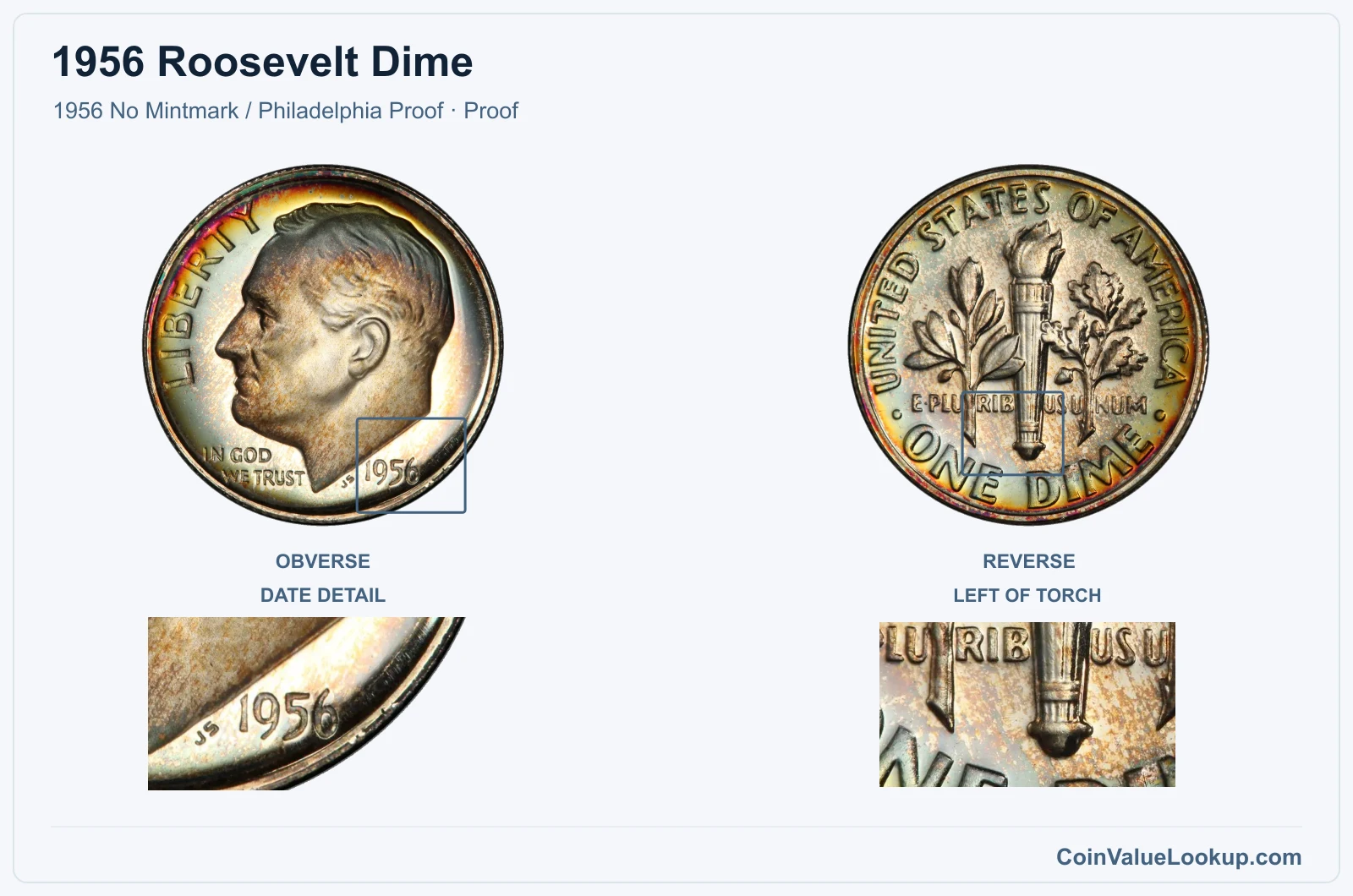
Philadelphia proofs for 1956 also carry no mintmark, just like business strikes, so you need to look at the surfaces to tell them apart. A proof has deeply mirrored fields and frosted or sharply struck devices, produced by specially prepared dies and planchets.
The USA Coin Book guide places a PR65 example at about $14.
Cameo contrast, where frosted designs stand against mirror fields, is a separate designation that must be compared on its own terms rather than pooled with standard proofs. Proof is a method of manufacture, not a grade above Mint State, so a PR65 and an MS65 are evaluated on entirely different scales.
Keep your proof stored carefully; fingerprints and improper handling can quickly knock a high-grade proof down a notch or two.
Range Grade
Price Auction Records Appraisal PR PR 1
—
Coin Identifier
PR 2
—
Coin Identifier
PR 3
—
Coin Identifier
PR 4
—
Coin Identifier
PR 6
—
Coin Identifier
PR 8
—
Coin Identifier
PR 10
—
Coin Identifier
PR 12
—
Coin Identifier
PR 15
—
Coin Identifier
PR 20
—
Coin Identifier
PR 25
—
Coin Identifier
PR 30
—
Coin Identifier
PR 35
—
Coin Identifier
PR 40
—
Coin Identifier
PR 45
—
Coin Identifier
PR 50
—
Coin Identifier
PR 53
—
Coin Identifier
PR 55
—
Coin Identifier
PR 58
—
Coin Identifier
PR 60
—
Coin Identifier
PR 61
—
Coin Identifier
PR 62
—
Coin Identifier
PR 63
—
Coin Identifier
PR 64
—
Coin Identifier
PR 65
Coin Identifier
PR 66
Coin Identifier
PR 67
Coin Identifier
PR 68
Coin Identifier
PR 69
Coin Identifier
PR 70
—
—
—
1956 Roosevelt Dime Error List
1. 1956 Roosevelt Dime — Off-Center Strike
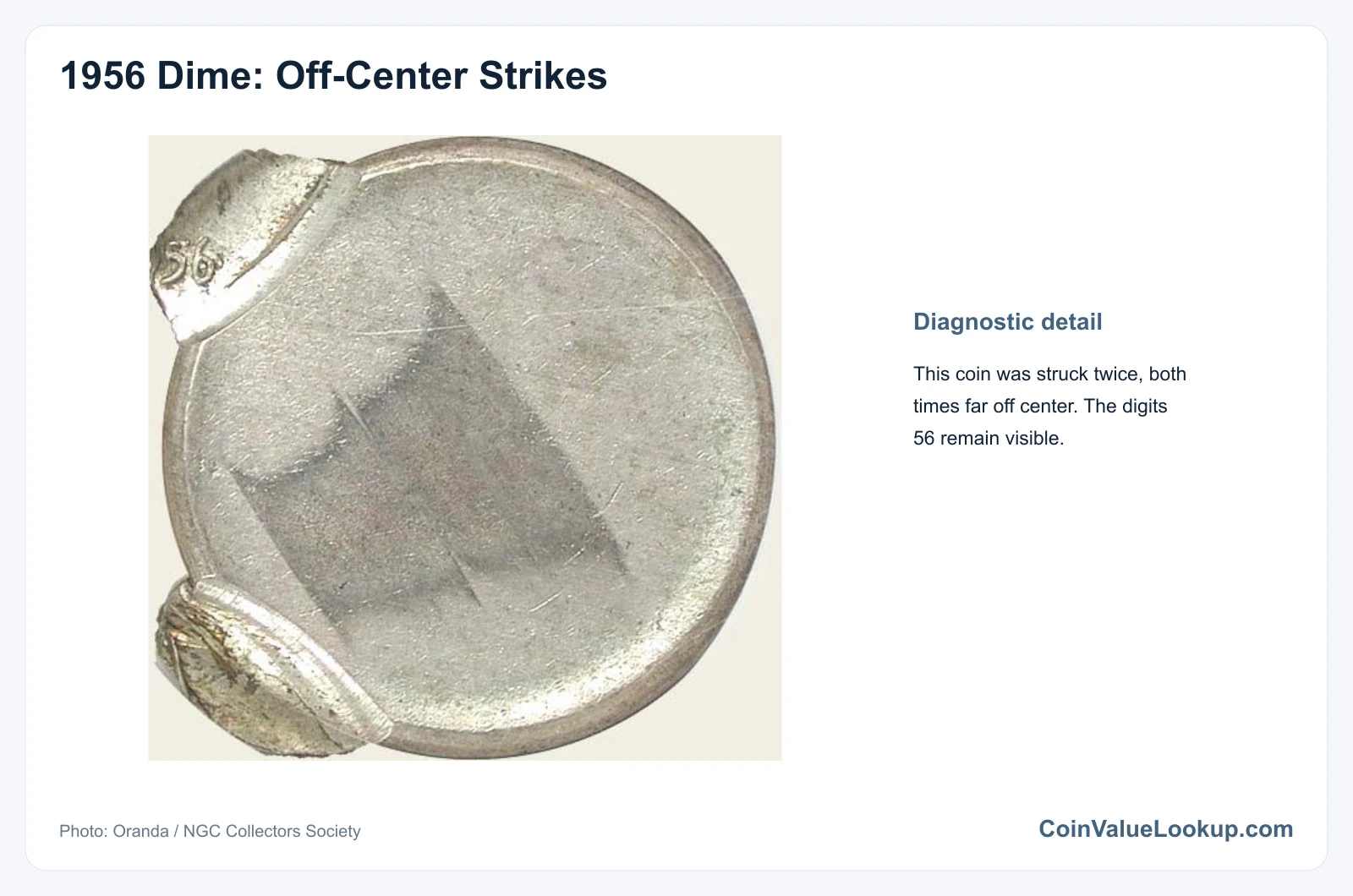
An off-center strike happens when the planchet is not properly seated in the collar before the dies come together. The result is a blank crescent along part of the rim where no design was impressed, with the remaining design shifted in the opposite direction.
On confirmed 1956 no-mintmark business strikes, Heritage Auctions has handled examples such as a 55% off-center piece graded NGC MS62.
The date must still be readable for most collectors to take interest. That crescent of blank metal should appear on both sides in corresponding positions.
If only one side looks off or the edge shows file marks and tool scratches, you may be looking at post-mint damage rather than a genuine striking error. Compare against a certified off-center specimen at matching magnification before drawing conclusions.
Value depends on the percentage of displacement, whether the date is visible, and overall condition, so each piece requires individual assessment.
2. 1956 Roosevelt Dime — Straight Clip with Broadstrike
This is a compound error: a straight clipped planchet that was also broadstruck, meaning the collar failed to contain the metal during striking and the planchet was already missing a strip-edge segment. The result is a coin wider than normal with a straight missing section along one edge.
Heritage Auctions listed a 1956 no-mintmark example graded PCGS MS64, described as a 16% straight clip combined with a broadstrike.
Because two distinct errors occurred on the same coin, this is evaluated as one compound event, not two separate premiums stacked together. Look for the straight missing edge plus design elements that extend beyond the normal rim boundary.
Post-mint cutting or filing can mimic a clip, so check for metal flow at the straight edge and matching displacement on both sides. Authentication by a third-party grading service is the safest route.
Each authenticated example is assessed individually based on error severity and condition.
3. 1956 Roosevelt Dime — Straight Clipped Planchet
A straight clipped planchet shows a straight edge cutting into where the normal round rim should be, caused by a strip-cutting error at the mint before the blank was struck. Heritage Auctions has handled a 1956 straight clip graded NGC MS65 at 2.35 grams, lighter than the standard 2.50-gram weight.
To confirm this error, examine both sides and the edge. Genuine clips show metal flow and a corresponding weakness in the strike opposite the missing area, called the Blakesley effect.
A coin that has been sawed or filed after leaving the mint will lack that strike weakness and may show tool marks under magnification. Do not diagnose from color or toning alone.
The value of a straight clipped planchet depends on visibility, percentage of missing metal, and the coin's overall condition, so individual assessment by an authenticated example is the right approach.
4. 1956 Roosevelt Dime — Doubled Die Obverse
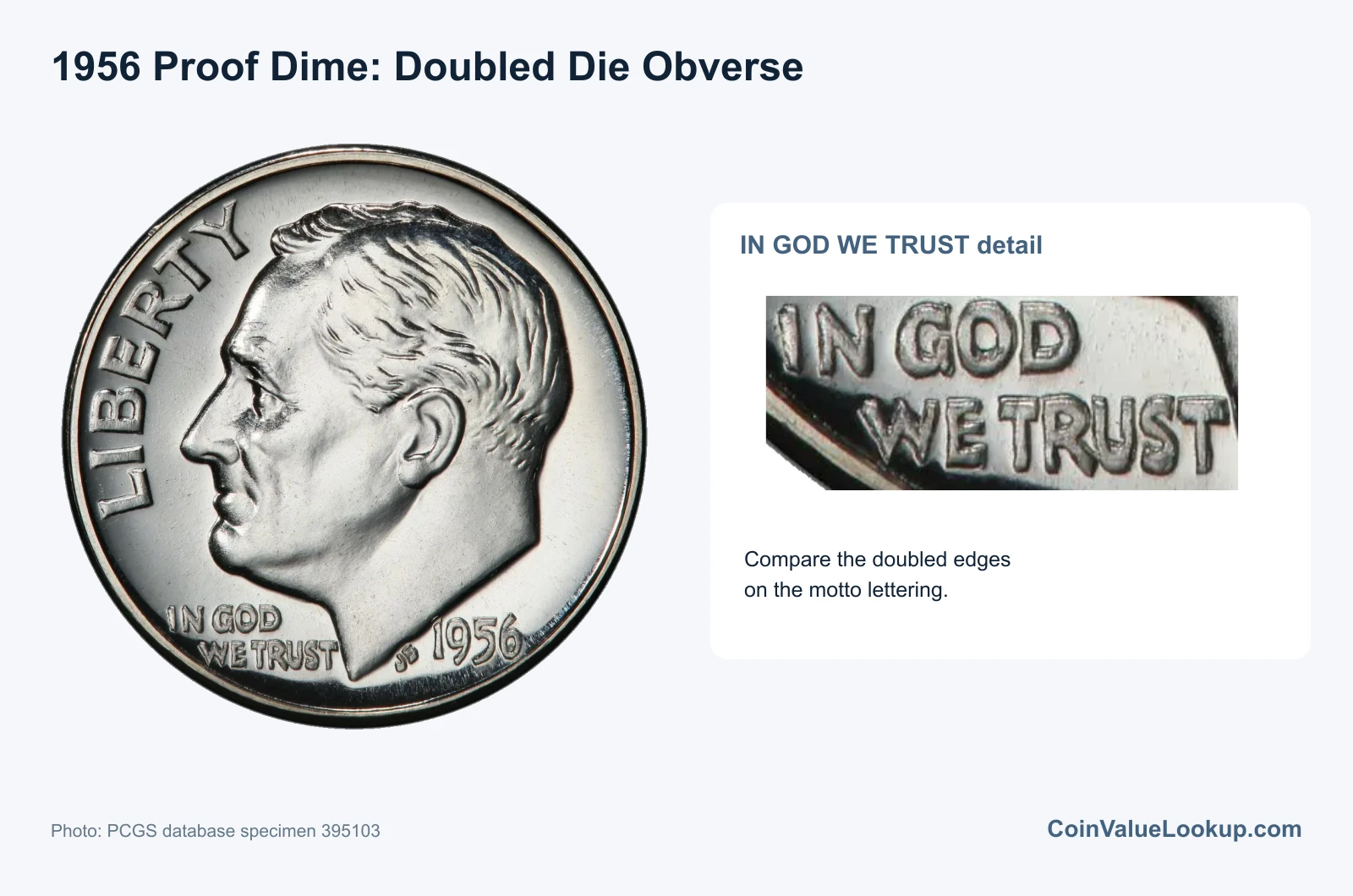
A doubled die obverse on a 1956 dime means the die itself carried a doubled image before striking any coins, producing consistent doubling on every piece struck from that die. This differs from machine doubling, which is flat, shelf-like displacement caused by die bounce and carries little to no premium.
To check your coin, examine the obverse lettering and date under magnification. Genuine hub doubling shows separation or notching that is raised and rounded, not flat.
Machine doubling tends to look like a shadow that leans in one direction with a shelf-like edge. Reflections or worn die contours can also mimic doubling to the untrained eye.
Condition, visibility of the doubling, and the specific die variety all affect what a doubled die obverse might be worth. No standard price range applies here, so each coin needs to be evaluated on its own based on those factors.
5. 1956 Roosevelt Dime — Die Crack / Die Chip
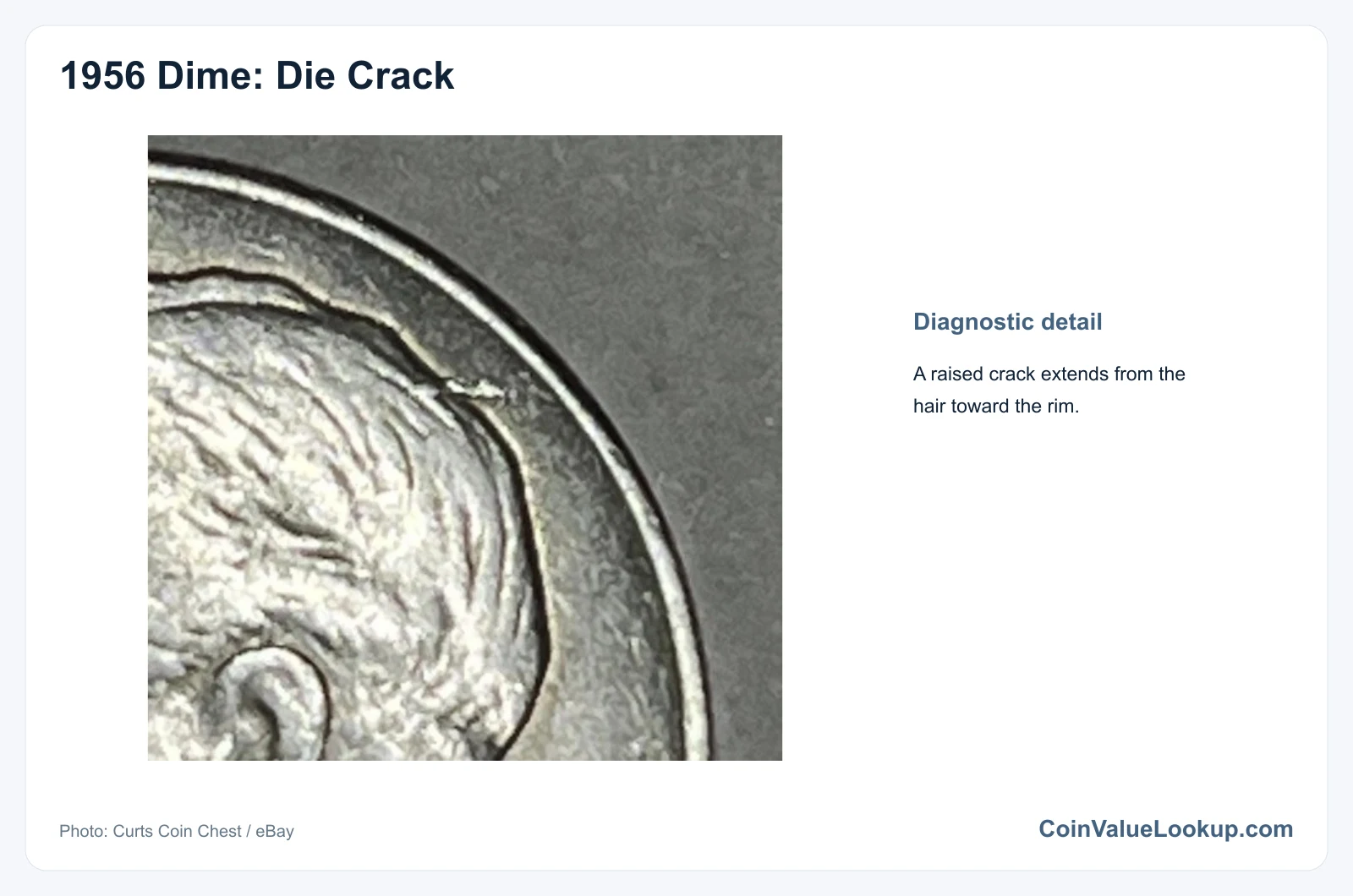
Die cracks and die chips are raised irregularities on the coin's surface caused by a deteriorating die at the mint. A die crack appears as a thin raised line running across part of the design, while a die chip shows up as a small raised blob.
A cud is a more dramatic version: a die crack that reaches the rim and results in a raised, featureless lump at the edge.
On a 1956 dime, look for these raised features under good light and moderate magnification. They should be raised above the coin's surface, not incised into it.
Scratches, corrosion deposits, and foreign material stuck to the surface can all mimic die damage but will typically appear recessed or sit unevenly on the metal.
The value of a die crack or cud depends on size, location, and overall coin condition. A small interior crack is far less dramatic than a full rim cud.
Each piece requires individual evaluation.
6. 1956 Roosevelt Dime — Repunched Mintmark
A repunched mintmark occurs when the mintmark punch was applied more than once in slightly different positions, leaving traces of the earlier placement visible beside or beneath the final mark. On 1956 dimes, this would appear on the "D" mintmark near the torch base on the reverse.
Under magnification, look for a second outline, partial letter, or shadow offset from the primary "D" that sits at a consistent angle and depth. Machine doubling around a mintmark tends to produce a flat shelf in one direction, while a die chip near the mark looks like a formless blob rather than a letter shape.
Corrosion can also obscure or distort the mintmark area, so clean magnification and good lighting are essential.
Value depends on the clarity and prominence of the repunching as well as the coin's grade and surface quality. Each confirmed example is assessed individually.