1958 Roosevelt Dime Coin Value: How Much Is It Worth?
The 1958 Roosevelt Dime is a 90% silver coin that still turns up in old collections and estate finds. According to USA Coin Book guide estimates, circulated examples start around $5.81 at the G4 grade level, while uncirculated pieces in MS65 can reach about $14.
Proof strikes in PR65 sit near $9.87. Actual value depends on the specific mint version, condition, any special strike designations, and whether an authenticated error is present.
Fast Way to Identify Your 1958 Roosevelt Dime
Snap a clear photo of the front and back of your 1958 dime and upload both images to our identifier. It will give you a preliminary identification of your coin's version and general condition.
This is not a substitute for professional authentication or grading, but it is a solid first step toward figuring out what you have.
1958 Roosevelt Dime Value
Upload both sides of your 1958 Roosevelt Dime.
Front Obverse
Upload photo
Back Reverse
Upload photo
Which 1958 Roosevelt Dime Versions Are Worth Money?
- Philadelphia and Denver business strikes in original, uncirculated condition with strong Full Bands designation command higher guide values than average circulated pieces.
- Philadelphia proofs with undisturbed mirror fields are a distinct collectible version; cameo contrast examples require separate comparison against like pieces.
- Curved Clipped Planchet errors, such as a confirmed 1958-D with a large clip, carry a premium that depends on clip size and authenticated condition.
- Defective Planchet errors on 1958 Philadelphia strikes are scarce and individually assessed based on severity and authentication.
Step 1: Identify Your 1958 Roosevelt Dime Mint Mark and Version
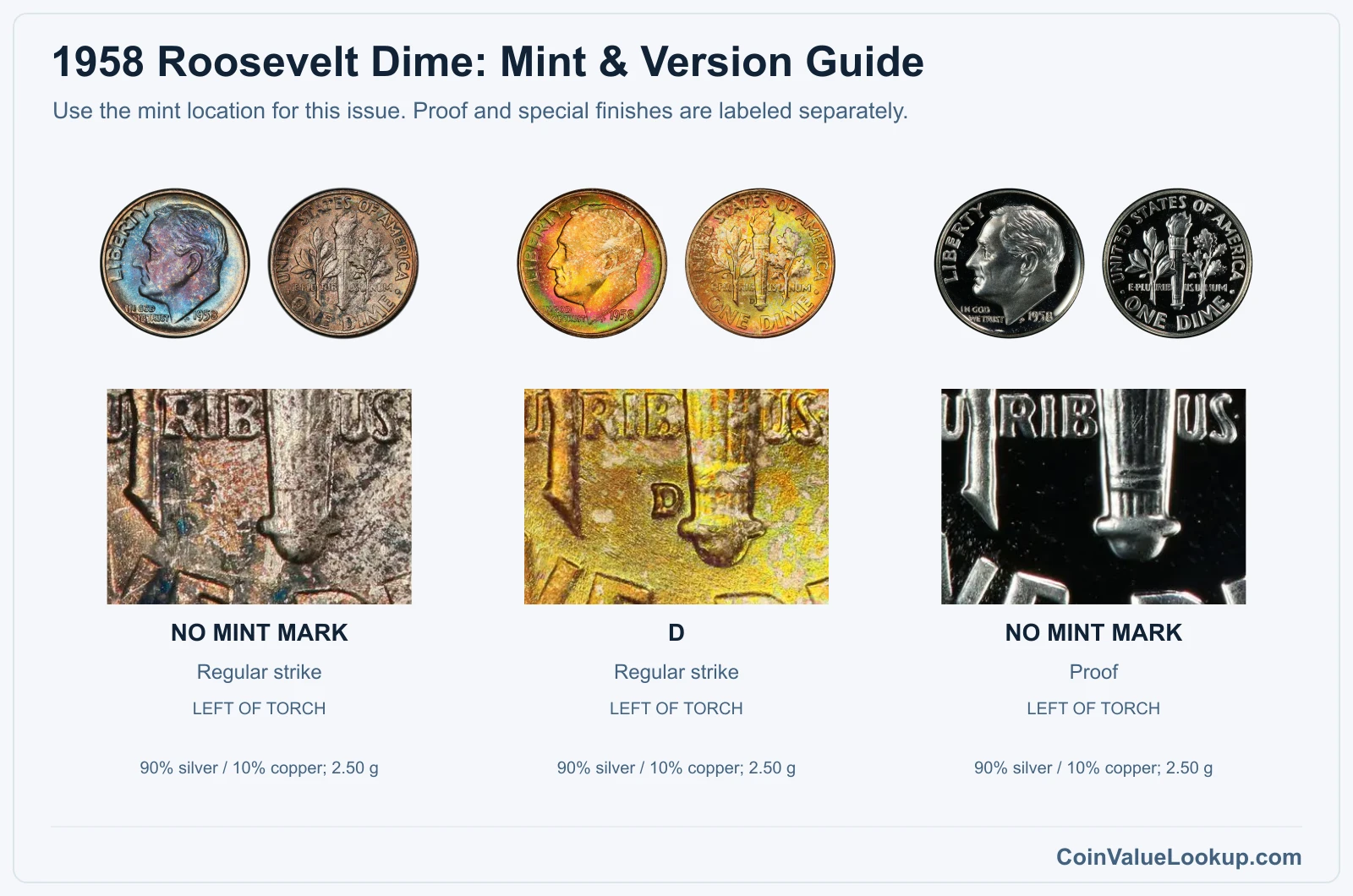
All 1958 Roosevelt Dimes are struck in 90% silver and 10% copper, weigh about 2.50 grams, and measure roughly 17.9 mm across. The obverse shows Roosevelt's portrait with the date below.
The reverse features a torch flanked by olive and oak branches.
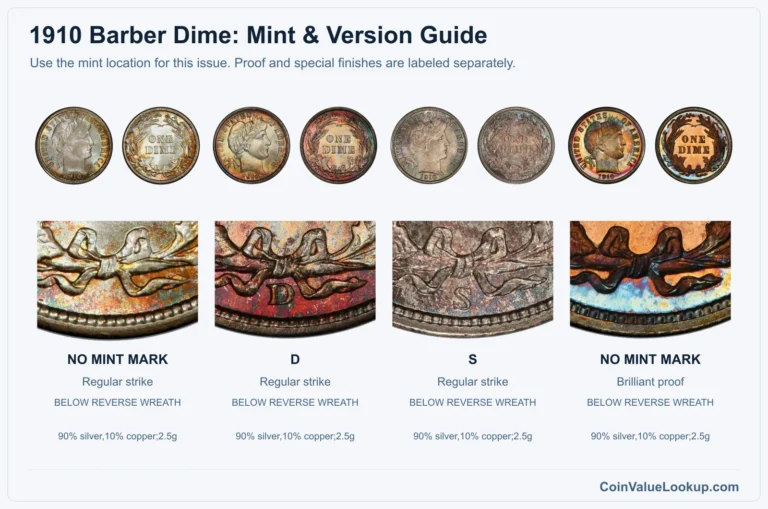
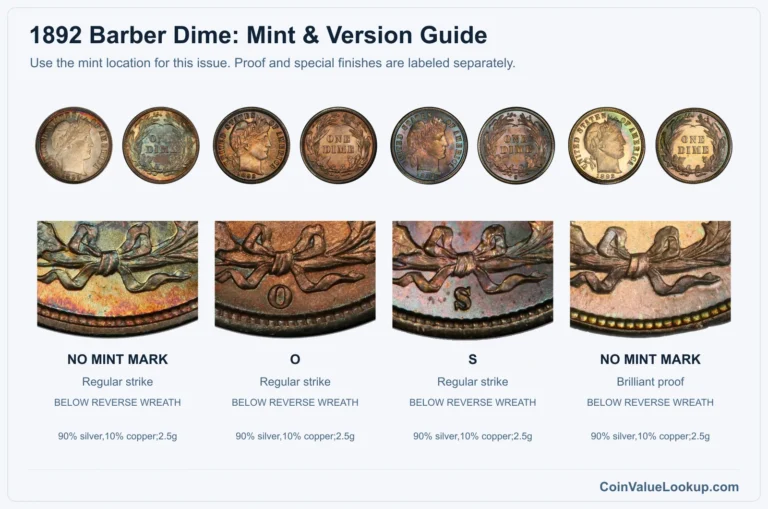
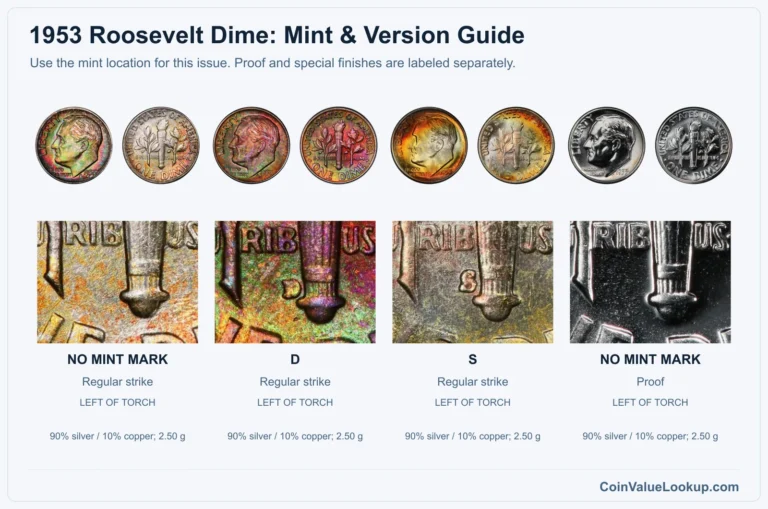
To tell the versions apart, flip the coin over and look beside the base of the torch. A small "D" mintmark means Denver.
No mintmark at all means Philadelphia, which covers both business strikes and proofs for this year.
Proofs are easy to spot once you know what to look for: deeply mirrored fields, razor-sharp design edges, and usually minimal contact marks because they were struck with extra care for collectors. A business strike, even a nice uncirculated one, will have a frosty or satiny luster rather than a mirror finish.
Error coins — clipped planchets, defective blanks, and others listed below — fall outside normal pricing and need to be evaluated individually based on severity and authenticated identity.
Step 2: Check Your 1958 Roosevelt Dime Grade
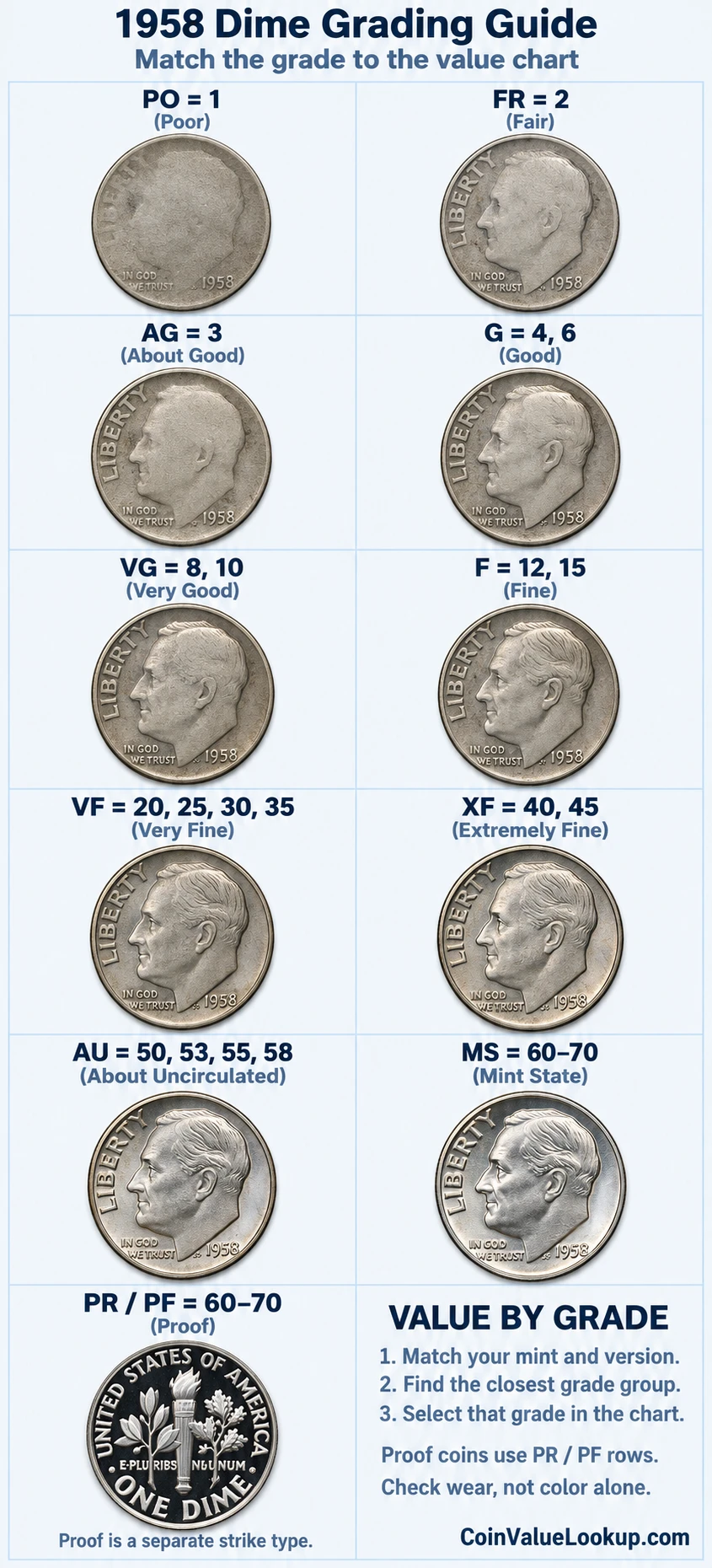
Start with Roosevelt's cheek and jawline. On a well-circulated coin, these high points flatten first, followed by the hair detail above the ear.
On the reverse, the torch bands and leaf veins wear down progressively.
Tilt the coin under a single light source. Unbroken luster that flows across the surface indicates a coin that saw little or no circulation.
A coin that looks bright but shows tiny parallel scratches was likely cleaned — and cleaning always hurts the value.
Full Bands is a strike designation, not a grade. It refers to clear separation of both horizontal torch-band pairs on the reverse.
A coin can be MS65 without Full Bands, or MS63 with them. Grade and designation are assessed independently, so compare your coin against examples that match in both categories.
Use the comparison image to match your coin's wear pattern against known grade benchmarks. Focus on actual surface loss rather than overall brightness.
Step 3: Check 1958 Roosevelt Dime Value by Mint and Version
1958 Roosevelt Dime — No Mintmark / Philadelphia Business Strike
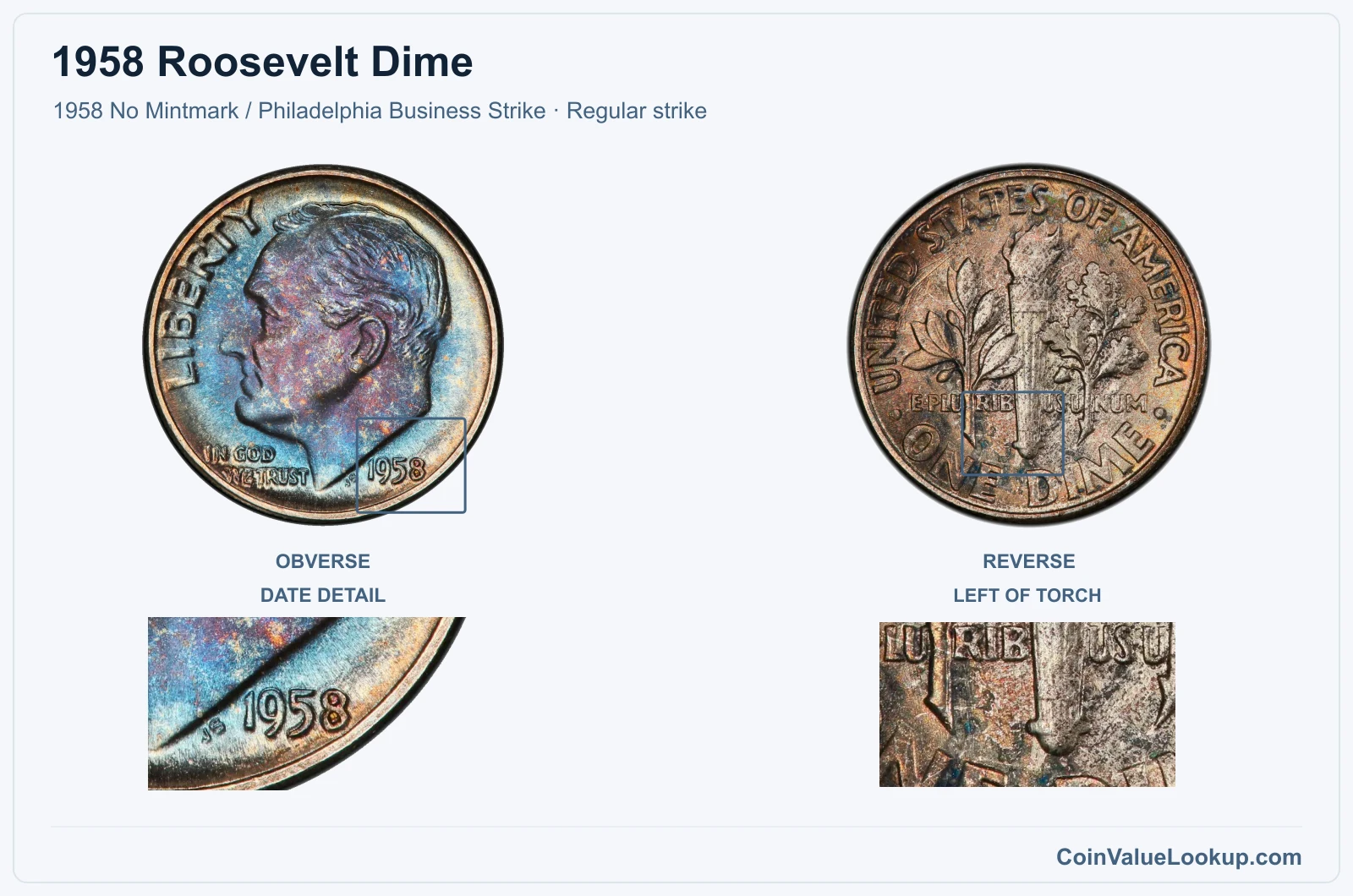
The 1958 Philadelphia business strike carries no mintmark — look at the reverse near the torch base and you should see bare space. USA Coin Book lists guide estimates of about $5.81 in G4 and around $14 in MS65.
These are silver coins, so even a well-worn example has intrinsic metal value that shifts with the silver market. For collector premiums above melt, you want original surfaces free of cleaning and, ideally, full separation of the torch bands.
Coins with the Full Bands designation in comparable grades tend to bring more, so always compare like-for-like: same mint, same grade, same designation.
Range Grade
Price Auction Records Appraisal PO PO 1
—
Coin Identifier FR FR 2
—
Coin Identifier AG AG 3
—
Coin Identifier G G 4
—
Coin Identifier
G 6
—
Coin Identifier VG VG 8
—
Coin Identifier
VG 10
—
Coin Identifier F F 12
—
Coin Identifier
F 15
—
Coin Identifier VF VF 20
—
Coin Identifier
VF 25
—
Coin Identifier
VF 30
—
Coin Identifier
VF 35
—
Coin Identifier XF XF 40
—
Coin Identifier
XF 45
—
Coin Identifier AU AU 50
—
Coin Identifier
AU 53
—
Coin Identifier
AU 55
—
Coin Identifier
AU 58
—
Coin Identifier MS MS 60
—
Coin Identifier
MS 61
—
Coin Identifier
MS 62
—
Coin Identifier
MS 63
—
Coin Identifier
MS 64
Coin Identifier
MS 65
Coin Identifier
MS 66
Coin Identifier
MS 67
Coin Identifier
MS 68
—
—
—
MS 69
—
—
—
MS 70
—
—
—
1958 Roosevelt Dime — D Mintmark Business Strike
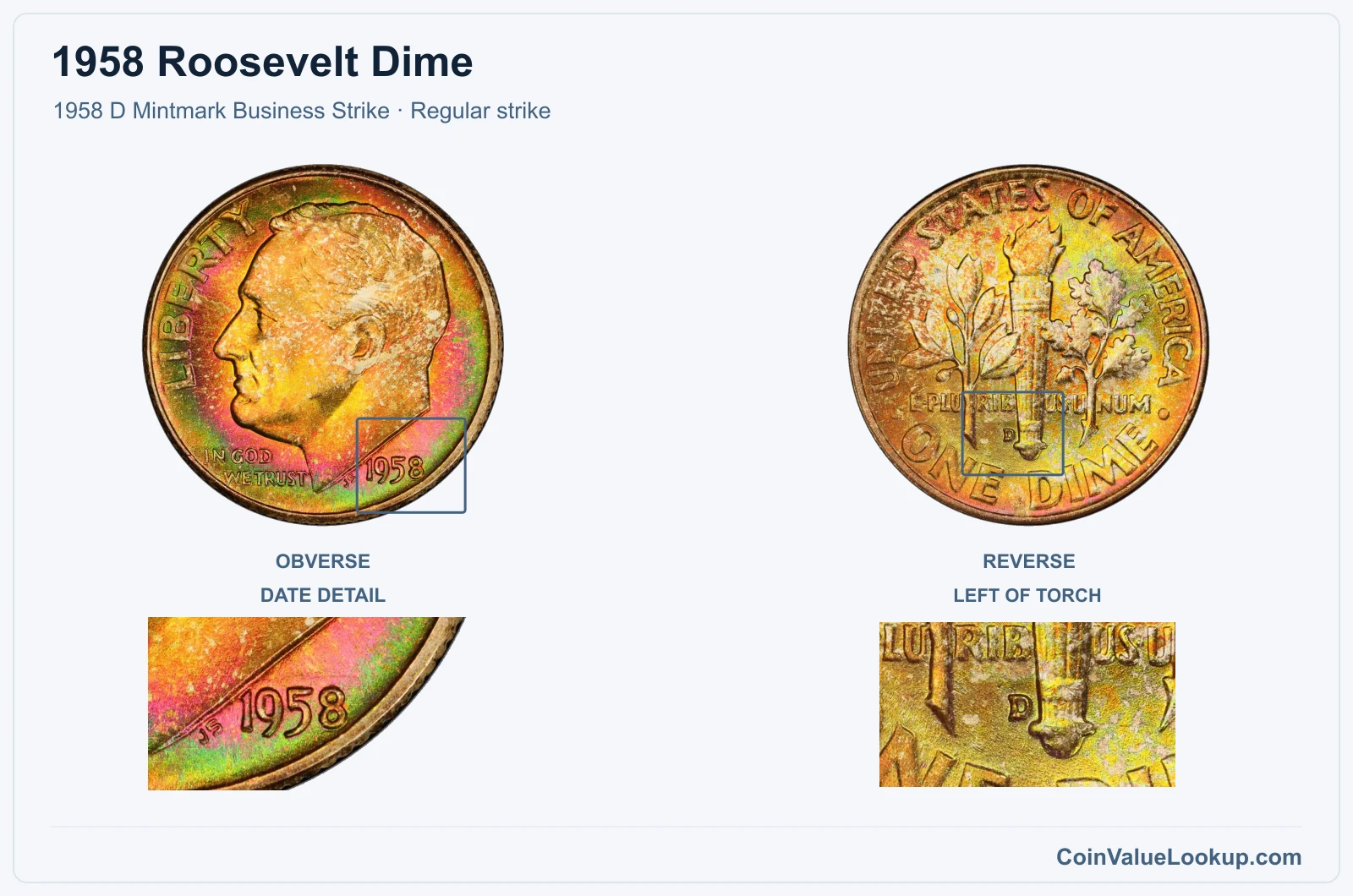
Look for a small "D" mintmark beside the torch base on the reverse. The 1958-D Denver issue has the same silver composition and weight as the Philadelphia version.
Guide estimates from USA Coin Book place it at roughly $5.81 in G4 and about $14 in MS65.
Coin Value Lookup is a handy starting point if you want to look up guides for other Roosevelt Dime dates or different series entirely. It covers a wide range of U.S. coins and can save you time when sorting through a mixed collection.
As with the Philadelphia strike, original luster and a Full Bands designation matter for collector value. Compare your coin against certified examples from the same mint when making any assessment.
Range Grade
Price Auction Records Appraisal PO PO 1
—
Coin Identifier FR FR 2
—
Coin Identifier AG AG 3
—
Coin Identifier G G 4
—
Coin Identifier
G 6
—
Coin Identifier VG VG 8
—
Coin Identifier
VG 10
—
Coin Identifier F F 12
—
Coin Identifier
F 15
—
Coin Identifier VF VF 20
—
Coin Identifier
VF 25
—
Coin Identifier
VF 30
—
Coin Identifier
VF 35
—
Coin Identifier XF XF 40
—
Coin Identifier
XF 45
—
Coin Identifier AU AU 50
—
Coin Identifier
AU 53
—
Coin Identifier
AU 55
—
Coin Identifier
AU 58
—
Coin Identifier MS MS 60
—
Coin Identifier
MS 61
—
Coin Identifier
MS 62
—
Coin Identifier
MS 63
—
Coin Identifier
MS 64
—
Coin Identifier
MS 65
Coin Identifier
MS 66
Coin Identifier
MS 67
Coin Identifier
MS 68
Coin Identifier
MS 69
—
—
—
MS 70
—
—
—
1958 Roosevelt Dime — No Mintmark / Philadelphia Proof
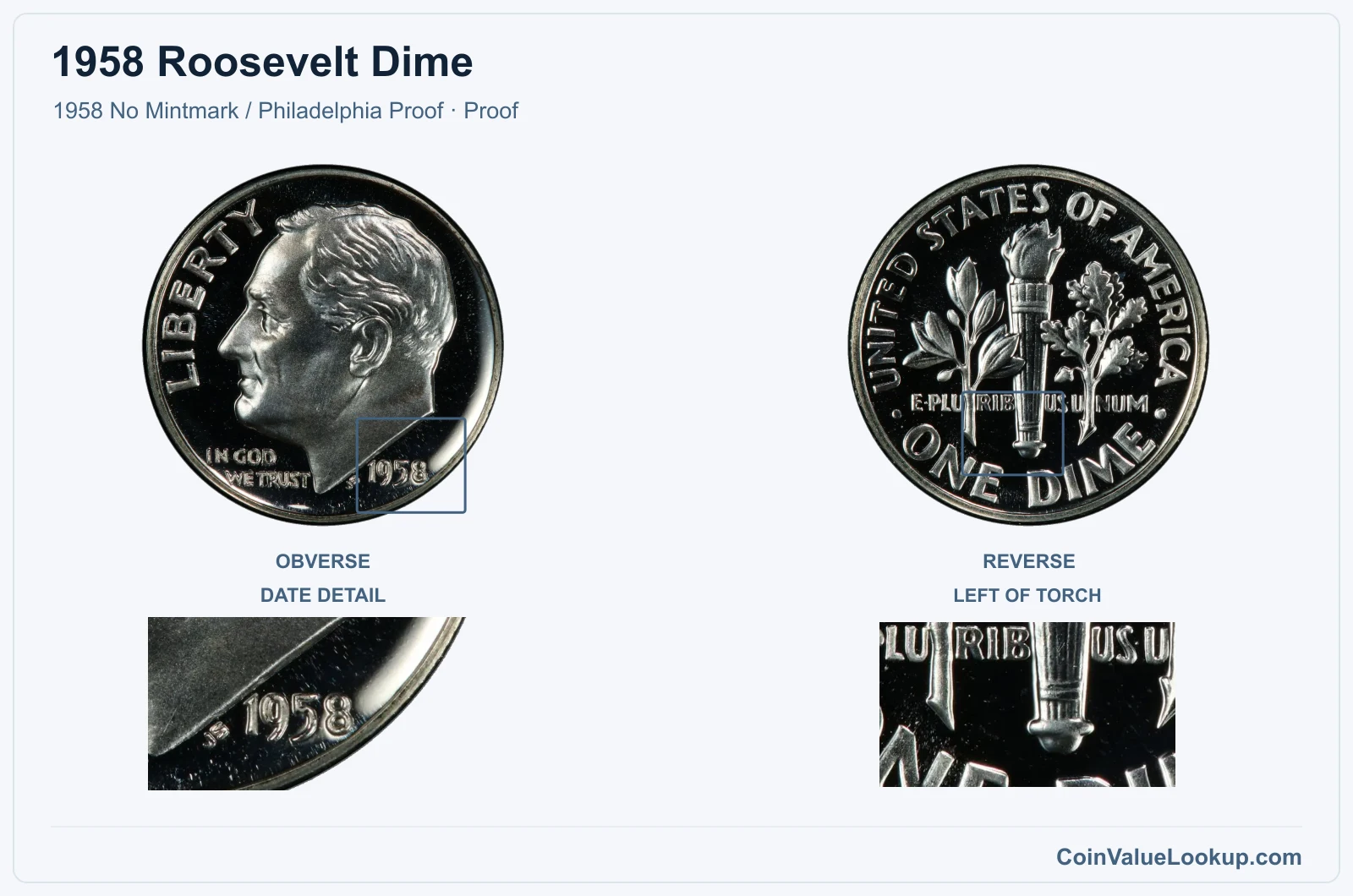
Philadelphia also struck proof dimes in 1958, distributed in proof sets sold directly to collectors. These have mirrored fields and sharply detailed devices.
There is no mintmark, same as the business strike, so the finish itself is how you tell them apart.
USA Coin Book estimates the ordinary PR65 proof at about $9.87. Cameo contrast — frosted devices against deep mirror fields — is a separate designation and should not be pooled with standard proof pricing.
If your coin shows that white-frost-over-black-mirror look, it needs its own comparison against cameo-designated examples of the same year and grade.
Range Grade
Price Auction Records Appraisal PR PR 1
—
Coin Identifier
PR 2
—
Coin Identifier
PR 3
—
Coin Identifier
PR 4
—
Coin Identifier
PR 6
—
Coin Identifier
PR 8
—
Coin Identifier
PR 10
—
Coin Identifier
PR 12
—
Coin Identifier
PR 15
—
Coin Identifier
PR 20
—
Coin Identifier
PR 25
—
Coin Identifier
PR 30
—
Coin Identifier
PR 35
—
Coin Identifier
PR 40
—
Coin Identifier
PR 45
—
Coin Identifier
PR 50
—
Coin Identifier
PR 53
—
Coin Identifier
PR 55
—
Coin Identifier
PR 58
—
Coin Identifier
PR 60
Coin Identifier
PR 61
—
Coin Identifier
PR 62
—
Coin Identifier
PR 63
—
Coin Identifier
PR 64
Coin Identifier
PR 65
Coin Identifier
PR 66
Coin Identifier
PR 67
Coin Identifier
PR 68
Coin Identifier
PR 69
Coin Identifier
PR 70
—
—
—
1958 Roosevelt Dime Error List
1. 1958 Roosevelt Dime — Curved Clipped Planchet
A curved clipped planchet means the blank was punched from strip metal that overlapped a previously punched hole, leaving a bite-shaped gap in the finished coin. On a confirmed 1958-D example graded NGC MS61, the clip measured approximately 20% of the planchet — a large, obvious absence of metal along one edge.
To check yours, look for a smooth curved interruption in the rim. The opposite side of the rim often shows a slight weakness called the Blakesley effect, which helps confirm the clip happened before striking.
If the missing area has rough, jagged, or discolored edges, that points toward post-mint damage — someone cut, filed, or corroded the edge after the coin left the press.
No numerical price range is adopted for this error. Value depends on the size of the clip, overall condition, and authenticated identity.
2. 1958 Roosevelt Dime — Defective Planchet
A defective planchet error means the blank itself had flaws before the dies struck it. A Heritage Auctions specimen attributed as (1958) and graded NGC MS65 weighed just 2.3 grams — lighter than the standard 2.50 grams — with an uneven, compromised surface visible across the coin.
The date was only partially legible due to the planchet defect, so the attribution carries a parenthetical notation.
Do not confuse this with post-mint corrosion or environmental damage. A genuine defective planchet shows irregularities that the strike impressed over, meaning design elements follow the flaw rather than covering it up.
Pitting from years in soil looks random and sits on top of the design.
No numerical price range is adopted. Each defective planchet piece is assessed individually based on severity, eye appeal, and authenticated identity.
3. 1958 Roosevelt Dime — Repunched Mintmark
A repunched mintmark occurs when the mintmark punch was applied to the working die more than once in slightly different positions. The result is a doubled or shadowed appearance around the "D" on the reverse, visible under moderate magnification.
To check, examine the mintmark area beside the torch base. You are looking for remnants of a second impression — a partial letter that does not line up with the primary punch.
Compare your mintmark at matching magnification against a known normal example.
Do not confuse this with machine doubling, which produces flat, shelf-like outlines, or with a die chip that adds a small blob of metal near the letter. Corrosion around the mintmark can also mimic doubling to the untrained eye.
No specific price range is adopted. Value depends on the visibility of the repunching, overall condition, and the particular variety involved.
4. 1958 Roosevelt Dime — Off-Center Strike
An off-center strike happens when the planchet is not seated properly between the dies, so the design is displaced to one side and a blank crescent of unstruck metal appears on the opposite edge. The most collectible off-center errors still show a full, readable date — without the date, identification becomes difficult and value drops.
Look at the overall design placement. If Roosevelt's portrait or the torch is shifted noticeably, and you see a smooth, featureless arc along part of the rim, you may have a genuine off-center strike.
Be careful not to confuse this with a curved clip, which removes metal but still shows a centered design, or with post-mint flattening that can distort edges.
No specific price range is adopted for this error. The percentage of off-center displacement, date visibility, and authenticated condition all factor into individual assessment.
5. 1958 Roosevelt Dime — Clashed Dies
Clashed dies result from the obverse and reverse dies striking each other without a planchet in between. The impact transfers faint mirror-image traces of one die's design onto the other.
On a 1958 dime, you might see ghostly outlines of the torch or branches on Roosevelt's neck area, or hints of the portrait on the reverse fields.
These traces are subtle. Use a magnifier and tilt the coin under a directional light to pick them up.
The transferred design elements should align with where the opposing die's features would logically appear — random scratches or raised lines in odd positions are not die clashes.
A brockage, where a previously struck coin acts as a die, leaves a much more dramatic impression and is a different error entirely. Surface scratches from handling can also mimic faint clash marks.
No specific price range is adopted. Value depends on the strength of the clash, the coin's condition, and authenticated identification.