1981 Roosevelt Dime Coin Value: How Much Is It Worth?
Most circulated 1981 Roosevelt dimes are worth face value — $0.10. In higher uncirculated grades, USA Coin Book lists Philadelphia and Denver business strikes at about $2.79 each in MS 65, while a standard San Francisco proof starts around $3.08 in PR 65.
The real action sits with the S-proof Type 2 variety and a handful of documented errors, so read on before you spend or sell.
Fast Way to Identify Your 1981 Roosevelt Dime
Snap a clear photo of both sides of your 1981 dime and upload them here for a preliminary identification. This helps sort out which mint produced your coin, whether it carries a P, D, or S mint mark, and flags any obvious variety or error worth investigating further.
It is not a substitute for professional certification but gives you a solid starting point.
1981 Roosevelt Dime Value
Upload both sides of your 1981 Roosevelt Dime.
Front Obverse
Upload photo
Back Reverse
Upload photo
Which 1981 Roosevelt Dime Versions Are Worth Money?
- The 1981-S Proof Type 2 dime, with its distinctive flat-topped S and bulbous terminals, lists at $6.81 in PR 65 — roughly double the Type 1 proof value.
- Well-preserved P or D business strikes in MS 65 or higher with clear Full Bands torch detail are worth checking, listed around $2.79 each at MS 65.
- A documented 1981-S Type 1 Proof Double Strike with Indent sold for $2,185 in January 2008 — confirm the diagnostic before expecting that kind of premium.
- An Improperly Annealed 1981-P planchet graded MS 63 sold for $139 in March 2025, showing that verified mint errors carry real premiums over face value.
Step 1: Identify Your 1981 Roosevelt Dime Mint Mark and Version
Start by confirming the date reads 1981 and the design shows Franklin Roosevelt's portrait on the obverse with a torch flanked by branches on the reverse. The coin is copper-nickel clad, weighs about 2.27 grams, and measures roughly 17.9 mm across.
There is no silver in the standard issue.
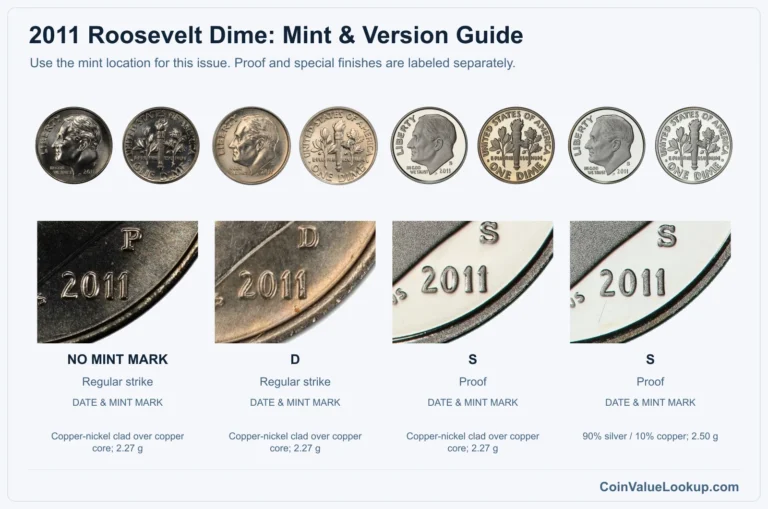
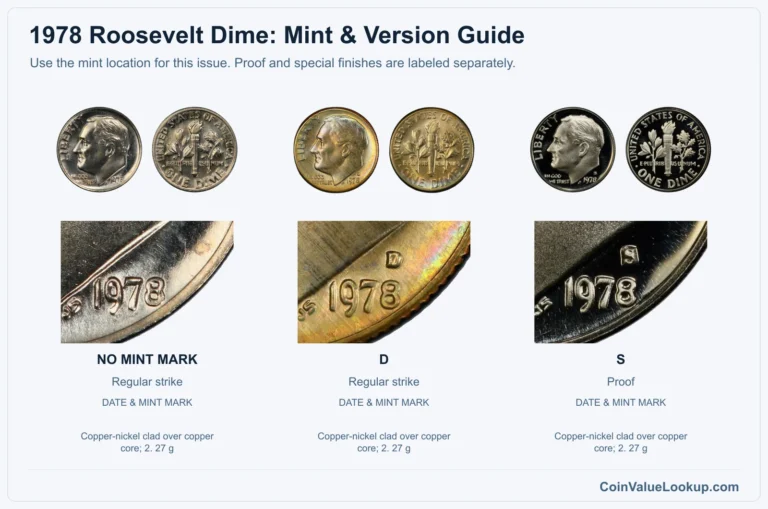
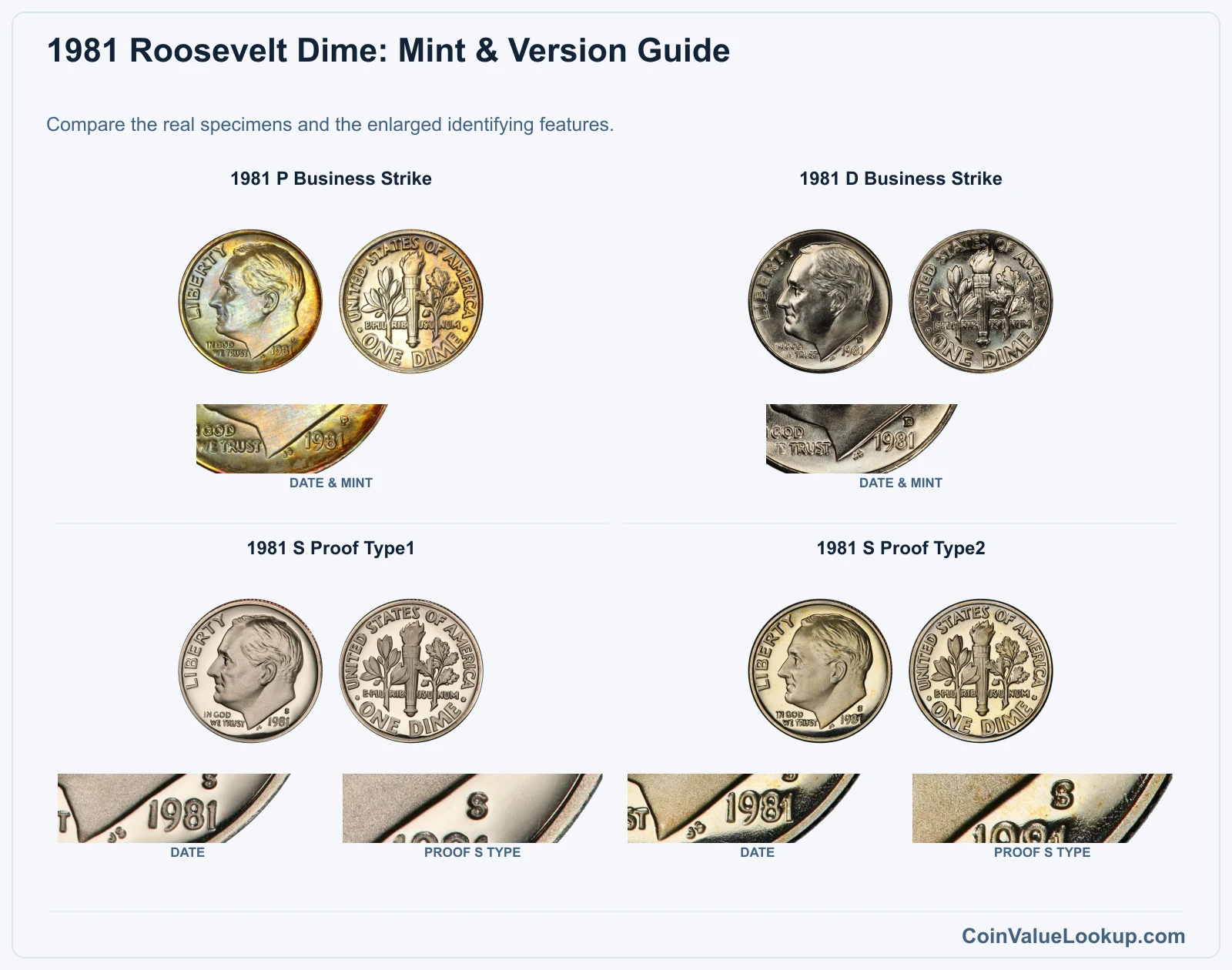
Look near the date on the obverse for the mint mark. A "P" means Philadelphia, a "D" means Denver, and an "S" means San Francisco proof.
If you have an S-mint proof, you need one more step.
The 1981 proof set comes in two mint mark styles. Type 1 uses an earlier, clear-S punch — the same style carried over from the 1979 Type 2 proof.
Type 2 has a flatter top on the S with distinct bulbous terminals at each end. Compare your coin directly to known 1981 Type 1 and Type 2 examples rather than borrowing 1979 descriptions, because the labels shifted between years and can cause confusion.
Step 2: Check Your 1981 Roosevelt Dime Grade
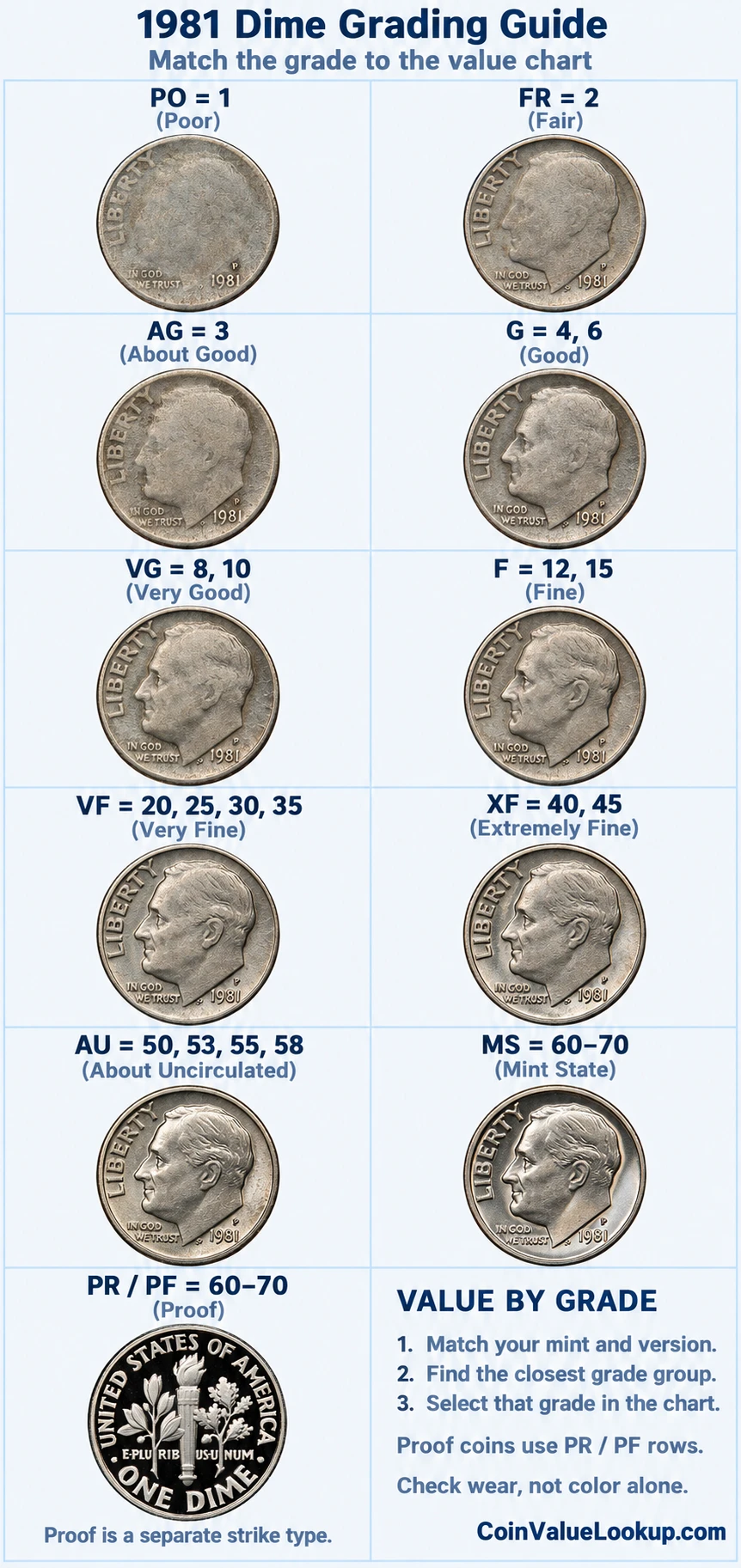
Check Roosevelt's cheekbone and jawline first — these are the high points that show wear earliest. Then flip the coin and examine the torch lines and leaf details on the reverse.
On a well-struck piece, both horizontal band pairs on the torch should be clearly separated; this is the Full Bands designation, which is a strike characteristic, not an error.
Original luster matters. A coin that still has its full mint bloom across the fields will grade higher than one that has been cleaned or has hairline scratches, even if the design detail looks sharp.
Use the comparison image to match your coin's wear pattern against known grade examples.
For proofs, look at the mirror fields and frosted devices. Cameo contrast — heavy frost against deep mirrors — is a separate designation from the numerical grade.
A PR 65 with strong cameo is a different animal than a PR 65 without it, so note the surface quality carefully.
Step 3: Check 1981 Roosevelt Dime Value by Mint and Version
1981 Roosevelt Dime — P Business Strike
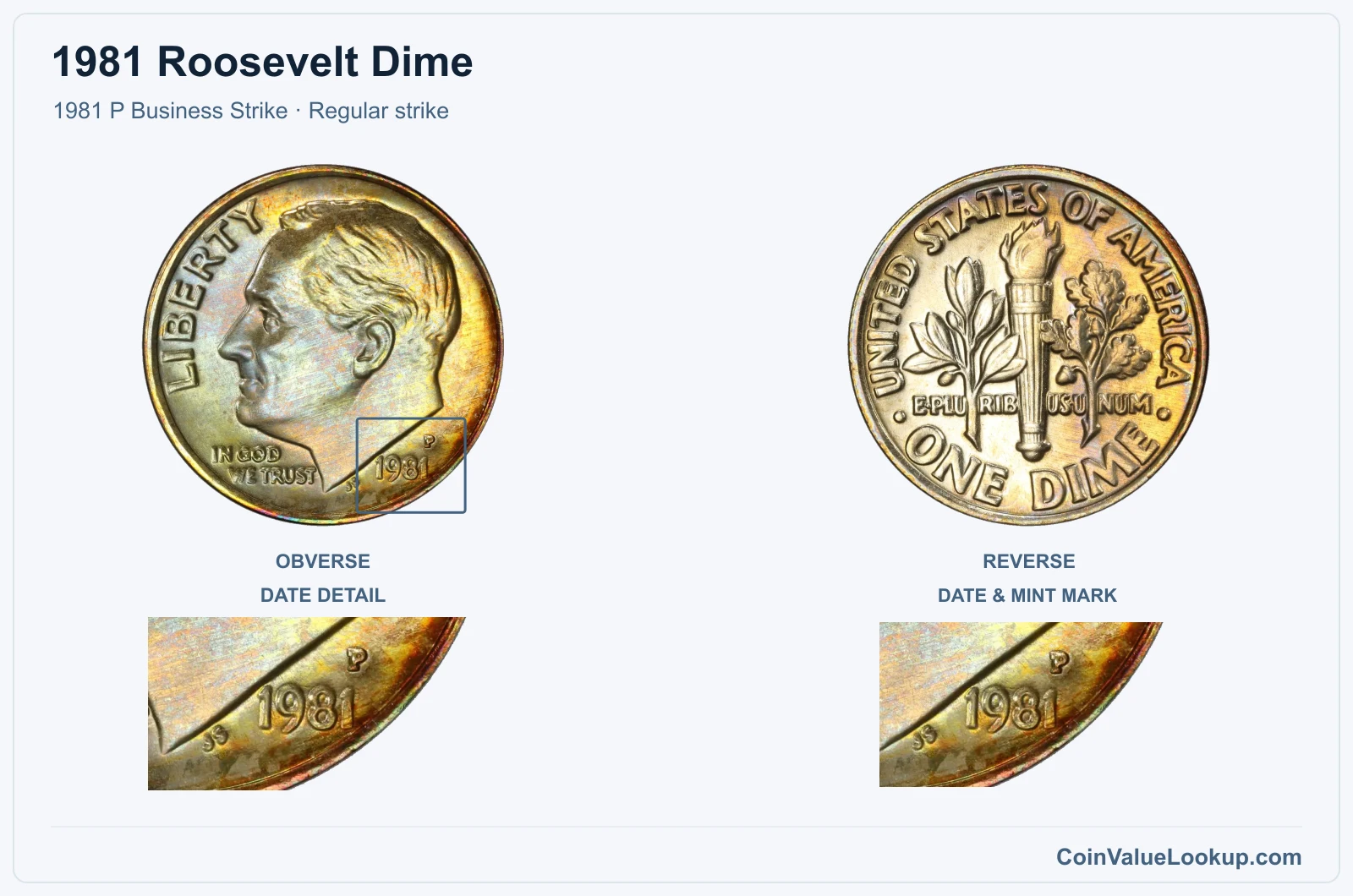
The 1981-P Roosevelt dime is a copper-nickel clad business strike from Philadelphia, weighing 2.27 grams. Billions were made, so circulated examples are worth face value.
In MS 65, the USA Coin Book guide lists it at $2.79.
Look for the small "P" mint mark on the obverse near the date. Coins with full original luster and cleanly separated torch bands are the ones worth setting aside.
Most pocket change specimens will show enough wear to keep them in the ten-cent column.
Range Grade
Price Auction Records Appraisal PO PO 1
—
Coin Identifier FR FR 2
—
Coin Identifier AG AG 3
—
Coin Identifier G G 4
—
Coin Identifier
G 6
—
Coin Identifier VG VG 8
—
Coin Identifier
VG 10
—
Coin Identifier F F 12
—
Coin Identifier
F 15
—
Coin Identifier VF VF 20
—
Coin Identifier
VF 25
—
Coin Identifier
VF 30
—
Coin Identifier
VF 35
—
Coin Identifier XF XF 40
—
Coin Identifier
XF 45
—
Coin Identifier AU AU 50
—
Coin Identifier
AU 53
—
Coin Identifier
AU 55
—
Coin Identifier
AU 58
—
Coin Identifier MS MS 60
—
Coin Identifier
MS 61
—
Coin Identifier
MS 62
Coin Identifier
MS 63
Coin Identifier
MS 64
Coin Identifier
MS 65
Coin Identifier
MS 66
Coin Identifier
MS 67
Coin Identifier
MS 68
—
Coin Identifier
MS 69
—
—
—
MS 70
—
—
—
1981 Roosevelt Dime — D Business Strike
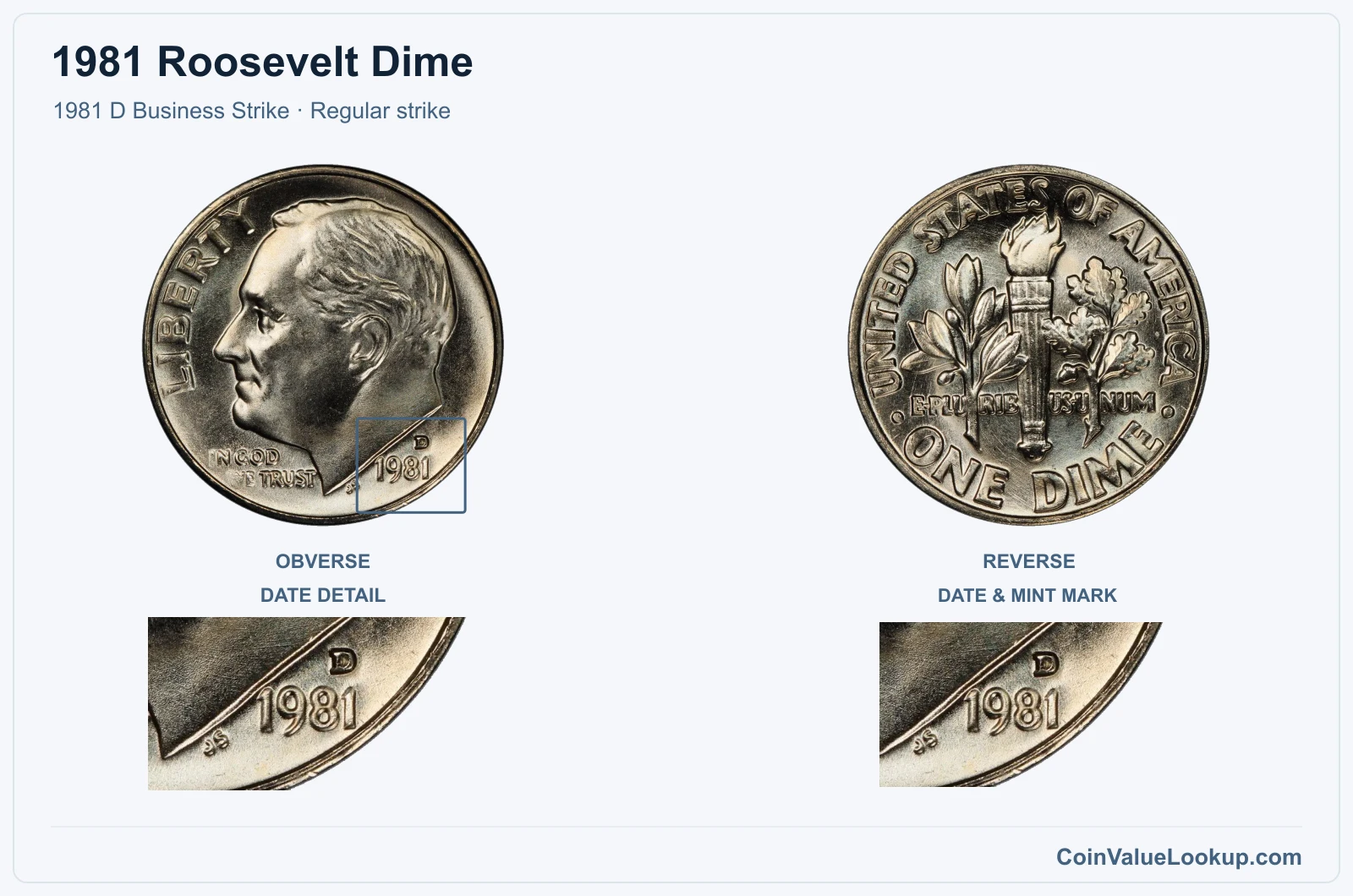
Denver's 1981-D dime shares the same copper-nickel clad composition and 2.27-gram weight as its Philadelphia sibling. Guide value at MS 65 is also $2.79 per USA Coin Book.
The "D" mint mark sits on the obverse near the date. Like the P-mint version, circulated pieces trade at face value.
Your best bet for a premium is an uncirculated example with strong luster and well-defined torch bands, pulled from an original bank roll rather than pocket change.
Range Grade
Price Auction Records Appraisal PO PO 1
—
Coin Identifier FR FR 2
—
Coin Identifier AG AG 3
—
Coin Identifier G G 4
—
Coin Identifier
G 6
—
Coin Identifier VG VG 8
—
Coin Identifier
VG 10
—
Coin Identifier F F 12
—
Coin Identifier
F 15
—
Coin Identifier VF VF 20
—
Coin Identifier
VF 25
—
Coin Identifier
VF 30
—
Coin Identifier
VF 35
—
Coin Identifier XF XF 40
—
Coin Identifier
XF 45
—
Coin Identifier AU AU 50
—
Coin Identifier
AU 53
—
Coin Identifier
AU 55
—
Coin Identifier
AU 58
—
Coin Identifier MS MS 60
—
Coin Identifier
MS 61
—
Coin Identifier
MS 62
—
Coin Identifier
MS 63
—
Coin Identifier
MS 64
—
Coin Identifier
MS 65
Coin Identifier
MS 66
Coin Identifier
MS 67
Coin Identifier
MS 68
—
Coin Identifier
MS 69
—
—
—
MS 70
—
—
—
1981 Roosevelt Dime — S Proof Type1
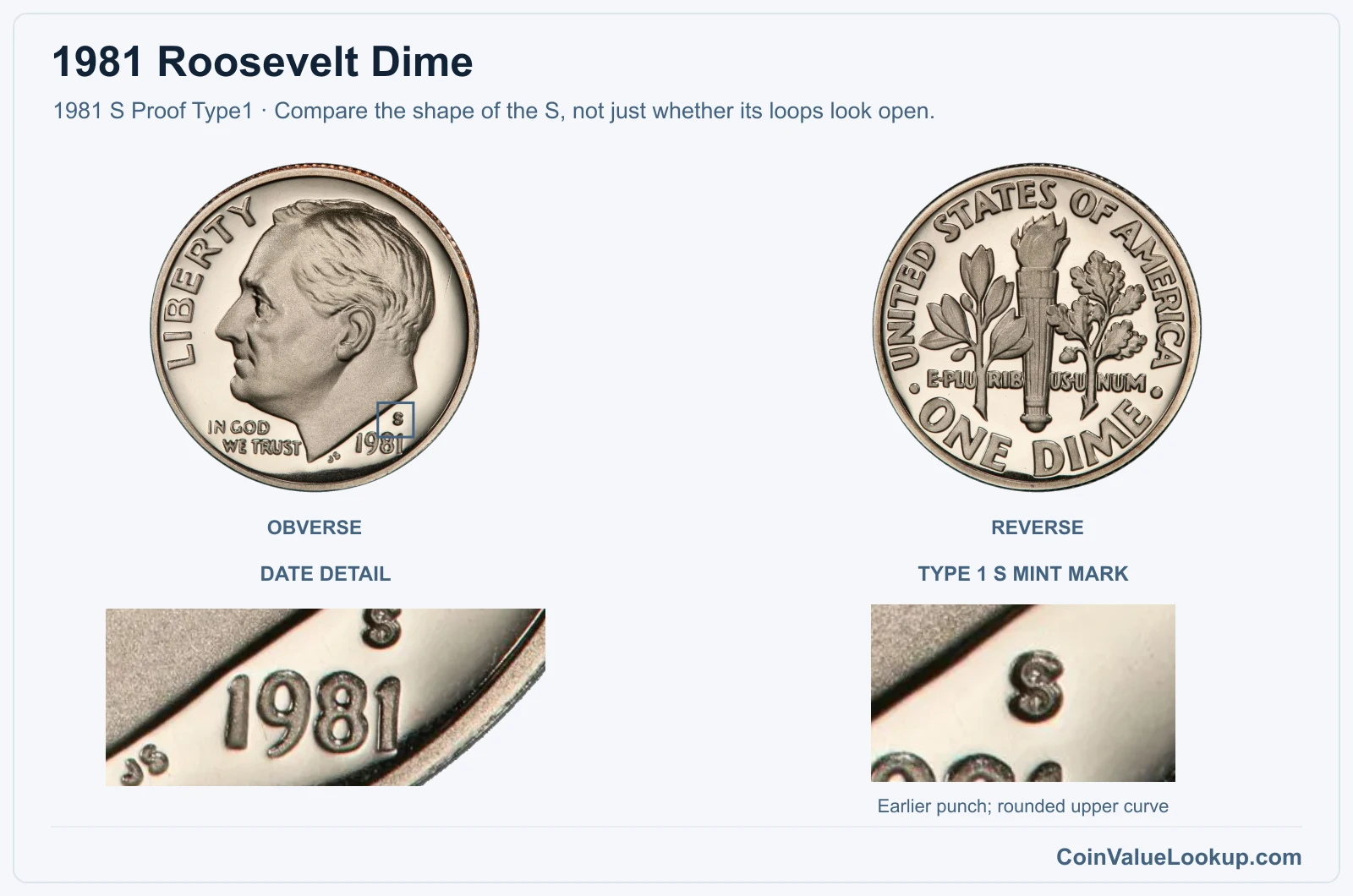
The 1981-S Type 1 proof was struck at San Francisco using the same clear-S punch that served as the 1979 Type 2. It is a copper-nickel clad proof, not silver, weighing 2.27 grams.
In PR 65, the USA Coin Book guide lists it at $3.08.
To confirm Type 1, examine the S mint mark carefully. It should appear crisp and rounded with relatively uniform curves — the same style collectors already knew from late-1979 proof sets.
If the top of the S looks noticeably flat with thick, bulbous ends, you have a Type 2 instead. Comparing both types side by side is the most reliable method.
Coin Value Lookup is a handy place to look up guides for Roosevelt dimes and other U.S. coins when you need a quick reference while sorting your collection.
Range Grade
Price Auction Records Appraisal PR PR 1
—
Coin Identifier
PR 2
—
Coin Identifier
PR 3
—
Coin Identifier
PR 4
—
Coin Identifier
PR 6
—
Coin Identifier
PR 8
—
Coin Identifier
PR 10
—
Coin Identifier
PR 12
—
Coin Identifier
PR 15
—
Coin Identifier
PR 20
—
Coin Identifier
PR 25
—
Coin Identifier
PR 30
—
Coin Identifier
PR 35
—
Coin Identifier
PR 40
—
Coin Identifier
PR 45
—
Coin Identifier
PR 50
—
Coin Identifier
PR 53
—
Coin Identifier
PR 55
—
Coin Identifier
PR 58
—
Coin Identifier
PR 60
—
Coin Identifier
PR 61
—
Coin Identifier
PR 62
—
Coin Identifier
PR 63
—
Coin Identifier
PR 64
—
Coin Identifier
PR 65
—
Coin Identifier
PR 66
—
Coin Identifier
PR 67
Coin Identifier
PR 68
Coin Identifier
PR 69
Coin Identifier
PR 70
Coin Identifier
1981 Roosevelt Dime — S Proof Type2
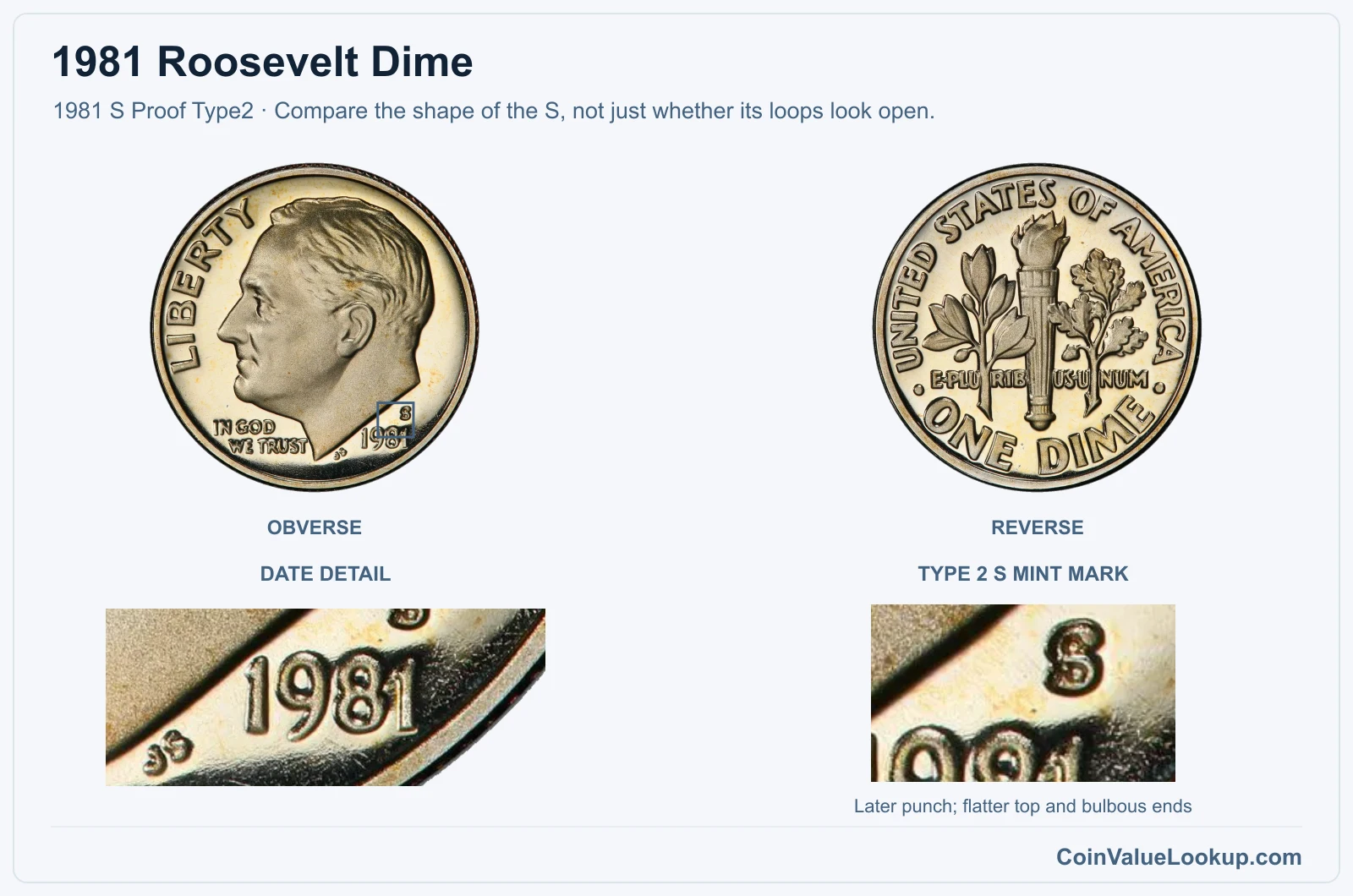
This is the variety that gets collectors reaching for their loupes. The 1981-S Type 2 proof dime features a new mint mark punch with a distinctly flat-topped S and bulbous serif terminals at both ends.
It is still copper-nickel clad at 2.27 grams — no silver.
USA Coin Book lists the Type 2 at $6.81 in PR 65, roughly double the Type 1 guide point. That premium exists because the Type 2 punch was introduced partway through 1981 proof production, making it less common in surviving proof sets.
Do not borrow dollar-coin rarity assumptions here. The dime has its own supply dynamics.
Confirm the mint mark shape against a known certified Type 2 specimen rather than guessing from photographs of other denominations.
Range Grade
Price Auction Records Appraisal PR PR 1
—
Coin Identifier
PR 2
—
Coin Identifier
PR 3
—
Coin Identifier
PR 4
—
Coin Identifier
PR 6
—
Coin Identifier
PR 8
—
Coin Identifier
PR 10
—
Coin Identifier
PR 12
—
Coin Identifier
PR 15
—
Coin Identifier
PR 20
—
Coin Identifier
PR 25
—
Coin Identifier
PR 30
—
Coin Identifier
PR 35
—
Coin Identifier
PR 40
—
Coin Identifier
PR 45
—
Coin Identifier
PR 50
—
Coin Identifier
PR 53
—
Coin Identifier
PR 55
—
Coin Identifier
PR 58
—
Coin Identifier
PR 60
—
Coin Identifier
PR 61
—
Coin Identifier
PR 62
—
Coin Identifier
PR 63
—
Coin Identifier
PR 64
—
Coin Identifier
PR 65
—
Coin Identifier
PR 66
—
Coin Identifier
PR 67
—
Coin Identifier
PR 68
Coin Identifier
PR 69
Coin Identifier
PR 70
Coin Identifier
1981 Roosevelt Dime Error List
1. 1981 Roosevelt Dime — Proof Double Strike with Indent
This error was documented on a 1981-S Type 1 proof dime. During a second strike, a blank planchet obstructed the obverse from roughly 7 o'clock to 11 o'clock, thinning and stretching Roosevelt's portrait upward in that zone.
The result is a coin showing a normal first-strike design alongside a smooth, indented area where the blank sat.
A certified NGC PR 68 Ultra Cameo example of this double strike with indent sold for $2,185 in January 2008. That is a single recorded result, not a guaranteed market price.
Do not confuse this with normal proof striking, which can leave aligned design traces, or with post-mint press damage. The key diagnostic is the smooth indented area combined with visible distortion of the portrait — both must be present and consistent with the minting process.
2. 1981 Roosevelt Dime — Improperly Annealed Planchet
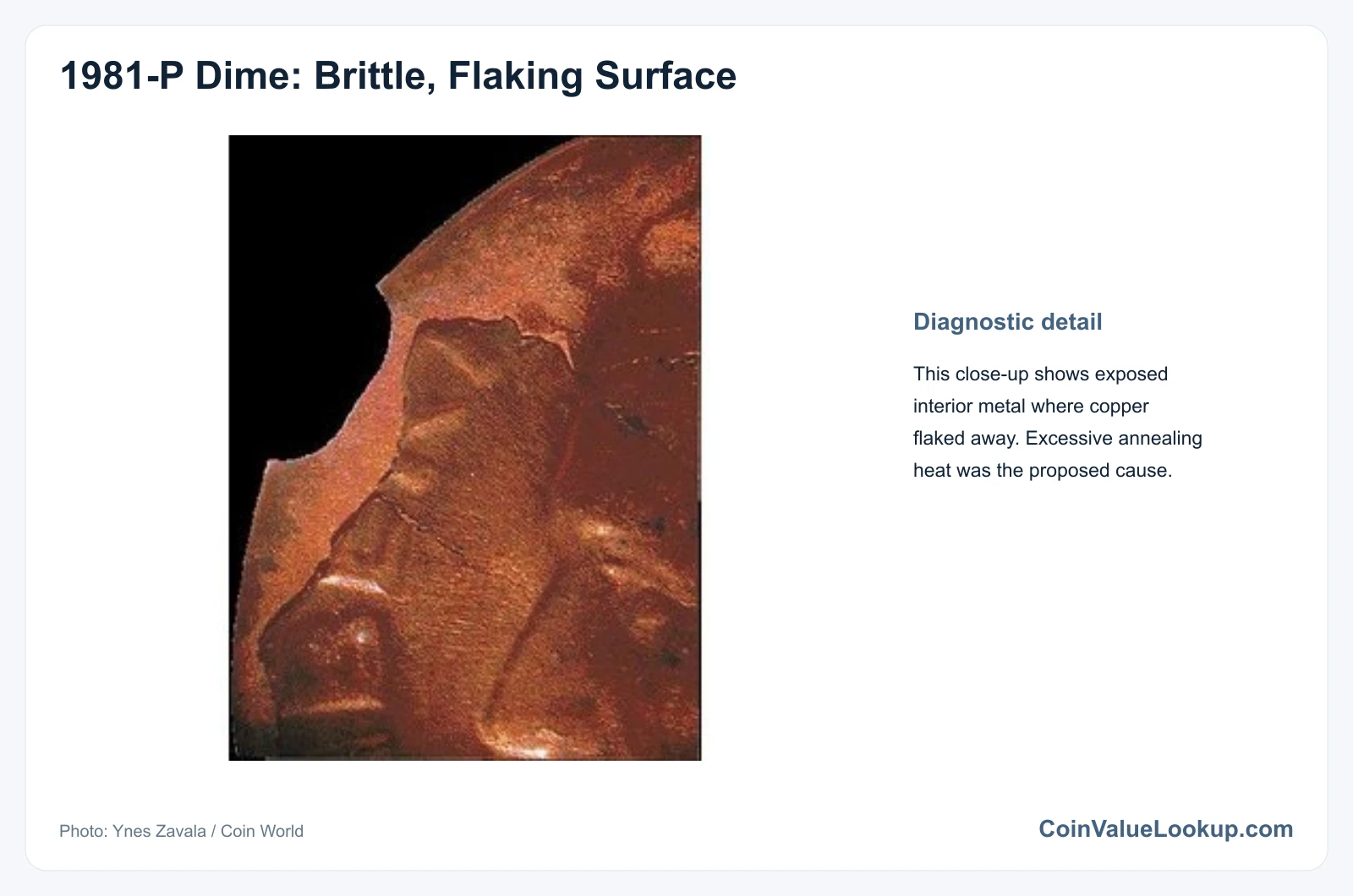
An improperly annealed planchet error has been documented on the 1981-P business strike. The planchet preparation step went wrong, producing an abnormal surface appearance and sometimes unusual coloring on the finished coin.
A PCGS MS 63 example sold at Heritage Auctions in March 2025 for $139. That is one confirmed sale, not a broad market range.
Here is the critical part: do not identify this error solely by a brownish or discolored surface. Toning, post-mint heat exposure, and chemical treatments can all mimic the look.
A certified comparison coin is your best reference. The composition should still be standard copper-nickel clad unless professional testing says otherwise.
When in doubt, have the coin examined by a third-party grading service.
3. 1981 Roosevelt Dime — Doubled Die Obverse
Doubled die obverse varieties have been reported for the 1981 dime. On a genuine doubled die, you will see consistent separation or notching on obverse letters or design elements — not a flat, shelf-like distortion.
Examine the coin under steady, angled light and compare each letter and numeral against a normal 1981 dime. True hub doubling will appear in the same direction and degree across multiple design elements.
The most common lookalike is machine doubling, which leaves flat, shelf-like displacement on device edges rather than rounded, separated serifs. Reflections and worn die contours can also fool you at first glance.
Value depends on the specific die, how visible the doubling is, and the coin's overall condition. Professional attribution is strongly recommended before assuming a premium.
4. 1981 Roosevelt Dime — Doubled Die Reverse
Doubled die reverse varieties have also been reported for 1981 Roosevelt dimes. The diagnostic is similar to the obverse version: look for consistent separation or notching on reverse legends and design contours such as the torch, branches, or lettering.
Compare the reverse closely with a normal coin under identical lighting and magnification. Genuine hub doubling affects multiple elements in a uniform direction.
Machine doubling, which is extremely common and worth little, produces flat shelf-like distortion instead of true separated contours.
Reflections and random surface damage round out the usual imposters. Condition, the specific die variety, and how obvious the doubling is all factor into any premium.
Have the coin attributed by a recognized grading service if you suspect a genuine doubled die.
5. 1981 Roosevelt Dime — Die Crack / Die Chip
Die cracks and die chips have been reported on 1981 dimes. These show up as raised lines or small raised blobs on the coin's surface — raised because the crack or chip is recessed into the die itself, so metal flows into the gap during striking.
A die crack running to the rim is just a crack. A larger break connected to the rim that displaces a chunk of the design is called a cud, and cuds tend to be more collectible.
Interior chips usually appear as small, raised lumps within letters or near design elements.
Do not confuse these with incuse scratches, corrosion spots, or foreign material stuck to the surface. Die cracks are raised and follow a consistent path.
Value depends on size, location, and the coin's grade — there is no single price for this category.
6. 1981 Roosevelt Dime — Missing Clad Layer
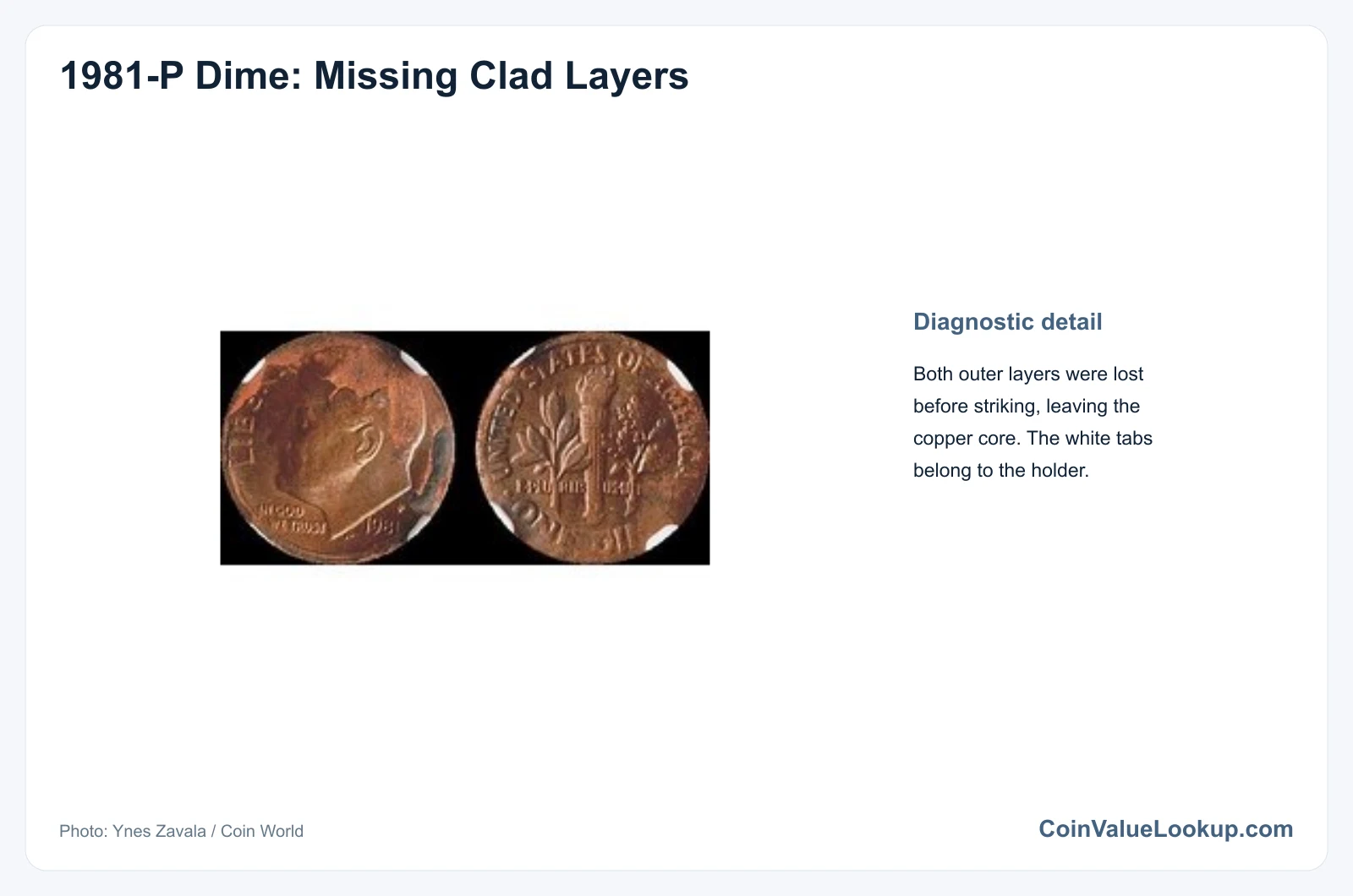
Missing clad layer errors have been reported for 1981 dimes. On a normal coin, copper-nickel clad covers both sides.
When one layer is missing, the exposed side may show a different color, and the coin's weight will be noticeably lighter than the standard 2.27 grams.
Check the edge of the coin. A normal clad dime shows a visible sandwich of layers.
A missing-clad example will look different on the affected side and at the edge. Weigh the coin if possible — a meaningful weight difference supports the diagnosis.
Lookalikes include toned coins, plated coins, corroded surfaces, and coins where someone has chemically or mechanically removed surface metal after minting. Value depends on how complete the remaining design is, which side is affected, and the coin's overall condition.
7. 1981 Roosevelt Dime — Clashed Dies
Die clash errors have been reported on 1981 Roosevelt dimes. A die clash happens when the obverse and reverse dies strike each other without a planchet between them, transferring faint ghost images of the opposite design onto each die face.
On the struck coin, you might see traces of the torch or branches ghosted onto the obverse field, or parts of Roosevelt's portrait faintly visible on the reverse. These transferred elements will line up with where the opposing die features would naturally fall.
Do not mistake scratches, random raised lines, or surface contamination for a clash. True clash marks align with the expected opposing design and appear on coins struck from the same damaged die pair.
Value depends on the strength of the clash, coin grade, and collector demand for the specific variety.
8. 1981 Roosevelt Dime — Off-Center Strike
Off-center strikes have been reported for 1981 dimes. This happens when the planchet is not properly seated between the dies, so the design is displaced to one side, leaving an unstruck crescent of blank metal.
The key collectibility factor is the percentage off center and whether the date is still visible. A 5% off-center coin is a minor curiosity.
A 10–50% off-center coin with a readable date tends to draw real collector interest.
Do not confuse an off-center strike with a clipped planchet, which removes a curved section but still centers the design, or with post-mint damage that flattened one side. The displaced design and blank crescent should be consistent and symmetrical.
Value depends on the degree of offset, date visibility, and overall condition.
9. 1981 Roosevelt Dime — Repunched Mintmark
Repunched mint mark varieties have been reported on 1981 dimes. Before mint marks were placed on the die by hub, each working die received its mint mark from a hand-held punch — and sometimes the punch landed slightly off on the first try, leaving remnants of a second position.
Inspect the P or D mint mark under magnification and compare it with a normal example at the same angle and lighting. You are looking for traces of a second impression — a shadow, notch, or partial letter near the primary mark.
Machine doubling, die chips, and corrosion around the mint mark can all mimic the appearance. True repunching shows a distinctly separate positioning rather than flat mechanical spread.
Value varies with the specific variety, visibility, and coin condition.
10. 1981 Roosevelt Dime — Broadstrike
Broadstrike errors have been reported for the 1981 dime. A broadstrike occurs when the coin is struck without the retaining collar that normally confines the metal and forms the reeded edge.
The result is a coin that spreads outward, appearing slightly larger than normal with a smooth or misshapen rim.
The full design is usually present but may look slightly stretched toward the edges. Check the edge profile — a broadstruck dime will lack the normal reeding.
This is different from an off-center strike, where the design is displaced and part of the planchet is blank. It is also different from a coin that was flattened after leaving the mint.
Value depends on how dramatic the spread is and the coin's condition. Professional authentication helps confirm the error is genuine.
11. 1981 Roosevelt Dime — Wrong Planchet / Off-Metal Strike
Wrong planchet or off-metal strike errors have been reported for 1981 dimes. This occurs when a planchet intended for a different denomination or composition accidentally enters the dime press and receives the Roosevelt dime design.
The most obvious clue is a coin that looks like a dime but feels wrong — different weight, different diameter, or an unusual edge. Compare the suspect coin's measured weight and size against the standard 2.27-gram, 17.9-mm clad dime specification.
Lookalikes include plated coins, acid-thinned coins, and deliberate alterations. Corrosion can also change a coin's appearance and weight enough to create confusion.
Do not assume a specific wrong-planchet denomination without professional verification. These errors are rare, and value depends heavily on which planchet was used and the coin's overall condition.