1997 Roosevelt Dime Coin Value: How Much Is It Worth?
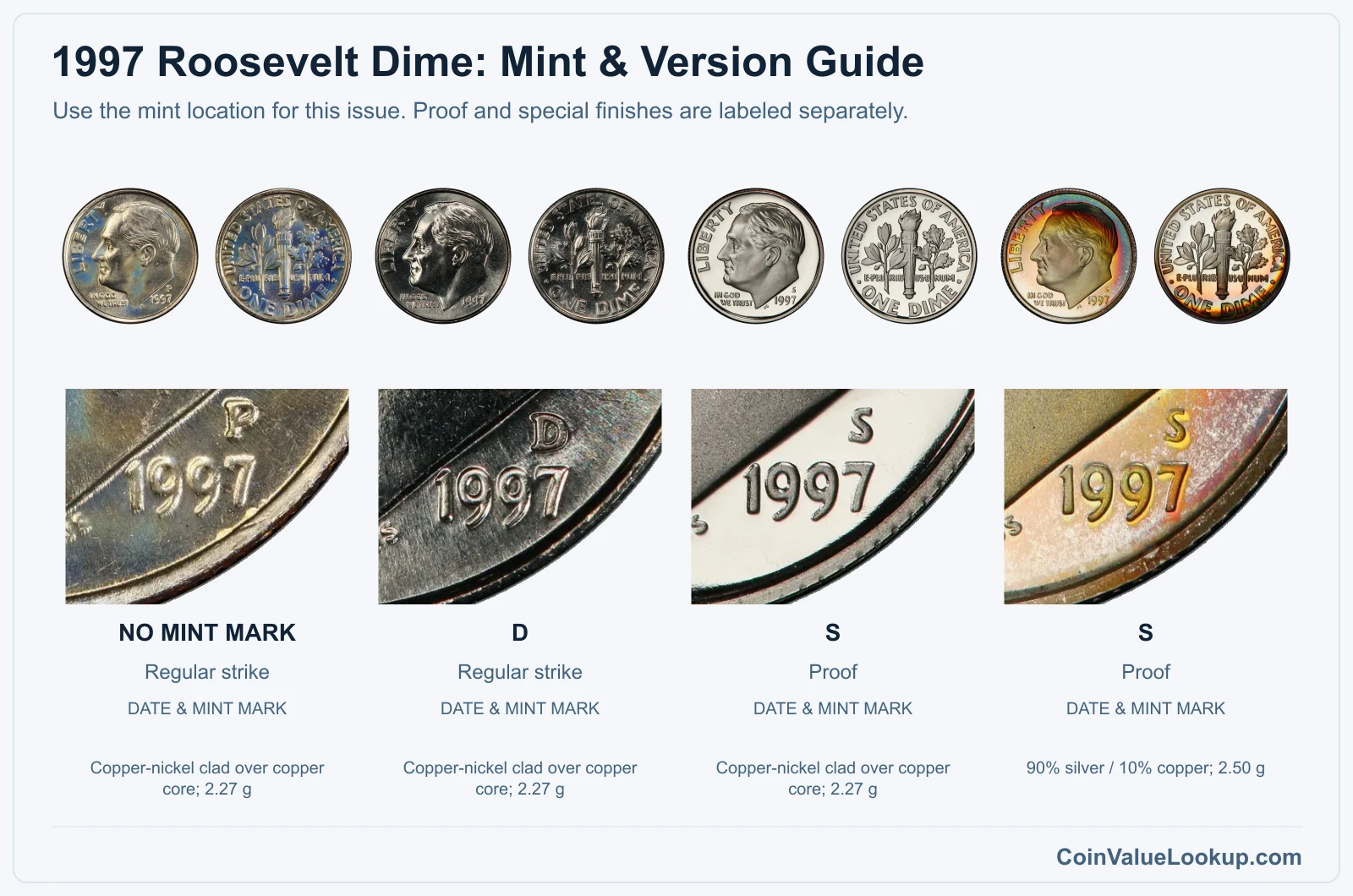
Most 1997 Roosevelt dimes pulled from pocket change are worth face value — ten cents, no more. In mint state, a USA Coin Book guide lists the P or D at about $2.50 in MS65.
The S clad proof sits around $10 in PR65, while the S silver proof reaches roughly $18 in PR65. Special finishes, higher grades, and authenticated errors can push values well beyond those guide figures, so the details matter.
Fast Way to Identify Your 1997 Roosevelt Dime
The quickest way to start figuring out what you have is to snap a clear photo of both sides of your coin and upload them here. This gives you a preliminary identification of the mint, finish, and general condition.
It is not a substitute for professional authentication or grading, but it points you in the right direction before you invest more time or money.
1997 Roosevelt Dime Value
Upload both sides of your 1997 Roosevelt Dime.
Front Obverse
Upload photo
Back Reverse
Upload photo
Which 1997 Roosevelt Dime Versions Are Worth Money?
- 1997-P or 1997-D in uncirculated condition with strong torch-band detail can exceed the ten-cent baseline.
- 1997-S clad proof with clean mirrored fields and sharp cameo contrast — guide value around $10 at PR65.
- 1997-S silver proof confirmed by weight (2.50 g) and edge color — guide value around $18 at PR65.
- Double Strike with Off-Center Second Strike on a 1997-P: one certified MS64 sold for $138 in December 2020.
- Struck Through Capped Die on a 1997-P: one certified MS60 sold for $49 in October 2022.
- Partial Collar Strike documented on a 1997-S silver proof — value depends on authentication, condition, and error severity.
Step 1: Identify Your 1997 Roosevelt Dime Mint Mark and Version
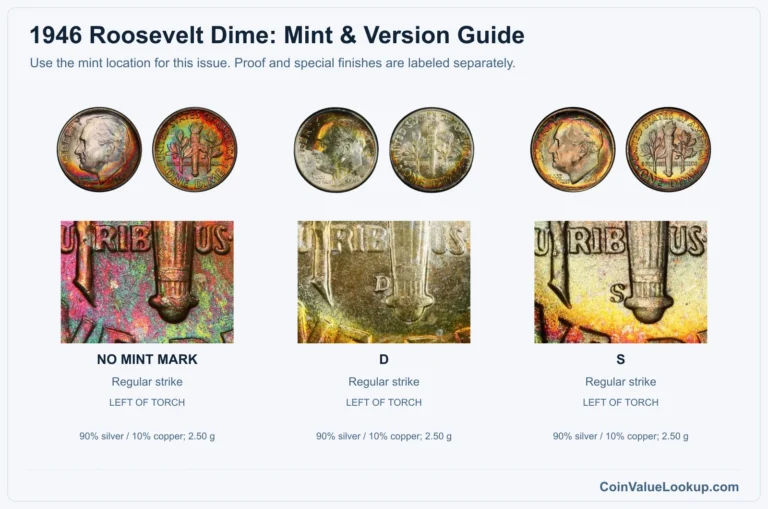
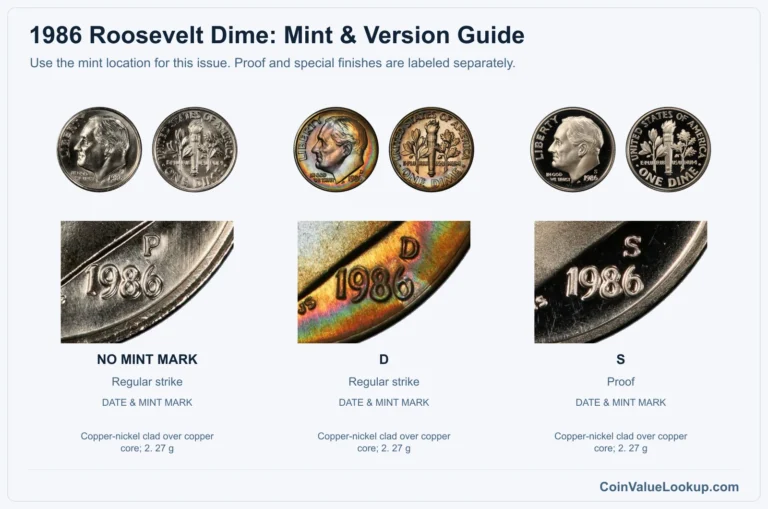
Every 1997 Roosevelt dime shares the same basic design: Franklin Roosevelt's portrait on the obverse and a torch flanked by branches on the reverse. The date appears on the obverse, and the mintmark — P, D, or S — sits just above it.
Philadelphia coins carry a P, Denver coins a D, and San Francisco coins an S. That much is straightforward.
The tricky part is separating the two S-mint versions.
Both the clad proof and the silver proof have an S mintmark, an identical design, and the same mirror-finish appearance. The mintmark alone tells you nothing about the metal.
A normal clad dime weighs 2.27 grams; the silver proof weighs 2.50 grams. That difference is small but measurable on a decent scale.
Edge color helps too. A clad coin typically shows a visible copper-toned stripe along the edge, while a silver proof edge is uniformly silver-gray.
Original government packaging, if you still have it, is the simplest confirmation. When the metal remains ambiguous after these checks, professional authentication is the way to settle it.
Step 2: Check Your 1997 Roosevelt Dime Grade
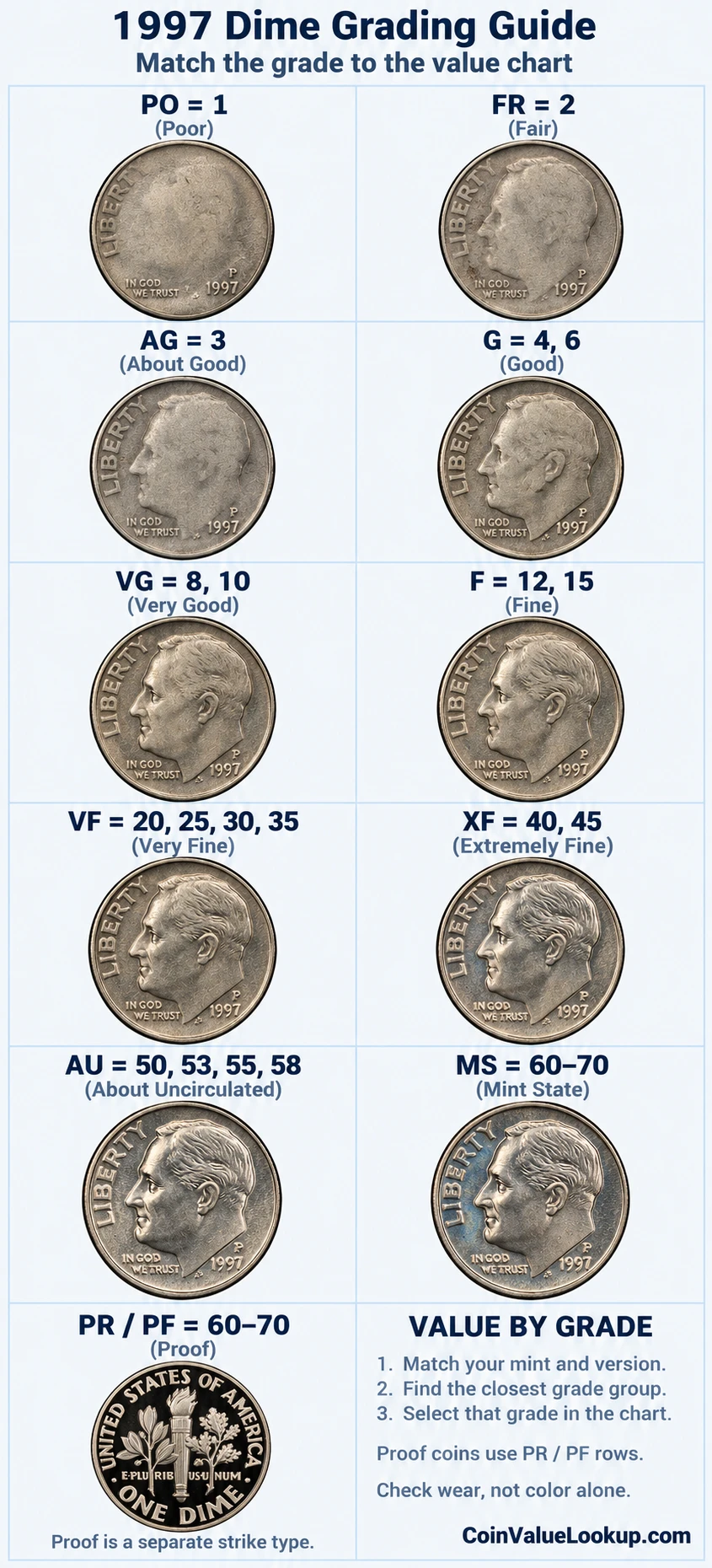
Start at the high points: Roosevelt's cheekbone, jawline, and the hair directly above his ear. On the reverse, check the torch lines and the leaf details.
These are the first areas to lose definition as a coin circulates.
A coin that still has full original luster across both sides, with no wear on those high points, is in mint state territory. Don't confuse brightness with grade — a cleaned coin can look shiny but will show hairlines under magnification that drag the grade down.
For proofs, look at the mirrored fields for haze, hairlines, or fingerprints. Cameo contrast — where the devices appear frosty against mirror fields — is a separate characteristic from the numeric grade.
Scratches, corrosion, and environmental damage all reduce a coin's appeal regardless of the underlying wear level.
The comparison image is useful here. Hold your coin next to it and match the detail on the cheek and torch.
If your coin's high-point detail is softer, it has seen more wear. "Full Bands" is a designation describing fully separated horizontal torch bands — a strike quality feature, not an error.
Step 3: Check 1997 Roosevelt Dime Value by Mint and Version
1997 Roosevelt Dime — P Business Strike
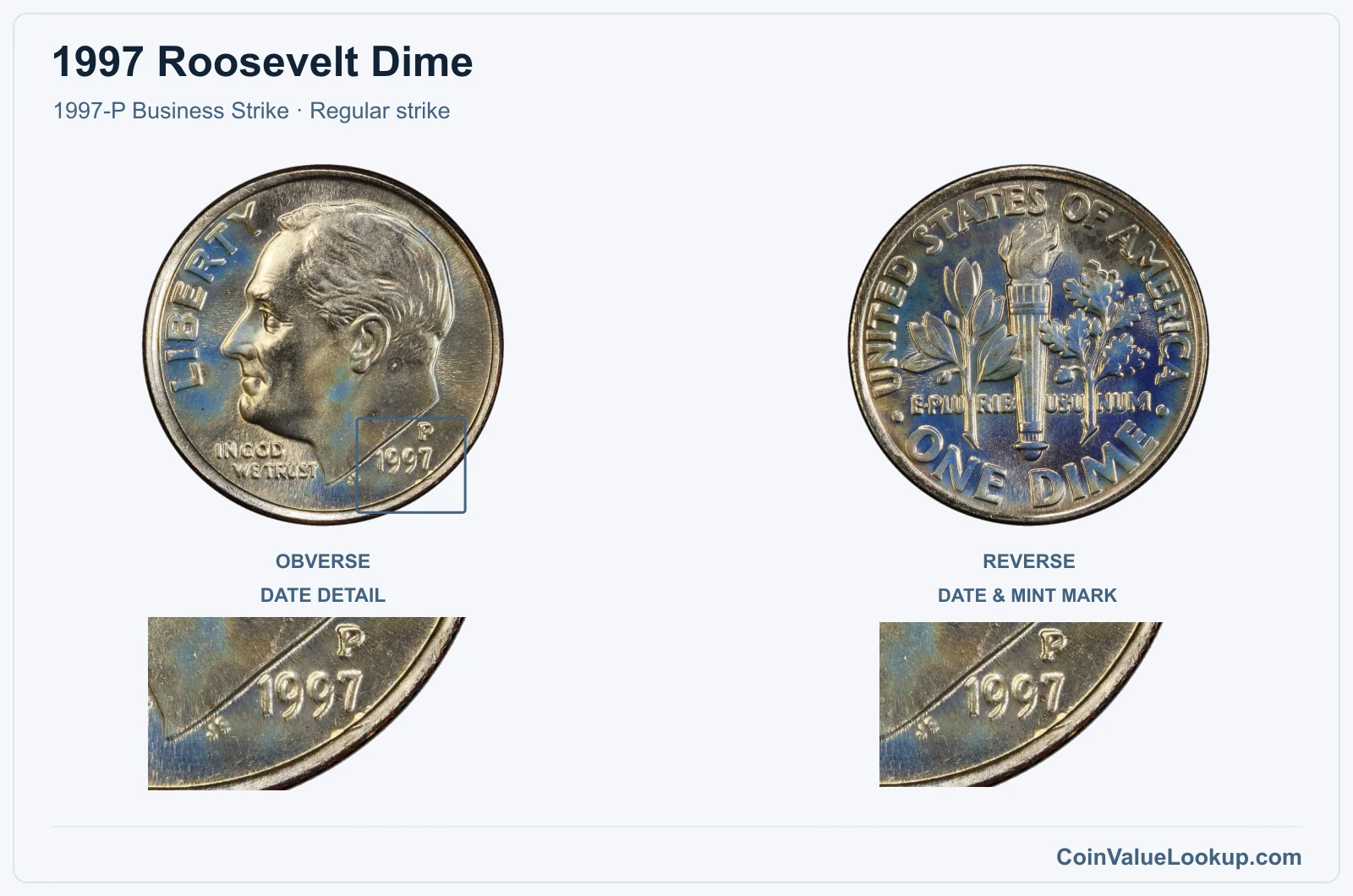
The 1997-P is a copper-nickel clad business strike from Philadelphia, weighing 2.27 grams. Look for the P mintmark on the obverse near the date.
In typical circulated condition these are face-value coins. The USA Coin Book guide places an MS65 example at about $2.50.
Coins with fully separated horizontal torch bands on the reverse can carry a premium when graded with that designation. A sharp, lustrous example with no bag marks is what you want to look for if you are cherry-picking rolls.
Range Grade
Price Auction Records Appraisal PO PO 1
—
Coin Identifier FR FR 2
—
Coin Identifier AG AG 3
—
Coin Identifier G G 4
—
Coin Identifier
G 6
—
Coin Identifier VG VG 8
—
Coin Identifier
VG 10
—
Coin Identifier F F 12
—
Coin Identifier
F 15
—
Coin Identifier VF VF 20
—
Coin Identifier
VF 25
—
Coin Identifier
VF 30
—
Coin Identifier
VF 35
—
Coin Identifier XF XF 40
—
Coin Identifier
XF 45
—
Coin Identifier AU AU 50
—
Coin Identifier
AU 53
—
Coin Identifier
AU 55
—
Coin Identifier
AU 58
—
Coin Identifier MS MS 60
—
Coin Identifier
MS 61
—
Coin Identifier
MS 62
—
Coin Identifier
MS 63
—
Coin Identifier
MS 64
Coin Identifier
MS 65
Coin Identifier
MS 66
—
Coin Identifier
MS 67
Coin Identifier
MS 68
Coin Identifier
MS 69
—
—
—
MS 70
—
—
—
1997 Roosevelt Dime — D Business Strike
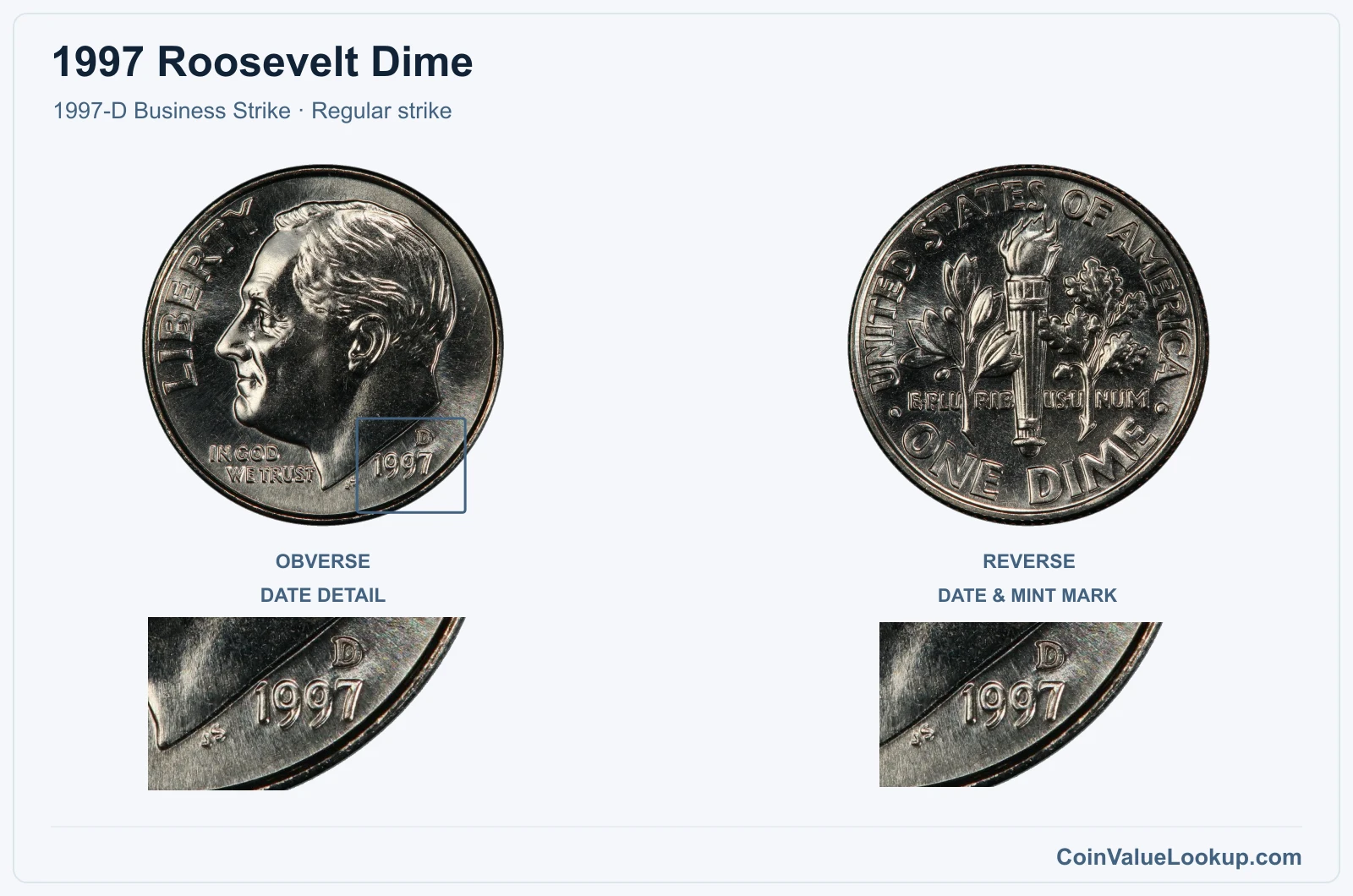
Denver's 1997-D is the same copper-nickel clad composition and 2.27-gram weight as the P. Identify it by the D mintmark near the date on the obverse.
The USA Coin Book guide also lists MS65 at about $2.50.
Circulated pieces are worth ten cents. The value difference shows up only in higher mint-state grades with clean surfaces and strong strike detail.
As with the P, torch-band sharpness is worth checking under magnification before dismissing the coin.
Coin Value Lookup is a good starting point when you want to compare your 1997-D against other Roosevelt dime years and mints. It can help you quickly look up guide values across the series.
Range Grade
Price Auction Records Appraisal PO PO 1
—
Coin Identifier FR FR 2
—
Coin Identifier AG AG 3
—
Coin Identifier G G 4
—
Coin Identifier
G 6
—
Coin Identifier VG VG 8
—
Coin Identifier
VG 10
—
Coin Identifier F F 12
—
Coin Identifier
F 15
—
Coin Identifier VF VF 20
—
Coin Identifier
VF 25
—
Coin Identifier
VF 30
—
Coin Identifier
VF 35
—
Coin Identifier XF XF 40
—
Coin Identifier
XF 45
—
Coin Identifier AU AU 50
—
Coin Identifier
AU 53
—
Coin Identifier
AU 55
—
Coin Identifier
AU 58
—
Coin Identifier MS MS 60
—
Coin Identifier
MS 61
—
Coin Identifier
MS 62
—
Coin Identifier
MS 63
—
Coin Identifier
MS 64
—
Coin Identifier
MS 65
Coin Identifier
MS 66
—
Coin Identifier
MS 67
Coin Identifier
MS 68
Coin Identifier
MS 69
—
—
—
MS 70
—
—
—
1997 Roosevelt Dime — S Clad Proof
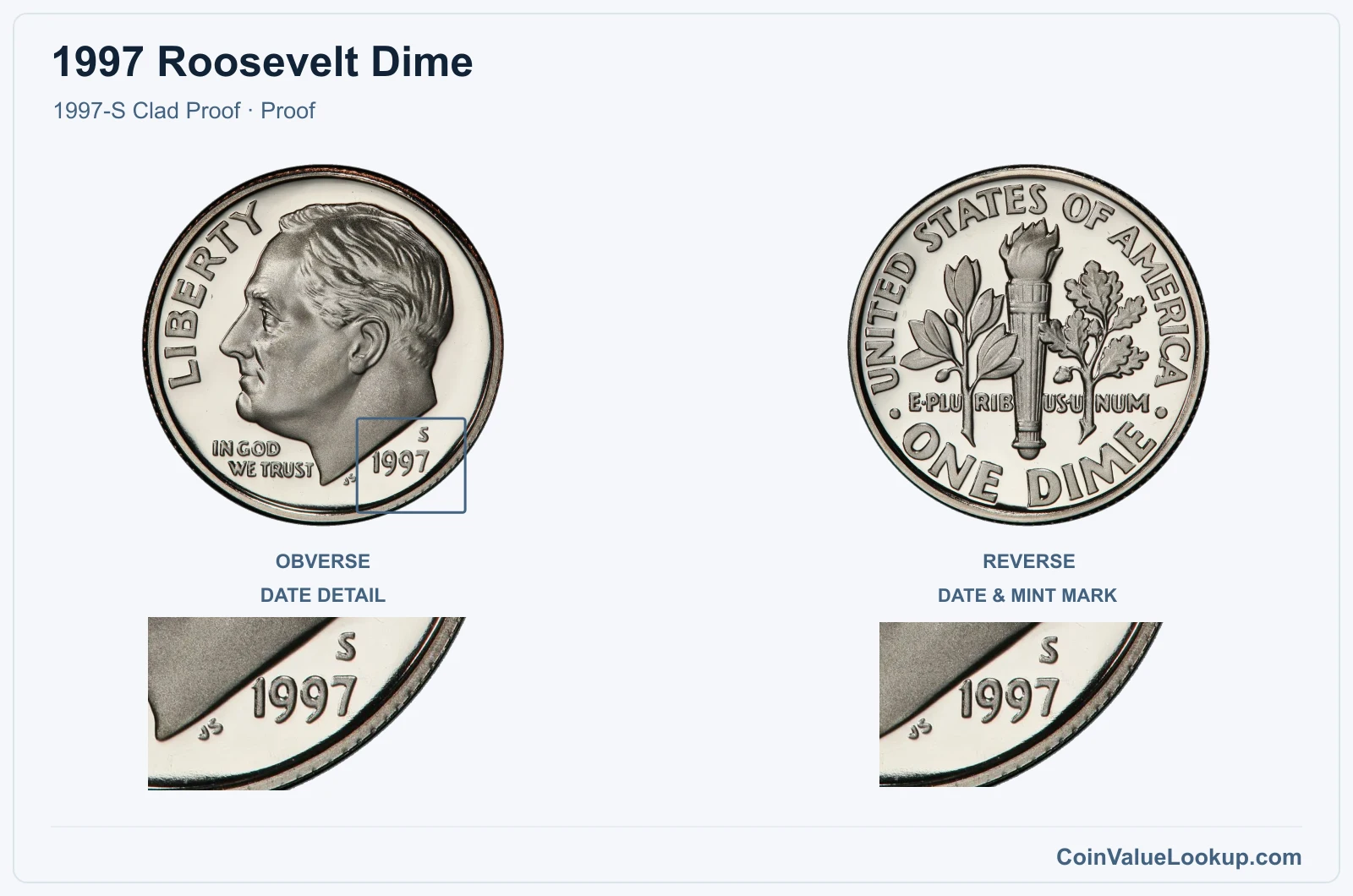
The 1997-S clad proof was struck at San Francisco on a copper-nickel clad planchet weighing 2.27 grams. It has the S mintmark and mirror-finish fields produced by specially prepared dies.
The USA Coin Book guide places a PR65 at about $10.
This is the version most often confused with its silver sibling. Both carry an S, both look like proofs, and from the obverse they are identical.
Check the edge for a copper-toned stripe — clad pieces usually show one. Weight and original packaging are your best allies when the edge is inconclusive.
Use the correct mint, metal, and finish when comparing prices, because the clad and silver proofs trade at different levels.
Range Grade
Price Auction Records Appraisal PR PR 1
—
Coin Identifier
PR 2
—
Coin Identifier
PR 3
—
Coin Identifier
PR 4
—
Coin Identifier
PR 6
—
Coin Identifier
PR 8
—
Coin Identifier
PR 10
—
Coin Identifier
PR 12
—
Coin Identifier
PR 15
—
Coin Identifier
PR 20
—
Coin Identifier
PR 25
—
Coin Identifier
PR 30
—
Coin Identifier
PR 35
—
Coin Identifier
PR 40
—
Coin Identifier
PR 45
—
Coin Identifier
PR 50
—
Coin Identifier
PR 53
—
Coin Identifier
PR 55
—
Coin Identifier
PR 58
—
Coin Identifier
PR 60
—
Coin Identifier
PR 61
—
Coin Identifier
PR 62
—
Coin Identifier
PR 63
—
Coin Identifier
PR 64
—
Coin Identifier
PR 65
—
Coin Identifier
PR 66
—
Coin Identifier
PR 67
—
Coin Identifier
PR 68
—
Coin Identifier
PR 69
Coin Identifier
PR 70
Coin Identifier
1997 Roosevelt Dime — S Silver Proof
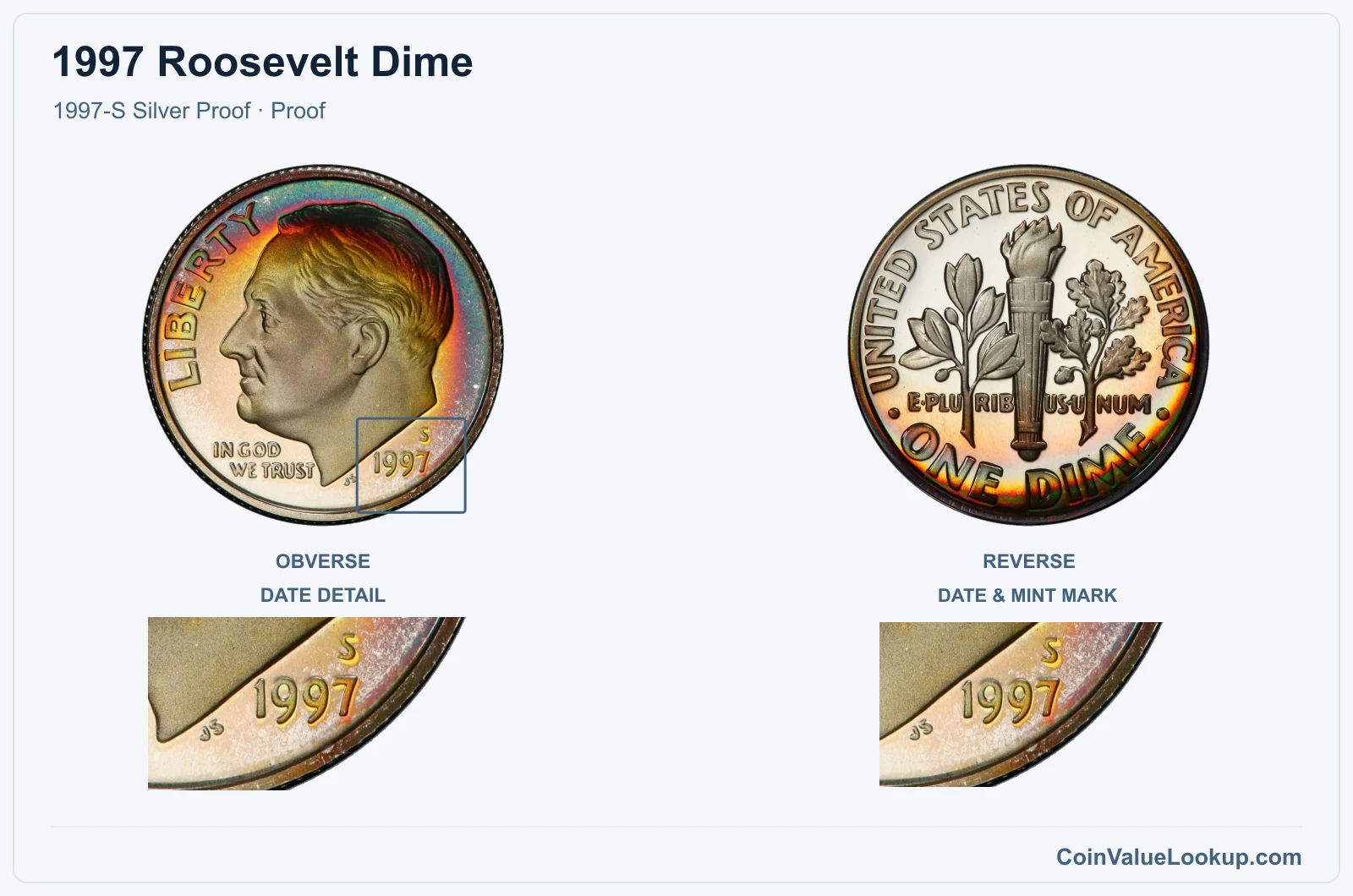
The 1997-S silver proof is struck on a 90% silver, 10% copper planchet weighing 2.50 grams. It shares the S mintmark and proof finish with the clad version, so visual inspection of the design alone will not separate them.
The USA Coin Book guide lists PR65 at about $18, and that figure can shift because of silver content.
Edge color is your first clue: silver proofs show a uniformly silver-gray edge with no copper stripe. A precise scale reading of 2.50 grams versus 2.27 grams confirms it.
If the coin came from a Silver Proof Set in its original government packaging, you already have your answer. When none of these checks are conclusive, professional authentication resolves the question.
Range Grade
Price Auction Records Appraisal PR PR 1
—
Coin Identifier
PR 2
—
Coin Identifier
PR 3
—
Coin Identifier
PR 4
—
Coin Identifier
PR 6
—
Coin Identifier
PR 8
—
Coin Identifier
PR 10
—
Coin Identifier
PR 12
—
Coin Identifier
PR 15
—
Coin Identifier
PR 20
—
Coin Identifier
PR 25
—
Coin Identifier
PR 30
—
Coin Identifier
PR 35
—
Coin Identifier
PR 40
—
Coin Identifier
PR 45
—
Coin Identifier
PR 50
—
Coin Identifier
PR 53
—
Coin Identifier
PR 55
—
Coin Identifier
PR 58
—
Coin Identifier
PR 60
—
Coin Identifier
PR 61
—
Coin Identifier
PR 62
—
Coin Identifier
PR 63
—
Coin Identifier
PR 64
—
Coin Identifier
PR 65
—
Coin Identifier
PR 66
—
Coin Identifier
PR 67
—
Coin Identifier
PR 68
—
Coin Identifier
PR 69
Coin Identifier
PR 70
Coin Identifier
1997 Roosevelt Dime Error List
1. 1997 Roosevelt Dime — Double Strike with Off-Center Second Strike
A double-struck 1997-P dime shows two complete impressions of the design because the coin failed to eject from the press between strikes. The second impression is displaced from the first, creating an obvious overlapping effect — not just slightly fuzzy lettering.
Look for the full first-strike design still visible beneath or beside a shifted second strike, with the date and P mintmark present. This is dramatically different from a doubled die or machine doubling, which produce minor doubling on individual letters or design elements without moving the entire image.
One NGC-certified MS64 example sold for $138 at Heritage Auctions in December 2020. That is a single recorded sale, not a guaranteed market value — condition, the degree of off-center displacement, and the certifier all influence what a given piece brings.
2. 1997 Roosevelt Dime — Struck Through Capped Die
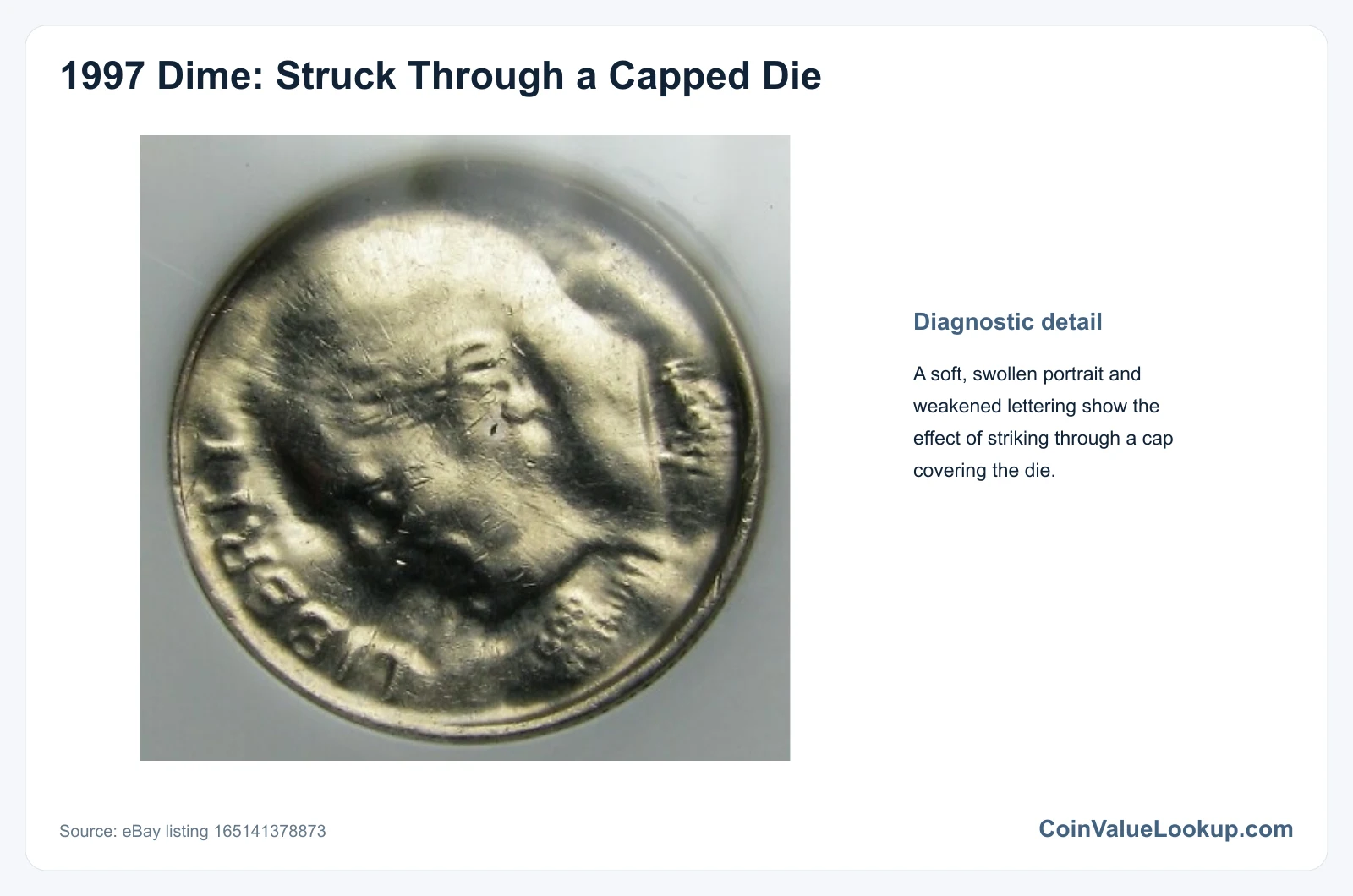
A struck-through-capped-die 1997-P dime occurs when a previously struck coin sticks to the die face and acts as a barrier during subsequent strikes. The result is a muffled, distorted impression on the obstructed side — soft or ghost-like design elements — while the opposite side may appear relatively normal.
Do not confuse this with heavy circulation wear, sanding, or simply weak letters from a tired die. A capped-die strike distorts the design in a specific, uniform way that differs from random damage.
Authentication by a grading service confirms the mechanism.
One ANACS-certified MS60 specimen sold for $49 at Heritage Auctions in October 2022. As with any error coin, the sale price of one piece does not establish a range for all examples.
3. 1997 Roosevelt Dime — Partial Collar Strike
A partial collar strike on a 1997-S silver proof dime means the planchet was not fully seated in the collar during striking. Part of the rim forms normally while the rest expands outward, leaving a visible step or ledge along the edge.
The proof surfaces — mirrored fields, frosted devices — should remain intact on a genuine example.
Confirm this is indeed a silver S-mint proof by checking edge color and weight (2.50 grams for silver). A normal proof rim is uniform all the way around; a broadstrike lacks any collar impression; post-mint edge damage tends to look irregular and shows tool marks.
No adopted price range is available for this error. Value depends on the individual coin's condition, the severity of the misalignment, and authentication by a recognized grading service.
4. 1997 Roosevelt Dime — Clipped Planchet
A clipped planchet error on a 1997 dime means the blank was incompletely punched from the metal strip before striking. You will see a missing curved, straight, or irregular section along the edge where metal simply is not there.
Often, the area directly opposite the clip shows design weakness because the metal could not flow fully during the strike.
Compare the missing section to the rest of the edge. A genuine clip has a natural metal-flow texture at its boundary, while a filed notch or deliberate cut leaves tool marks and a sharp, unnatural edge.
Corrosion can eat away at an edge too, but it usually leaves pitting rather than a clean absence of metal.
No specific price data is available for this variety. Condition, the size and visibility of the clip, and professional authentication all affect what a clipped 1997 dime might bring.
5. 1997 Roosevelt Dime — Broadstrike
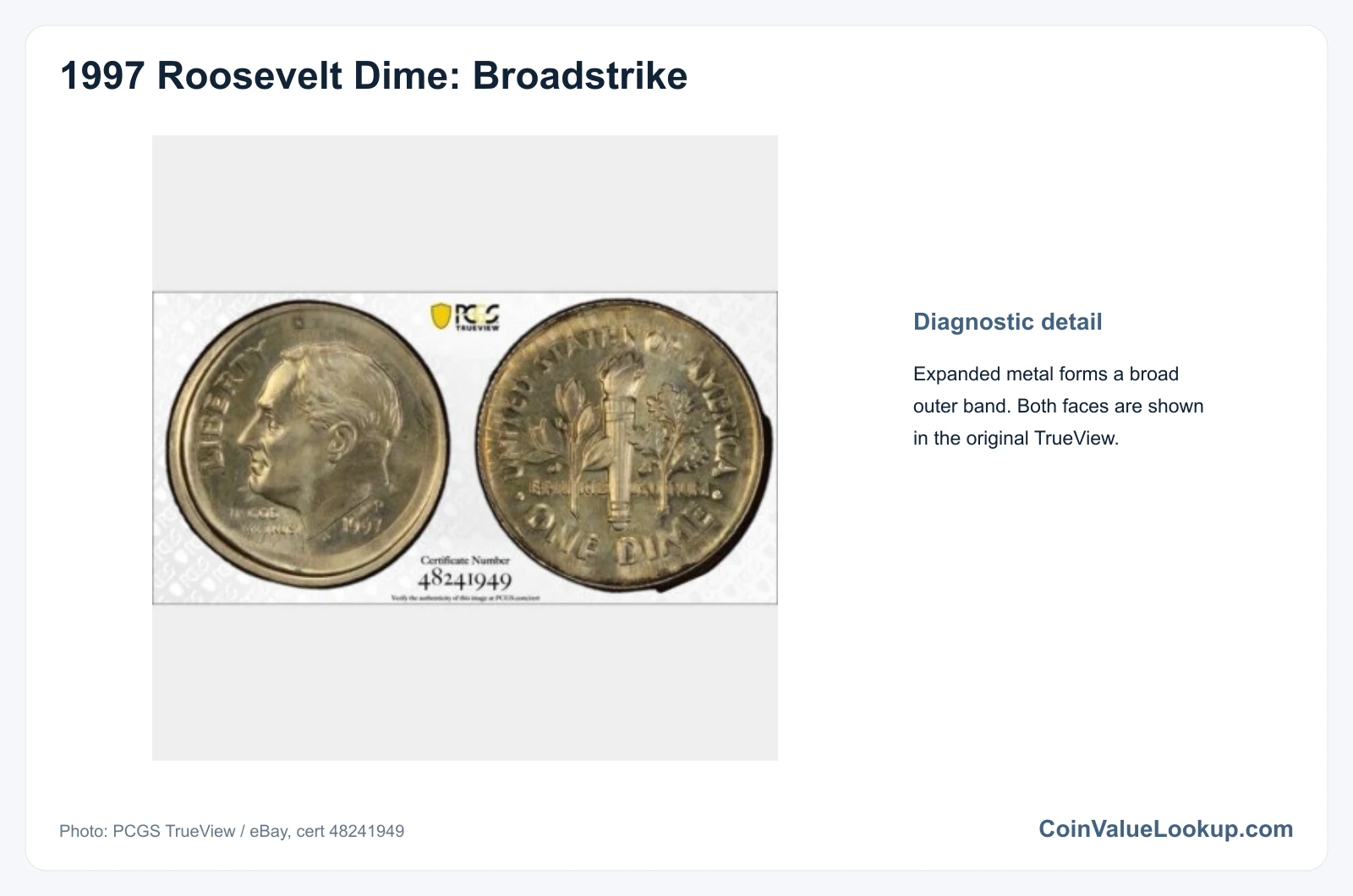
A broadstrike happens when a 1997 dime is struck without the retaining collar that normally confines the planchet. The metal spreads outward beyond its usual diameter, and the rim is absent or extremely weak.
The full design is still present — it just extends to a wider, irregular edge.
This differs from an off-center strike, where part of the design is missing entirely because the planchet was misaligned. It also differs from a coin flattened by a train or vise after leaving the mint, which typically shows distorted lettering and surface damage inconsistent with a single-press event.
No adopted price is available for this error. Value depends on the degree of spread, overall condition, and whether the coin has been authenticated by a grading service.
6. 1997 Roosevelt Dime — Die Crack / Die Chip
Die cracks and die chips are raised features on a 1997 dime caused by damage to the die itself. A crack appears as a thin raised line running across the coin's surface — sometimes connecting design elements, sometimes running to the rim.
A chip shows up as a small raised blob, usually in a field or inside a letter.
When a crack reaches the rim and displaces a section of it, the result is sometimes called a cud — a larger, flat raised area at the edge. These are all raised above the coin's normal surface, which separates them from incuse scratches, corrosion pits, or foreign material stuck to the surface.
No specific price data is available. The location, size, and visual impact of the crack or chip, along with the coin's overall condition, determine collector interest.
7. 1997 Roosevelt Dime — Wrong Planchet / Off-Metal Strike
A wrong-planchet or off-metal 1997 dime means the Roosevelt dime dies struck a blank intended for a different denomination or coin. The resulting piece has the dime's design but the wrong weight, diameter, edge characteristics, or some combination of these.
To check, weigh the coin and measure its diameter carefully. A normal clad dime is 2.27 grams and about 17.9 mm.
Significant deviation from those numbers — combined with an unusual edge or incomplete design impression from a mismatched blank — points toward a wrong-planchet strike.
Do not confuse this with coins that have been plated, acid-treated, or intentionally altered after minting. Those modifications change the surface but leave the weight and diameter close to normal.
No adopted price is available; value depends on authentication, the specific planchet involved, and condition.