1902 Morgan Silver Dollar Coin Value: How Much Is It Worth?
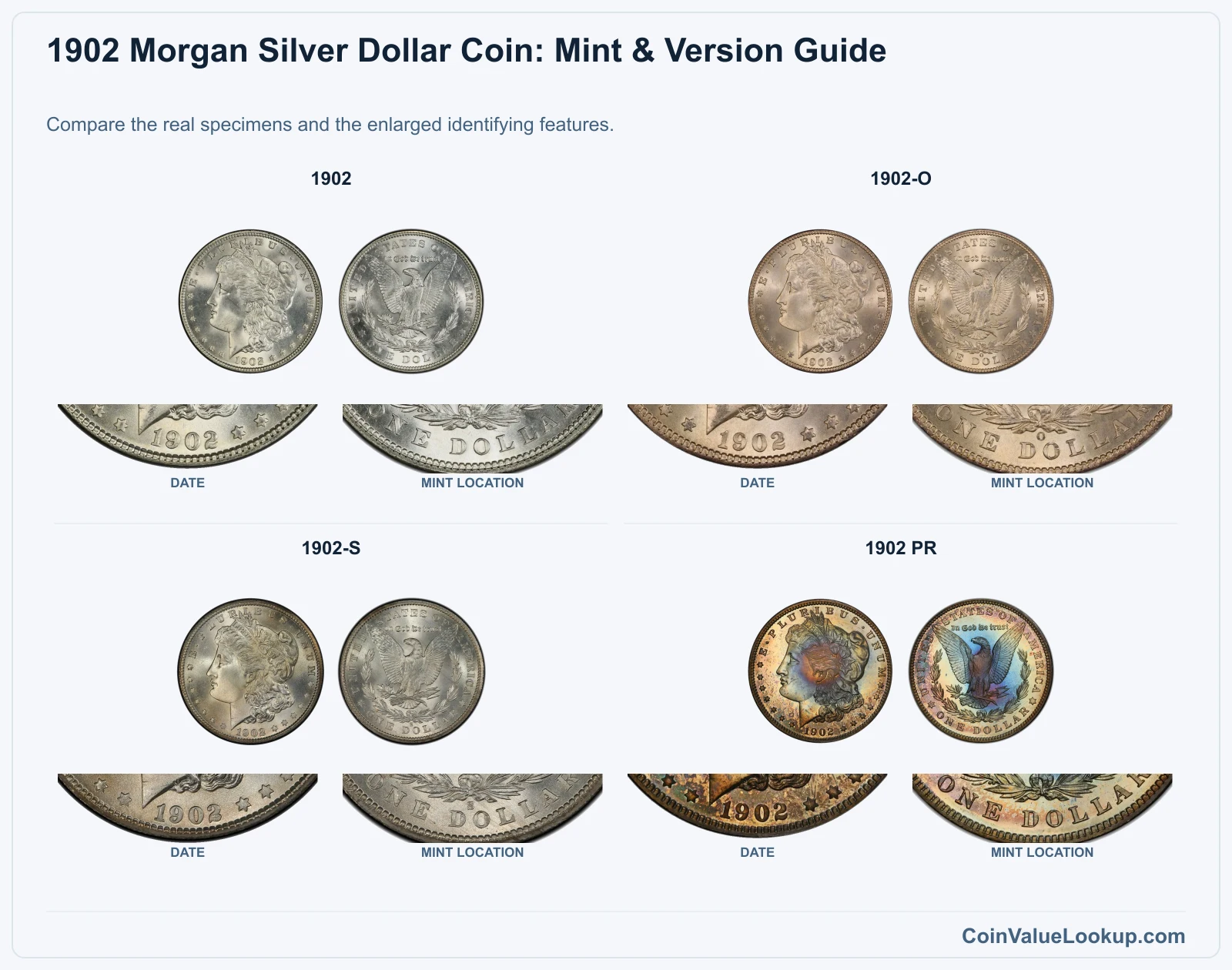
The 1902 Morgan Silver Dollar is a late-date issue in one of America's most collected series. Struck in 90% silver and 10% copper at 26.73 grams, its value depends entirely on which mint produced it, whether it received a business or proof strike, its preservation, and whether it carries a genuine mint error.
Identifying the exact version you hold is the essential first step.
Fast Way to Identify Your 1902 Morgan Silver Dollar
The quickest way to start is to upload clear photos of the front and back of your 1902 Morgan Dollar. Our identifier offers a preliminary look at your coin's mint, finish and general condition based on those images.
It is not a substitute for professional authentication or certified grading, but it gives you a useful starting point before diving deeper.
1902 Morgan Silver Dollar Value
Upload both sides of your 1902 Morgan Silver Dollar.
Front Obverse
Upload photo
Back Reverse
Upload photo
Which 1902 Morgan Silver Dollar Versions Are Worth Money?
- The 1902 Proof is a distinct manufacturing finish, not just a high-grade regular coin; genuine proofs carry strong collector premiums.
- Prooflike (PL) and Deep Mirror Prooflike (DMPL) surfaces on eligible business strikes can boost value, but require proper third-party attribution, not just a shiny look.
- The 1902-S in high Mint State grades tends to be scarcer than its Philadelphia or New Orleans siblings, making authenticated condition a key value driver.
- A confirmed Doubled Ear error or Off-Center strike on a 1902 Morgan can add significant value beyond the base coin's worth.
Step 1: Identify Your 1902 Morgan Silver Dollar Mint Mark and Version
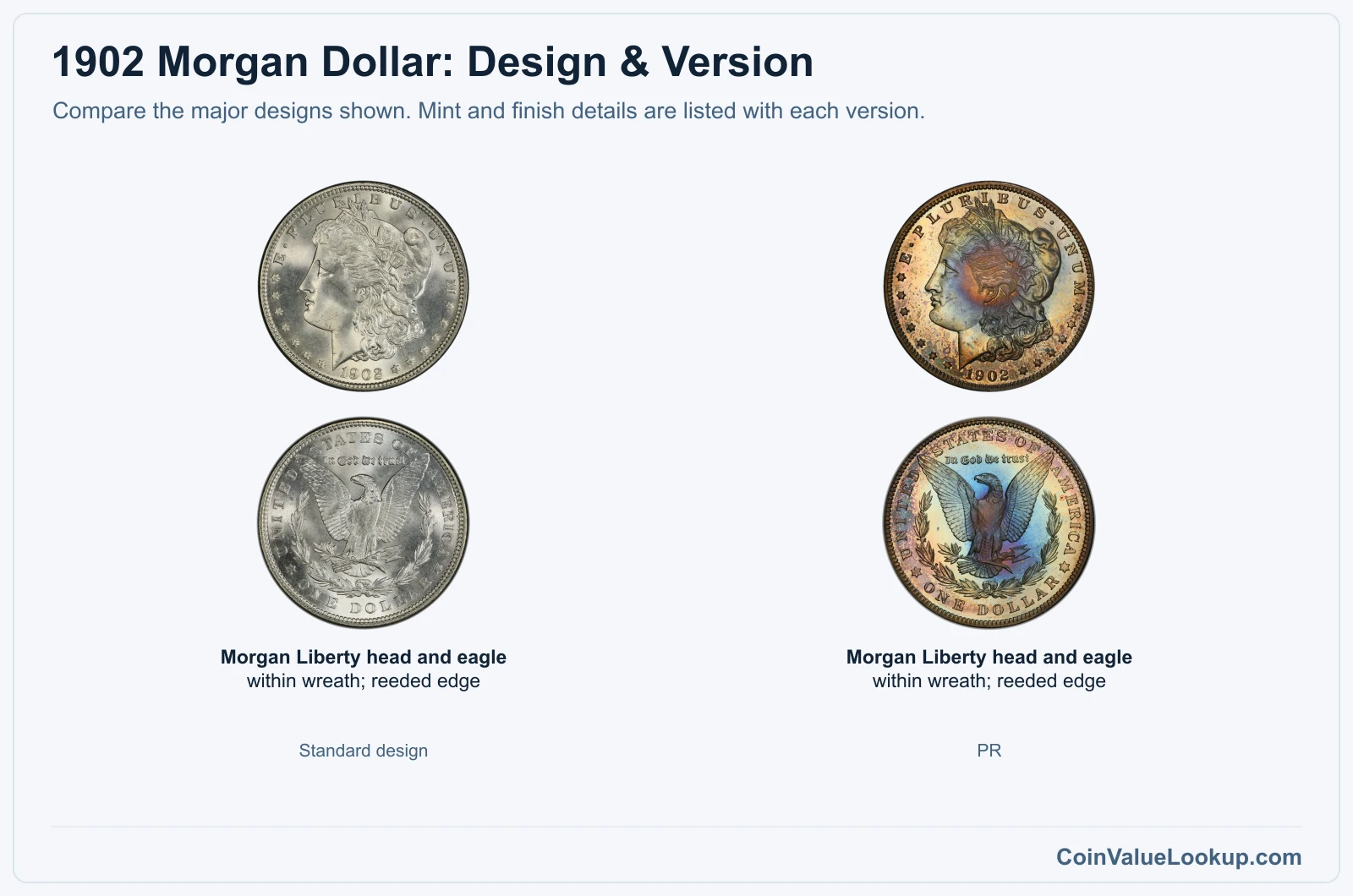
Flip your coin to the reverse. Below the bow that ties the wreath, look for a small letter.
No letter means Philadelphia. An "O" means New Orleans, and an "S" means San Francisco.
There is no "D" or "CC" mintmark for the 1902 date.
The 1902 Morgan comes in four collectible branches: 1902 (Philadelphia business strike), 1902-O (New Orleans), 1902-S (San Francisco), and 1902 Proof (Philadelphia, proof finish). Each has its own collector demand and price structure, so getting the mintmark right matters.
All genuine examples weigh 26.73 grams and are composed of 90% silver and 10% copper with a reeded edge. If your coin feels light, sticks to a magnet, or has a smooth edge, it may be a replica.
A shiny surface alone does not make a coin a proof or prooflike piece; those are specific manufacturing or surface designations that require proper attribution.
Step 2: Check Your 1902 Morgan Silver Dollar Grade
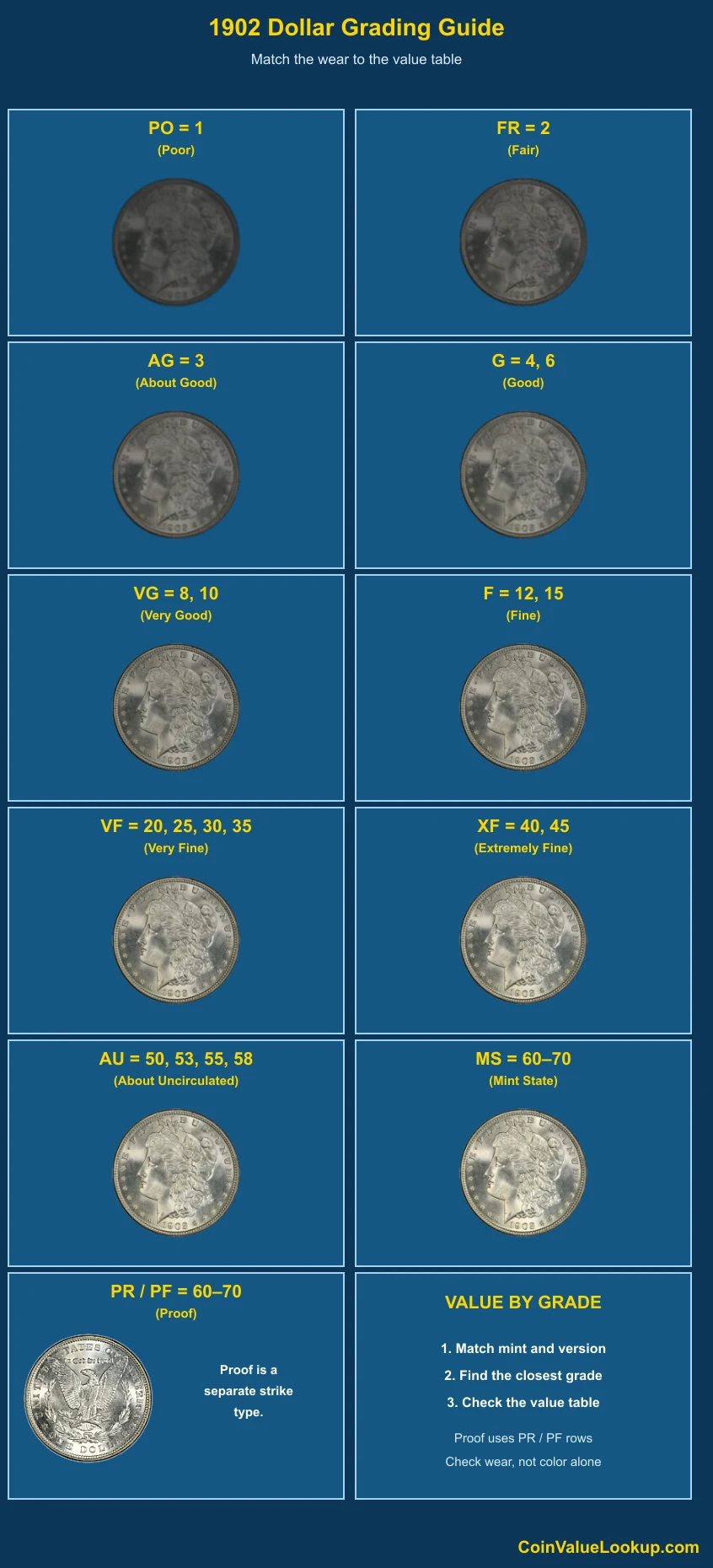
Start with Liberty's hair detail above her ear and the fullness of her cheek. On a well-worn coin, these areas flatten first and merge into smooth patches.
A coin grading in the mid-circulated range will show clear hair strands above the ear but obvious wear on the high points of the cap and cheek.
On the reverse, check the eagle's breast feathers. Sharp, individually separated feathers point to a higher grade.
Mushy or flat breast detail signals significant wear.
Mint State coins retain full original luster, but that does not mean they are perfect. Bag marks, which are small nicks from coins banging together in storage bags, can pull an otherwise lustrous coin down several grade points.
These are different from actual circulation wear.
Use the comparison image to see the progression from circulated through About Uncirculated to Mint State. Pay attention to how luster breaks down across the highpoints.
Cleaned or polished coins lose their natural surface character and typically grade lower than unaltered examples at the same apparent wear level.
Step 3: Check 1902 Morgan Silver Dollar Value by Mint and Version
1902 Morgan Silver Dollar
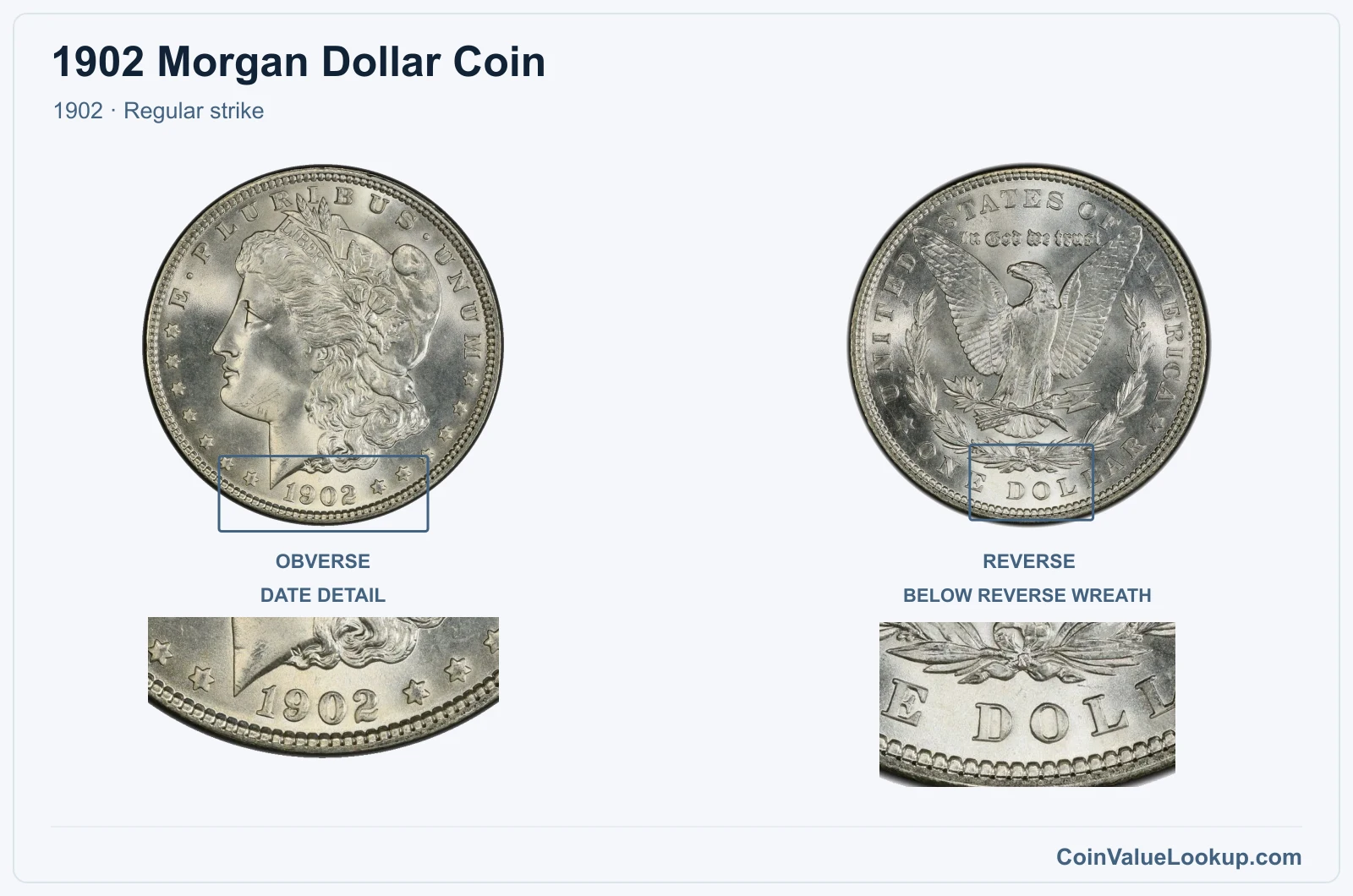
The 1902 Philadelphia Morgan has no mintmark below the wreath bow. It was a business strike produced in standard fashion.
Original, unaltered surfaces matter more than raw shine. Coins that have been polished or cleaned lose their natural luster and trade at a discount compared to problem-free examples at the same wear level.
Some Philadelphia strikes exhibit Prooflike (PL) or Deep Mirror Prooflike (DMPL) surfaces, which are surface designations on business strikes and not proof manufacture. Those designations can influence value when confirmed by a grading service.
Because no single adopted price range covers all grades, your coin's value depends on its authenticated identity, condition, and whether any genuine errors are present.
Range Grade
Price Auction Records Appraisal PO PO 1
—
Coin Identifier FR FR 2
—
Coin Identifier AG AG 3
—
Coin Identifier G G 4
—
Coin Identifier
G 6
Coin Identifier VG VG 8
Coin Identifier
VG 10
—
Coin Identifier F F 12
—
Coin Identifier
F 15
—
Coin Identifier VF VF 20
—
Coin Identifier
VF 25
Coin Identifier
VF 30
Coin Identifier
VF 35
—
Coin Identifier XF XF 40
—
Coin Identifier
XF 45
Coin Identifier AU AU 50
—
Coin Identifier
AU 53
Coin Identifier
AU 55
Coin Identifier
AU 58
Coin Identifier MS MS 60
Coin Identifier
MS 61
Coin Identifier
MS 62
Coin Identifier
MS 63
Coin Identifier
MS 64
Coin Identifier
MS 65
Coin Identifier
MS 66
Coin Identifier
MS 67
Coin Identifier
MS 68
—
—
—
MS 69
—
—
—
MS 70
—
—
—
1902 Morgan Silver Dollar — O
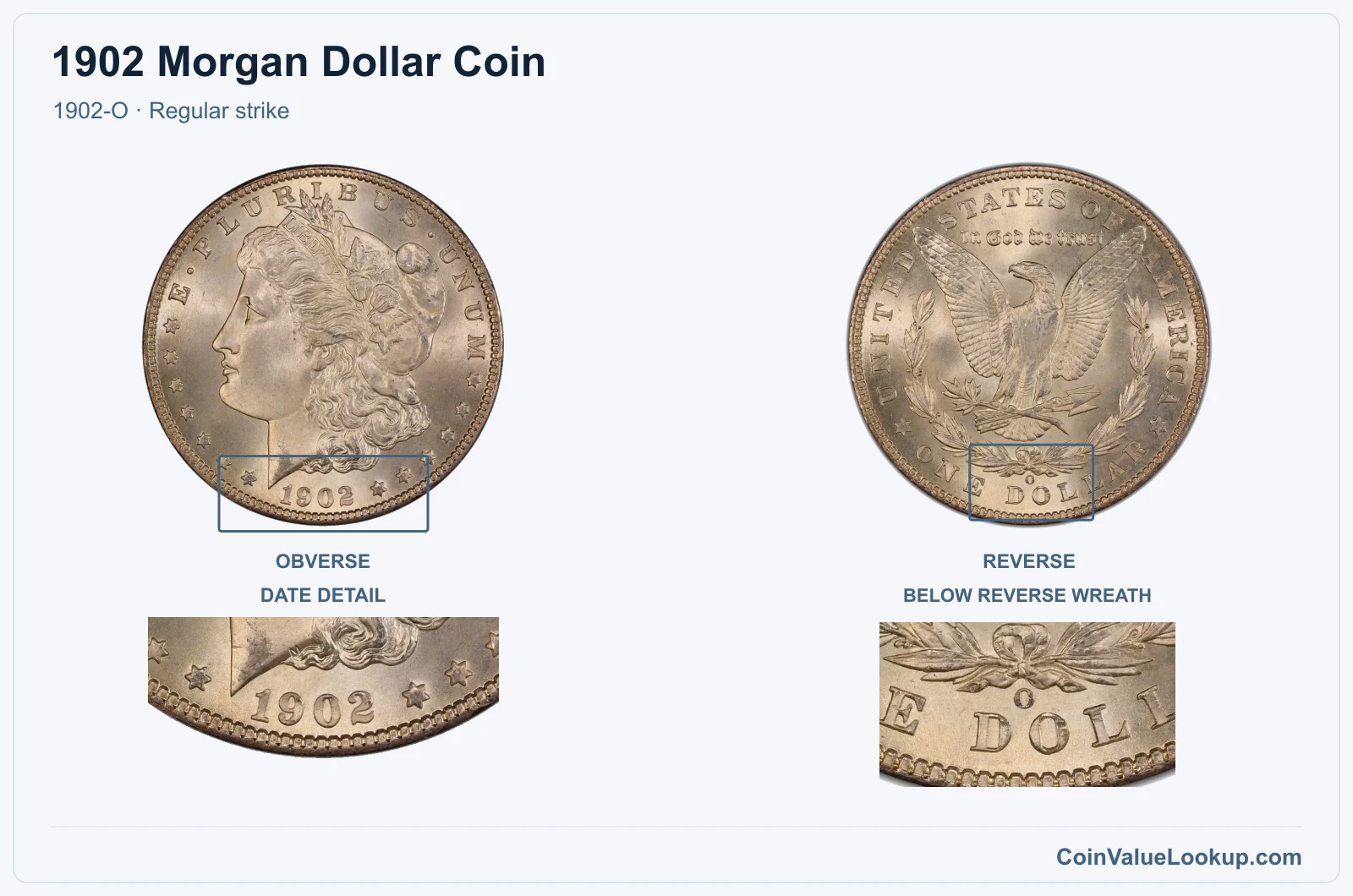
The 1902-O carries a small "O" mintmark beneath the wreath on the reverse. New Orleans struck large quantities of Morgan Dollars, and 1902-O examples circulated widely across the South.
Grade and original surfaces are the primary value drivers. A bag-toned, untouched example in Mint State will typically command more than a cleaned coin that looks shinier at first glance.
PL and DMPL surface designations apply to eligible business strikes and can affect pricing when confirmed by a reputable grading service.
No single numeric range covers all conditions. Value depends on authenticated identity, grade, and error status.
Range Grade
Price Auction Records Appraisal PO PO 1
—
Coin Identifier FR FR 2
—
Coin Identifier AG AG 3
—
Coin Identifier G G 4
—
Coin Identifier
G 6
—
Coin Identifier VG VG 8
—
Coin Identifier
VG 10
—
Coin Identifier F F 12
—
Coin Identifier
F 15
—
Coin Identifier VF VF 20
—
Coin Identifier
VF 25
Coin Identifier
VF 30
—
Coin Identifier
VF 35
—
Coin Identifier XF XF 40
—
Coin Identifier
XF 45
—
Coin Identifier AU AU 50
—
Coin Identifier
AU 53
Coin Identifier
AU 55
Coin Identifier
AU 58
Coin Identifier MS MS 60
Coin Identifier
MS 61
Coin Identifier
MS 62
Coin Identifier
MS 63
Coin Identifier
MS 64
Coin Identifier
MS 65
Coin Identifier
MS 66
Coin Identifier
MS 67
Coin Identifier
MS 68
—
—
—
MS 69
—
—
—
MS 70
—
—
—
1902 Morgan Silver Dollar — S
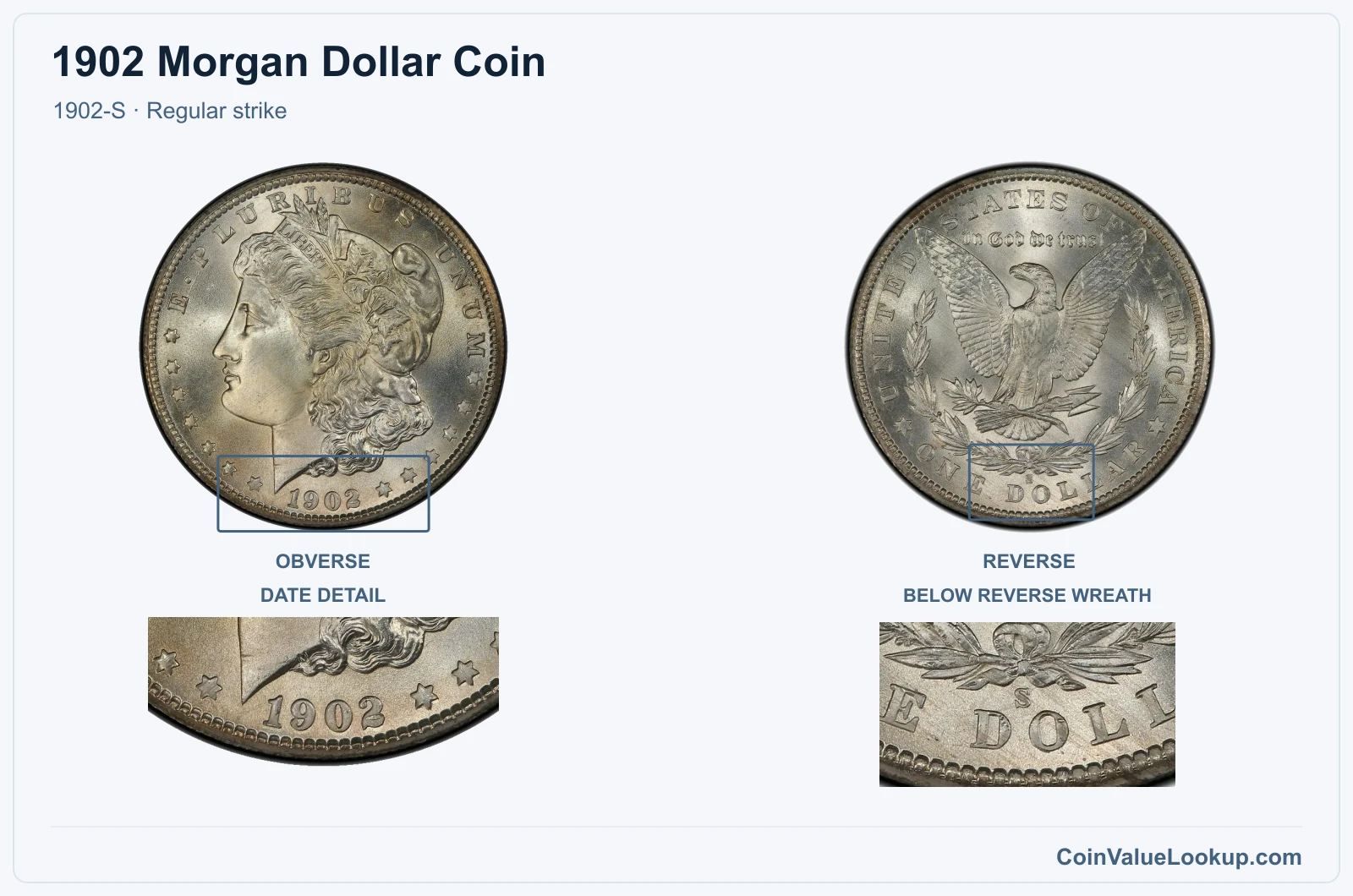
Look for the "S" mintmark on the reverse to confirm a San Francisco strike. The 1902-S is generally considered tougher to find in upper Mint State grades compared to the Philadelphia or New Orleans issues, which makes accurate grading especially important.
Coin Value Lookup is a good starting point if you want to compare guides for different Morgan Dollar dates and mints before deciding on professional authentication.
As with all branches, original surfaces beat a polished-up coin every time. PL and DMPL designations on business strikes can add to the value when properly attributed.
Because no adopted price range covers this version across all grades, individual assessment by condition and authenticated identity is the way to determine what your coin is worth.
Range Grade
Price Auction Records Appraisal PO PO 1
—
Coin Identifier FR FR 2
Coin Identifier AG AG 3
Coin Identifier G G 4
Coin Identifier
G 6
Coin Identifier VG VG 8
Coin Identifier
VG 10
Coin Identifier F F 12
Coin Identifier
F 15
Coin Identifier VF VF 20
Coin Identifier
VF 25
Coin Identifier
VF 30
Coin Identifier
VF 35
Coin Identifier XF XF 40
Coin Identifier
XF 45
Coin Identifier AU AU 50
Coin Identifier
AU 53
Coin Identifier
AU 55
Coin Identifier
AU 58
Coin Identifier MS MS 60
Coin Identifier
MS 61
Coin Identifier
MS 62
Coin Identifier
MS 63
Coin Identifier
MS 64
Coin Identifier
MS 65
Coin Identifier
MS 66
Coin Identifier
MS 67
Coin Identifier
MS 68
—
—
—
MS 69
—
—
—
MS 70
—
—
—
1902 Morgan Silver Dollar — PR
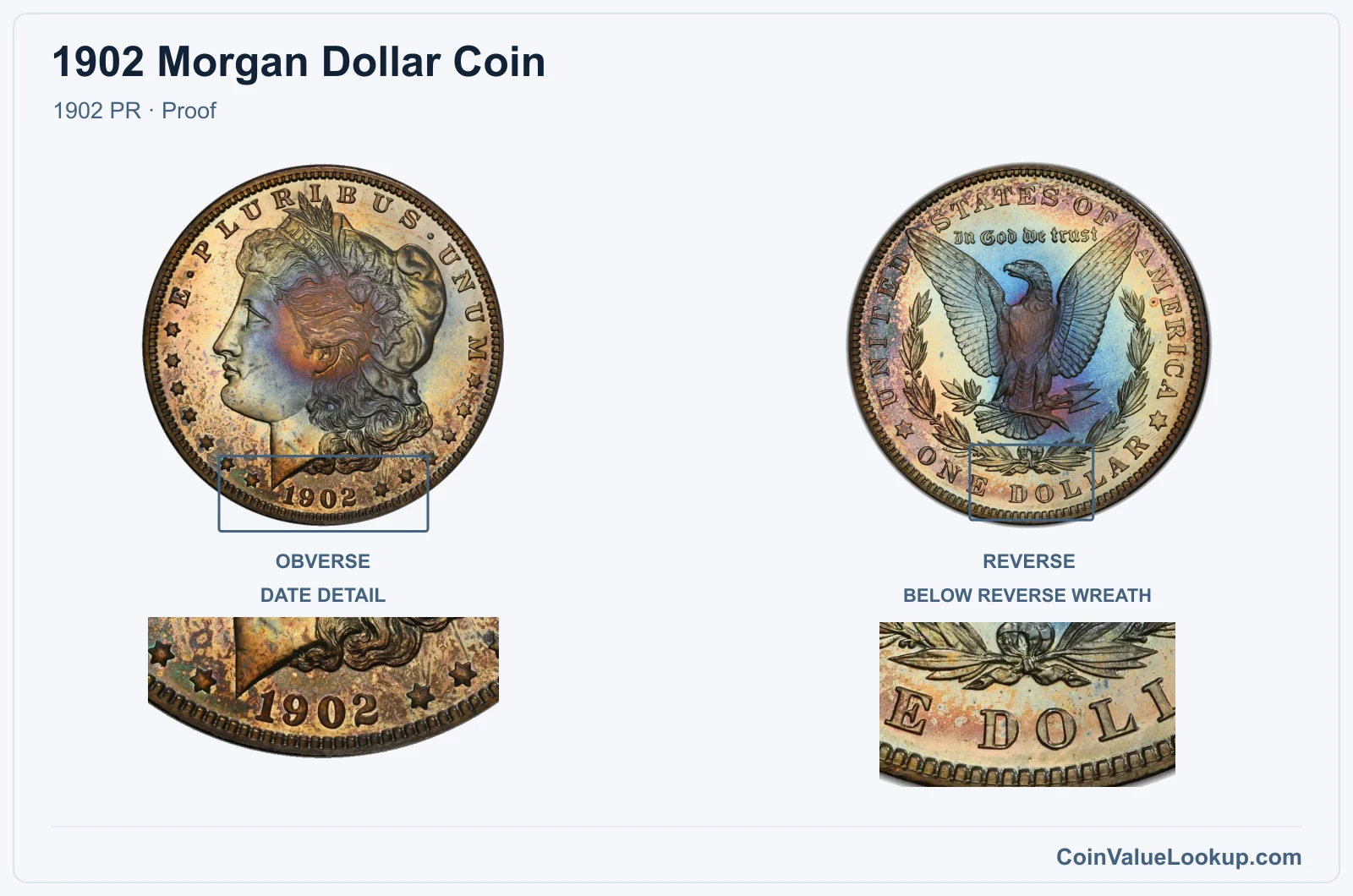
The 1902 Proof Morgan Dollar was struck at Philadelphia using specially prepared dies and polished planchets. It carries no mintmark.
A proof is a manufacturing finish, not simply a high-grade or shiny regular coin. The mirrored fields, sharp rims, and crisp detail are intentional results of the proof production process.
Genuine proofs are scarce relative to business strikes and carry strong collector demand. However, many regular-strike Morgans with reflective surfaces get mistaken for proofs.
If your coin has not been attributed by a recognized grading service, approach any proof claim with caution.
PL and DMPL are surface designations for business strikes and should not be confused with proof manufacture. Value for a genuine 1902 Proof depends on its authenticated condition and any impairments such as hairlines or haze.
Range Grade
Price Auction Records Appraisal PR PR 1
—
Coin Identifier
PR 2
—
Coin Identifier
PR 3
—
Coin Identifier
PR 4
—
Coin Identifier
PR 6
—
Coin Identifier
PR 8
—
Coin Identifier
PR 10
—
Coin Identifier
PR 12
—
Coin Identifier
PR 15
—
Coin Identifier
PR 20
—
Coin Identifier
PR 25
—
Coin Identifier
PR 30
—
Coin Identifier
PR 35
—
Coin Identifier
PR 40
—
Coin Identifier
PR 45
—
Coin Identifier
PR 50
—
Coin Identifier
PR 53
—
Coin Identifier
PR 55
Coin Identifier
PR 58
Coin Identifier
PR 60
—
Coin Identifier
PR 61
Coin Identifier
PR 62
Coin Identifier
PR 63
Coin Identifier
PR 64
Coin Identifier
PR 65
Coin Identifier
PR 66
Coin Identifier
PR 67
Coin Identifier
PR 68
Coin Identifier
PR 69
—
—
—
PR 70
—
—
—
1902 Morgan Silver Dollar Error List
1. 1902 Morgan Silver Dollar — Doubled Die Obverse
A Doubled Ear error has been reported on the 1902 Morgan Dollar. On an affected coin, the ear on Liberty's portrait shows a secondary outline or consistent separation that is not present on a normal die.
To check, examine the ear under magnification and steady lighting. Genuine doubling will appear as a raised, shifted contour with depth, not a flat shelf.
Do not confuse this with machine doubling, which tends to look flat and shelf-like without the rounded profile of a true doubled die. Reflections from nearby surfaces or worn die contours can also mimic doubling.
The visibility and strength of the doubling, along with the coin's overall condition, determine how much extra value the error adds. Third-party authentication is recommended before paying any premium for this variety.
2. 1902 Morgan Silver Dollar — Clashed Dies
Clashed dies errors have been reported on the 1902 Morgan Dollar. This happens when the obverse and reverse dies strike each other without a planchet between them, transferring faint ghost images of the opposite design onto each die.
On the obverse, you might see traces of the eagle or wreath impressed into Liberty's fields. On the reverse, traces of Liberty's portrait may appear in the eagle's fields.
These transferred elements will line up with where the opposing design would normally sit. Random scratches, raised lines from die polishing, or a brockage are common lookalikes.
Scratches lack the design-specific shape, and die polish lines run in parallel streaks rather than tracing a recognizable design element. Condition and clash visibility both affect the premium this error carries, so professional attribution is worth pursuing.
3. 1902 Morgan Silver Dollar — Off-Center Strike
An off-center strike on a 1902 Morgan Dollar occurs when the planchet is not properly seated between the dies at the moment of striking. The result is a displaced design with an unstruck crescent of blank metal along one edge.
A Heritage Auctions lot described a 1902 Morgan struck approximately 5% off center, graded AU58 by PCGS.
Even a small percentage off center is unusual on a Morgan Dollar, so confirmed examples attract collector attention. The value depends on the degree of displacement, whether the full date remains visible, and the coin's overall condition.
Do not confuse an off-center strike with a clipped planchet, which removes a curved section of the blank before striking, or with post-mint damage that flattens part of the rim. A genuine off-center strike shifts the entire design uniformly in one direction.
Professional authentication is strongly recommended for any off-center claim.