2008 Sacagawea Dollar Coin Value: How Much Is It Worth?
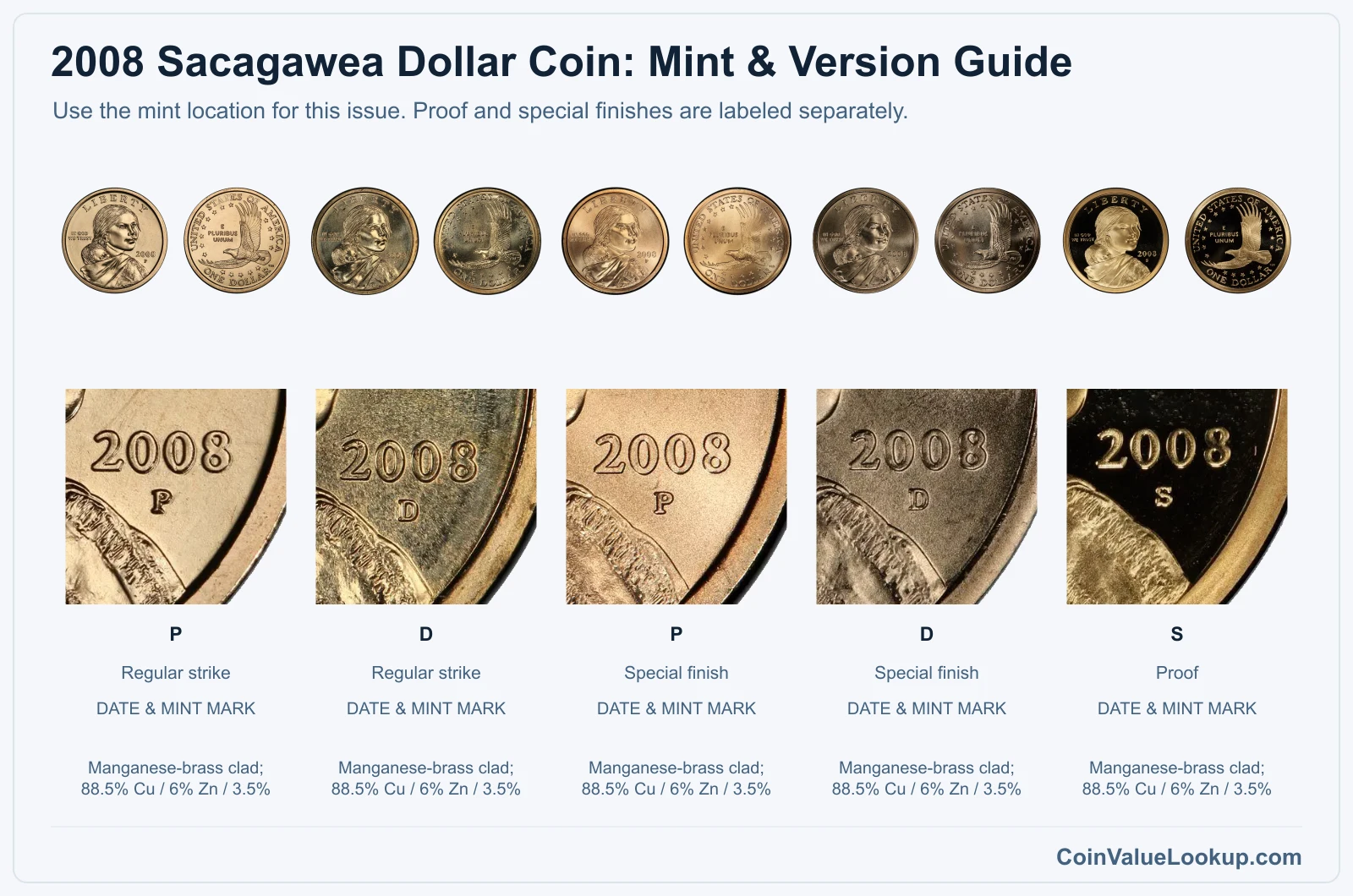
The 2008 Sacagawea Dollar is a manganese-brass clad coin worth roughly $6.25 to $7.29 at selected guide grades, depending on the mint, finish and condition. Those are USA Coin Book guide estimates, not guaranteed sale prices.
Most circulated examples trade near face value, so the key is knowing which version you actually have — Philadelphia business strike, Denver business strike, satin finish from a mint set, or San Francisco proof — before you start comparing prices.
Fast Way to Identify Your 2008 Sacagawea Dollar
Snap a clear photo of the front and back of your 2008 Sacagawea Dollar and upload both images. That gives you a preliminary identification of the mint, finish and any visible variety.
It won't replace professional authentication or grading, but it's a solid first step toward figuring out what you're holding.
2008 Sacagawea Dollar Value
Upload both sides of your 2008 Sacagawea Dollar.
Front Obverse
Upload photo
Back Reverse
Upload photo
Which 2008 Sacagawea Dollar Versions Are Worth Money?
- 2008-P Satin Finish — packaged in the official mint set, distinct soft luster separates it from regular business strikes.
- 2008-D Satin Finish — same special luster as the P satin; confirm it came from a mint set before paying any premium.
- 2008-S Proof — mirror fields and frosted devices, struck at San Francisco; guide estimate around $7.29 at PR65.
- Authenticated mint errors on any 2008 Sacagawea Dollar can carry premiums depending on type, severity and condition.
Step 1: Identify Your 2008 Sacagawea Dollar Mint Mark and Version
Start on the obverse. The date reads 2008, and the mintmark — P, D or S — sits just below the date on the front of the coin.
No mintmark at all usually means Philadelphia on older coins, but for this series look closely because the P is there.
The golden color looks like gold. It is not gold.
The composition is manganese-brass clad: 88.5% copper, 6% zinc, 3.5% manganese and 2% nickel, weighing 8.10 grams.
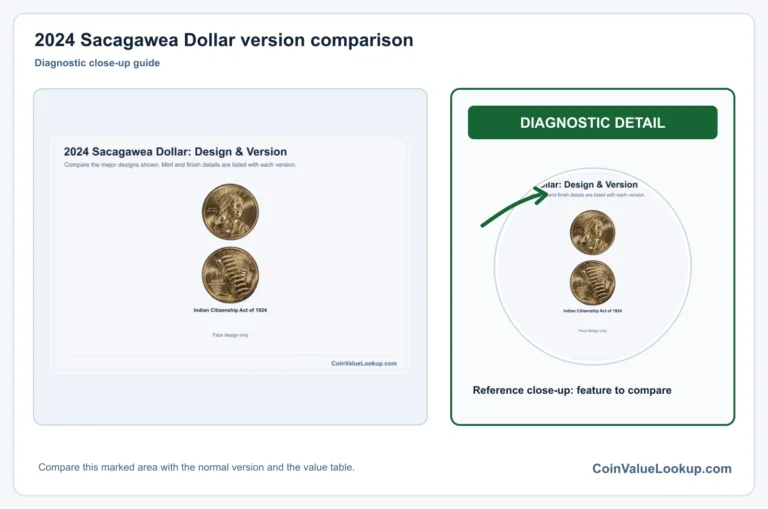
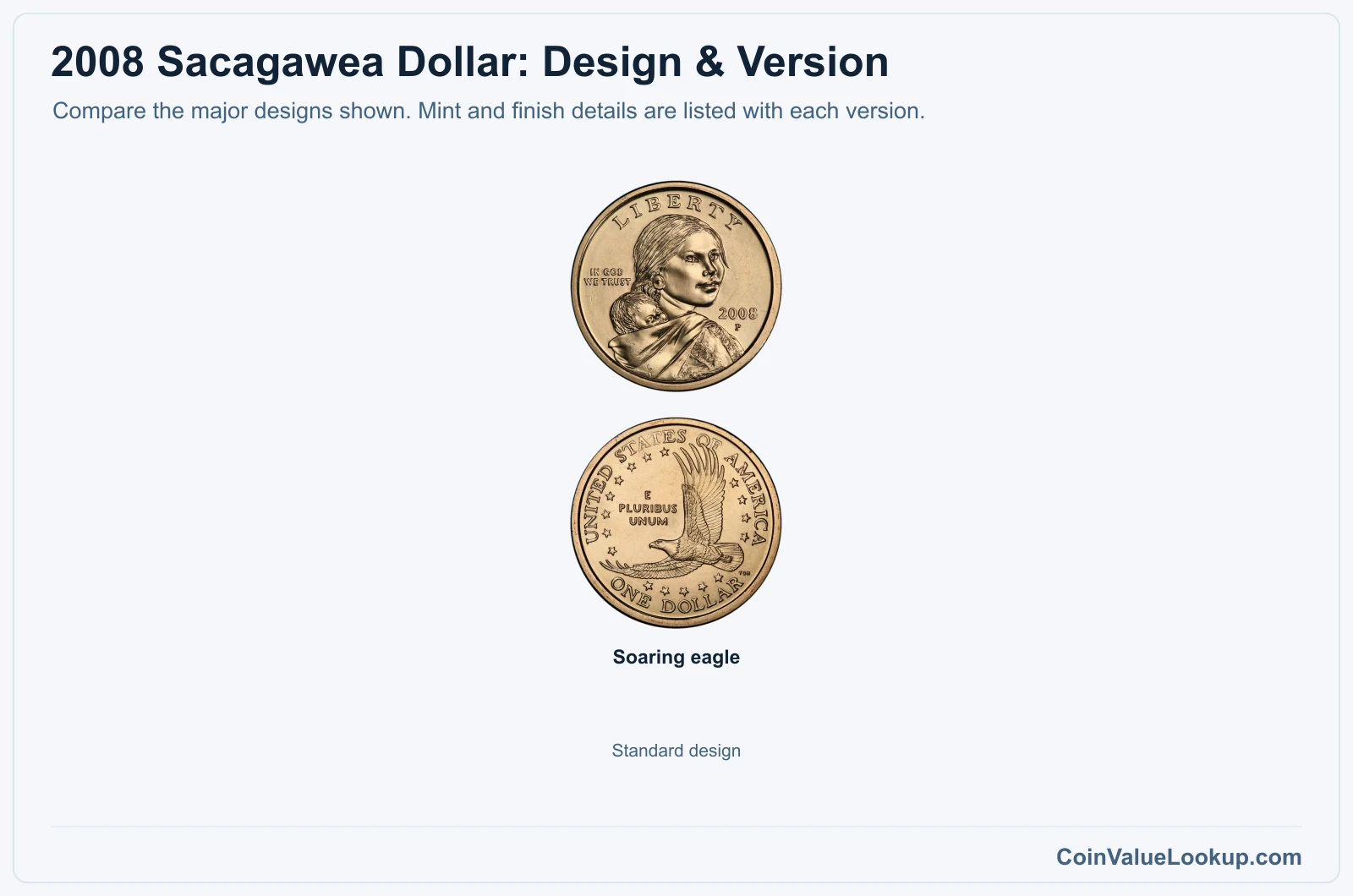
The obverse shows Sacagawea carrying her son Jean-Baptiste. The reverse features a soaring eagle, which was the standard design used from 2000 through 2008.
Starting in 2009 the Mint switched to annual Native American reverse designs, so the eagle reverse locks you into the 2000–2008 window.
Five distinct versions exist for this year. Both the P and D mints produced regular business strikes plus satin-finish coins packaged in that year's uncirculated mint sets.
The S mint produced proofs only. Satin coins have a distinctive soft, even luster that differs from the cartwheel shine of business strikes and the mirror-and-frost contrast of proofs.
If your coin came from a government-sealed mint set, that's a strong clue it's the satin version.
Coin Value Lookup is a good starting point if you want to look up guides for other Sacagawea Dollar years or different series entirely. It keeps things organized so you can compare versions quickly.
Step 2: Check Your 2008 Sacagawea Dollar Grade
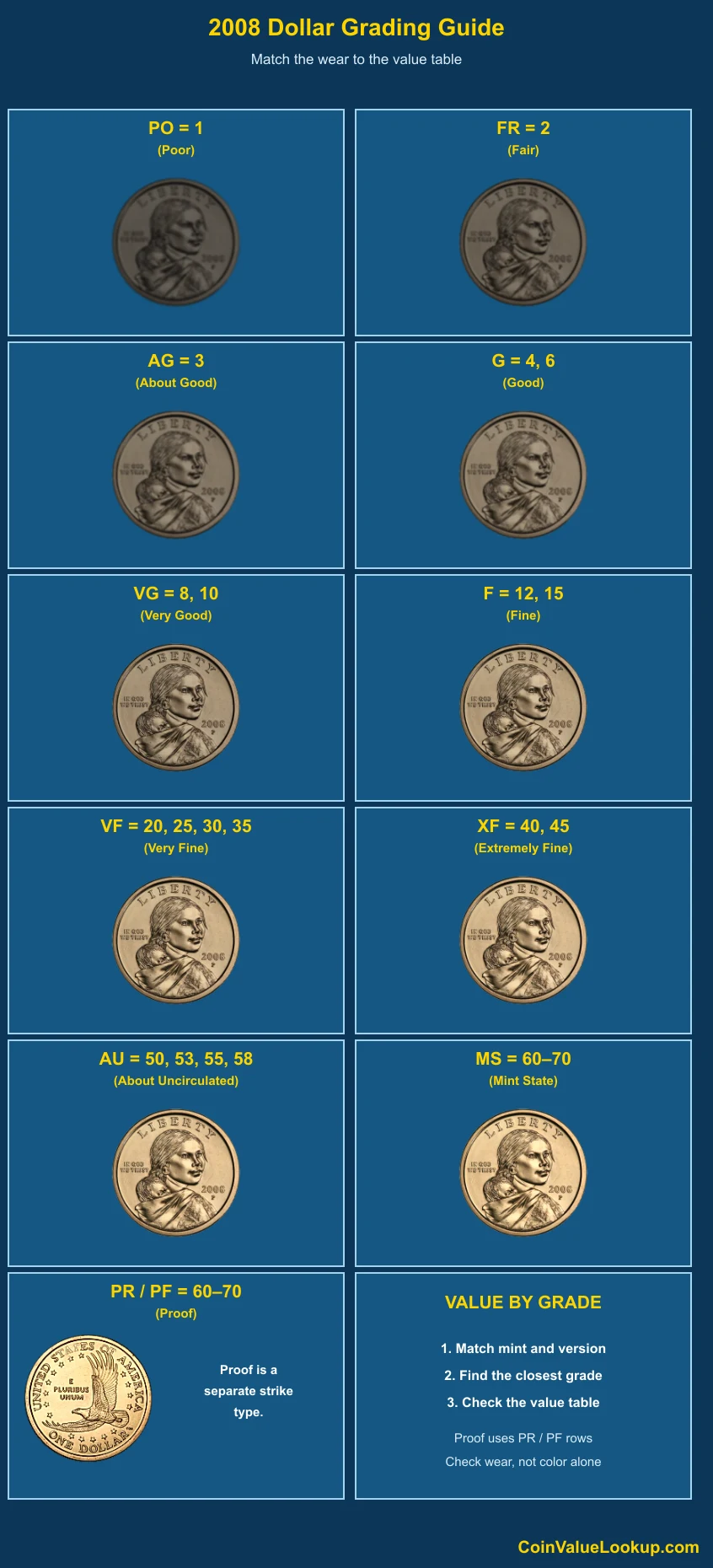
On a circulated Sacagawea Dollar, check the high points first. Sacagawea's cheekbone and the hair detail above her forehead wear earliest.
The baby's head and blanket also lose definition quickly. On the reverse, the eagle's breast feathers and wingtips show wear before anything else.
At About Uncirculated grades you'll see faint friction on those same spots, but most luster remains. A true Mint State coin retains full original luster with no wear — though contact marks and bag scratches are still possible and affect the numeric grade.
For proof and satin coins, grading works differently. You're comparing the coin to others made the same way, not to a business strike.
A proof should have deeply mirrored fields and sharp frosted devices. A satin coin has uniform matte-like luster across both surfaces.
Hairlines from mishandling hurt proofs more visibly than they hurt business strikes.
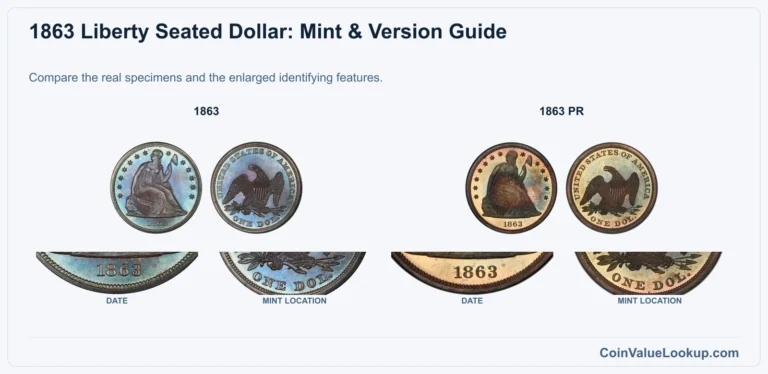
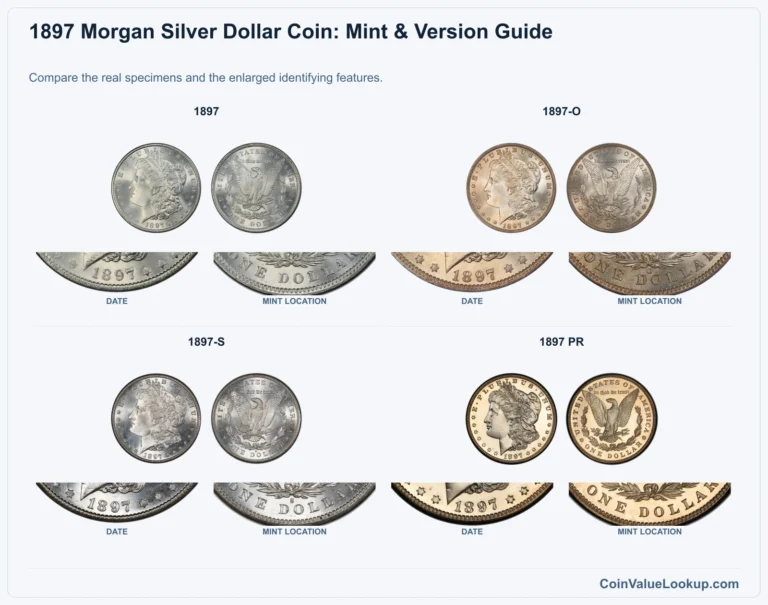
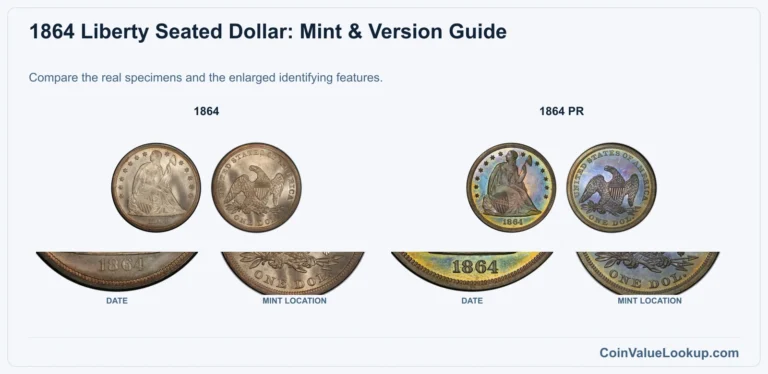
Use the comparison image to see how each wear stage looks on this specific type. Matching the finish matters as much as matching the wear level.
Step 3: Check 2008 Sacagawea Dollar Value by Mint and Version
2008 Sacagawea Dollar — P — Soaring eagle
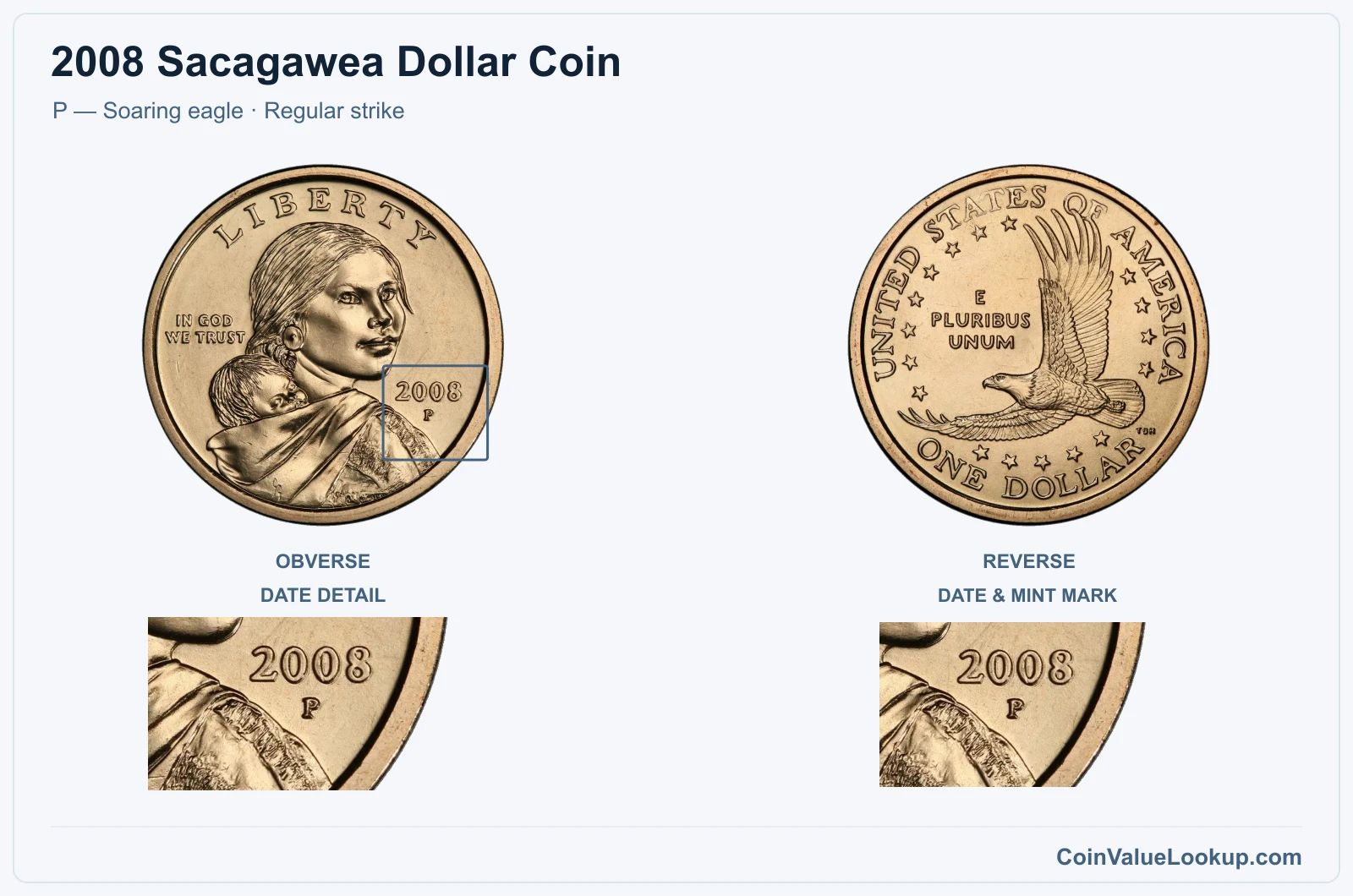
The 2008-P business strike is the standard Philadelphia issue. You'll find the small P mintmark on the obverse below the date.
These entered circulation in large numbers and most remain common in all grades.
At MS65 the USA Coin Book guide estimate is about $6.25. That's a specific grade — a coin with full luster and only minor contact marks.
Lower-grade examples are worth less, and heavily circulated pieces generally trade at or near face value. Confirm the reverse shows the soaring eagle design before checking any value chart.
Range Grade
Price Auction Records Appraisal PO PO 1
—
Coin Identifier FR FR 2
—
Coin Identifier AG AG 3
—
Coin Identifier G G 4
—
Coin Identifier
G 6
—
Coin Identifier VG VG 8
—
Coin Identifier
VG 10
—
Coin Identifier F F 12
—
Coin Identifier
F 15
—
Coin Identifier VF VF 20
—
Coin Identifier
VF 25
—
Coin Identifier
VF 30
—
Coin Identifier
VF 35
—
Coin Identifier XF XF 40
—
Coin Identifier
XF 45
—
Coin Identifier AU AU 50
—
Coin Identifier
AU 53
—
Coin Identifier
AU 55
—
Coin Identifier
AU 58
—
Coin Identifier MS MS 60
—
Coin Identifier
MS 61
—
Coin Identifier
MS 62
—
Coin Identifier
MS 63
—
Coin Identifier
MS 64
—
Coin Identifier
MS 65
—
Coin Identifier
MS 66
Coin Identifier
MS 67
Coin Identifier
MS 68
Coin Identifier
MS 69
—
—
—
MS 70
—
—
—
2008 Sacagawea Dollar — P — Soaring eagle — satin
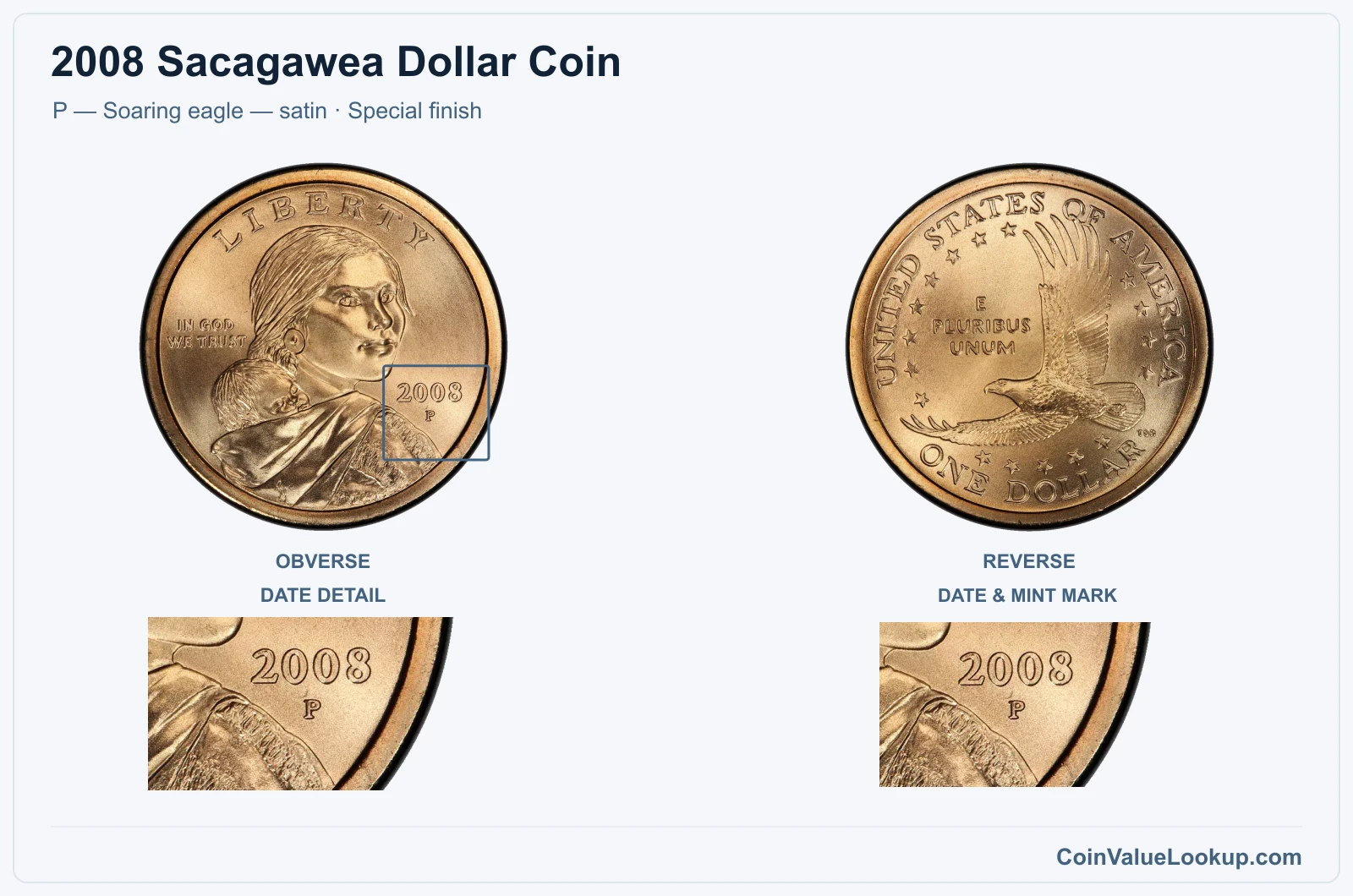
The 2008-P satin finish came exclusively in that year's official uncirculated mint set from the U.S. Mint. It carries the same P mintmark as the business strike, so the luster is how you tell them apart.
Satin coins have a soft, uniform sheen across the entire surface — no cartwheel effect, no mirror fields.
No specific numeric price range is adopted for this version. Value depends on authenticated identity, condition and whether any errors are present.
Even at the same numerical grade a satin coin is a different product than a business strike, so keep them separate when comparing.
Range Grade
Price Auction Records Appraisal SP SP 1
—
Coin Identifier
SP 2
—
Coin Identifier
SP 3
—
Coin Identifier
SP 4
—
Coin Identifier
SP 6
—
Coin Identifier
SP 8
—
Coin Identifier
SP 10
—
Coin Identifier
SP 12
—
Coin Identifier
SP 15
—
Coin Identifier
SP 20
—
Coin Identifier
SP 25
—
Coin Identifier
SP 30
—
Coin Identifier
SP 35
—
Coin Identifier
SP 40
—
Coin Identifier
SP 45
—
Coin Identifier
SP 50
—
Coin Identifier
SP 53
—
Coin Identifier
SP 55
—
Coin Identifier
SP 58
—
Coin Identifier
SP 60
—
Coin Identifier
SP 61
—
Coin Identifier
SP 62
—
Coin Identifier
SP 63
—
Coin Identifier
SP 64
—
Coin Identifier
SP 65
—
Coin Identifier
SP 66
—
Coin Identifier
SP 67
—
Coin Identifier
SP 68
Coin Identifier
SP 69
Coin Identifier
SP 70
—
—
—
2008 Sacagawea Dollar — D — Soaring eagle
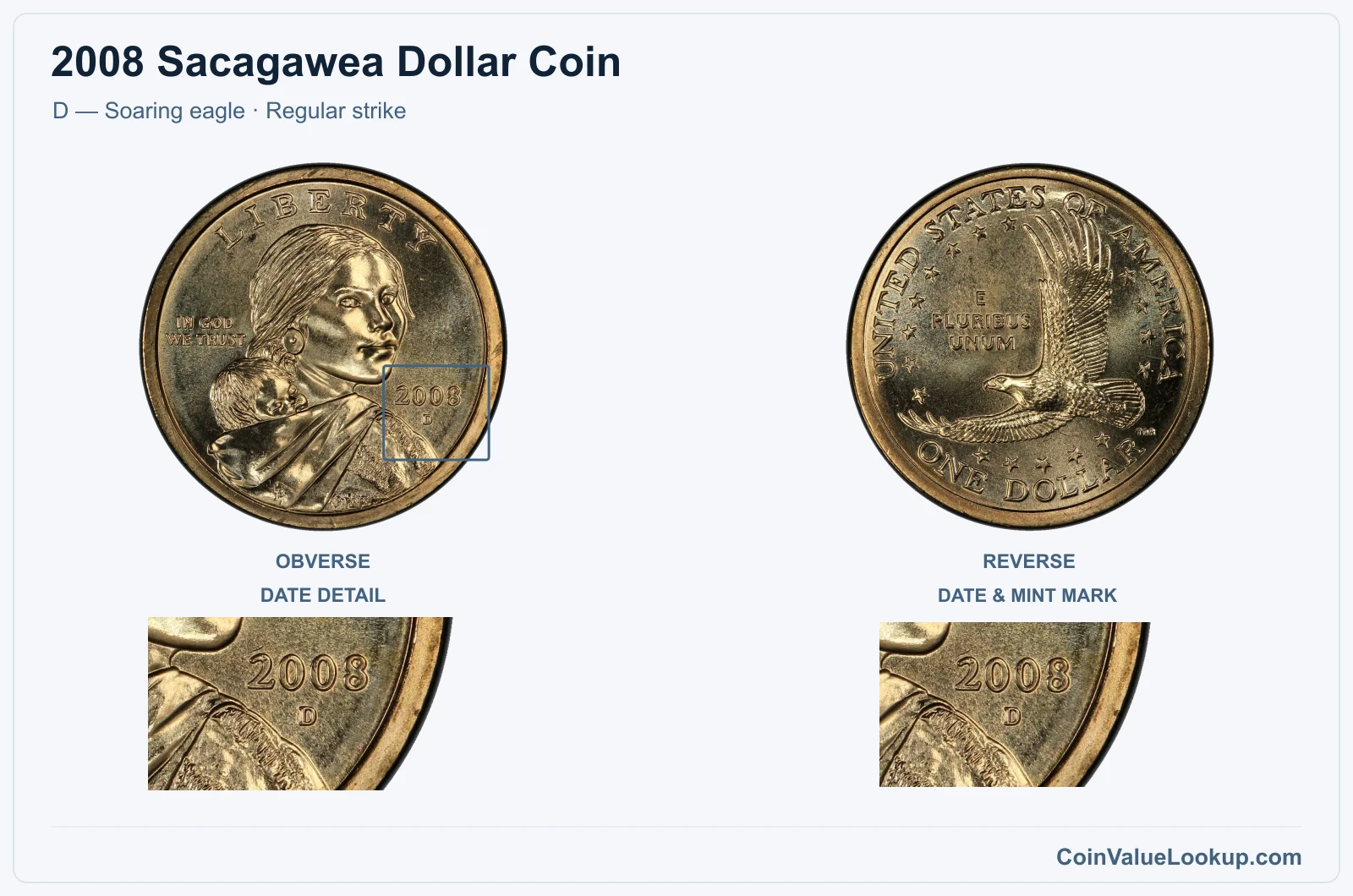
The 2008-D business strike is the Denver Mint's standard-issue Sacagawea Dollar. Look for the D mintmark on the obverse just below the date.
Like its Philadelphia counterpart, this coin was produced in large quantities.
The USA Coin Book guide estimate places this at about $6.25 in MS65. Circulated examples are common and typically worth face value.
Always verify the soaring eagle reverse and the D mintmark before using the value chart for this specific version.
Range Grade
Price Auction Records Appraisal PO PO 1
—
Coin Identifier FR FR 2
—
Coin Identifier AG AG 3
—
Coin Identifier G G 4
—
Coin Identifier
G 6
—
Coin Identifier VG VG 8
—
Coin Identifier
VG 10
—
Coin Identifier F F 12
—
Coin Identifier
F 15
—
Coin Identifier VF VF 20
—
Coin Identifier
VF 25
—
Coin Identifier
VF 30
—
Coin Identifier
VF 35
—
Coin Identifier XF XF 40
—
Coin Identifier
XF 45
—
Coin Identifier AU AU 50
—
Coin Identifier
AU 53
—
Coin Identifier
AU 55
—
Coin Identifier
AU 58
—
Coin Identifier MS MS 60
—
Coin Identifier
MS 61
—
Coin Identifier
MS 62
—
Coin Identifier
MS 63
—
Coin Identifier
MS 64
—
Coin Identifier
MS 65
—
Coin Identifier
MS 66
Coin Identifier
MS 67
Coin Identifier
MS 68
Coin Identifier
MS 69
—
—
—
MS 70
—
—
—
2008 Sacagawea Dollar — D — Soaring eagle — satin
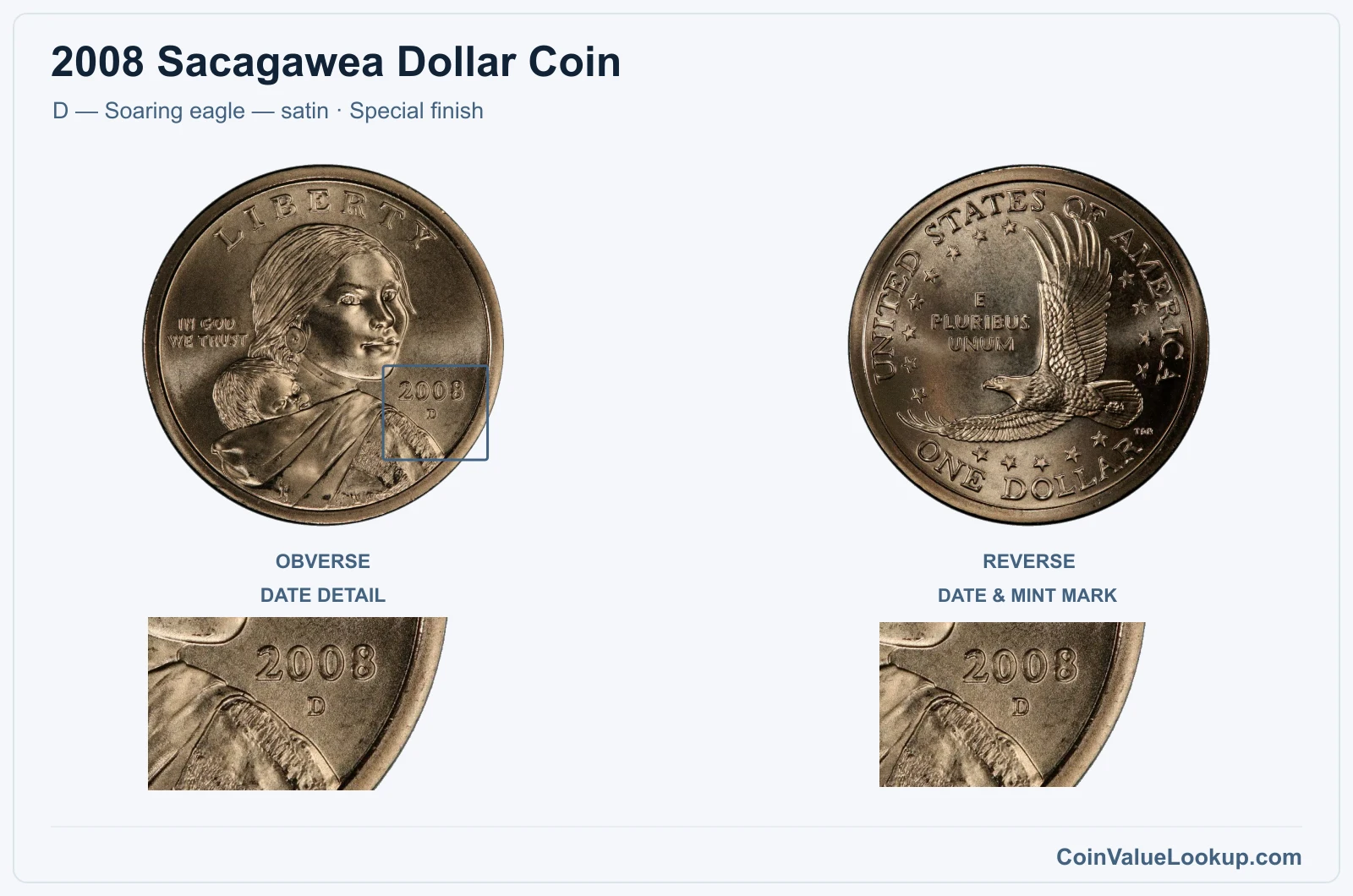
The 2008-D satin finish was part of the same uncirculated mint set program as its P counterpart. The D mintmark is visible on the obverse, and the surface has that characteristic soft, even luster rather than the sharper cartwheel of a business strike.
No specific numeric price range is adopted here. Its value depends on authenticated finish, grade and any verified errors.
If you're unsure whether your coin is satin or business strike, compare it side by side with a known regular-issue piece — the difference in surface texture is subtle but consistent.
Range Grade
Price Auction Records Appraisal SP SP 1
—
Coin Identifier
SP 2
—
Coin Identifier
SP 3
—
Coin Identifier
SP 4
—
Coin Identifier
SP 6
—
Coin Identifier
SP 8
—
Coin Identifier
SP 10
—
Coin Identifier
SP 12
—
Coin Identifier
SP 15
—
Coin Identifier
SP 20
—
Coin Identifier
SP 25
—
Coin Identifier
SP 30
—
Coin Identifier
SP 35
—
Coin Identifier
SP 40
—
Coin Identifier
SP 45
—
Coin Identifier
SP 50
—
Coin Identifier
SP 53
—
Coin Identifier
SP 55
—
Coin Identifier
SP 58
—
Coin Identifier
SP 60
—
Coin Identifier
SP 61
—
Coin Identifier
SP 62
—
Coin Identifier
SP 63
—
Coin Identifier
SP 64
—
Coin Identifier
SP 65
—
Coin Identifier
SP 66
—
Coin Identifier
SP 67
—
Coin Identifier
SP 68
Coin Identifier
SP 69
Coin Identifier
SP 70
—
—
—
2008 Sacagawea Dollar — S — Soaring eagle — proof
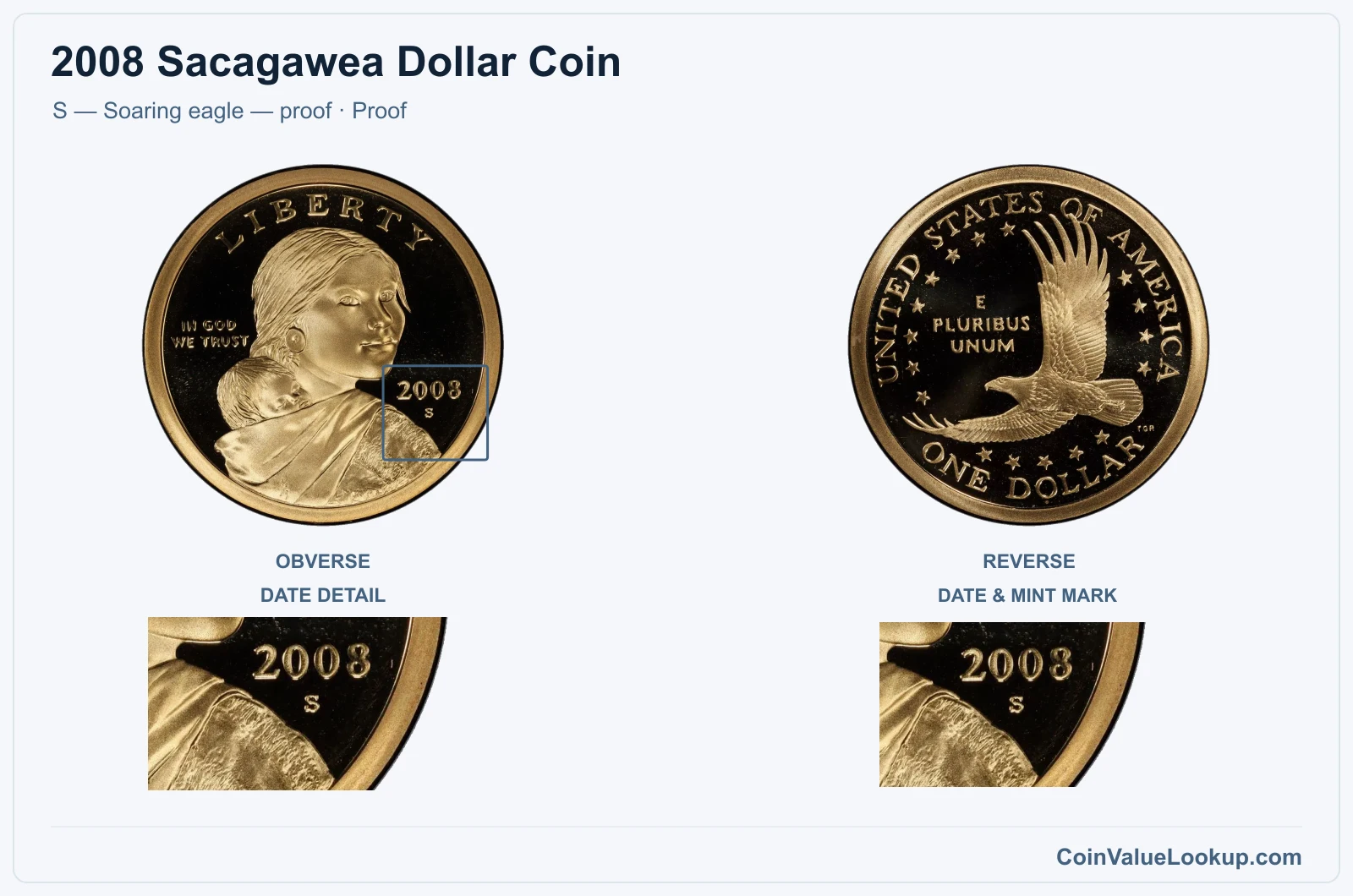
The 2008-S proof was struck at the San Francisco Mint for collector proof sets. It features deeply mirrored fields against frosted raised devices, giving it the classic cameo or deep cameo look when well preserved.
The S mintmark appears on the obverse.
The USA Coin Book guide estimate is about $7.29 at PR65. A proof is a manufacturing method, not a grade above Mint State — proof coins are graded on their own PR scale.
One common mistake: just because this coin came in a silver proof set packaging doesn't make the dollar itself silver. It's the same manganese-brass clad composition as every other 2008 Sacagawea Dollar.
Range Grade
Price Auction Records Appraisal PR PR 1
—
Coin Identifier
PR 2
—
Coin Identifier
PR 3
—
Coin Identifier
PR 4
—
Coin Identifier
PR 6
—
Coin Identifier
PR 8
—
Coin Identifier
PR 10
—
Coin Identifier
PR 12
—
Coin Identifier
PR 15
—
Coin Identifier
PR 20
—
Coin Identifier
PR 25
—
Coin Identifier
PR 30
—
Coin Identifier
PR 35
—
Coin Identifier
PR 40
—
Coin Identifier
PR 45
—
Coin Identifier
PR 50
—
Coin Identifier
PR 53
—
Coin Identifier
PR 55
—
Coin Identifier
PR 58
—
Coin Identifier
PR 60
—
Coin Identifier
PR 61
—
Coin Identifier
PR 62
—
Coin Identifier
PR 63
—
Coin Identifier
PR 64
—
Coin Identifier
PR 65
—
Coin Identifier
PR 66
—
Coin Identifier
PR 67
—
Coin Identifier
PR 68
—
Coin Identifier
PR 69
Coin Identifier
PR 70
Coin Identifier
2008 Sacagawea Dollar Error List
1. 2008 Sacagawea Dollar — Off-Center Strike
An off-center strike happens when the planchet isn't seated properly in the collar before the dies come together. The result is a displaced design with an unstruck crescent of blank metal along part of the edge.
The more dramatic the shift, the more obvious it is.
For a 2008 Sacagawea Dollar, the date and mintmark remaining visible on an off-center coin generally makes it more desirable to collectors. No specific price range is adopted for this error; value depends on the percentage of offset, overall condition and whether key design elements survived.
Don't confuse this with a clipped planchet, a one-sided die misalignment, or a coin that was flattened or damaged after leaving the mint. Off-center strikes show clean unstruck metal, not bent or crushed edges.
2. 2008 Sacagawea Dollar — Broadstrike
A broadstrike occurs when the coin is struck without the retaining collar that normally confines the metal and forms the edge. The result is a coin that spreads outward and appears wider than normal, with a distorted or absent rim but a complete (or nearly complete) design.
On a 2008 Sacagawea Dollar, check the edge profile carefully. A genuine broadstrike will have a smooth, unformed edge rather than the normal plain edge.
No specific price range is adopted — condition, severity and visual appeal all factor in.
This can be confused with an off-center strike, which also shows displaced metal, but an off-center piece is missing part of the design entirely. A coin that was simply flattened after minting will show distortion and damage marks that a broadstrike won't.
3. 2008 Sacagawea Dollar — Lamination / Split Planchet
Lamination errors on a 2008 Sacagawea Dollar show up as peeling metal, a retained flap, or visible separation within the manganese-brass clad layers. The coin's multi-layer composition makes this type of error possible when impurities or gas pockets exist in the strip before striking.
Photograph both the affected face and the edge together to document the depth and extent of the separation. No specific price range is adopted for this error.
Value depends on the size of the affected area, whether the flap is still attached, and the coin's overall condition.
Corrosion, deliberate scraping, and intentionally cut coins can mimic lamination. Genuine lamination follows the metal's natural layers and edges tend to look organic rather than sharp or tool-marked.
4. 2008 Sacagawea Dollar — Doubled Die Obverse
A doubled die obverse on the 2008 Sacagawea Dollar means the die itself received a doubled impression during manufacture, transferring that doubling to every coin it struck. Look at the obverse lettering and design elements under magnification and compare them to a normal example under the same lighting.
Genuine doubled dies show consistent separation or notching on affected elements — not a flat, shelf-like distortion. No specific price range is adopted.
The strength and location of the doubling, plus the coin's condition, determine what it's worth.
The most common lookalike is machine doubling, which produces flat, shelf-like outlines rather than the rounded, separated profiles of a true doubled die. Reflections and worn die contours can also trick you, especially on the golden-colored surface of this series.
5. 2008 Sacagawea Dollar — Doubled Die Reverse
A doubled die reverse affects the soaring eagle side of the 2008 Sacagawea Dollar. The same principle applies as with the obverse: the doubling originates in the die, so every coin from that die carries it.
Compare reverse legends and design contours with a confirmed normal coin. Focus on the lettering and the eagle's feather details.
Use a close-up of any suspected doubled area. No specific price range is adopted — value hinges on the doubling's visibility, location and the coin's grade.
Machine doubling is the usual suspect for false positives. It leaves flat, shelf-like traces rather than the clearly separated, raised profiles of a genuine doubled die.
Random damage and surface reflections can also fool you, particularly under uneven lighting.
6. 2008 Sacagawea Dollar — Die Crack / Die Chip
Die cracks show up as thin, raised lines on the coin's surface — the opposite of a scratch, which is incuse. They form when the steel die develops a fracture during its service life.
A die chip is a small raised blob where a tiny piece of the die face broke away.
On a 2008 Sacagawea Dollar, inspect both sides under magnification. A crack that stays in the interior of the design is different from one that connects to the rim (which moves into cud territory).
No specific price range is adopted; value depends on prominence, location and coin condition.
Don't confuse die cracks with incuse scratches, surface corrosion, or foreign material stuck to the coin. Die cracks are raised and follow the die's stress pattern.
They feel like ridges, not grooves.
7. 2008 Sacagawea Dollar — Die Break / Cud
A cud is a major die break that connects to the rim, leaving a raised, featureless blob of metal along the coin's edge where design detail should be. It happens when a chunk of the die face breaks away entirely.
On a 2008 Sacagawea Dollar, look for a smooth, raised area at the rim that interrupts the normal design. The boundary between the cud and the surviving design is usually sharp.
No specific price range is adopted; the size, location and condition of the coin all affect value.
Rim dents from post-mint damage can mimic cuds at first glance, but dents push metal inward rather than raising it. Corrosion buildups and interior die chips also get confused with cuds.
A true cud always touches the rim and the raised area is uniform, not rough or pitted.