2011 Sacagawea Dollar Coin Value: How Much Is It Worth?
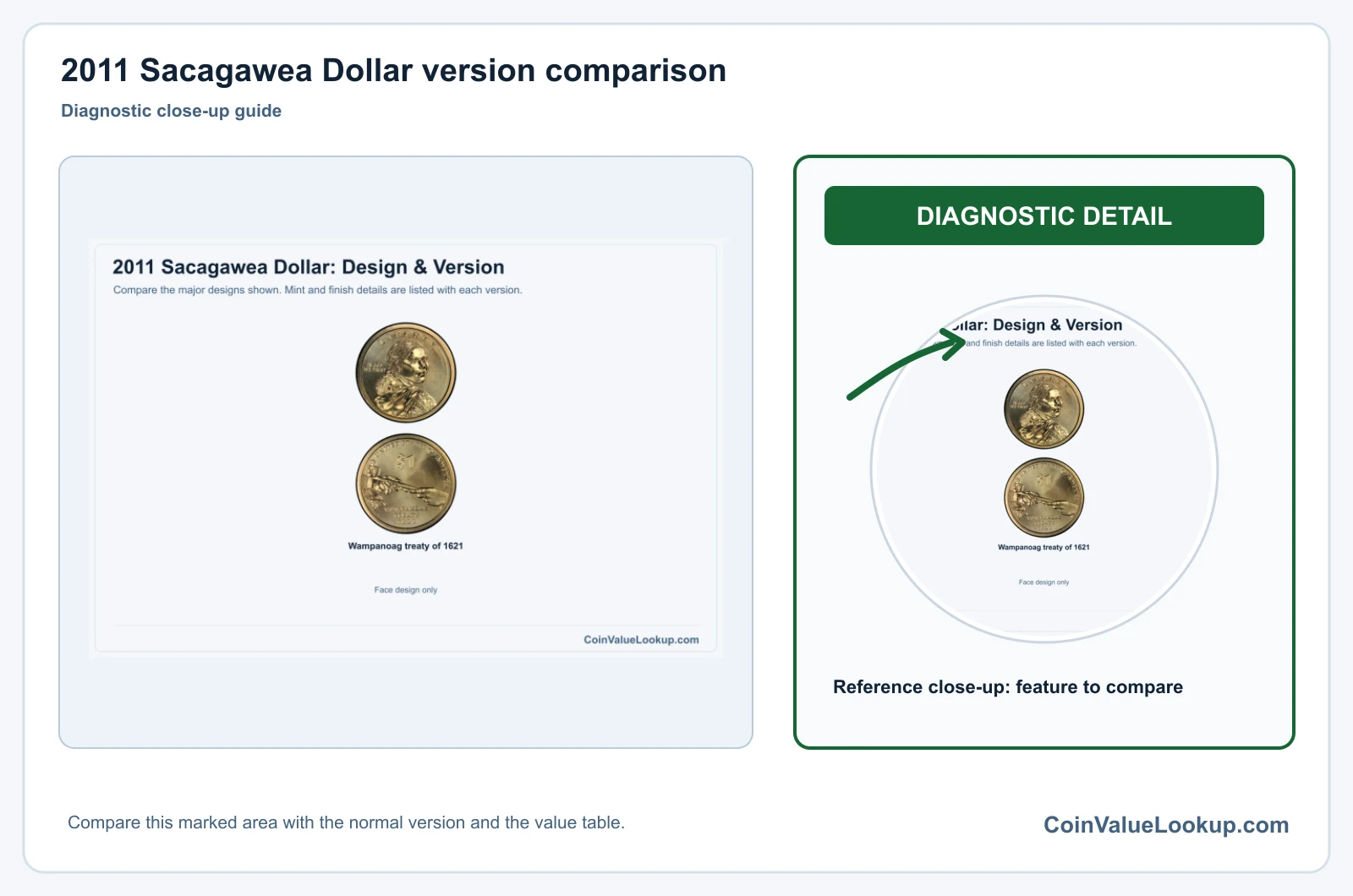
The 2011 Sacagawea Dollar features the Wampanoag Treaty of 1621 reverse design and comes in several collectible branches. Guide estimates for explicitly listed grades and versions range from about $6.25 to $10.00, depending on mint, finish and condition.
These are guide estimates, not guaranteed offers. Most circulated examples spend at face value, so the key is knowing which branch you actually have.
Fast Way to Identify Your 2011 Sacagawea Dollar
The quickest way to start is to snap clear photos of both sides of your coin and upload them here. Our identifier can give you a preliminary read on mint, design and finish from your front and back images.
That first step helps you zero in on the right version before you dig into grading or error hunting.
2011 Sacagawea Dollar Value
Upload both sides of your 2011 Sacagawea Dollar.
Front Obverse
Upload photo
Back Reverse
Upload photo
Which 2011 Sacagawea Dollar Versions Are Worth Money?
- S proof from San Francisco carries a guide estimate of about $10.00 at PR65, the highest listed value among 2011 Sacagawea branches.
- Verify your coin's edge lettering position (A or B) and mintmark before assuming any premium — most P and D examples trade near face value in circulated condition.
Step 1: Identify Your 2011 Sacagawea Dollar Mint Mark and Version
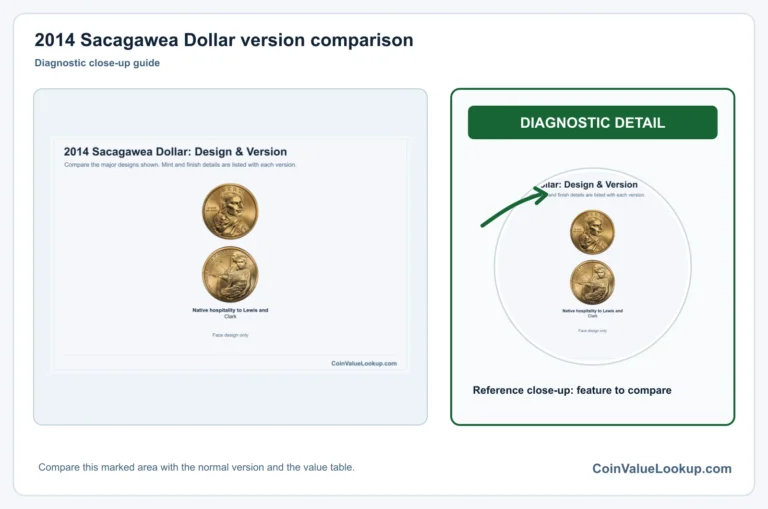
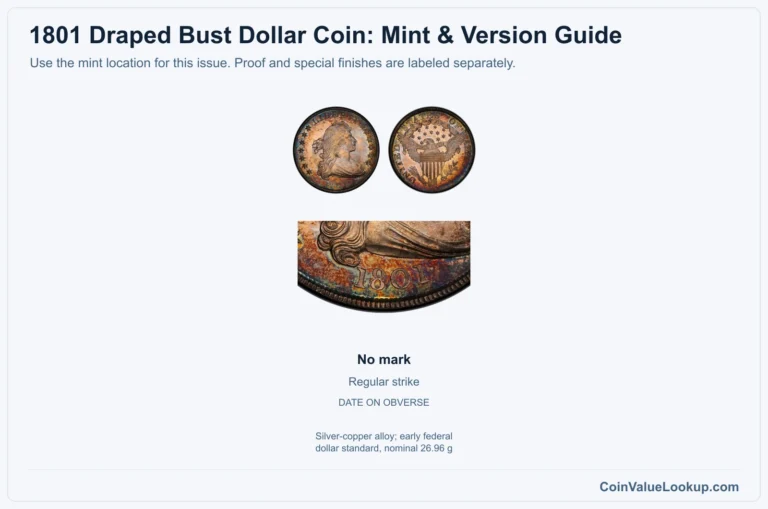
Starting in 2009, Sacagawea Dollars moved the date and mintmark to the incuse edge lettering, so flip the coin on its side to find them. The 2011 reverse shows the Wampanoag Treaty of 1621 scene.
Do not confuse the golden color with gold content. The coin is manganese-brass clad, composed of 88.5% copper, 6% zinc, 3.5% manganese and 2% nickel, weighing 8.10 grams.
Five distinct branches exist for 2011. Philadelphia (P) and Denver (D) business strikes each come in Position A and Position B, referring to the orientation of the edge lettering relative to the obverse.
The San Francisco (S) proof is a separate collector finish altogether. To tell Position A from Position B, hold the obverse facing you and read the edge.
If the inscriptions read normally from that orientation, it is Position A; if they are upside down, Position B.
Coin Value Lookup is a useful starting point if you are sorting through other dates or denominations in the Sacagawea series. You can look up guides for different years and mints without digging through multiple sites.
Step 2: Check Your 2011 Sacagawea Dollar Grade
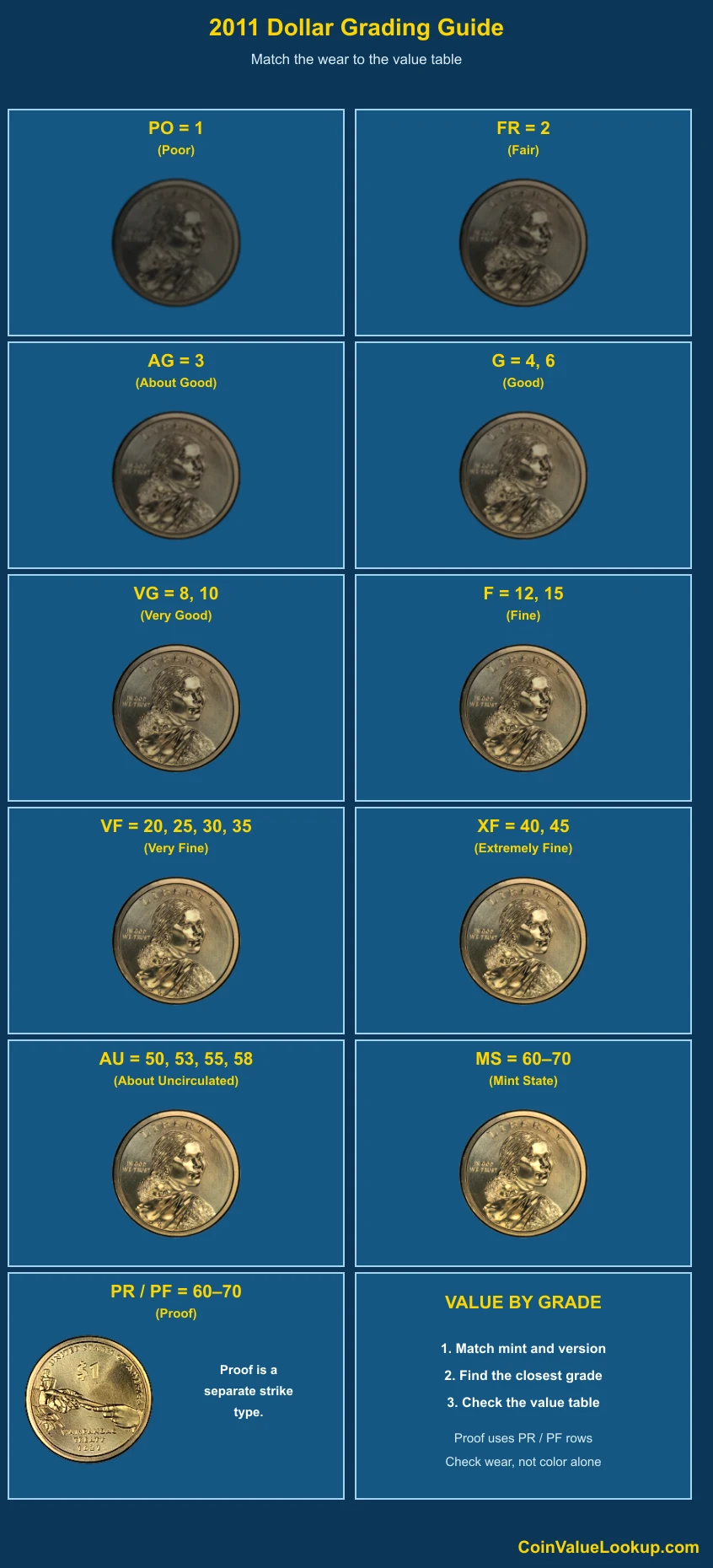
On business strikes, check Sacagawea's cheek and the high points of her hair first. These areas lose detail quickly in circulation.
The child on her back and the raised features on the treaty reverse are also reliable wear indicators.
A coin with full luster and no post-mint contact marks is heading toward Mint State territory. Light friction on the cheek alone usually means About Uncirculated.
Heavy, flat wear across the hair and reverse figures drops you into lower circulated grades.
For the S proof, you are comparing manufacturing quality, not brightness. Proofs should show sharp contrast between mirrored fields and frosted devices.
Hairlines from mishandling lower the proof grade. Do not compare proof finish directly against business-strike luster.
Use the comparison image to see how wear stages look on this specific coin type, keeping business strikes and proofs in their own lanes.
Step 3: Check 2011 Sacagawea Dollar Value by Mint and Version
2011 Sacagawea Dollar — P — Wampanoag treaty of 1621 — Position A
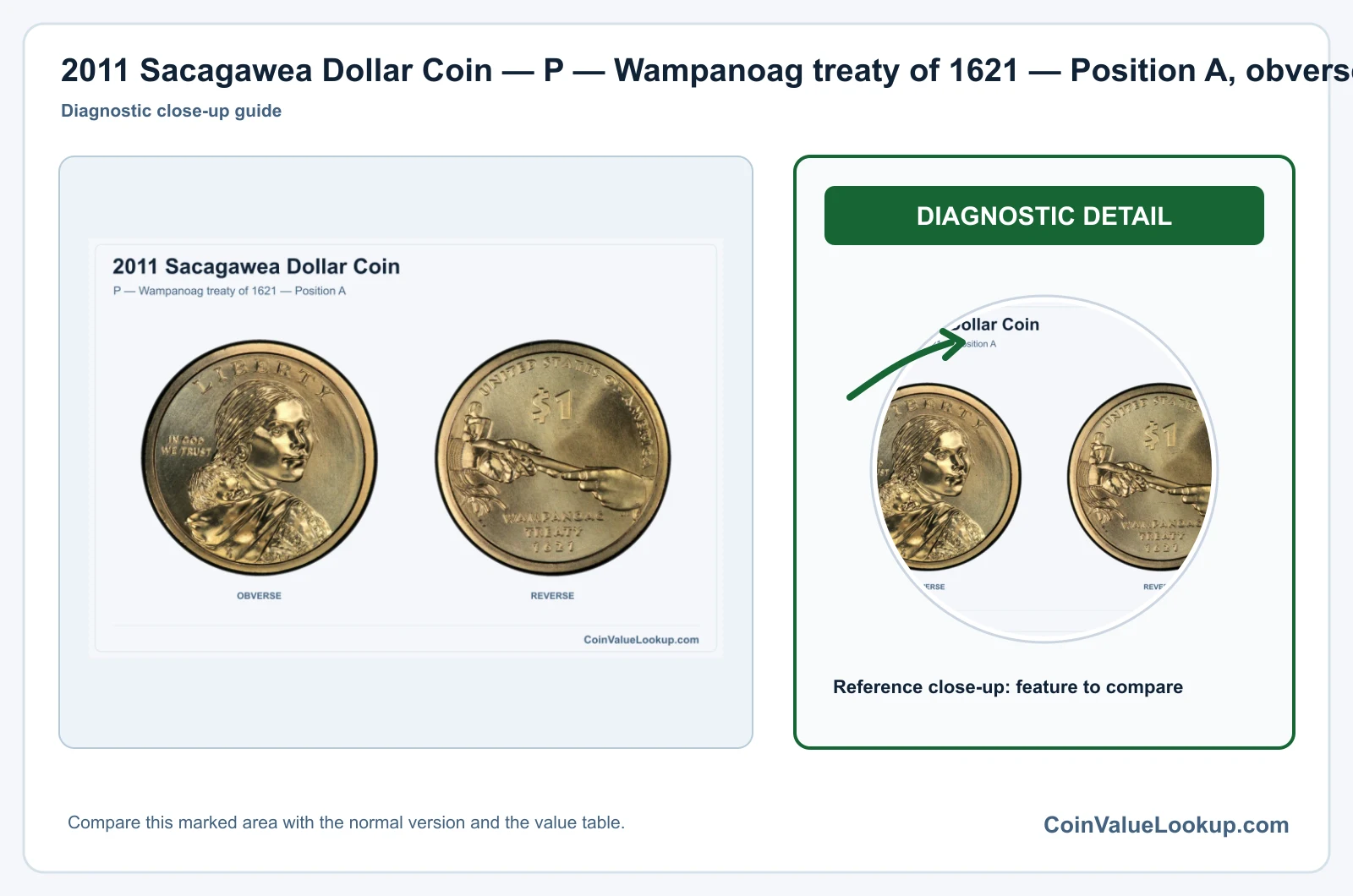
This is the Philadelphia business strike with Position A edge lettering. Hold the obverse facing you and read the edge inscriptions; if they read normally from that orientation, you have Position A.
The reverse depicts the Wampanoag Treaty of 1621. A guide estimate places this coin at about $6.25 in MS65, a gem uncirculated grade.
Circulated examples are worth face value. Look for full luster and minimal bag marks to land near that MS65 neighborhood.
Range Grade
Price Auction Records Appraisal PO PO 1
—
Coin Identifier FR FR 2
—
Coin Identifier AG AG 3
—
Coin Identifier G G 4
—
Coin Identifier
G 6
—
Coin Identifier VG VG 8
—
Coin Identifier
VG 10
—
Coin Identifier F F 12
—
Coin Identifier
F 15
—
Coin Identifier VF VF 20
—
Coin Identifier
VF 25
—
Coin Identifier
VF 30
—
Coin Identifier
VF 35
—
Coin Identifier XF XF 40
—
Coin Identifier
XF 45
—
Coin Identifier AU AU 50
—
Coin Identifier
AU 53
—
Coin Identifier
AU 55
—
Coin Identifier
AU 58
—
Coin Identifier MS MS 60
—
Coin Identifier
MS 61
—
Coin Identifier
MS 62
—
Coin Identifier
MS 63
—
Coin Identifier
MS 64
—
Coin Identifier
MS 65
—
Coin Identifier
MS 66
—
Coin Identifier
MS 67
Coin Identifier
MS 68
Coin Identifier
MS 69
—
—
—
MS 70
—
—
—
2011 Sacagawea Dollar — P — Wampanoag treaty of 1621 — Position B
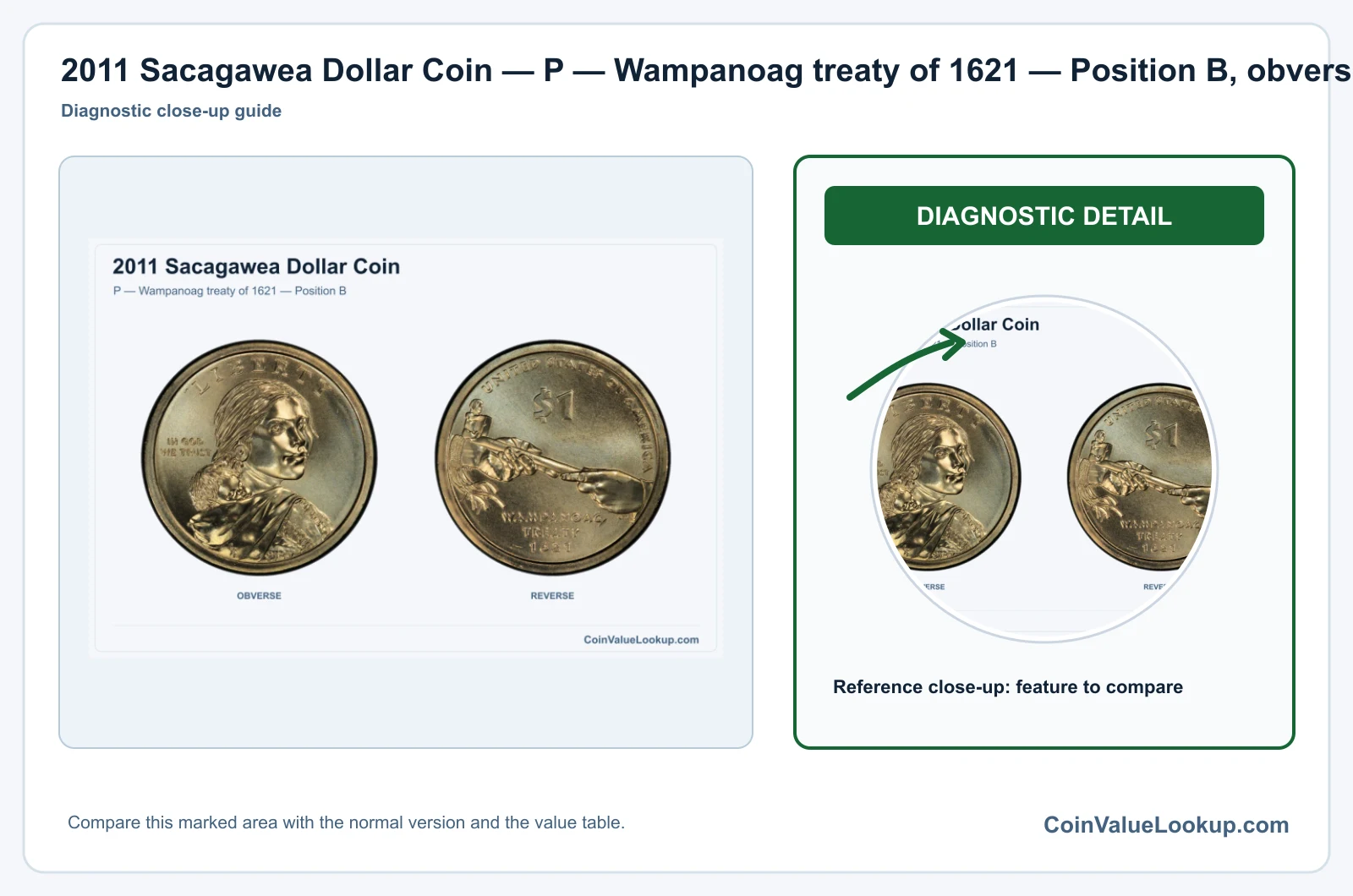
Same Philadelphia mint, same Wampanoag Treaty reverse, but the edge lettering is inverted relative to the obverse — that makes it Position B. Functionally identical in composition and weight (8.10 grams, manganese-brass clad).
The guide estimate is also about $6.25 at MS65. Position B is not rarer or more valuable than Position A for this date; both are standard production orientations.
Condition drives any premium over face value.
Range Grade
Price Auction Records Appraisal PO PO 1
—
Coin Identifier FR FR 2
—
Coin Identifier AG AG 3
—
Coin Identifier G G 4
—
Coin Identifier
G 6
—
Coin Identifier VG VG 8
—
Coin Identifier
VG 10
—
Coin Identifier F F 12
—
Coin Identifier
F 15
—
Coin Identifier VF VF 20
—
Coin Identifier
VF 25
—
Coin Identifier
VF 30
—
Coin Identifier
VF 35
—
Coin Identifier XF XF 40
—
Coin Identifier
XF 45
—
Coin Identifier AU AU 50
—
Coin Identifier
AU 53
—
Coin Identifier
AU 55
—
Coin Identifier
AU 58
—
Coin Identifier MS MS 60
—
Coin Identifier
MS 61
—
Coin Identifier
MS 62
—
Coin Identifier
MS 63
—
Coin Identifier
MS 64
—
Coin Identifier
MS 65
—
Coin Identifier
MS 66
—
Coin Identifier
MS 67
Coin Identifier
MS 68
—
Coin Identifier
MS 69
—
—
—
MS 70
—
—
—
2011 Sacagawea Dollar — D — Wampanoag treaty of 1621 — Position A
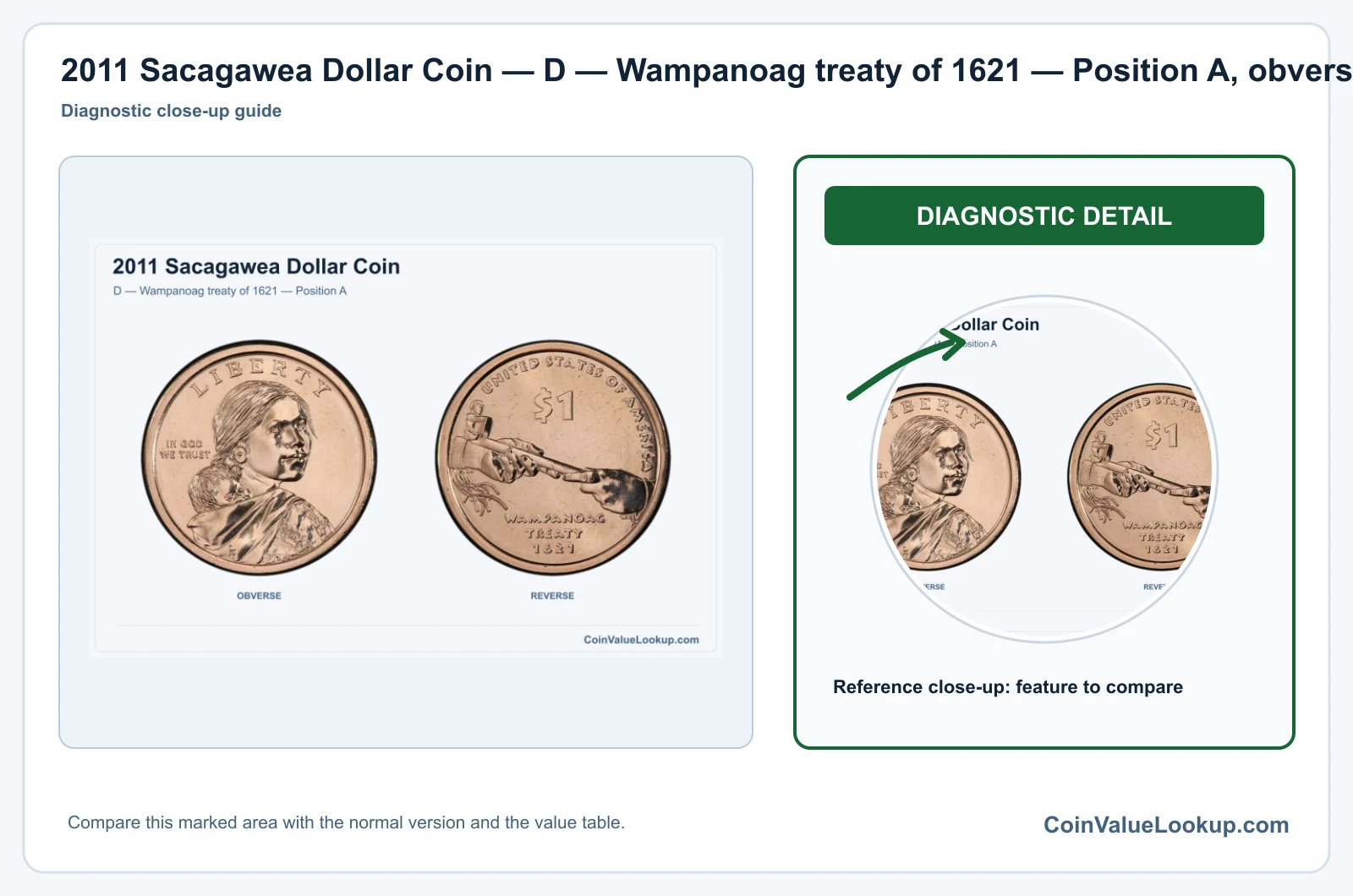
Denver's Position A entry mirrors its Philadelphia counterpart in design and composition. Look for the D mintmark incuse on the edge.
The guide estimate sits at approximately $6.25 in MS65. As with all business-strike Sacagaweas, circulated pieces are spenders.
A clean, lustrous example pulled from a mint roll is your best shot at a grade worth tracking.
Range Grade
Price Auction Records Appraisal PO PO 1
—
Coin Identifier FR FR 2
—
Coin Identifier AG AG 3
—
Coin Identifier G G 4
—
Coin Identifier
G 6
—
Coin Identifier VG VG 8
—
Coin Identifier
VG 10
—
Coin Identifier F F 12
—
Coin Identifier
F 15
—
Coin Identifier VF VF 20
—
Coin Identifier
VF 25
—
Coin Identifier
VF 30
—
Coin Identifier
VF 35
—
Coin Identifier XF XF 40
—
Coin Identifier
XF 45
—
Coin Identifier AU AU 50
—
Coin Identifier
AU 53
—
Coin Identifier
AU 55
—
Coin Identifier
AU 58
—
Coin Identifier MS MS 60
—
Coin Identifier
MS 61
—
Coin Identifier
MS 62
—
Coin Identifier
MS 63
—
Coin Identifier
MS 64
—
Coin Identifier
MS 65
—
Coin Identifier
MS 66
—
Coin Identifier
MS 67
Coin Identifier
MS 68
—
Coin Identifier
MS 69
—
—
—
MS 70
—
—
—
2011 Sacagawea Dollar — D — Wampanoag treaty of 1621 — Position B
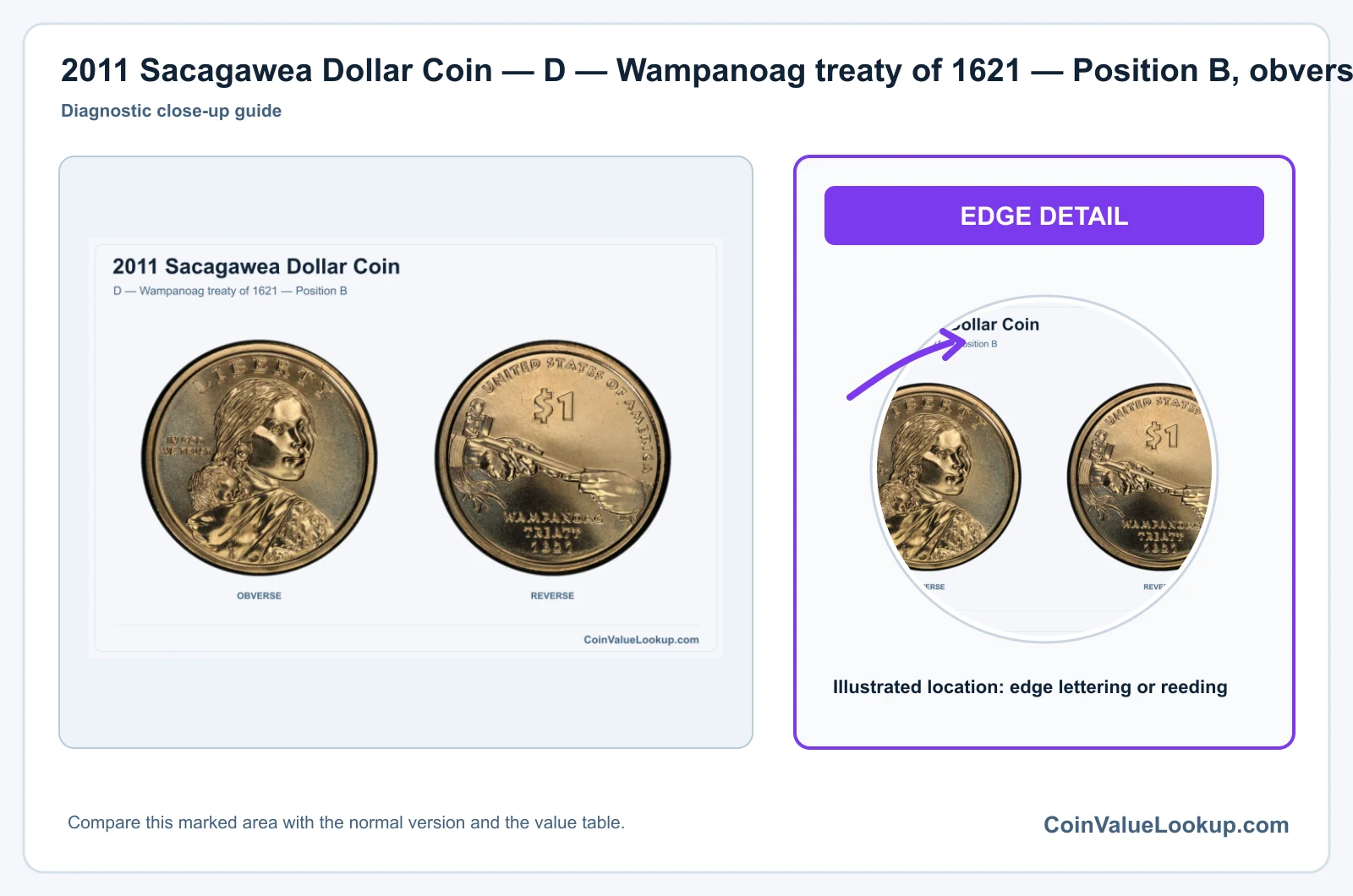
The Denver Position B version has the edge lettering flipped relative to the obverse, just like the Philadelphia Position B. Same manganese-brass clad composition, same 8.10-gram weight, same Wampanoag Treaty reverse.
Guide estimate: about $6.25 at MS65. Neither edge-lettering position commands a premium over the other for the 2011 D date.
Keeping these in original mint packaging helps preserve the surface quality that matters for grading.
Range Grade
Price Auction Records Appraisal PO PO 1
—
Coin Identifier FR FR 2
—
Coin Identifier AG AG 3
—
Coin Identifier G G 4
—
Coin Identifier
G 6
—
Coin Identifier VG VG 8
—
Coin Identifier
VG 10
—
Coin Identifier F F 12
—
Coin Identifier
F 15
—
Coin Identifier VF VF 20
—
Coin Identifier
VF 25
—
Coin Identifier
VF 30
—
Coin Identifier
VF 35
—
Coin Identifier XF XF 40
—
Coin Identifier
XF 45
—
Coin Identifier AU AU 50
—
Coin Identifier
AU 53
—
Coin Identifier
AU 55
—
Coin Identifier
AU 58
—
Coin Identifier MS MS 60
—
Coin Identifier
MS 61
—
Coin Identifier
MS 62
—
Coin Identifier
MS 63
—
Coin Identifier
MS 64
—
Coin Identifier
MS 65
—
Coin Identifier
MS 66
—
Coin Identifier
MS 67
—
Coin Identifier
MS 68
—
Coin Identifier
MS 69
—
—
—
MS 70
—
—
—
2011 Sacagawea Dollar — S — Wampanoag treaty of 1621 — proof
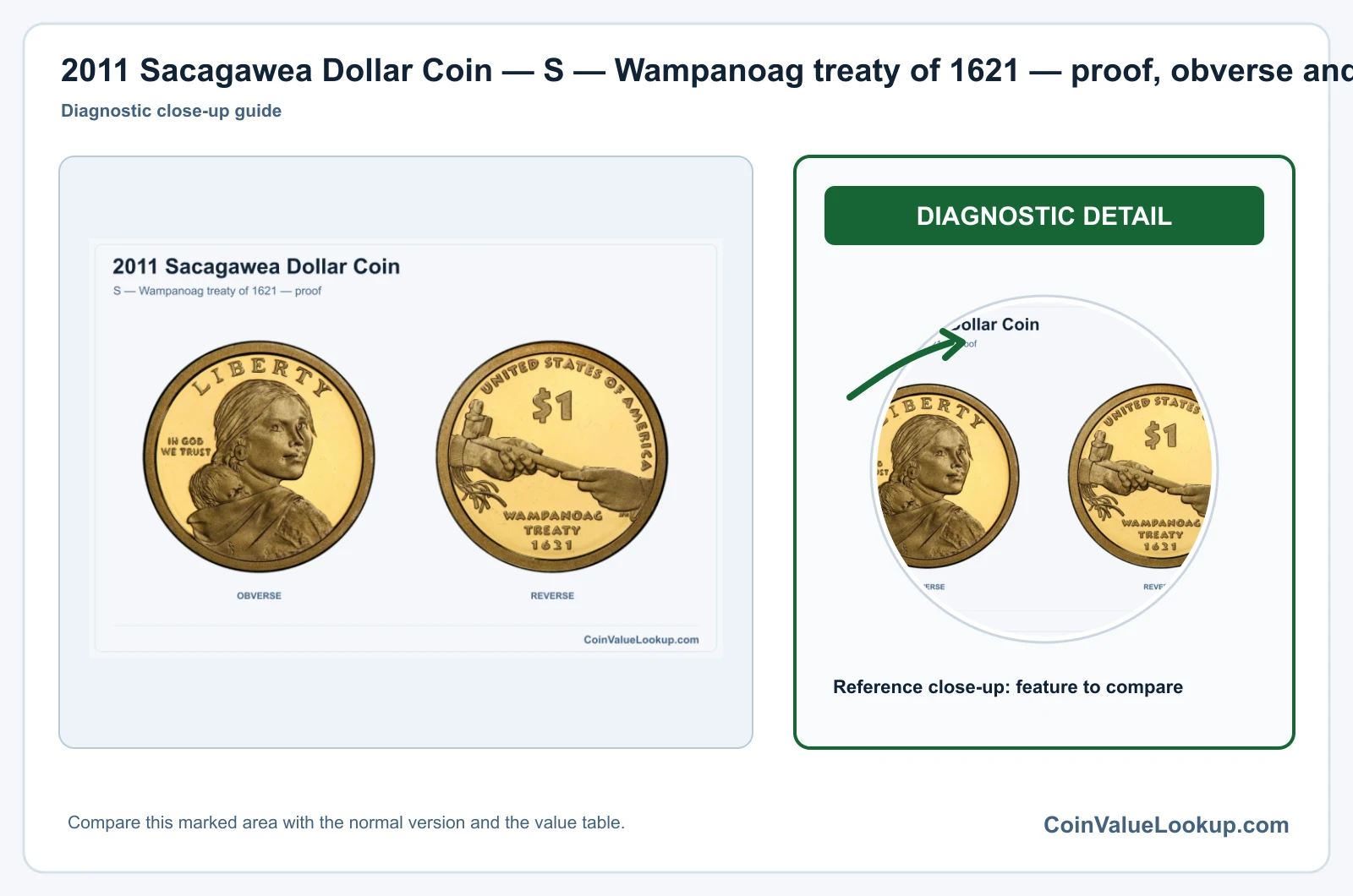
The San Francisco proof is struck on the same manganese-brass clad planchet, not silver, even if it came in a set alongside silver proof quarters or dimes. The mirrored fields and frosted devices distinguish it from any business strike.
A guide estimate of about $10.00 at PR65 makes it the highest-valued standard branch for this year. Look for clean, hairline-free fields when evaluating grade.
Proofs that have been removed from their capsules and handled bare-handed often pick up distracting surface imperfections that pull them below PR65. Keep it in the original government packaging if you can.
Range Grade
Price Auction Records Appraisal PR PR 1
—
Coin Identifier
PR 2
—
Coin Identifier
PR 3
—
Coin Identifier
PR 4
—
Coin Identifier
PR 6
—
Coin Identifier
PR 8
—
Coin Identifier
PR 10
—
Coin Identifier
PR 12
—
Coin Identifier
PR 15
—
Coin Identifier
PR 20
—
Coin Identifier
PR 25
—
Coin Identifier
PR 30
—
Coin Identifier
PR 35
—
Coin Identifier
PR 40
—
Coin Identifier
PR 45
—
Coin Identifier
PR 50
—
Coin Identifier
PR 53
—
Coin Identifier
PR 55
—
Coin Identifier
PR 58
—
Coin Identifier
PR 60
—
Coin Identifier
PR 61
—
Coin Identifier
PR 62
—
Coin Identifier
PR 63
—
Coin Identifier
PR 64
—
Coin Identifier
PR 65
—
Coin Identifier
PR 66
—
Coin Identifier
PR 67
—
Coin Identifier
PR 68
—
Coin Identifier
PR 69
Coin Identifier
PR 70
Coin Identifier
2011 Sacagawea Dollar Error List
1. 2011 Sacagawea Dollar — Weak / Partial Edge Lettering
Weak or partial edge lettering has been reported on 2011 Sacagawea Dollars. The diagnostic is straightforward: examine the full circumference for incuse letters that are unusually faint, shallow or interrupted compared to a normal example.
Photograph the edge closely, retaining images of whatever lettering remains visible.
Be cautious with this one. Ordinary Sacagawea edge lettering can appear slightly shallow under certain lighting, and circulation wear naturally softens incuse letters over time.
Deliberate sanding or abrasion can also mimic the look. A genuine weak-strike error shows consistent weakness, not isolated rubbed spots.
No specific price range is available here; value depends on the severity of the weakness, overall coin condition and buyer interest in the specific error.
2. 2011 Sacagawea Dollar — Doubled Edge Lettering
Doubled edge lettering errors have been reported for the 2011 Sacagawea Dollar. On an affected coin, you can see two overlapping or offset sets of incuse inscriptions running around the edge.
This is distinct from the normal Position A versus Position B orientation, which is simply a single set of lettering in one direction or the other.
Before getting excited, rule out optical illusions. Reflections in the incuse channels, camera angles and even comparing two different photos of the same edge can create the false impression of doubling.
A genuine doubled-edge coin will show a physically repeated impression when examined under magnification. No adopted price range is available for this error; the coin's value depends on visibility, condition and the degree of offset between the two impressions.