1950 Franklin Half Dollar Coin Value: How Much Is It Worth?
The 1950 Franklin Half Dollar is a 90% silver coin that draws steady collector interest thanks to its metal content and limited surviving population in higher grades. Guide estimates for the year's branches range from about $32.00 in well-worn condition up to $947.00 for a gem proof, depending on mint, grade and finish.
These figures are guide anchors from USA Coin Book, not guaranteed selling prices or current silver-melt quotes. Condition, originality and the presence of Full Bell Lines detail can all shift the premium.
Fast Way to Identify Your 1950 Franklin Half Dollar
Want a quick read on what you have? Upload clear photos of both the front and back of your 1950 Franklin Half Dollar, and our identifier can give you a preliminary take on the mint, finish and approximate version.
Good lighting and a steady shot go a long way — try to avoid glare on the silver surfaces.
1950 Franklin Half Dollar Value
Upload both sides of your 1950 Franklin Half Dollar.
Front Obverse
Upload photo
Back Reverse
Upload photo
Which 1950 Franklin Half Dollar Versions Are Worth Money?
- The 1950-D in MS65 carries a guide estimate of $267.00, the highest business-strike anchor for this date, making it worth checking your mintmark.
- The 1950 proof (PR65) is listed at $947.00 — confirm mirrored fields and sharp devices before assuming you hold one.
- Full Bell Lines detail on either business strike can push premiums above the standard grade estimate, but the lines must be fully intact under magnification.
Step 1: Identify Your 1950 Franklin Half Dollar Mint Mark and Version
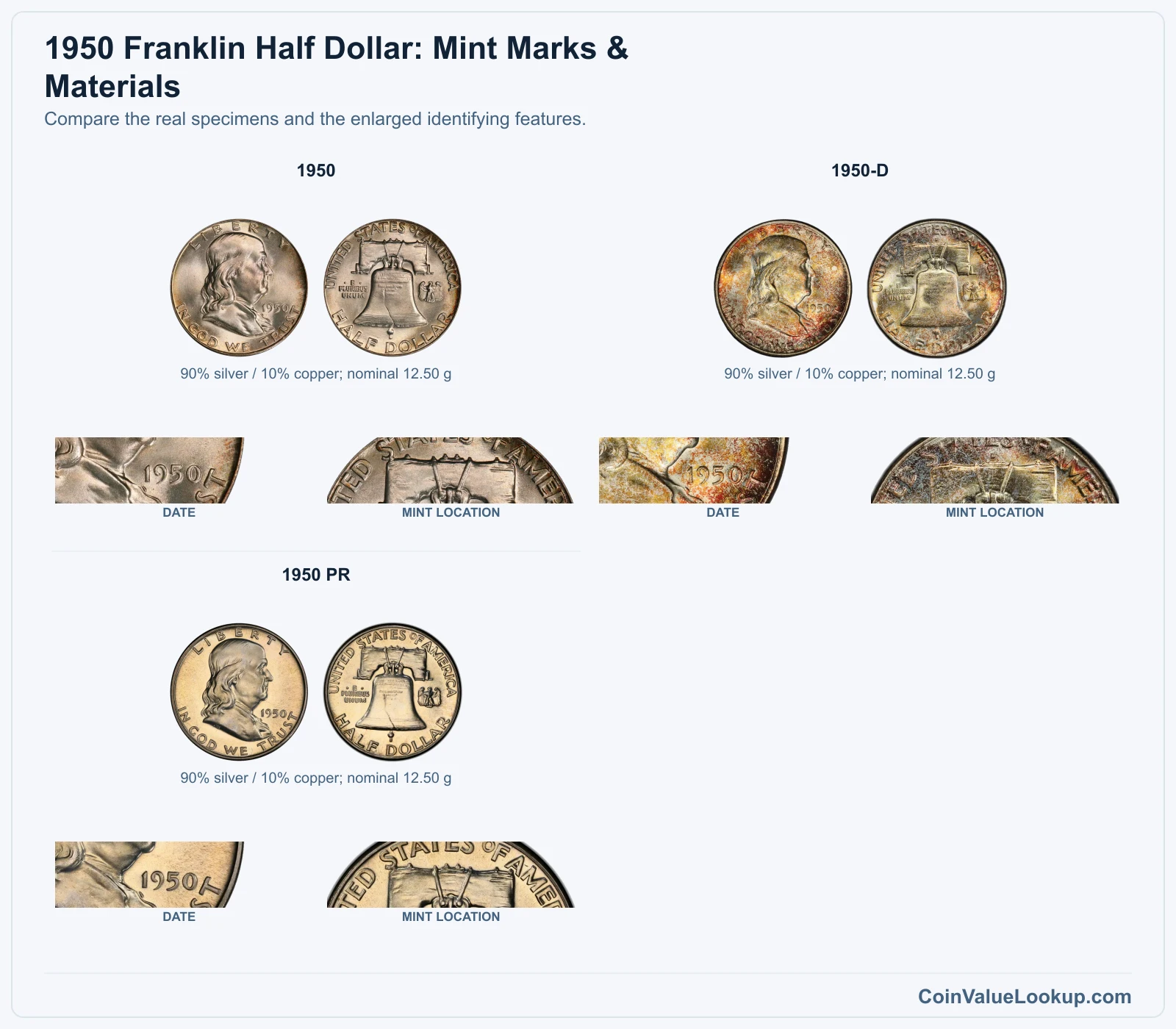
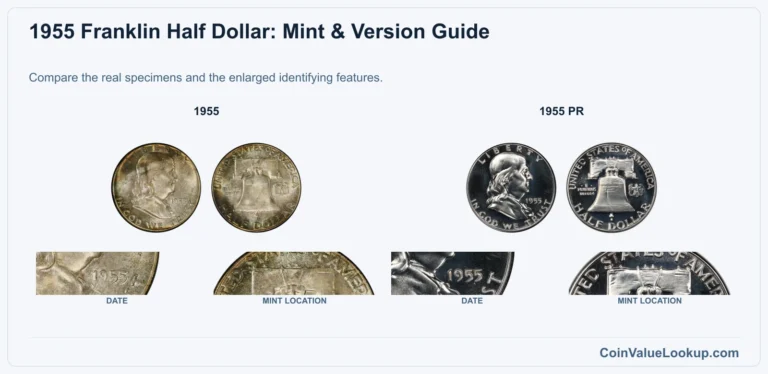
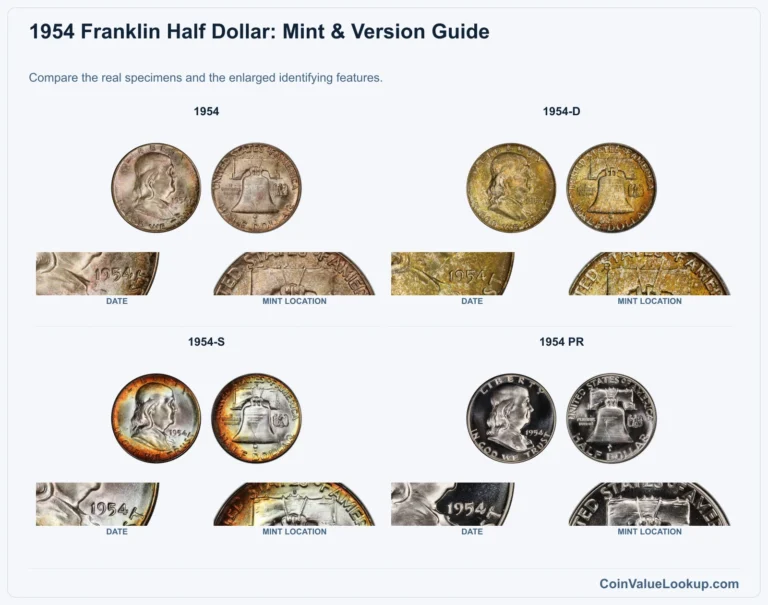
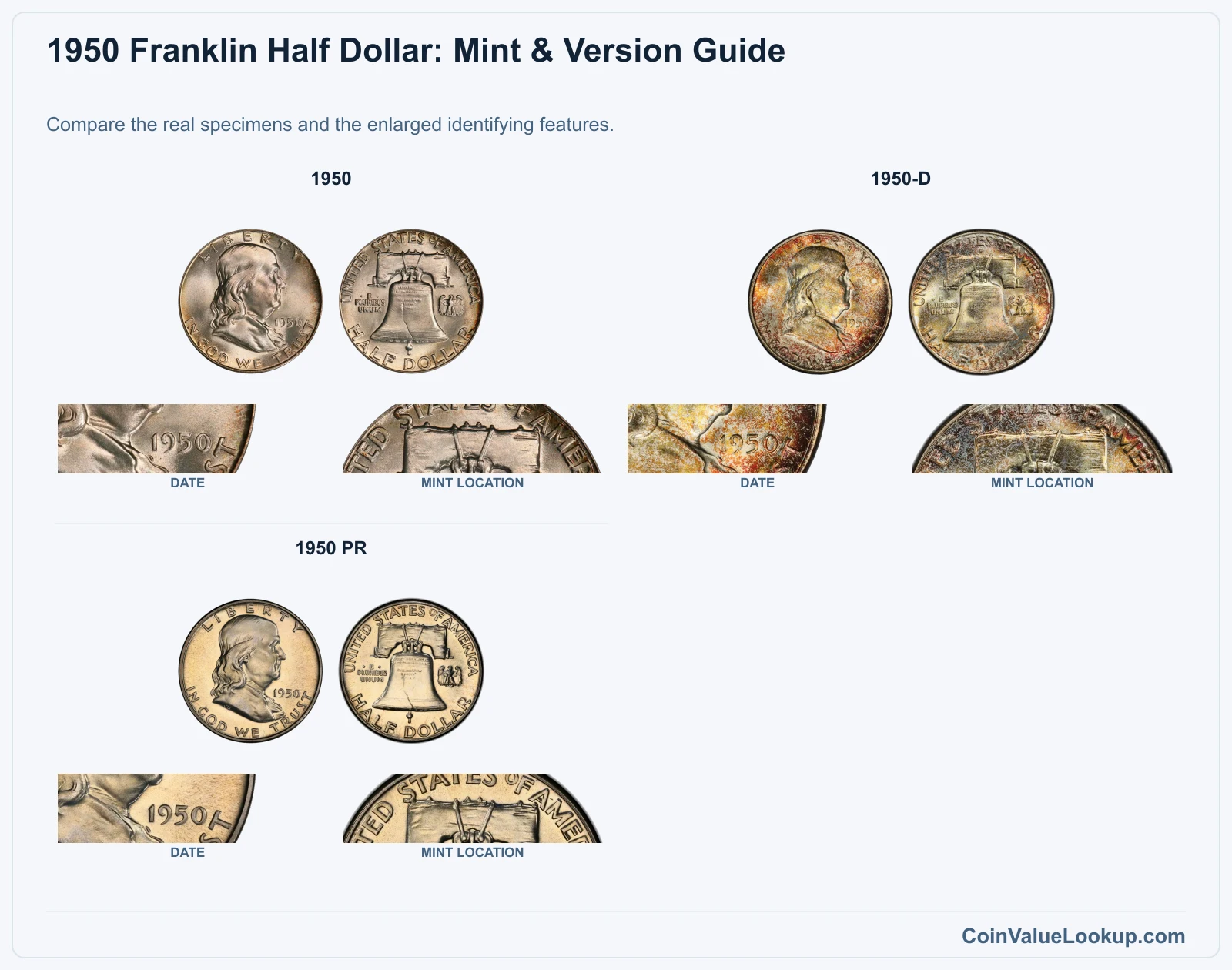
Three branches exist for this date: the 1950 Philadelphia business strike (no mintmark), the 1950-D Denver business strike, and the 1950 Philadelphia proof.
Flip the coin over. The mintmark sits on the reverse, above the Liberty Bell and just below E PLURIBUS UNUM.
If you see a small "D" there, you have the Denver issue. No letter at all means Philadelphia.
Proofs are a different animal. They were struck at Philadelphia for collectors, and you will see deeply mirrored fields — almost glass-like — with crisp, razor-sharp devices.
A polished circulated coin is not a proof, no matter how shiny someone made it. If the fields look reflective but the devices are mushy, it has just been cleaned.
All three versions share the same alloy: 90% silver and 10% copper at a nominal weight of 12.50 grams. Toning — those rainbow or golden hues — does not change the underlying metal.
Original, untampered surfaces are always preferred over coins that have been dipped, polished or otherwise "improved."
Step 2: Check Your 1950 Franklin Half Dollar Grade
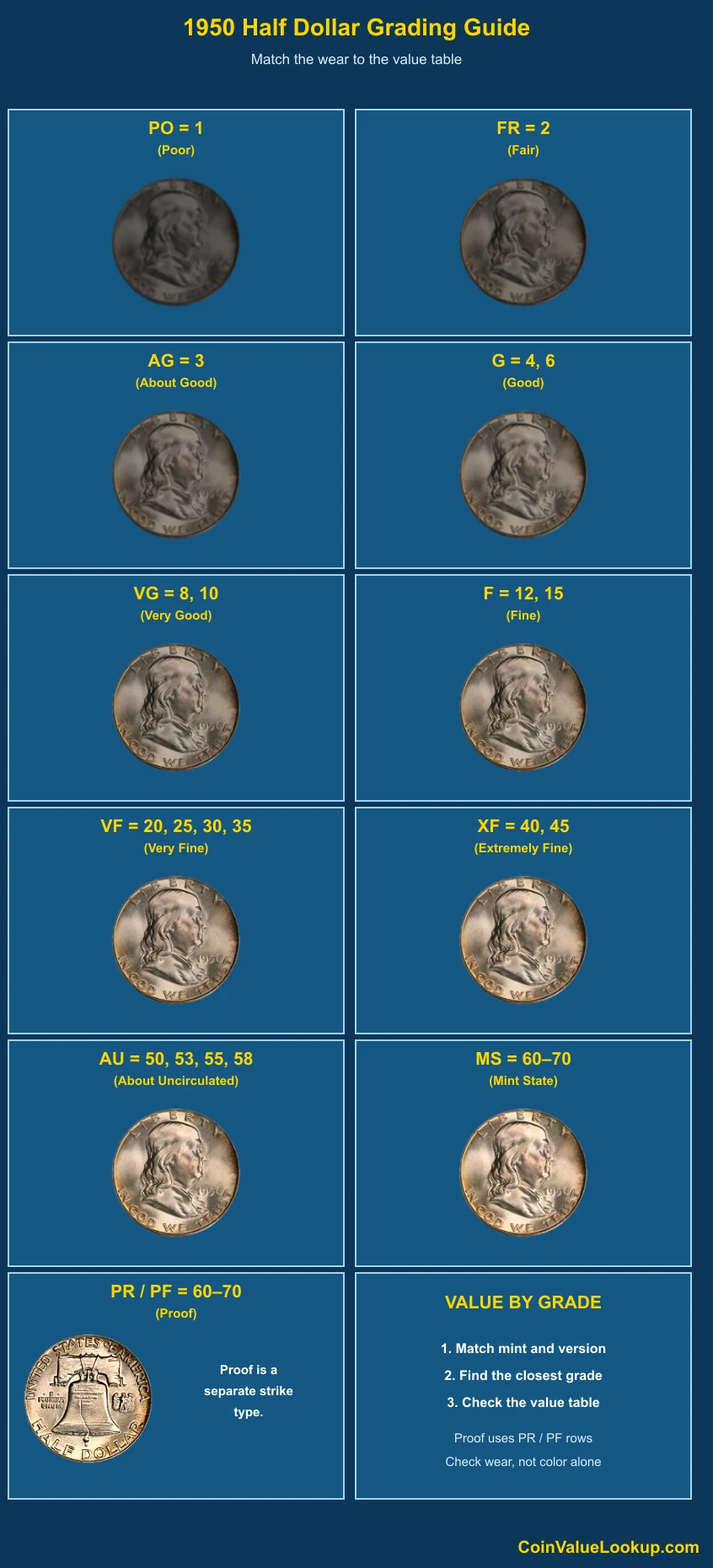
Start with Franklin's cheek. On a lightly circulated coin, you will see the first flattening right there, plus on the high points of the hair behind his ear and on his shoulder.
Compare your coin to a same-type reference image to see where wear appears at each grade level.
On the reverse, check the lettering around the Liberty Bell and the lower bell lines. Full Bell Lines (FBL) is a strike-quality designation, not a separate grade — it means the horizontal lines at the bottom of the bell are complete and unbroken.
Weak strikes can look like wear, so compare carefully.
For proofs, forget about wear. Instead, look for hairlines from mishandling, haze from improper storage, and whether the fields retain their original mirror finish.
Contact marks — little dings from other coins — are different from the smooth loss of detail you see on a circulated piece. Learning that distinction saves a lot of confusion.
Step 3: Check 1950 Franklin Half Dollar Value by Mint and Version
1950 Franklin Half Dollar
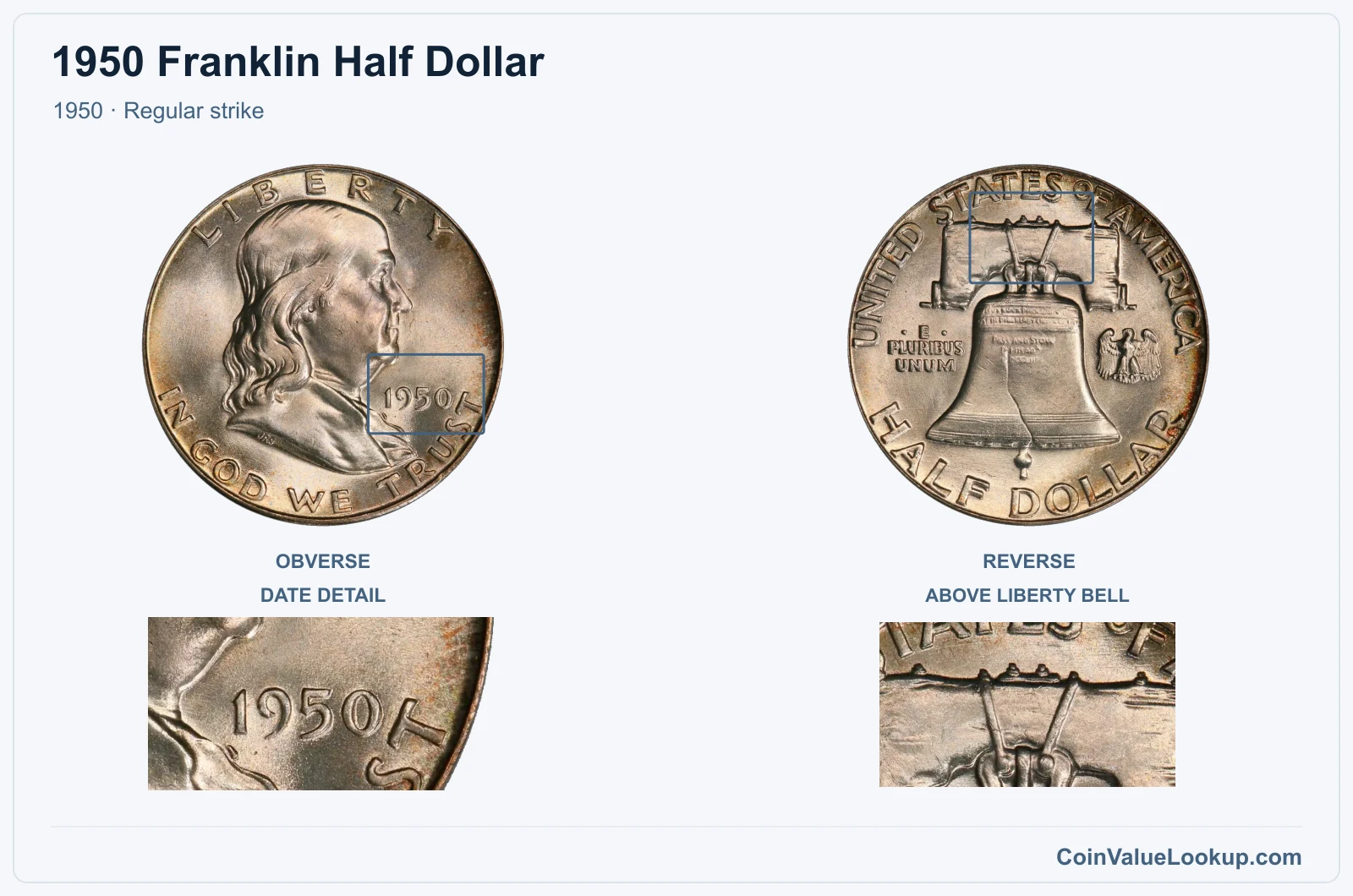
The 1950 Philadelphia half dollar is the no-mintmark business strike. Look at the reverse above the Liberty Bell — if the space below E PLURIBUS UNUM is empty, this is your coin.
Guide estimates from USA Coin Book place a well-worn G4 example around $32.00 and a gem MS65 around $140.00.
Silver content provides a floor, but a cleaned or damaged coin will not bring the same premium as a problem-free piece with original surfaces. Full Bell Lines is a strike-detail designation that can add value when the lower bell lines are fully intact — it is not a different mint or metal variety.
Coin Value Lookup is a good starting point if you want to compare this coin against other Franklin dates and denominations. You can look up guides for the full series in one place.
Range Grade
Price Auction Records Appraisal PO PO 1
—
Coin Identifier FR FR 2
—
Coin Identifier AG AG 3
—
Coin Identifier G G 4
—
Coin Identifier
G 6
—
Coin Identifier VG VG 8
—
Coin Identifier
VG 10
—
Coin Identifier F F 12
—
Coin Identifier
F 15
—
Coin Identifier VF VF 20
—
Coin Identifier
VF 25
—
Coin Identifier
VF 30
—
Coin Identifier
VF 35
—
Coin Identifier XF XF 40
—
Coin Identifier
XF 45
—
Coin Identifier AU AU 50
—
Coin Identifier
AU 53
—
Coin Identifier
AU 55
Coin Identifier
AU 58
Coin Identifier MS MS 60
—
Coin Identifier
MS 61
Coin Identifier
MS 62
Coin Identifier
MS 63
Coin Identifier
MS 64
Coin Identifier
MS 65
Coin Identifier
MS 66
Coin Identifier
MS 67
—
Coin Identifier
MS 68
—
—
—
MS 69
—
—
—
MS 70
—
—
—
1950 Franklin Half Dollar — D
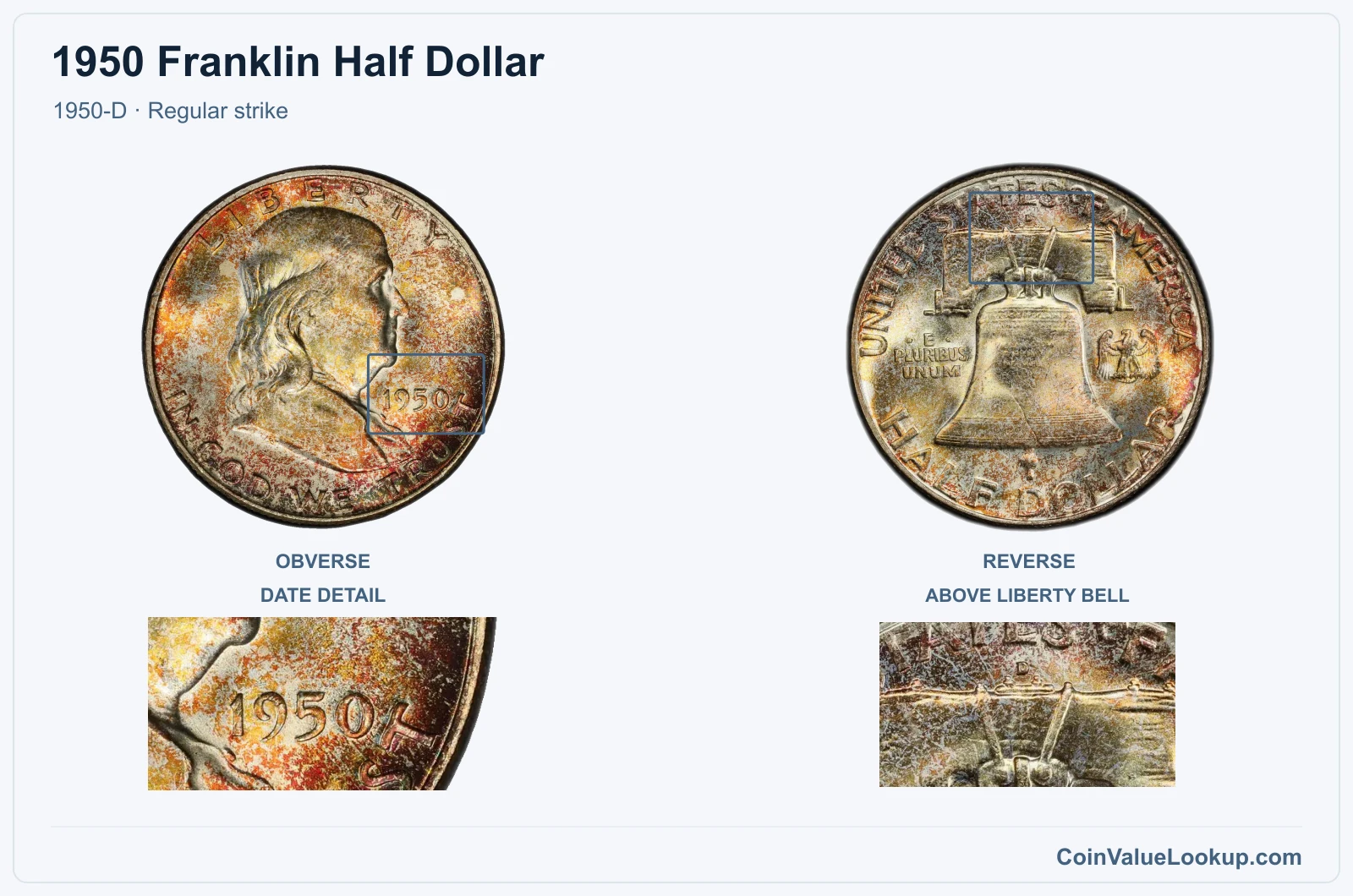
The 1950-D was struck at the Denver Mint. You will find a small "D" on the reverse, above the Liberty Bell.
In low grades (G4), guide estimates sit around $32.00 — essentially the same as Philadelphia. But at the MS65 level the Denver coin jumps to roughly $267.00, nearly double the Philadelphia business strike.
That gap usually reflects how many survived in top condition, not a difference in total mintage alone. As with any Franklin, check for original surfaces.
Cleaning knocks the value down hard, even on a coin that otherwise looks sharp. Full Bell Lines examples command an additional premium when the detail is genuinely complete.
Range Grade
Price Auction Records Appraisal PO PO 1
—
Coin Identifier FR FR 2
—
Coin Identifier AG AG 3
—
Coin Identifier G G 4
—
Coin Identifier
G 6
—
Coin Identifier VG VG 8
—
Coin Identifier
VG 10
—
Coin Identifier F F 12
—
Coin Identifier
F 15
—
Coin Identifier VF VF 20
—
Coin Identifier
VF 25
—
Coin Identifier
VF 30
—
Coin Identifier
VF 35
—
Coin Identifier XF XF 40
—
Coin Identifier
XF 45
—
Coin Identifier AU AU 50
—
Coin Identifier
AU 53
—
Coin Identifier
AU 55
Coin Identifier
AU 58
Coin Identifier MS MS 60
—
Coin Identifier
MS 61
—
Coin Identifier
MS 62
Coin Identifier
MS 63
Coin Identifier
MS 64
Coin Identifier
MS 65
Coin Identifier
MS 66
Coin Identifier
MS 67
Coin Identifier
MS 68
—
—
—
MS 69
—
—
—
MS 70
—
—
—
1950 Franklin Half Dollar — PR
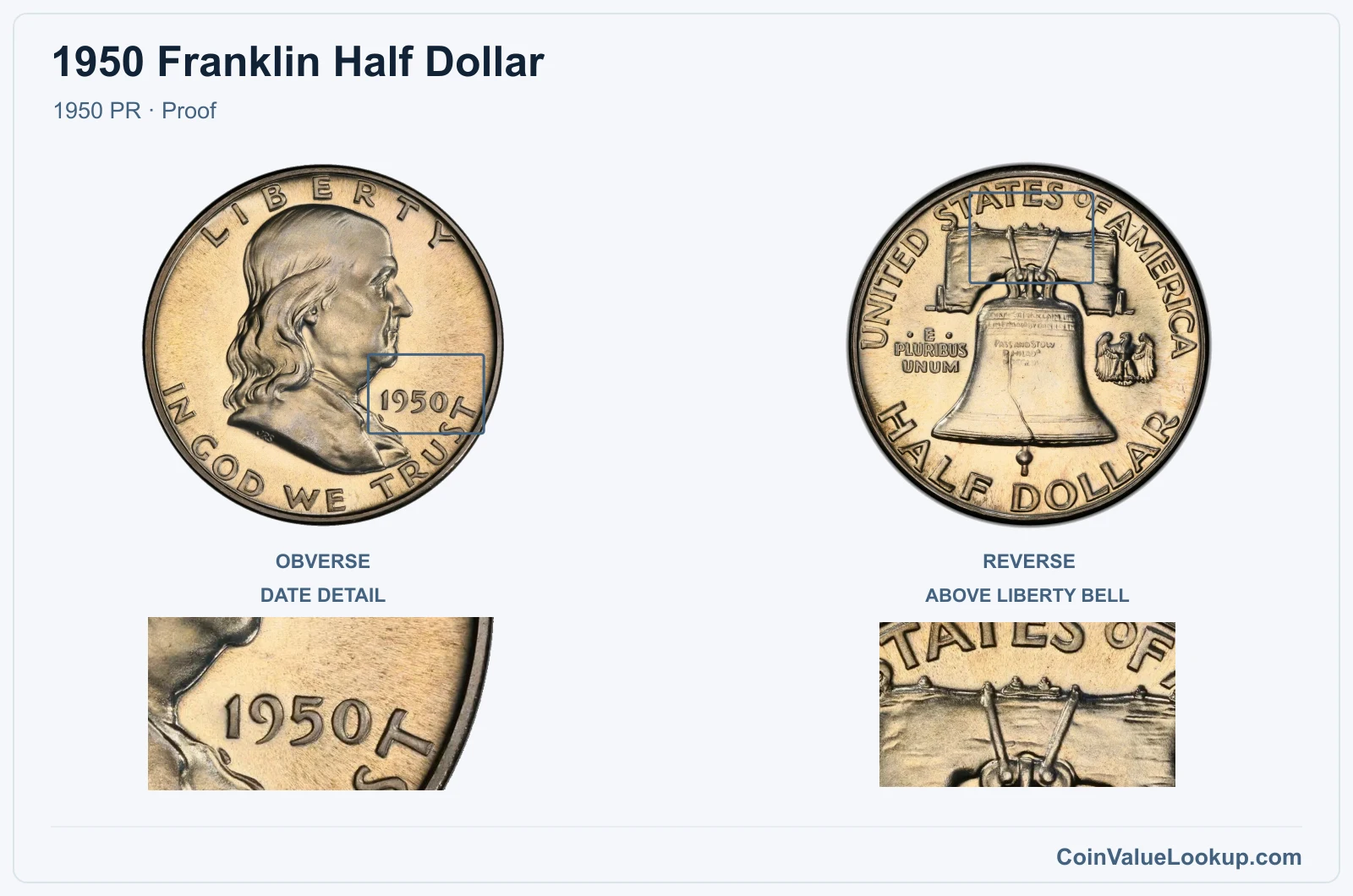
The 1950 proof was manufactured at Philadelphia specifically for collectors, using specially prepared dies. The fields should show a deep, mirror-like reflectiveness, and the devices — Franklin's portrait, the bell, the lettering — should be exceptionally sharp.
At PR65, the USA Coin Book guide estimate is $947.00, making this the highest-value branch for the date.
Before you celebrate, confirm what you actually have. Hairlines from wiping, haze from decades in a damp drawer, and the presence or absence of cameo contrast all affect the grade and desirability.
A polished business strike can fool you at first glance, but the devices will lack the proof's crispness and the reflectivity will look uneven rather than uniform. Handle by the edges and photograph in diffused light to reveal the true surface character.
Range Grade
Price Auction Records Appraisal PR PR 1
—
Coin Identifier
PR 2
—
Coin Identifier
PR 3
—
Coin Identifier
PR 4
—
Coin Identifier
PR 6
—
Coin Identifier
PR 8
—
Coin Identifier
PR 10
—
Coin Identifier
PR 12
—
Coin Identifier
PR 15
—
Coin Identifier
PR 20
—
Coin Identifier
PR 25
—
Coin Identifier
PR 30
—
Coin Identifier
PR 35
—
Coin Identifier
PR 40
—
Coin Identifier
PR 45
—
Coin Identifier
PR 50
—
Coin Identifier
PR 53
—
Coin Identifier
PR 55
Coin Identifier
PR 58
—
Coin Identifier
PR 60
Coin Identifier
PR 61
Coin Identifier
PR 62
Coin Identifier
PR 63
Coin Identifier
PR 64
Coin Identifier
PR 65
Coin Identifier
PR 66
Coin Identifier
PR 67
Coin Identifier
PR 68
Coin Identifier
PR 69
—
—
—
PR 70
—
—
—
1950 Franklin Half Dollar Error List
1. 1950 Franklin Half Dollar — Bugs Bunny Die Clash
The "Bugs Bunny" die clash on the 1950 Franklin Half Dollar gets its nickname from the way it looks: raised, tooth-like lines appear around Franklin's mouth and lip area, giving him a buck-toothed appearance. This happened when obverse and reverse dies struck each other without a planchet between them, transferring faint design elements to the wrong die.
To check, magnify Franklin's mouth and compare it to a normal 1950 half dollar at the same zoom level. The extra raised lines should be consistent and in the same position — not random scratches or contact marks.
Scratches tend to be sharper and less uniform. A brockage or random raised line from damage will not replicate the characteristic tooth pattern.
No specific price range is available for this variety. Value depends on the visibility of the clash, overall coin grade and surface condition.
Stronger, more obvious examples generally attract more collector attention.
2. 1950 Franklin Half Dollar — Lamination / Split Planchet
Lamination errors on the 1950 Franklin Half Dollar show up as peeling metal, a retained flap or a visible separation within the silver alloy. These defects originated in the planchet before striking — impurities or gas pockets in the metal caused layers to split apart.
Look along the surface for a raised area that appears to lift away from the coin's body. Photograph the affected face and the edge together so you can document the depth and extent of the separation.
A retained flap — one still attached — is generally more desirable than a missing piece.
Do not confuse lamination with post-mint damage. Scraping from a tool, corrosion pitting from environmental exposure and deliberately cut or filed areas can mimic a lamination at first glance.
Genuine laminations follow the contour of the planchet rather than showing sharp, tool-made edges.
No adopted price range is available. The value depends on the error's size, visibility and the coin's overall condition.
3. 1950 Franklin Half Dollar — Repunched Mintmark
Repunched mintmark (RPM) varieties have been reported on the 1950-D Franklin Half Dollar specifically. In that era, mintmarks were hand-punched into working dies, and sometimes the punch landed slightly off position, was corrected and punched again.
The result is a visible remnant of the first placement alongside the final "D."
Grab a loupe — 5x to 10x — and examine the D mintmark above the Liberty Bell. You are looking for traces of a second impression: a notch, a shadow or a partial letter slightly offset from the primary mark.
Compare what you see to a normal 1950-D at matching magnification so you have a baseline.
Machine doubling, small die chips and corrosion around the mintmark can all create a similar look. Machine doubling tends to appear flat and shelf-like, while a true RPM shows distinct, rounded letter forms.
No specific price range is available; value depends on the RPM's clarity, the coin's grade and overall eye appeal.