1845 Liberty Seated Half Dollar Coin Value: How Much Is It Worth?
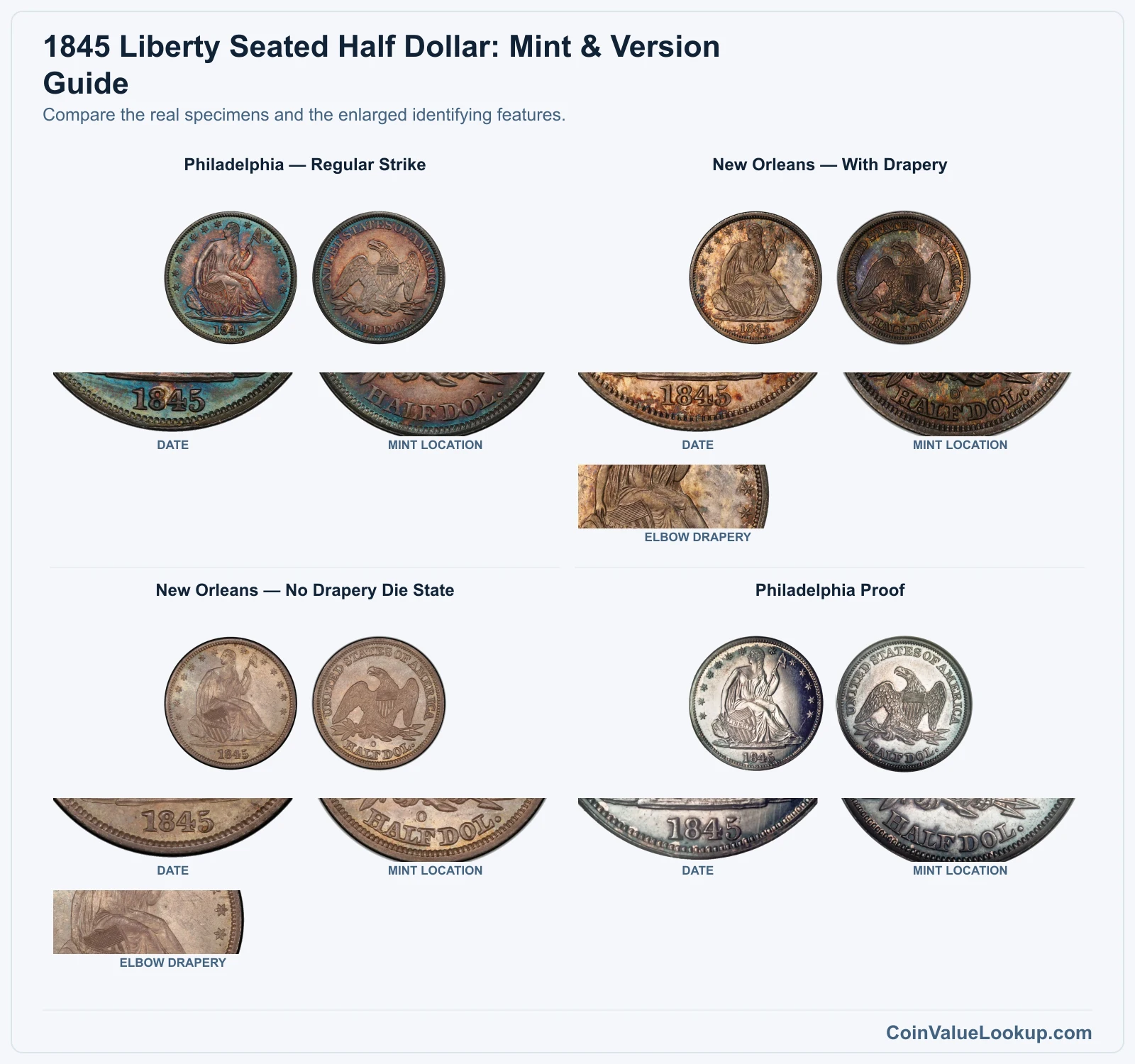
The 1845 Liberty Seated Half Dollar is a 90% silver coin struck at Philadelphia and New Orleans. Ordinary Philadelphia strikes range from about $111 in G4 to $741 in AU50 based on guide estimates, while New Orleans pieces with normal drapery start lower at roughly $80 in G4.
Your coin's specific mint, die state and condition determine its real worth, and a few scarce versions push values well beyond those baseline figures.
Fast Way to Identify Your 1845 Liberty Seated Half Dollar
Want a quick read on what you have? Upload clear photos of both the front and back of your 1845 half dollar.
The preliminary identification can help you figure out which mint and version you're holding, whether there's a mintmark present, and what condition range your coin falls into. It only takes a moment and gives you a solid starting point.
1845 Liberty Seated Half Dollar Value
Upload both sides of your 1845 Liberty Seated Half Dollar.
Front Obverse
Upload photo
Back Reverse
Upload photo
Which 1845 Liberty Seated Half Dollar Versions Are Worth Money?
- 1845-O No Drapery Die State — Die polishing removed elbow drapery; guide values run $142 (G4) to $1,017 (AU50), roughly double the normal 1845-O.
- 1845 Philadelphia Proof — Extremely rare manufacture; a PR66 example sold for $74,750 at Heritage in January 2008. Professional attribution is essential.
- 1845-O Repunched Date — A tripled date variety has been identified on New Orleans coins; the repeated numeral remnants make these sought after by variety specialists.
- 1845-O Repunched Mintmark — An O punched over a horizontal O is documented; the remnant is visible inside the upper portion of the upright mintmark.
Step 1: Identify Your 1845 Liberty Seated Half Dollar Mint Mark and Version
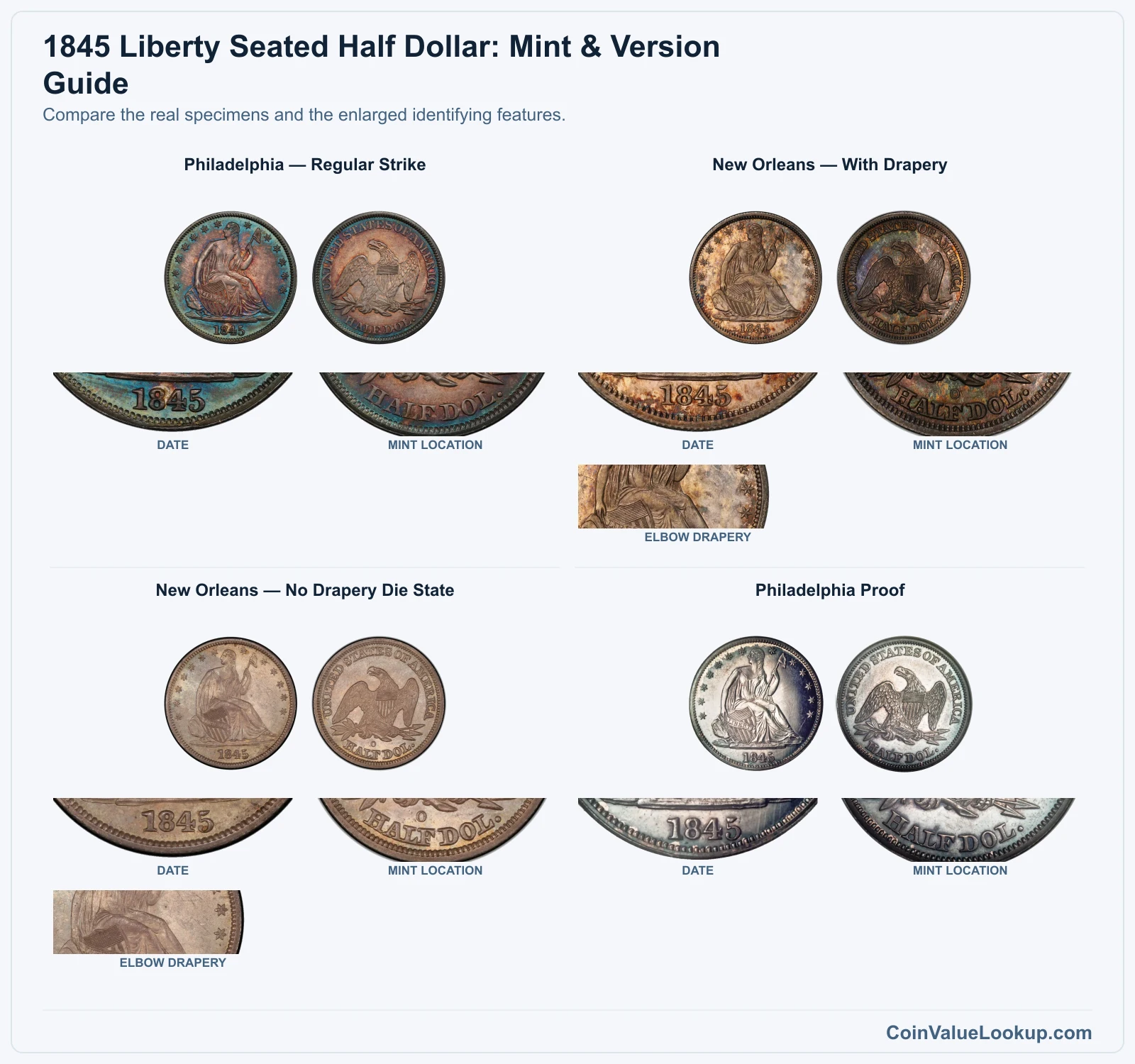
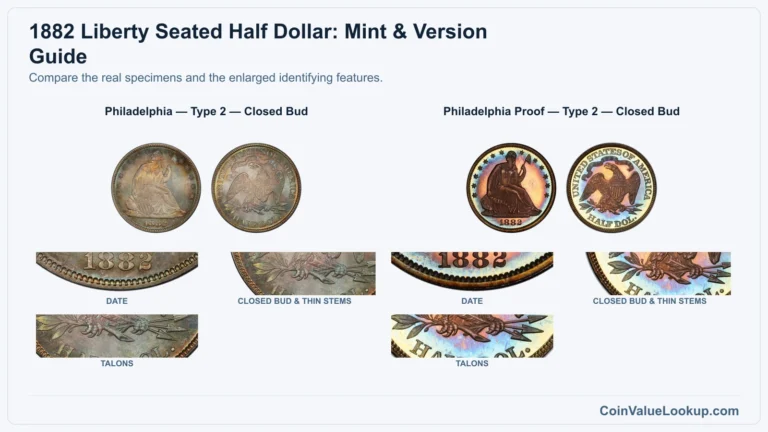
The 1845 half dollar shows the Seated Liberty portrait on the obverse and an eagle with HALF DOL. on the reverse.
There is no IN GOD WE TRUST motto on this type. The coin is 90% silver, 10% copper, weighs about 13.36 grams, and has a reeded edge.
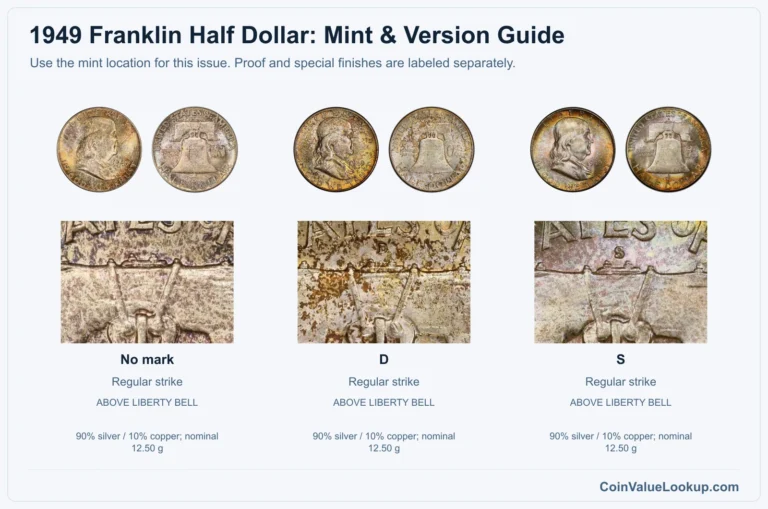
Philadelphia coins carry no mintmark at all. New Orleans coins display an O mintmark on the reverse, positioned below the eagle.
Don't assume a shiny coin is pure silver or a higher purity than 90% — surface appearance can be deceptive after nearly two centuries.
You need to check three things: mint (Philadelphia or New Orleans), drapery status (present or polished away on certain New Orleans dies), and whether any die errors are visible on the date or mintmark. The No Drapery die state on 1845-O coins is a result of heavy die polishing that removed the extra fabric detail below Liberty's elbow.
This is not the same as the original 1839 No Drapery design — it's a late die state of a with-drapery die. Look closely at the elbow area and compare to known examples.
Proof or presentation strikes from Philadelphia exist but are extremely rare. A bright, well-preserved coin is not automatically a Proof; that designation requires professional attribution of the manufacturing method.
Step 2: Check Your 1845 Liberty Seated Half Dollar Grade
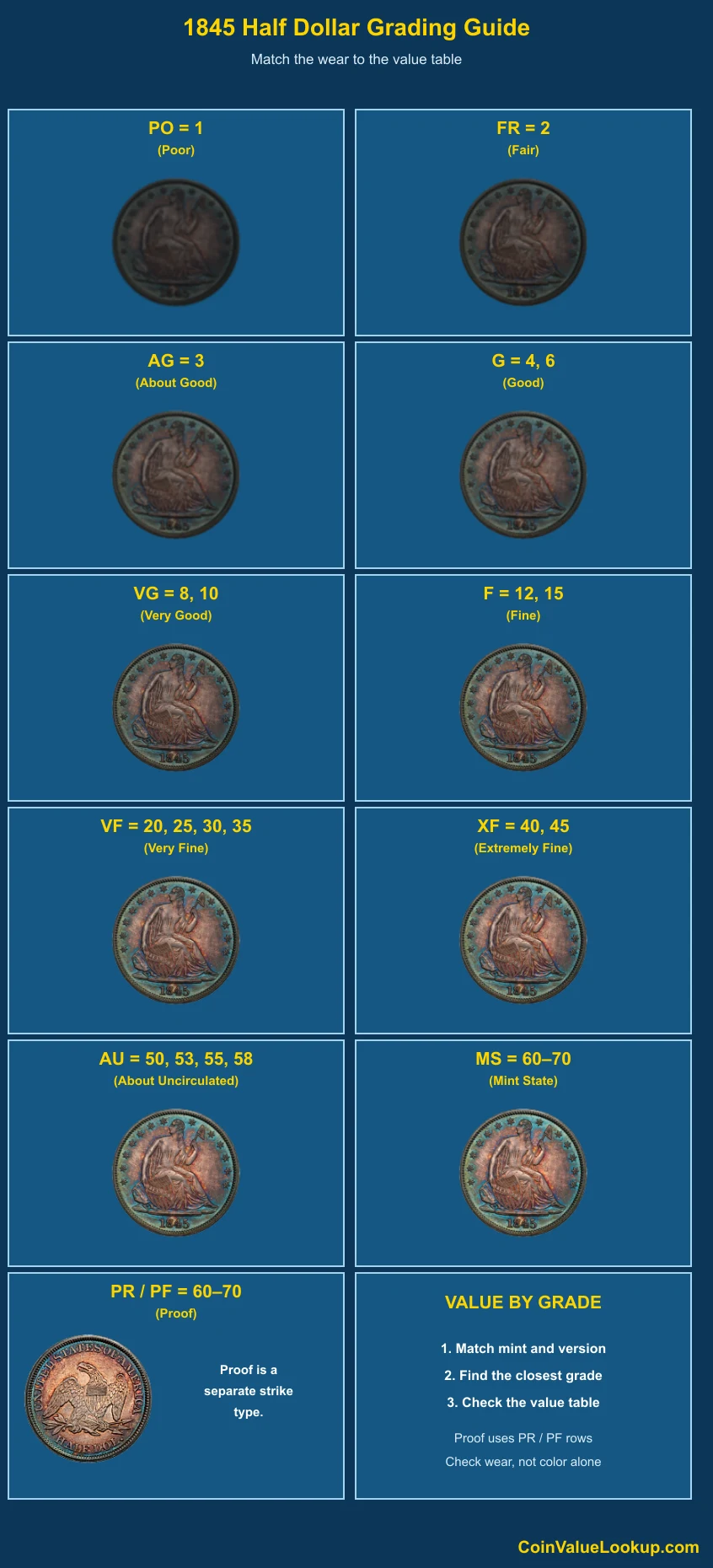
Focus on Liberty's head, the breast area, the knee and the shield on the obverse. On the reverse, check the eagle's breast feathers, wing tips and claws.
These are the first spots to show wear.
A coin in G4 (Good) will have Liberty's outline visible but most interior detail gone. By VF20 (Very Fine), Liberty's gown lines and some shield detail should be clear.
AU50 (About Uncirculated) retains most original luster with only slight friction on the highest points.
One tricky part with Seated halves: some were weakly struck from the factory, so a soft breast or knee doesn't always mean heavy wear. Compare your coin's surfaces side by side with the type-matched grading comparison image to separate genuine wear from a soft original strike.
Look for unbroken cartwheel luster in the fields — that's your best friend for distinguishing AU from cleaned VF.
Cleaning, holes, scratches and artificial toning all reduce value significantly. If you're tempted to clean your coin, don't.
A naturally toned original coin is always preferred over a harshly cleaned bright one.
Step 3: Check 1845 Liberty Seated Half Dollar Value by Mint and Version
1845 Liberty Seated Half Dollar — Philadelphia — Regular Strike
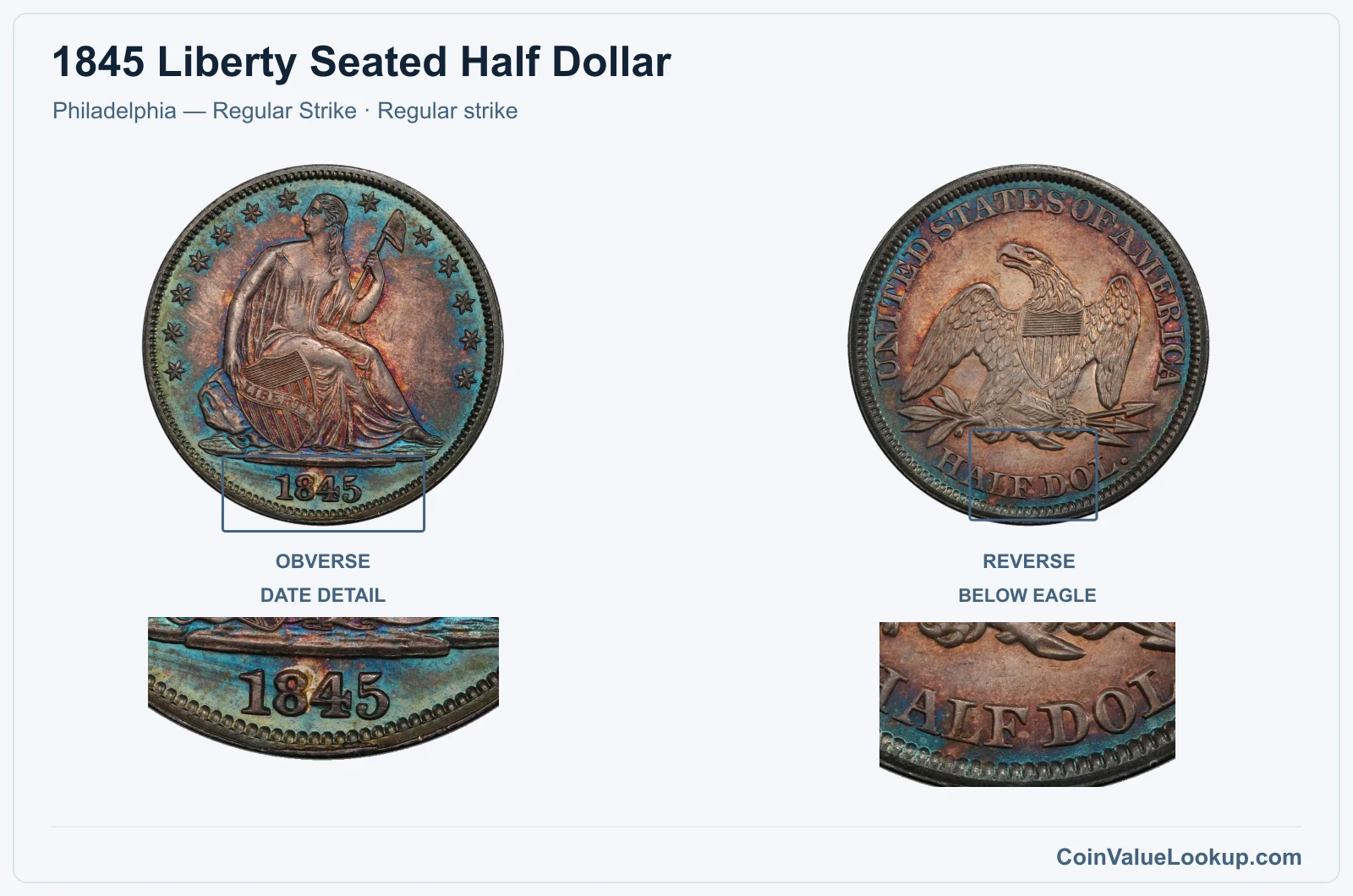
The Philadelphia issue carries no mintmark. Guide estimates place it at about $111 in G4, $332 in VF20 and $741 in AU50.
These are the standard circulation strikes, and they survive in decent numbers across lower grades.
Look on the reverse below the eagle — if you see nothing there, you have a Philadelphia coin. Any bright, mirror-like Philadelphia piece that appears to be a Proof needs professional attribution; the vast majority of shiny survivors are simply well-preserved or cleaned regular strikes.
Coin Value Lookup is a handy place to look up guides for this series and other coins in your collection if you want to compare values across different dates and mints.
Range Grade
Price Auction Records Appraisal PO PO 1
—
Coin Identifier FR FR 2
—
Coin Identifier AG AG 3
—
Coin Identifier G G 4
—
Coin Identifier
G 6
—
Coin Identifier VG VG 8
—
Coin Identifier
VG 10
—
Coin Identifier F F 12
—
Coin Identifier
F 15
—
Coin Identifier VF VF 20
Coin Identifier
VF 25
Coin Identifier
VF 30
Coin Identifier
VF 35
Coin Identifier XF XF 40
Coin Identifier
XF 45
Coin Identifier AU AU 50
Coin Identifier
AU 53
Coin Identifier
AU 55
Coin Identifier
AU 58
Coin Identifier MS MS 60
Coin Identifier
MS 61
Coin Identifier
MS 62
Coin Identifier
MS 63
Coin Identifier
MS 64
Coin Identifier
MS 65
—
—
—
MS 66
—
—
—
MS 67
—
—
—
MS 68
—
—
—
MS 69
—
—
—
MS 70
—
—
—
1845 Liberty Seated Half Dollar — New Orleans — With Drapery
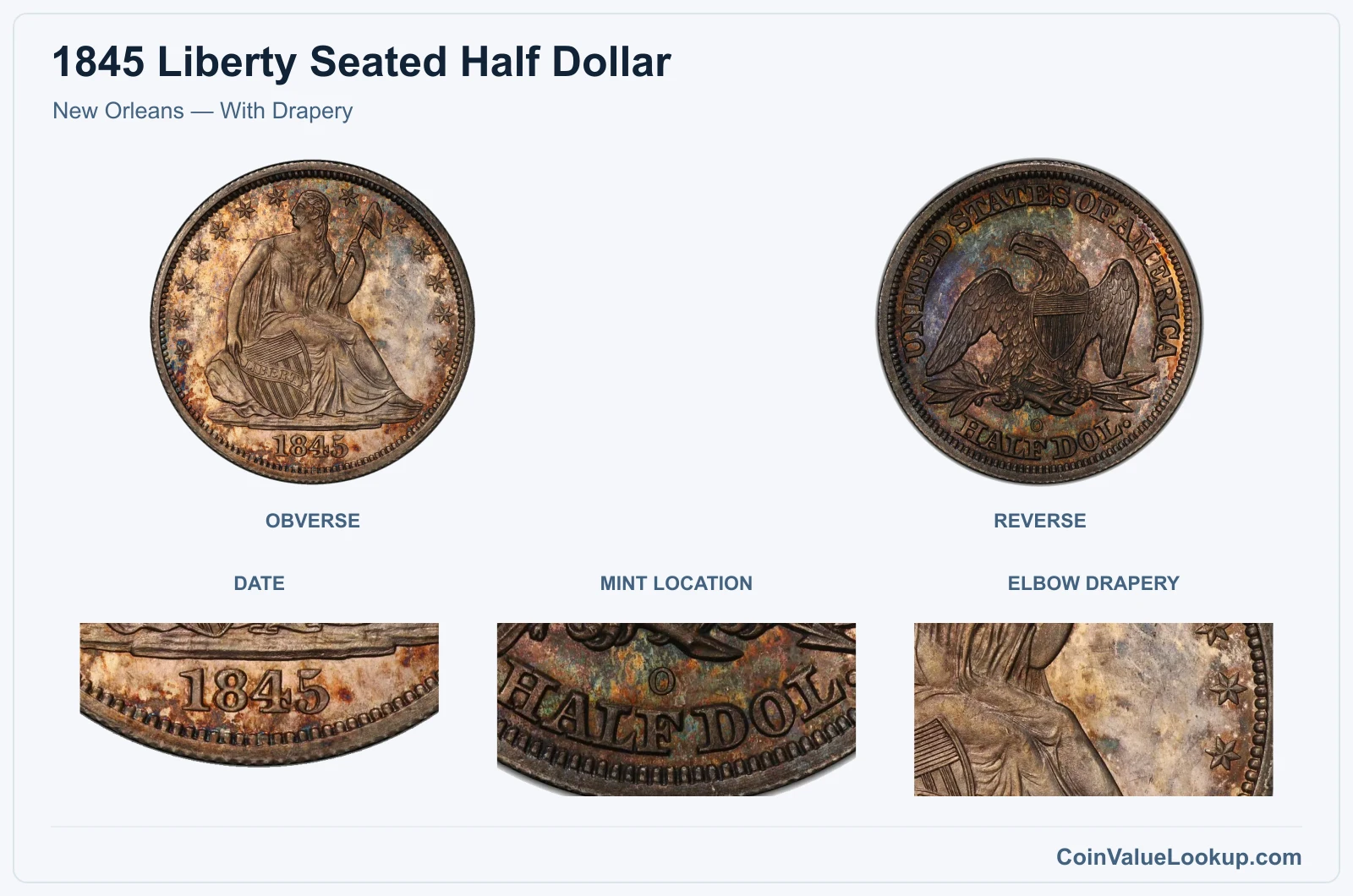
New Orleans strikes show an O mintmark on the reverse below the eagle. On a normal 1845-O with drapery intact, guide estimates run about $80 at G4, $269 at VF20 and $632 at AU50 — a bit less than Philadelphia across the board.
Check Liberty's elbow carefully. If you see the extra fold of drapery beneath it, you have the standard with-drapery version.
Also inspect the date digits and the O mintmark for any doubling or repunching, because this date is known for spectacular repunched-date and repunched-mintmark varieties that carry additional collector interest.
Ordinary-issue reference: Ordinary-issue reference only: The table below shows prices for the 1845-O Liberty Seated Half Dollar (regular strike). It does not represent the value of the specific New Orleans — With Drapery variety or its variety premium. Year, mint, metal and strike type are matched; the specific variety is not priced by this table.
Range Grade
Price Auction Records Appraisal PO PO 1
—
Coin Identifier FR FR 2
—
Coin Identifier AG AG 3
—
Coin Identifier G G 4
—
Coin Identifier
G 6
—
Coin Identifier VG VG 8
—
Coin Identifier
VG 10
Coin Identifier F F 12
Coin Identifier
F 15
Coin Identifier VF VF 20
Coin Identifier
VF 25
Coin Identifier
VF 30
Coin Identifier
VF 35
Coin Identifier XF XF 40
Coin Identifier
XF 45
Coin Identifier AU AU 50
Coin Identifier
AU 53
Coin Identifier
AU 55
Coin Identifier
AU 58
Coin Identifier MS MS 60
Coin Identifier
MS 61
Coin Identifier
MS 62
Coin Identifier
MS 63
Coin Identifier
MS 64
Coin Identifier
MS 65
Coin Identifier
MS 66
Coin Identifier
MS 67
—
—
—
MS 68
—
—
—
MS 69
—
—
—
MS 70
—
—
—
1845 Liberty Seated Half Dollar — New Orleans — No Drapery Die State
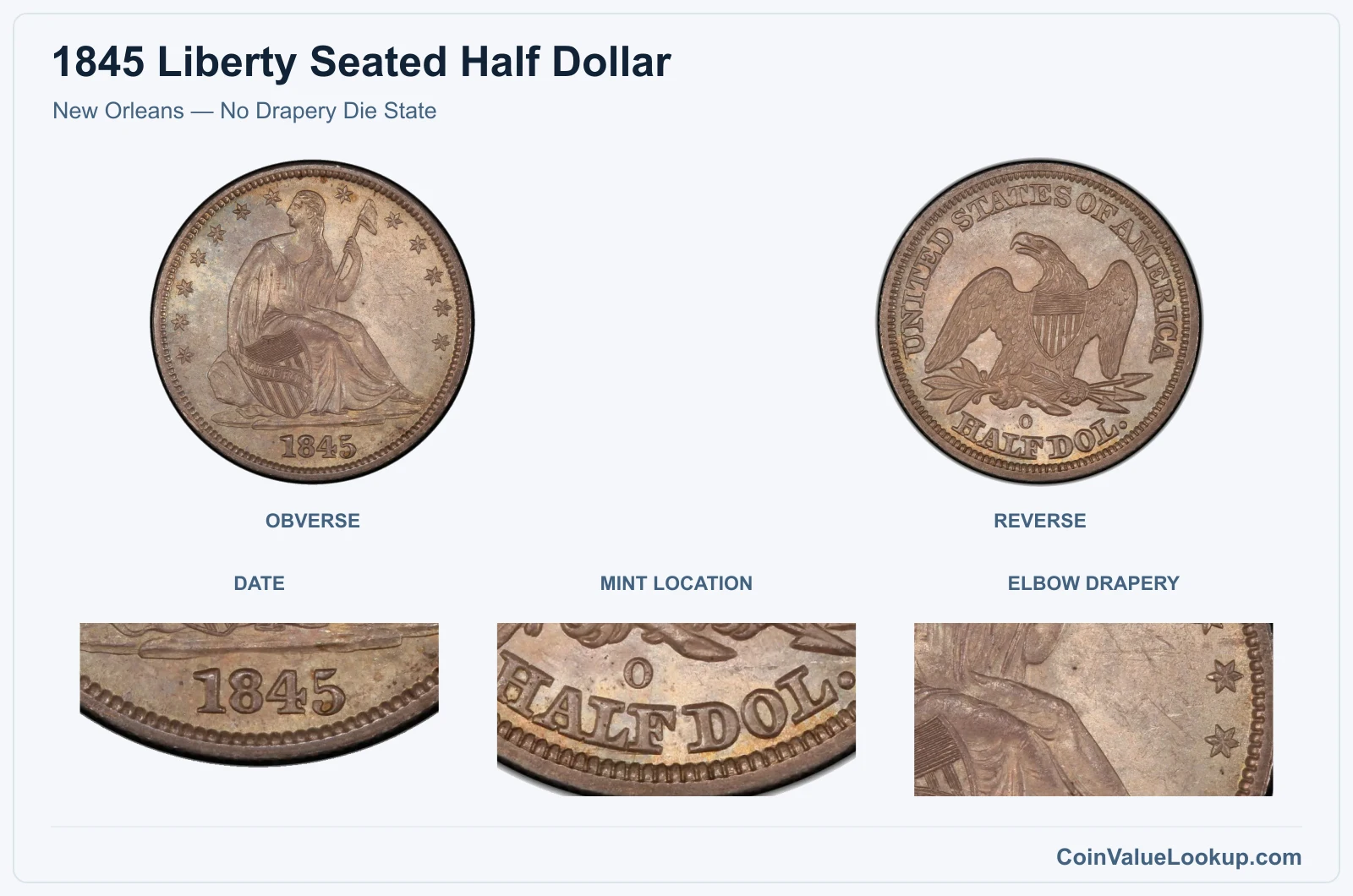
This is where things get interesting for variety collectors. On certain 1845-O dies, the Mint polished the die heavily enough to erase the extra drapery fold below Liberty's elbow.
The result looks superficially like the original 1839 No Drapery design, but it's a completely different cause — worn tooling, not an intentional design change.
Guide estimates for this die state run roughly $142 at G4, $426 at VF20 and $1,017 at AU50, which is a meaningful premium over the standard 1845-O. To confirm you have one, examine the elbow area and the adjacent surfaces closely.
The surrounding details may also appear slightly softer or simplified compared to a normal drapery example because the same polishing that removed the drapery affected neighboring elements.
Range Grade
Price Auction Records Appraisal PO PO 1
—
Coin Identifier FR FR 2
—
Coin Identifier AG AG 3
—
Coin Identifier G G 4
—
Coin Identifier
G 6
—
Coin Identifier VG VG 8
—
Coin Identifier
VG 10
—
Coin Identifier F F 12
—
Coin Identifier
F 15
Coin Identifier VF VF 20
—
Coin Identifier
VF 25
—
Coin Identifier
VF 30
Coin Identifier
VF 35
Coin Identifier XF XF 40
Coin Identifier
XF 45
Coin Identifier AU AU 50
Coin Identifier
AU 53
Coin Identifier
AU 55
Coin Identifier
AU 58
Coin Identifier MS MS 60
—
Coin Identifier
MS 61
—
Coin Identifier
MS 62
Coin Identifier
MS 63
—
Coin Identifier
MS 64
Coin Identifier
MS 65
—
—
—
MS 66
—
—
—
MS 67
—
—
—
MS 68
—
—
—
MS 69
—
—
—
MS 70
—
—
—
1845 Liberty Seated Half Dollar — Philadelphia Proof
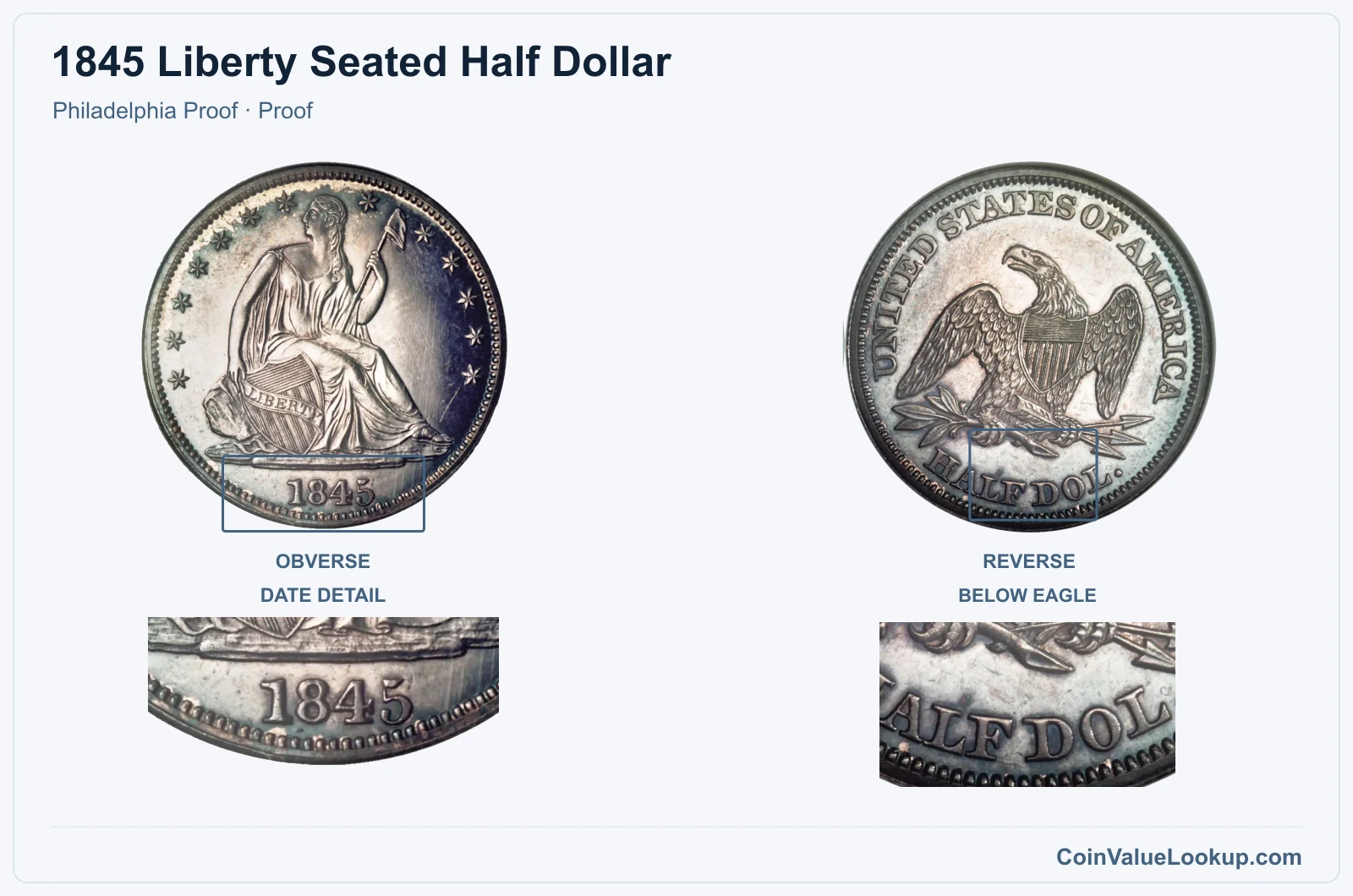
Philadelphia Proof half dollars from 1845 are genuinely rare. These are special manufacture coins struck with polished dies on prepared planchets — Proof is a method of production, not a grade above Mint State.
The only confirmed historical sale in the supplied records is a PR66 example that brought $74,750 at a Heritage auction in January 2008. That figure reflects one coin at one moment and should not be treated as a current market range.
If you suspect you have a Proof 1845 half dollar, professional attribution and certification are non-negotiable. A regular strike that happens to be bright or well-preserved is not a Proof, no matter how clean the surfaces look.
Range Grade
Price Auction Records Appraisal PR PR 1
—
Coin Identifier
PR 2
—
Coin Identifier
PR 3
—
Coin Identifier
PR 4
—
Coin Identifier
PR 6
—
Coin Identifier
PR 8
—
Coin Identifier
PR 10
—
Coin Identifier
PR 12
—
Coin Identifier
PR 15
—
Coin Identifier
PR 20
—
Coin Identifier
PR 25
—
Coin Identifier
PR 30
—
Coin Identifier
PR 35
—
Coin Identifier
PR 40
—
Coin Identifier
PR 45
—
Coin Identifier
PR 50
—
Coin Identifier
PR 53
—
Coin Identifier
PR 55
—
Coin Identifier
PR 58
—
Coin Identifier
PR 60
—
Coin Identifier
PR 61
—
Coin Identifier
PR 62
—
Coin Identifier
PR 63
—
Coin Identifier
PR 64
Coin Identifier
PR 65
Coin Identifier
PR 66
—
—
—
PR 67
—
—
—
PR 68
—
—
—
PR 69
—
—
—
PR 70
—
—
—
1845 Liberty Seated Half Dollar Error List
1. 1845 Liberty Seated Half Dollar — Die Crack / Die Chip
Die cracks and die chips occur when the steel die fractures during use, leaving raised lines or lumps on the struck coin. On a known 1845 Proof specimen, a reverse crack runs from the lower-right serif of the F in HALF into the field beneath the D, and an oblong obverse chip sits below the left side of the 8 in the date.
That specific diagnostic is documented on a Proof coin — a crack alone does not make an ordinary circulation strike into a Proof. On your coin, look for any raised irregular lines that follow no design element.
Scratches, corrosion tracks and foreign material stuck to the surface can mimic cracks, so check whether the feature is raised (die crack) or incuse (scratch). Value depends on the crack's size, location and the coin's overall condition; no fixed price range applies across the board.
2. 1845 Liberty Seated Half Dollar — Clashed Dies
A die clash happens when the obverse and reverse dies strike each other without a planchet between them, transferring faint ghost impressions of one die's design onto the other. The 1845 date has been reported with minor clashed dies, though the specific mint and exact transferred elements are not detailed in the available records.
If you see faint, unexplained design outlines in the open fields of your coin — especially near Liberty's head on the obverse or around the eagle on the reverse — you may have a clash. Don't confuse random raised lines, scratches or brockage marks for a genuine clash.
The transferred image should mirror a recognizable element from the opposite die. Value depends on the clash's visibility and overall coin condition; no specific price range is established for this category.
3. 1845 Liberty Seated Half Dollar — Repunched Mintmark
On the 1845-O, a repunched mintmark has been documented where the O was first entered horizontally, then corrected to the normal upright position. A remnant of the original horizontal O is visible inside the upper portion of the final upright mintmark.
To check, examine the O below the eagle on the reverse under magnification. Compare it to a normal, cleanly punched O.
You're looking for traces of an extra curve or partial letter that shouldn't be there. Machine doubling, small die chips and corrosion around the mintmark area can all create confusing look-alikes, so compare carefully.
The value of a confirmed repunched mintmark depends on its clarity and the coin's overall grade; no fixed premium is established here.
4. 1845 Liberty Seated Half Dollar — Repunched Date
A tripled date has been identified on certain 1845-O half dollars. This means the date numerals were punched into the die multiple times with slight misalignment, leaving ghost remnants of earlier impressions alongside the final digits.
Look at the date under magnification. You're searching for repeated outlines or partial numeral traces near the primary digits — not a shift of the entire coin's design, just the date area.
This is sometimes called a tripled date, but it refers to the die-making process, not the coin being struck three times.
A damaged date from circulation hits or machine doubling from a loose die can look similar at first glance. Machine doubling tends to produce flat, shelf-like doubling, while a genuine repunched date shows rounded, distinct secondary impressions.
Value depends on the degree of visibility and the coin's condition, with no established price range available for this variety.