1877 Liberty Seated Half Dollar Coin Value: How Much Is It Worth?
The 1877 Liberty Seated Half Dollar is a 90% silver coin struck at three mints, with several reverse hub varieties and one recognized overdate. Guide estimates for ordinary Philadelphia strikes range from about $79 at G4 to $363 at AU50, while Proofs in PR63 carry a guide estimate near $1,409.
These are retail guide figures, not guaranteed purchase offers. Before pricing your coin, check the last digit of the date carefully — the 1877/6 overdate is a separate, higher-value branch.
Fast Way to Identify Your 1877 Liberty Seated Half Dollar
The fastest way to start identifying your 1877 Seated Half Dollar is to upload clear photos of the front and back. Our identifier can provide a preliminary identification based on your images, helping you narrow down the mint, reverse type and whether your coin might be something unusual.
Two well-lit, in-focus shots are all you need to get started.
1877 Liberty Seated Half Dollar Value
Upload both sides of your 1877 Liberty Seated Half Dollar.
Front Obverse
Upload photo
Back Reverse
Upload photo
Which 1877 Liberty Seated Half Dollar Versions Are Worth Money?
- The 1877/6 overdate, struck in Philadelphia, carries guide estimates well above ordinary issues — around $574 at G4 and $2,747 at AU50 — so always inspect the last digit of the date.
- Carson City half dollars from any reverse hub carry higher guide estimates than Philadelphia or San Francisco issues at the same grade, starting near $162 at G4.
- Proof examples with confirmed Proof surfaces and sharp rims are a separate category, with a PR63 guide estimate near $1,409.
- Identifying the correct reverse hub type (open bud, closed bud or transitional) helps ensure accurate attribution and pricing.
- Original mint-state surfaces without cleaning or damage can substantially increase value over circulated examples.
Step 1: Identify Your 1877 Liberty Seated Half Dollar Mint Mark and Version
The 1877 half dollar shows a seated Liberty on the obverse and an eagle with a motto banner reading IN GOD WE TRUST on the reverse. Below the eagle, HALF DOL appears in the denomination area.
The coin is 90% silver and 10% copper, weighs a nominal 12.50 grams and has a reeded edge.
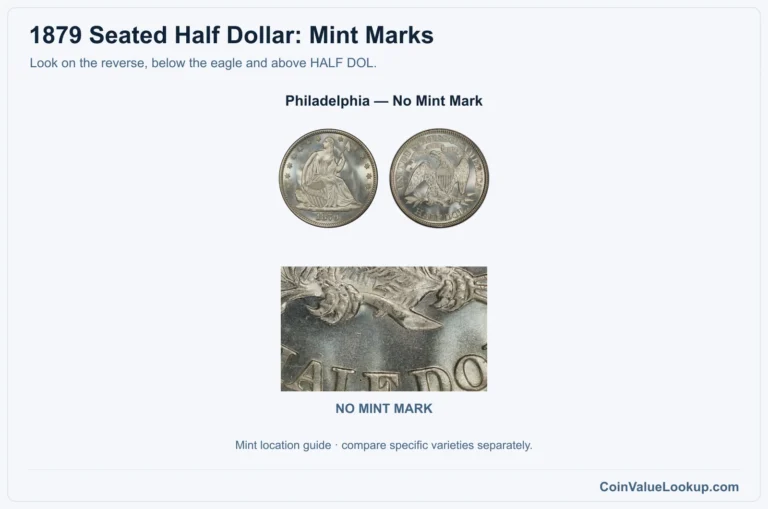
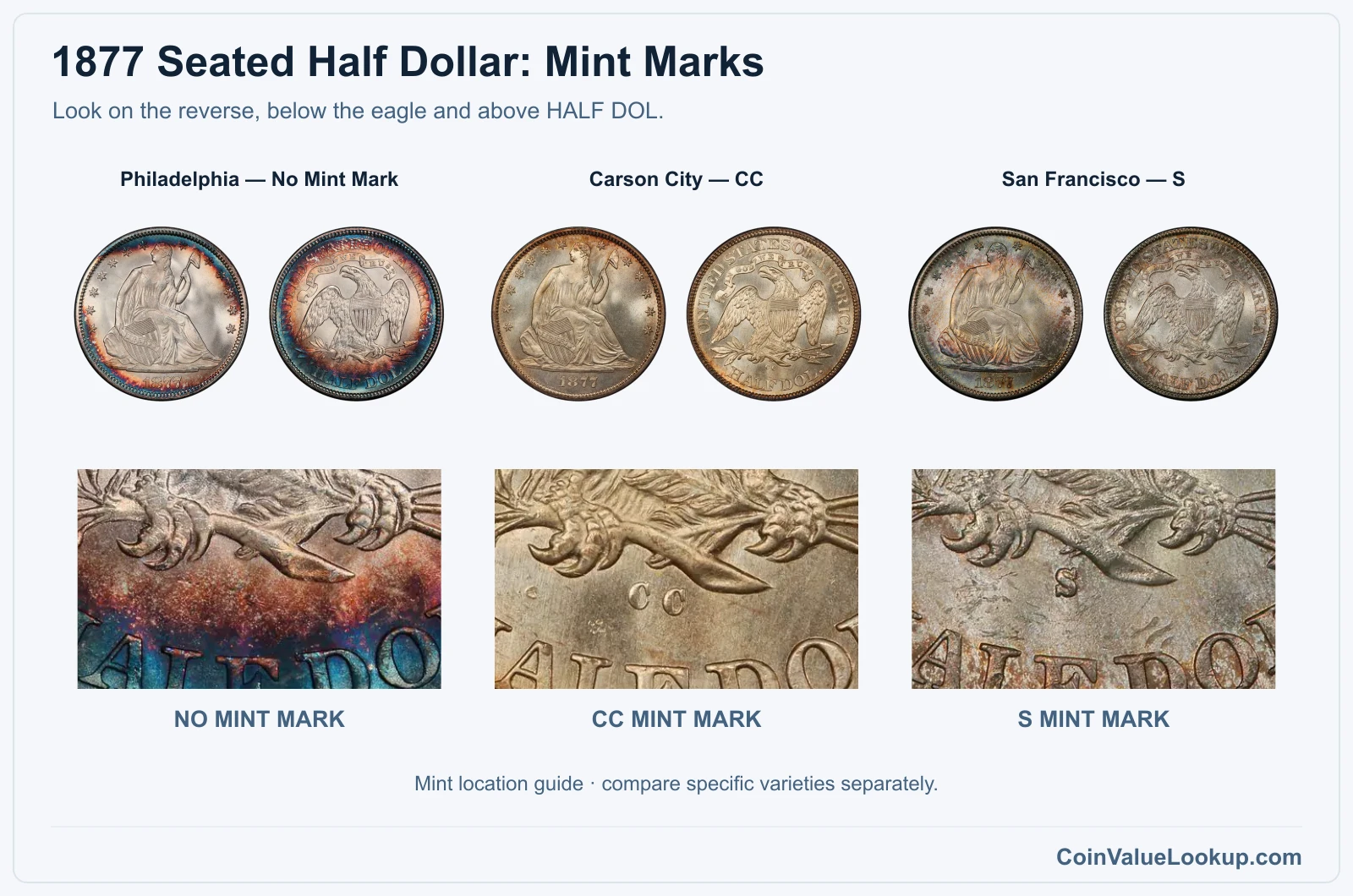
Mintmarks sit below the eagle on the reverse. No mintmark means Philadelphia.
An S means San Francisco, and CC means Carson City. Get a loupe or magnifier on that spot before going further.
Reverse hub type matters here. Type 1 has an open lower olive bud, while Type 2 shows the bud closed.
A transitional reverse combines the open bud of Type 1 with stronger olive stems — you need both features to call it transitional, not just one. Different mintmark sizes also exist: Carson City coins come in Small CC and Medium CC, while San Francisco coins appear with Micro S and Very Small S punches.
Proof and circulation strike are manufacturing categories. A bright, reflective surface alone does not make a coin a Proof; many late Seated Liberty halves can appear prooflike from normal production.
True Proofs show squared rims and mirror fields that differ from even the shiniest business strike.
Step 2: Check Your 1877 Liberty Seated Half Dollar Grade
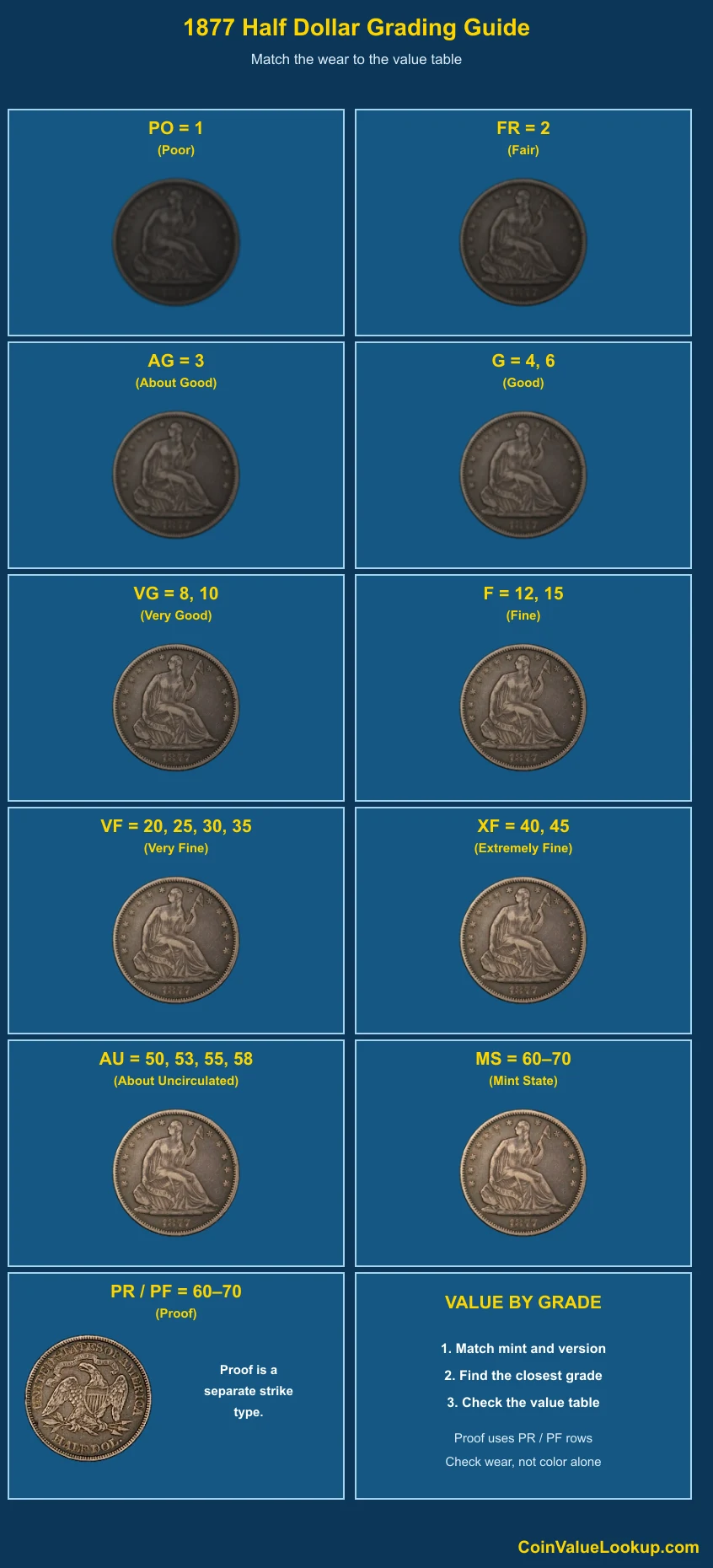
Start with Liberty's head on the obverse. In lower grades, her hair detail above the ear disappears first.
Move to the breast, knee and shield — those are the high-relief zones that show rub earliest.
On the reverse, check the eagle's breast feathers and wing tips. Luster loss on both sides should be roughly symmetrical if the wear is from actual circulation.
A weakly struck coin can mimic wear. If luster is still visible in the fields but some design detail looks soft, you may be looking at a strike issue, not a grade problem.
Compare your coin to the grading image for reference.
Cleaned coins, those with holes or heavy rim damage, are worth significantly less than problem-free examples at the same grade. Resist the urge to polish the coin — original toning and surfaces are what buyers want.
If you are unsure, leave it alone.
Step 3: Check 1877 Liberty Seated Half Dollar Value by Mint and Version
1877 Liberty Seated Half Dollar — Philadelphia — Type 1 — Open Bud
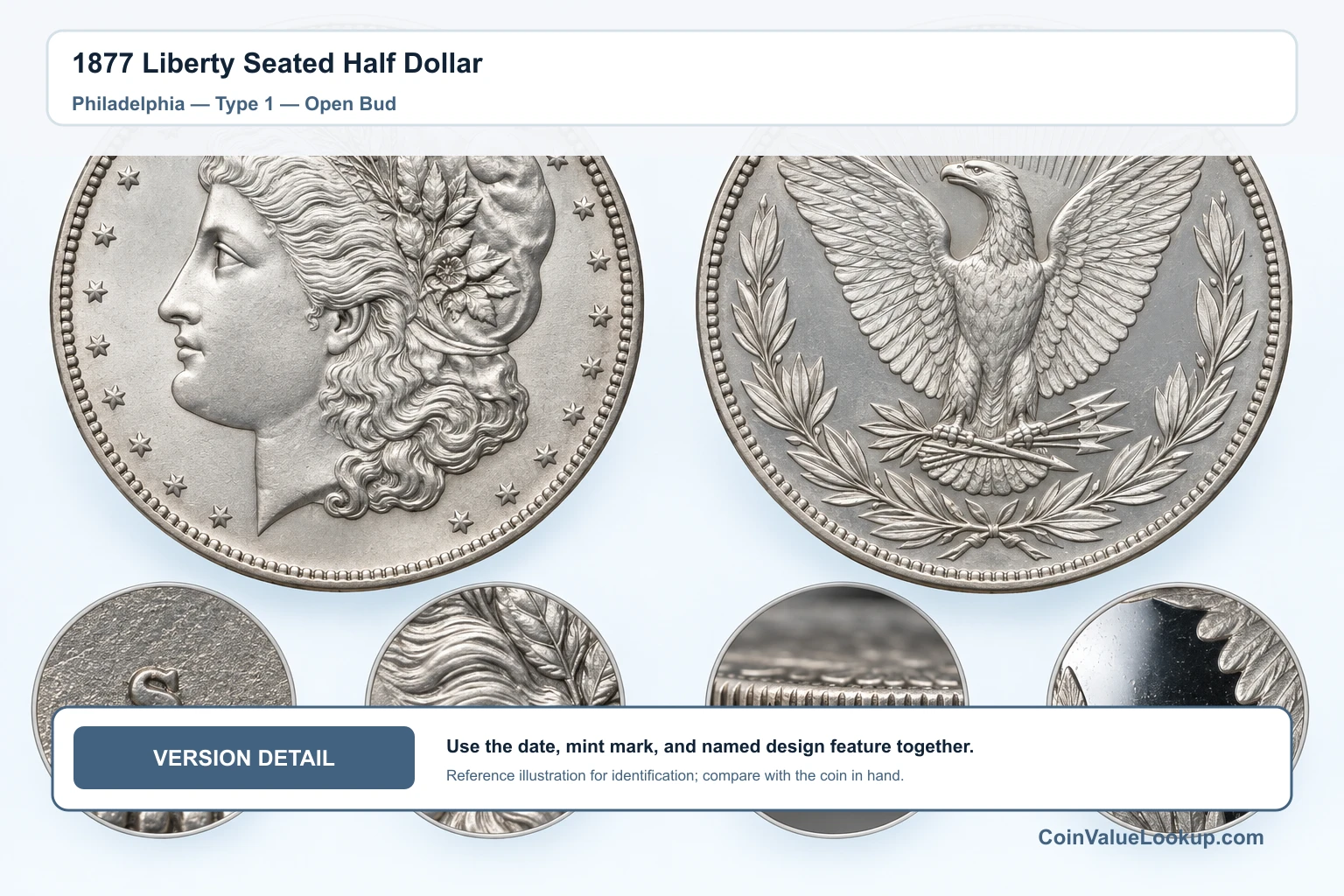
This is the standard Philadelphia issue with the Type 1 reverse — look for an open lower olive bud and relatively weak olive stems. No mintmark appears on the reverse.
Guide estimates for 1877 Philadelphia half dollars run about $79 at G4, $172 at VF20 and $363 at AU50 (USA Coin Book estimates, not guaranteed offers). No separate hub-specific premium is adopted, so you price this alongside other Philadelphia business strikes at the same grade.
Check the date carefully to rule out the overdate before settling on this variety.
Range Grade
Price Auction Records Appraisal PO PO 1
—
Coin Identifier FR FR 2
—
Coin Identifier AG AG 3
—
Coin Identifier G G 4
—
Coin Identifier
G 6
Coin Identifier VG VG 8
—
Coin Identifier
VG 10
—
Coin Identifier F F 12
—
Coin Identifier
F 15
—
Coin Identifier VF VF 20
—
Coin Identifier
VF 25
—
Coin Identifier
VF 30
—
Coin Identifier
VF 35
—
Coin Identifier XF XF 40
—
—
—
XF 45
—
—
— AU AU 50
—
—
—
AU 53
—
—
—
AU 55
—
—
—
AU 58
—
—
— MS MS 60
—
—
—
MS 61
—
—
—
MS 62
—
—
—
MS 63
—
—
—
MS 64
—
—
—
MS 65
—
—
—
MS 66
—
—
—
MS 67
—
—
—
MS 68
—
—
—
MS 69
—
—
—
MS 70
—
—
—
1877 Liberty Seated Half Dollar — Philadelphia — Transitional Reverse — Open Bud / Strong Stems
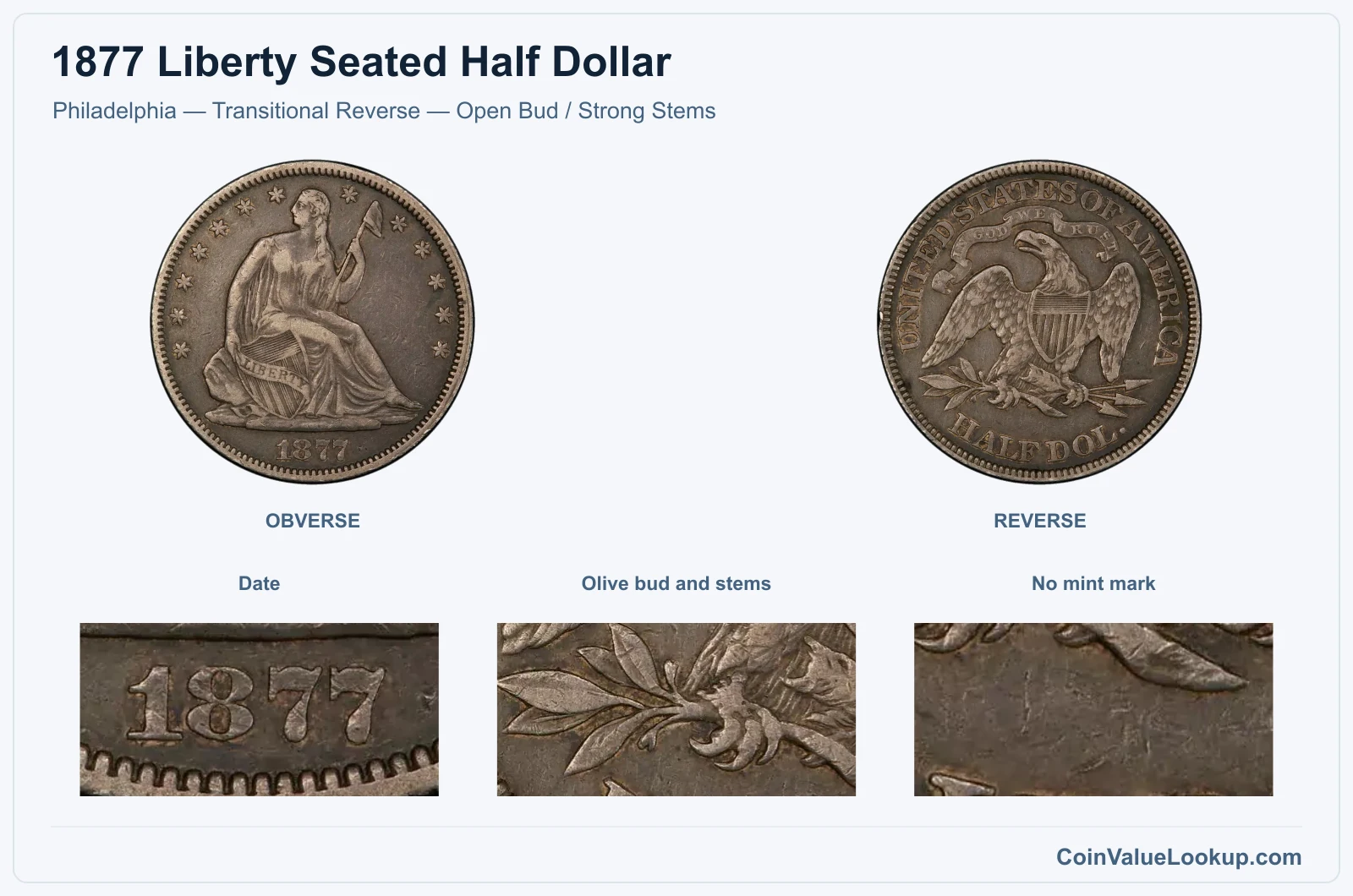
The transitional reverse is the hybrid you need two features to identify: an open lower olive bud (like Type 1) paired with strong, bold olive stems (like Type 2). If only one feature matches, you are looking at a different hub.
Philadelphia business-strike guide estimates sit at about $79 (G4), $172 (VF20) and $363 (AU50). No individual premium for this hub is adopted, but correct attribution matters for registry collectors.
Compare your reverse to reference images showing both the bud shape and stem strength side by side before deciding.
Range Grade
Price Auction Records Appraisal PO PO 1
—
Coin Identifier FR FR 2
—
Coin Identifier AG AG 3
—
Coin Identifier G G 4
—
Coin Identifier
G 6
—
Coin Identifier VG VG 8
—
Coin Identifier
VG 10
—
Coin Identifier F F 12
—
Coin Identifier
F 15
—
Coin Identifier VF VF 20
—
Coin Identifier
VF 25
—
Coin Identifier
VF 30
—
Coin Identifier
VF 35
—
—
— XF XF 40
—
—
—
XF 45
—
—
— AU AU 50
—
—
—
AU 53
—
—
—
AU 55
—
—
—
AU 58
—
—
— MS MS 60
—
—
—
MS 61
—
—
—
MS 62
—
—
—
MS 63
—
—
—
MS 64
—
—
—
MS 65
—
—
—
MS 66
—
—
—
MS 67
—
—
—
MS 68
—
—
—
MS 69
—
—
—
MS 70
—
—
—
1877 Liberty Seated Half Dollar — Philadelphia — Type 2 — Closed Bud
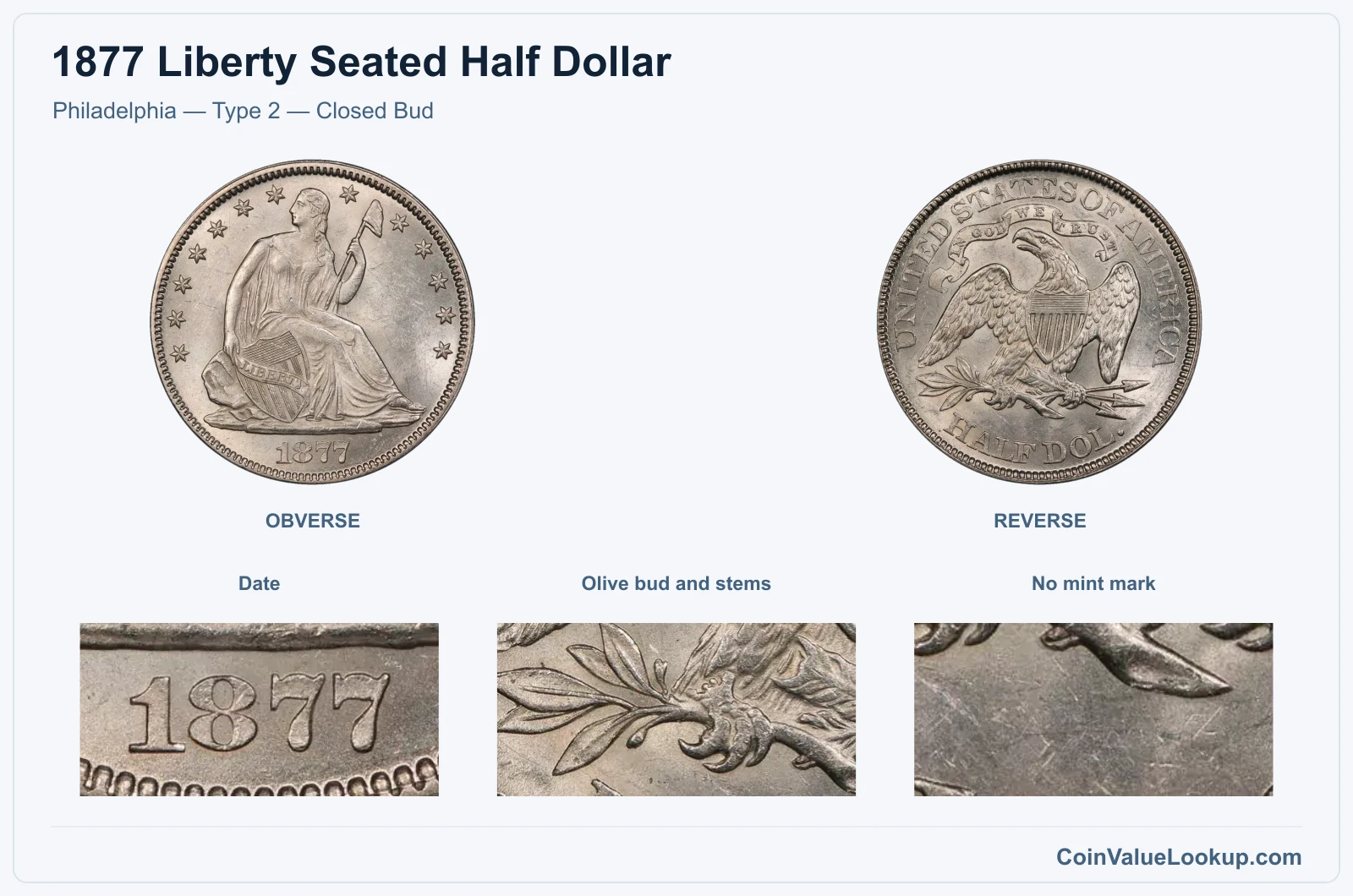
Type 2 is the closed-bud reverse. The lower olive bud is clearly sealed shut, and the olive stems are generally stronger than on the Type 1 hub.
This is the other main production reverse for 1877 Philadelphia half dollars. Guide estimates remain about $79 at G4, $172 at VF20 and $363 at AU50.
No separate hub premium is adopted. Confirming the bud is actually closed — not just worn — requires decent magnification and good lighting, especially on well-circulated pieces.
Range Grade
Price Auction Records Appraisal PO PO 1
—
Coin Identifier FR FR 2
—
Coin Identifier AG AG 3
—
Coin Identifier G G 4
—
Coin Identifier
G 6
—
Coin Identifier VG VG 8
—
Coin Identifier
VG 10
—
Coin Identifier F F 12
—
Coin Identifier
F 15
—
Coin Identifier VF VF 20
—
Coin Identifier
VF 25
—
Coin Identifier
VF 30
—
Coin Identifier
VF 35
—
Coin Identifier XF XF 40
—
Coin Identifier
XF 45
Coin Identifier AU AU 50
—
Coin Identifier
AU 53
—
Coin Identifier
AU 55
—
—
—
AU 58
—
—
— MS MS 60
—
—
—
MS 61
—
Coin Identifier
MS 62
—
Coin Identifier
MS 63
—
—
—
MS 64
—
—
—
MS 65
—
—
—
MS 66
—
—
—
MS 67
—
—
—
MS 68
—
—
—
MS 69
—
—
—
MS 70
—
—
—
1877 Liberty Seated Half Dollar — Philadelphia — 1877/6 Overdate
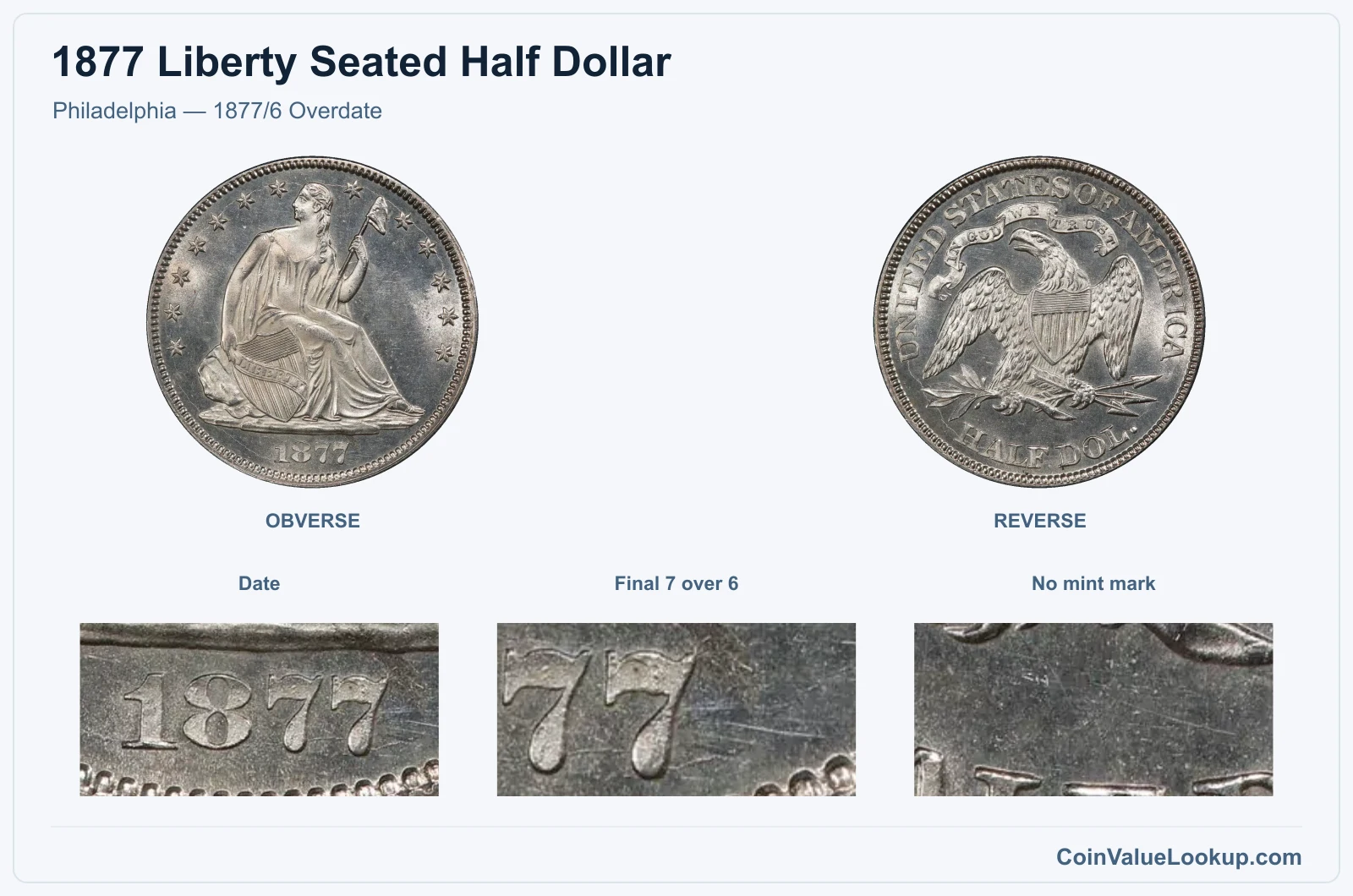
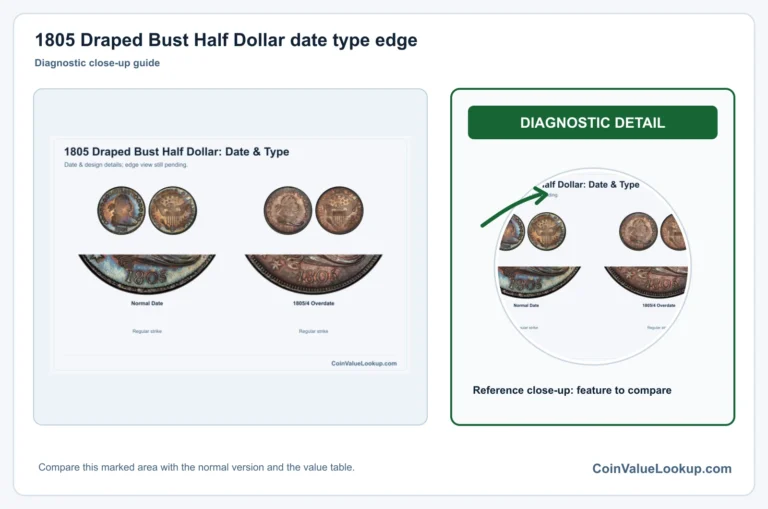
This is the one to look for. The 1877/6 overdate shows the remnant of an earlier 6 peeking out at the top of the final 7 in the date.
On a genuine example, you will see a curved element above the 7 that does not belong to the normal digit shape. Compare it against an ordinary 1877 date — the difference is subtle but real under magnification.
Guide estimates from USA Coin Book are substantially higher than a regular 1877: about $574 at G4, $1,114 at VF20 and $2,747 at AU50. These are guide figures, not guaranteed offers, and actual value depends on the coin's condition, eye appeal and how clearly the underdigit is visible.
Do not mistake dirt, corrosion or damage in the date area for an overdate — a clean comparison with a known example is essential.
Range Grade
Price Auction Records Appraisal PO PO 1
—
Coin Identifier FR FR 2
—
Coin Identifier AG AG 3
—
Coin Identifier G G 4
—
Coin Identifier
G 6
—
Coin Identifier VG VG 8
—
Coin Identifier
VG 10
—
Coin Identifier F F 12
—
Coin Identifier
F 15
—
Coin Identifier VF VF 20
—
Coin Identifier
VF 25
—
Coin Identifier
VF 30
—
Coin Identifier
VF 35
—
Coin Identifier XF XF 40
—
Coin Identifier
XF 45
—
Coin Identifier AU AU 50
—
Coin Identifier
AU 53
—
Coin Identifier
AU 55
—
Coin Identifier
AU 58
—
Coin Identifier MS MS 60
—
Coin Identifier
MS 61
—
Coin Identifier
MS 62
Coin Identifier
MS 63
—
Coin Identifier
MS 64
—
Coin Identifier
MS 65
—
—
—
MS 66
—
—
—
MS 67
—
—
—
MS 68
—
—
—
MS 69
—
—
—
MS 70
—
—
—
1877 Liberty Seated Half Dollar — Carson City — Type 1 — Small CC
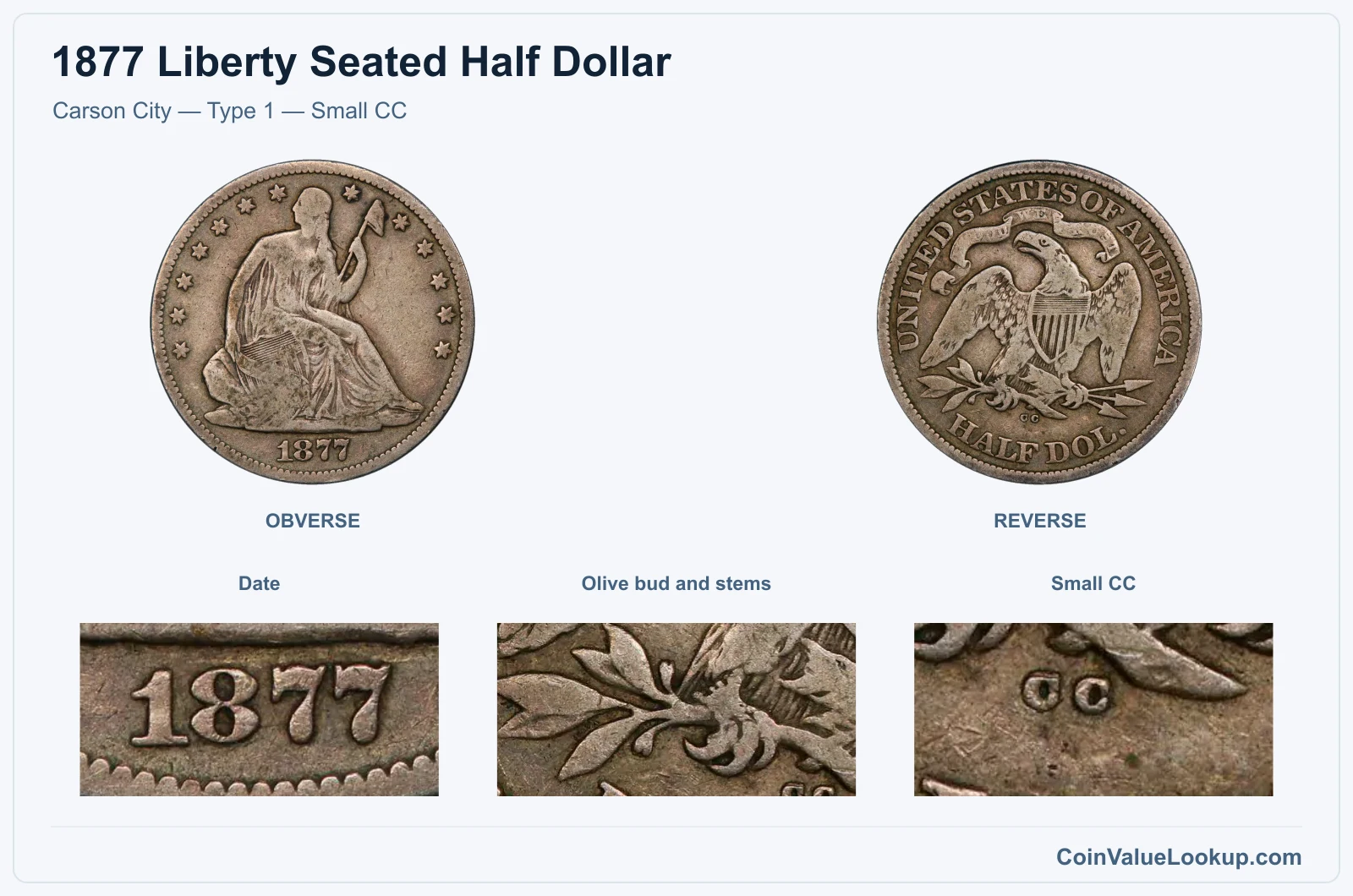
Carson City halves carry the CC mintmark below the eagle. This version uses the Type 1 reverse with an open lower bud and a Small CC punch.
The smaller mintmark can sometimes be tricky to distinguish from a Medium CC, so compare punch size against a known reference. Guide estimates for 1877-CC half dollars run about $162 at G4, $331 at VF20 and $809 at AU50.
No separate premium for the Small CC punch is adopted, but correct identification matters for attribution. These are always popular with Western-mint collectors.
Ordinary-issue reference: Ordinary-issue reference only: The table below shows prices for the 1877-CC Liberty Seated Half Dollar (regular strike). It does not represent the value of the specific Carson City — Type 1 — Small CC variety or its variety premium. Year, mint, metal and strike type are matched; the specific variety is not priced by this table.
Range Grade
Price Auction Records Appraisal PO PO 1
—
Coin Identifier FR FR 2
Coin Identifier AG AG 3
Coin Identifier G G 4
—
Coin Identifier
G 6
—
Coin Identifier VG VG 8
Coin Identifier
VG 10
Coin Identifier F F 12
Coin Identifier
F 15
Coin Identifier VF VF 20
Coin Identifier
VF 25
Coin Identifier
VF 30
Coin Identifier
VF 35
Coin Identifier XF XF 40
Coin Identifier
XF 45
Coin Identifier AU AU 50
Coin Identifier
AU 53
Coin Identifier
AU 55
Coin Identifier
AU 58
Coin Identifier MS MS 60
Coin Identifier
MS 61
Coin Identifier
MS 62
Coin Identifier
MS 63
Coin Identifier
MS 64
Coin Identifier
MS 65
Coin Identifier
MS 66
Coin Identifier
MS 67
Coin Identifier
MS 68
—
—
—
MS 69
—
—
—
MS 70
—
—
—
1877 Liberty Seated Half Dollar — Carson City — Type 1 — Medium CC
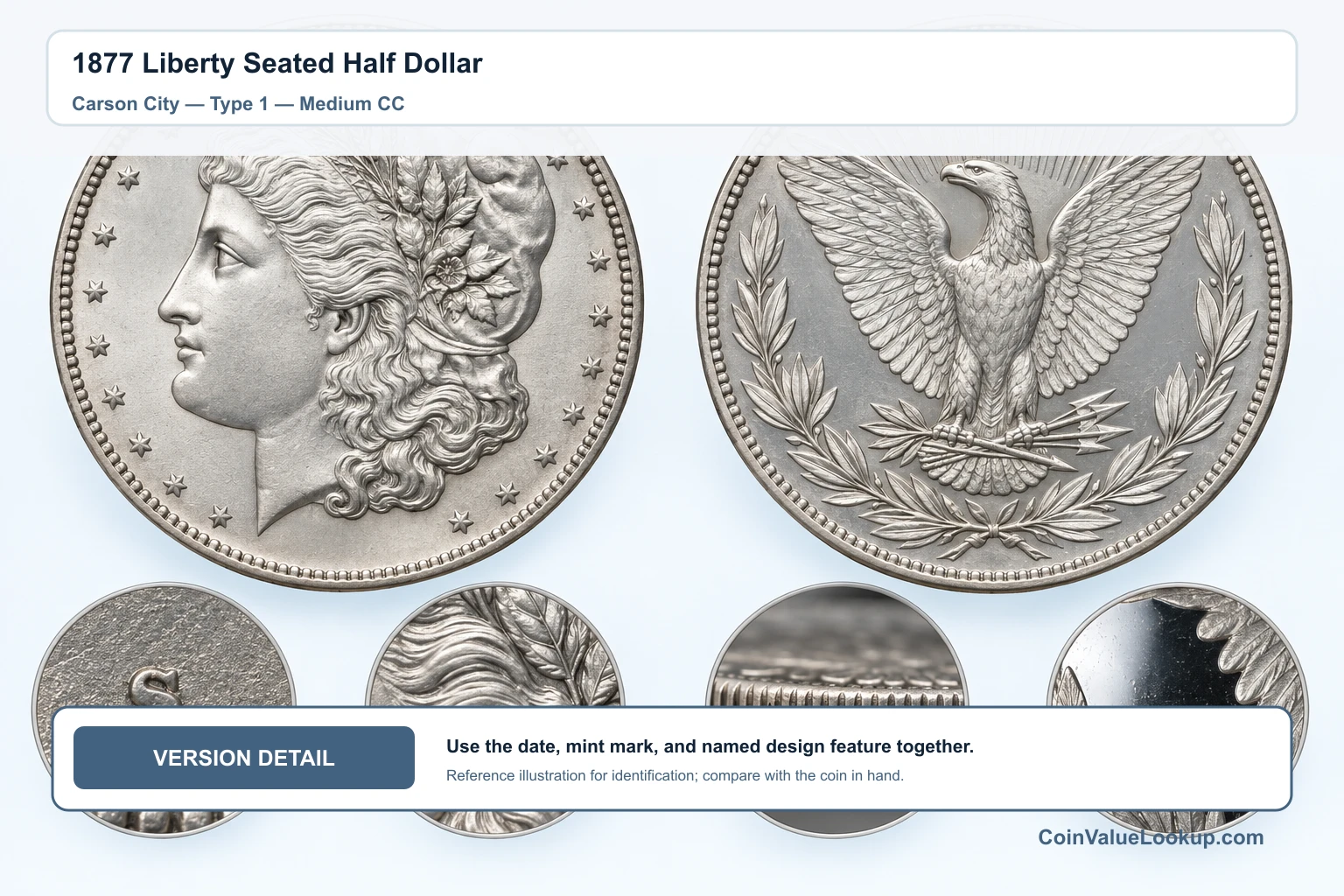
Same Type 1 open-bud reverse as the previous variety, but this one carries a Medium CC mintmark. The letters are slightly larger and more widely spaced than the Small CC.
Guide estimates match the aggregate 1877-CC values: approximately $162 at G4, $331 at VF20 and $809 at AU50. No individual mintmark-size premium is adopted.
Distinguishing Small from Medium CC takes a careful side-by-side comparison — the difference is measured in fractions of a millimeter. A loupe and a reference image will save you a lot of squinting.
Ordinary-issue reference: Ordinary-issue reference only: The table below shows prices for the 1877-CC Liberty Seated Half Dollar (regular strike). It does not represent the value of the specific Carson City — Type 1 — Medium CC variety or its variety premium. Year, mint, metal and strike type are matched; the specific variety is not priced by this table.
Range Grade
Price Auction Records Appraisal PO PO 1
—
Coin Identifier FR FR 2
Coin Identifier AG AG 3
Coin Identifier G G 4
—
Coin Identifier
G 6
—
Coin Identifier VG VG 8
Coin Identifier
VG 10
Coin Identifier F F 12
Coin Identifier
F 15
Coin Identifier VF VF 20
Coin Identifier
VF 25
Coin Identifier
VF 30
Coin Identifier
VF 35
Coin Identifier XF XF 40
Coin Identifier
XF 45
Coin Identifier AU AU 50
Coin Identifier
AU 53
Coin Identifier
AU 55
Coin Identifier
AU 58
Coin Identifier MS MS 60
Coin Identifier
MS 61
Coin Identifier
MS 62
Coin Identifier
MS 63
Coin Identifier
MS 64
Coin Identifier
MS 65
Coin Identifier
MS 66
Coin Identifier
MS 67
Coin Identifier
MS 68
—
—
—
MS 69
—
—
—
MS 70
—
—
—
1877 Liberty Seated Half Dollar — Carson City — Type 2 — Medium CC
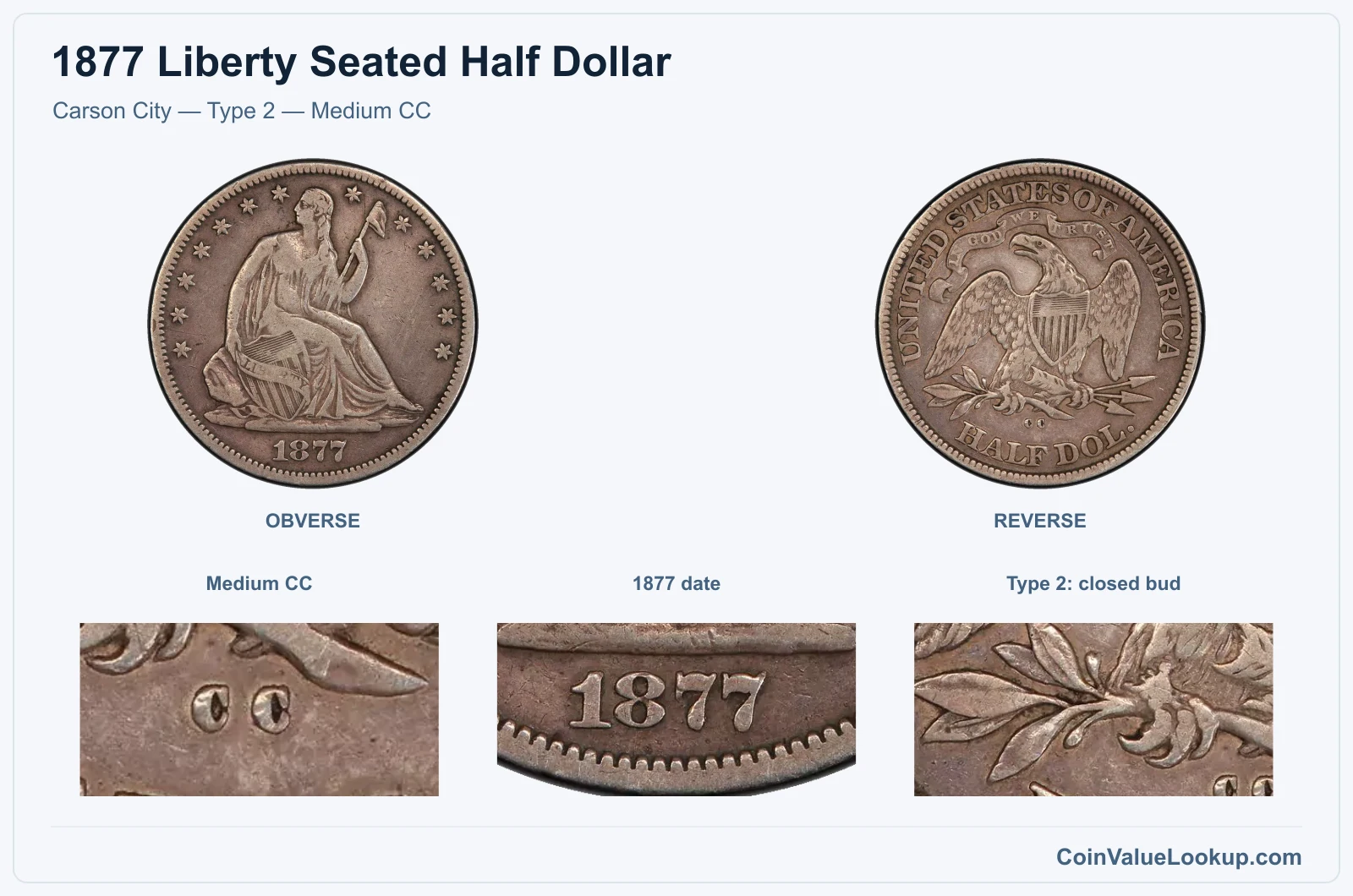
This Carson City issue pairs the Type 2 closed-bud reverse with a Medium CC mintmark. Confirm the bud is closed and stems are strong before assigning this hub.
Guide estimates are in the same range as other 1877-CC varieties: around $162 at G4, $331 at VF20 and $809 at AU50. No hub-specific premium is separately adopted.
The transitional reverse has not been confirmed for Carson City, so if you see an open bud on a CC coin, it is a Type 1, not a transitional.
Ordinary-issue reference: Ordinary-issue reference only: The table below shows prices for the 1877-CC Liberty Seated Half Dollar (regular strike). It does not represent the value of the specific Carson City — Type 2 — Medium CC variety or its variety premium. Year, mint, metal and strike type are matched; the specific variety is not priced by this table.
Range Grade
Price Auction Records Appraisal PO PO 1
—
Coin Identifier FR FR 2
Coin Identifier AG AG 3
Coin Identifier G G 4
—
Coin Identifier
G 6
—
Coin Identifier VG VG 8
Coin Identifier
VG 10
Coin Identifier F F 12
Coin Identifier
F 15
Coin Identifier VF VF 20
Coin Identifier
VF 25
Coin Identifier
VF 30
Coin Identifier
VF 35
Coin Identifier XF XF 40
Coin Identifier
XF 45
Coin Identifier AU AU 50
Coin Identifier
AU 53
Coin Identifier
AU 55
Coin Identifier
AU 58
Coin Identifier MS MS 60
Coin Identifier
MS 61
Coin Identifier
MS 62
Coin Identifier
MS 63
Coin Identifier
MS 64
Coin Identifier
MS 65
Coin Identifier
MS 66
Coin Identifier
MS 67
Coin Identifier
MS 68
—
—
—
MS 69
—
—
—
MS 70
—
—
—
1877 Liberty Seated Half Dollar — San Francisco — Type 1 — Micro S
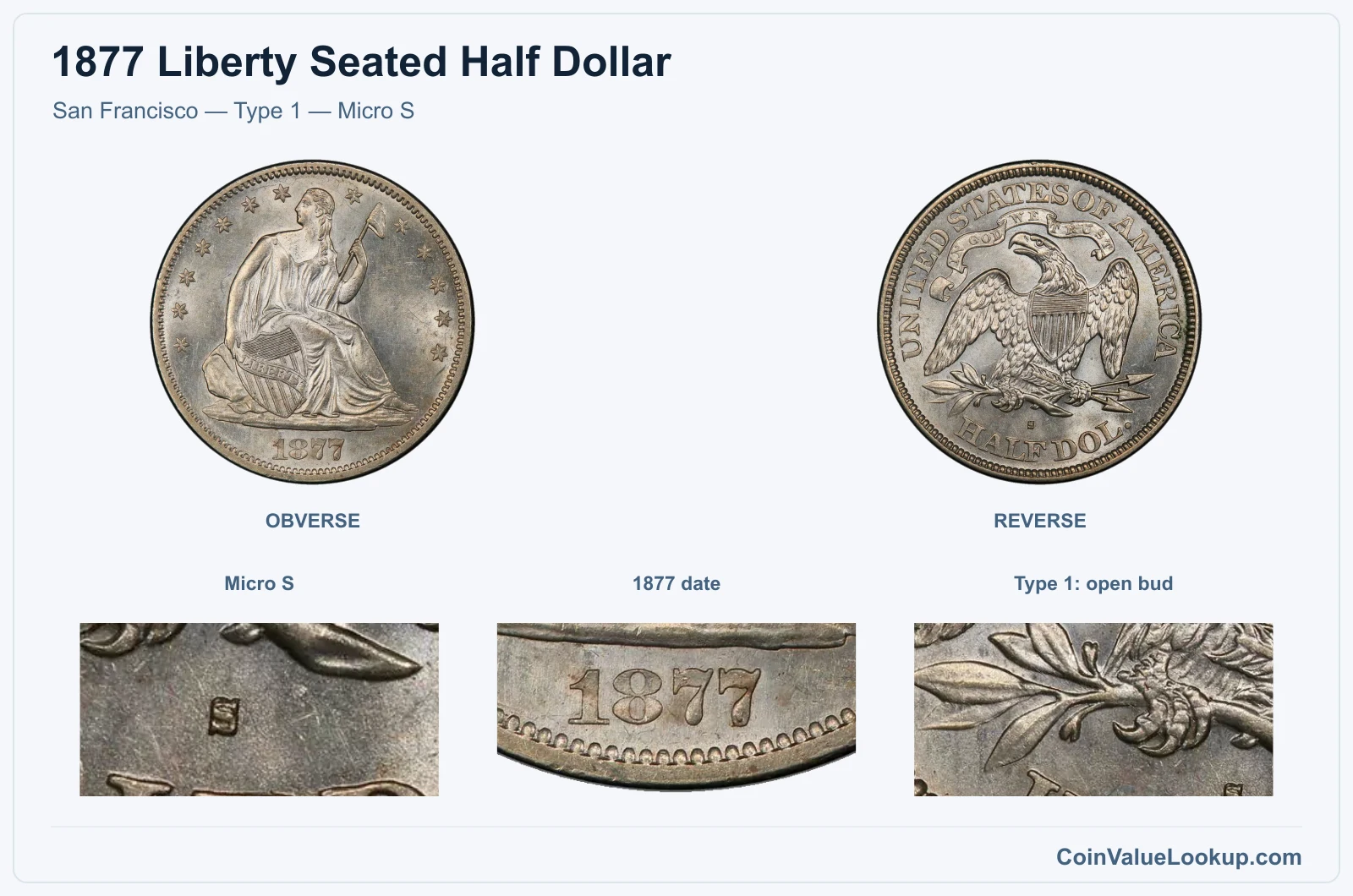
San Francisco struck 1877 halves with multiple mintmark and hub combinations. This one uses a Type 1 open-bud reverse with a Micro S mintmark — a noticeably small letter below the eagle.
Guide estimates for 1877-S halves are about $79 at G4, $172 at VF20 and $394 at AU50. No individual mintmark-size premium is adopted.
Distinguishing Micro S from Very Small S requires a known reference, because both are smaller than typical S punches of the era.
Ordinary-issue reference: Ordinary-issue reference only: The table below shows prices for the 1877-S Liberty Seated Half Dollar (regular strike). It does not represent the value of the specific San Francisco — Type 1 — Micro S variety or its variety premium. Year, mint, metal and strike type are matched; the specific variety is not priced by this table.
Range Grade
Price Auction Records Appraisal PO PO 1
Coin Identifier FR FR 2
Coin Identifier AG AG 3
—
Coin Identifier G G 4
—
Coin Identifier
G 6
—
Coin Identifier VG VG 8
Coin Identifier
VG 10
—
Coin Identifier F F 12
—
Coin Identifier
F 15
—
Coin Identifier VF VF 20
—
Coin Identifier
VF 25
Coin Identifier
VF 30
Coin Identifier
VF 35
Coin Identifier XF XF 40
Coin Identifier
XF 45
Coin Identifier AU AU 50
Coin Identifier
AU 53
Coin Identifier
AU 55
Coin Identifier
AU 58
Coin Identifier MS MS 60
Coin Identifier
MS 61
Coin Identifier
MS 62
Coin Identifier
MS 63
Coin Identifier
MS 64
Coin Identifier
MS 65
Coin Identifier
MS 66
Coin Identifier
MS 67
Coin Identifier
MS 68
—
—
—
MS 69
—
—
—
MS 70
—
—
—
1877 Liberty Seated Half Dollar — San Francisco — Type 1 — Very Small S
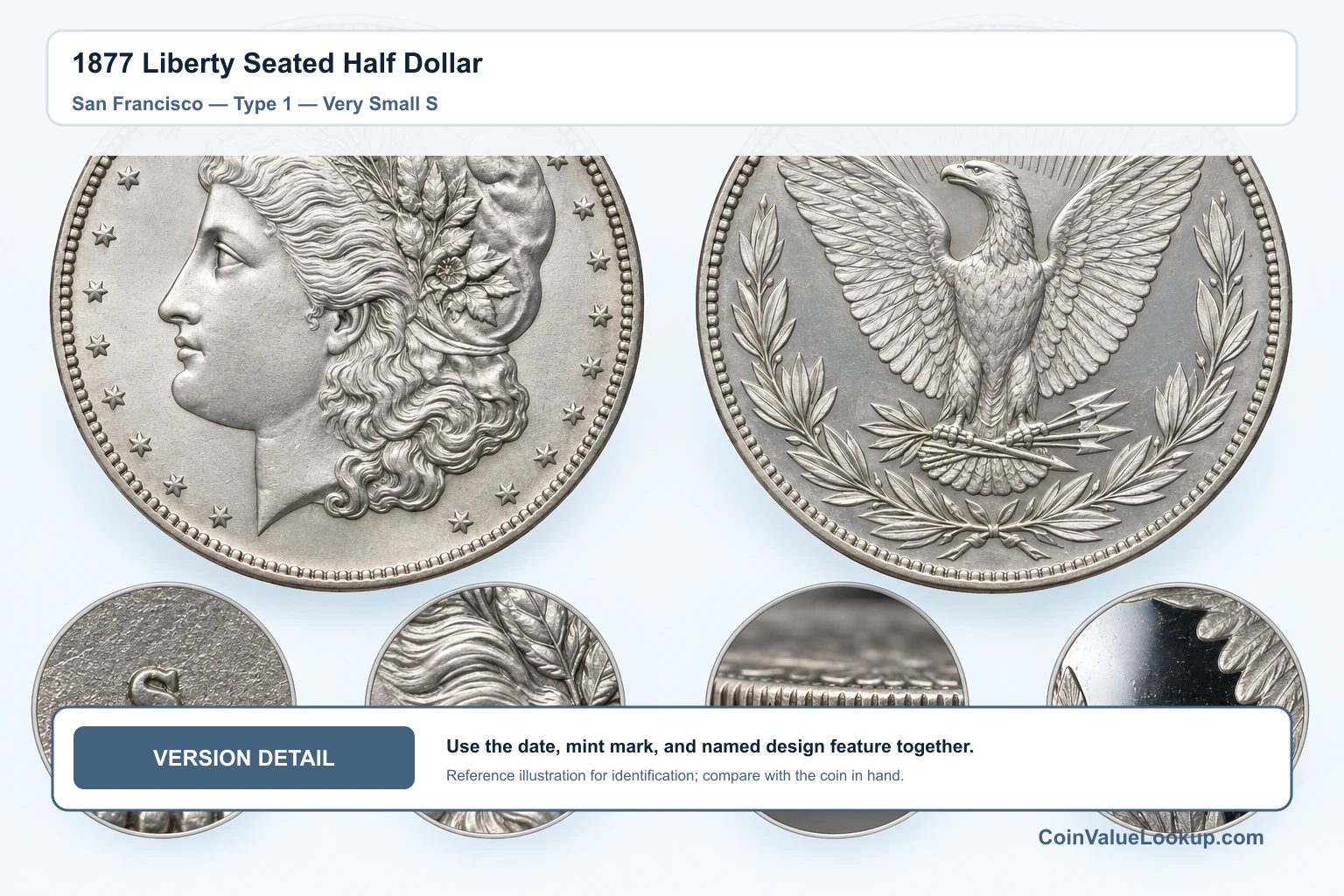
Another Type 1 open-bud San Francisco issue, but this one carries a Very Small S mintmark rather than the Micro S. The difference is slight and best confirmed with a side-by-side comparison against attributed examples.
Guide estimates sit at roughly $79 (G4), $172 (VF20) and $394 (AU50). No separate premium for the mintmark style is adopted here.
Both the bud shape and mintmark size need to match for accurate attribution, so check each feature independently.
Ordinary-issue reference: Ordinary-issue reference only: The table below shows prices for the 1877-S Liberty Seated Half Dollar (regular strike). It does not represent the value of the specific San Francisco — Type 1 — Very Small S variety or its variety premium. Year, mint, metal and strike type are matched; the specific variety is not priced by this table.
Range Grade
Price Auction Records Appraisal PO PO 1
Coin Identifier FR FR 2
Coin Identifier AG AG 3
—
Coin Identifier G G 4
—
Coin Identifier
G 6
—
Coin Identifier VG VG 8
Coin Identifier
VG 10
—
Coin Identifier F F 12
—
Coin Identifier
F 15
—
Coin Identifier VF VF 20
—
Coin Identifier
VF 25
Coin Identifier
VF 30
Coin Identifier
VF 35
Coin Identifier XF XF 40
Coin Identifier
XF 45
Coin Identifier AU AU 50
Coin Identifier
AU 53
Coin Identifier
AU 55
Coin Identifier
AU 58
Coin Identifier MS MS 60
Coin Identifier
MS 61
Coin Identifier
MS 62
Coin Identifier
MS 63
Coin Identifier
MS 64
Coin Identifier
MS 65
Coin Identifier
MS 66
Coin Identifier
MS 67
Coin Identifier
MS 68
—
—
—
MS 69
—
—
—
MS 70
—
—
—
1877 Liberty Seated Half Dollar — San Francisco — Transitional Reverse — Very Small S
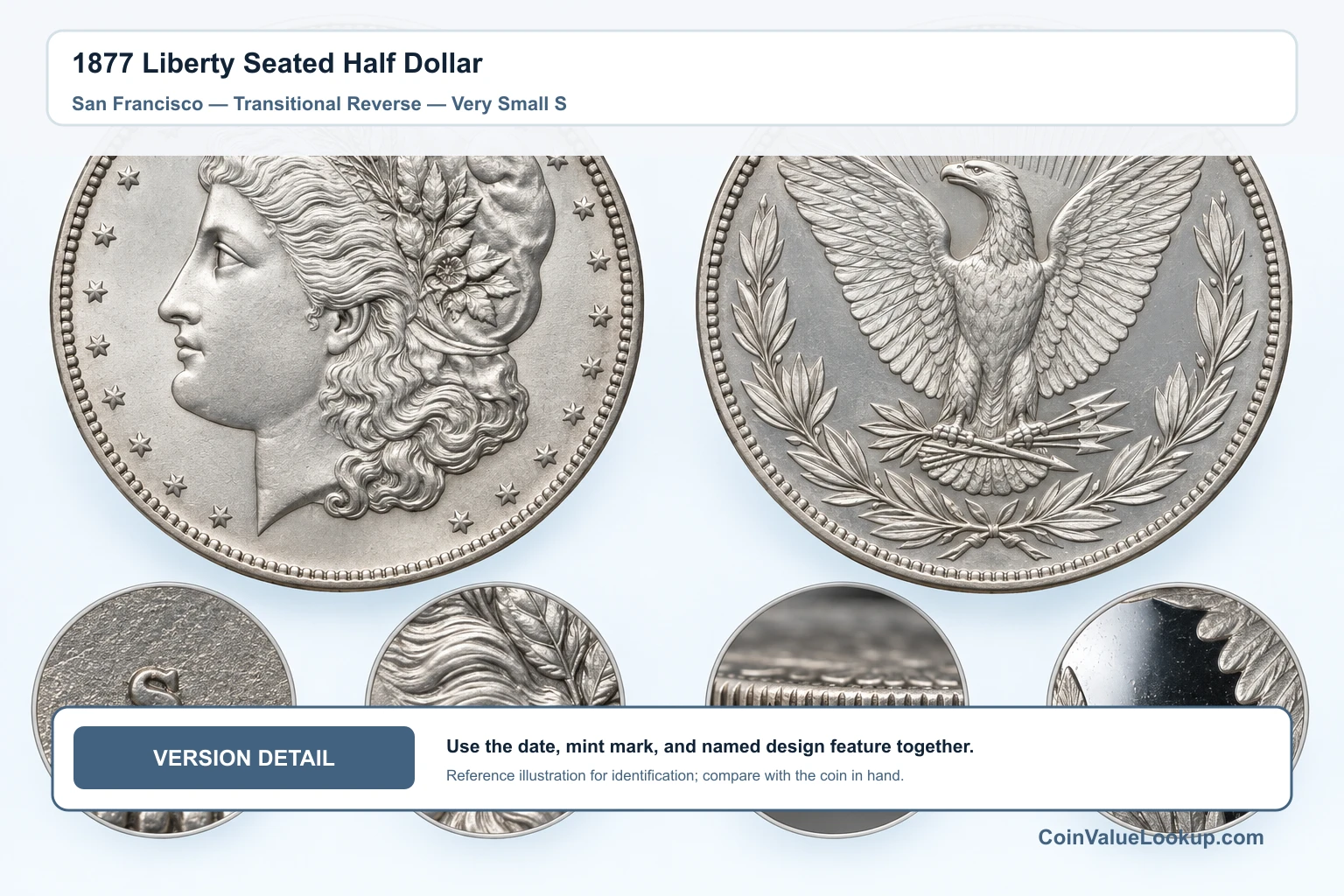
This is the San Francisco transitional reverse — open lower olive bud combined with strong olive stems — paired with a Very Small S mintmark. You need both the open bud and bold stems present to call this transitional rather than a plain Type 1.
This die marriage is documented for 1877-S production. Guide estimates are about $79 at G4, $172 at VF20 and $394 at AU50, with no separate hub premium adopted.
Careful reverse examination under magnification is the only way to confidently distinguish this from the ordinary Type 1 open-bud version.
Coin Value Lookup is a good starting point if you are working through multiple Seated Liberty dates. You can look up guides for other years and denominations in the series to compare values across your collection.
Ordinary-issue reference: Ordinary-issue reference only: The table below shows prices for the 1877-S Liberty Seated Half Dollar (regular strike). It does not represent the value of the specific San Francisco — Transitional Reverse — Very Small S variety or its variety premium. Year, mint, metal and strike type are matched; the specific variety is not priced by this table.
Range Grade
Price Auction Records Appraisal PO PO 1
Coin Identifier FR FR 2
Coin Identifier AG AG 3
—
Coin Identifier G G 4
—
Coin Identifier
G 6
—
Coin Identifier VG VG 8
Coin Identifier
VG 10
—
Coin Identifier F F 12
—
Coin Identifier
F 15
—
Coin Identifier VF VF 20
—
Coin Identifier
VF 25
Coin Identifier
VF 30
Coin Identifier
VF 35
Coin Identifier XF XF 40
Coin Identifier
XF 45
Coin Identifier AU AU 50
Coin Identifier
AU 53
Coin Identifier
AU 55
Coin Identifier
AU 58
Coin Identifier MS MS 60
Coin Identifier
MS 61
Coin Identifier
MS 62
Coin Identifier
MS 63
Coin Identifier
MS 64
Coin Identifier
MS 65
Coin Identifier
MS 66
Coin Identifier
MS 67
Coin Identifier
MS 68
—
—
—
MS 69
—
—
—
MS 70
—
—
—
1877 Liberty Seated Half Dollar — San Francisco — Type 2 — Very Small S
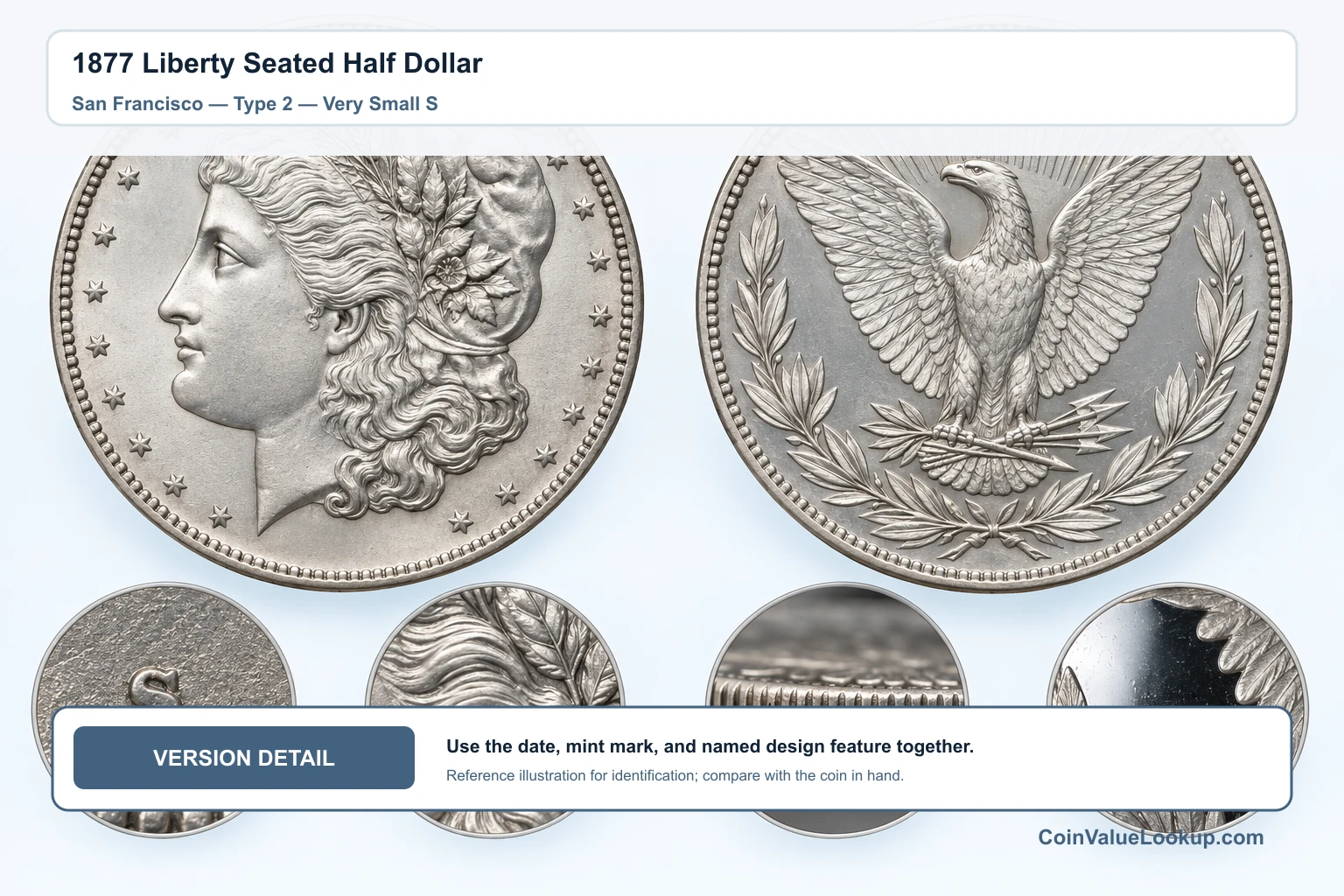
The Type 2 closed-bud San Francisco issue uses a Very Small S mintmark. The closed bud and stronger stems distinguish this reverse from the Type 1 hub.
Guide estimates are approximately $79 at G4, $172 at VF20 and $394 at AU50. No separate hub premium is adopted.
On heavily worn coins, confirming the bud is closed rather than just worn smooth can be difficult — look for any remaining definition in the olive cluster area under magnification before committing to a hub call.
Ordinary-issue reference: Ordinary-issue reference only: The table below shows prices for the 1877-S Liberty Seated Half Dollar (regular strike). It does not represent the value of the specific San Francisco — Type 2 — Very Small S variety or its variety premium. Year, mint, metal and strike type are matched; the specific variety is not priced by this table.
Range Grade
Price Auction Records Appraisal PO PO 1
Coin Identifier FR FR 2
Coin Identifier AG AG 3
—
Coin Identifier G G 4
—
Coin Identifier
G 6
—
Coin Identifier VG VG 8
Coin Identifier
VG 10
—
Coin Identifier F F 12
—
Coin Identifier
F 15
—
Coin Identifier VF VF 20
—
Coin Identifier
VF 25
Coin Identifier
VF 30
Coin Identifier
VF 35
Coin Identifier XF XF 40
Coin Identifier
XF 45
Coin Identifier AU AU 50
Coin Identifier
AU 53
Coin Identifier
AU 55
Coin Identifier
AU 58
Coin Identifier MS MS 60
Coin Identifier
MS 61
Coin Identifier
MS 62
Coin Identifier
MS 63
Coin Identifier
MS 64
Coin Identifier
MS 65
Coin Identifier
MS 66
Coin Identifier
MS 67
Coin Identifier
MS 68
—
—
—
MS 69
—
—
—
MS 70
—
—
—
1877 Liberty Seated Half Dollar — Philadelphia Proof — Type 1 — Open Bud
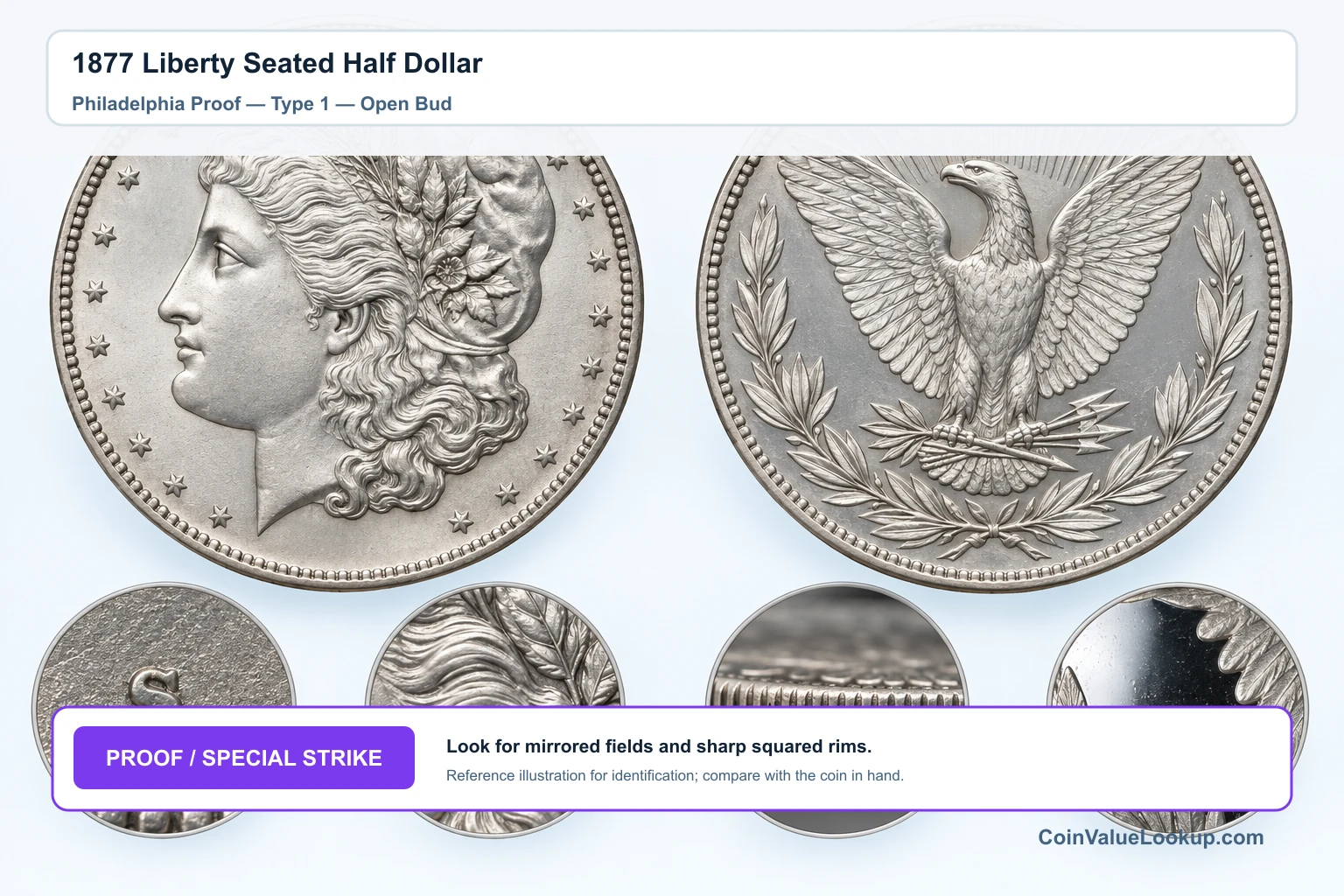
Philadelphia Proof with a Type 1 open-bud reverse. True Proofs show mirrored fields, squared rims and a distinctly different surface quality from even a prooflike business strike.
A bright circulation strike is not a Proof. The aggregate guide estimate for 1877 Proof half dollars at PR63 is about $1,409, with no individual reverse-hub premium adopted.
Cameo and Deep Cameo are contrast designations within the Proof finish, describing how frosted the devices appear against the mirror fields — they do not change the basic identification. Expert attribution is recommended because early business strikes and Proofs can look similar.
Ordinary-issue reference: Ordinary-issue reference only: The table below shows prices for the 1877 Liberty Seated Half Dollar (proof). It does not represent the value of the specific Philadelphia Proof — Type 1 — Open Bud variety or its variety premium. Year, mint, metal and strike type are matched; the specific variety is not priced by this table.
Range Grade
Price Auction Records Appraisal PR PR 1
—
Coin Identifier
PR 2
—
Coin Identifier
PR 3
—
Coin Identifier
PR 4
—
Coin Identifier
PR 6
—
Coin Identifier
PR 8
—
Coin Identifier
PR 10
—
Coin Identifier
PR 12
—
Coin Identifier
PR 15
—
Coin Identifier
PR 20
—
Coin Identifier
PR 25
—
Coin Identifier
PR 30
—
Coin Identifier
PR 35
—
Coin Identifier
PR 40
—
Coin Identifier
PR 45
—
Coin Identifier
PR 50
—
Coin Identifier
PR 53
—
Coin Identifier
PR 55
—
Coin Identifier
PR 58
—
Coin Identifier
PR 60
—
Coin Identifier
PR 61
Coin Identifier
PR 62
Coin Identifier
PR 63
Coin Identifier
PR 64
Coin Identifier
PR 65
Coin Identifier
PR 66
Coin Identifier
PR 67
Coin Identifier
PR 68
—
—
—
PR 69
—
—
—
PR 70
—
—
—
1877 Liberty Seated Half Dollar — Philadelphia Proof — Transitional Reverse — Open Bud / Strong Stems
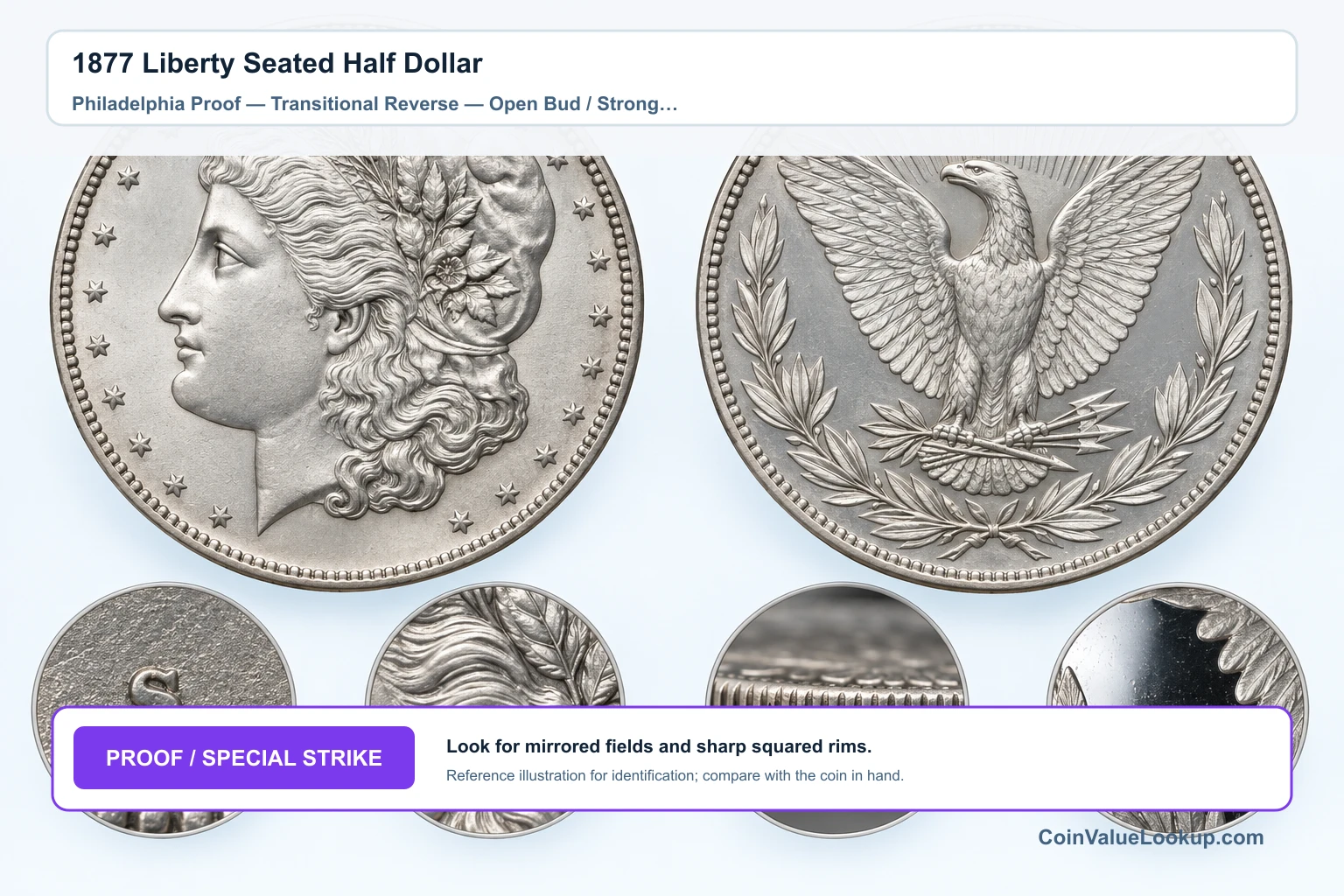
The transitional reverse Proof combines the open lower olive bud with strong olive stems — both features must be present. Do not identify this hub from the bud alone; the stem strength is the other half of the diagnostic.
This hub is documented for Philadelphia Proofs in the 1876–78 and 1881 date range. The aggregate PR63 guide estimate is about $1,409, with no separate hub premium adopted.
Careful reverse comparison against known Type 1 and Type 2 Proof examples is the only reliable way to confirm you have the transitional hub. Professional attribution is worth considering.
Ordinary-issue reference: Ordinary-issue reference only: The table below shows prices for the 1877 Liberty Seated Half Dollar (proof). It does not represent the value of the specific Philadelphia Proof — Transitional Reverse — Open Bud / Strong Stems variety or its variety premium. Year, mint, metal and strike type are matched; the specific variety is not priced by this table.
Range Grade
Price Auction Records Appraisal PR PR 1
—
Coin Identifier
PR 2
—
Coin Identifier
PR 3
—
Coin Identifier
PR 4
—
Coin Identifier
PR 6
—
Coin Identifier
PR 8
—
Coin Identifier
PR 10
—
Coin Identifier
PR 12
—
Coin Identifier
PR 15
—
Coin Identifier
PR 20
—
Coin Identifier
PR 25
—
Coin Identifier
PR 30
—
Coin Identifier
PR 35
—
Coin Identifier
PR 40
—
Coin Identifier
PR 45
—
Coin Identifier
PR 50
—
Coin Identifier
PR 53
—
Coin Identifier
PR 55
—
Coin Identifier
PR 58
—
Coin Identifier
PR 60
—
Coin Identifier
PR 61
Coin Identifier
PR 62
Coin Identifier
PR 63
Coin Identifier
PR 64
Coin Identifier
PR 65
Coin Identifier
PR 66
Coin Identifier
PR 67
Coin Identifier
PR 68
—
—
—
PR 69
—
—
—
PR 70
—
—
—
1877 Liberty Seated Half Dollar — Philadelphia Proof — Type 2 — Closed Bud
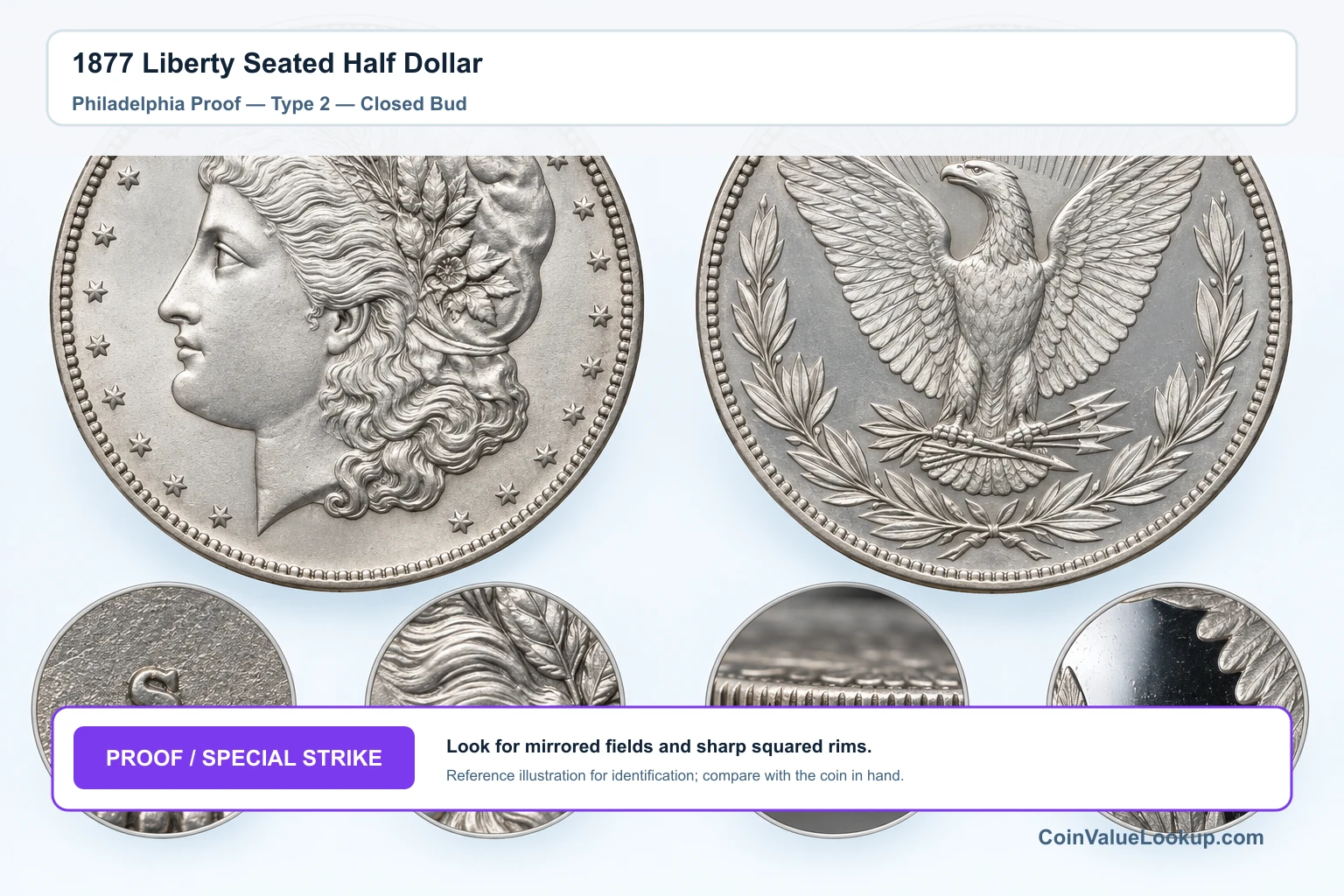
This Proof uses the Type 2 closed-bud reverse. The lower olive bud is clearly sealed, and the stems are generally bolder than on Type 1.
As with all 1877 Proofs, confirm the coin has genuine Proof surfaces — mirrored fields and squared rims — rather than simply being a bright or prooflike circulation strike. The PR63 guide estimate is about $1,409.
Cameo and Deep Cameo designations describe contrast levels within the Proof finish. No individual hub premium is adopted, but accurate hub attribution is important for registry and collector purposes.
Ordinary-issue reference: Ordinary-issue reference only: The table below shows prices for the 1877 Liberty Seated Half Dollar (proof). It does not represent the value of the specific Philadelphia Proof — Type 2 — Closed Bud variety or its variety premium. Year, mint, metal and strike type are matched; the specific variety is not priced by this table.
Range Grade
Price Auction Records Appraisal PR PR 1
—
Coin Identifier
PR 2
—
Coin Identifier
PR 3
—
Coin Identifier
PR 4
—
Coin Identifier
PR 6
—
Coin Identifier
PR 8
—
Coin Identifier
PR 10
—
Coin Identifier
PR 12
—
Coin Identifier
PR 15
—
Coin Identifier
PR 20
—
Coin Identifier
PR 25
—
Coin Identifier
PR 30
—
Coin Identifier
PR 35
—
Coin Identifier
PR 40
—
Coin Identifier
PR 45
—
Coin Identifier
PR 50
—
Coin Identifier
PR 53
—
Coin Identifier
PR 55
—
Coin Identifier
PR 58
—
Coin Identifier
PR 60
—
Coin Identifier
PR 61
Coin Identifier
PR 62
Coin Identifier
PR 63
Coin Identifier
PR 64
Coin Identifier
PR 65
Coin Identifier
PR 66
Coin Identifier
PR 67
Coin Identifier
PR 68
—
—
—
PR 69
—
—
—
PR 70
—
—
—
1877 Liberty Seated Half Dollar Error List
1. 1877 Liberty Seated Half Dollar — /6 Overdate
The 1877/6 overdate is a Philadelphia variety where a remnant of the digit 6 appears at the top of the final 7 in the date. Under magnification, you will see a curved element extending from the upper portion of the 7 that does not belong to the normal digit shape.
This feature is specific to Philadelphia strikes.
Compare your date closely against an ordinary 1877 — the difference becomes obvious once you know what to look for. Do not mistake accumulated dirt, surface corrosion, cleaning lines or rim damage for the underdigit.
The remnant is part of the die impression, so it appears consistent and repeatable, not random like post-mint damage. Value depends on the coin's overall condition and how clearly the underlying 6 is visible; no specific numerical price range is adopted here.
Individual assessment is recommended.
2. 1877 Liberty Seated Half Dollar — Repunched Date
Repunched dates on 1877 Seated Half Dollars have been reported for Philadelphia, Carson City and San Francisco issues. The diagnostic is displaced or doubled numeral outlines in the date, where one or more digits show traces of an earlier, slightly offset punch position.
You might see a ghostly second contour near one of the numerals — thicker bases, split serifs or shadow outlines.
Do not confuse this with post-mint damage to the date area or machine doubling, which tends to produce flat, shelf-like distortion rather than the rounded secondary punch traces of a genuine repunched date. Condition, the clarity of the repunching and the specific die variety all affect value, so no numerical price range is adopted.
Compare against an attributed same-mint example before committing to the call.
3. 1877 Liberty Seated Half Dollar — Repunched Mintmark
Repunched mintmarks on 1877 Seated Half Dollars have been reported for San Francisco issues, where the S mintmark shows evidence of a secondary punch impression. Look for a doubled or offset outline near the S below the eagle — traces of an earlier placement that did not quite line up with the final position.
Do not confuse an unusual mintmark size with repunching. The 1877-S already comes in Micro S and Very Small S styles, so the punch itself varies.
A true repunched mintmark shows overlapping impressions of the same letter. Machine doubling, die chips and corrosion near the mintmark can mimic repunching, so careful comparison with a known attributed example is essential.
Value depends on visibility and condition; no specific price range is adopted.
4. 1877 Liberty Seated Half Dollar — Die Crack / Die Chip
Die cracks on 1877 Seated Half Dollars have been reported for San Francisco production, including a reverse crack above AMERICA that extends to the rim. A die crack appears as a thin raised line on the coin's surface, following the path where the die fractured during use.
The key word is raised — scratches and corrosion lines are incuse (sunk into the surface), while a genuine die crack stands proud of the field.
To confirm, run your fingernail or a toothpick across the suspected line. If it catches going one direction but not the other, it is likely raised.
Corrosion, foreign material stuck to the surface or incuse scratches can all mimic a crack at first glance. Value depends on the prominence of the crack and overall coin condition; no specific price range is adopted for this category.
5. 1877 Liberty Seated Half Dollar — Die Gouge / Named Raised-Line Variety
A die gouge variety has been reported on 1877-S Seated Half Dollars, described as an arched gouge across the lower portion of Liberty's gown. On the coin, this appears as a raised line that follows a consistent arc — it is part of the die impression, not random surface damage.
The critical distinction is raised versus incuse. A die gouge transfers as a raised feature on the struck coin because the gouge was cut into the die itself.
A post-mint scratch, by contrast, is incuse — dug into the coin's surface. If the line sits above the surrounding field and is consistent across multiple examples, it is die-related.
Do not confuse it with unrelated die cracks or contact marks. Value depends on visibility and overall condition; no numerical price range is adopted.
6. 1877 Liberty Seated Half Dollar — Die Chips / Raised Lumps
Die chips show up as small raised lumps or blobs on the coin's surface, occurring where a tiny piece of the die face broke away. On 1877-S Seated Half Dollars, die chips have been reported at locations including the shield, gown area and eagle's neck.
They look like irregular bumps that do not correspond to the normal design.
These are not the same as corrosion pits or surface debris. A genuine die chip is raised, appears in a consistent location on coins struck from that die, and sits within or adjacent to the design.
Worn surfaces, cleaning residue and impact marks can look similar but lack the repeatable, raised character of a true chip. Most die chips are minor and carry no particular premium, but value depends on the specific coin's condition and how dramatic the chip appears.
No numerical price range is adopted.
7. 1877 Liberty Seated Half Dollar — Partial Collar Strike
A partial collar strike has been reported for an 1877-S Seated Half Dollar, described as a tilted partial collar. On such a coin, one portion of the rim and edge show normal reeding from the collar die, while the opposite side is expanded, unfinished or stepped because the planchet was not fully seated in the collar during striking.
Look at the edge all the way around. Normal reeding that abruptly transitions to a smooth or distorted area is the hallmark.
This is different from post-mint edge damage, which shows irregular dings and nicks rather than a clean transition zone. A complete broadstrike would have no reeding at all, and a flattened rim from a drop or vise lacks the collar-engagement geometry.
Value depends on condition and the degree of the error; no specific price range is adopted.
8. 1877 Liberty Seated Half Dollar — Rotated Dies
A rotated die error on an 1877 Seated Half Dollar has been reported through a secondary source referencing a specific F12 example. Normally, flipping a coin top-to-bottom should show the reverse perfectly upside-down relative to the obverse.
On a rotated die coin, the reverse is turned to some degree off that standard 180-degree alignment.
To test, hold your coin with the obverse upright and flip it along the vertical axis. If the reverse is noticeably tilted rather than perfectly inverted, you may have rotation.
Be careful — a coin turned sideways in your hand or a photo rotated in software can create the same illusion. Confirm with a controlled, repeatable flip.
Value depends on the degree of rotation and the coin's condition; no numerical price range is adopted for this category.
9. 1877 Liberty Seated Half Dollar — Off-Center Strike
An off-center strike on an 1877 Seated Half Dollar has been reported through a historical dealer listing describing a Philadelphia MS63 example struck approximately 10% off center. On an off-center coin, the entire design is shifted toward one side, leaving a crescent-shaped blank area on the opposite edge where the planchet was not covered by the dies.
This is different from a misaligned die, where one side is shifted but the other remains centered. It is also distinct from a clipped planchet, which shows a curved bite out of the blank before striking.
Post-mint flattening can deform a rim but will not produce the characteristic blank crescent with displaced design. The date must be visible for the coin to be attributed.
Value depends on the percentage of off-center shift and overall condition; no specific price range is adopted.