1982 Jefferson Nickel Coin Value: How Much Is It Worth?
The 1982 Jefferson nickel is a common coin in circulation, and most pocket-found examples are worth face value. Uncirculated pieces carry modest collector premiums: guide estimates for MS60 to MS65 range from roughly $2.50 to $12, depending on the mint.
S-mint proofs and confirmed error strikes occupy separate markets. These guide figures reflect retail estimates, not guaranteed cash offers for any particular coin.
Fast Way to Identify Your 1982 Jefferson Nickel
Want a quick read on your 1982 nickel? Snap clear photos of both the front and back of the coin, making sure the mintmark area below the date is visible.
Upload them for a preliminary identification of your coin's mint, finish, and general condition. This is not a substitute for professional authentication, but it gives you a solid starting point.
1982 Jefferson Nickel Value
Upload both sides of your 1982 Jefferson Nickel.
Front Obverse
Upload photo
Back Reverse
Upload photo
Which 1982 Jefferson Nickel Versions Are Worth Money?
- Uncirculated 1982-P nickels in MS65 condition carry a guide estimate around $12, making strong-strike Philadelphia coins worth checking.
- 1982-D nickels in MS65 grade list near $7.29 in guides, above face value but below the P-mint equivalent at the same grade.
- 1982-S proofs are collector strikes; a PR65 example lists around $2.50, with cameo contrast levels graded separately.
- A 1982-D nickel struck on a cent planchet sold for $372 at auction in November 2020, showing that authenticated wrong-planchet errors carry real premiums.
- Off-center strikes, cud die breaks, double strikes, and filled-die errors are all reported for this date and can add value when authenticated.
Step 1: Identify Your 1982 Jefferson Nickel Mint Mark and Version
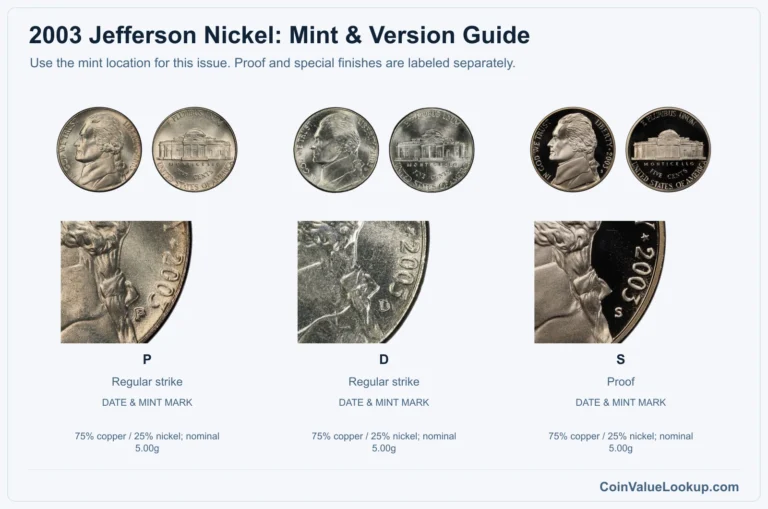
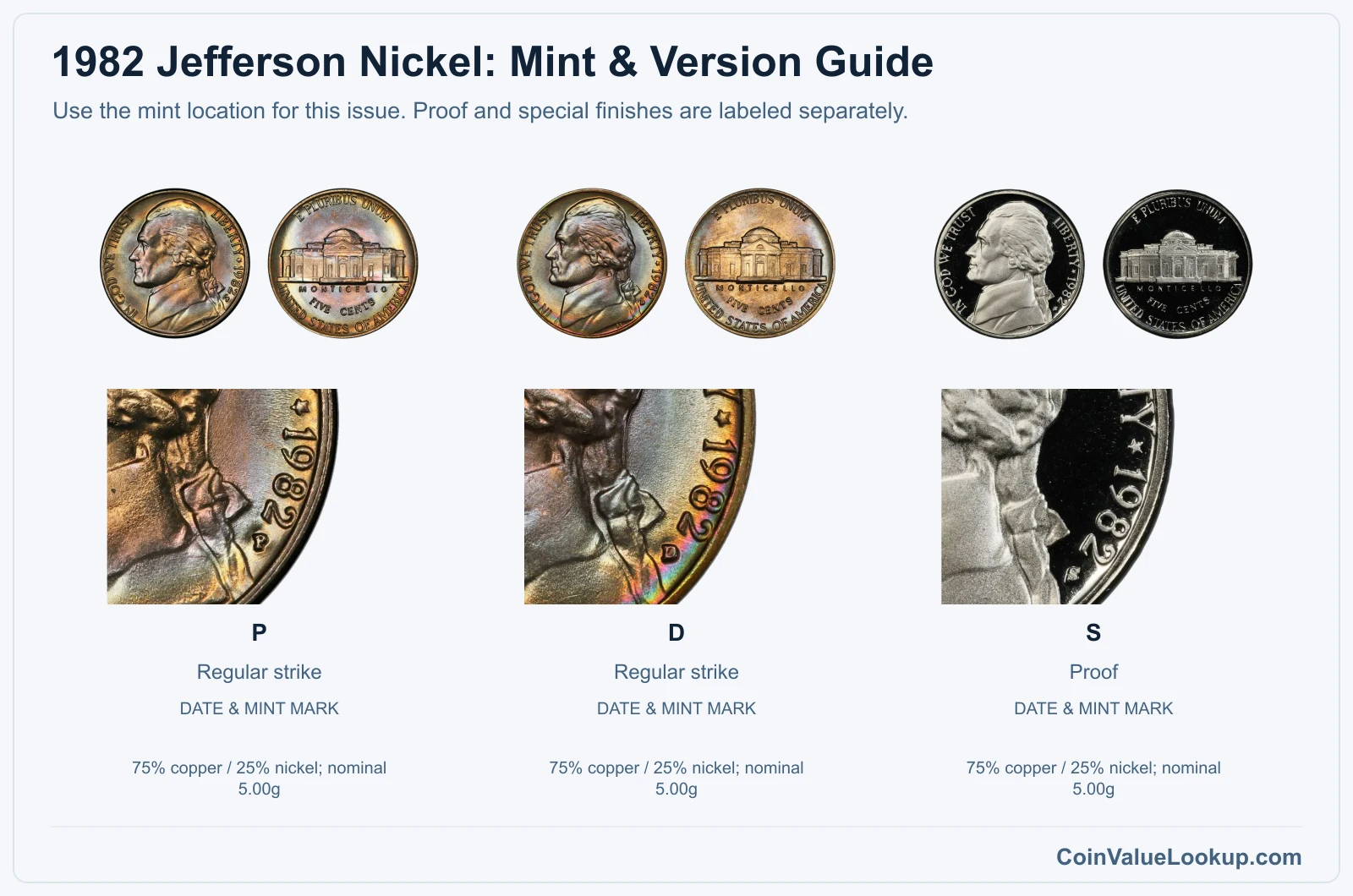
Three versions of the 1982 Jefferson nickel exist: Philadelphia (P), Denver (D), and San Francisco (S) proof. The mintmark sits on the obverse, just below and to the right of the date.
Starting in 1980, Philadelphia nickels carry an explicit P mintmark, so every business strike from this year should show either a P or a D.
All three are struck in the standard 75% copper, 25% nickel alloy, weighing about 5 grams on a 21.2 mm plain-edge planchet. Do not confuse the normal copper-nickel composition with a clad sandwich or a silver issue; there is no silver collector branch for this date.
The S-mint proof is a collector strike sold in proof sets, featuring mirror fields and a sharper strike than business issues. Compare the finish carefully: a proof is not simply a high-grade circulation coin.
Photograph both sides and the mintmark before consulting any price reference.
Step 2: Check Your 1982 Jefferson Nickel Grade
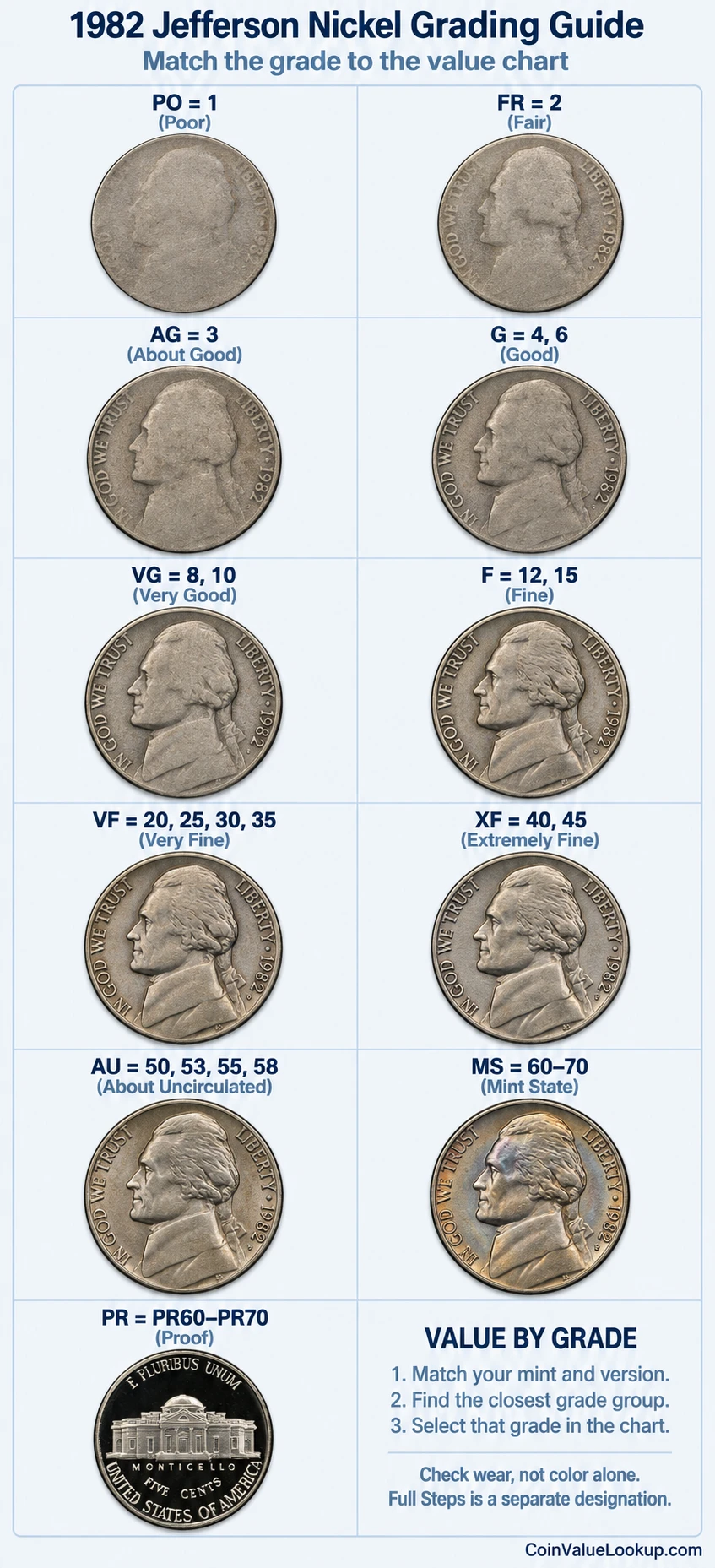
Start with Jefferson's cheek and the hair detail above his ear. On a well-worn coin, the cheek is flat and the individual hair strands merge together.
A coin with only light friction will still show original mint luster across most of the surface.
Flip to the reverse and check the Monticello columns and the steps at the building's base. Sharp, uninterrupted steps can indicate a strong strike, but weak steps alone do not prove the coin circulated.
Full Steps is a certified designation for mint-state business strikes that meet specific step-clarity standards; it is not a mint error.
Use the comparison image to match your coin's wear level. A coin grading around MS60 shows no wear but may have bag marks, while an MS65 example is clean with strong eye appeal.
Proof coins are graded on a separate scale that accounts for hairlines and haze rather than circulation wear.
Step 3: Check 1982 Jefferson Nickel Value by Mint and Version
1982 Jefferson Nickel — P Business strike
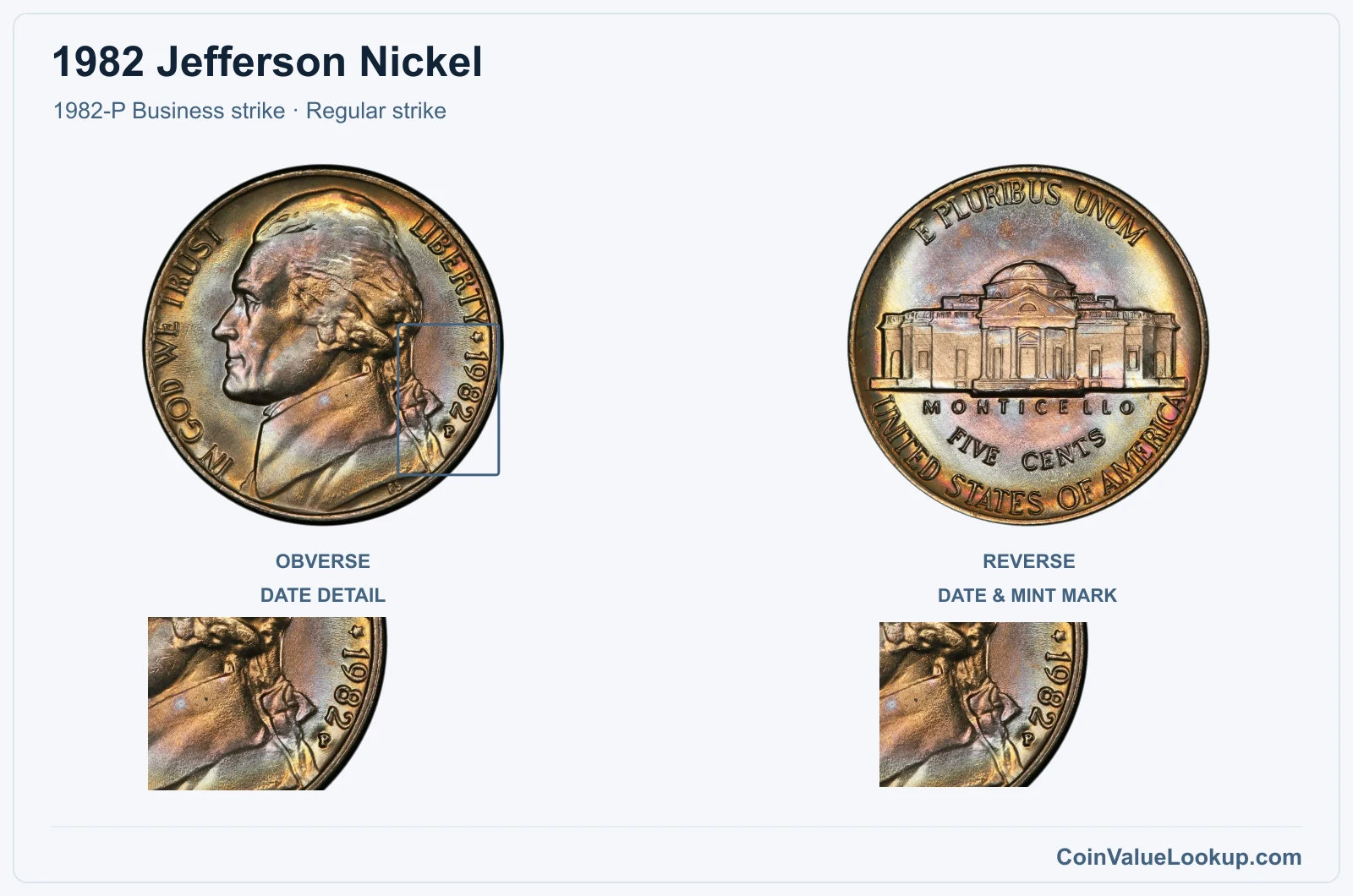
The 1982-P is the Philadelphia business strike, identified by the small P mintmark on the obverse below the date. It uses the standard 75% copper, 25% nickel composition at a nominal 5 grams.
There is no silver or special collector variant for this mint and year.
Guide estimates place an MS60 example around $6.25 and an MS65 around $12, according to USA Coin Book. Coins with strong step detail on the Monticello reverse may attract additional collector interest under separate Full Steps designations, but that is a strike-quality filter, not a different version.
Circulated pieces are common and generally trade at face value.
| Range | Grade | Price | Auction Records | Appraisal |
|---|---|---|---|---|
| PO | PO 1 | — | Coin Identifier | |
| FR | FR 2 | — | Coin Identifier | |
| AG | AG 3 | — | Coin Identifier | |
| G | G 4 | — | Coin Identifier | |
| G 6 | — | Coin Identifier | ||
| VG | VG 8 | — | Coin Identifier | |
| VG 10 | — | Coin Identifier | ||
| F | F 12 | — | Coin Identifier | |
| F 15 | — | Coin Identifier | ||
| VF | VF 20 | — | Coin Identifier | |
| VF 25 | — | Coin Identifier | ||
| VF 30 | — | Coin Identifier | ||
| VF 35 | — | Coin Identifier | ||
| XF | XF 40 | — | Coin Identifier | |
| XF 45 | — | Coin Identifier | ||
| AU | AU 50 | — | Coin Identifier | |
| AU 53 | — | Coin Identifier | ||
| AU 55 | — | Coin Identifier | ||
| AU 58 | — | Coin Identifier | ||
| MS | MS 60 | — | Coin Identifier | |
| MS 61 | — | Coin Identifier | ||
| MS 62 | — | Coin Identifier | ||
| MS 63 | — | Coin Identifier | ||
| MS 64 | Coin Identifier | |||
| MS 65 | Coin Identifier | |||
| MS 66 | — | Coin Identifier | ||
| MS 67 | — | Coin Identifier | ||
| MS 68 | — | — | — | |
| MS 69 | — | — | — | |
| MS 70 | — | — | — |
1982 Jefferson Nickel — D Business strike
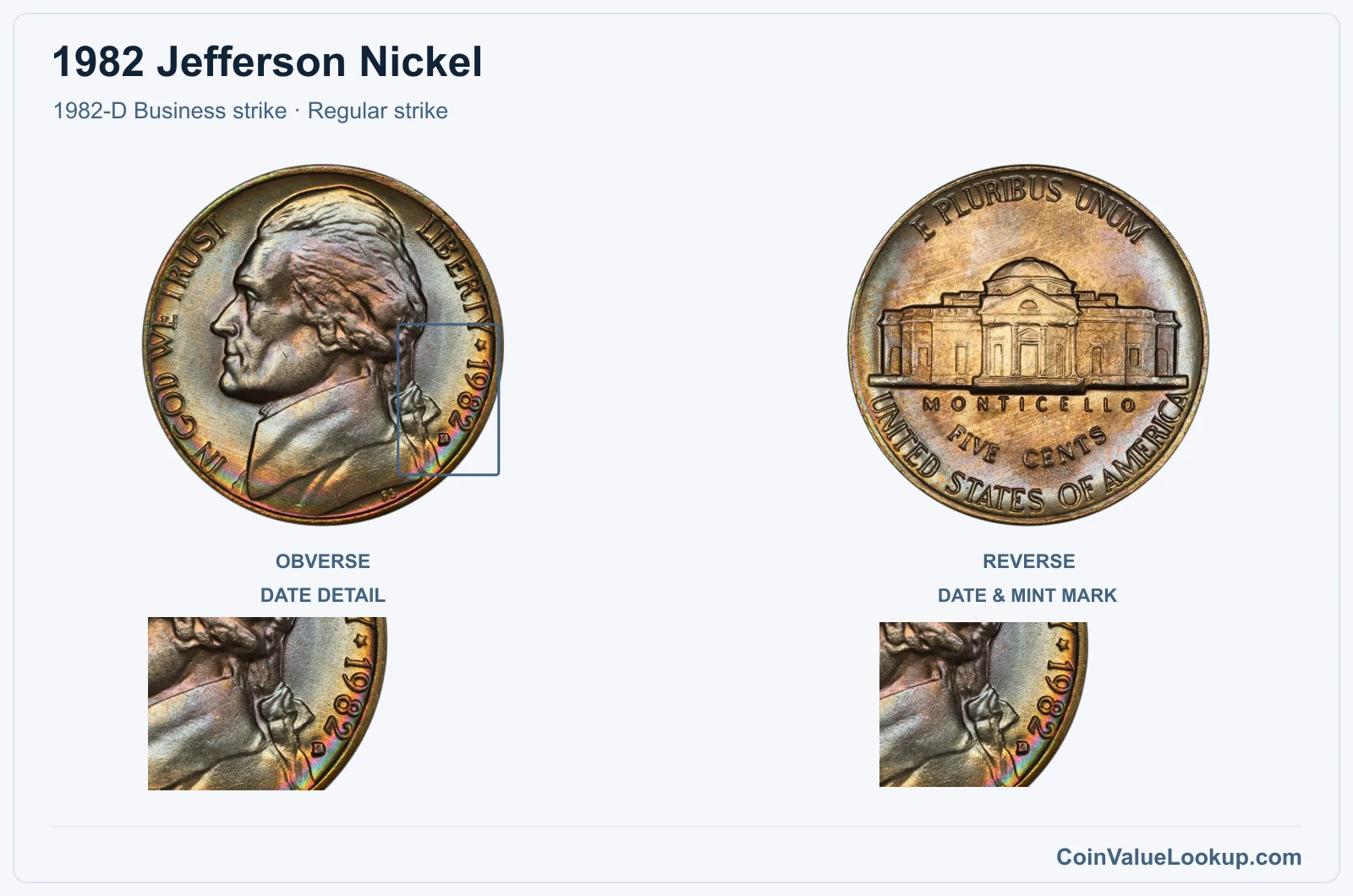
The 1982-D comes from the Denver Mint, with a D mintmark in the same obverse location below the date. Same alloy, same weight, same design as the Philadelphia issue.
Guide estimates are a bit lower here: about $2.50 at MS60 and roughly $7.29 at MS65 per USA Coin Book. That gap versus the P-mint is typical for Jefferson nickels of this era.
Circulated examples are extremely common and worth five cents. Look for original luster and minimal bag marks if you are hoping to land in the uncirculated range.
Coin Value Lookup is a handy place to look up guides for Jefferson nickels and other U.S. series when you want to compare values across dates and mints.
| Range | Grade | Price | Auction Records | Appraisal |
|---|---|---|---|---|
| PO | PO 1 | — | Coin Identifier | |
| FR | FR 2 | — | Coin Identifier | |
| AG | AG 3 | — | Coin Identifier | |
| G | G 4 | — | Coin Identifier | |
| G 6 | — | Coin Identifier | ||
| VG | VG 8 | — | Coin Identifier | |
| VG 10 | — | Coin Identifier | ||
| F | F 12 | — | Coin Identifier | |
| F 15 | — | Coin Identifier | ||
| VF | VF 20 | — | Coin Identifier | |
| VF 25 | — | Coin Identifier | ||
| VF 30 | — | Coin Identifier | ||
| VF 35 | — | Coin Identifier | ||
| XF | XF 40 | — | Coin Identifier | |
| XF 45 | — | Coin Identifier | ||
| AU | AU 50 | — | Coin Identifier | |
| AU 53 | — | Coin Identifier | ||
| AU 55 | — | Coin Identifier | ||
| AU 58 | — | Coin Identifier | ||
| MS | MS 60 | — | Coin Identifier | |
| MS 61 | — | Coin Identifier | ||
| MS 62 | — | Coin Identifier | ||
| MS 63 | — | Coin Identifier | ||
| MS 64 | — | Coin Identifier | ||
| MS 65 | — | Coin Identifier | ||
| MS 66 | — | Coin Identifier | ||
| MS 67 | Coin Identifier | |||
| MS 68 | — | — | — | |
| MS 69 | — | — | — | |
| MS 70 | — | — | — |
1982 Jefferson Nickel — S Proof
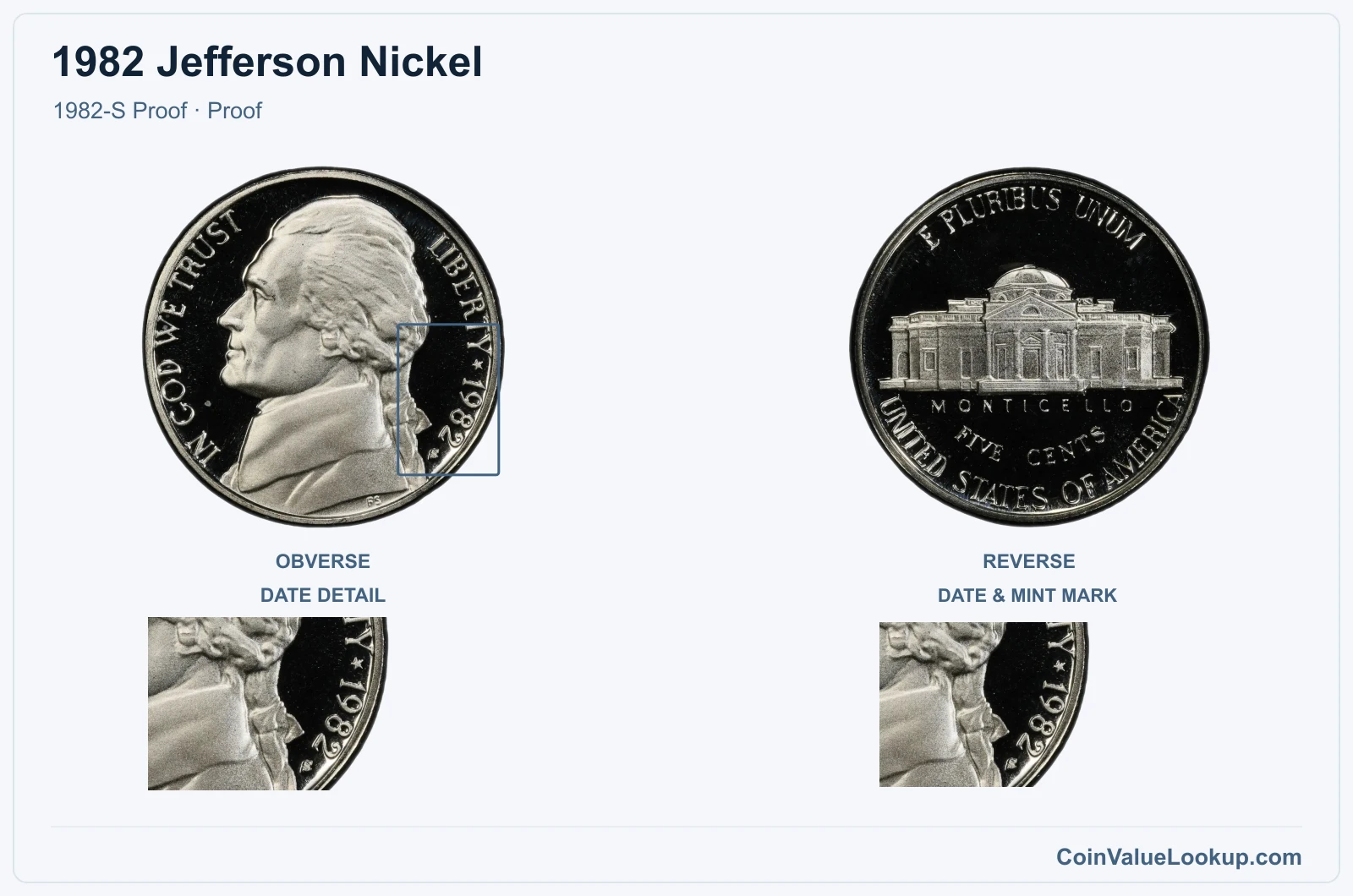
The 1982-S proof was struck at San Francisco exclusively for collector proof sets. It carries an S mintmark and features mirror-like fields with frosted design elements.
This is not a circulation coin, so you will not find one in pocket change.
A PR65 example lists around $2.50 according to USA Coin Book. Cameo and deep cameo contrast levels are graded separately by certification services and carry their own pricing, but no specific cameo value is adopted here.
Judge proof coins by hairlines, haze, and contrast rather than the wear-based scale used for business strikes.
| Range | Grade | Price | Auction Records | Appraisal |
|---|---|---|---|---|
| PR | PR 1 | — | Coin Identifier | |
| PR 2 | — | Coin Identifier | ||
| PR 3 | — | Coin Identifier | ||
| PR 4 | — | Coin Identifier | ||
| PR 6 | — | Coin Identifier | ||
| PR 8 | — | Coin Identifier | ||
| PR 10 | — | Coin Identifier | ||
| PR 12 | — | Coin Identifier | ||
| PR 15 | — | Coin Identifier | ||
| PR 20 | — | Coin Identifier | ||
| PR 25 | — | Coin Identifier | ||
| PR 30 | — | Coin Identifier | ||
| PR 35 | — | Coin Identifier | ||
| PR 40 | — | Coin Identifier | ||
| PR 45 | — | Coin Identifier | ||
| PR 50 | — | Coin Identifier | ||
| PR 53 | — | Coin Identifier | ||
| PR 55 | — | Coin Identifier | ||
| PR 58 | — | Coin Identifier | ||
| PR 60 | — | Coin Identifier | ||
| PR 61 | — | Coin Identifier | ||
| PR 62 | — | Coin Identifier | ||
| PR 63 | — | Coin Identifier | ||
| PR 64 | — | Coin Identifier | ||
| PR 65 | — | Coin Identifier | ||
| PR 66 | — | Coin Identifier | ||
| PR 67 | Coin Identifier | |||
| PR 68 | Coin Identifier | |||
| PR 69 | Coin Identifier | |||
| PR 70 | Coin Identifier |
1982 Jefferson Nickel Error List
1. 1982 Jefferson Nickel — Struck on cent planchet
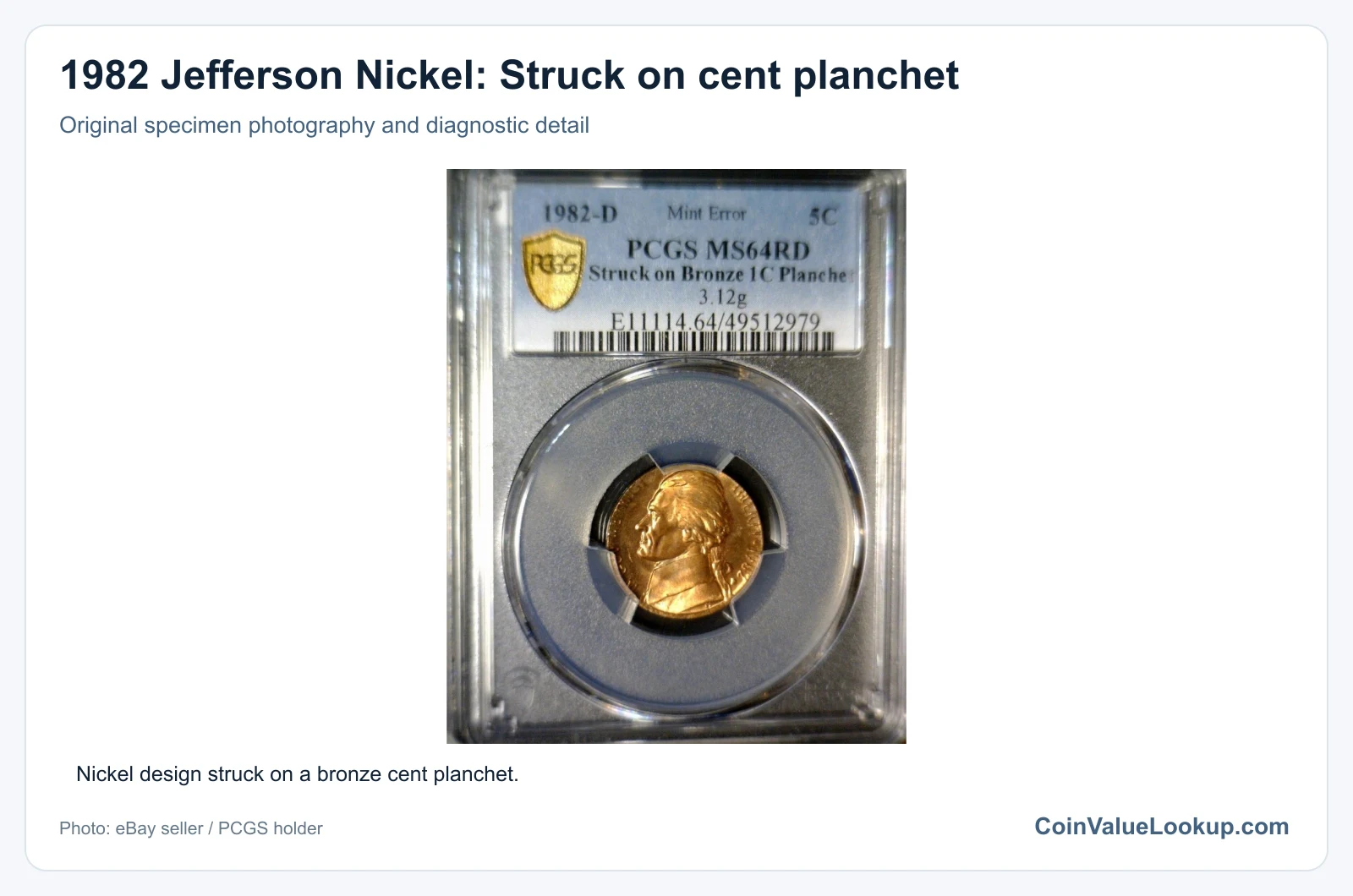
A 1982 Jefferson nickel struck on a cent-sized planchet is a genuine wrong-planchet error. The nickel dies impress on a smaller, lighter blank meant for a Lincoln cent, so the finished coin shows cropped peripheral details where the design runs off the undersized flan.
The authenticated example is a 1982-D graded NGC MS64 RB, weighing 3.1 grams on a copper-alloy blank.
Do not assume every copper-toned nickel is a wrong-planchet strike. Copper plating, environmental toning, and ground-down coins can mimic the look.
Weight and alloy confirmation through professional attribution are essential. That specific Heritage Auctions example sold in November 2020 for $372, illustrating the premium these carry when properly certified.
2. 1982 Jefferson Nickel — Off-center strike
Off-center strikes happen when the planchet is not properly seated between the dies. The result is a displaced design with an unstruck crescent on one side and missing detail on the opposite edge.
A dramatic example exists for the 1982-P: an ANACS MS64 coin struck approximately 70% off center at the 11 o'clock position.
The key is that enough of the date and both faces remain visible to confirm the coin's identity. That visibility, combined with the severity of the displacement, drives collector interest.
Do not confuse a minor single-die misalignment, a cut rim, or post-strike damage with a true off-center error. Value depends on the authenticated identity, condition, and how far off center the strike landed.
3. 1982 Jefferson Nickel — Cud die break
A cud is a raised, featureless blob of metal connected to the rim, caused by a piece of the die breaking away before striking. Where normal design detail should appear, you get a smooth lump instead.
An authenticated example exists for the 1982-P, graded PCGS MS65.
Look at the rim area carefully: the cud will be firmly connected to the rim and raised above the surrounding surface. Do not confuse it with an incuse gouge, corrosion buildup, or foreign metal stuck to the coin after striking.
Post-mint damage tends to disturb the surrounding field, while a genuine cud integrates cleanly with the rim. Value depends on the size, location, and condition of the specific coin, so professional authentication matters here.
4. 1982 Jefferson Nickel — Double / Multiple Strike
A double-struck or multiple-strike error occurs when a coin receives two or more impressions from the dies, typically with some shift or rotation between strikes. The result is overlapping or displaced design elements that look nothing like a normal coin.
You will see separate impressions of Jefferson's portrait or Monticello rather than merely thickened lettering.
This category is distinct from a doubled die, which is a single strike from a die that was made with doubled hub impressions. It is also different from impressions added after minting by a vise or other pressure.
Condition, the degree of visible displacement, and the specific characteristics of the error all factor into value. No standard price range applies; each piece needs individual assessment through authentication.
5. 1982 Jefferson Nickel — Struck-Through Error
A struck-through error on a 1982 nickel shows up as a localized depression or area of incomplete design where foreign material sat between the die and the planchet during striking. The most common variety is a filled-die or grease strike, where lubricant or debris fills part of the die cavity and prevents the design from fully forming.
These range from subtle soft spots on a letter to large blank patches across a major design element. Do not mistake normal wear, cleaning marks, scratches, or an ordinarily weak strike for a struck-through error.
Genuine examples typically show a smooth, rounded depression rather than the sharp edges left by post-mint scratches. Value depends on how dramatic and well-located the obstruction impression is, along with the coin's overall condition.