1989 Jefferson Nickel Coin Value: How Much Is It Worth?
Most 1989 Jefferson nickels you find in pocket change are worth face value. Worn examples simply do not carry a collector premium.
In uncirculated condition, guide estimates from USA Coin Book place these coins between roughly $0.30 at MS60 and $3.36 at MS65, depending on the specific mint. S-mint proofs and authenticated striking errors occupy separate markets with their own pricing.
Fast Way to Identify Your 1989 Jefferson Nickel
The quickest way to start figuring out what you have is to upload clear photos of both the front and back of your coin. That gives us enough to make a preliminary identification of the mint, finish, and any obvious oddities.
Good lighting and a steady hand go a long way.
1989 Jefferson Nickel Value
Upload both sides of your 1989 Jefferson Nickel.
Front Obverse
Upload photo
Back Reverse
Upload photo
Which 1989 Jefferson Nickel Versions Are Worth Money?
- Uncirculated 1989-P and 1989-D nickels with strong, fully separated steps may qualify for a Full Steps designation, which collectors treat as a distinct category worth investigating.
- 1989-S proofs in high grade with deep cameo contrast are collected separately from business strikes; a PR65 base guide estimate sits around $4.96.
- A 1989 nickel struck over a 1989-D cent is a dramatic double-denomination error; one NGC MS64 Red example sold at Heritage in January 2007 for $1,610.
- Off-center strikes, broadstrikes, and wrong-planchet errors have been reported for this date and can carry individual premiums when authenticated.
Step 1: Identify Your 1989 Jefferson Nickel Mint Mark and Version
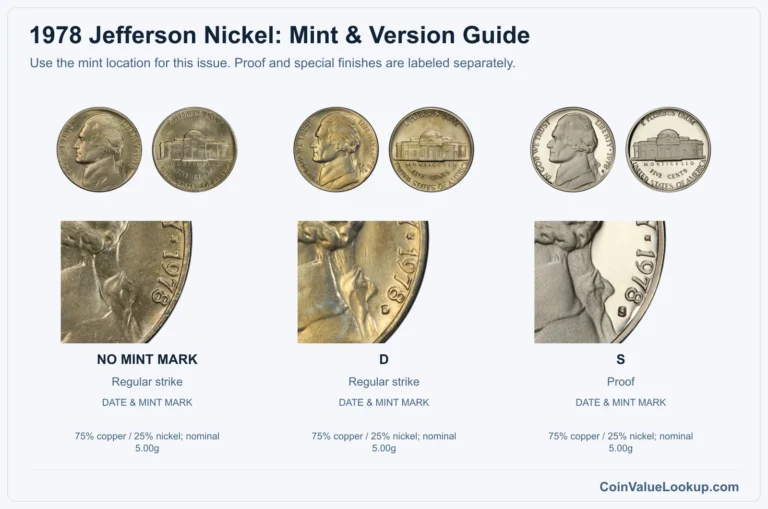
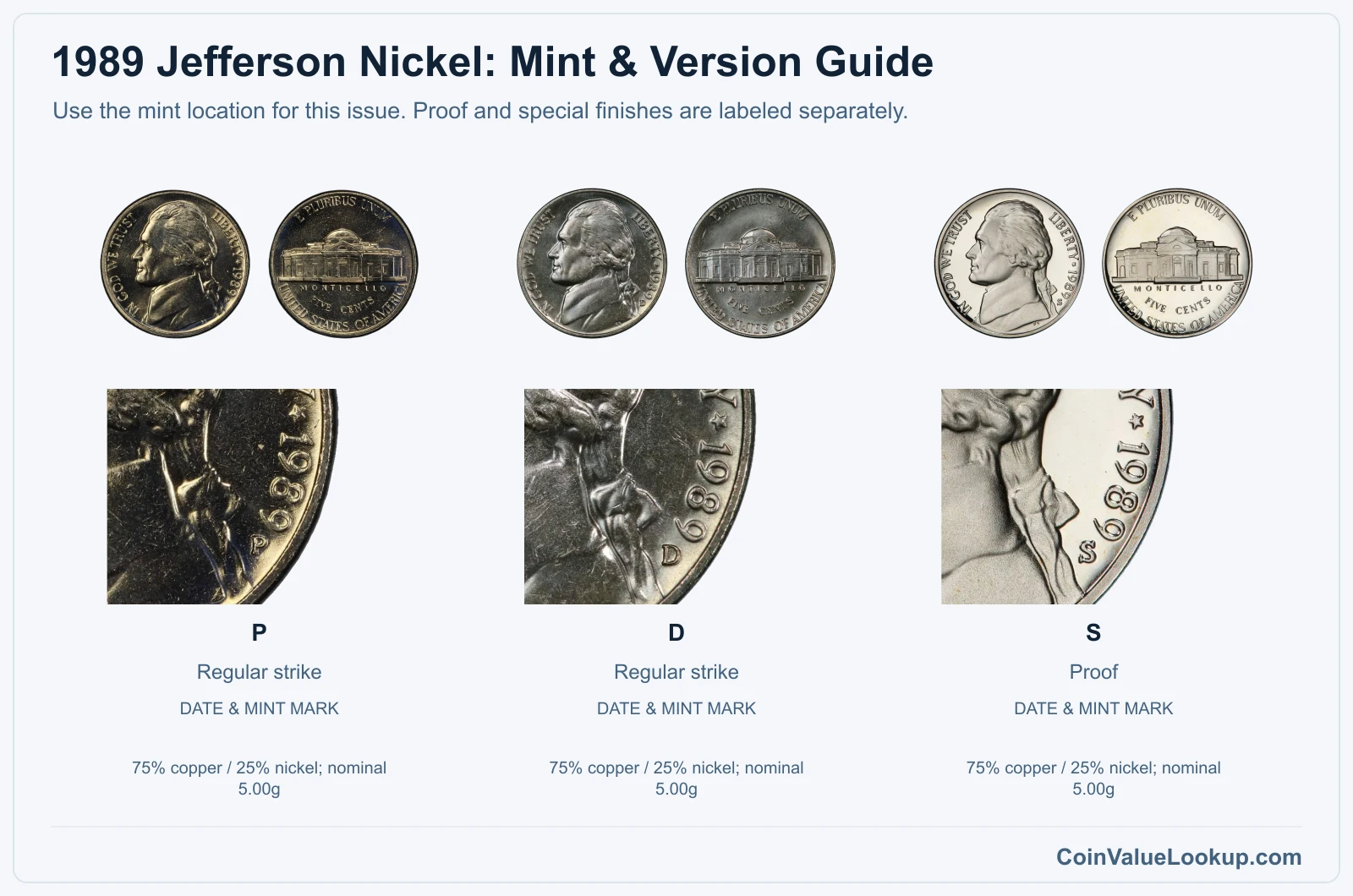
Three versions of the 1989 Jefferson nickel exist: the Philadelphia (P) business strike, the Denver (D) business strike, and the San Francisco (S) proof. Look below the date on the obverse for a small letter.
A "P" means Philadelphia, "D" means Denver, and "S" means San Francisco proof.
All three share the same alloy: 75% copper, 25% nickel, weighing about 5 grams with a 21.2 mm diameter and a plain edge. Do not confuse this standard composition with a silver issue; there is no silver collector branch for 1989 nickels.
The S-mint proof has mirror-like fields and was made specifically for collectors, not for circulation. Business strikes from P and D have a satin or cartwheel luster instead.
Identifying the finish correctly matters before you compare prices, because proof and business-strike grading scales are completely different.
Step 2: Check Your 1989 Jefferson Nickel Grade
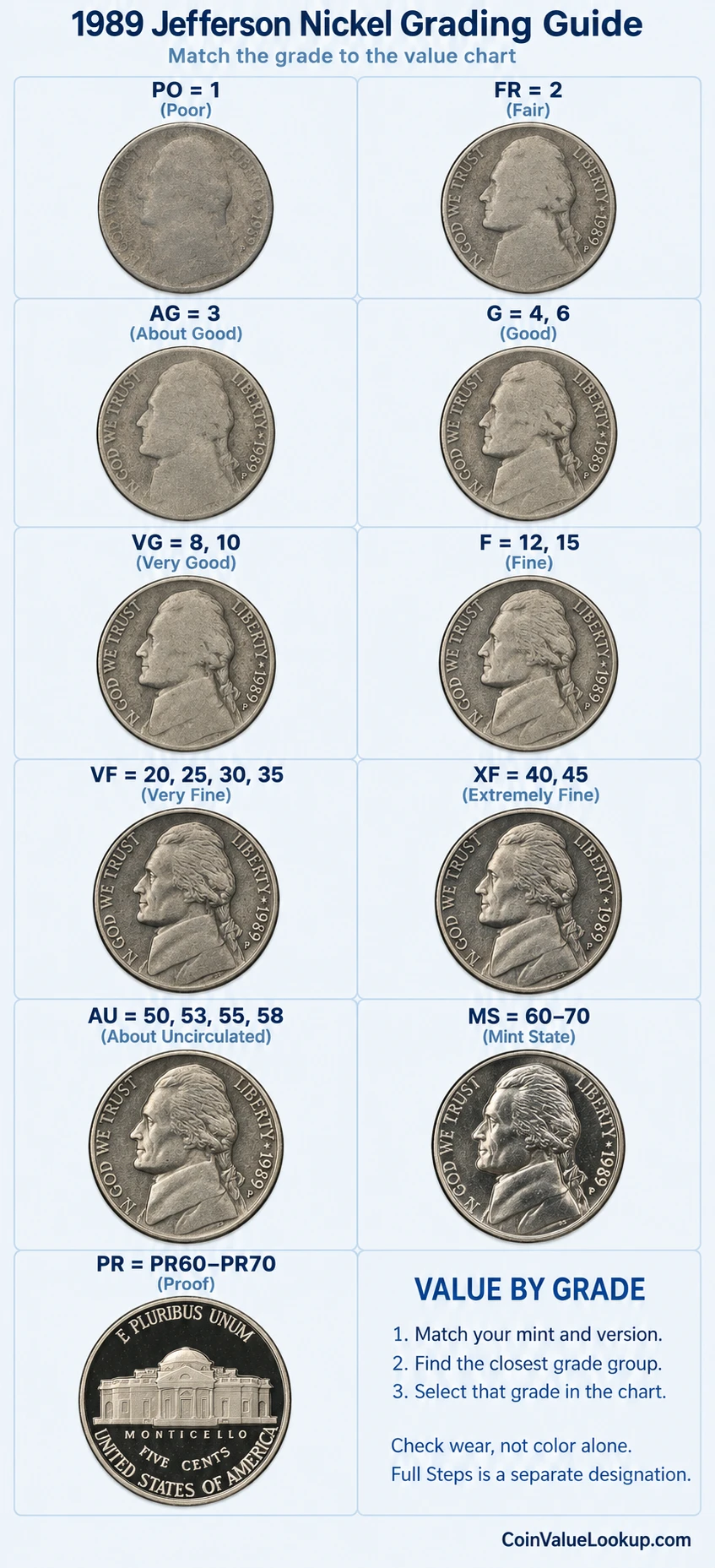
Start with Jefferson's cheek and the hair detail above his ear. On a well-worn coin, the cheek is flat and the hair strands merge into a smooth blob.
A coin with only light friction will still show individual hair lines and retain most of its original luster.
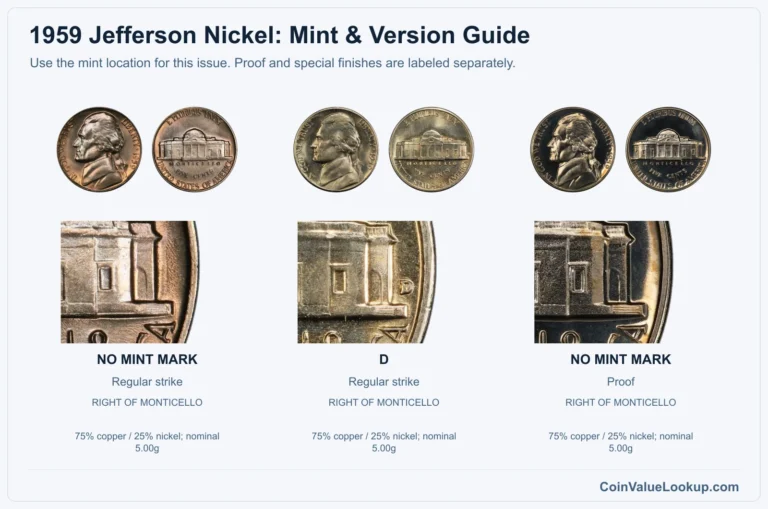
Flip it over and check Monticello. The pillars, windows, and steps tell you a lot.
Sharp, fully separated steps can reflect a strong strike rather than low wear, so weak steps alone do not prove a coin circulated.
The comparison image is your friend here. Hold your coin next to it under the same lighting and match the wear patterns.
Certified "Full Steps" is a separate designation for business strikes with uninterrupted step lines; it is not a mint error.
For proofs, look for hairlines or haze across the mirror fields. Cameo contrast, where devices are frosty against deep mirrors, is graded separately from the proof grade itself.
Step 3: Check 1989 Jefferson Nickel Value by Mint and Version
1989 Jefferson Nickel — P Business strike
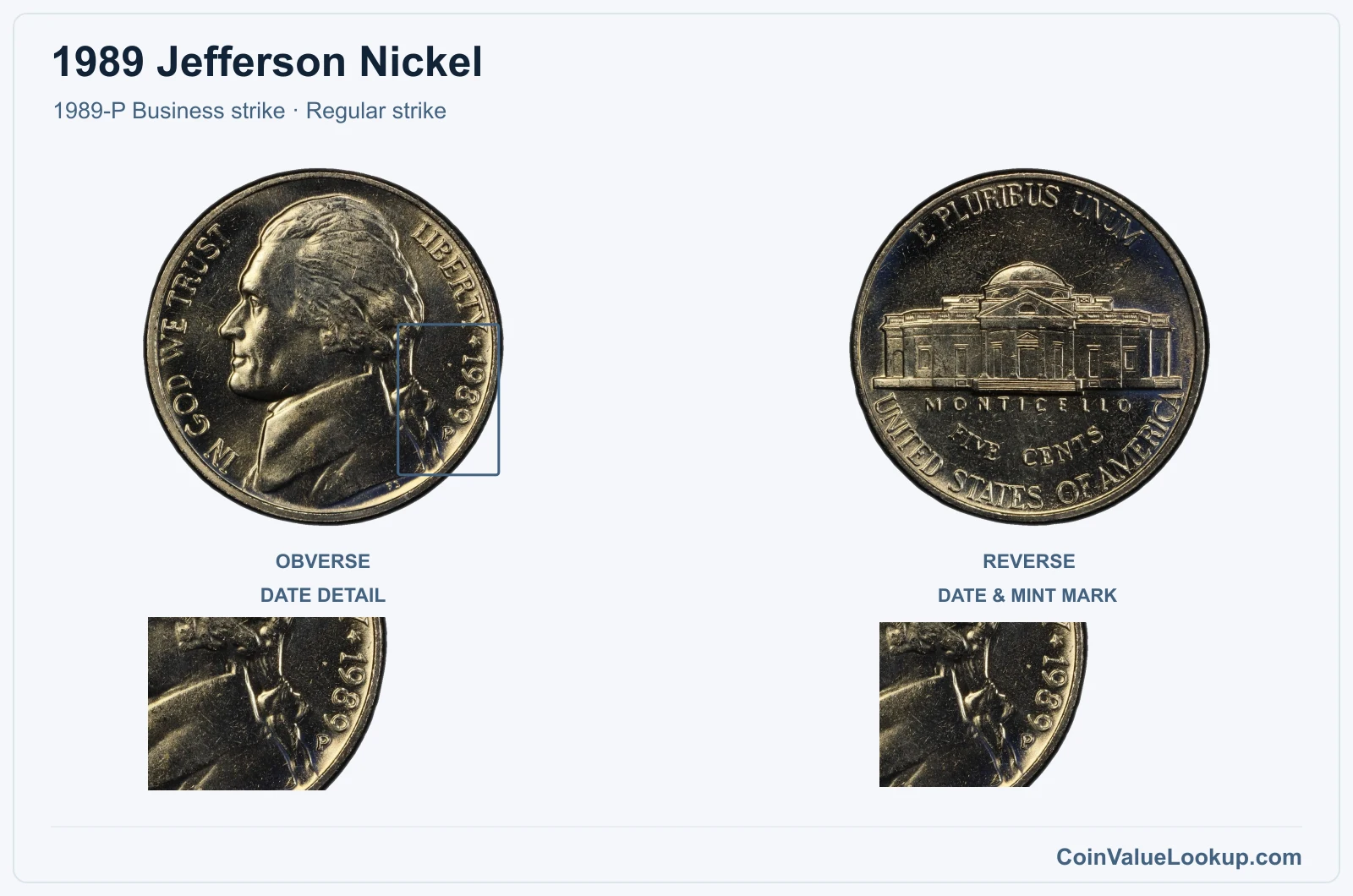
The 1989-P is a standard business strike from Philadelphia. It carries the "P" mintmark below the date on the obverse, a practice that began on nickels in 1980.
The alloy is 75% copper and 25% nickel at a nominal 5 grams.
USA Coin Book guide estimates place this coin at about $0.30 in MS60 and around $3.36 in MS65. Circulated examples are worth face value.
If your coin shows full, unbroken Monticello steps, it may warrant a closer look under the Full Steps designation, which is a strike-quality filter, not an error.
| Range | Grade | Price | Auction Records | Appraisal |
|---|---|---|---|---|
| PO | PO 1 | — | Coin Identifier | |
| FR | FR 2 | — | Coin Identifier | |
| AG | AG 3 | — | Coin Identifier | |
| G | G 4 | — | Coin Identifier | |
| G 6 | — | Coin Identifier | ||
| VG | VG 8 | — | Coin Identifier | |
| VG 10 | — | Coin Identifier | ||
| F | F 12 | — | Coin Identifier | |
| F 15 | — | Coin Identifier | ||
| VF | VF 20 | — | Coin Identifier | |
| VF 25 | — | Coin Identifier | ||
| VF 30 | — | Coin Identifier | ||
| VF 35 | — | Coin Identifier | ||
| XF | XF 40 | — | Coin Identifier | |
| XF 45 | — | Coin Identifier | ||
| AU | AU 50 | — | Coin Identifier | |
| AU 53 | — | Coin Identifier | ||
| AU 55 | — | Coin Identifier | ||
| AU 58 | — | Coin Identifier | ||
| MS | MS 60 | — | Coin Identifier | |
| MS 61 | — | Coin Identifier | ||
| MS 62 | Coin Identifier | |||
| MS 63 | — | Coin Identifier | ||
| MS 64 | Coin Identifier | |||
| MS 65 | Coin Identifier | |||
| MS 66 | Coin Identifier | |||
| MS 67 | — | Coin Identifier | ||
| MS 68 | — | — | — | |
| MS 69 | — | — | — | |
| MS 70 | — | — | — |
1989 Jefferson Nickel — D Business strike
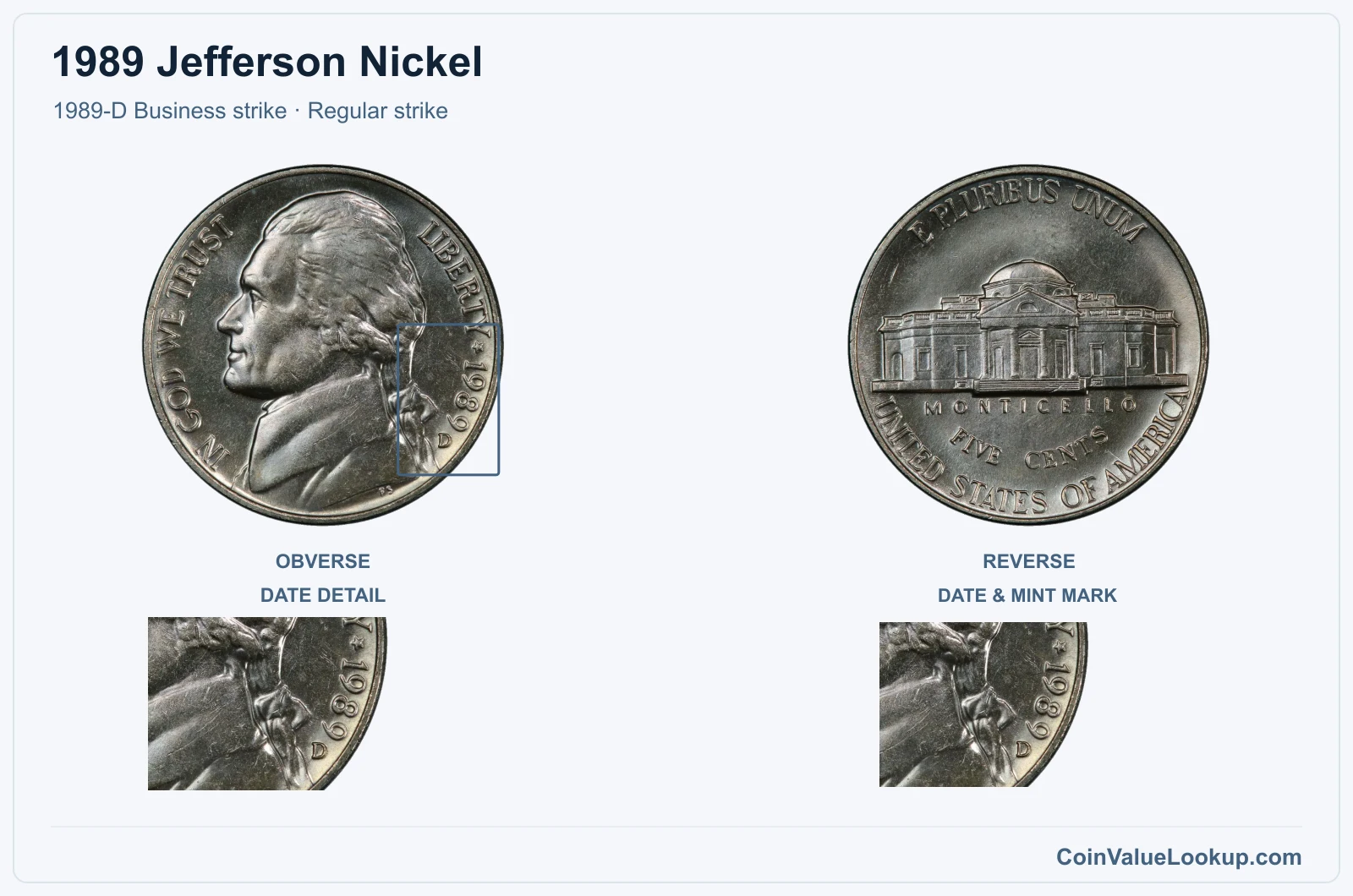
The 1989-D comes from Denver and is identified by a small "D" below the date. Same alloy, same weight, same design as the P-mint coin.
Guide estimates mirror the Philadelphia issue: roughly $0.30 at MS60 and $3.36 at MS65 per USA Coin Book. In circulated grades, plan on face value.
Denver strikes can vary in sharpness, so if you have one with crisp step detail on Monticello, it could be worth having professionally evaluated for a Full Steps designation.
Coin Value Lookup is a handy starting point if you want to check values for other dates and denominations in the Jefferson nickel series.
| Range | Grade | Price | Auction Records | Appraisal |
|---|---|---|---|---|
| PO | PO 1 | — | Coin Identifier | |
| FR | FR 2 | — | Coin Identifier | |
| AG | AG 3 | — | Coin Identifier | |
| G | G 4 | — | Coin Identifier | |
| G 6 | — | Coin Identifier | ||
| VG | VG 8 | — | Coin Identifier | |
| VG 10 | — | Coin Identifier | ||
| F | F 12 | — | Coin Identifier | |
| F 15 | — | Coin Identifier | ||
| VF | VF 20 | — | Coin Identifier | |
| VF 25 | — | Coin Identifier | ||
| VF 30 | — | Coin Identifier | ||
| VF 35 | — | Coin Identifier | ||
| XF | XF 40 | — | Coin Identifier | |
| XF 45 | — | Coin Identifier | ||
| AU | AU 50 | — | Coin Identifier | |
| AU 53 | — | Coin Identifier | ||
| AU 55 | — | Coin Identifier | ||
| AU 58 | — | Coin Identifier | ||
| MS | MS 60 | — | Coin Identifier | |
| MS 61 | — | Coin Identifier | ||
| MS 62 | — | Coin Identifier | ||
| MS 63 | — | Coin Identifier | ||
| MS 64 | Coin Identifier | |||
| MS 65 | — | Coin Identifier | ||
| MS 66 | Coin Identifier | |||
| MS 67 | Coin Identifier | |||
| MS 68 | — | — | — | |
| MS 69 | — | — | — | |
| MS 70 | — | — | — |
1989 Jefferson Nickel — S Proof
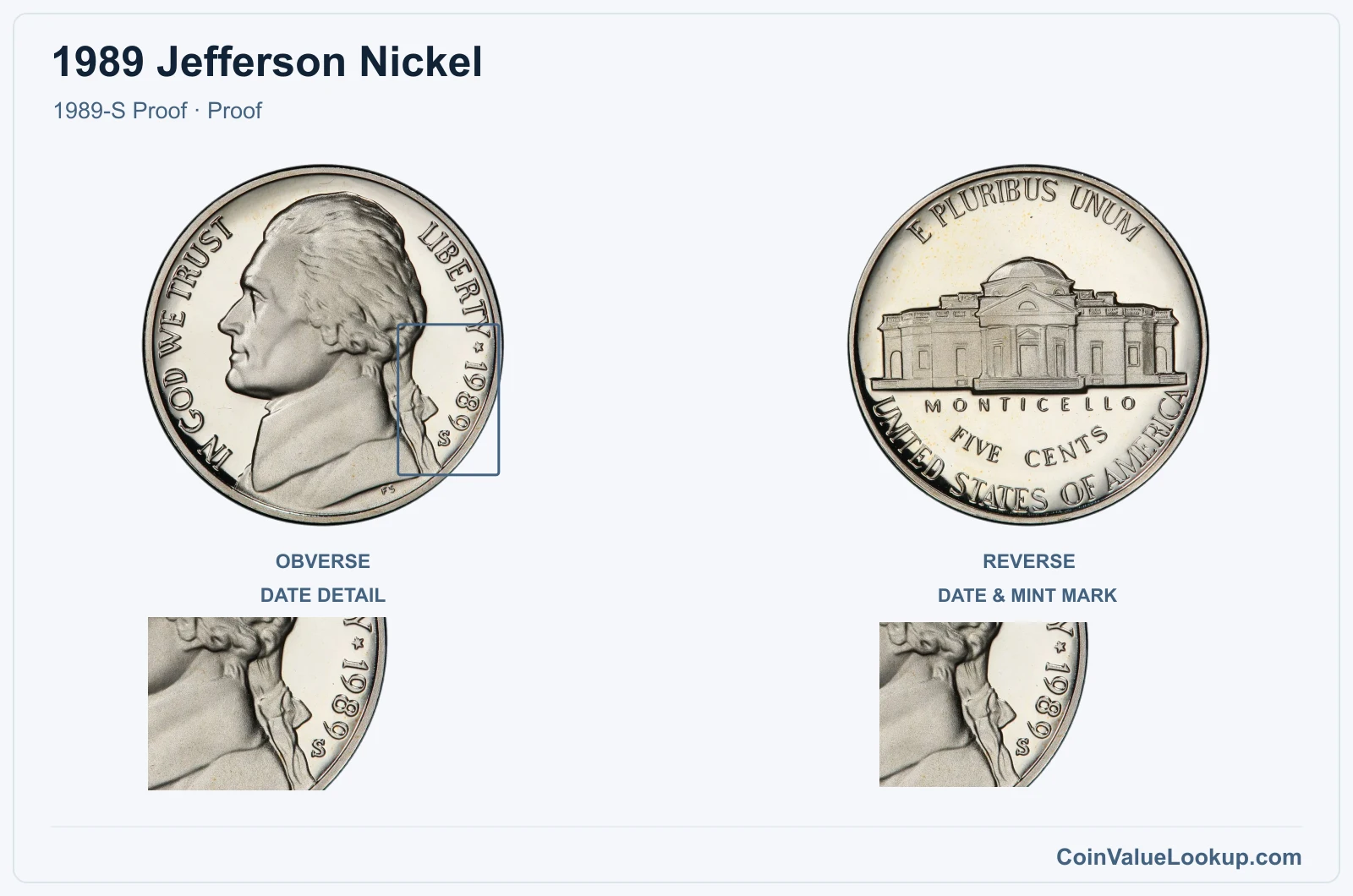
The 1989-S proof was struck at San Francisco exclusively for collector sets. It has mirror fields, sharp device edges, and an "S" mintmark below the date.
The alloy remains 75% copper, 25% nickel.
A base PR65 guide estimate from USA Coin Book is about $4.96. Coins with deep cameo or ultra-cameo contrast are graded under separate designations and may carry different premiums, but no specific cameo price is adopted here.
These were never released into circulation, so wear usually means mishandling after the fact.
| Range | Grade | Price | Auction Records | Appraisal |
|---|---|---|---|---|
| PR | PR 1 | — | Coin Identifier | |
| PR 2 | — | Coin Identifier | ||
| PR 3 | — | Coin Identifier | ||
| PR 4 | — | Coin Identifier | ||
| PR 6 | — | Coin Identifier | ||
| PR 8 | — | Coin Identifier | ||
| PR 10 | — | Coin Identifier | ||
| PR 12 | — | Coin Identifier | ||
| PR 15 | — | Coin Identifier | ||
| PR 20 | — | Coin Identifier | ||
| PR 25 | — | Coin Identifier | ||
| PR 30 | — | Coin Identifier | ||
| PR 35 | — | Coin Identifier | ||
| PR 40 | — | Coin Identifier | ||
| PR 45 | — | Coin Identifier | ||
| PR 50 | — | Coin Identifier | ||
| PR 53 | — | Coin Identifier | ||
| PR 55 | — | Coin Identifier | ||
| PR 58 | — | Coin Identifier | ||
| PR 60 | — | Coin Identifier | ||
| PR 61 | — | Coin Identifier | ||
| PR 62 | — | Coin Identifier | ||
| PR 63 | — | Coin Identifier | ||
| PR 64 | — | Coin Identifier | ||
| PR 65 | — | Coin Identifier | ||
| PR 66 | — | Coin Identifier | ||
| PR 67 | — | Coin Identifier | ||
| PR 68 | Coin Identifier | |||
| PR 69 | Coin Identifier | |||
| PR 70 | Coin Identifier |
1989 Jefferson Nickel Error List
1. 1989 Jefferson Nickel — Struck over a1989-Dcent
This is the headline error for 1989 nickels. A nickel die struck a 1989-D Lincoln cent that was already in the press, leaving traces of the cent's design visible beneath the nickel impression.
Both dates are readable, and the cent's reverse shows under the nickel's obverse.
The diagnostic is the surviving undertype: Lincoln's portrait, wheat or memorial details, and the cent date peeking through. Copper color alone is not enough.
A coin that simply looks coppery could be toned, plated, or environmental damage.
One NGC MS64 Red example sold through Heritage Auctions in January 2007 for $1,610. That is a single recorded result, not a market range, but it shows these pieces attract serious attention when properly attributed by a grading service.
2. 1989 Jefferson Nickel — Struck on cent planchet
A 1989 nickel struck on a cent-sized copper planchet produces a coin with the full Jefferson nickel design on a blank meant for a Lincoln cent. The piece is undersized, so peripheral details get cropped or appear weak at the rim.
Authentication matters here. The giveaway is the correct nickel design on a smaller, lighter blank with a different alloy.
Do not rely on copper color alone; copper plating, toning, and ground-down rims can all mimic this look. A certified example from a P-mint coin has been graded PCGS MS63 RB.
No specific price range is adopted. Value depends on the individual coin's condition, the severity of the wrong-planchet error, and confirmation from a recognized grading service.
3. 1989 Jefferson Nickel — Collar die break
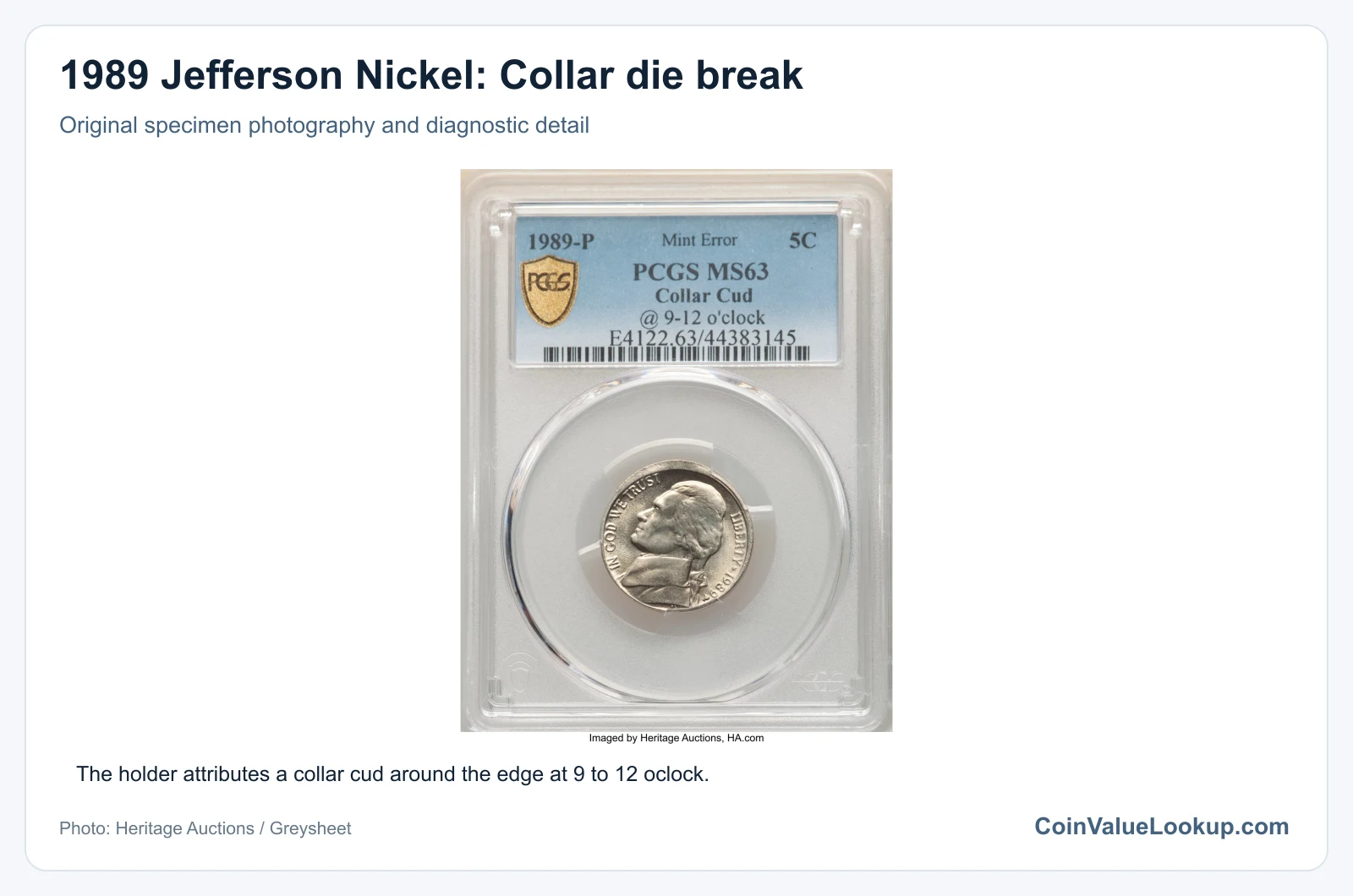
A collar die break on a 1989-P nickel occurs when the collar die that normally confines the coin's edge cracks. The result is a raised, irregular extrusion along part of the rim, different from a normal cud on the face of the die.
One PCGS MS62 example with the break spanning roughly 9 to 12 o'clock sold through Heritage Auctions in March 2023 for $114. That is a single auction result.
To identify this, examine the edge and adjacent rim carefully. A legitimate collar break leaves raised displaced metal that is part of the strike, not a post-mint dent.
Compare against normal rim texture and solder blobs, which are damage. Photograph the affected edge alongside both faces for any attribution attempt.
4. 1989 Jefferson Nickel — Off-center strike
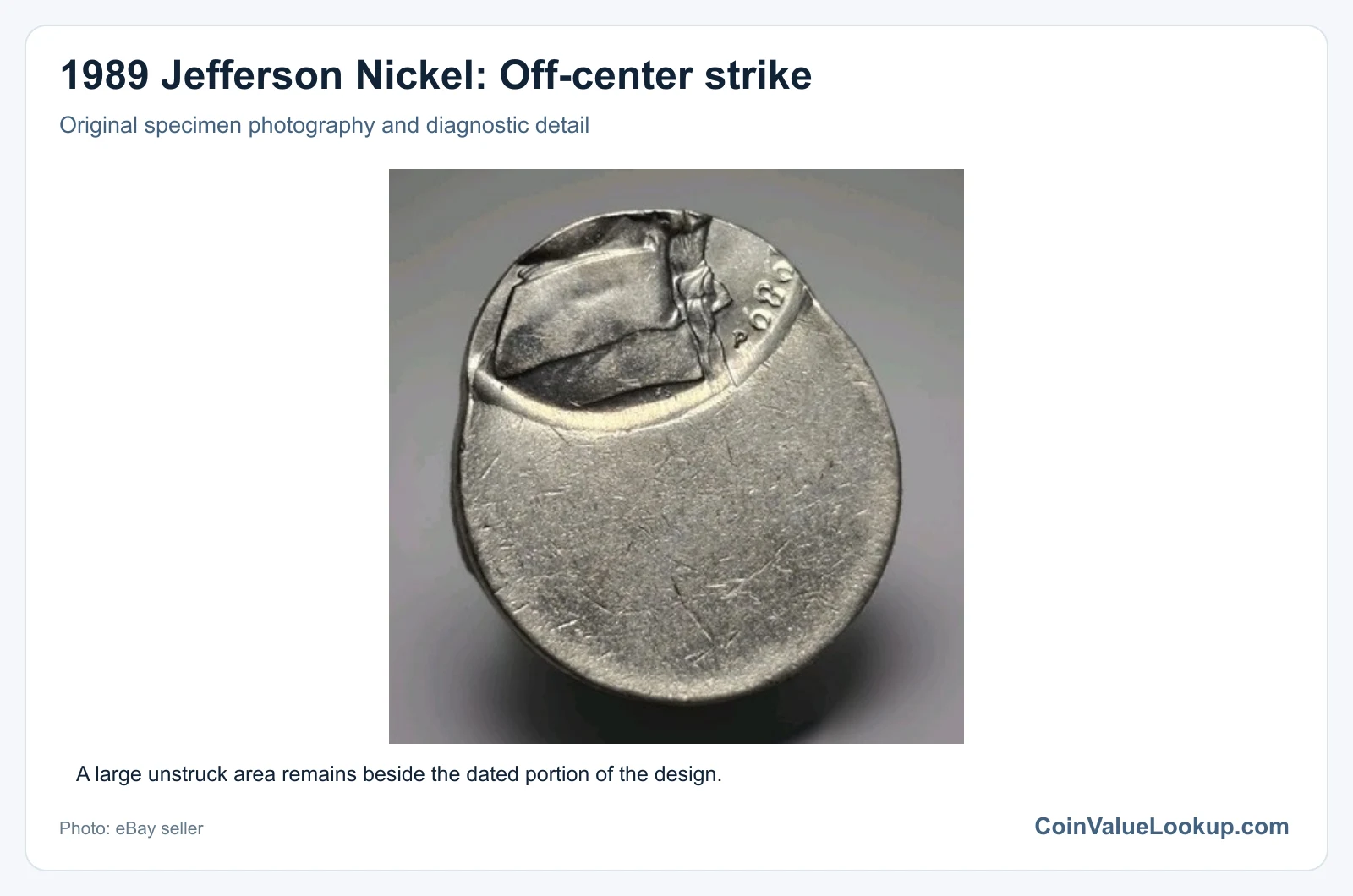
An off-center 1989 nickel was fed into the press misaligned, so the dies struck only part of the blank. The result is an unstruck crescent on one side and truncated design on the other.
A dramatic example exists: a 1989-P graded ANACS MS64, struck 55% off center at about 11 o'clock. No set price range is adopted for off-center nickels because value depends on how far off center the strike landed, whether the date remains visible, and overall condition.
Do not confuse this with a single-die misalignment, where the design is shifted but still fully present, or a coin with a filed or cut rim. Genuine off-center strikes have a smooth, unstruck blank area with natural planchet texture.
5. 1989 Jefferson Nickel — Repunched Mintmark
Repunched mintmark errors on 1989 nickels show remnants of a second, slightly offset mintmark punch beneath or beside the primary letter. You need magnification to spot this; look for doubling, a notch, or a shadow near the P or D.
This is different from machine doubling, which creates a flat, shelf-like distortion, and from die chips or corrosion that just make the letter look lumpy. Compare your mintmark to a known normal example at the same magnification.
No specific price range is adopted. The value of a repunched mintmark depends on how visible the extra impression is, the coin's overall condition, and collector demand for that particular variety.
6. 1989 Jefferson Nickel — Clipped Planchet
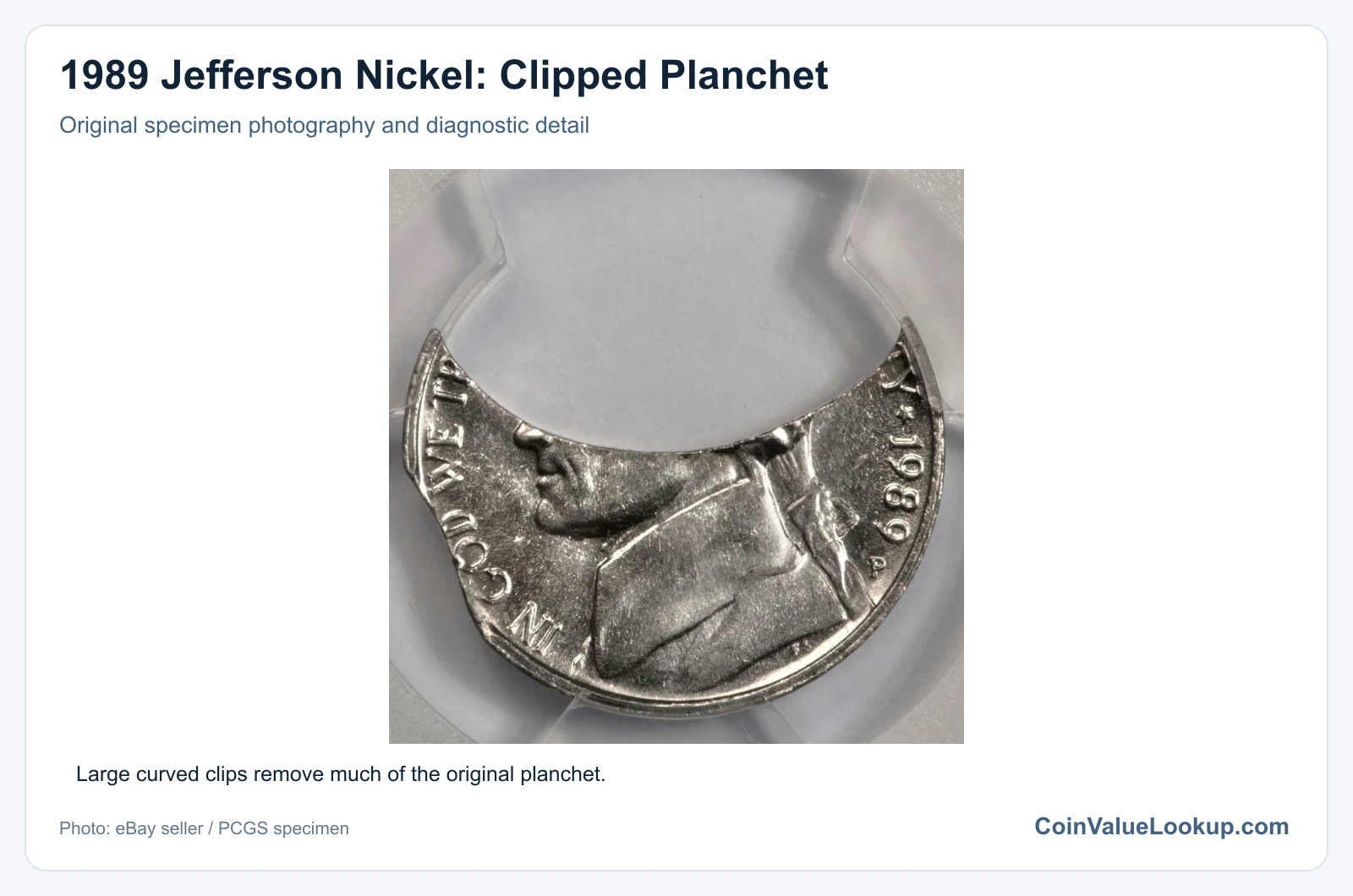
A clipped planchet error means the blank was incompletely punched from the metal strip before striking. The missing section can be curved, straight, or ragged, depending on where the punch overlapped.
One useful diagnostic: look for a zone of design weakness directly opposite the clip. The metal had less material to flow into during the strike, so that area appears soft.
Edge texture at the clip should look like raw planchet, not a file mark.
Filed notches, corrosion, and deliberate cuts can look similar, so examine the edge profile closely. No specific price is adopted.
Condition, clip size, and authentication all factor into what a clipped 1989 nickel is worth.
7. 1989 Jefferson Nickel — Broadstrike
A broadstruck nickel was struck without the collar die holding it in place. The metal spreads outward, making the coin visibly wider than normal, and the rim is either missing or malformed.
The whole design is still present and centered, which separates a broadstrike from an off-center error where part of the design is missing. It is also different from a coin that has been flattened or smashed after leaving the mint; post-strike damage lacks the uniform metal flow of a genuine broadstrike.
Check the edge: it should be smooth and expanded, not reeded or showing signs of tooling. No price range is adopted; value depends on the degree of spread, condition, and third-party authentication.
8. 1989 Jefferson Nickel — Struck-Through Error
A struck-through error happens when debris, grease, or a foreign object sits between the die and the planchet during striking. The result is a localized depression or an impression of the obstruction pressed into the coin's surface.
Grease-filled dies produce soft, mushy areas where detail is simply absent. A retained foreign object, like a fragment of wire or cloth, leaves a distinct impression with sharp edges.
These are different categories and are collected separately.
Do not confuse struck-through areas with normal wear, cleaning scratches, or a weakly struck design from tired dies. No specific price is adopted for 1989 struck-through nickels; value depends on the size of the affected area, what caused it, and the coin's grade.