2013 Jefferson Nickel Coin Value: How Much Is It Worth?
Most 2013 Jefferson nickels you pull from pocket change are worth face value or close to it. Circulated coins rarely command a premium.
For uncirculated P and D business strikes, USA Coin Book guide estimates sit around $0.30 at MS60 and $0.61 at MS65. Proofs, Full Steps designations, and authenticated mint errors occupy their own price tiers entirely.
Fast Way to Identify Your 2013 Jefferson Nickel
Snap a clear photo of both sides of your 2013 nickel and upload them here for a preliminary identification. This step can help you figure out which mint version you have and whether any visible features are worth a closer look.
It is not a substitute for professional authentication or grading, but it is a solid starting point.
2013 Jefferson Nickel Value
Upload both sides of your 2013 Jefferson Nickel.
Front Obverse
Upload photo
Back Reverse
Upload photo
Which 2013 Jefferson Nickel Versions Are Worth Money?
- Certified high-grade Mint State coins with a Full Steps designation can carry premiums well above the ordinary MS60–MS65 guide anchors for P and D strikes.
- The 2013-S proof exists in its own collector market; a reflective-looking coin without an S mintmark is not a proof.
Step 1: Identify Your 2013 Jefferson Nickel Mint Mark and Version
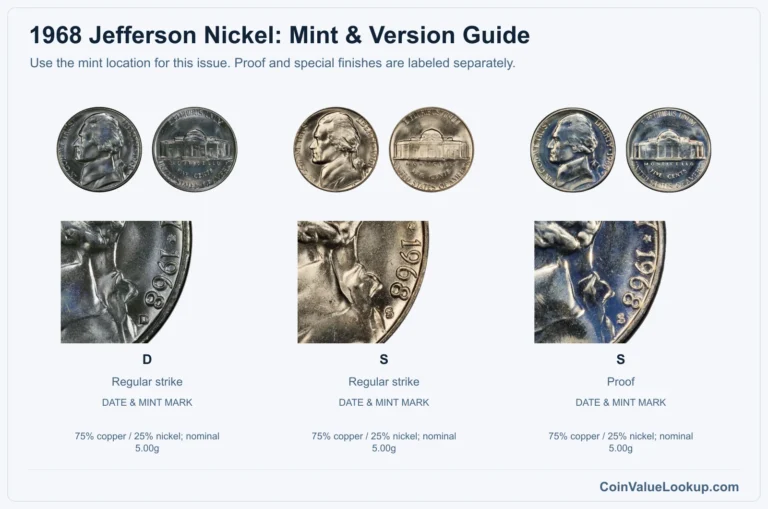
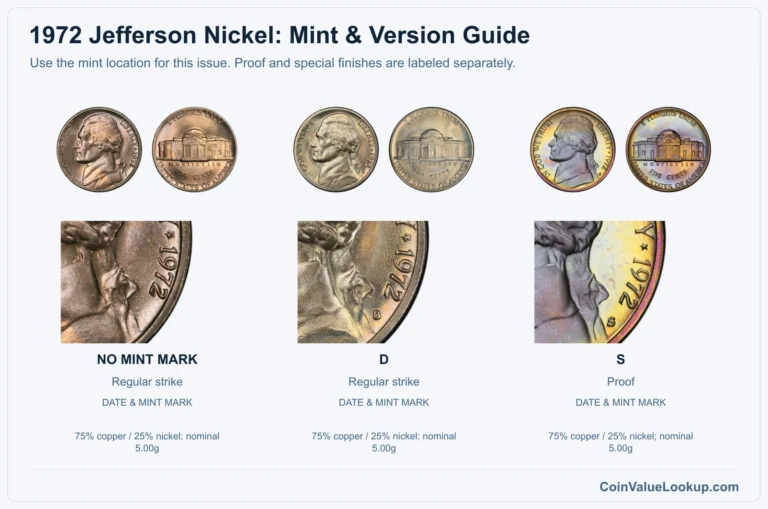
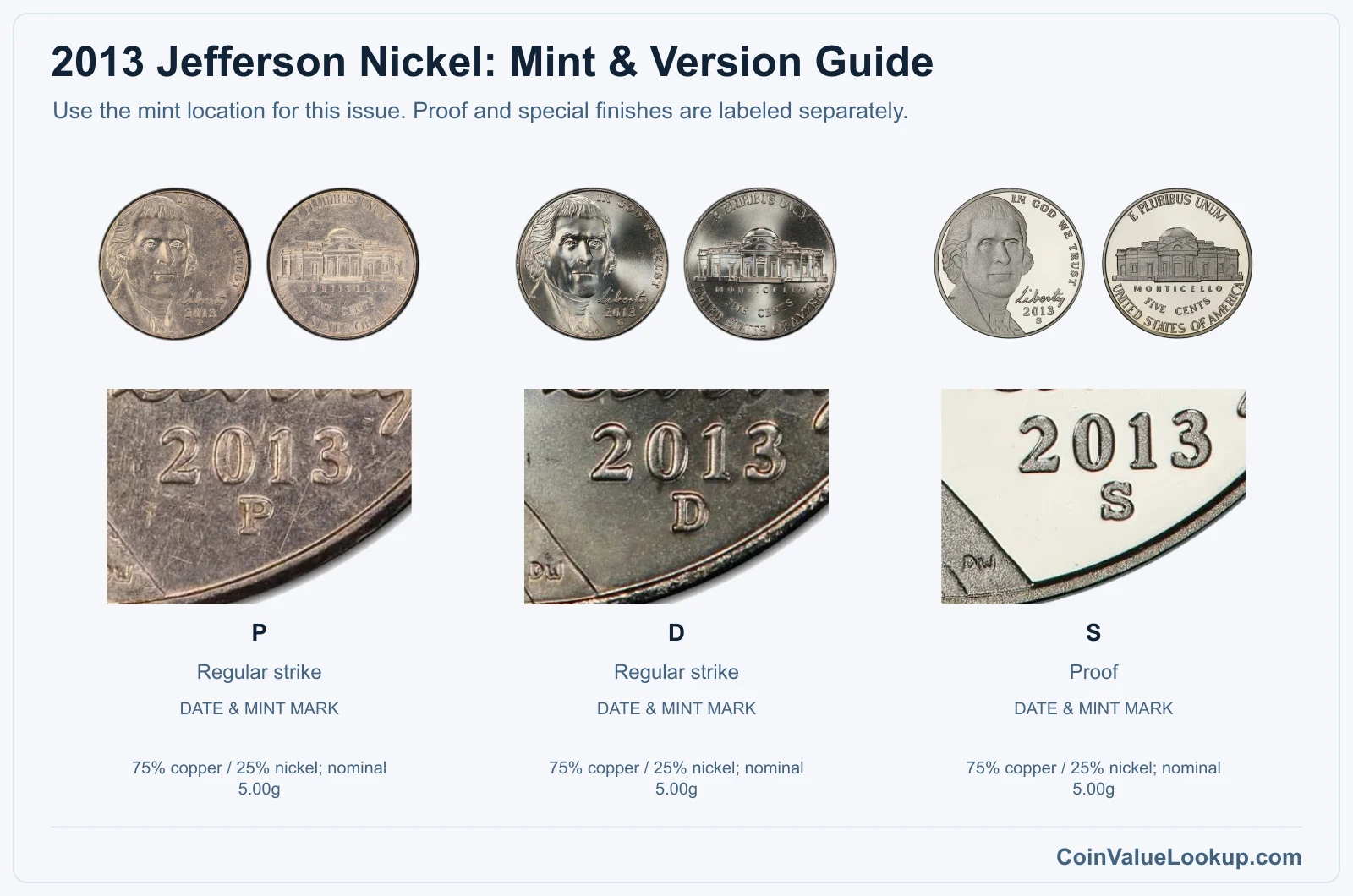
Flip the coin to the obverse, the side with Jefferson's forward-facing portrait. Below the date you will find a small mintmark: P for Philadelphia, D for Denver, or S for San Francisco.
If there is an S, you almost certainly have a proof, which was made for collectors rather than circulation.
All three versions share the same composition: 75% copper and 25% nickel, weighing about 5 grams with a 21.2 mm diameter and a plain edge. Before you start grading, determine whether your coin has the bright, reflective mirror fields of a proof or the satiny-to-brilliant luster of a regular business strike.
That distinction matters because proof and business-strike coins are valued on completely different scales.
Do not confuse a toned or cleaned circulation coin for a proof just because it looks shiny. Proofs have deeply mirrored fields and sharply defined rims produced by a specialized striking process.
Step 2: Check Your 2013 Jefferson Nickel Grade
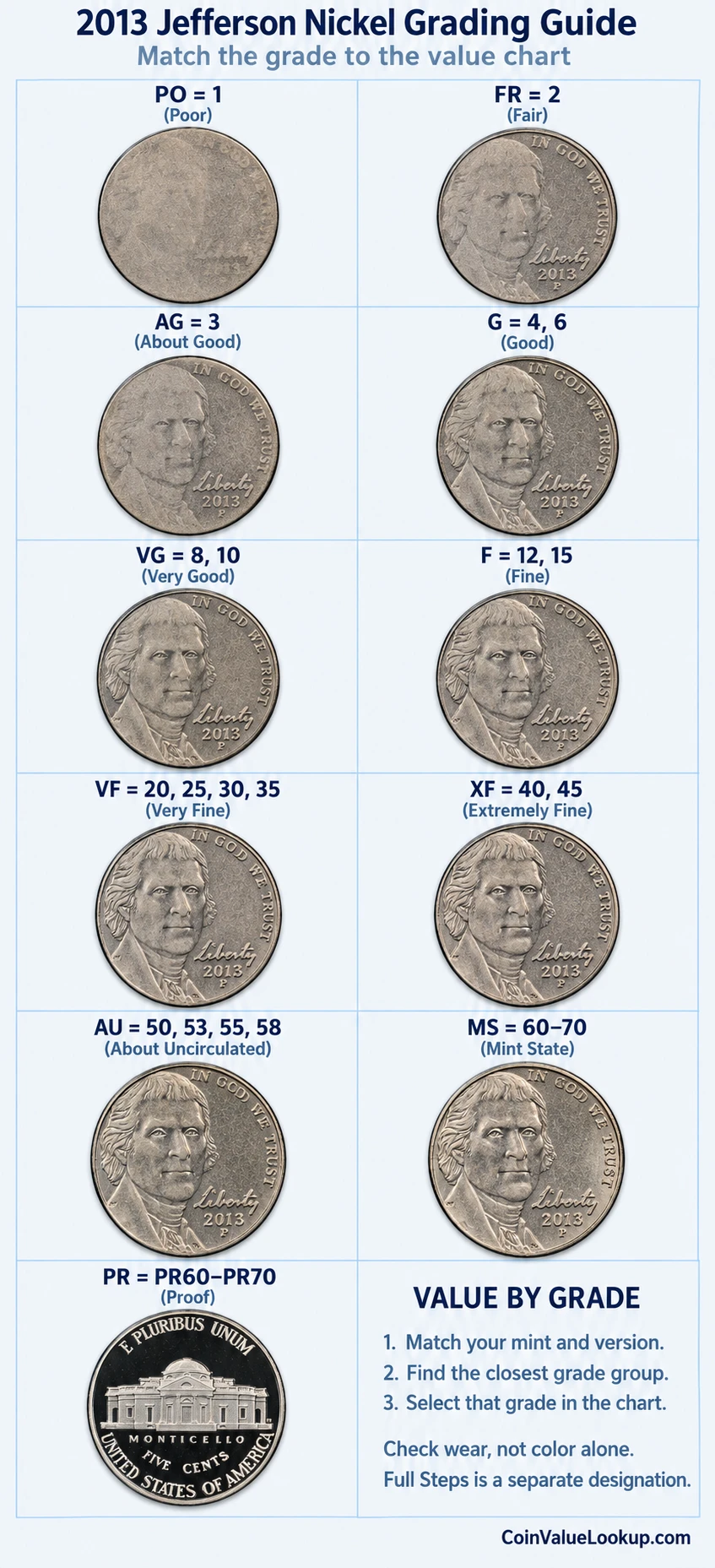
Start with Jefferson's cheekbone, hair detail, and the shoulder area of his coat. These are the highest points on the obverse and the first places to show wear.
On the reverse, check the columns and steps of Monticello for softness.
A Full Steps designation means five or six steps on Monticello are fully separated and complete. That is a strike-quality label, not a grade, so a coin can be MS65 without Full Steps and MS65 with Full Steps, and those are two different things in the marketplace.
Use the comparison image to gauge your coin's luster and contact marks. Bag marks, which are tiny dings from coins banging together in mint bags, are normal on uncirculated pieces but drag the grade down as they increase.
Proof contrast, where frosted devices sit against mirrored fields, is a finish characteristic and does not by itself raise the numerical grade.
Step 3: Check 2013 Jefferson Nickel Value by Mint and Version
2013 Jefferson Nickel — P Business strike
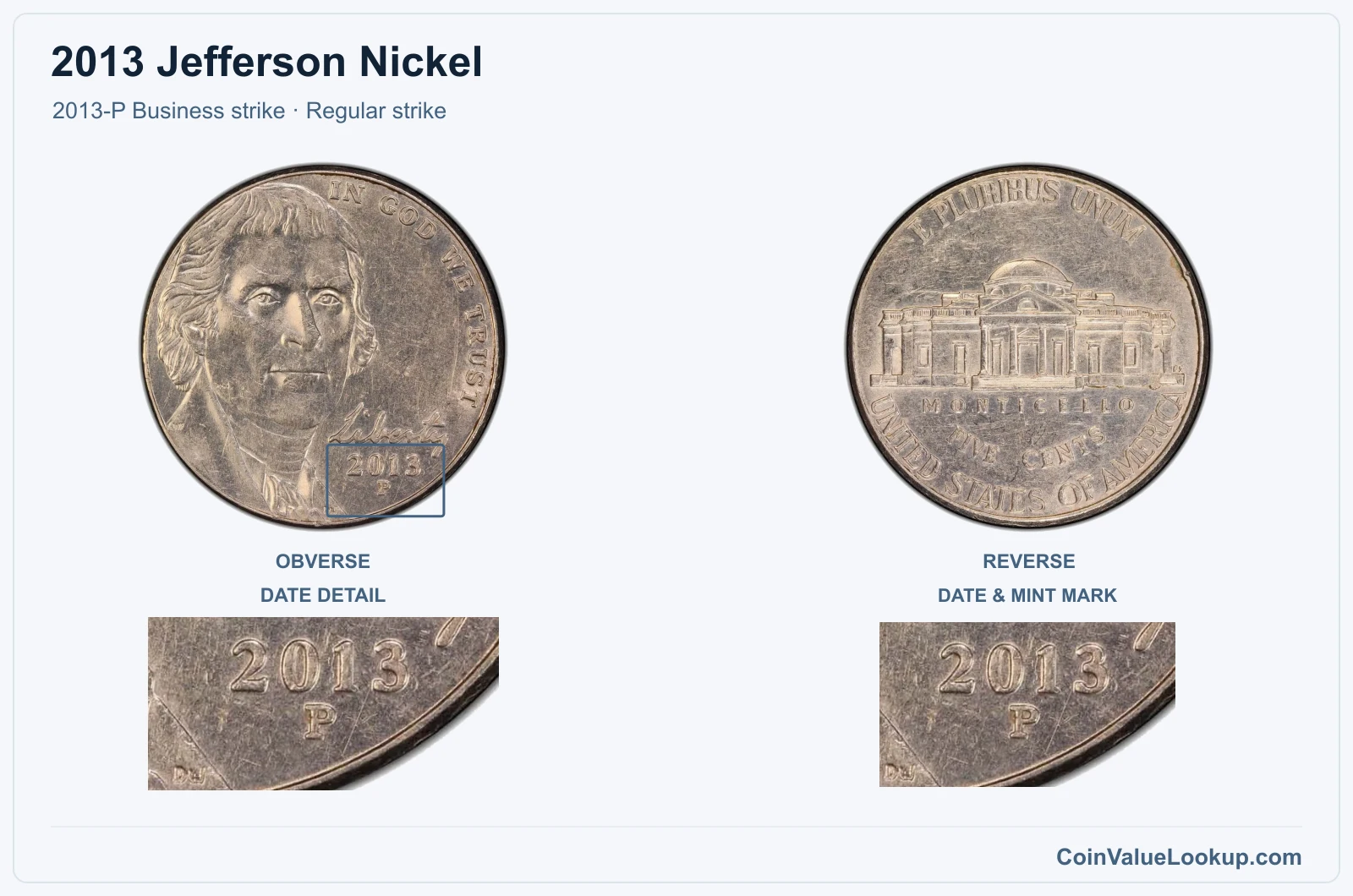
The 2013-P business strike carries a small P mintmark on the obverse beneath the date. It was produced at the Philadelphia Mint in copper-nickel clad with the standard forward-facing Jefferson portrait and Monticello reverse.
USA Coin Book lists guide estimates of roughly $0.30 at MS60 and $0.61 at MS65 for ordinary examples.
Those figures do not reflect coins with a Full Steps designation or deep cameo contrast, which are valued differently. Most circulated pieces are worth face value.
If yours is uncirculated with strong luster and minimal marks, it might grade above MS65, where premiums start to get more interesting.
| Range | Grade | Price | Auction Records | Appraisal |
|---|---|---|---|---|
| PO | PO 1 | — | Coin Identifier | |
| FR | FR 2 | — | Coin Identifier | |
| AG | AG 3 | — | Coin Identifier | |
| G | G 4 | — | Coin Identifier | |
| G 6 | — | Coin Identifier | ||
| VG | VG 8 | — | Coin Identifier | |
| VG 10 | — | Coin Identifier | ||
| F | F 12 | — | Coin Identifier | |
| F 15 | — | Coin Identifier | ||
| VF | VF 20 | — | Coin Identifier | |
| VF 25 | — | Coin Identifier | ||
| VF 30 | — | Coin Identifier | ||
| VF 35 | — | Coin Identifier | ||
| XF | XF 40 | — | Coin Identifier | |
| XF 45 | — | Coin Identifier | ||
| AU | AU 50 | — | Coin Identifier | |
| AU 53 | — | Coin Identifier | ||
| AU 55 | — | Coin Identifier | ||
| AU 58 | — | Coin Identifier | ||
| MS | MS 60 | — | Coin Identifier | |
| MS 61 | — | Coin Identifier | ||
| MS 62 | — | Coin Identifier | ||
| MS 63 | — | Coin Identifier | ||
| MS 64 | — | Coin Identifier | ||
| MS 65 | — | Coin Identifier | ||
| MS 66 | — | Coin Identifier | ||
| MS 67 | — | — | — | |
| MS 68 | — | — | — | |
| MS 69 | — | — | — | |
| MS 70 | — | — | — |
2013 Jefferson Nickel — D Business strike
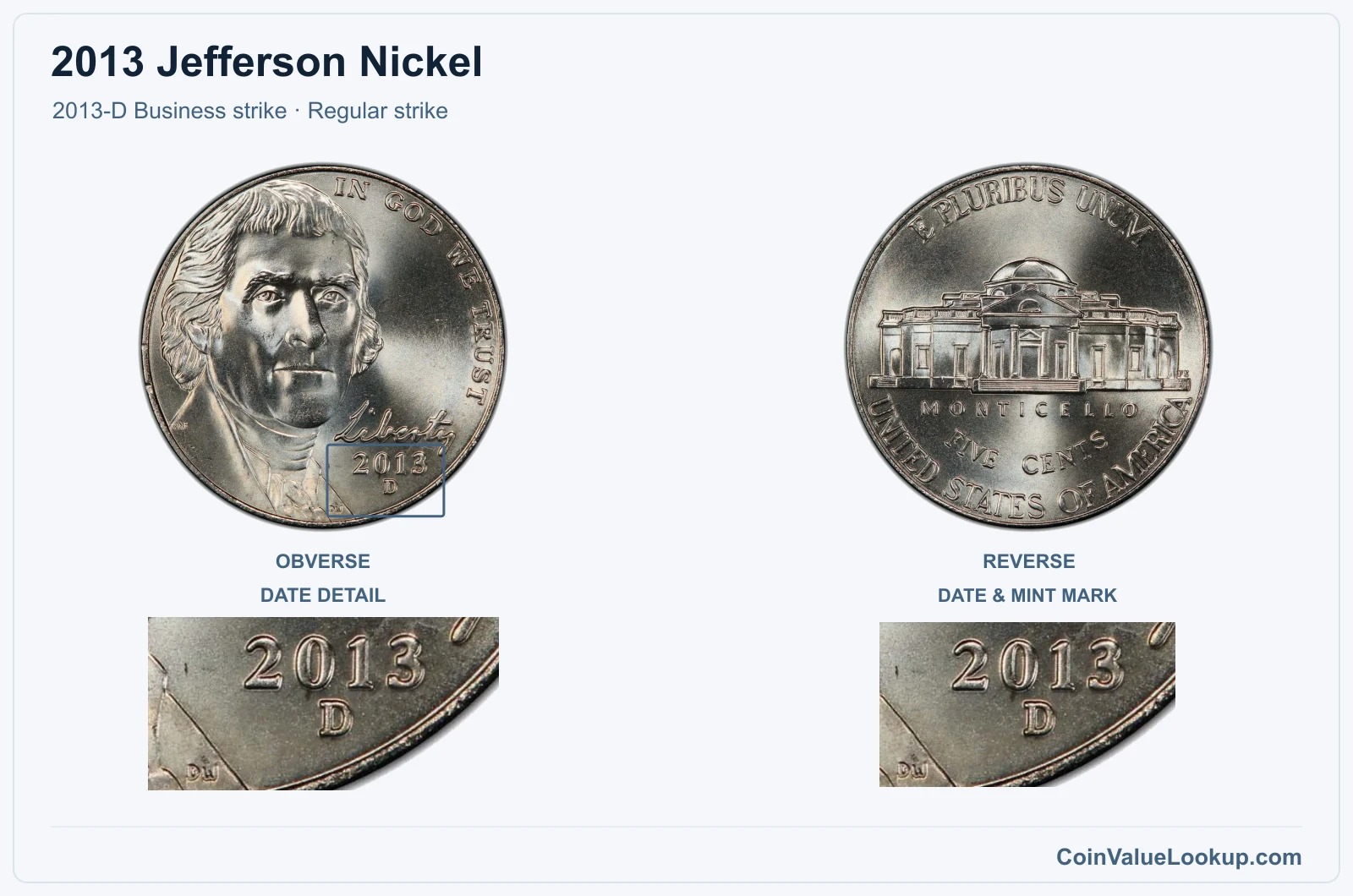
Denver struck 2013-D nickels with the same copper-nickel composition and forward-facing Jefferson design. Look for the D mintmark just below the date on the obverse.
Guide estimates from USA Coin Book place ordinary examples around $0.30 at MS60 and $0.61 at MS65.
Coin Value Lookup is a handy place to look up guides for Jefferson nickels and other series if you are sorting through a pile of coins. Those ordinary guide figures do not cover Full Steps coins, which are graded and priced separately based on strike sharpness.
| Range | Grade | Price | Auction Records | Appraisal |
|---|---|---|---|---|
| PO | PO 1 | — | Coin Identifier | |
| FR | FR 2 | — | Coin Identifier | |
| AG | AG 3 | — | Coin Identifier | |
| G | G 4 | — | Coin Identifier | |
| G 6 | — | Coin Identifier | ||
| VG | VG 8 | — | Coin Identifier | |
| VG 10 | — | Coin Identifier | ||
| F | F 12 | — | Coin Identifier | |
| F 15 | — | Coin Identifier | ||
| VF | VF 20 | — | Coin Identifier | |
| VF 25 | — | Coin Identifier | ||
| VF 30 | — | Coin Identifier | ||
| VF 35 | — | Coin Identifier | ||
| XF | XF 40 | — | Coin Identifier | |
| XF 45 | — | Coin Identifier | ||
| AU | AU 50 | — | Coin Identifier | |
| AU 53 | — | Coin Identifier | ||
| AU 55 | — | Coin Identifier | ||
| AU 58 | — | Coin Identifier | ||
| MS | MS 60 | — | Coin Identifier | |
| MS 61 | — | Coin Identifier | ||
| MS 62 | — | Coin Identifier | ||
| MS 63 | — | Coin Identifier | ||
| MS 64 | — | Coin Identifier | ||
| MS 65 | — | Coin Identifier | ||
| MS 66 | — | Coin Identifier | ||
| MS 67 | — | — | — | |
| MS 68 | — | — | — | |
| MS 69 | — | — | — | |
| MS 70 | — | — | — |
2013 Jefferson Nickel — S Proof
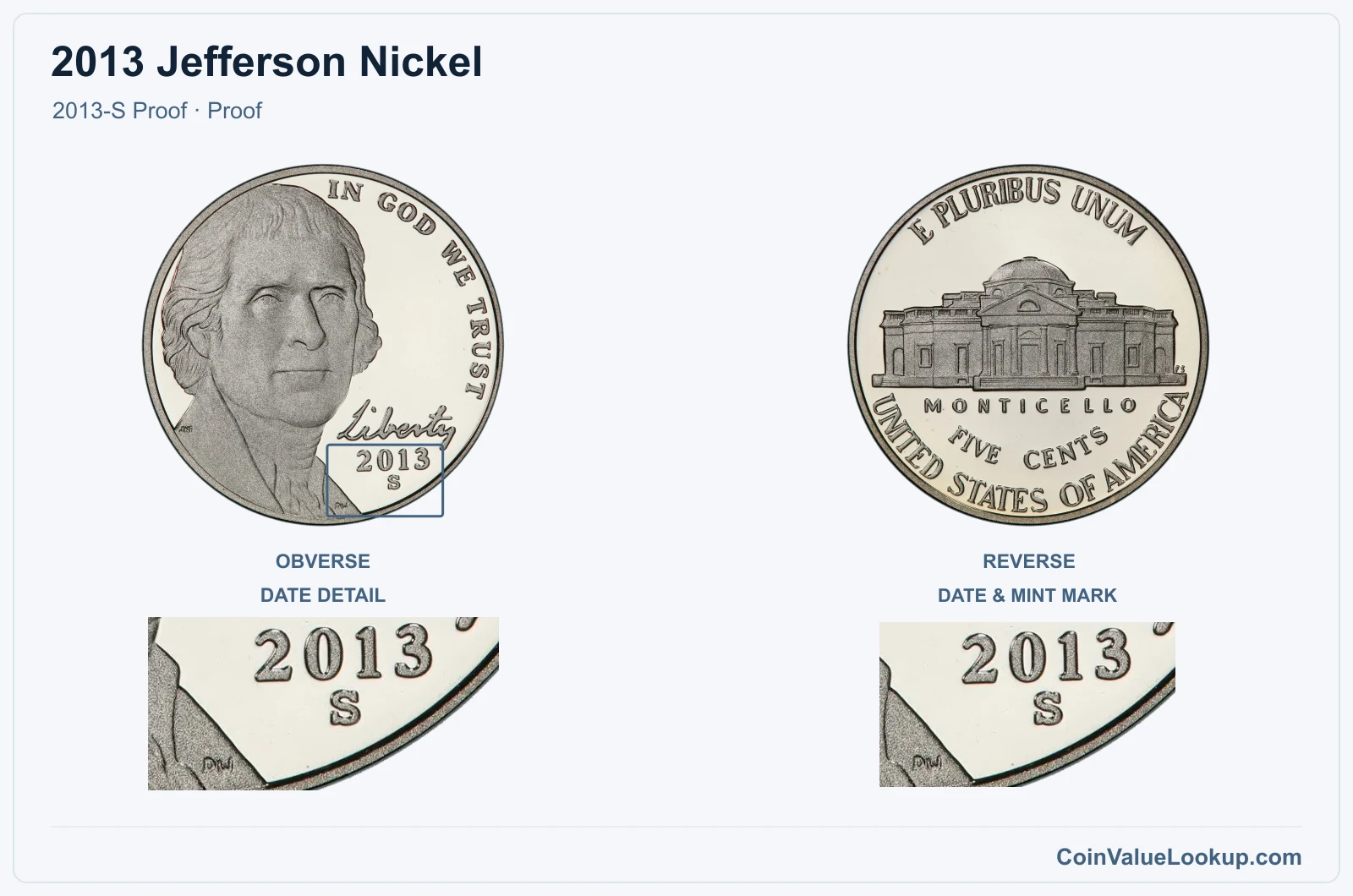
The 2013-S proof was struck at San Francisco exclusively for collector sets. It features deeply mirrored fields and sharp detail that you will not see on a business strike.
USA Coin Book lists a guide estimate of about $5.30 at PR65.
Do not assume every shiny nickel is a proof. Genuine proofs carry the S mintmark and show mirror-like reflections in the flat fields that are unmistakable once you have seen one.
Cameo and deep cameo designations describe the degree of frost on the raised devices, but those are separate labels from the numerical proof grade. Standard guide anchors here do not represent those special contrast designations.
| Range | Grade | Price | Auction Records | Appraisal |
|---|---|---|---|---|
| PR | PR 1 | — | Coin Identifier | |
| PR 2 | — | Coin Identifier | ||
| PR 3 | — | Coin Identifier | ||
| PR 4 | — | Coin Identifier | ||
| PR 6 | — | Coin Identifier | ||
| PR 8 | — | Coin Identifier | ||
| PR 10 | — | Coin Identifier | ||
| PR 12 | — | Coin Identifier | ||
| PR 15 | — | Coin Identifier | ||
| PR 20 | — | Coin Identifier | ||
| PR 25 | — | Coin Identifier | ||
| PR 30 | — | Coin Identifier | ||
| PR 35 | — | Coin Identifier | ||
| PR 40 | — | Coin Identifier | ||
| PR 45 | — | Coin Identifier | ||
| PR 50 | — | Coin Identifier | ||
| PR 53 | — | Coin Identifier | ||
| PR 55 | — | Coin Identifier | ||
| PR 58 | — | Coin Identifier | ||
| PR 60 | — | Coin Identifier | ||
| PR 61 | — | Coin Identifier | ||
| PR 62 | — | Coin Identifier | ||
| PR 63 | — | Coin Identifier | ||
| PR 64 | — | Coin Identifier | ||
| PR 65 | — | Coin Identifier | ||
| PR 66 | — | Coin Identifier | ||
| PR 67 | — | Coin Identifier | ||
| PR 68 | — | Coin Identifier | ||
| PR 69 | Coin Identifier | |||
| PR 70 | Coin Identifier |
2013 Jefferson Nickel Error List
1. 2013 Jefferson Nickel — Doubled die obverse
A doubled die obverse on a 2013-P Jefferson nickel shows extra thickness or separation in the letters of LIBERTY, the digits of the date, the P mintmark, and the motto IN GOD WE TRUST. The area around Jefferson's right eye may also display corresponding doubling.
All affected areas should show doubling in a consistent direction because they originate from the same die.
Do not confuse this with flat, shelf-like machine doubling, which is a strike artifact rather than a die variety. Machine doubling tends to look mushy and lacks the distinct separated profile of a true doubled die.
A doubled modern mintmark is part of the doubled die and should not be called a repunched mintmark.
No reliable price range is available for this variety. Value depends on the authenticated identity of the specific die, the severity of the doubling, and the coin's overall condition.
Individual assessment by a professional grading service is the way to go.
2. 2013 Jefferson Nickel — Clipped Planchet
A clipped planchet error means a portion of the blank was missing before the coin was struck. On a 2013 nickel, look for a curved, straight, or irregular bite out of the edge.
The missing area will often cause design weakness on the opposite side of the coin because the metal could not flow evenly during striking.
The edge at the clip should show the original blank's texture rather than a sharp cut or file marks. If someone ground or cut the edge after minting, the surrounding metal will look disturbed in a different way.
Genuine clips also tend to produce a characteristic "Blakesley effect" weakness opposite the missing section.
Value depends on the size and type of the clip, overall condition, and visual drama. No specific price range is adopted here, so individual assessment based on the authenticated coin is the best approach.
3. 2013 Jefferson Nickel — Die Crack / Die Chip
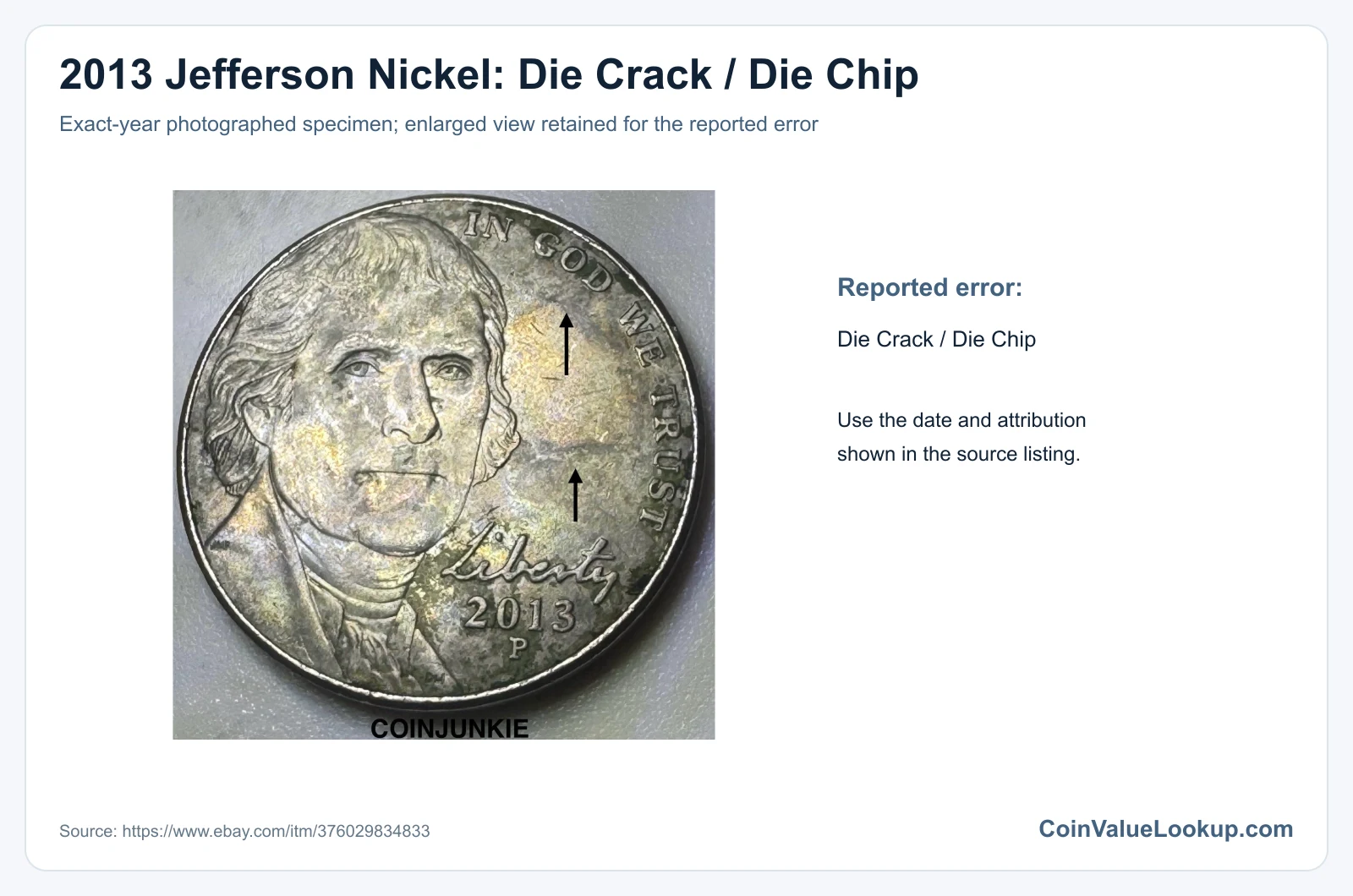
Die cracks appear as thin raised lines on the coin's surface, running across the design or connecting to the rim. A die chip looks like a small raised blob, usually within a letter or design element.
Both happen because the steel die fractured during use. On a 2013 nickel, these can appear on either side.
A crack that extends from an interior point to the rim and displaces a chunk of metal is sometimes called a cud, which is generally more collectible than a hairline crack. Look at the feature under magnification: a genuine die crack is raised above the field, whereas a scratch or corrosion line is incuse, meaning it sits below the surface.
Pricing depends on the size, location, and visual appeal of the crack or chip, along with the coin's grade. No numerical range is established here, so each piece needs individual evaluation.
4. 2013 Jefferson Nickel — Broadstrike
A broadstrike occurs when the coin is struck without the restraining collar that normally forms the rim and controls diameter. The result is a 2013 nickel that looks wider and thinner than usual, with the design spreading outward and the rim appearing weak or absent.
The full design should still be present, just expanded. That distinguishes a broadstrike from an off-center strike, where part of the design is missing entirely.
Also watch out for coins that were simply flattened after leaving the mint, perhaps by a railroad track or a vise. Post-mint damage usually shows uneven distortion and surface marks that are inconsistent with a single press event.
Condition, the degree of spread, and overall eye appeal determine what a broadstrike is worth. No specific price range is adopted, so authenticated examples need to be evaluated individually.
5. 2013 Jefferson Nickel — Improper Annealing
Improper annealing means the blank was heated incorrectly before striking, resulting in unusual surface color or texture. On a 2013 nickel, this can show up as dark streaks, a rough or grainy surface, or patches of discoloration that seem baked into the metal rather than sitting on top of it.
The key distinction is between this kind of factory defect and environmental damage that happened after the coin left the mint. Corrosion, heat damage from a fire, or chemical toning can mimic improper annealing.
A genuine annealing error usually affects the surface uniformly or in patterns consistent with the manufacturing process, and the coin's details remain sharp underneath.
Appearance alone is a screening clue, not proof of the cause. No numerical price range is adopted here.
Value depends on severity, condition, and authenticated confirmation of the error.
6. 2013 Jefferson Nickel — Struck-Through Error
A struck-through error happens when a foreign object, such as grease, a thread, or a metal fragment, gets between the die and the planchet during striking. On a 2013 nickel, this shows up as a depression, a textured impression, or a localized area of missing design detail.
Grease-filled dies produce a smooth, flat blank area. A retained foreign object may leave a distinct shape pressed into the coin's surface.
Either way, the affected zone should be recessed into the field, not raised above it.
Do not confuse a struck-through with ordinary wear, cleaning marks, or a weak strike from a tired die. Wear affects the highest points first, while a struck-through can appear anywhere and often has sharp boundaries.
No price range is adopted for this error, so value depends on the size of the impression, what caused it, the coin's condition, and professional authentication.
7. 2013 Jefferson Nickel — Brockage
A brockage occurs when a previously struck coin sticks to a die and acts as a secondary die for the next blank fed into the press. The result is one normal side and one side bearing an incuse, mirror-image impression of the design from the stuck coin.
On a 2013 nickel, you would see one face looking correct and the other showing a sunken, reversed copy of either the obverse or reverse. The incuse image should be a true mirror image.
If both sides look normal but one has faint ghost lettering, that is more likely a die clash, which is a different and generally less dramatic error.
Also rule out coins that were mechanically pressed together after minting, which will lack the even depth and metal flow of a genuine brockage. No numerical price is established here.
Each brockage must be individually assessed based on its clarity, completeness, and authenticated status.
8. 2013 Jefferson Nickel — Off-Center Strike
An off-center strike means the blank was not properly seated between the dies, so part of the design is missing and a blank crescent appears where no metal was struck. On a 2013 nickel, the percentage of off-center displacement matters a lot: a 5% shift is minor, while 50% or more with the date still visible tends to attract strong collector interest.
Make sure the date is legible. An off-center nickel with no visible date is harder to attribute and much less desirable.
Compare the blank crescent to a clipped planchet, which shows a missing section of the original blank rather than a displaced design.
Post-mint flattening or a misaligned die can also mimic a mild off-center strike, so look for consistent displacement of the entire design. No specific price range is adopted, and value depends on the degree of displacement, date visibility, and overall condition.
Professional authentication is recommended.