1894 Liberty Nickel Coin Value: How Much Is It Worth?
The 1894 Liberty Nickel is a scarcer mid-series date that can reward patient collectors. A guide estimate from USA Coin Book places an ordinary business strike at about $19 in G4 and around $527 in MS63, while a PR63 proof sits near $344.
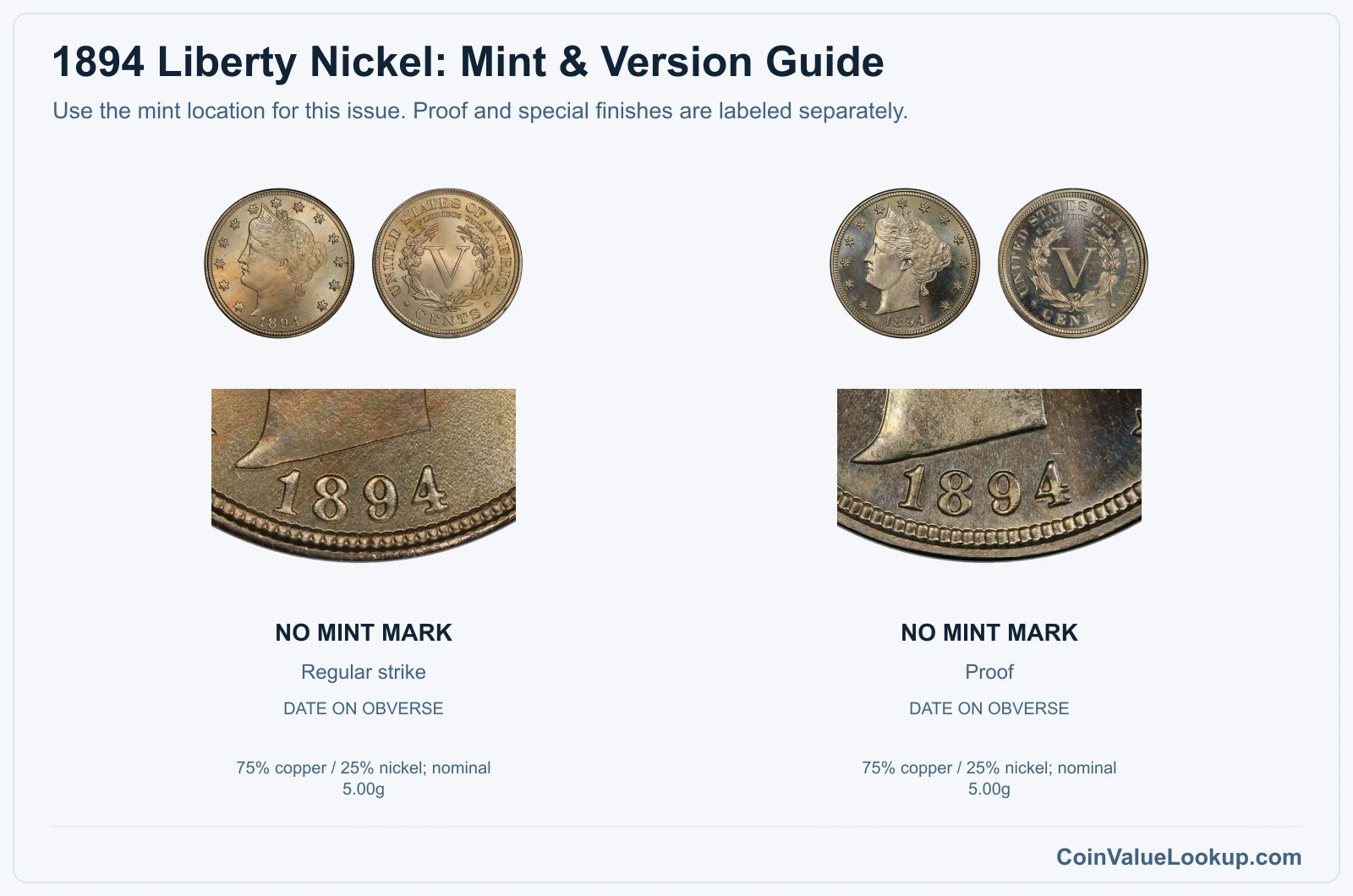
All examples were struck at Philadelphia with no mintmark, so there are no branch-mint varieties to chase — just condition and finish matter here.
Fast Way to Identify Your 1894 Liberty Nickel
Snap clear photos of both the front and back of your coin under good lighting. Upload them to our identification tool for a preliminary look at what you have.
This step helps sort out the version and general condition before you dig deeper, though it is not a substitute for professional authentication or precise grading.
1894 Liberty Nickel Value
Upload both sides of your 1894 Liberty Nickel.
Front Obverse
Upload photo
Back Reverse
Upload photo
Which 1894 Liberty Nickel Versions Are Worth Money?
- Business strikes in G4 guide near $19 and climb to roughly $527 in MS63 per USA Coin Book — condition drives this coin's value dramatically.
- Proof examples guide around $344 in PR63; proofs with original surfaces free of hairlines command the strongest interest.
- Double or multiple strike errors have been reported for 1894; confirmed examples are scarce and worth professional evaluation.
Step 1: Identify Your 1894 Liberty Nickel Mint Mark and Version
Every 1894 Liberty Nickel came from Philadelphia. There is no mintmark, and you should not expect to find a D or S on genuine examples.
The coin is 75% copper and 25% nickel, weighs about 5 grams, measures 21.2 mm across, and has a plain edge. There is no regular silver branch for this year.
All genuine pieces carry the WITH CENTS reverse — the words CENTS appear below the Roman numeral V inside the wreath. The earlier No CENTS design was used only in 1883, so if your 1894 lacks the word CENTS something is off.
Because this is a scarcer date in the series, altered coins do turn up. Some fakes are created by tooling the date on a more common Liberty Nickel.
Look closely at the spacing and style of the digits under magnification. Genuine 1894 dates should show consistent depth and font relative to the rest of the design.
Step 2: Check Your 1894 Liberty Nickel Grade
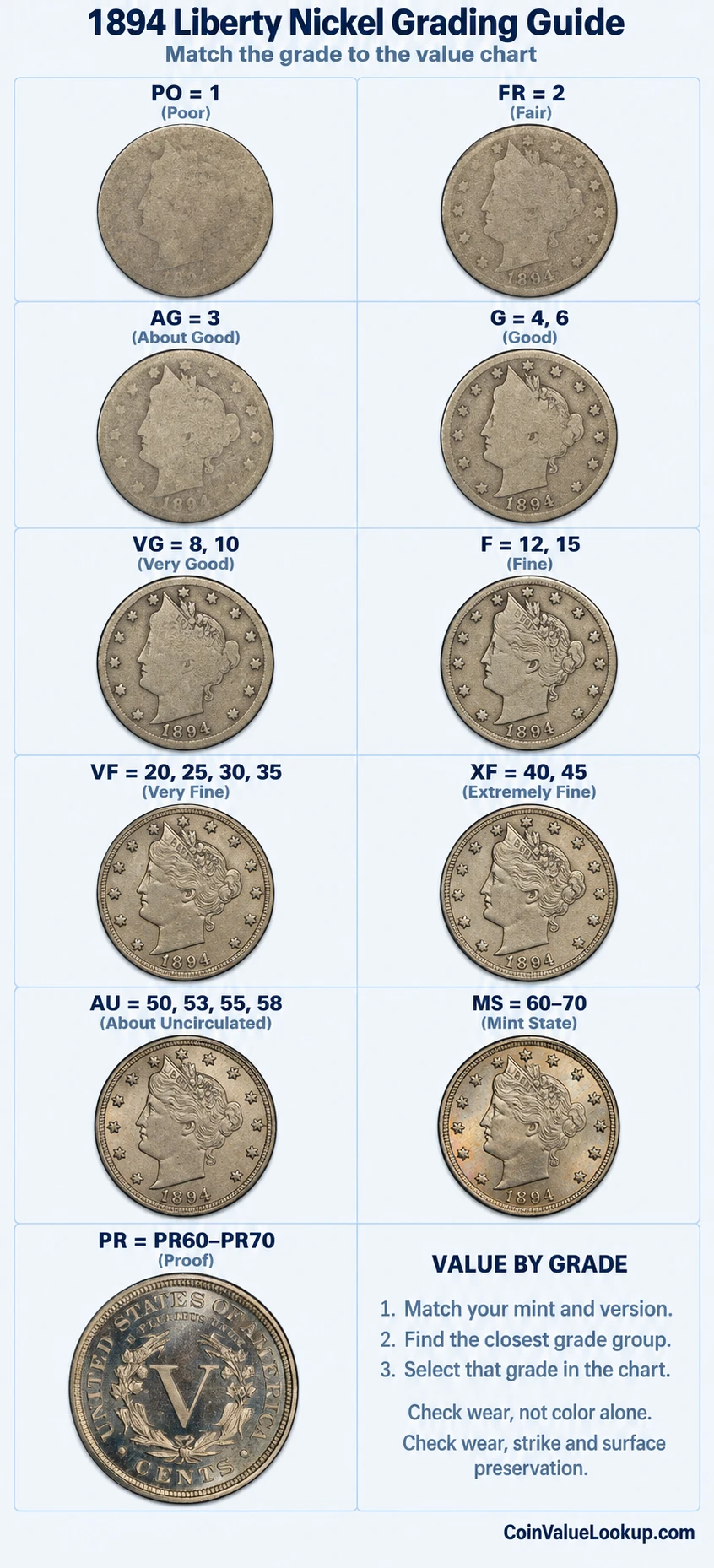
Start by checking the word LIBERTY on the coronet across the top of the head. On a well-worn coin in the Good range, only partial letters may remain.
A Fine example should show a full LIBERTY with moderate softness.
Next, examine the high points of the hair curls above and behind the ear and the smoothness of the cheek. These are the first areas to lose detail.
On the reverse, the ears of corn and the wreath leaves tell a similar story.
Do not mistake a weak strike for wear. Some 1894 nickels left the press with soft detail on the hair or corn, yet their fields still show original luster.
A coin with mushy hair but frosty, undisturbed surfaces is likely mint state despite looking "flat" in spots. Compare your coin against the reference image to calibrate your eye.
Proofs are a manufacturing method, not a grade above Mint State. Proof surfaces typically show mirror-like fields and squared-off rims.
Hairlines from cleaning or handling lower a proof's grade just as bag marks lower a business strike's grade.
Step 3: Check 1894 Liberty Nickel Value by Mint and Version
1894 Liberty Nickel — No Mint Mark — With CENTS Circulation
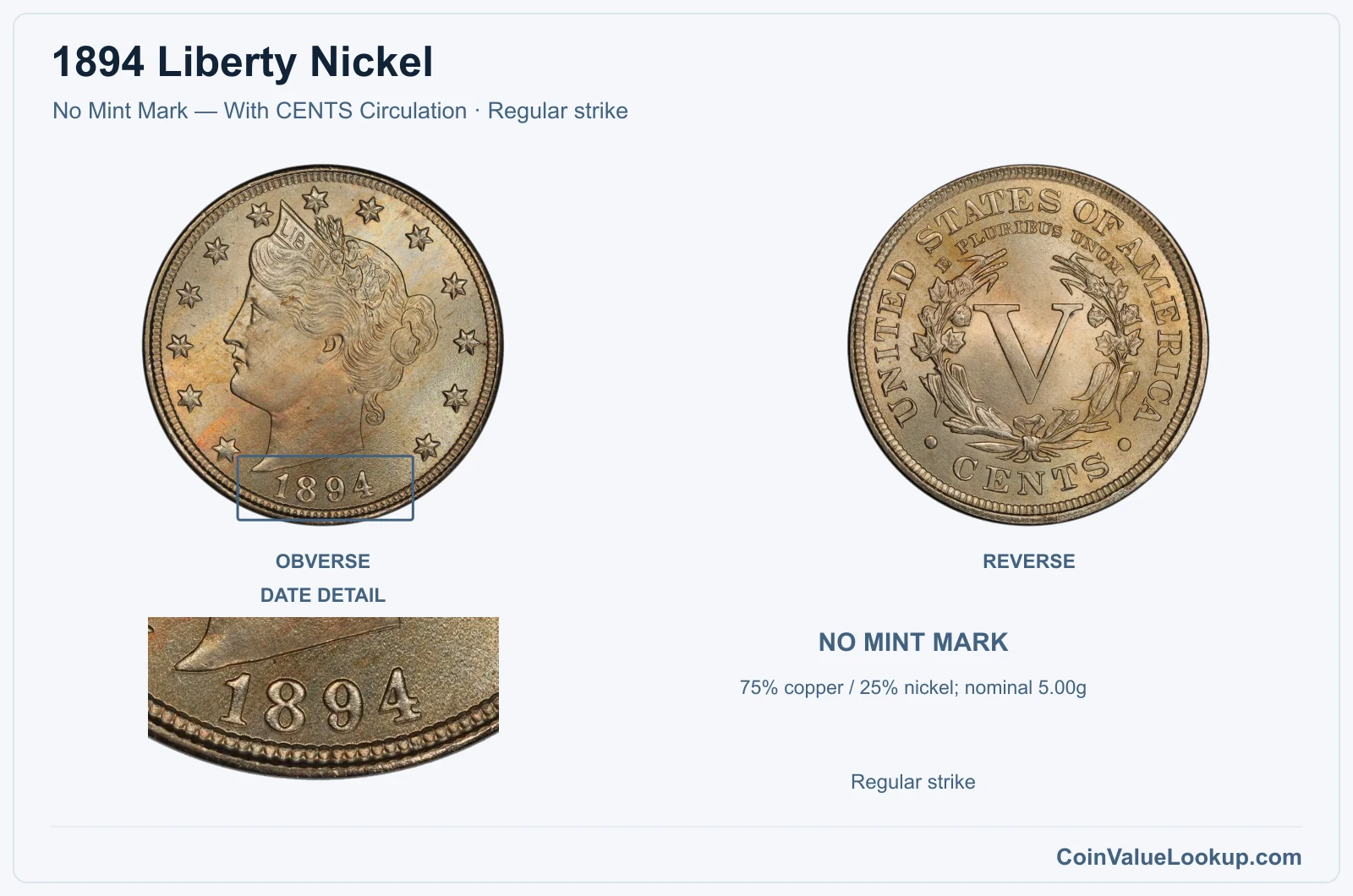
The standard 1894 Liberty Nickel is a Philadelphia business strike on a copper-nickel planchet with the WITH CENTS reverse. No mintmark appears anywhere on the coin.
USA Coin Book's guide estimate places it at about $19 in G4, rising to around $527 in MS63.
This is a scarcer date relative to many other Liberty Nickels from the 1890s, so even lower-grade circulated pieces carry a modest premium over common years. In high grades, original luster and minimal contact marks make a real difference.
Be cautious of coins with altered dates — a genuine 1894 should show evenly spaced, uniformly struck digits.
Coin Value Lookup is a handy starting point when you want to look up values for other dates and denominations in the series.
Range Grade
Price Auction Records Appraisal PO PO 1
—
Coin Identifier FR FR 2
—
Coin Identifier AG AG 3
—
Coin Identifier G G 4
—
Coin Identifier
G 6
—
Coin Identifier VG VG 8
—
Coin Identifier
VG 10
—
Coin Identifier F F 12
—
Coin Identifier
F 15
Coin Identifier VF VF 20
Coin Identifier
VF 25
Coin Identifier
VF 30
Coin Identifier
VF 35
Coin Identifier XF XF 40
Coin Identifier
XF 45
Coin Identifier AU AU 50
Coin Identifier
AU 53
Coin Identifier
AU 55
Coin Identifier
AU 58
Coin Identifier MS MS 60
—
Coin Identifier
MS 61
Coin Identifier
MS 62
Coin Identifier
MS 63
Coin Identifier
MS 64
Coin Identifier
MS 65
Coin Identifier
MS 66
Coin Identifier
MS 67
Coin Identifier
MS 68
—
—
—
MS 69
—
—
—
MS 70
—
—
—
1894 Liberty Nickel — No Mint Mark — With CENTS Proof
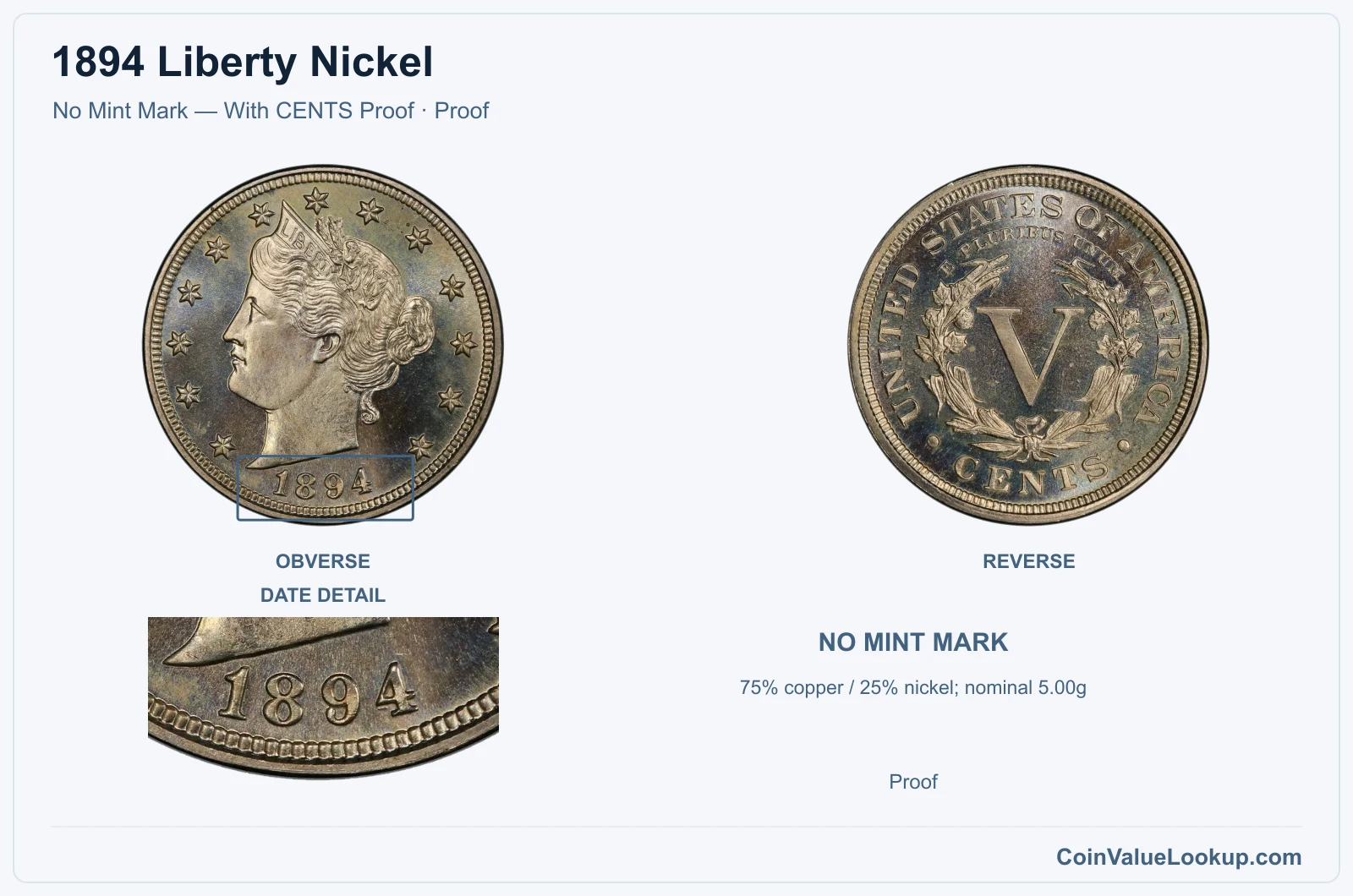
Philadelphia struck proof Liberty Nickels in 1894 for collectors, using specially prepared dies and planchets. These coins display mirror-like fields and sharp design details that differ from the satin or cartwheel luster of business strikes.
A PR63 example guides near $344 according to USA Coin Book.
To identify a proof, look for reflective, glassy surfaces in the flat areas around the head and inside the wreath. Rims tend to be sharper and more squared off than on circulation pieces.
Hairlines from improper cleaning are the most common grade-killers on proofs, so tilt the coin under a single light source to check.
Keep in mind that these are guide estimates from a single published snapshot, not guaranteed sale prices. Individual assessment from a grading service is the surest way to pin down what a specific proof is worth.
Range Grade
Price Auction Records Appraisal PR PR 1
—
Coin Identifier
PR 2
—
Coin Identifier
PR 3
—
Coin Identifier
PR 4
—
Coin Identifier
PR 6
—
Coin Identifier
PR 8
—
Coin Identifier
PR 10
—
Coin Identifier
PR 12
—
Coin Identifier
PR 15
—
Coin Identifier
PR 20
—
Coin Identifier
PR 25
—
Coin Identifier
PR 30
—
Coin Identifier
PR 35
—
Coin Identifier
PR 40
—
Coin Identifier
PR 45
—
Coin Identifier
PR 50
—
Coin Identifier
PR 53
—
Coin Identifier
PR 55
—
Coin Identifier
PR 58
Coin Identifier
PR 60
Coin Identifier
PR 61
Coin Identifier
PR 62
Coin Identifier
PR 63
Coin Identifier
PR 64
Coin Identifier
PR 65
Coin Identifier
PR 66
Coin Identifier
PR 67
Coin Identifier
PR 68
Coin Identifier
PR 69
—
—
—
PR 70
—
—
—
1894 Liberty Nickel Error List
1. 1894 Liberty Nickel — Double / Multiple Strike
A double or multiple strike occurs when the coin is struck more than once by the press, with the planchet shifting or rotating between impacts. The result is two or more overlapping design impressions that are visibly displaced from each other.
On a 1894 Liberty Nickel, you would see a second ghost image of the head or the reverse wreath offset from the primary strike.
Do not confuse this with a doubled die, which shows doubling within a single impression because of a misaligned hub. A double strike produces two distinct, separated images; a doubled die shows split serifs or thickened letters within one image.
Post-mint damage from a vise or drop can also mimic a second strike, but those marks lack the full-design detail of a genuine second impression.
No specific price was available for this error. Value depends on how dramatic and clearly visible the second strike is, the coin's overall condition, and professional confirmation of authenticity.