1898 Liberty Nickel Coin Value: How Much Is It Worth?
The 1898 Liberty Nickel is a Philadelphia-only issue struck in copper-nickel. A well-worn example in G4 condition books at about $4.96 according to USA Coin Book guide estimates, while an MS63 business strike reaches roughly $238.
Proofs exist as a separate manufacturing category, with a PR63 anchor around $344. These are retail guide snapshots, not guaranteed sale prices.
Fast Way to Identify Your 1898 Liberty Nickel
Want a quick read on your 1898 Liberty Nickel? Upload clear photos of both the front and back of your coin.
Our identifier can offer a preliminary identification based on those images, helping you figure out which version you have and what condition range it falls into. Sharp, well-lit shots make a real difference.
1898 Liberty Nickel Value
Upload both sides of your 1898 Liberty Nickel.
Front Obverse
Upload photo
Back Reverse
Upload photo
Which 1898 Liberty Nickel Versions Are Worth Money?
- Business strikes jump sharply in value at higher grades, from about $4.96 in G4 to roughly $238 in MS63 per USA Coin Book estimates.
- Proofs carry their own premium, with a PR63 guide value around $344, reflecting their limited collector-focused mintage.
- Repunched-date varieties are a separate collectible category; visible remnants of extra date punches can add appeal beyond the base coin.
- Wrong-planchet strikes, if authenticated, represent a dramatic departure from normal production and attract specialist interest.
Step 1: Identify Your 1898 Liberty Nickel Mint Mark and Version
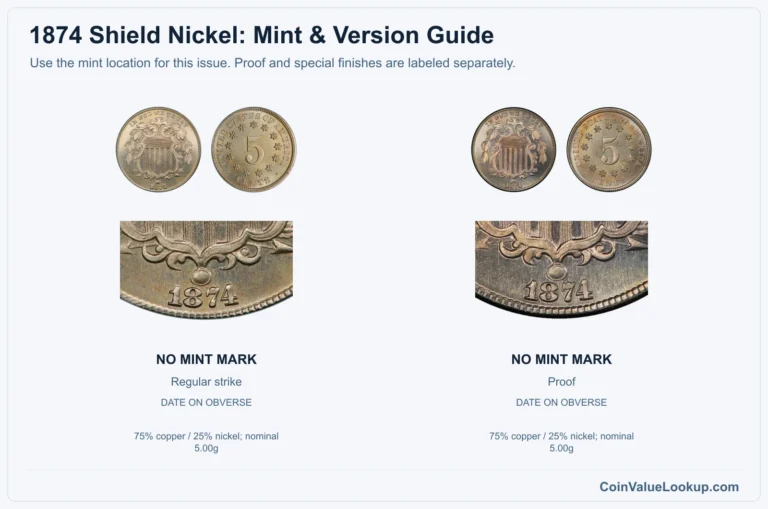
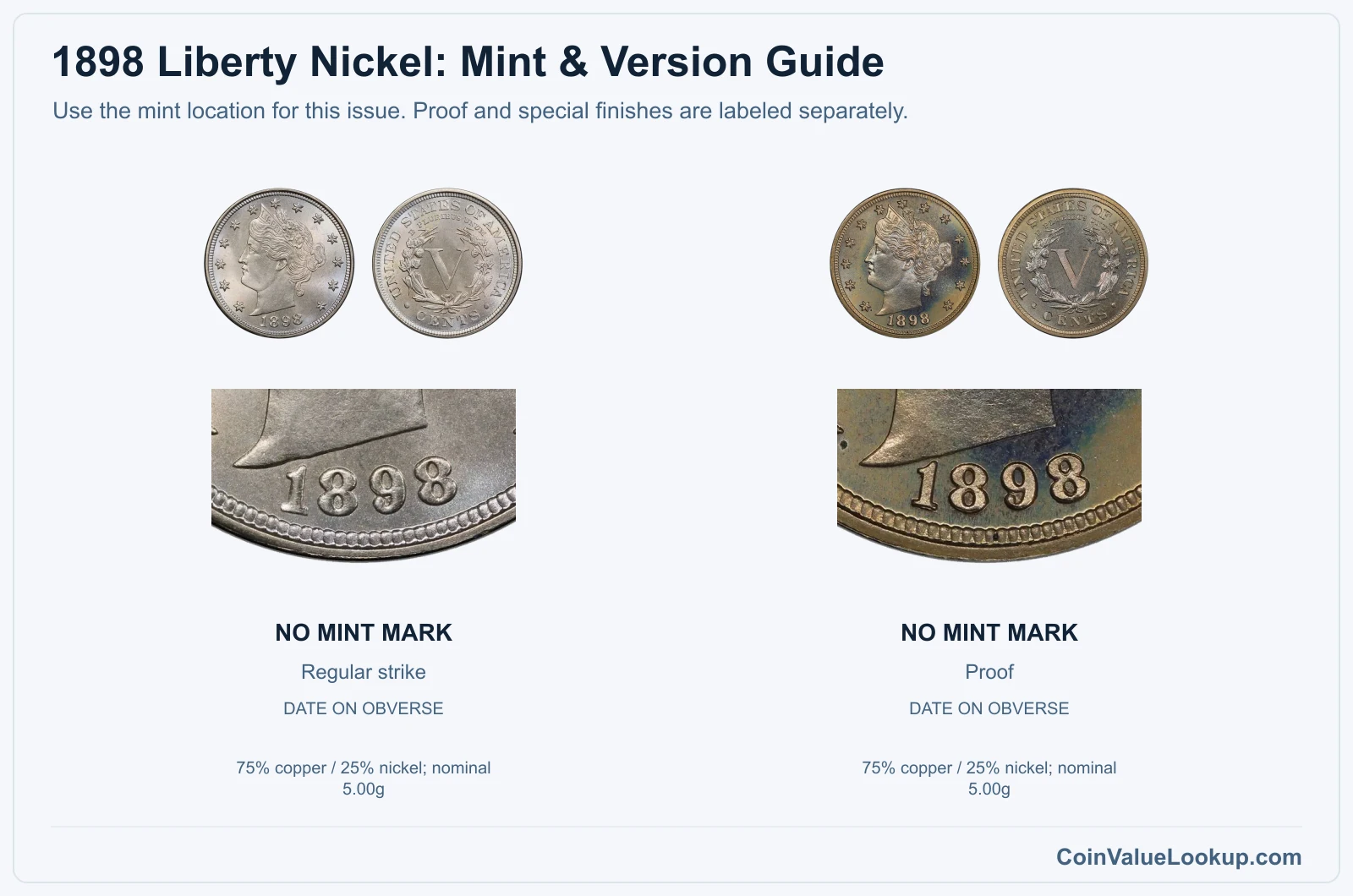
Every regular 1898 Liberty Nickel was struck at Philadelphia. There is no mintmark to hunt for, and no branch-mint version exists for this date.
The coin is 75% copper and 25% nickel, weighs nominally 5 grams, measures 21.2 mm across, and has a plain edge. No silver version was produced.
The reverse reads "CENTS" below the Roman numeral V, which distinguishes it from the earlier 1883 No CENTS design type.
Two legitimate manufacturing categories exist for 1898: business strikes and proofs. Proofs were made for collectors using specially prepared dies and polished planchets.
If your coin has mirror-like fields and sharp, square rims, it may be a proof, but confirmation from a grading service is the safest route. Repunched dates and wrong-planchet strikes are error categories reported separately from normal production.
Step 2: Check Your 1898 Liberty Nickel Grade
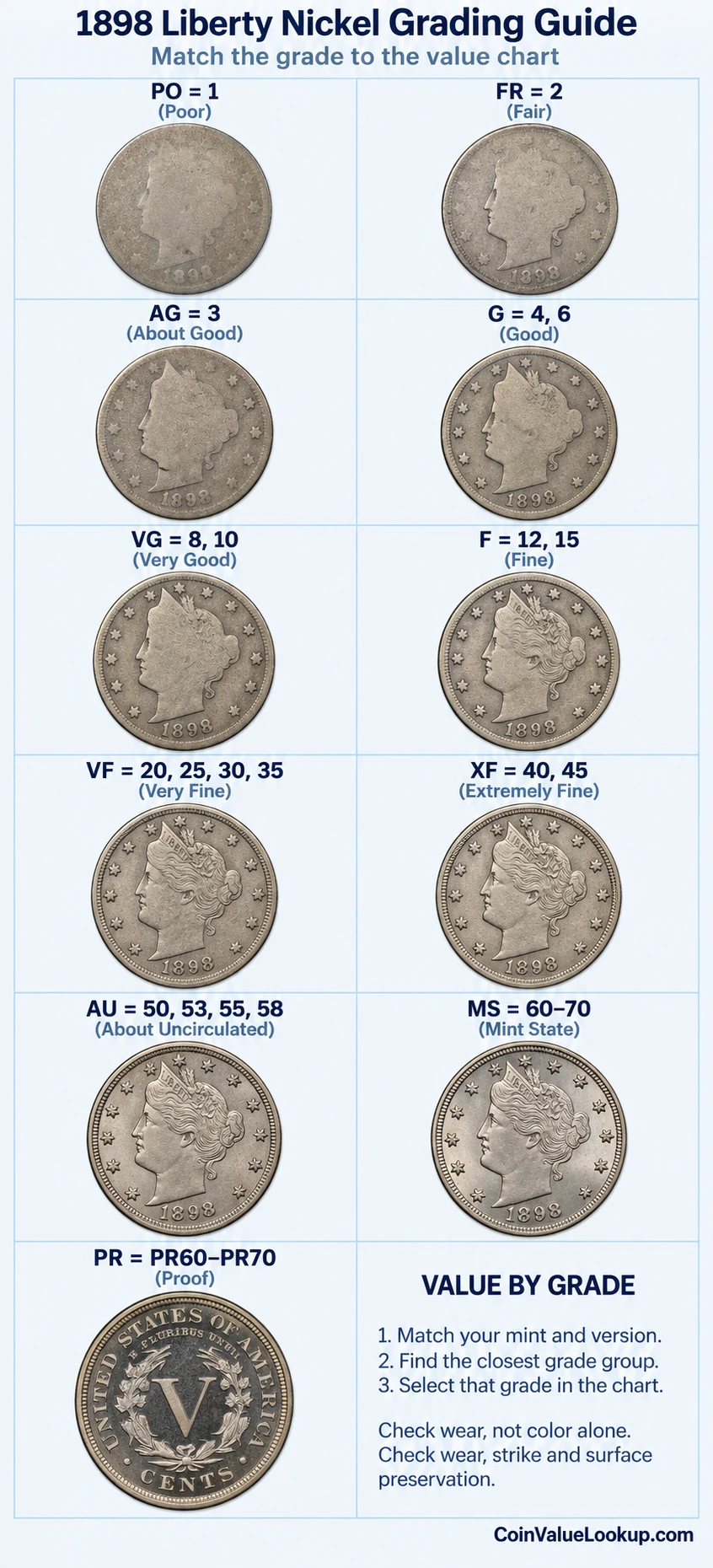
Start with the obverse. The word LIBERTY stamped into the coronet is your first wear checkpoint.
On a lightly circulated coin, all letters should be fully visible. As wear progresses, the high points of the hair curls above the forehead and the cheek flatten first.
A coin missing several LIBERTY letters is solidly in the Good range.
Flip it over. The ears of corn flanking the wreath and the knot at the base are next.
These lose definition early in a coin's life.
Don't confuse a weak strike with wear. Some 1898 nickels left the press with soft detail on the hair or corn.
Check the fields and luster instead. A coin with flat hair but still-bright, undisturbed luster was probably struck that way.
For mint-state pieces, look at contact marks, the quality of luster, and overall eye appeal. Compare your coin against the reference image to calibrate where it sits on the scale.
Proof is not a grade above Mint State. It describes how the coin was made.
Proof surfaces should show reflective fields, and you should examine for hairlines from past cleaning, which lower the effective grade.
Step 3: Check 1898 Liberty Nickel Value by Mint and Version
1898 Liberty Nickel — No Mint Mark — With CENTS Circulation
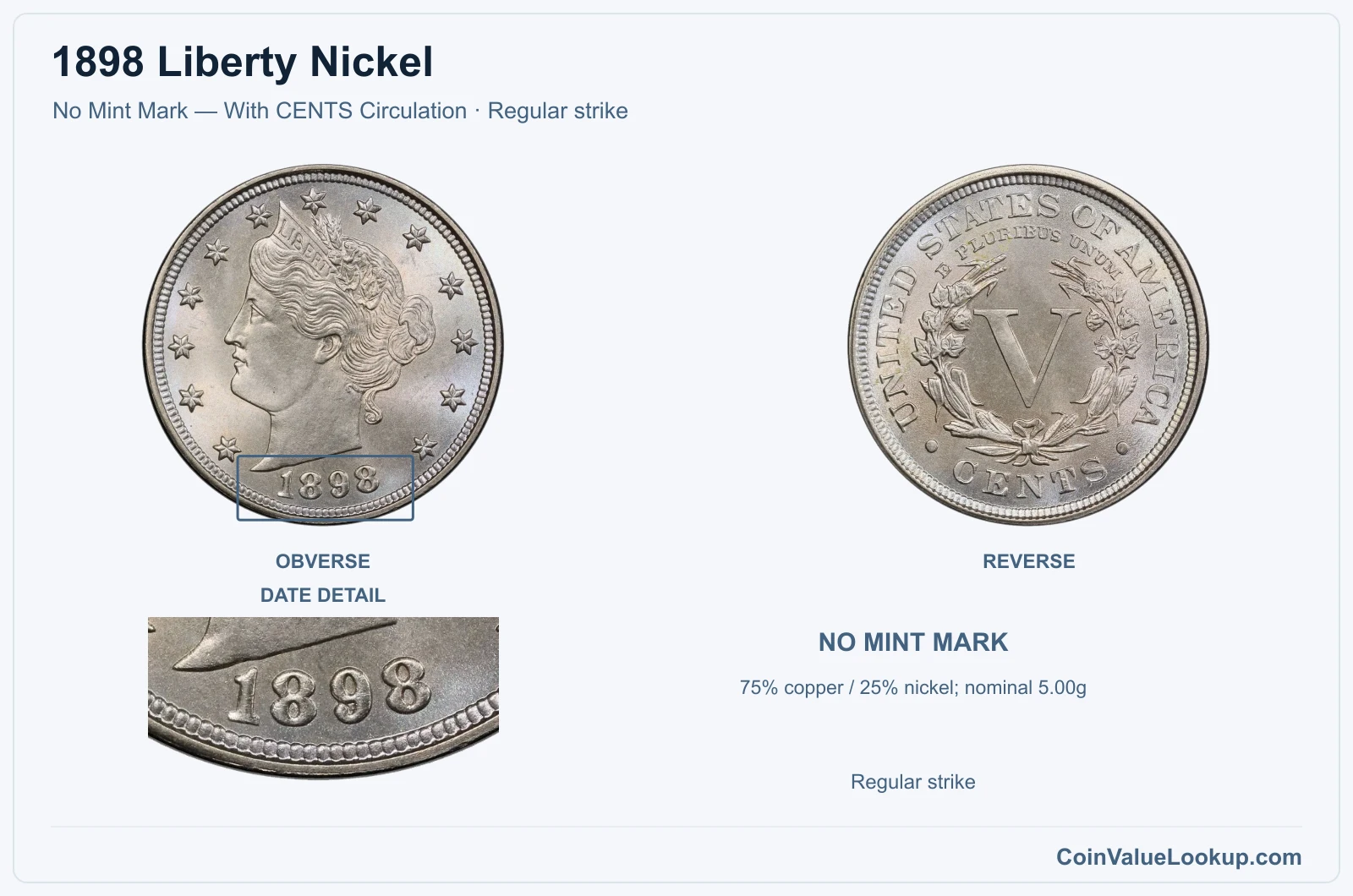
This is the standard 1898 Liberty Nickel struck for circulation at Philadelphia. No mintmark appears on the coin.
The alloy is 75% copper and 25% nickel at a nominal weight of 5 grams, and the reverse carries the CENTS denomination.
USA Coin Book guide estimates place a G4 example at about $4.96 and an MS63 at roughly $238. That is a steep curve, which tells you condition matters enormously.
Most surviving examples are well circulated, so a genuinely uncirculated piece with strong luster and minimal bag marks stands apart. Look for complete LIBERTY letters, full hair detail and undisturbed fields when evaluating higher grades.
If you are exploring values across different dates and denominations, Coin Value Lookup is a handy starting point for finding coin guides organized by series and year.
Range Grade
Price Auction Records Appraisal PO PO 1
—
Coin Identifier FR FR 2
—
Coin Identifier AG AG 3
—
Coin Identifier G G 4
—
Coin Identifier
G 6
—
Coin Identifier VG VG 8
—
Coin Identifier
VG 10
—
Coin Identifier F F 12
—
Coin Identifier
F 15
—
Coin Identifier VF VF 20
Coin Identifier
VF 25
—
Coin Identifier
VF 30
—
Coin Identifier
VF 35
—
Coin Identifier XF XF 40
—
Coin Identifier
XF 45
—
Coin Identifier AU AU 50
—
Coin Identifier
AU 53
—
Coin Identifier
AU 55
Coin Identifier
AU 58
Coin Identifier MS MS 60
Coin Identifier
MS 61
Coin Identifier
MS 62
Coin Identifier
MS 63
Coin Identifier
MS 64
Coin Identifier
MS 65
Coin Identifier
MS 66
Coin Identifier
MS 67
Coin Identifier
MS 68
—
—
—
MS 69
—
—
—
MS 70
—
—
—
1898 Liberty Nickel — No Mint Mark — With CENTS Proof
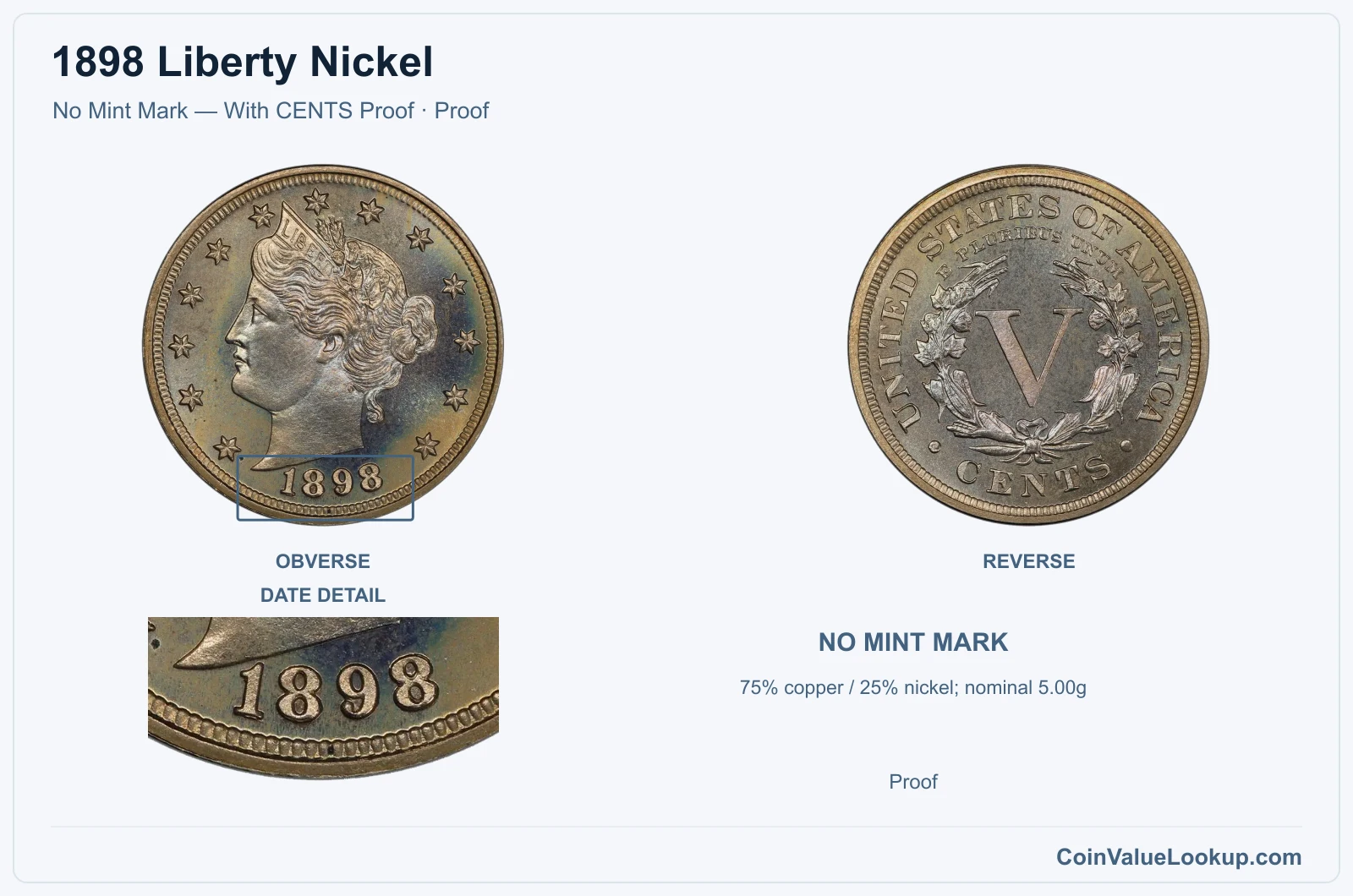
Philadelphia also produced proof 1898 Liberty Nickels for collectors. These were struck on polished planchets with specially prepared dies, yielding mirror-like fields and crisp design edges that business strikes rarely match.
A PR63 example carries a guide estimate of about $344 from USA Coin Book. That premium over a comparable mint-state coin reflects both the different manufacturing process and the smaller number produced.
To identify a proof, examine the fields under good light. They should be deeply reflective, and the rims will appear squared and sharp.
Hairlines from improper storage or cleaning are common on older proofs and will lower the effective grade. If you suspect you have a proof, comparing it side by side with a known business strike is the fastest way to see the difference in surface quality.
Range Grade
Price Auction Records Appraisal PR PR 1
—
Coin Identifier
PR 2
—
Coin Identifier
PR 3
—
Coin Identifier
PR 4
—
Coin Identifier
PR 6
—
Coin Identifier
PR 8
—
Coin Identifier
PR 10
—
Coin Identifier
PR 12
—
Coin Identifier
PR 15
—
Coin Identifier
PR 20
—
Coin Identifier
PR 25
—
Coin Identifier
PR 30
—
Coin Identifier
PR 35
—
Coin Identifier
PR 40
—
Coin Identifier
PR 45
—
Coin Identifier
PR 50
—
Coin Identifier
PR 53
—
Coin Identifier
PR 55
—
Coin Identifier
PR 58
Coin Identifier
PR 60
Coin Identifier
PR 61
Coin Identifier
PR 62
Coin Identifier
PR 63
Coin Identifier
PR 64
Coin Identifier
PR 65
Coin Identifier
PR 66
Coin Identifier
PR 67
Coin Identifier
PR 68
—
Coin Identifier
PR 69
—
—
—
PR 70
—
—
—
1898 Liberty Nickel Error List
1. 1898 Liberty Nickel — Repunched Date
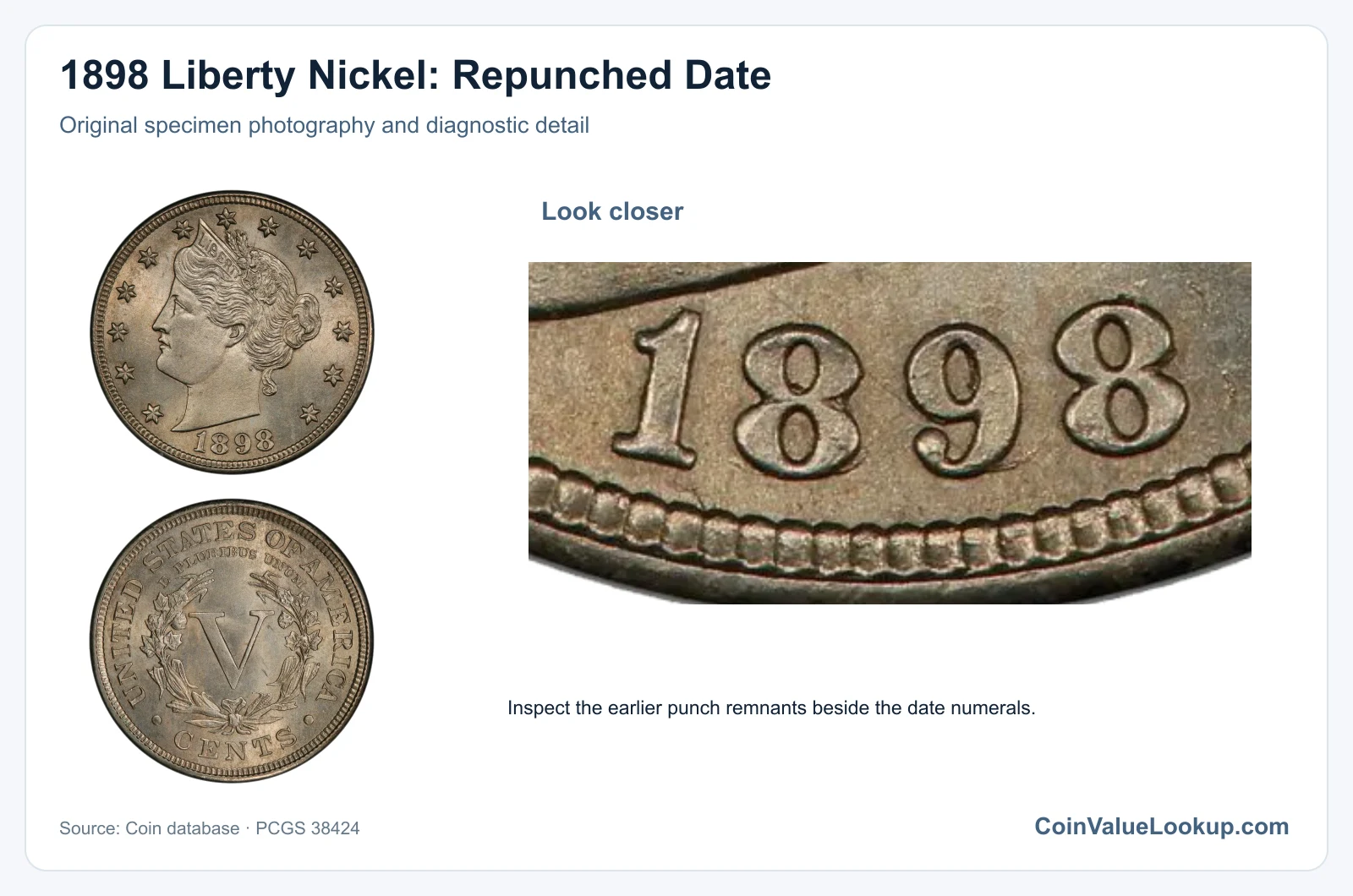
A repunched date on an 1898 Liberty Nickel shows traces of an earlier date-punch position next to the final numerals. You might see a shadow or partial extra digit offset slightly from the accepted position, most commonly visible on the 8 or 9.
This is a die variety, not a mistake made after the coin left the mint.
Do not confuse this with machine doubling, which produces flat, shelf-like outlines lacking the depth and separation of a true repunch. Damage from contact or corrosion can also mimic extra impressions, so look for consistency across the date area.
No specific price range is available for this variety. Value depends on the clarity and boldness of the repunching, the overall condition of the coin, and collector demand for the particular variety.
Professional attribution helps establish legitimacy.
2. 1898 Liberty Nickel — Die Crack / Die Chip
Die cracks appear as thin raised lines running across the coin's surface, caused by fractures in the steel die during production. On an 1898 Liberty Nickel, they can show up anywhere but are easiest to spot in open fields.
A die chip is a small raised blob where a piece of the die broke away, leaving a filled area on the struck coin. If a crack reaches the rim and a chunk of die metal breaks free, it creates a larger raised area called a cud.
These are not scratches. Scratches are incuse, meaning they go into the surface.
Die cracks and chips are raised above it. Corrosion or foreign material stuck to the coin can also look similar, so tilt the coin under a light and check whether the feature stands above the field.
No adopted price range exists for these. The size, location and visual prominence of the crack or chip, plus the coin's overall grade, all factor into any premium.
3. 1898 Liberty Nickel — Clipped Planchet
A clipped planchet occurs when the metal blank is improperly cut before striking, leaving a missing curved, straight or irregular portion along the edge. On an 1898 Liberty Nickel, a genuine clip will often show a characteristic area of design weakness on the opposite side of the coin from the missing metal, sometimes called the Blakesley effect.
Compare the edge texture at the clip boundary with the rest of the coin. A genuine clip usually shows smooth, slightly rounded metal at the missing area rather than sharp tool marks.
If you see a flat, filed edge or jagged corrosion, that points to post-mint damage, not a mint error.
There is no adopted numerical price for clipped-planchet 1898 nickels. The size of the clip, its type and the coin's condition all influence any added value.
Authentication is recommended before assuming a premium.
4. 1898 Liberty Nickel — Wrong Planchet / Off-Metal Strike
A wrong-planchet strike means the 1898 Liberty Nickel dies struck a blank intended for a different denomination or even a foreign coin. The result looks like a Liberty Nickel but feels wrong in hand because the weight, diameter or edge will not match the standard 5-gram, 21.2 mm copper-nickel specification.
To check, weigh and measure the coin carefully. Compare your readings against the normal specs.
Incomplete design coverage or an unusual edge can also signal the wrong blank. The exact foreign or domestic planchet involved is not specified in available sources for this date.
Beware of lookalikes. Plated coins, acid-treated surfaces and deliberately altered pieces can mimic off-metal strikes.
A coin that simply looks discolored is more likely damaged than struck on the wrong blank.
No numerical price is available for this category on the 1898 nickel. Condition, the identity of the wrong planchet and third-party authentication all affect value significantly.