1883 Shield Nickel Coin Value: How Much Is It Worth?
The 1883 Shield Nickel is the final year of the Shield design, making it a natural stopping point for series collectors. A USA Coin Book retail estimate puts a well-worn example around $38 in G4 and a nice uncirculated piece near $281 in MS63.
Proofs come in around $468 at PR63. These are guide estimates, not guaranteed sale prices.
Keep in mind this page covers the Shield design only — the 1883 Liberty Head "No CENTS" and "With CENTS" nickels are a completely different series.
Fast Way to Identify Your 1883 Shield Nickel
Snap a clear photo of the front and back of your 1883 nickel and upload both images to our identifier for a preliminary look at what you have. This can help you figure out whether your coin is a Shield design or a Liberty Head, and flag obvious features worth investigating further.
It is not a substitute for professional grading or authentication.
1883 Shield Nickel Value
Upload both sides of your 1883 Shield Nickel.
Front Obverse
Upload photo
Back Reverse
Upload photo
Which 1883 Shield Nickel Versions Are Worth Money?
- The 1883/2 overdate is the standout variety, with guide estimates of roughly $313 in G4 and $3,085 in MS63 — far above the normal date.
- Proof examples carry a distinct premium; the PR63 guide estimate is $468, and original surfaces are critical to that value.
- Doubled die obverse and repunched date varieties have been reported for this year; value depends on visibility and condition.
- Confirm you actually have a Shield Nickel and not an 1883 Liberty Head — the two designs share a year but have very different markets.
Step 1: Identify Your 1883 Shield Nickel Mint Mark and Version
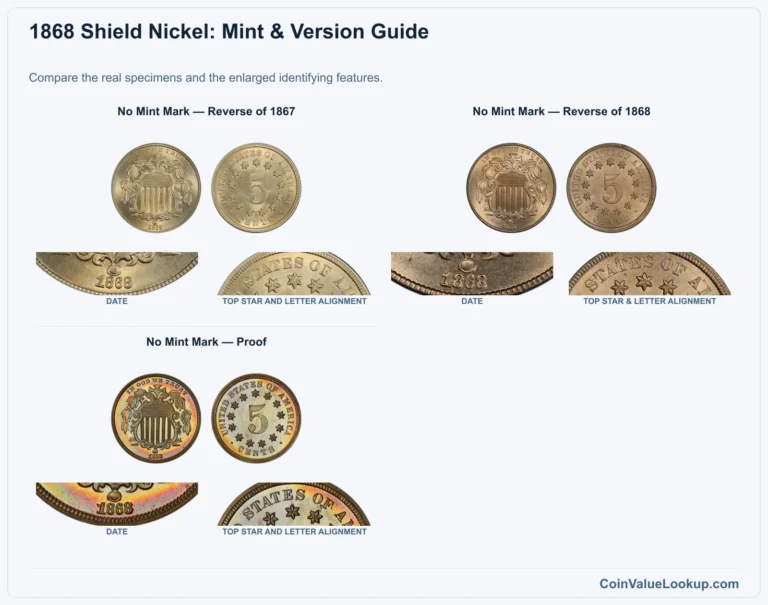
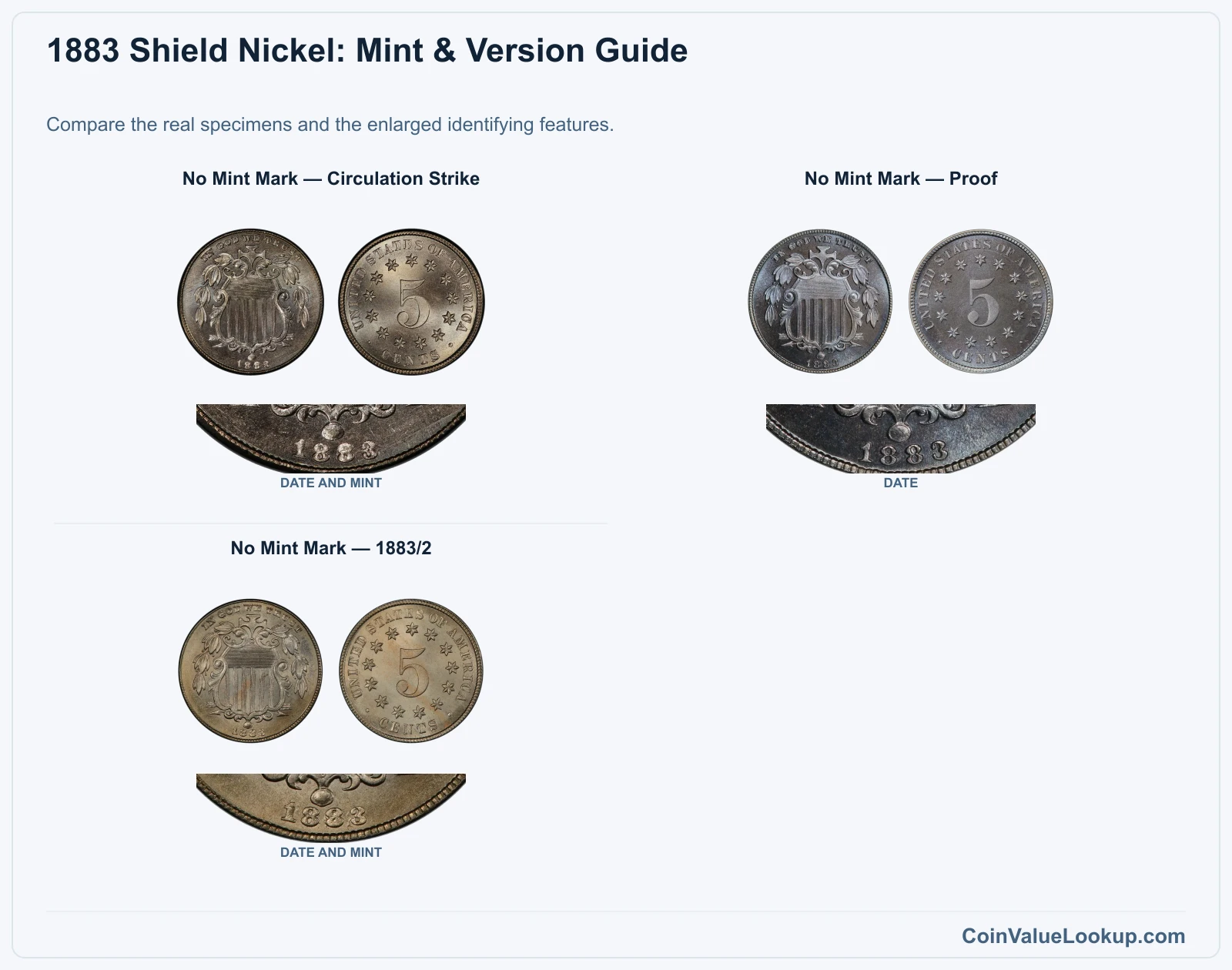
All 1883 Shield Nickels were struck at Philadelphia. There is no mintmark on this coin, and the absence of a mint letter is perfectly normal — not an error.
The coin is copper-nickel, 75% copper and 25% nickel, weighing about 5 grams with a 20.5 mm diameter and a plain edge. There is no silver version of this coin.
The design shows a shield on the obverse and a large numeral 5 surrounded by stars and rays (early type) or stars without rays on the reverse. The 1883 falls into the "No Rays" subtype.
If your coin has a Liberty Head portrait instead of a shield, you are looking at the wrong page entirely.
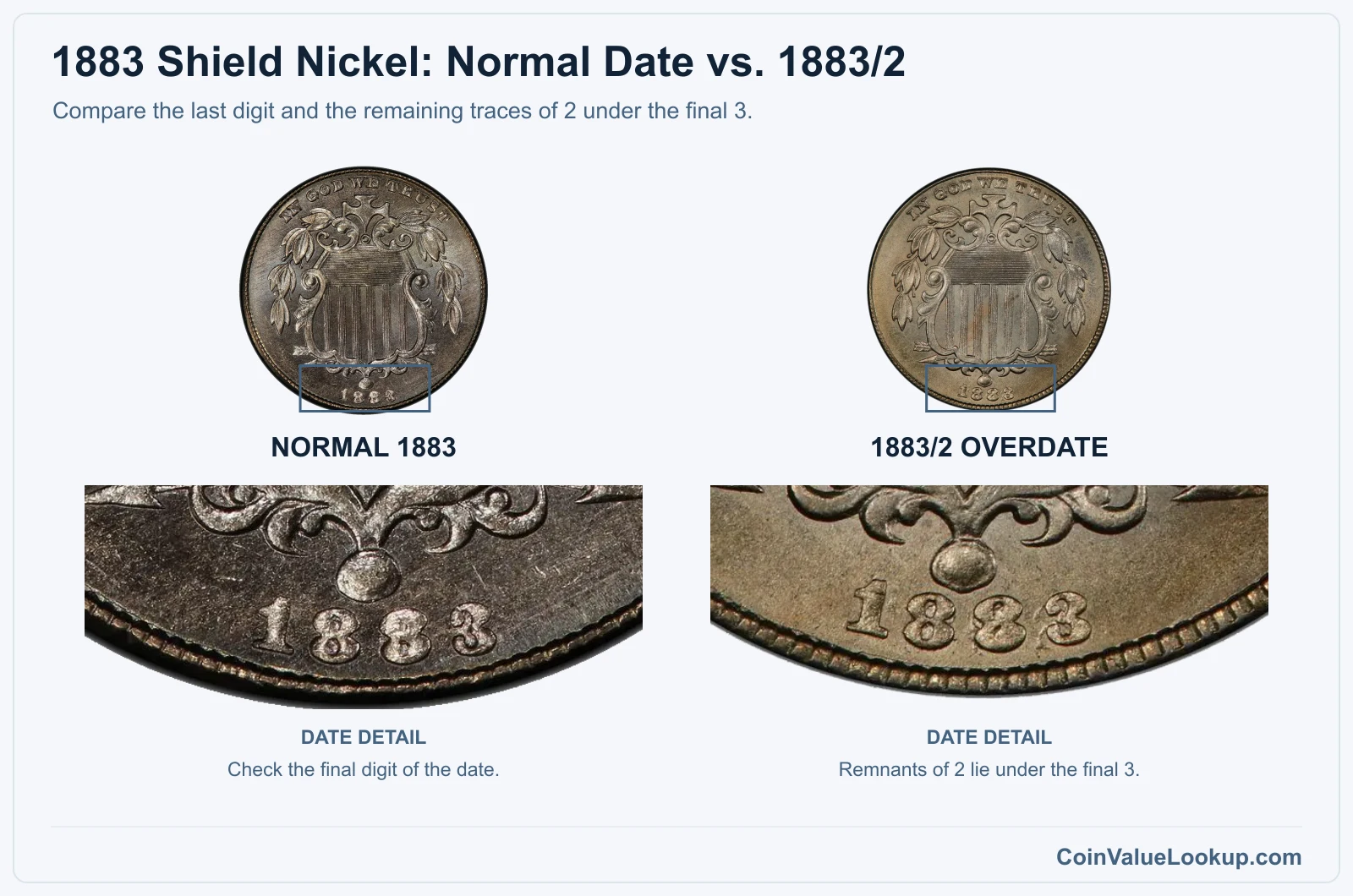
One key variety to watch for is the 1883/2 overdate, where a clear remnant of an underlying "2" shows beneath the final "3" in the date. Do not confuse a die crack running through the date or a filled numeral with an overdate — the 1883/2 requires a visible second digit, not just a blobby "3."
Step 2: Check Your 1883 Shield Nickel Grade
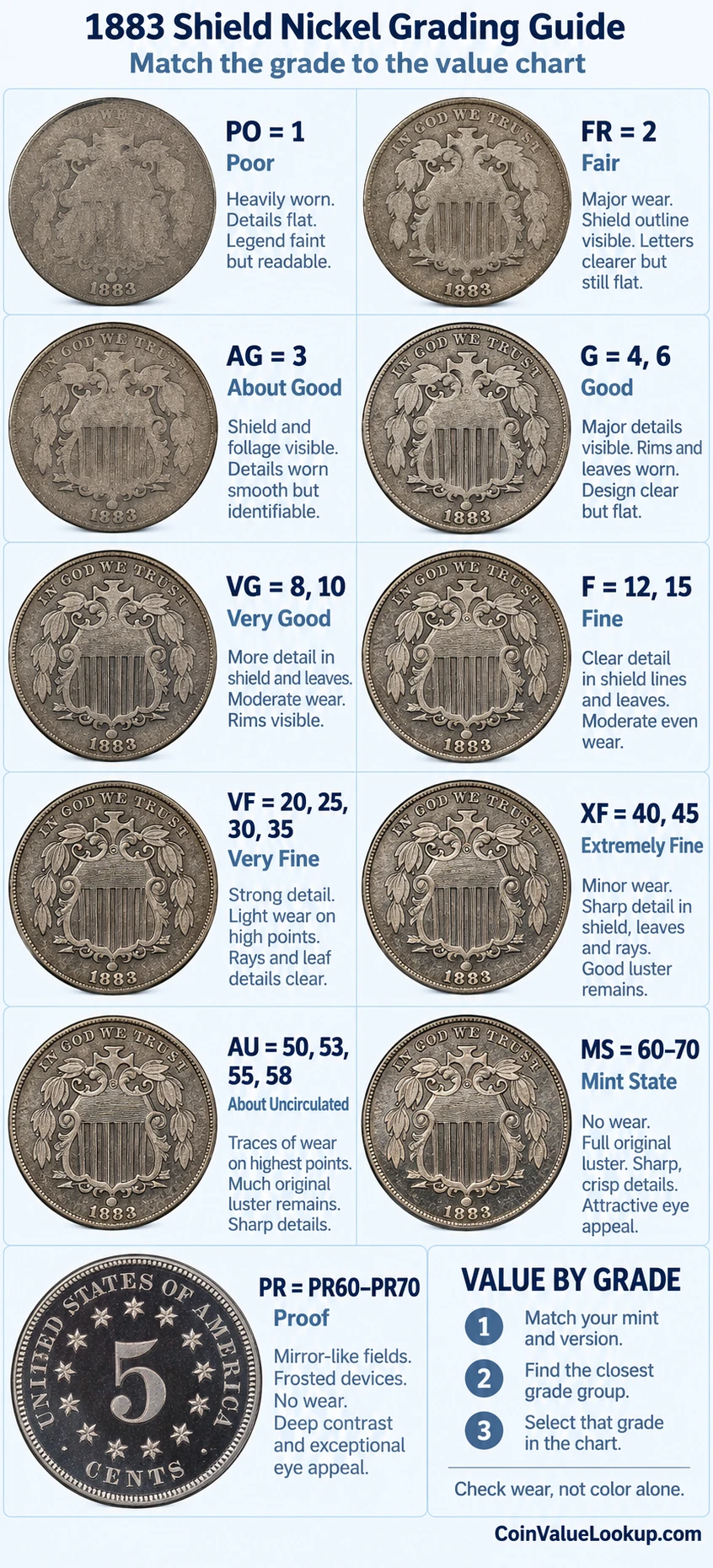
Start by examining the shield on the obverse. The horizontal and vertical lines of the shield are the first details to soften with wear, along with the cross at the top and the leaves at the base.
A coin grading G4 will have a flat shield with outlines visible but most internal detail gone. By MS63 the original luster should be intact across both sides with only minor contact marks.
Weak strikes are common on Shield Nickels. A soft strike can make the lines in the shield look worn even on a coin that never circulated, so check the luster and fields before assuming wear.
Proofs require a different eye. Look for reflective fields, sharp rims, and full design details.
Hairlines from old cleaning or mishandling reduce the grade. Compare your coin to the reference image to see how luster and detail should look at different conditions.
Cleaned or damaged coins fall outside standard grading and will sell for less. If your coin has been scrubbed, whizzed, or shows obvious scratches, factor that into any value estimate.
Step 3: Check 1883 Shield Nickel Value by Mint and Version
1883 Shield Nickel — No Mint Mark — Circulation Strike
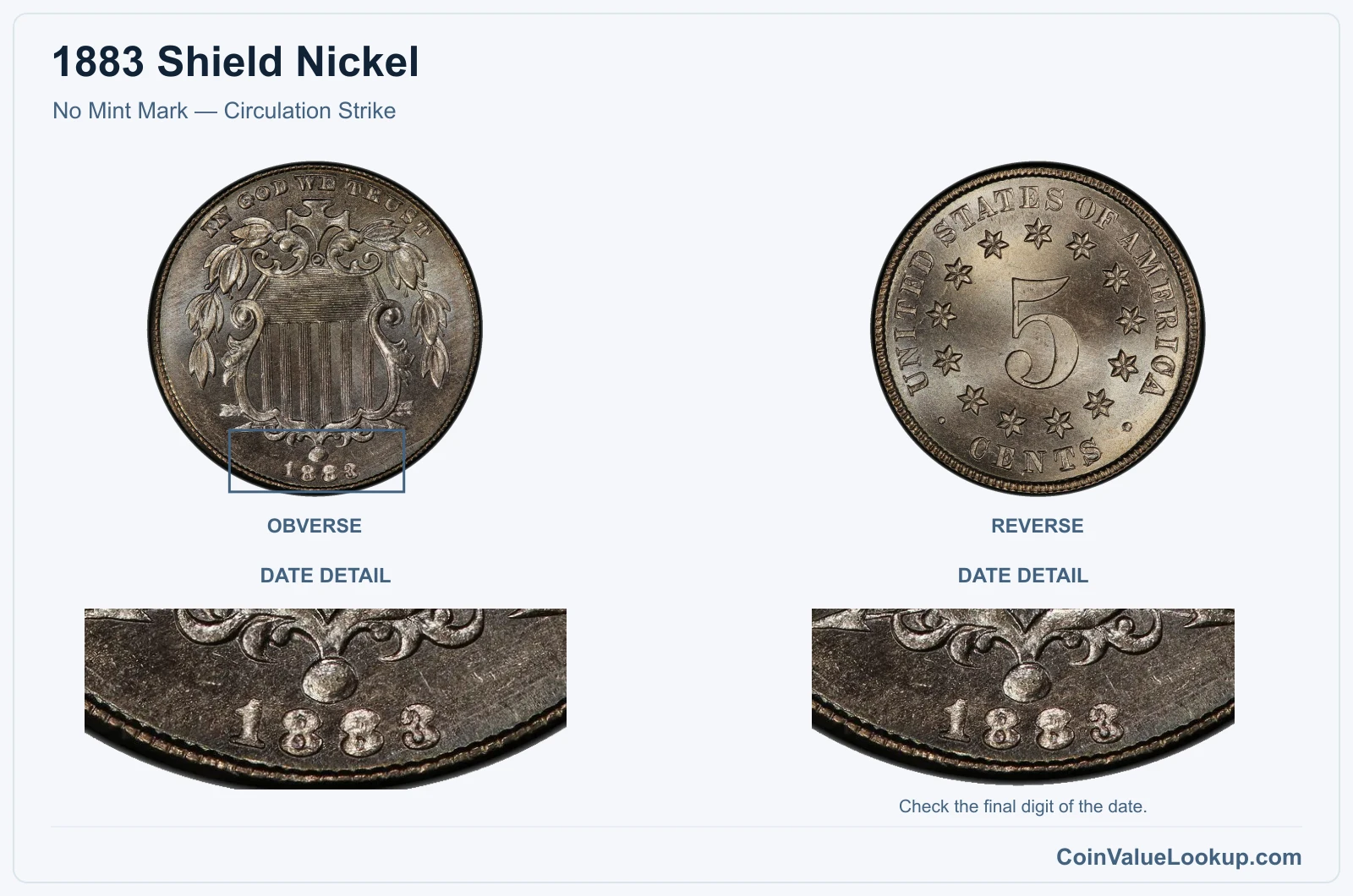
The standard 1883 Shield Nickel circulation strike is the most common version you will encounter. It was struck at Philadelphia with no mintmark, in the "No Rays" reverse style used from 1867 onward.
USA Coin Book estimates place this coin around $38 in G4 and about $281 in MS63. As the last year of the Shield series, it draws both date collectors finishing a set and type collectors wanting a single representative coin.
Original, problem-free surfaces make a real difference, especially at the upper grades where luster and eye appeal separate ordinary pieces from strong ones.
Range Grade
Price Auction Records Appraisal PO PO 1
—
Coin Identifier FR FR 2
—
Coin Identifier AG AG 3
—
Coin Identifier G G 4
—
Coin Identifier
G 6
—
Coin Identifier VG VG 8
—
Coin Identifier
VG 10
—
Coin Identifier F F 12
—
Coin Identifier
F 15
—
Coin Identifier VF VF 20
Coin Identifier
VF 25
—
Coin Identifier
VF 30
Coin Identifier
VF 35
Coin Identifier XF XF 40
Coin Identifier
XF 45
Coin Identifier AU AU 50
Coin Identifier
AU 53
Coin Identifier
AU 55
Coin Identifier
AU 58
Coin Identifier MS MS 60
Coin Identifier
MS 61
Coin Identifier
MS 62
Coin Identifier
MS 63
Coin Identifier
MS 64
Coin Identifier
MS 65
Coin Identifier
MS 66
Coin Identifier
MS 67
Coin Identifier
MS 68
—
—
—
MS 69
—
—
—
MS 70
—
—
—
1883 Shield Nickel — No Mint Mark — Proof
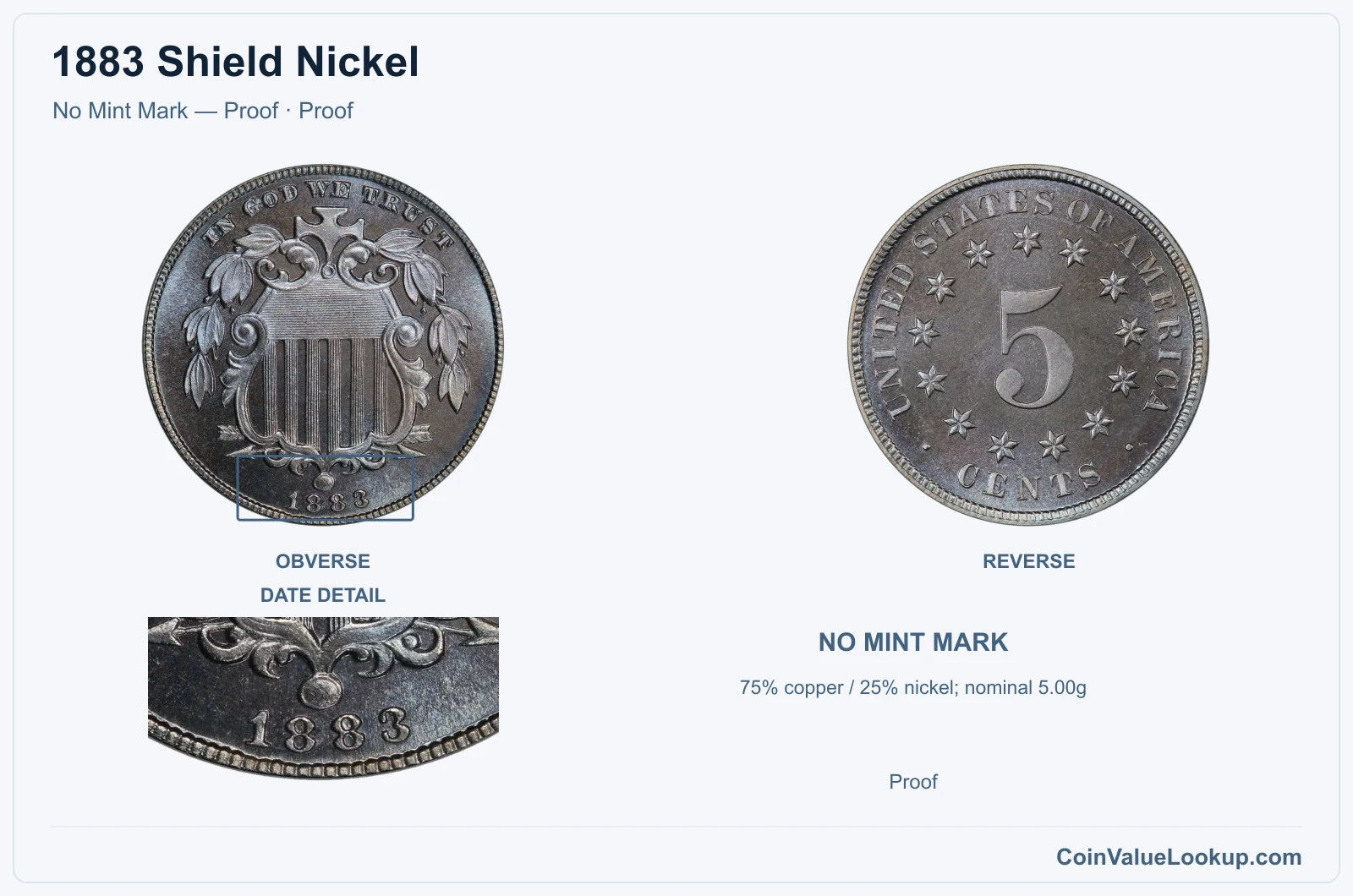
Philadelphia produced proof Shield Nickels for collectors in 1883. Look for deeply mirrored fields, sharp squared-off rims, and crisp detail in the shield lines and reverse stars that go beyond what even a fresh business strike shows.
The USA Coin Book guide estimate for PR63 is $468. Distinguishing a proof from a well-struck business strike can be tricky — compare rim sharpness and field reflectivity on both sides.
Hairlines from improper storage or old wipe-downs will drag the grade down. If you are looking up other coin values while researching this one, Coin Value Lookup is a handy starting point for browsing guides across many series and years.
Range Grade
Price Auction Records Appraisal PR PR 1
—
Coin Identifier
PR 2
—
Coin Identifier
PR 3
—
Coin Identifier
PR 4
—
Coin Identifier
PR 6
—
Coin Identifier
PR 8
—
Coin Identifier
PR 10
—
Coin Identifier
PR 12
—
Coin Identifier
PR 15
—
Coin Identifier
PR 20
—
Coin Identifier
PR 25
—
Coin Identifier
PR 30
—
Coin Identifier
PR 35
—
Coin Identifier
PR 40
—
Coin Identifier
PR 45
—
Coin Identifier
PR 50
—
Coin Identifier
PR 53
—
Coin Identifier
PR 55
—
Coin Identifier
PR 58
Coin Identifier
PR 60
—
Coin Identifier
PR 61
Coin Identifier
PR 62
Coin Identifier
PR 63
Coin Identifier
PR 64
Coin Identifier
PR 65
Coin Identifier
PR 66
Coin Identifier
PR 67
Coin Identifier
PR 68
Coin Identifier
PR 69
—
—
—
PR 70
—
—
—
1883 Shield Nickel — No Mint Mark — 1883/2
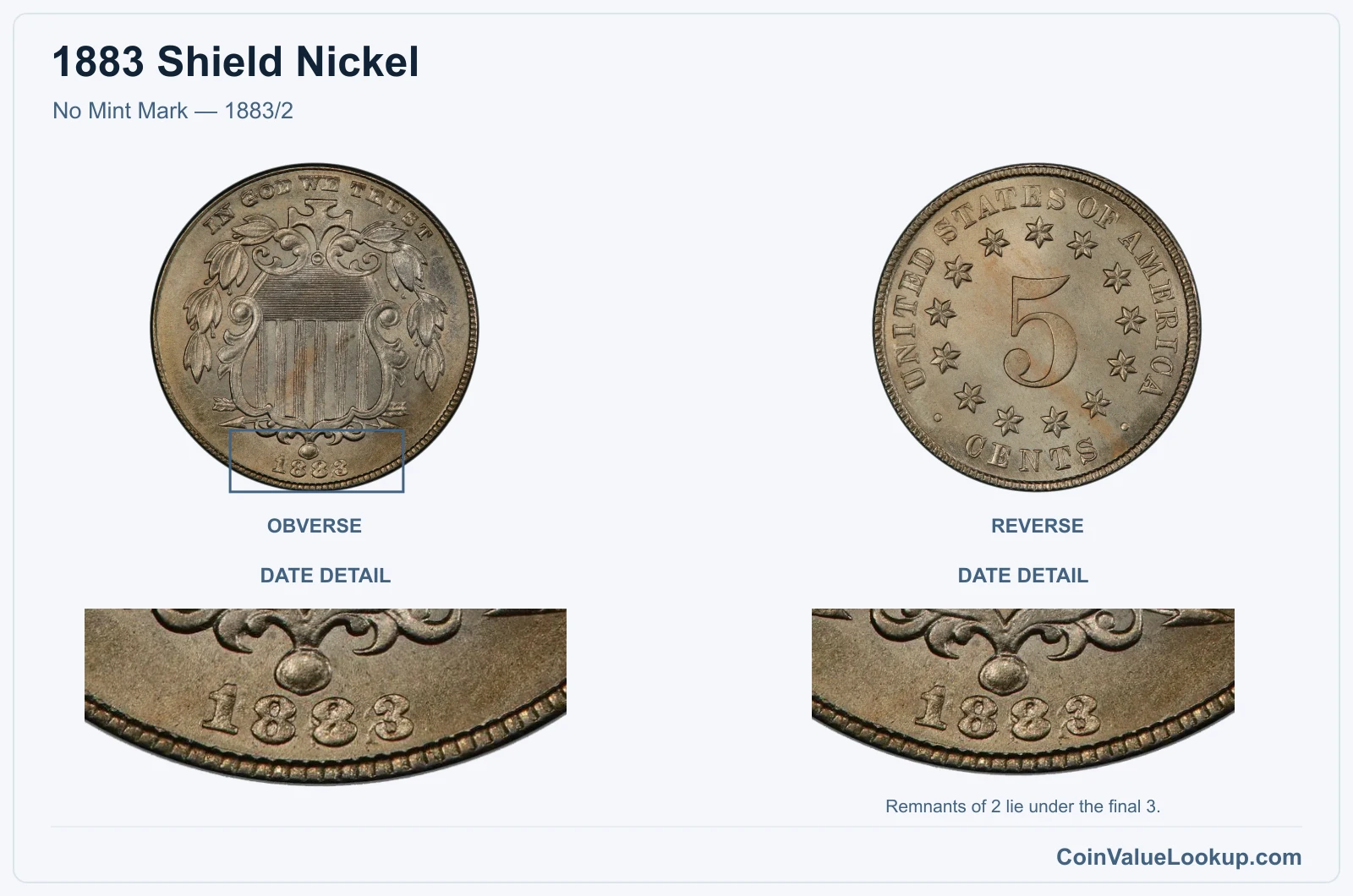
The 1883/2 overdate is the major variety for the year and one of only two recognized overdates in the entire Shield Nickel series. It was created when a die originally hubbed or punched with an 1882 date was re-entered with 1883 digits, leaving traces of the underlying "2" visible beneath the final "3."
To confirm it, examine the last digit of the date under magnification. You should see a clear remnant of a "2" — typically its curved lower portion — peeking out from behind the "3." A die crack passing through the date, or a filled-in numeral from grease or die wear, does not qualify.
USA Coin Book guide estimates put this variety around $313 in G4 and approximately $3,085 in MS63. That is a substantial jump over the normal date, which is why careful attribution matters.
Specialists have cataloged multiple die states, but the core diagnostic is always that visible underlying "2."
Range Grade
Price Auction Records Appraisal PO PO 1
—
Coin Identifier FR FR 2
—
Coin Identifier AG AG 3
—
Coin Identifier G G 4
—
Coin Identifier
G 6
—
Coin Identifier VG VG 8
Coin Identifier
VG 10
Coin Identifier F F 12
—
Coin Identifier
F 15
Coin Identifier VF VF 20
—
Coin Identifier
VF 25
—
Coin Identifier
VF 30
—
Coin Identifier
VF 35
—
Coin Identifier XF XF 40
Coin Identifier
XF 45
Coin Identifier AU AU 50
Coin Identifier
AU 53
Coin Identifier
AU 55
Coin Identifier
AU 58
Coin Identifier MS MS 60
Coin Identifier
MS 61
Coin Identifier
MS 62
Coin Identifier
MS 63
Coin Identifier
MS 64
Coin Identifier
MS 65
Coin Identifier
MS 66
Coin Identifier
MS 67
—
—
—
MS 68
—
—
—
MS 69
—
—
—
MS 70
—
—
—
1883 Shield Nickel Error List
1. 1883 Shield Nickel — Doubled Die Obverse
Doubled die obverse varieties have been reported for the 1883 Shield Nickel. On a genuine doubled die, you will see consistent separation or notching on the obverse lettering or design elements — the doubling appears in the same direction and magnitude across multiple features because it originated in the die-making process.
To check, compare the obverse legends and date numerals against a normal 1883 under the same lighting. Look for a second image slightly offset from the primary design.
Machine doubling, which is flat and shelf-like rather than rounded and separated, is a common lookalike that carries little or no premium. Reflections from worn dies can also mimic doubling at first glance.
No specific price data is available for this variety. The value of any doubled die depends heavily on the strength of the doubling, which specific die pair produced it, and the coin's overall condition.
2. 1883 Shield Nickel — Repunched Date
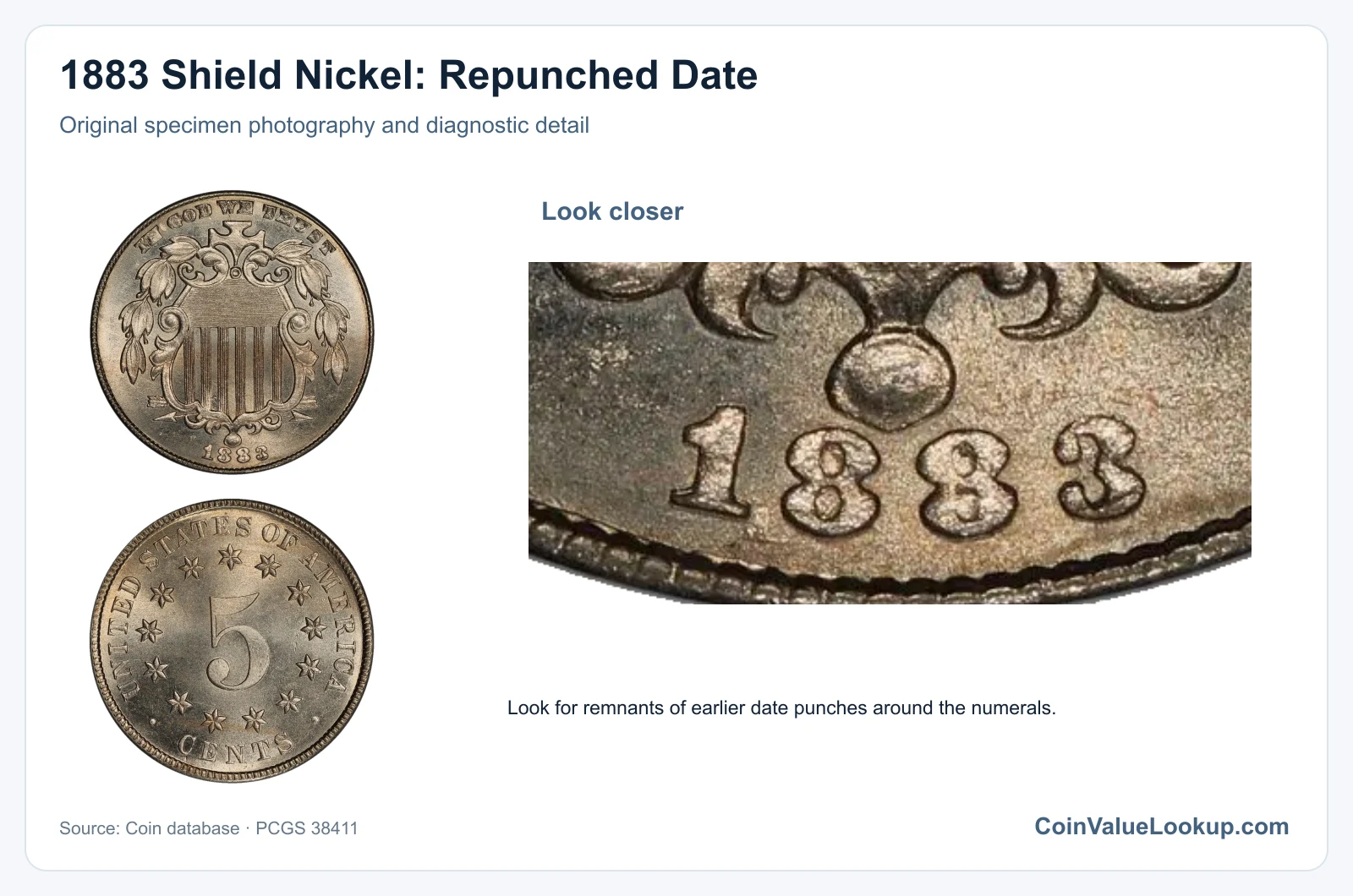
Repunched dates on the 1883 Shield Nickel show remnants of an earlier punch position next to the final date numerals. This happened when the date was physically punched into the working die and the first impression did not land in exactly the right spot, so a second strike was needed.
Look for traces of displaced digits — a ghost outline of a numeral slightly offset from its final position. This is different from a doubled die, which affects the entire obverse design, not just the date.
It is also different from the 1883/2 overdate, which shows a different digit entirely.
Damaged dates from post-mint hits, and flat machine doubling shelves, are the main lookalikes. No specific price data is available for this category.
Value depends on the clarity of the repunching, the specific die involved, and overall coin condition.
3. 1883 Shield Nickel — Die Crack / Die Chip
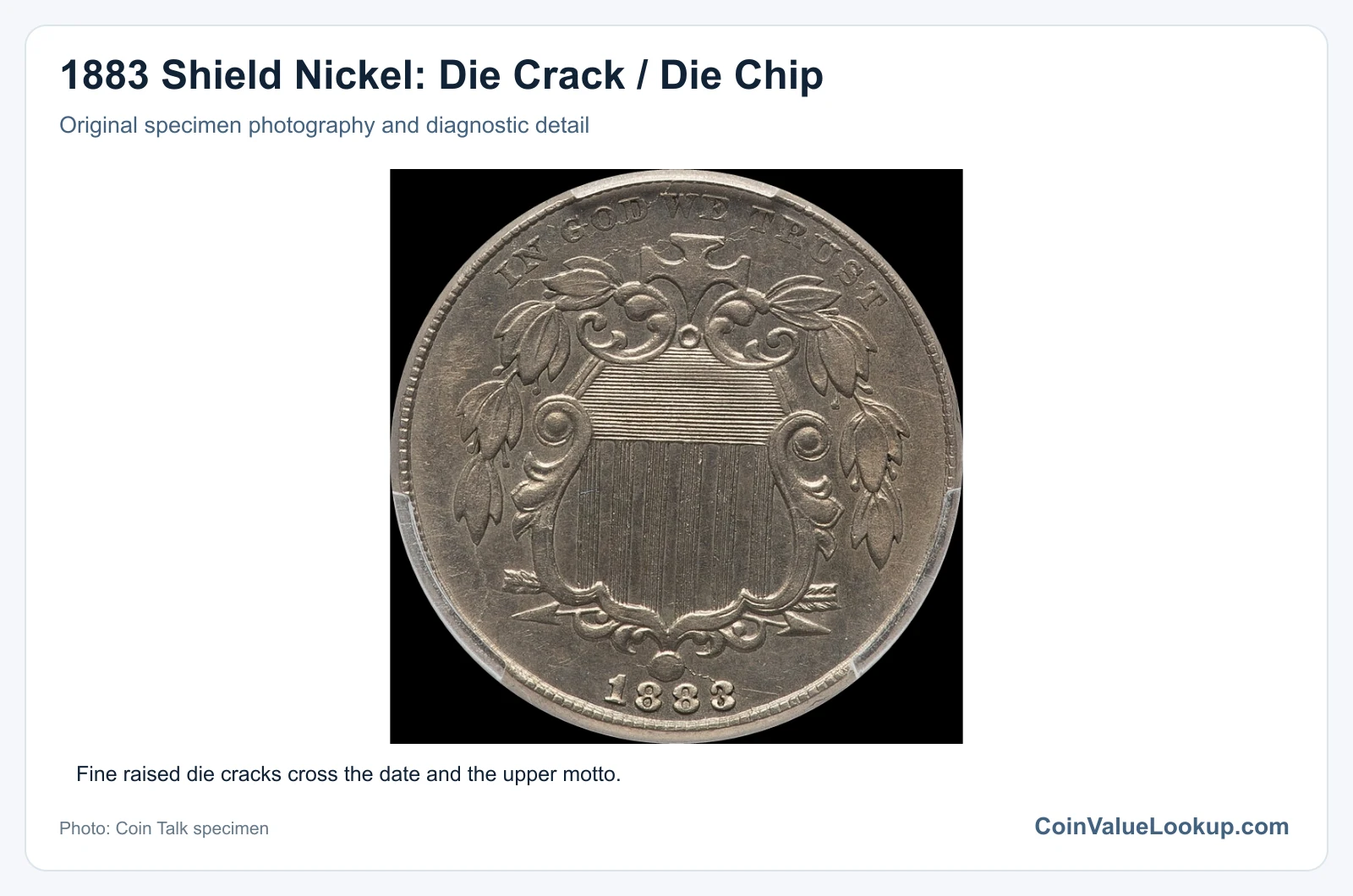
Die cracks and die chips are common on 1883 Shield Nickels because the hard copper-nickel alloy wore dies down quickly. A die crack appears as a thin raised line on the coin's surface — raised because the crack in the die created a recessed channel that metal flowed into during striking.
Die chips look like small raised blobs where a tiny piece of the die surface broke away. Both features can appear anywhere on the coin.
An interior chip stays within the design area, while a crack connecting to the rim edges toward cud territory.
Do not confuse die cracks with incuse scratches, which are recessed into the surface rather than raised. Corrosion pitting and foreign material stuck to a coin can also mimic small chips.
No specific price data is available; value depends on the crack's size, location, visual drama, and the coin's overall grade.
4. 1883 Shield Nickel — Die Break / Cud
A cud is a raised, featureless blob that connects to the rim of the coin. It forms when a chunk of the die breaks away entirely, leaving a void that fills with metal during striking.
The displaced design beneath the cud is gone — replaced by a smooth, raised lump.
To identify one, look at the rim area for any section where the normal design abruptly stops and a flat raised mass takes over, blending into the rim. The boundary between the cud and the surviving design should be sharp and distinct.
Rim dents from post-mint damage are recessed, not raised, so they are easy to separate once you know the difference. Corrosion near the rim can build up material, but it will lack the smooth, uniform appearance of a true cud.
Interior die chips that do not touch the rim are a related but separate category. No specific price data is available for cuds on this date; value varies with size, location, and the coin's condition.