1901 Barber Quarter Coin Value: How Much Is It Worth?
The 1901 Barber Quarter is a coin worth studying before you sell or toss it in a junk-silver pile. Guide estimates range from $21.00 to $62,630.00 depending on which mint struck your coin and what condition it survives in.
That is not one price for every piece — the mint, finish and grade determine where your quarter falls.
Fast Way to Identify Your 1901 Barber Quarter
The quickest way to start figuring out what you have is to snap clear photos of both sides of your coin and upload them here for a preliminary identification. Good lighting and a steady hand help.
This step can narrow down the mint, version and approximate condition so you know which part of the guide to look at.
1901 Barber Quarter Value
Upload both sides of your 1901 Barber Quarter.
Front Obverse
Upload photo
Back Reverse
Upload photo
Which 1901 Barber Quarter Versions Are Worth Money?
- 1901-S quarters command the highest guide values in this year, with estimates reaching $62,630.00 at MS63 — the San Francisco mint is the key date to check for.
- 1901-O (New Orleans) quarters carry guide estimates up to $3,328.00 at MS63, far above the Philadelphia issue at the same grade.
- 1901 Proof quarters, struck at Philadelphia with a proof finish, have a guide estimate of $799.00 at PR63 — a different manufacturing process from regular strikes.
Step 1: Identify Your 1901 Barber Quarter Mint Mark and Version
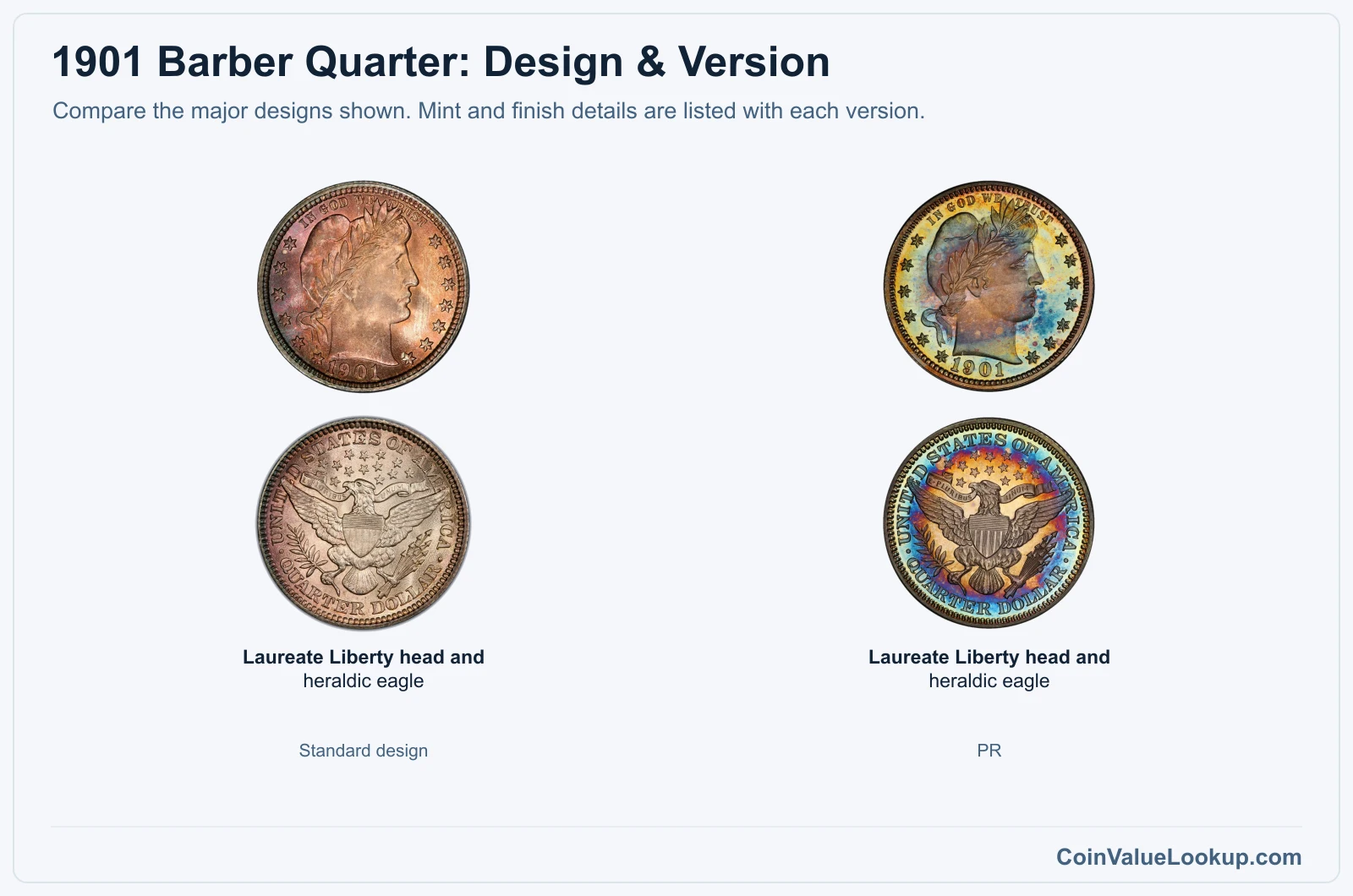
Every 1901 Barber Quarter carries the same basic design: a laureate Liberty head on the obverse and a heraldic eagle on the reverse. The coin is struck in 90% silver and 10% copper, weighing 6.25 grams.
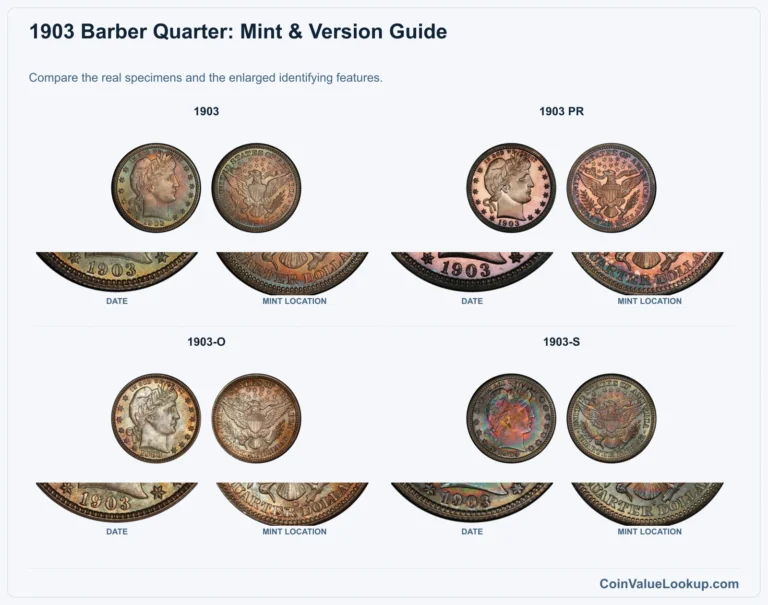
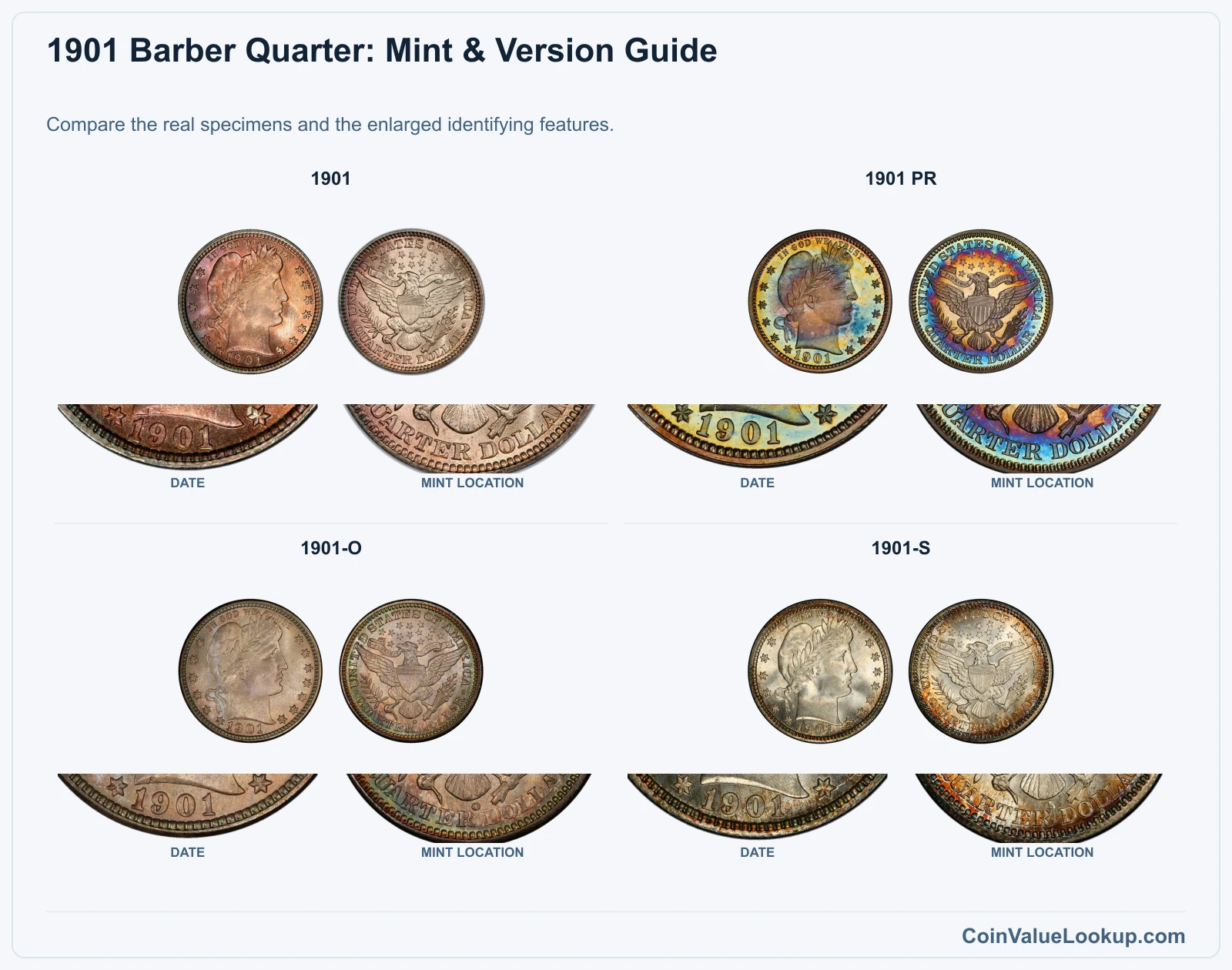
To identify which branch you hold, flip to the reverse. Look below the eagle's tail feathers and above the words QUARTER DOLLAR for a small mintmark letter.
No letter means Philadelphia. An "O" means New Orleans, and an "S" means San Francisco.
Four collectible branches exist for 1901: the Philadelphia business strike, the Philadelphia proof, the New Orleans business strike, and the San Francisco business strike. Get the mintmark right before you do anything else — the difference between a Philadelphia coin and a San Francisco coin in this year is enormous.
Step 2: Check Your 1901 Barber Quarter Grade
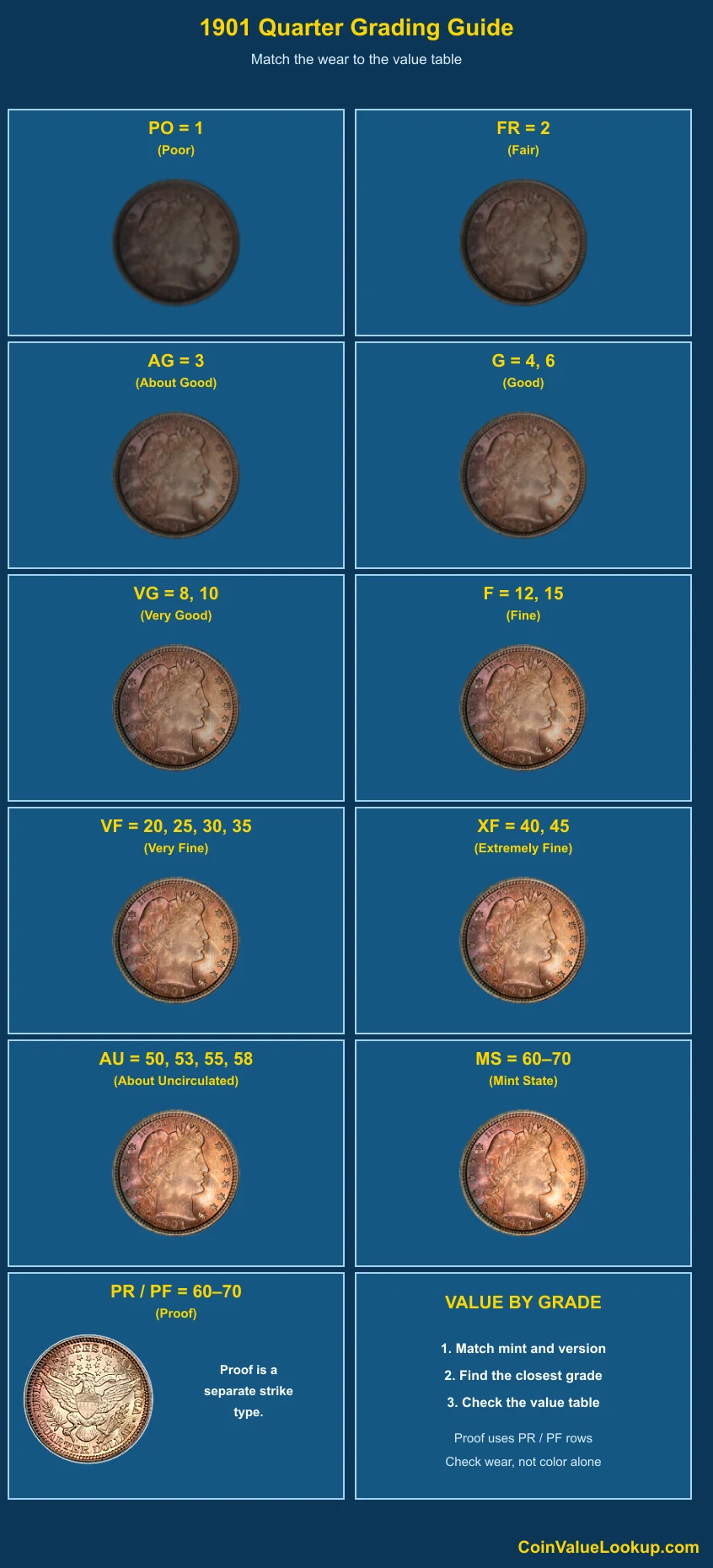
Start with the obverse. The first places to lose detail are the hair above Liberty's forehead, the cheek and the laurel wreath.
On the reverse, check the eagle's breast feathers, the tops of the wings and the tail feathers.
The word LIBERTY is stamped into a headband on the obverse. Its letters wear away progressively with circulation, and a coin showing all seven letters clearly is generally in better shape than one missing a few.
But do not rely on LIBERTY alone — look at overall wear and remaining luster together.
A weakly struck coin can look worn even if it never circulated. Compare your coin to the reference image to separate strike softness from actual wear.
Brightness from cleaning is not the same as original mint luster, and a cleaned coin typically carries a lower value than one with honest, original surfaces.
Step 3: Check 1901 Barber Quarter Value by Mint and Version
1901 Barber Quarter
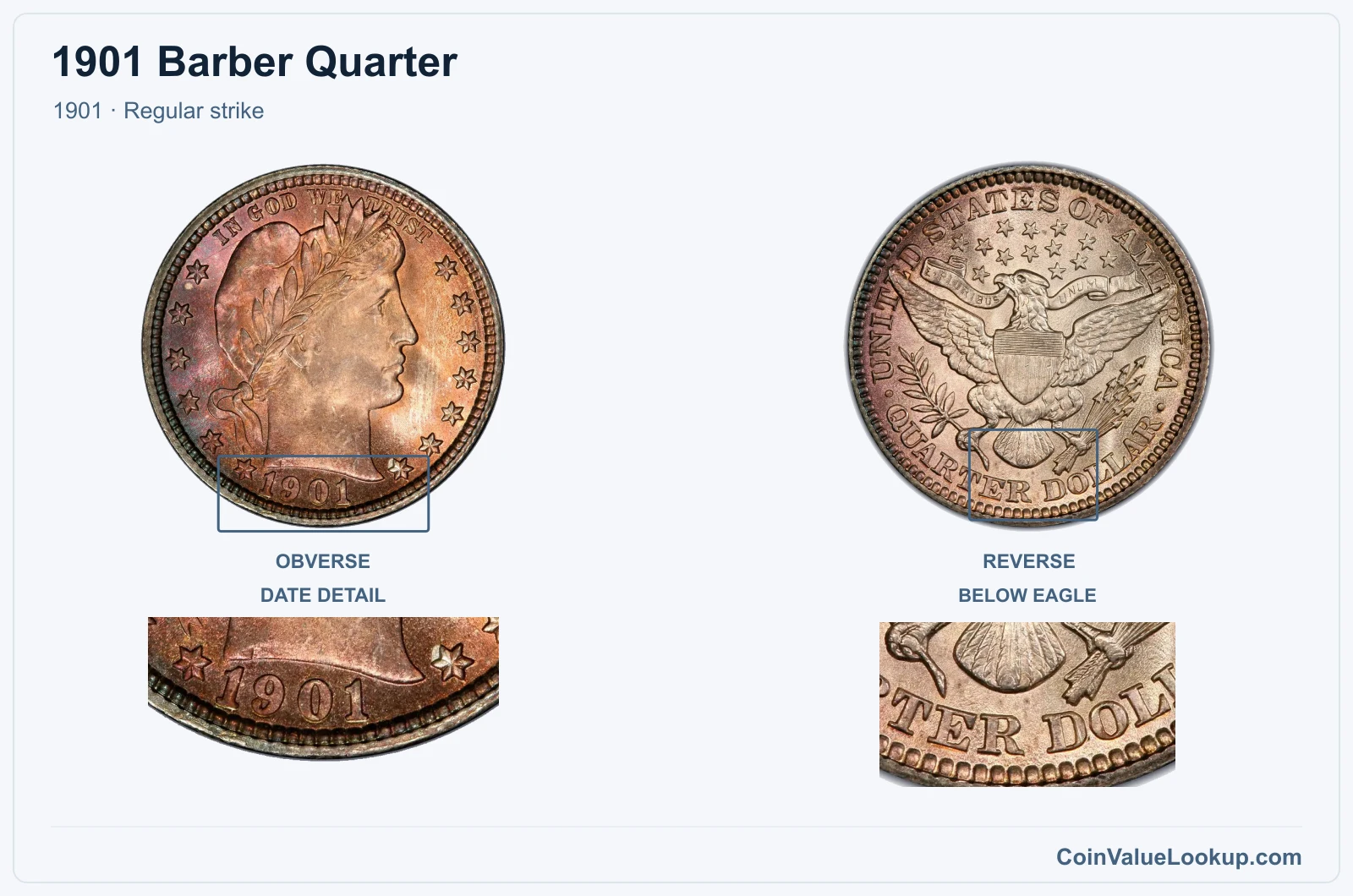
The 1901 Philadelphia business strike is the most common branch this year. It carries no mintmark — just a clean reverse below the eagle's tail.
USA Coin Book guide estimates place this version at about $21.00 in G4 (a heavily worn but readable coin), $353.00 in MS60 (uncirculated with contact marks) and $536.00 in MS63 (a nicer uncirculated example). These are guide estimates, not guaranteed sale prices.
Original surfaces matter. Cleaning or damage pulls the value down, sometimes sharply, even on a coin that otherwise grades well.
Range Grade
Price Auction Records Appraisal PO PO 1
Coin Identifier FR FR 2
—
Coin Identifier AG AG 3
—
Coin Identifier G G 4
—
Coin Identifier
G 6
—
Coin Identifier VG VG 8
Coin Identifier
VG 10
—
Coin Identifier F F 12
—
Coin Identifier
F 15
Coin Identifier VF VF 20
—
Coin Identifier
VF 25
Coin Identifier
VF 30
Coin Identifier
VF 35
Coin Identifier XF XF 40
Coin Identifier
XF 45
Coin Identifier AU AU 50
Coin Identifier
AU 53
Coin Identifier
AU 55
Coin Identifier
AU 58
Coin Identifier MS MS 60
Coin Identifier
MS 61
Coin Identifier
MS 62
Coin Identifier
MS 63
Coin Identifier
MS 64
Coin Identifier
MS 65
Coin Identifier
MS 66
Coin Identifier
MS 67
Coin Identifier
MS 68
—
—
—
MS 69
—
—
—
MS 70
—
—
—
1901 Barber Quarter — PR
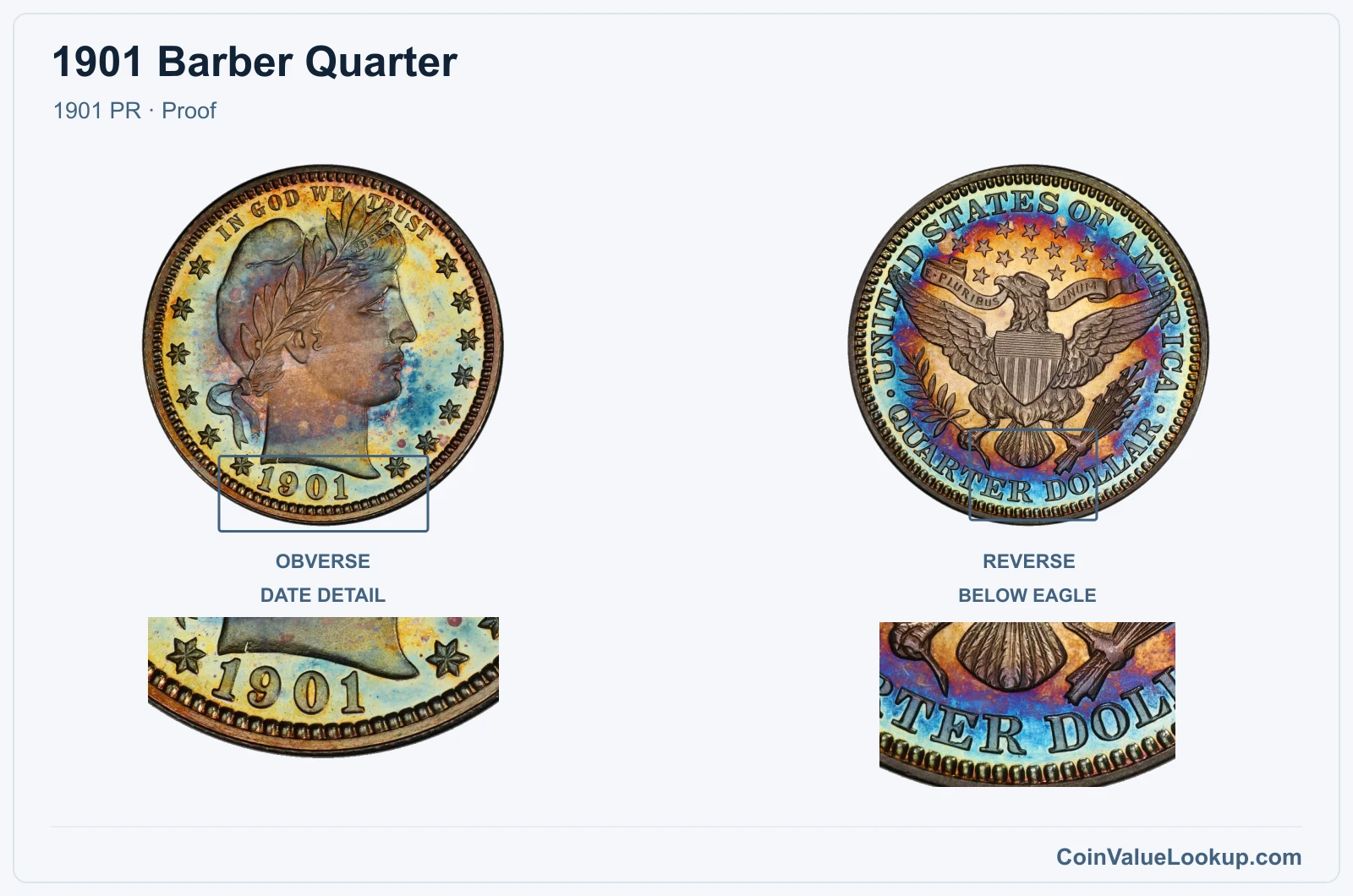
The 1901 Proof was produced at Philadelphia as a collector issue using polished dies and planchets. These are not just shiny business strikes — proofs have a distinct mirrored surface and sharper detail from the manufacturing process.
The USA Coin Book guide estimate for a PR63 example is $799.00. Surface haze, hairlines from improper storage and fingerprint residue all affect proof values.
If your coin has brilliant mirror fields but also visible hairlines, that is typical of a lower-grade proof rather than a high-end one. Do not assume a proof based on brightness alone; a business strike dipped in cleaner can mimic that look.
Range Grade
Price Auction Records Appraisal PR PR 1
—
Coin Identifier
PR 2
—
Coin Identifier
PR 3
—
Coin Identifier
PR 4
—
Coin Identifier
PR 6
—
Coin Identifier
PR 8
—
Coin Identifier
PR 10
—
Coin Identifier
PR 12
—
Coin Identifier
PR 15
—
Coin Identifier
PR 20
—
Coin Identifier
PR 25
—
Coin Identifier
PR 30
—
Coin Identifier
PR 35
—
Coin Identifier
PR 40
—
Coin Identifier
PR 45
—
Coin Identifier
PR 50
—
Coin Identifier
PR 53
—
Coin Identifier
PR 55
—
Coin Identifier
PR 58
Coin Identifier
PR 60
—
Coin Identifier
PR 61
Coin Identifier
PR 62
Coin Identifier
PR 63
Coin Identifier
PR 64
Coin Identifier
PR 65
Coin Identifier
PR 66
Coin Identifier
PR 67
Coin Identifier
PR 68
Coin Identifier
PR 69
—
—
—
PR 70
—
—
—
1901 Barber Quarter — O
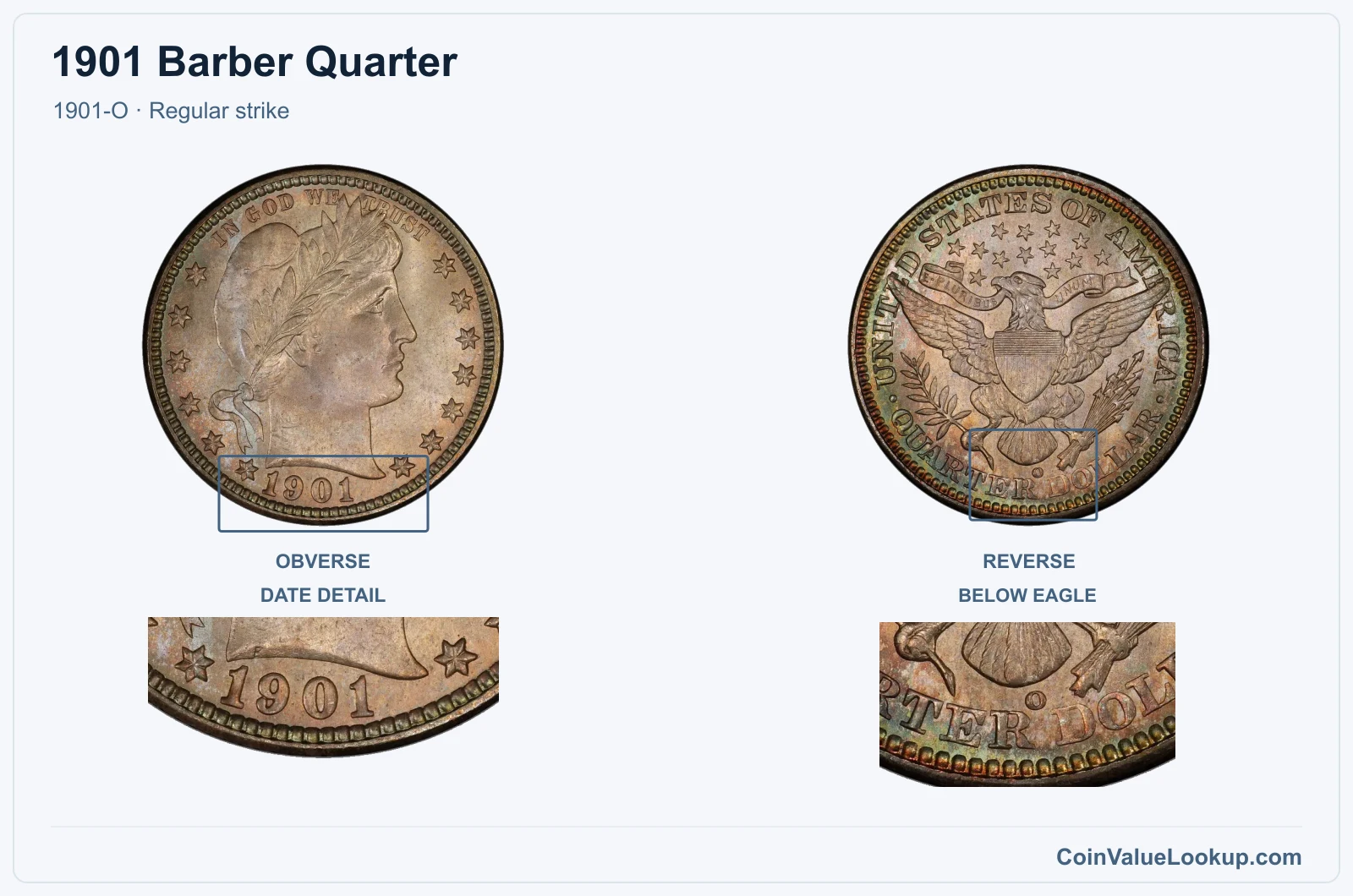
The 1901-O was struck at the New Orleans Mint and carries a small "O" mintmark on the reverse below the eagle's tail. This version is considerably scarcer than its Philadelphia counterpart in higher grades.
USA Coin Book guide estimates: $82.00 in G4, $2,350.00 in MS60 and $3,328.00 in MS63. That jump from a worn coin to an uncirculated one is steep, which tells you surviving mint-state examples are tough to find.
Coin Value Lookup is a useful starting point if you want to look up other dates or denominations in the Barber Quarter series. It can help you compare values across years so you know where your coin fits in the broader picture.
Range Grade
Price Auction Records Appraisal PO PO 1
—
Coin Identifier FR FR 2
—
Coin Identifier AG AG 3
Coin Identifier G G 4
Coin Identifier
G 6
Coin Identifier VG VG 8
Coin Identifier
VG 10
Coin Identifier F F 12
Coin Identifier
F 15
Coin Identifier VF VF 20
Coin Identifier
VF 25
Coin Identifier
VF 30
Coin Identifier
VF 35
Coin Identifier XF XF 40
Coin Identifier
XF 45
Coin Identifier AU AU 50
Coin Identifier
AU 53
Coin Identifier
AU 55
Coin Identifier
AU 58
Coin Identifier MS MS 60
—
Coin Identifier
MS 61
Coin Identifier
MS 62
Coin Identifier
MS 63
Coin Identifier
MS 64
Coin Identifier
MS 65
Coin Identifier
MS 66
Coin Identifier
MS 67
Coin Identifier
MS 68
—
—
—
MS 69
—
—
—
MS 70
—
—
—
1901 Barber Quarter — S
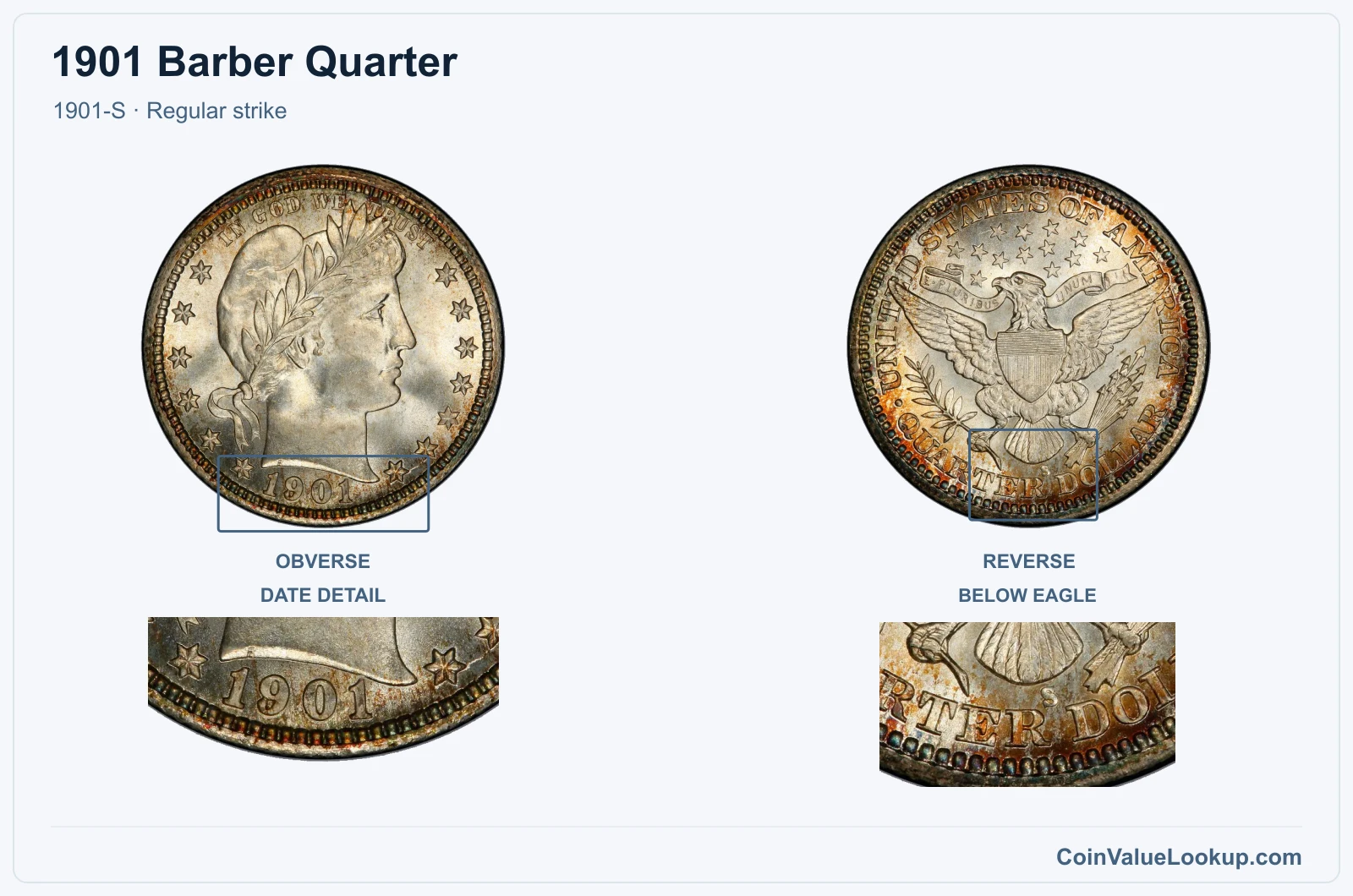
This is the one that makes collectors sit up. The 1901-S, struck at the San Francisco Mint with an "S" mintmark, is a genuine key date in the Barber Quarter series.
Even in G4 — a well-worn coin where Liberty's head is mostly flat — the USA Coin Book guide estimate is $4,952.00. In MS60 that climbs to $49,993.00, and at MS63 the guide figure reaches $62,630.00.
Those numbers reflect real scarcity across all grades. If you find an "S" below the eagle's tail on a 1901 quarter, handle it carefully.
Original surfaces are critical at these levels. Cleaning, scratches or rim damage can dramatically reduce what a collector is willing to pay.
Get it authenticated by a reputable grading service before making any decisions.
Range Grade
Price Auction Records Appraisal PO PO 1
Coin Identifier FR FR 2
Coin Identifier AG AG 3
Coin Identifier G G 4
Coin Identifier
G 6
Coin Identifier VG VG 8
Coin Identifier
VG 10
Coin Identifier F F 12
Coin Identifier
F 15
Coin Identifier VF VF 20
Coin Identifier
VF 25
Coin Identifier
VF 30
Coin Identifier
VF 35
Coin Identifier XF XF 40
Coin Identifier
XF 45
Coin Identifier AU AU 50
Coin Identifier
AU 53
Coin Identifier
AU 55
Coin Identifier
AU 58
Coin Identifier MS MS 60
—
Coin Identifier
MS 61
—
Coin Identifier
MS 62
Coin Identifier
MS 63
Coin Identifier
MS 64
Coin Identifier
MS 65
Coin Identifier
MS 66
Coin Identifier
MS 67
Coin Identifier
MS 68
Coin Identifier
MS 69
—
—
—
MS 70
—
—
—
1901 Barber Quarter Error List
1. 1901 Barber Quarter — Doubled Die
A doubled die on a 1901 Barber Quarter shows consistent design separation — elements of the design appear slightly duplicated in a uniform direction. This is different from a blurry or mushy look.
Compare the lettering, date numerals and Liberty's profile against a normal coin. On a genuine doubled die, you should see notching or a secondary image that repeats in the same way across multiple design elements.
The tricky part is separating this from machine doubling, which is a post-strike shelf-like distortion that carries little to no premium. Reflections from worn dies or post-mint impressions can also fool you.
Condition and the strength of the doubling both affect what a doubled die example might bring, but no specific price is established here.
2. 1901 Barber Quarter — Repunched Date
A repunched date on a 1901 quarter means the date numerals were punched into the working die more than once, with the second impression slightly offset from the first. Look closely at the 1, 9, 0 and 1 — remnants of an earlier punch position may appear as a ghost image beside or beneath the final digits.
This is a die variety, not a striking error, which means every coin from that die carries the same feature. Do not confuse it with a damaged date from post-mint hits or machine doubling, which tends to show flat, shelf-like displacement rather than distinct secondary punch traces.
The value depends on how visible the repunching is and the coin's overall condition. No specific price is established for this variety here.
3. 1901 Barber Quarter — Off-Center Strike
An off-center strike happens when the planchet is not properly seated between the dies at the moment of striking. The result is a displaced design with an unstruck crescent of blank metal along one edge.
The farther off center the strike, the more dramatic the appearance.
For collector appeal, the date and enough design detail to identify the coin should still be visible — a 1901 Barber Quarter struck, say, 10% off center with a full date is more desirable than one struck 50% off center where you cannot tell what year it is. Do not confuse an off-center strike with a clipped planchet (a curved bite from the blank) or post-mint flattening from damage.
No specific price is established for this error here, as the degree of misalignment and the coin's condition both heavily influence value.