1910 Barber Quarter Coin Value: How Much Is It Worth?
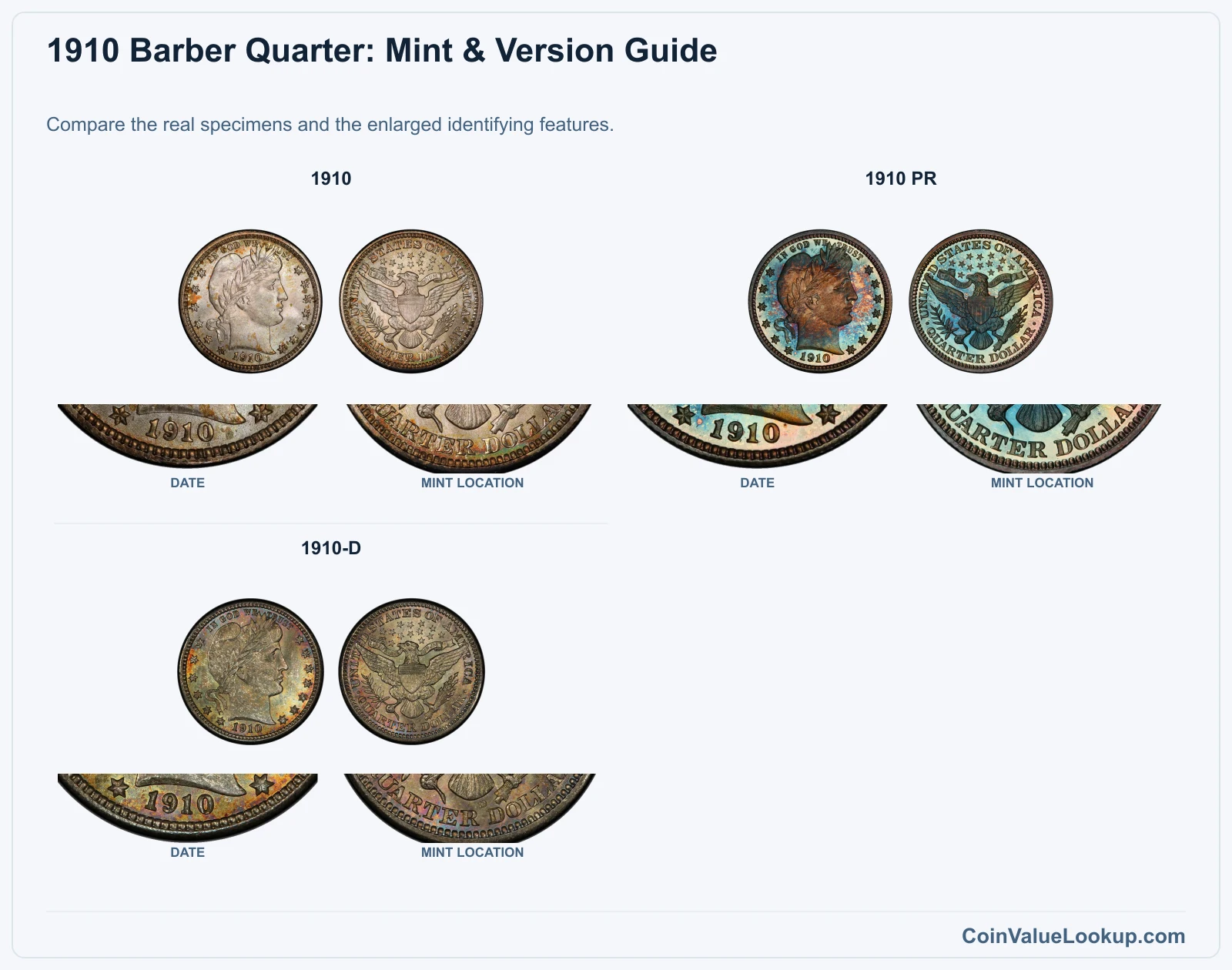
The 1910 Barber Quarter is a 90% silver coin that shows up in three collectible branches: the Philadelphia business strike, the Philadelphia proof, and the Denver mint issue. Guide estimates from USA Coin Book range from $21.00 to $1,007.00 depending on which version you hold and its condition.
Mint, finish, and grade each shift the number significantly.
Fast Way to Identify Your 1910 Barber Quarter
The quickest way to start figuring out what your 1910 quarter is worth is to upload clear photos of both the front and back. Our identifier can give you a preliminary read on the mint and version so you know which price column applies.
Good lighting and a sharp image of the reverse mintmark area help the most.
1910 Barber Quarter Value
Upload both sides of your 1910 Barber Quarter.
Front Obverse
Upload photo
Back Reverse
Upload photo
Which 1910 Barber Quarter Versions Are Worth Money?
- 1910-D in MS63 condition carries a USA Coin Book guide estimate of $1,007.00 — the Denver mint issue commands a premium in uncirculated grades.
- 1910 Proof (PR63) is listed at $799.00; these were struck exclusively at Philadelphia for collectors and are scarce survivors.
- 1910 Philadelphia business strike in MS63 is estimated at $477.00; even the common-mint version holds solid value when uncirculated.
- Always confirm the mintmark and finish before assuming you have a valuable version — wear, cleaning, or damage can sharply reduce what any of these are actually worth.
Step 1: Identify Your 1910 Barber Quarter Mint Mark and Version
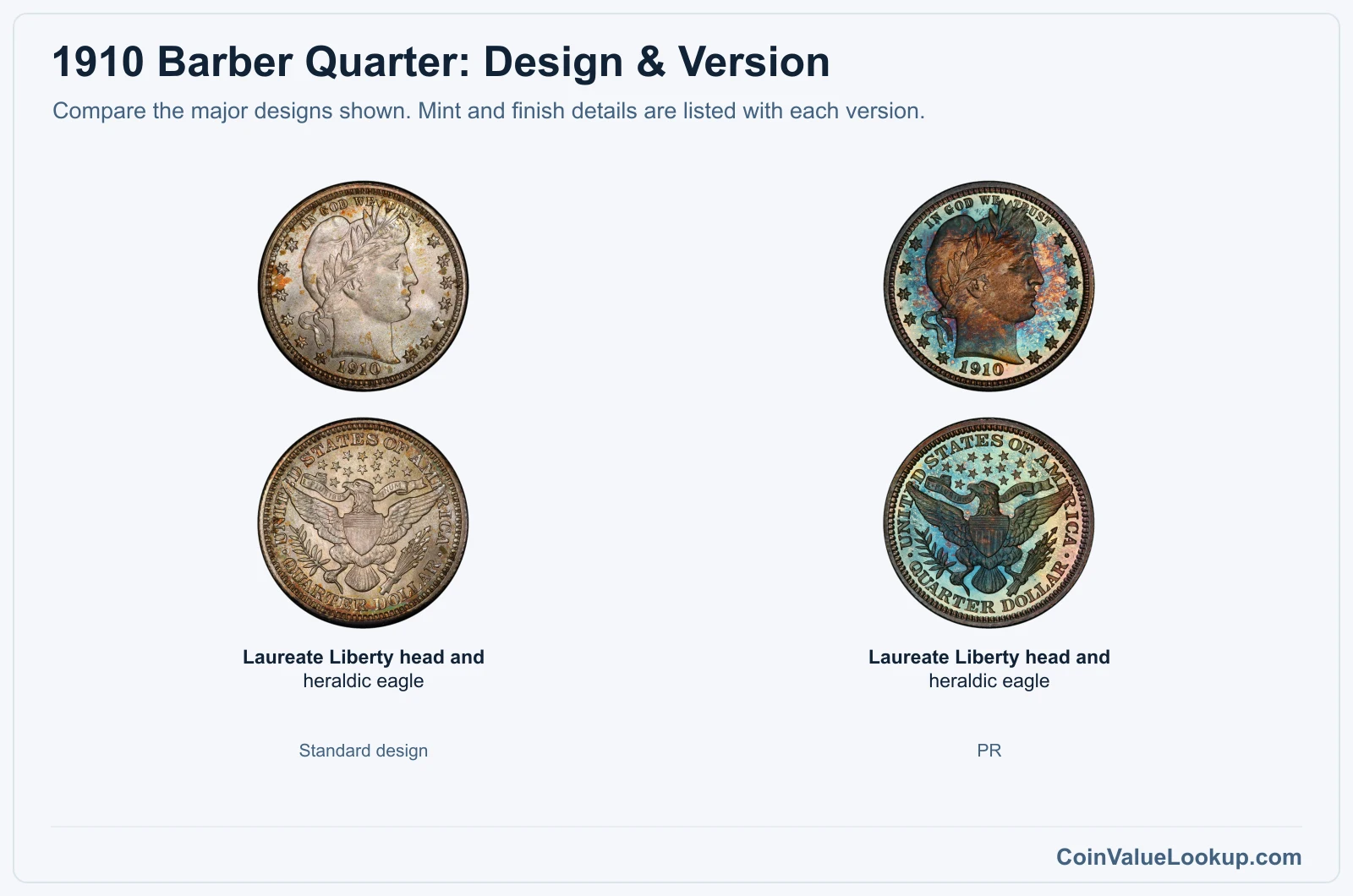
Flip the coin over. Below the eagle's tail feathers and above the words QUARTER DOLLAR, you are looking for a small letter.
No letter means Philadelphia. A "D" means Denver.
There was no San Francisco or New Orleans issue this year, so those are the only two mints in play.
Every 1910 Barber Quarter is struck in 90% silver and 10% copper, weighing 6.25 grams. The obverse shows Liberty wearing a laurel wreath and a Phrygian cap, with LIBERTY inscribed on a headband.
The reverse carries a heraldic eagle with a shield.
Philadelphia also produced proof strikes this year. A proof is not just a shiny coin — it was made with specially prepared dies and planchets for collectors.
If your coin has deeply mirrored fields and sharp, squared-off rims, it may be a proof, but confirmation usually requires professional grading.
Step 2: Check Your 1910 Barber Quarter Grade
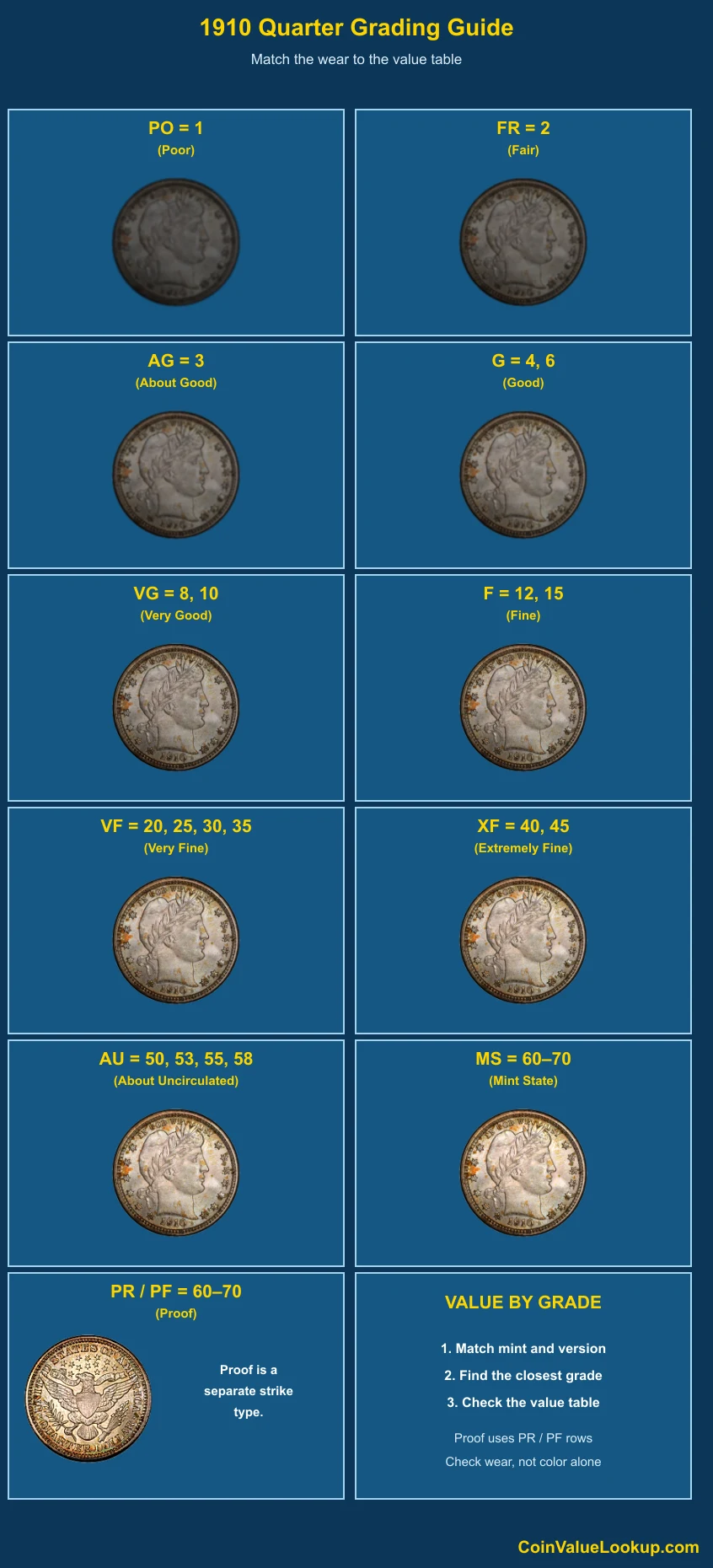
Start with the hair above Liberty's forehead and along the cheek. On a well-worn coin in Good-4 territory, those areas blend together and the headband letters disappear.
A mid-grade coin retains partial LIBERTY letters and some hair detail near the ear.
On the reverse, check the eagle's breast feathers, wing tips, and tail. These high points wear first.
An uncirculated coin keeps full luster across the fields with no rub on those features.
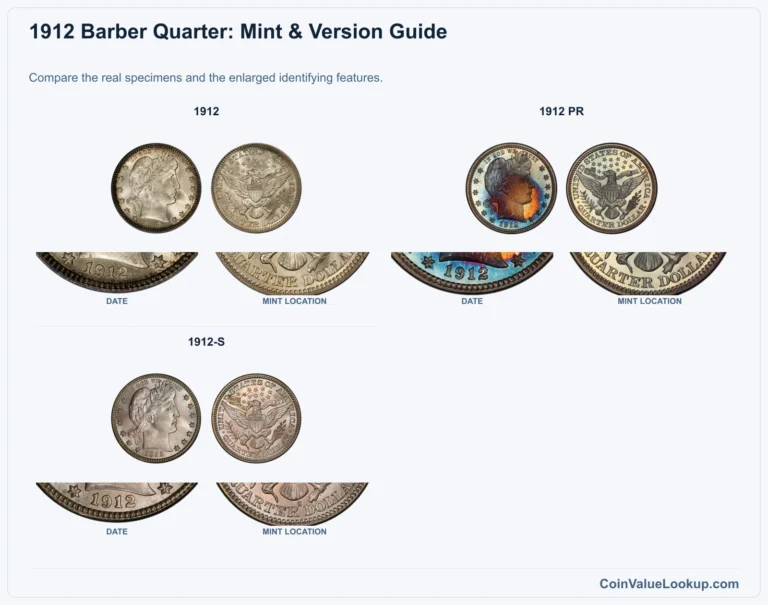
Use the comparison image to match your coin's overall look. Don't rely on the LIBERTY headband alone — a weakly struck coin can show mushy letters even without wear.
Look at luster alongside detail. A coin that's been cleaned may appear bright but will show tiny hairlines under magnification, and that lowers its collector value compared to original surfaces.
Step 3: Check 1910 Barber Quarter Value by Mint and Version
1910 Barber Quarter
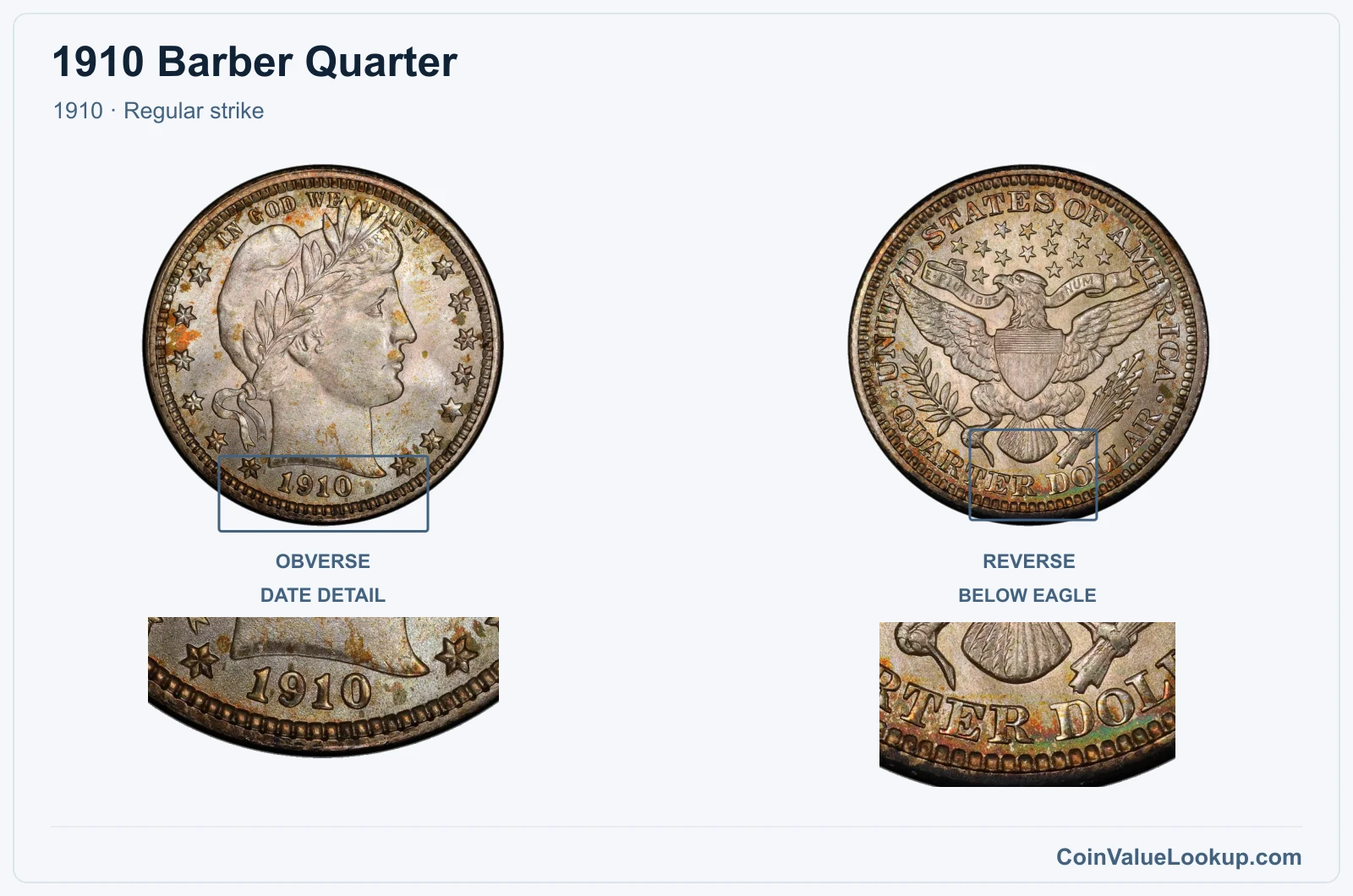
The 1910 Philadelphia business strike has no mintmark on the reverse. In heavily worn Good-4 condition, USA Coin Book estimates this coin at about $21.00.
That alone tells you the silver content is doing a lot of the work at lower grades.
Jump to uncirculated and the picture changes. An MS60 example is estimated at $309.00, and an MS63 reaches $477.00.
Original surfaces matter here — a coin that's been dipped or scrubbed loses the toning and luster collectors pay for. Match the mint first, then grade honestly against known examples before drawing conclusions.
Range Grade
Price Auction Records Appraisal PO PO 1
—
Coin Identifier FR FR 2
—
Coin Identifier AG AG 3
—
Coin Identifier G G 4
—
Coin Identifier
G 6
—
Coin Identifier VG VG 8
Coin Identifier
VG 10
Coin Identifier F F 12
—
Coin Identifier
F 15
—
Coin Identifier VF VF 20
—
Coin Identifier
VF 25
Coin Identifier
VF 30
—
Coin Identifier
VF 35
—
Coin Identifier XF XF 40
Coin Identifier
XF 45
Coin Identifier AU AU 50
Coin Identifier
AU 53
Coin Identifier
AU 55
Coin Identifier
AU 58
Coin Identifier MS MS 60
—
Coin Identifier
MS 61
Coin Identifier
MS 62
Coin Identifier
MS 63
Coin Identifier
MS 64
Coin Identifier
MS 65
Coin Identifier
MS 66
Coin Identifier
MS 67
Coin Identifier
MS 68
—
—
—
MS 69
—
—
—
MS 70
—
—
—
1910 Barber Quarter — PR
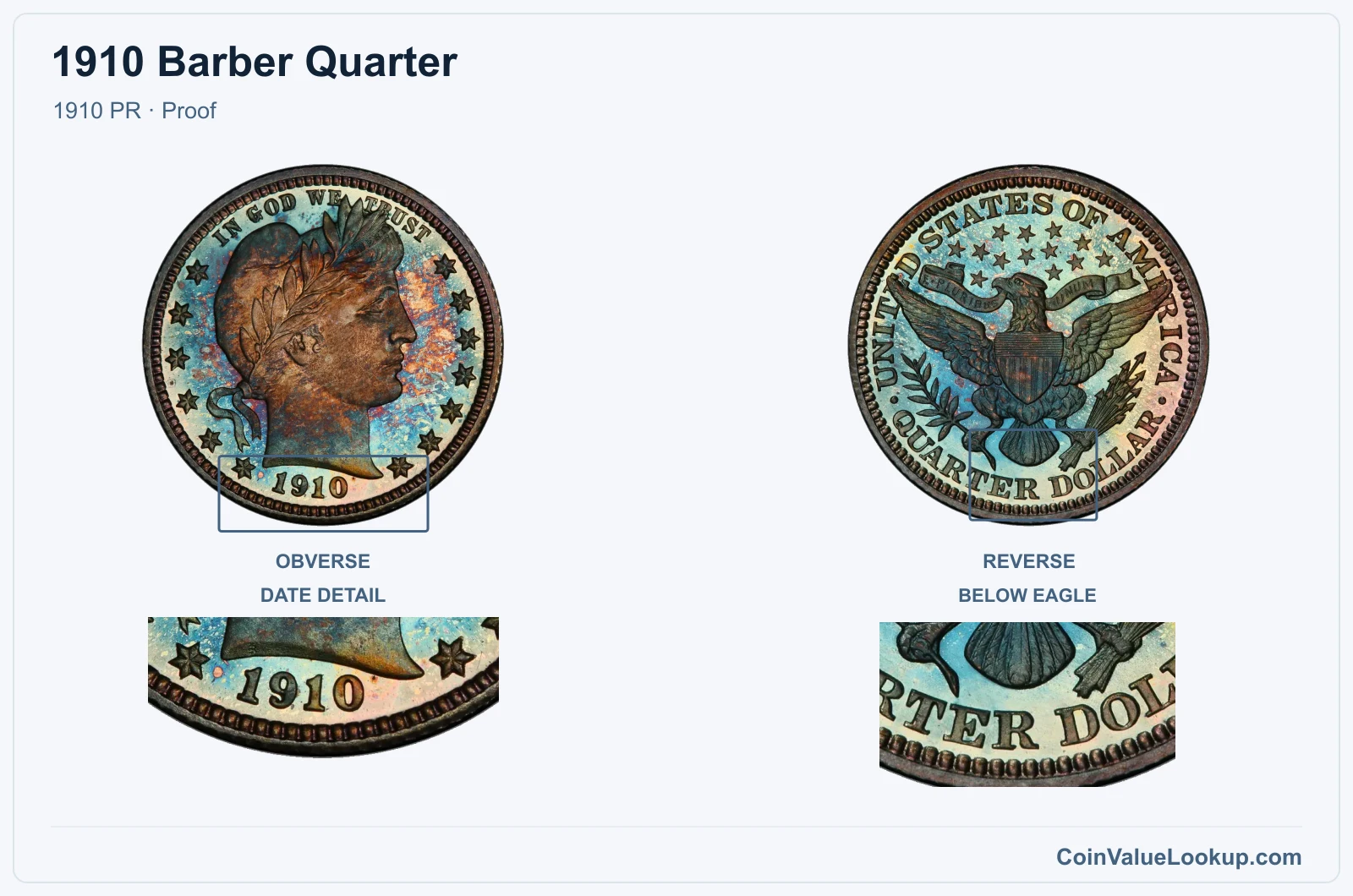
The 1910 proof was struck at Philadelphia with no mintmark, same as the business strike, so the surfaces are your main clue. Proofs have deeply reflective mirror fields and razor-sharp design details that a regular strike simply does not achieve.
At PR63, USA Coin Book places this version at $799.00. Haze, fingerprints, and hairlines from mishandling are the usual grade-killers for proofs.
A proof that looks "just shiny" to a beginner might actually be impaired by light cleaning, which would drag its value below the guide figure.
Coin Value Lookup is a good starting point if you want to compare this coin with other Barber Quarter years and see where the 1910 proof sits in the broader series.
Range Grade
Price Auction Records Appraisal PR PR 1
—
Coin Identifier
PR 2
—
Coin Identifier
PR 3
—
Coin Identifier
PR 4
—
Coin Identifier
PR 6
—
Coin Identifier
PR 8
—
Coin Identifier
PR 10
—
Coin Identifier
PR 12
—
Coin Identifier
PR 15
—
Coin Identifier
PR 20
—
Coin Identifier
PR 25
—
Coin Identifier
PR 30
—
Coin Identifier
PR 35
—
Coin Identifier
PR 40
—
Coin Identifier
PR 45
—
Coin Identifier
PR 50
—
Coin Identifier
PR 53
—
Coin Identifier
PR 55
Coin Identifier
PR 58
—
Coin Identifier
PR 60
—
Coin Identifier
PR 61
Coin Identifier
PR 62
Coin Identifier
PR 63
Coin Identifier
PR 64
Coin Identifier
PR 65
Coin Identifier
PR 66
Coin Identifier
PR 67
Coin Identifier
PR 68
Coin Identifier
PR 69
—
—
—
PR 70
—
—
—
1910 Barber Quarter — D
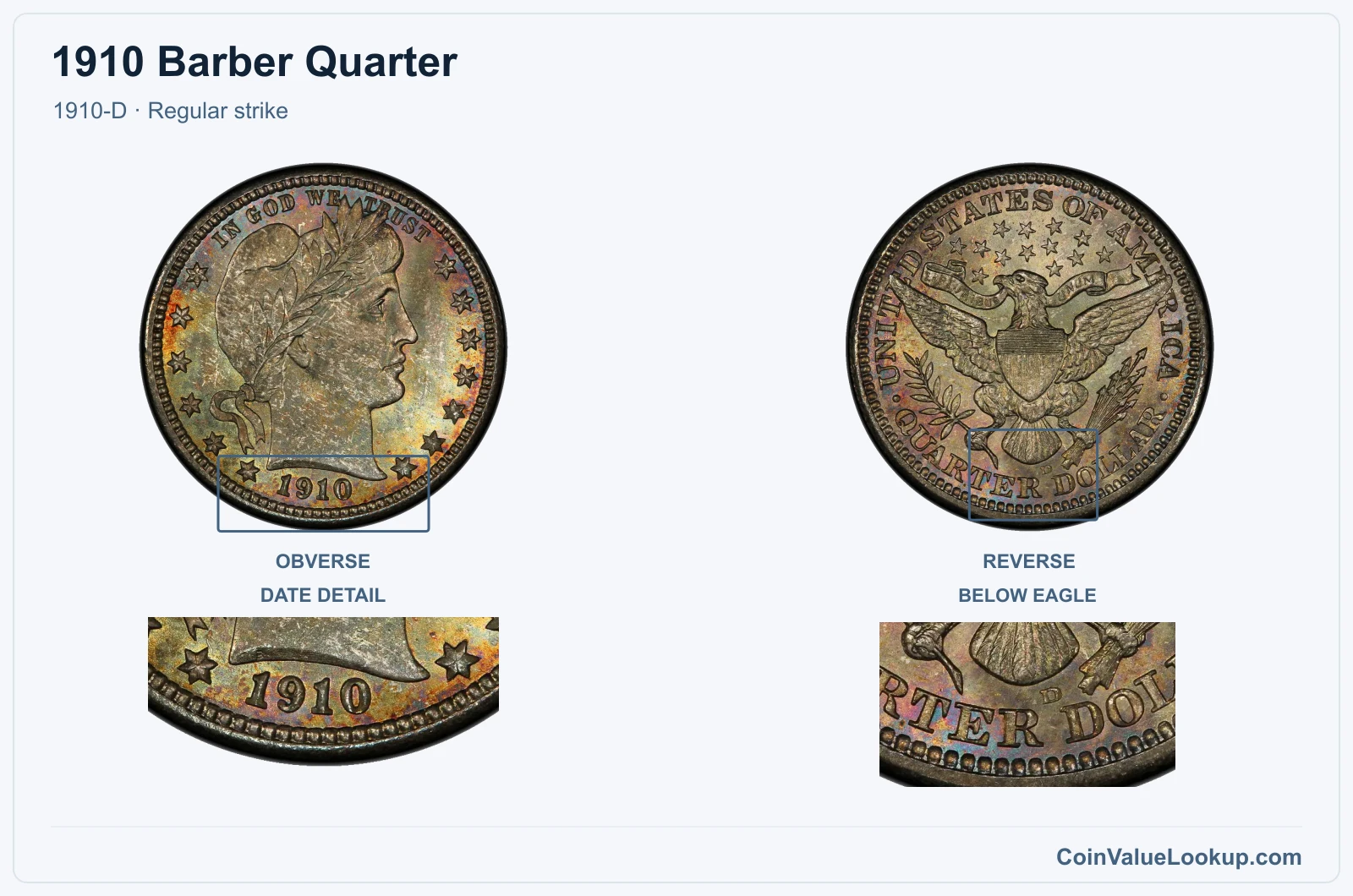
Look for a small "D" on the reverse beneath the eagle's tail. That marks the Denver issue, and in upper grades it is the most guide-valuable business strike of this year.
A worn G4 example is estimated at $23.00 by USA Coin Book — only two dollars above the Philadelphia coin at the same grade. The gap widens dramatically in mint state: $477.00 at MS60 and $1,007.00 at MS63.
Denver coins from this era often come weakly struck, so do not mistake soft details for wear. Check luster in the fields to separate a genuine uncirculated piece from one that simply has mushy features due to die quality.
Range Grade
Price Auction Records Appraisal PO PO 1
—
Coin Identifier FR FR 2
—
Coin Identifier AG AG 3
—
Coin Identifier G G 4
—
Coin Identifier
G 6
—
Coin Identifier VG VG 8
—
Coin Identifier
VG 10
Coin Identifier F F 12
—
Coin Identifier
F 15
—
Coin Identifier VF VF 20
—
Coin Identifier
VF 25
Coin Identifier
VF 30
—
Coin Identifier
VF 35
Coin Identifier XF XF 40
—
Coin Identifier
XF 45
Coin Identifier AU AU 50
Coin Identifier
AU 53
Coin Identifier
AU 55
Coin Identifier
AU 58
Coin Identifier MS MS 60
Coin Identifier
MS 61
Coin Identifier
MS 62
Coin Identifier
MS 63
Coin Identifier
MS 64
Coin Identifier
MS 65
Coin Identifier
MS 66
Coin Identifier
MS 67
Coin Identifier
MS 68
—
—
—
MS 69
—
—
—
MS 70
—
—
—